ISSN: 2278-067X, Volume 1, Issue 5 (June 2012), PP.12-17
www.ijerd.com
A New Energy Efficient and Scalable Multicasting Algorithm
for Hierarchical Networks
Sridhara Hansanoor
1, G Sadashivappa
2Department of Telecommunication Engineering, R.V. College of Engineering, Bangalore-560059
Abstract––In this paper a routing algorithm is proposed that would divide the entire network area is into different sub-areas known as zone. Each zone will contain set of nodes. The Zone follows a square topology. Efficient Geographic Multicast Protocol (EGMP) supports scalable and reliable multicast forwarding through a two-tier virtual zone- based structure. At the lower layer, in reference to a pre-determined virtual origin, the nodes in the network self-organize themselves into a set of zones and a leader is elected in a zone to manage the local group membership. At the upper layer, the leader serves as a representative for its zone used for inter zone routing. For efficient and reliable management and transmissions, location information will be considered to be known to each node and used to guide the zone construction, group membership management, multicast tree construction and maintenance, and packet forwarding. The multicast routing algorithm is also compared with the purely random propagation algorithm and the experimental results also prove that the proposed multicasting results show that multicast algorithm is better with respect to number of hops, maintenance of Routing algorithms, power consumed and energy consumed.
Keywords––Zone, Routing, Multicast, Protocol, EGMP, PRP.
I.
INTRODUCTION
There are increasing interests and importance in supporting group communications over Mobile Ad Hoc Networks (MANETs). Example applications include the exchange of messages among a group of soldiers in a battlefield, communications among the firemen in a disaster area, and the support of multimedia games and teleconferences. With a one-to-many or many-to-many transmission pattern, multicast is an efficient method to realize group communications. However, there is a big challenge in enabling efficient multicasting over a MANET whose topology may change constantly. Conventional MANET multicast protocols [4]–[7], [12] can be ascribed into two main categories, tree-based and mesh based. However, due to the constant movement as well as frequent network joining and leaving from individual nodes, it is very difficult to maintain the tree structure using these conventional tree-based protocols (e.g., MAODV [4], AMRIS [5] and MZR [12]). The mesh-based protocols (e.g., FGMP [6], Core-Assisted Mesh protocol [7]) are proposed to enhance the robustness with the use of redundant paths between the source and the destination pairs. Conventional multicast protocols generally do not have good scalability due to the overhead incurred for route searching, group membership management, and creation and maintenance of the tree/mesh structure over the dynamic MANET.
II.
ZONE FORMATION ALGORITHM
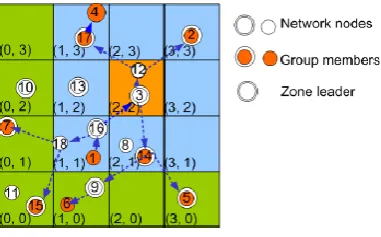
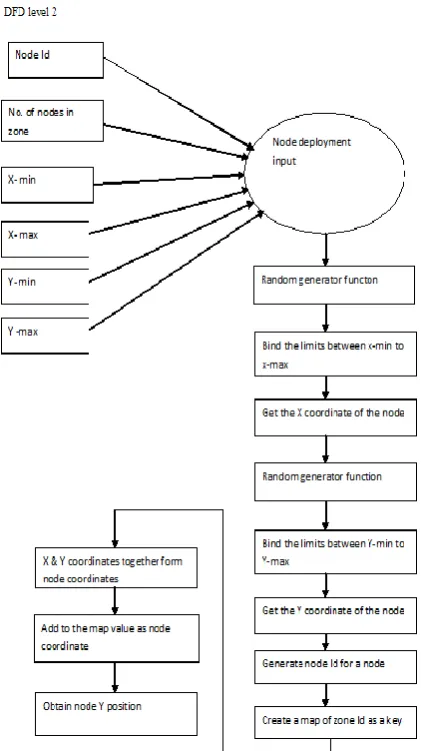
Zone Formation algorithm divides the entire are into multiple zones. Each Zone having a set of nodes in its zone. This is the algorithm which is responsible for deploying the nodes. The entire area is divided into zones with each zone bounded with the limits with some Xmin and Xmax. The Y region is bounded within the limits Ymin and Ymax. Each zone is allocated a set of nodes. Fig.1 shows the zone structure that has been created .
Fig. 1: Zone Formation Algorithm.
Fig. 2: Zone Formation Algorithm.
III.
ZONE LEADER ELECTION ALGORITHM
The zone leader algorithm first finds out the centered co-ordinates of the multiple zones. The set of nodes in each zone is taken and the distance between the center of a zone and other nodes is calculated. The node which is closer towards the center of the zone is considered to be zone leader because it can have all the nodes information and it is considered to have the high power for inter zone communication. The zone leader algorithm is summarized as shown in the figure 3.
Multicasting Algorithm
The multicasting algorithm is used to deliver the packets from source to multiple destination nodes. The following steps are followed for multicasting.
1. Obtain the node id of source node and zone id of source node.
2. Check whether the source node zone id is same as destination node. If yes transmit the packet directly. Otherwise find the zone leader of the current zone and send the packet to zone leader.
Fig. 3: Zone Leader Election Algorithm
IV.
PURELY RANDOM PROPAGATION ROUTING (PRP)
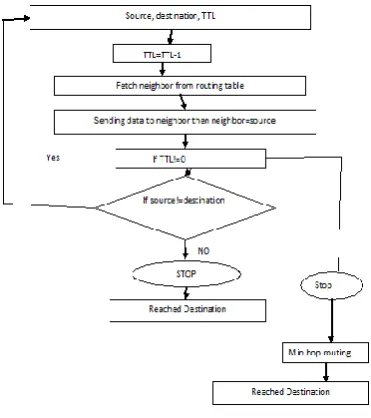
In PRP, shares are propagated based on one-hop neighbourhood information. More specifically, a sensor node maintains a neighbour list, which contains the ids of all nodes within its transmission range. When a source node wants to send shares to the sink, it includes a TTL of initial value N in each share. It then randomly selects a neighbour for each share, and unicasts the share to that neighbour. After receiving the share, the neighbour first decrements the TTL. If the new TTL is greater than 0, the neighbour randomly picks a node from its neighbour list (this node cannot be the source node) and relays the share to it, and so on. When the TTL reaches 0, the final node receiving this share stops the random propagation of this share, and starts routing it toward the sink using min-hop routing.
PRP Routing algorithm details are described in the following flow
V.
RESULTS
Case1: Zone Formation Output
Number of Nodes=80, Number of Routing Tables=80 Number of Zones=16
Fig. 5: Zone Area Formation
Fig. 5 shows the zone formation output. It shows the end points of the Zone Structure having 16 zones. Boundaries in which the nodes must be deployed.
Case2: Node Deployment Algorithm Output
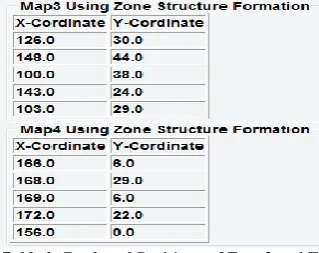
This algorithm will provide the nodes deployed positions in various zones.
Fig. 6: Node Deployed Positions.
Fig. 6 shows node deployed positions in the zone1 and zone2.
Fig. 7: Node Deployed Positions of Zone3 and Zone4
Case3: Zone Leader Output
Fig. 8: Zone Leader Output.
Fig. 8 shows the information about the zone leaders selected for all 16 zones based on Zone Leader Election Algorithm.
Case5: Centered Co-ordinates Output
Fig. 9: Centered Co-ordinate Output.
Fig. 9 gives the center co-ordinate output for the multicasting.
Fig. 10: Zone Id„s Output
Fig. 10 shows the output of zone id‟s for all 16 zones.
PERFORMANCE COMPARISON 1. Number of Hops
Fig. 11: Comparison of No. of Hops PRP and Multicasting.
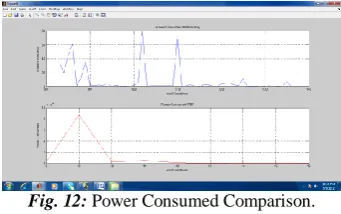
2. Power Consumed
Fig. 12: Power Consumed Comparison.
Fig. 12 shows the power consumed comparison of PRP algorithm and Multicasting algorithm. As seen from fig multicasting is the best.
3. Energy Efficiency
Fig. 13: Energy Efficiency of PRP and Multicasting.
Fig. 13 shows the comparison of PRP and Multicasting algorithm. Multicasting is highly energy efficient as compared to PRP.
VI.
CONCLUSIONS
From the simulation results one can come to know that the Multicasting algorithm is the most efficient as compared to PRP with respect to overhead of maintaining routing tables, no of hops from source to destination, power consumed from source to destination and energy consumed.
VII.
ACKNOWLEDGMENT
Authors wish to thank The Principal, Professors and Head of the Department of Telecommunication Engineering, R. V. College of Engineering for their Support and Encouragement.
REFERENCES
[1]. L.Wang and N.-T. Zhang, “Locally forwarding management in ad-hoc networks,” in Proc. IEEE Int. Conf. Communications,
Circuits and Systems and West Sino Expositions, Jun./Jul. 2002, pp. 160–164.
[2]. D. Johnson and D. Maltz, “Dynamic source routing in ad hoc wireless networks,” in Book Chapter inMobile Computing, T. Imielinski andH. Korth, Eds. Dordrecht, The Netherlands: Kluwer, 1996, pp. 131–181.
[3]. A. Wood and J. A. Stankovic, “A taxonomy for denial-of-service attacks in wireless sensor networks,” in Handbook of
Sensor Networks: Compact Wireless and Wired Sensing Systems. Boca Raton, FL: CRC, 2005, pp. 32:1–32:20.
[4]. E. M. Royer and C. E. Perkins. Multicast operation of the ad hoc On-demand distance vector routing protocol. in
Proceedings of the ACM/IEEE International Conference on Mobile Computing and Networking (MOBICOM), August 1999,
pp. 207218.
[5]. C. Wu, Y. Tay and C.-K. Toh. Ad hoc multicast routing protocol utilizing increasing id-numbers (AMRIS) functional specification. Internet draft, November 1998.
[6]. C.-C. Chiang, M. Gerla and L. Zhang. Forwarding group multicast Protocol (FGMP) for multihop mobile wireless networks
In AJ. Cluster Comp, Special Issue on Mobile Computing, vol. 1, no. 2, pp. 187196, 1998.
[7]. J. J. Garcia-Luna-Aceves and E. Madruga. The core-assisted mesh Protocol. In IEEE JSAC, pp. 13801394, August 1999. . [8]. W. Diffie and M. E. Hellman, “New directions in cryptography,” IEEE Trans. Inform. Theory, vol. IT-22, no. 6, pp.
644–654, 1976.
[9]. M. S. Obaidat and N. Boudriga, Security of e-riSystems and Computer Networks. Cambridge, U.K.: Cambridge Univ. Press, 2007.
[10]. K. Sanzgiri, B. N. Levine, C. Shields, B. Dahill, and E. M. Belding- Royer, “A secure routing protocol for ad hoc networks,”
in Proc. 10th IEEE Int. Conf. Network Protocols (ICNP), Paris, France, Nov. 12–15, 2002, pp. 78–89.
[11]. Y. Hu, A. Perrig, and D. B. Johnson, “Ariadne: A secure on-demand routing protocol for ad hoc networks,”Wireless Netw., vol. 11, no. 1–2, pp. 21–38, Jan. 2005.