Page 22 www.ijiras.com | Email: [email protected]
Status Of Elementary Education In Assam At The Dawn Of
Independence
Education in Assam, as in the rest of India in ancient times was too much restricted to the priestly classes and upper castes. Epigraphic and literary evidences clearly prove the existence of Gurugrihas and Sanskrit Tols patronized by the rulers for the promotion of learning in this region of India. In these centers, instructions in various branches of studies, including the religious lore, was imparted by competent teachers who were very keen in discharging their duties. Learning was confined to the higher classes, especially among the Brahmins and the Priestly classes. The pupils having thirst for knowledge flocked to them, and occasionally teachers also invited pupils from different parts of the country, and accordingly the Brahmin teachers (Gurus) in homely atmosphere of Tols and priestly classes in the serene atmosphere of temples imparted instructions to their pupils (Barpujari, 1990).
Following the Neo-Vaishnavite movement under Sri Sankar Deva, the great Vaishnavite reformer of the Sixteenth century in Assam, another type of quasi religious schools where non-Brahmins were also admitted existed in important villages and it trained up the youth in the knowledge of Sanskrit literature and Science namely the Satra. The Satra, literally meaning “holy areas” each headed by a Guru (teacher) designated as the Satradhikar. The Namghar, actually evolved as an offshoot, an extended wing or a miniature replica of the Satra institutions. The Kirtanghar (prayer hall) was the nerve centre of the entire place. There was no idol in the altar, but only a book, generally the
Bhagavata Gita, symbolizing God. In addition to prayers and cultural functions, religious discourses were also held in the Kirtanghar.
In addition to these religious and quasi-religious institutions, the respectable gentry employed private teachers to instruct their sons and daughters at home. The village kakatis and scribes were generally selected for this purpose, but a Brahmin was always preferred to instruct the children in a Brahmin family. Since instructor had to be remunerated, this system was confined to those parents who were comparatively in affluent circumstances. In medieval period with the arrival of the Muslims, opened up a new system of education which was so organized, planned and aimed to prepare a man fit to live in this world and the world hereafter. It was very much liberal and opens for all. Religious instruction comprised the most significant aspects of this education and was imparted in Maktabs generally attached to the mosque and Madrasas—the institutions meant for primary and secondary education respectively. Quran and Hadith were the main sources of Islamic education. In Madrasas, with the religious instructions some practical subjects were also taught (Debi, 1972).
Modern education in Assam is of comparatively recent origin. Towards the close of the 18th century, when the neighboring state of Bengal had already been familiar with the system of Western education, Assam was still in the midst of political confusion created by civil wars, insurrections and repeated invasions by the Burmese. The endeavor of modern Abstract: Elementary education is the base / foundation on which all sorts of further education depend. It is compared with the life, without which life become meaningless. During the preceding years of independence, there existed a wide disparity in educational attainment between the different sections of population e.g. Boys and Girls, Rural and Urban, High and low caste, educated and uneducated parents, among different religious groups etc. The funding in the fields of education was very meager and insufficient from Government side; the private entrepreneurship was also limited. Therefore, to have a thorough understanding of the field and to study the position of elementary education in Assam at the dawn of independence, the present study has been conducted.
Keywords: Education; caste; religion; gender; Assam; Barak valley Md. Aynul Hoque
Page 23 www.ijiras.com | Email: [email protected] education in Assam, at the initial stage starts with some
individual efforts made by some enlightened scholars. David Scott, the agent to the Governor General, North East Frontier, encouraged the indigenous schools by land grant. The educational institutions which survived the Burmese ravages, continues to be controlled by the priestly classes who had also exercised considerable influence over the masses. He realized that the introduction of any scheme for secular education affecting their monopoly would be productive of great dissatisfaction and resentment which might be prejudicial to the interests of the British Government. He, therefore, left the indigenous system of education undisturbed and continued to make grant of lands to these educational institutions. In early 1826, with the approval of the Government of Bengal, he made additional grants for the establishment of several indigenous schools in upper and lower Assam. Accordingly, in September-1826, eleven schools were established in lower and upper Assam. Of these, two were at Nineduars and one in each station of Gauhati, Nilachal, Darrang, Hajo, Bijali, Silcahr, Biswanath, Nowgong and Desh-Darang. Within a few months the number of schools rose to sixteen by the addition of schools at Gauhati, Behanjee, Dharmapore, Pattee Darang, and Boreegoge.
The efforts made by David Scott, John Mathei, Robbinson and others for the spread of education in Assam as administrators, the benevolent work of missionaries like- Carrey, Ward, Marshman (Serempur Trio), the recommendations of Charles Woods Dispatch, the Indian Education Commission, Lord Curzons’ initiative, the passing of famous Assam Compulsory Primary Education 1926, all are the milestones for the development of education in Assam during modern time (Chakraborty, 1971). Having examined the progress of education in Assam from ancient times through the medieval period and having highlighted how the modern western type of education emerged, it is time to review the status of elementary education at the dawn of independence because having got freedom from the colonial rule; the government of free India had to begin from there. Table no’s 1 to 7 below summaries the status of elementary education in Assam at the time of independence. Table 1 shows that in Assam, during 1946-47, there were total 10,748 elementary schools, which includes 8,420 Primary schools for Male and 1,464 primary schools for Female; 750 Middle schools for Male and 114 Middle schools for Female. Altogether, there were 9,170 (85.31%) Elementary Schools for Male only and 1,578 (14.69%) Elementary schools for Female only.
Types of institutions
No. of institutions
No. of scholars Total Males Female Males Female Primary 8420 1464 449058
(88.74)
56998 (11.26)
506056 (83.98)
Middle 750 114 84499
(87.51)
12058 (12.49)
96557 (16.02)
Total 9170 1578 533557
(88.54) 69056 (11.46) 602613 (100) Grand Total
10,748 6,02,613
Table: 1: No. of Elementary Schools and Scholars in Assam, 1946-47
Figures in the parenthesis indicates %.
Source: Educational Tables Related to Assam, 1946-47 During the year 1946-47 there were a total of 6, 02,163 pupils among whom 5, 33,557 (88.54 %) were male and 69,056 (11.46 %) only were female. And out of 6, 02,163 pupils, 5, 06,056 (83.98 %) were at the Primary stage while 96,557 (16.02 %) were at the Middle stage. Among the 5, 06,056 pupils at the Primary stage 4, 49,058 (88.74 %) were male and 56,998 (11.26 %) were female while among 96,557 pupils at the Middle stage 84,499 (87.51 %) were male and 12,058 (12.49 %) were female. The figures shows that the relative proportion of boys declined from Primary to Middle stage to a greater extent than that of girls or in other words a little larger proportion of girls continued at the Middle stage after Primary school than that of boys.
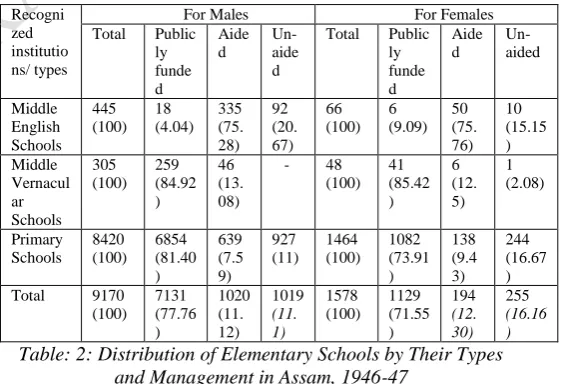
Table 2 gives the details of the types and management of elementary schools in Assam in 1946-47. It shows that the total number of schools was 9,170 for male out of which 445 (4.85%) were Middle English Schools, 305 (3.33%) were Middle Vernacular Schools, and 8,420 (91.82%) were Primary Schools. The data shows that, out of the total 9,170 elementary schools 7,131 (77.76%) were publicly funded, 1,020 (11.12%) were Aided and 1,019 (11.11%) were Un-aided schools. Out of 445 Middle English Schools 18 (4.04%) were publicly funded, 335 (75.28%) were Aided and 92 (20.67%) were Un-aided schools. Among the 305 Middle Vernacular schools 259 (84.91%) were publicly managed, 46 (13.08%) were Aided and there were no Unaided Middle Vernacular schools. Of the 8420 Primary schools 6854 (81.40%) were publicly funded, 639 (7.59%) were Aided and 929 (11%) were Un-aided schools.
Recogni zed institutio ns/ types
For Males For Females Total Public
ly funde d Aide d Un-aide d
Total Public ly funde d Aide d Un-aided Middle English Schools 445 (100) 18 (4.04) 335 (75. 28) 92 (20. 67) 66 (100) 6 (9.09) 50 (75. 76) 10 (15.15 ) Middle Vernacul ar Schools 305 (100) 259 (84.92 ) 46 (13. 08)
- 48 (100) 41 (85.42 ) 6 (12. 5) 1 (2.08) Primary Schools 8420 (100) 6854 (81.40 ) 639 (7.5 9) 927 (11) 1464 (100) 1082 (73.91 ) 138 (9.4 3) 244 (16.67 ) Total 9170
(100) 7131 (77.76 ) 1020 (11. 12) 1019 (11. 1) 1578 (100) 1129 (71.55 ) 194 (12. 30) 255 (16.16 ) Table: 2: Distribution of Elementary Schools by Their Types
and Management in Assam, 1946-47
(The figures in the parenthesis indicates the percentage %) Source: Educational Tables Related to Assam, 1946-47
Page 24 www.ijiras.com | Email: [email protected] which 66 (4.18%) Middle English Schools, 48 (3.04%) Middle
Vernacular School, 1,464 (92.78%) were Primary schools. Of the total 1,578, 1129 (71.55%) were publicly managed, 194 (12.30%) were Aided and 255 (16.16%) were Un-aided schools for female. Among the 66 Middle English schools 6 (9.09%) were publicly managed, 50 (75.76%) were Aided and 10 (15.15%) were Un-aided.
Out of 48 Middle Vernacular schools, 41 (85.42%) were publicly managed, 6 (12.5%) were Aided and 1 (2.08%) were Un-aided. Among the 1464 Primary schools, 1,082 (73.91%) were publicly managed, 138 (9.43%) were Aided and 244 (16.67%) were Un-aided schools. This data shows that the number of elementary schools for girls were about 1/17 of the number for boys, implying thereby that the society and the state discriminated against the girls in access to elementary education. This data also shows that the state funding for Vernacular medium schools was much greater in extent than the English medium schools for both boys and girls. The voluntary effort in elementary education was very limited as shown by the proportion of aided and un-aided schools both for boys and girls. This implies that, although the state propagates vernacular education for the masses, the English medium education for the elite was supported mainly by the private effort. Table-3, gives the distribution of boys in elementary schools by religion (race) and classes attended. A perusal of this table shows that out of a total of 4,89,389 pupils 121 (0.02%) were Anglo-Indians & Europeans, 29,313 (6%) were Indian Christian, 2,64,140 (53.97%) were Hindus, 1,41,128 (28.84%) were Muslims, 431 (0.09%) were Buddhist, 177 (0.04%) were Sikhs, 54,079 (11%) were belonging to Others which include tribal and other minor religions.
Table: 3: Distribution of Elementary School Scholars by Race and Class attended (MALE), 1946-47
(The figures in the parenthesis indicates the percentage %) Source: Educational Tables Related to Assam, 1946-47
Comparing the proportions of boys from various religious communities with their respective proportions in the population it is noticed that Hindus who formed only 42 % of the population significantly over represented as they occupied about 54% of the berths in the elementary schools, and again the Indian Christians who formed only 0.37% of the total population were also over represented as they formed 6% of
the pupils in the elementary schools. While Buddhists and Sikhs proportions were the same as in the population, the Muslims were highly under represented forming only about 29% of the elementary school enrolment while they were about 34% in total population of the province. Others which included tribals and minor religions who formed about 24% of the population were grossly underrepresented at the elementary stage as they formed only 11% of the enrolment. Historically, among the Hindus, more than 60% population has been those of Lower Castes, but the data on elementary school enrolments show that only about 17% of all Hindu boys were from the Lower Castes while 83% of the boys came from among the Brahmins and other Caste Hindus.
Table: 4: Distribution of Scholars in Elementary Stage by Race and Class attended in Assam (FEMALE), 1946-47 (The figures in the parenthesis indicates the percentage) Source: Educational Tables Related to Assam, 1946-47
While comparing the proportion (25.42%) of Urban pupils with (74.58%) of Rural pupils, it appears that in absolute terms a vast majority of the pupils at this stage came from rural areas, but considering the extent of urbanization at this time the Urban population would not have been more than 7-8%. Thus, rural population in real terms also was at a disadvantage. The table 4 gives the distribution of female pupils in elementary schools by religion (race) and classes they attended in Assam in 1946-47. This table shows that out of the total of 1,59,723 pupils 107 (0.07%) were Anglo-Indians & Europeans, 18,161 (11.37%) were Indian Christian, 92,754 (58.07%) were Hindus, 35,174 (22.02%) were Muslims, 263 (0.16%) were Buddhists, 3 (0.001%) were Sikhs, 13,254 (8.30%) were belonged to Others which include tribal and other minor religions. Comparing the proportions of girls from various religious communities with their respective proportions in the population it is notice that Hindus who formed only 40.45 % of the population significantly over represented as they occupied about 58.07% of the berths in the elementary school, and again the Indian Christians who formed only 0.37% of the total population were also over represented as they formed 11.37% of the pupils in the elementary schools. While Buddhists were slightly over represented with 0.16% enrolment, while they represent only 0.07% in the population, the proportion of Sikh in this category are almost nil, but they formed 0.03% in population.
Page 25 www.ijiras.com | Email: [email protected] were about 34% in total population of the province. Others
which included tribals and minor religions who formed about 25% of the population were grossly underrepresented at the elementary stage as they formed only 8.30% of the female enrolment. As has been said above that among the Hindus, more than 60% population has been those of Lower Castes, but the data on elementary school enrolments among the girls show that only about 15% of Hindu girls were from the Lower Castes while 85% of the girls came from among the Brahmins and other Caste Hindus. While comparing the proportions (19.35%) of Urban pupils with (80.65%) of Rural pupils, it appears that in absolute terms a vast majority of the girls at this stage came from rural areas, but considering the extent of Urbanization at this time the Urban population would not have been more than 7-8%. Thus, rural population in real terms also was at a disadvantage. Comparing the data on boys’ enrolments by castes with those of the girls, it is seen that girls in general were at a disadvantage and those belonging to weaker sections of Lower Castes and Muslims were at a greater disadvantage than their male counterparts. It appears that rural girls were at a little lesser disadvantage than the rural boys.
The table 5 below gives the distribution of male teachers by their Academic qualifications and training. This table shows that the total number of male teachers at elementary stage was 14,588, out of which 11,204 (76.80%) were in Primary schools and 3,384 (23.20%) were in Middle schools. Of the total 11,204 primary teachers 9,471 (84.53%) were in public schools with 2,275 (24.02%) trained and 7,196 (77.98%) were untrained. There were 767 (6.85%) teachers in Aided primary schools of them 62 (8.08%) were trained and 705 (91.92%) were untrained, 966 (8.62%) teachers were in unaided primary schools with 41 (4.24%) trained and 925 (95.81%) were untrained teachers. In the Middle stage, the total number of male teachers were 3,384, out of them 1,407 (41.58%) were in public schools with 735 (52.24%) trained and 672 (47.76%) untrained teachers. In Aided Middle schools the number of teachers were 1,595 (47.13%), of which 204 (12.79%) were trained and 1,391 (87.21%) were untrained. In Un-aided Middle schools, there were 382 (11.29%) teachers of which 42 (11%) were trained and 340 (89%) were Untrained male teachers.
Table: 5: Distribution of Elementary school teachers (Male) by their qualifications and training (1946-47) (The figures in the parenthesis indicates the percentage %) Source: Educational Tables Related to Assam, 1946-47
Also the data reveals that out of 14,588 male teachers in elementary stage very few 3,451 were having formal
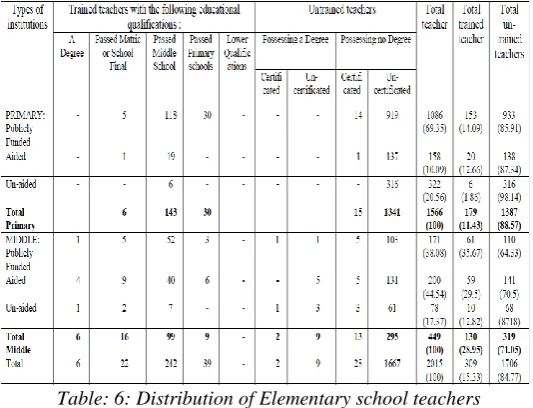
educational degrees only and the majorities 11,141 were having no formal educational degree. Table 6 gives the distribution of elementary school teachers (Female) by their qualifications and training (1946-47). The table shows that there were total 2,015 female teachers, out of which 1,566 (77.71%) were in Primary schools and 449 (22.29%) were in Middle schools. Of the total 1,566 primary teachers 1,086 (69.35%) were in public schools with 153 (14.09%) trained and 933 (85.91%) were untrained. There were 158 (10.09%) teachers in Aided primary schools of them 20 (12.66%) were trained and 138 (87.34%) were untrained, 322 (20.56%) teachers were in unaided primary schools with 6 (1.86%) trained and 316 (98.14%) were untrained teachers. In the Middle stage, the total number of female teachers were 449, out of them 171 (38.08%) were in public schools with 61 (35.67%) trained and 110 (64.33%) untrained teachers. In Aided Middle schools the number of teachers were 200 (44.54%), of which 59 (29.5%) were trained and 141 (70.5%) were untrained.
Table: 6: Distribution of Elementary school teachers (Female) by their qualifications and training (1946-47) (The figures in the parenthesis indicates the percentage %) Source: Educational Tables Related to Assam, 1946-47
Page 26 www.ijiras.com | Email: [email protected] Expenditure for female elementary education, 74.33% was
meted from public fund, only 5.36% from fees and 20.31% from other sources.
Areas of
expenditure
Total Expenditure (In Rs)
% of Expenditure From
1946-47 Govt. Funds
Local Funds
Fees Other Sources Directions
&inspections
7,44,330 100 - - -
Miscellaneous 20,29,469 4.59 8.63 15.69 26.09
Total 27,73,799
(34.33)
63.12 6.31 11.48 19.09
(MALE)Middle schools
13,50,518 33.33 21.78 32.47 12.42
Primary schools 28,94,410 69.52 22.00 0.06 8.42
Special schools 3,98,376 75.79 5.56 7.00 11.65
Total 46,43,304
(57.46)
59.55 16.45 13.18 10.83
(FEMALE)Mid dle schools
2,39,518 37.80 22.22 13.79 26.19
Primary schools 3,84,319 65.19 28.32 0.04 5.73
Special schools 29,992 57.23 11.50 2.25 29.02
Total 6,63,829
(8.21)
53.65 20.68 5.36 20.31
Grand totals 80,80,932
(100)
58.78 14.48 10.00 17.01
Table: 7: Expenditure on Elementary Education in Assam, 1946-47
Source: Quinquennial Review of the progress of Education in Assam during 1942-47
The data also shows that while for boys’ schools 76% funding came from the government and local funds, for girls schools only 74.33% came from this sources. In the girls education fees constitute only 5.36% of the total funding in the case of boys it was 13.18%. Other sources of expenditure on girls’ education formed 20.31% compared to 10.83% on boys’ education. This shows that a large proportion of funding for girls education came from voluntary funding.
CONCLUSION
Therefore, the aforesaid discussion leads us to conclude the status of elementary education in Barak Valley during the preceding years of independence. One major finding of this study is that the numbers of elementary schools for girls were about 1/17 of the number for boys, implying thereby that the society and the state discriminated against the girls in access to elementary education. The relative proportion of boys declined from Primary to Middle stage to a greater extent than that of girls or in other words a little larger proportion of girls continued at the Middle stage after Primary school than that of boys.
The state funding for Vernacular medium schools was much greater in extent than the English medium schools for both boys and girls. The voluntary effort in elementary education was very limited as shown by the proportion of aided and un-aided schools both for boys and girls and although the state propagates vernacular education for the masses, the English medium education for the elite was supported mainly by the private effort. Historically, among the Hindus residing in Barak valley, more than 60% population has been those of lower castes, but the data on elementary school enrolments show that only about 17% of all Hindu boys were from the lower castes while 83% of the boys came from among the Brahmins and other caste Hindus. This implies that education opportunities for the lower caste Hindus in this region have been largely limited. Similarly, among the girl students belonging to Hindu community enrolled at schools, it shows that only about 15% of them were from the lower castes while 85% of the girls came from among the Brahmins and other caste Hindus.
While comparing the proportion of urban boy pupils (25.42%) with rural boy pupils (74.58%), it appears that in absolute terms a vast majority of the pupils at this stage came from rural areas, but considering the extent of urbanization at this time the urban population would not have been more than 7 to 8%. Thus, rural families in real terms were the main contributors to the school going population. While comparing the proportions of urban girl pupils (19.35%) with that of rural girl pupils (80.65%), it appears that in absolute terms a vast majority of the girls at this stage came from rural areas, but considering the extent of urbanization as observed before, such findings are inevitable. Coming to the picture for the Muslim segment, the Muslims were highly under represented forming only about 22% of the elementary school enrolment while they were about 34% in total population of the province. Others which included tribal and minor religions who formed about 25% of the population were also grossly underrepresented at the elementary stage as they formed only 8.30% of the enrolment. Comparing the data on boys’ enrolments by castes with those of the girls, it is seen that girls in general were at a disadvantage and those belonging to weaker sections of lower castes and Muslims were at a greater disadvantage than their male counterparts. However, it also appears that girls from rural backgrounds were at a little lesser disadvantage than the rural boys. Another important revelation of the analysis was the fact that out of 14,588 male teachers in elementary stage very few- 3,451 male teachers (23.66%) were having formal educational degrees only and the majority- 11,141 male teachers (76.34%) were having no formal educational degree. The data also shows that out of 2,015 female teachers in elementary stage very few 348 (17.27%) were having formal educational degrees only and the majority of female teachers- 1,667 (82.73%) were having no formal educational degree.
REFERENCES
Page 27 www.ijiras.com | Email: [email protected] [2] Chakraborty, A. (1971). History of Education in Assam
1826-1919. An unpublished Ph.D., Education, G.U. [3] Debi, R (1972). Progress of Education in Assam
1882-1937. An unpublished Ph. D., Political Science, G. U. [4] Government of Assam: Educational Tables Related to
Assam-1946-47, Secretarial Administration, Record [5] and Library Deptt. Assam Secretariat, Dispur, Guwahati. [6] Government of Assam: General Educational Tables
Relating to Assam-1944-45, Secretarial Administration,
[7] Record and Library Deptt. Assam Secretariat, Dispur, Guwahati.
[8] Government of Assam: Quinquennial Review of the Progress of Education in Assam during 1942-47,