An Experience in Automatically Building Lexicons for
Affective Computing in Multiple Target Languages
Francisco Jurado and Pilar Rodriguez
Department of Computer Engineering Universidad Autónoma de Madrid Francisco Tomas & Valiente 11, Madrid {Francisco.Jurado; Pilar.Rodriguez]@uam.es
Abstract. Affective Computing in text attempts to identify the emotional charge reflected in it, trying to analyse the moods transmitted while writing. There are sev-eral techniques and approaches to perform Affective Computing in texts, but lexi-cons are their common point. However, it is difficult to find solutions for specific languages different from English. Thus, this article presents an experience in auto-matically generating lexicons to perform Affective Computing following a multi-ple-target languages approach. The experience starts with some initial seeds of words in English that define the emotions we want to identify. It then expands them as much as possible with related words in a bootstrapping process and finally ob-tains a lexicon by processing the context sentences from parallel translated text where the terms have been used. We have checked the resulting lexicons by con-ducting an exploratory analysis of the affective fingerprint on a parallel corpus with books translated from and to different languages. The obtained results look promis-ing, showing really similar affective fingerprints in different language translations for the same books.
Keywords. Sentiment Analysis, Affective Computing, Multiple Target Languages, Automatically Building Lexicons
1
Introduction
Sentiment Analysis and Opinion Mining can be defined as the “computational treatment of opinion, sentiment, and subjectivity in text” [1, 2]. In recent years, it has been applied to many different contexts, such as reviewing customers’ products and services, monitor-ing reputations in social networks, trackmonitor-ing people’s feelmonitor-ings about politicians, promotmonitor-ing marketing campaigns, etc. [3]. So it has become a growing research discipline [4]. More-over, because currently social media texts are widely available and need to be analysed to create knowledge for decision-making processes, new approaches rise to perform sen-timent analysis on code repositories like GitHub [5] and social networks like Twitter [6] or YouTube [7]. However, it looks as though “affective computing and sentiment analysis are still finding their own voice as new interdisciplinary fields” [8].
as subjective, a Sentiment Analysis (also called Polarity Analysis) can be performed by assigning a score (positive or negative) to the opinion underlying the text.
Regardless of the subjectivity and objectivity of the text, Affective Computing at-tempts to identify the emotional charge (happiness, sadness, fear, anger-passion, etc.) that is reflected and hence transmitted in the text, depending on the words used.
Accordingly, it is straightforward to see the difference between examining the opinion about something (a product or service) or somebody (an actor or politician) with a Polarity Analysis in the subjective text and analysing the moods reflected and transmitted in a text, either subjective or objective. We will focus our attention on this last kind of analysis, namely, Affective Computing.
Independently of the kind of analysis to be performed, there are several techniques and approaches to computing, including and Affective Computing in the text [1, 2, 9–11], among which we can mention Naive Bayes, Maximum Entropy, Support Vector Ma-chines, Lexicon-based, etc. Nevertheless, the common point is a central piece known as lexicon [3].
Fortunately, there are several lexicons available. As examples, we can mention works like SentiWordNet [12, 13], which gives positivity, negativity and objectivity scores to each synset (synonym set) of WordNet [14]; WordNet-Affect [15], which assigns one or more affective labels (a-labels) for those synsets from WordNet that represent emotions (with emotional categories), emotional valence (positive, negative, ambiguous and neu-tral), moods, cognitive states, behaviour, etc.; the Affective Norms for English Words (ANEW) [16], which provides valence, arousal and dominance scores for the 1,034 most used words in English; and the NRC Word-Emotion Association Lexicon also known as EmoLex [17], which provides polarity and emotional annotations (anger, anticipation, disgust, fear, joy, sadness, surprise and trust) for 14,182 English words and their corre-sponding automatic translations to more than 40 languages.
However, the main drawback is that most of them have English as the goal language and it is difficult to find solutions for other languages [18].
While building a lexicon we must make some decisions. In particular, high precision lexicons can be obtained manually but with a low coverage, and in the opposite situation we find those automatically derived from pre-existing knowledge [19]. That is, the more human supervision devoted to classification, the more precision, but the more automati-cally derived, the more coverage. In particular, developing a supervised approach will be slower but more precise than an unsupervised one. However, because human supervision is not always available and we are focused on working with multiple target languages, we will centre our attention on this last kind of approach.
From this perspective, the main achievements of this paper can be summarised as fol-lows:
• Facing the issue of automatically generating lexicons to perform Sentiment Analysis on texts following a target language independent approach and using automatic translation systems.
• Checking the validity of the approach by conducting an exploratory analysis on a parallel corpus with books translated into different target languages to analyse the affective fingerprint identified in the texts and comparing the results between two different target languages.
Thus, the rest of the article is structured as follows: section 2 shows some related works; section 3 outlines the approach we followed to build the lexicons; section 4 shows some implementation issues; section 5 explains some inspections we carried out to the lexicons; section 6 exposes the conducted exploratory analysis we performed on a parallel corpus; section 7 provides a discussion and some further works; and finally, section 8 ends with the conclusions.
2
Related Works
Although most of the research in Sentiment Analysis has been done for the English lan-guage, the literature offers a few examples of multilingual automatic translation ap-proaches to build resources and tools for Sentiment Analysis.
Thus, [18, 20, 21] use bilingual dictionaries and parallel corpora to rapidly create tools for Subjectivity Analysis in the new language. The authors employ resources available for English and apply machine translation to generate resources for subjectivity analysis in other languages different from English. Comparing evaluations of Romanian and Span-ish, they conclude that automatic translation is a viable alternative for the construction of resources and tools for Subjectivity Analysis in a new target language.
In the same way, [22, 23] face the issue of sentiment detection in different languages using distinct machine translation systems (Bing Translator, Google Translate and the Moses statistical machine translation system), concluding that those systems can be used to obtain training data and to build Sentiment Analysis tools for languages other than English with comparable performance to the one obtained for English.
All these previous approaches make use of existing English resources and perform the corresponding translation to a target language; however, none of them builds the original resources on their own.
For their part, [24] try to produce a set of lexicons for 136 major languages via graph propagation. They use the Lius’ lexicon [2] as the initial seed of words in English and make use of several resources like Wiktionary [25], Google Translate and WordNet [14]. As a result, they are able to build polarity-annotated lexicons for the major languages.
As far as we know, although all these researchers have proved the validity of using automatic machine translations and propagation to build resources for Sentiment Analy-sis, the above approaches have not been developed with an aim to build an emotional lexicon to assemble tools that allow analysis of the moods reflected in a text, but also the polarity.
similar way, [26] have used crowdsourcing for harvesting emotional annotations of news articles rather than the words. After processing these annotated articles, they were able to build an English lexicon for Sentiment Analysis. However, they do not provide translation into any other languages.
In these last-mentioned works, although the translation to the non-English languages can be automatically performed, the translation is not validated, and the time and effort consumed by the crowdsourcing process cannot always be tackled depending on the ap-plication domain.
Although not designed for multilingual purposes, [6] presents SentiCircles, an inter-esting lexicon-based approach that takes into account the co-occurrence of words to pro-vide a context-specific sentiment orientation. Their authors argue that “words that co-occur in a given context tend to have certain relation or semantic influence”.Thus, the SentiCircles approach modifies the pre-established sentiment value by taking into sideration the context in which the term was used and building lexicons that use a con-textual representation of words.
Aside from the fact that SentiClircles was designed to perform polarity analysis on Twitter (not tested in general texts) and only in the English language, what is the reason for limiting this idea of co-occurrence of words to single words but not the associated emotion? If words are used that appear near emotional and affective terms, they are some-how related to that emotion and must be incorporated in the emotional lexicon. That is, we will identify those words that co-occur to emotional related terms, and then we will label them with the emotion with which they co-occur.
From this perspective, we will show an approach that makes use of the co-occurrence of words for emotional terms in sentences retrieved from parallel texts to build lexicons for affective computing in multiple target languages.
3
An Approach to Automatically Building Lexicons for Affective
Analysis
To automatically generate lexicons to perform Affective Analysis that annotates words with emotions in different target languages, our approach will start from the initial seeds of words in English and then use linguistic tools to perform expansion and translation. The outline of the approach can be summarized as follows:
1. Build sets of emotional words in English starting from some initial seeds for each emotion.
2. Retrieve parallel sentences in English and in the target language, where the words from the initial sets in English have been used.
3. Compute the most frequently used words in the parallel context sentences ob-tained for the target language.
4. Build the lexicon with the most frequently used words for each emotion.
In order to identify emotions to work with, we must consider disjoined categories. Alt-hough initially conceived to identify facial expressions within the Computer Image Anal-ysis field, one of the most common models is the one proposed by Ekman [27], who defined a six basic emotions model that takes into account these emotions: anger, disgust, fear, happiness, sadness, and surprise.
Within the Natural Language Processing field, inter-annotator agreement studies for each of these six emotions have been performed in order to measure how well the anno-tators can make the same annotation decision for a certain category [15, 20, 28, 29], show-ing that the six emotions from Ekman’s model are applicable. Thus, Table 1 shows the initial seeds associated with each emotion. As we can see, the seeds contain the emotion noun and its related adjective in the English language.
Table 1. Seeds associated with each emotion (noun and adjective) in English.
Emotion Seeds (noun + adjective)
Joy joy, joyful
Sadness sadness, sad
Anger anger, angry
Fear fear, afraid
Disgust disgust, displeased Surprise surprise, surprised
Then, to build the sets of emotional words in the English language, each word from these seeds is expanded with its synonyms from WordNet [14] and terms with similar meaning taking into account the target language from bab.la [30]. So far, we have ob-tained a set of words for each emotion in the English language. Afterwards, we collect context sentences in English where the emotional words have been used, and the corre-sponding translation of these sentences into the target language. That is, we get a corpus of parallel sentences where the emotional words are used. To build it, we have made use of the bab.la service [30]. Finally, we annotate the most frequently used words from the context sentences in the target languages with the corresponding emotion from which they come from, and then create the lexicon with those words.
4
Details of the Experience on Applying the Approach
1. Bootstrap the initial seeds of emotional words in English 1.1 For each Emotion
1.1.1 {Emotion} = set {noun{Emotion}, adjective{Emotion}}
1.1.2 For each word in {Emotion}
1.1.2.1 {Emotion}= {Emotion} Synonyms(word)
2. Retrieve the context sentences from parallel texts 2.1 For each Emotion
2.1.1 For each word in the {Emotion}
2.1.1.1 {Emotion}= Context_sentences(word, lang) 3. Obtain the sets of words for the target language 3.1 = {entities} {abbreviations} {acronyms} 3.2 For each Emotion
3.2.1 For each cs in {Emotion} 3.2.1.1 ’{Emotion} = tokenize(cs) - 3.3 =
3.4 For each E1, E2 in combination(Emotions) 3.4.1 = (’{E1} ’{E2})
3.5 For each Emotion
3.5.1 ’{Emotion} = ’{Emotion} -
4. Build the lexicon with the words for each emotion 4.1 =
4.2 For each Emotion
4.2.1 For each word in ’{Emotion} 4.2.1.1 = { (word, Emotion) }
Algorithm 1. Steps to implement the approach.
Following Algorithm 1, the next step was to retrieve the context sentences in a target language. To perform this step, we again made use of bab.la, which provides a large list of parallel context sentences to exemplify the usage of the words for both the source and the target languages.
Thus, for each word from the corresponding set , we fetched as many context sen-tences as possible. Bab.la reports these sensen-tences as parallel examples where each word is used in both the original language (English) and its corresponding translation into a target language. Therefore, we filter only the translated sentences. The result is the context sentences in the target language for each emotion.
language-independent approach, and this is an exploratory study, we considered this method a good starting point.
Following those steps, after removing the entities, abbreviations and acronyms that appear in the context sentences, we created a set ’ of words for each emotion in the target language by including the most frequently used words in the context sentence for the corresponding emotion. Because our aim was to obtain exclusive sets of words for each emotion, we removed the intersection between sets of words so that we eliminated stop-words, domain-specific words and ambiguous words that could be associated with more than one emotion. Moreover, we did not include in the sets those words that have appeared only in one context sentence.
Finally, the lexicon is composed by the ’ sets containing the words in the target language and their corresponding emotion. To measure the precision of these obtained sets, we use EmoLex [17] as labelled data.
To summarize and help make the rest of the article easier to follow, we can provide these definitions:
• {Emotion} is the initial set of emotion-related words in English, including the seeds we use to build the lexicon (i.e., the emotion nouns and their related adjectives), as well as their synonyms.
• {Emotion} contains the context sentences in the target language for the specific emotion, where the words from {Emotion} have been used in parallel translated texts.
• ’{Emotion} is the set of words in the target language for the specific emotion. • is the resulting lexicon containing the aggregation of ’{Emotion} with all the
emo-tions.
5
Checking the Obtained Lexicons
To validate the set of English words ({Emotion} from step one of Algorithm 1, we checked their precision against a gold-labelled lexicon for two different languages with very dif-ferent origins and roots, namely, Spanish and German. As far as we know, currently the only manually labelled emotional English lexicon is EmoLex [17] with 14,182 words. Thus, we will use EmoLex as a reference dataset.
Table 2 shows the number of words labelled under certain emotions in EmoLex and how many of them can be found in the initial sets of emotional words we obtained in English. As expected, the initial sets contain a reduced number of words compared with those contained in EmoLex. For their part, Table 3 shows the precision computed for each emotion after using bab.la for the Spanish and German languages to obtain the initial sets in English. To compute the precision we followed Equation (1).
precision{emotion} = card(EmoLex{emotion} ∩ {Emotion})/card({Emotion}), (1)
where EmoLex{emotion} is the subset from the reference dataset containing the words for
the specific emotion, and {emotion} is the set of words we have obtained for the same
Table 2. Number of words for each emotion in EmoLex and in the emotional words in English for Spanish and German.
Emotion Emolex
Spanish
Emolex{emotion} ∩ {Emotion})
German
Emolex{emotion} ∩ {Emotion}
Anger 1247 54 108
Disgust 1058 29 65
Fear 1476 60 191
Joy 689 57 83
Sadness 1191 68 140
Surprise 534 20 39
Table 3. Precision for each emotion for the initial sets of emotional words in English.
Precision for Spanish Precision for German
Anger 0.333 0.315
Disgust 0.379 0.246
Fear 0.317 0.204
Joy 0.404 0.337
Sadness 0.529 0.393
Surprise 0.350 0.231
Table 4. Number of missing words we can find in the obtained initial seeds of emotional words but which do not appear in EmoLex.
Spanish German
Anger 17 52
Disgust 9 22
Fear 19 68
Joy 28 44
Sadness 20 64
Surprise 5 15
Table 5. Number of retrieved context sentences and tokens per sentence scrapped from bab.la
Tokens per sentence
Emotion Lang. Nr. of sentences mean std Var
Fear German 38,303 13.831 4.954 24.541
Spanish 11,440 15.981 5.599 31.344
Anger German 6,695 14.563 7.082 50.149
Spanish 5,326 18.326 8.249 68.047
Surprise German 5,441 14.947 5.889 34.675
Spanish 3,396 15.078 4.959 24.593
Disgust German 5,394 15.561 5.930 35.167
Spanish 3,134 18.668 7.256 52.654
Sadness German 12,134 15.230 6.643 44.132
Spanish 9,875 16.751 6.081 36.974
Joy German 9,039 15.286 5.475 29.972
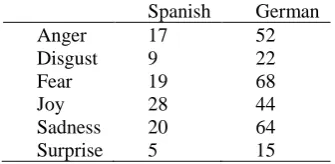
As we can observe, the obtained precision is a bit low. The reason for this can be found by looking inside the lexicon: although the initial sets clearly contain emotional words, those words are not contained in the EmoLex lexicon. Table 4 shows the number of seeds per emotion we have obtained but are missed in the EmoLex dataset. Details about the whole list of missing seeds can be found in Appendix A.
According to these results, it looks obvious that the initial sets contain a great percent-age of emotional words related to their corresponding emotion, but currently there are is not a gold-labelled lexicon that we can use to validate them.
After performing step 2 of Algorithm 1 to obtain the context sentences for each emo-tion {Emotion} for German and Spanish as target languages, Table 5 summarizes the results. The table shows the number of context sentences we gathered from bab.la in December 2016 grouped by emotion and language. In addition, it presents the mean, standard devi-ation and variance for the number of tokens (words) per sentence, once we have removed acronyms, entities and abbreviations. As can be seen, there are differences in the number of gathered sentences per sentiment depending on the language. This is really significant because the resulting lexicon quality is directly related to the number of processed sen-tences.
Continuing applying step 3 of the algorithm to obtain the ’{Emotion}, we retrieved the words for each language from the context sentences after removing the entities, abbrevi-ations, acronyms, stop-words and domain-specific terms. As a result, we obtained the
’{Emotion} containing the words related to each one of the six emotions for German and Spanish.
German Spanish Lexicons' dimmension
Sentiment
0
5
0
0
1
0
0
0
1
5
0
0
2
0
0
0
2
5
0
0
3
0
0
0
ange r
disg
ust fear joy sadn
ess surp
rise
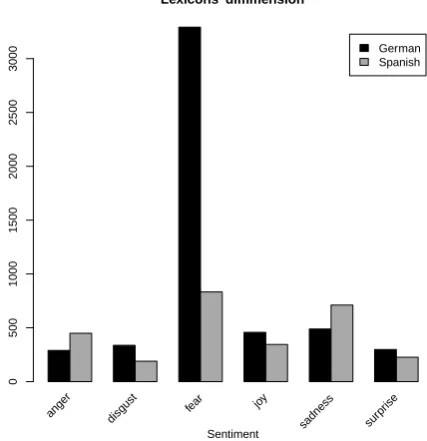
By performing step 4 of the algorithm and obtaining the final lexicons, we got those words that appear at least twice, that is, in two sentences. As a result, Figure 1 shows the number of words per sentiment for the obtained lexicons for German and Spanish. As you can see, the number of words we obtained for each emotion may significantly differ among emotions and between languages.
6
Exploratory Analysis in a Parallel Corpora for German and
Spanish
As previously stated, there is currently no gold-labelled lexicon that we can use to validate the obtained lexicons. Therefore, taking into account that most of the studies on Sentiment Analysis focused on documents [11], we conducted an exploratory Affective Analysis on a parallel corpus composed of well-known books in order to check the validity of the approach.
Thus, by checking the emotions identified in the texts as well as comparing the affective fingerprints between two different languages for the same books, we will see the viability of the proposal. In the next subsections, we will give the details and the initial results obtained.
6.1 Choosing the Corpus and Target Languages
The corpus we’ve used was developed in the OPUS project (Open Parallel corpUS) [32]. It constitutes a collection of translated aligned free texts from the web. In particular, from the corpora available in OPUS, we selected “books”, a collection of multilingually aligned copyright-free well-known books.
As target languages, we again selected German and Spanish. Accordingly, the books that we can find multilingually aligned in OPUS for those two languages are Jane Eyre by C. Bronte, Alice in Wonderland by L. Carroll, Die Verwandlung by F. Kafka, The Fall of the House of Usher by E.A. Poe, and Anna Karenina by L. Tolstoy. All of them are well-known titles.
6.2 Performing a Simple Emotional Identification to the Parallel Corpus
In order to check only the computed lexicon but not any classification algorithm, we simply performed a wordspotting approach to perform the Affective Analysis.
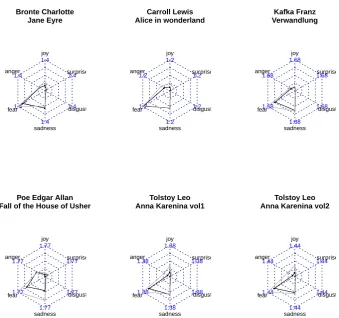
The obtained results are summarized in Figure 2. This figure shows a radar chart for each book with the six emotions in both target languages, namely, German (in black) and Spanish (in grey).
Recalling Figure 1, fear has over 3,000 words in the generated lexicon for the German language, but fewer than 1,000 for the Spanish language. Therefore, to avoid possible bias introduced by the size of the lexicon, in order to compare the emotions, values have been normalized for the German language following Equations (2), (3) and (4):
%{emotion} = 100 x (card(
Book
{emotion})/card(Book
))factor{emotion} = card(
-
Spanish{emotion})/card(
-
German{emotion})Normalized %{emotion} = %{emotion} x factor{emotion}
(2)
(3)
(4)
where %{emotion} is the computed percentage of words from each book that are identified
under a certain emotion, and factor{emotion} is the scaling factor in order to avoid lexicon
size bias for the specific emotion.
Bronte Charlotte Jane Eyre 1.4 1.4 1.4 1.4 1.4 1.4 joy anger fear sadness disgust surprise ● ● ● ● ●● ● ● ● ● ●● Carroll Lewis Alice in wonderland
1.2 1.2 1.2 1.2 1.2 1.2 joy anger fear sadness disgust surprise ● ● ● ● ●● ● ● ● ● ●● Kafka Franz Verwandlung 1.68 1.68 1.68 1.68 1.68 1.68 joy anger fear sadness disgust surprise ● ● ● ● ●● ● ● ● ● ●●
Poe Edgar Allan Fall of the House of Usher
1.77 1.77 1.77 1.77 1.77 1.77 joy anger fear sadness disgust surprise ● ● ● ● ●● ● ● ● ● ●● Tolstoy Leo Anna Karenina vol1
1.38 1.38 1.38 1.38 1.38 1.38 joy anger fear sadness disgust surprise ● ● ● ● ●● ● ● ● ● ●● Tolstoy Leo Anna Karenina vol2
1.44 1.44 1.44 1.44 1.44 1.44 joy anger fear sadness disgust surprise ● ● ● ● ● ● ● ● ● ● ●●
Because they are all well-known books, it is easy to check their emotional sign. More-over, that affective fingerprint is really similar in both languages, that is, they present the same emotional tendency in both languages. It is interesting to notice that in fact disgust and surprise have almost no emotional load in the text. This agrees with the work per-formed by [33], who advise that the basic emotions are only four: anger, fear, joy and sadness.
6.3 Discussion and Further Work
Along with this article, we have detailed an approach for automatically generating target language independent lexicons to perform Affective Analysis. The approach starts with some initial seeds of nouns and adjectives for each emotion in English; these seeds are expanded by a bootstrapping process; and finally, the affective lexicon for the target lan-guage is obtained by processing the context sentence from the parallel text where the words for each emotion have been used.
We implemented the necessary routines that make use of bab.la, a language portal that provides multilanguage dictionaries, translations of common phrases and expressions, etc. in order to check our approach, to automatize the creation of sets of words with those words with similar meanings, to retrieve the context sentences and to perform the trans-lation process.
Later, we conducted an exploratory analysis by applying the approach to a parallel corpus, checking the emotions identified in the texts and comparing the results between two different target languages. This exploratory analysis has shown that the approach provides coherent results and can be used to automatically generate target language inde-pendent lexicons to perform Affective Analysis.
However, although the conducted study has shown evidence about the benefits of the approach by providing us with an affective fingerprint in whole texts, it is necessary to improve its accuracy and enhance several critical points. The precision of the resulting lexicons depends on the quality of the context sentences as well as on the domain from which they are extracted. Validating the proposal using a set of context sentences for different specific domains will give us a better idea of the accuracy of our approach. In addition, it is necessary to test the proposed approach by using different bilingual diction-aries and translation tools such as Bing Translator, Google Translate, the Moses statistical machine translation system, and others.
7
Conclusions
Acknowledgement. This research has been partially supported by the Ministry of Econ-omy and Competitiveness (in Spanish Ministerio de Economía y Competitividad) through the projects REF: TIN2013-44586-R, TIN2014-52129-R and by the Ministry of Educa-tion, Youth and Sports, Community of Madrid (in Spanish Consejería de Educación, Ju-ventud y Deporte, Comunidad de Madrid) through the project S2013/ICE-2715.
1.
References
1. Pang, B., Lee, L.: Opinion Mining and Sentiment Analysis. Found. Trends Inf. Retr. 2, 1–135 (2008).
2. Liu, B.: Sentiment Analysis and Subjectivity. Presented at the (2010).
3. Feldman, R.: Techniques and Applications for Sentiment Analysis. Commun. ACM. 56, 82– 89 (2013).
4. Piryani, R., Madhavi, D., Singh, V.K.: Analytical mapping of opinion mining and sentiment analysis research during 2000-2015. Inf. Process. Manag. 53, 122–150 (2017).
5. Jurado, F., Rodriguez, P.: Sentiment Analysis in monitoring software development processes: An exploratory case study on GitHub’s project issues. J. Syst. Softw. 104, 82–89 (2015). 6. Saif, H., He, Y., Fernandez, M., Alani, H.: Contextual semantics for sentiment analysis of
Twitter. Inf. Process. Manag. 52, 5–19 (2016).
7. Severyn, A., Moschitti, A., Uryupina, O., Plank, B., Filippova, K.: Multi-lingual opinion mining on YouTube. Inf. Process. Manag. 52, 46–60 (2016).
8. Cambria, E.: Affective Computing and Sentiment Analysis. IEEE Intell. Syst. 31, 102–107 (2016).
9. Pang, B., Lee, L., Vaithyanathan, S.: Thumbs Up?: Sentiment Classification Using Machine Learning Techniques. Presented at the (2002).
10. Liu, B.: Sentiment Analysis and Opinion Mining. Presented at the (2012).
11. Ravi, K., Ravi, V.: A survey on opinion mining and sentiment analysis: Tasks, approaches and applications. Knowledge-Based Syst. 89, 14–46 (2015).
12. Esuli, A., Sebastiani, F.: SENTIWORDNET: A Publicly Available Lexical Resource for Opinion Mining. Presented at the (2006).
13. Baccianella, S., Esuli, A., Sebastiani, F.: SentiWordNet 3.0: An Enhanced Lexical Resource for Sentiment Analysis and Opinion Mining. Presented at the (2010).
14. Wordnet: Wordnet, https://wordnet.princeton.edu/wordnet.
15. Strapparava, C., Valitutti, A.: WordNet-Affect: an affective extension of WordNet. Presented at the May (2004).
16. Bradley, M.M., Lang, P.J.: Affective Norms for English Words (ANEW): Instruction manual and affective ratings. (1999).
17. Mohammad, S.M., Turney, P.D.: Crowdsourcing a Word-Emotion Association Lexicon. Comput. Intell. 29, 436–465 (2013).
18. Banea, C., Mihalcea, R., Wiebe, J., Hassan, S.: Multilingual Subjectivity Analysis Using Machine Translation. In: Proceedings of the Conference on Empirical Methods in Natural Language Processing. pp. 127–135. Association for Computational Linguistics, Stroudsburg, PA, USA (2008).
19. Gatti, L., Guerini, M., Turchi, M.: SentiWords: Deriving a High Precision and High Coverage Lexicon for Sentiment Analysis. IEEE Trans. Affect. Comput. 7, 409–421 (2016).
20. Strapparava, C., Mihalcea, R.: SemEval-2007 Task 14: Affective Text. Presented at the (2007). 21. Banea, C., Mihalcea, R., Wiebe, J.: Porting multilingual subjectivity resources across
languages. IEEE Trans. Affect. Comput. 4, 211–225 (2013).
23. Balahur, A., Turchi, M.: Comparative experiments using supervised learning and machine translation for multilingual sentiment analysis. Comput. Speech Lang. 28, 56–75 (2014). 24. Chen, Y., Skiena, S.: Building Sentiment Lexicons for All Major Languages. In: for
Computational Linguistics, A. (ed.) Proceedings of the 52nd Annual Meeting of the Association for Computational Linguistics. pp. 383–389. , Baltimore, Maryland, USA (2014). 25. Wiktionary, the free dictionary, https://www.wiktionary.org/.
26. Staiano, J., Guerini, M.: DepecheMood: a Lexicon for Emotion Analysis from Crowd-Annotated News. In: Proceedings of the 52nd Annual Meeting of the Association for Computational Linguistics. pp. 427–433. , Baltimore, Maryland, USA (2014).
27. Ekman, P.: Handbook of Cognition and Emotion. Presented at the (1999).
28. Strapparava, C., Mihalcea, R.: Learning to Identify Emotions in Text. Presented at the (2008). 29. Bhowmick, P.K., Mitra, P., Basu, A.: An Agreement Measure for Determining Inter-annotator Reliability of Human Judgements on Affective Text. In: Proceedings of the Workshop on Human Judgements in Computational Linguistics. pp. 58–65. Association for Computational Linguistics, Stroudsburg, PA, USA (2008).
30. Babla: Babla, http://bab.la.
31. TheOpenThesaurus: TheOpenThesaurus, https://www.openthesaurus.de.
32. Tiedemann, J.: Parallel Data, Tools and Interfaces in OPUS. In: Chair), N.C. (Conference, Choukri, K., Declerck, T., Dogan, M.U., Maegaard, B., Mariani, J., Odijk, J., and Piperidis, S. (eds.) Proceedings of the Eight International Conference on Language Resources and Evaluation (LREC’12). European Language Resources Association (ELRA), Istanbul, Turkey (2012).
33. Zinck, A., Newen, A.: Classifying emotion: a developmental account. Synthese. 161, 1–25 (2008).
Francisco Jurado is Lecturer in the Computer Engineering Department of the Uni-versidad Autónoma de Madrid, Spain. He received his Ph.D. degree with honours in Com-puter Science from the University of Castilla-La Mancha in 2010. His research areas in-clude Natural Language Processing, Intelligent Tutoring Systems, Heterogeneous Dis-tributed eLearning Systems and Computer Supported Collaborative Environments.
Pilar Rodriguez is Associate Professor in the Computer Engineering Department of the Universidad Autónoma de Madrid. She received her Ph.D. degree in 1990, with a thesis on Computational Linguistics. She joined IBM in 1985, working at the IBM-UAM Scientific Center until 1989, when she was assigned to the Instituto de Ingeniería del Conocimiento, IIC. In November 1996 she joined UAM. At present, she is a member of the GHIA group at the UAM. Main research focuses on adaptive systems, especially for learning purposes, both in individual and collaborative environments.
Appendix A. Missing words in Emolex from the initial sets of emotional words in English
Spanish German
A
n
g
er
abuzz, angriness, annoyed, apotheosize, braveness, choler, cou-rageousness, enraged, feral, heated-up, impassionated, involving, law-less, ricochet, tempestuous, thun-dery, vexed
aggravate, angrily, angriness, annoyed, blowy, blustering, bolshy, bombing, brawling, choler, cock-a-hoop, coltish, dis-solute, ebullient, enrage, exasperated, extravagant, fantastic, feral, ferociously, great, groovy, hilariously, incensed, infuri-ated, infuriates, intemperate, irately, mean, miff, mindless, mustered, obstreperous, peeve, rabidly, rampant, random, rap-turous, rioting, riotously, roaring, skittish, speeding, squally, sulfurous, sulphurous, super, tempestuous, vex, wrathful, wrathfully, wroth
D
isg
u
st
abhorrence, creeps, displease, nauseate, reluctancy, repel, repulse, sicken, uspet
abhorrence, abominate, appal, appall, cloy, disgruntle, dis-please, dissatisfy, exasperate, insubordination, insurgency, nauseate, odium, putsch, rebelliousness, repel, repugnance, repulse, scuff, sicken, spurn, vex
F
ea
r
agonized, anguished, attend, be-long, bow, brokenhearted, browbeat, bussy, carefulness, enshrine, fearful-ness, heedfulness, incumbency, trouble, troubling, tyrannize, vener-ate, worrier, worrisome
accurateness, affect, agitate, angst, appertain, apprehensi-bility, apprehensiveness, attentiveness, biz, browbeat, careful-ness, cause, cautiouscareful-ness, charicareful-ness, consideration, cure, daunt, devotion, devotions, dignify, disconcertment, disquiet, disturb, edited, egis, elaborateness, enshrine, enshrinement, fearfulness, fosterage, funky, godawful, handling, harass-ment, heedfulness, honour, idolise, idolize, insurgency, in-volve, ministration, misgiving, mousey, mousy, neatness, nursing, obeisance, overawe, painstakingness, regard, regard-fulness, revers, safe-keeping, scariness, shy, solicitousness, solicitude, therapy, timidly, trouble, turnout, unease, value, venerate, vex, wariness, wish, wonder
Jo
y
God, buoyant, cock-a-hoop, de-ity, delectation, elation, enjoyment, enthuse, euphoric, exhilarate, exhil-arated, exult, gaiety, gladden, glee-ful, gloat, godhead, jolly, joyfulness, joyousness, jubilate, jubilation, lively, luxuriate, mirthful, perky, playfulness, pleasure
blissfulness, bright, buoyant, chirpy, complacence, con-tentment, convivial, delectation, elate, elates, emboldened, en-couraged, encourages, enjoyable, enthral, enthrall, exhila-rated, exultant, exulting, gaiety, gay, gayety, gladden, gleeful, gloating, gloatingly, gratification, gratifying, gratifyingly, joyfully, joyfulness, joyousness, jubilantly, jubilate, jubilat-ing, lively, nerved, please, pleasure, prosperousness, regale, sneering, zestful, zestfulness
S
ad
n
ess
aggrieved, anguished, distress-ful, disturbing, gloominess, grief-stricken, grieved, heartbroken, lam-entable, lugubriousness, paretic, pit-iable, pitiful, regretful, sad, shamed, sorrowfulness, sorry, troubling, wistfulness
abominably, afflicting, afflictive, afflictively, afflicts, awkward, bewail, bitchiness, bitter, broody, caitiff, deplora-bly, depressingness, dim, disconcerting, dolefully, dolorous-ness, down-at-heel, drearidolorous-ness, funereal, gloomidolorous-ness, grief-stricken, grilling, heartrending, heavy-hearted, hoodoo, lam-entable, lamentably, lamentation, lugubrious, lugubriousness, meagre, mercifully, misadventure, niggling, penitence, pite-ous, pitiable, pitiably, pitiful, pitifully, pitying, plangent, re-gretfulness, regrettably, ruefulness, sad, saddening, serious, shattering, smart, sombreness, sorrowfulness, sorry, tearful-ness, tearitearful-ness, tormenting, trouble, troubled, troubling, upset-ting, verminous, vexed, woebegone
S
u
rp
ri
se
rainstorm, startled, surprisal, wonder, wonderment