Volume 18 Number 4 pp. 410–418 C The Author(s) 2015 doi:10.1017/thg.2015.38
Heritability of Gestational Weight Gain – A Swedish
Register-Based Twin Study
Elina Scheers Andersson,1Karri Silventoinen,2Per Tynelius,1Ellen A. Nohr,3Thorkild I. A. Sørensen,4,5,6 and Finn Rasmussen1
1Department of Public Health Sciences, Child and Adolescent Public Health Epidemiology, Karolinska Institutet, Solna,
Sweden
2University of Helsinki, Department of Social Research, Helsinki, Finland
3Research Unit of Obstetrics and Gynaecology, Institute of Clinical Research, University of Southern Denmark, Odense, Denmark
4Novo Nordisk Foundation Centre for Basic Metabolic Research, Section on Metabolic Genetics, Faculty of Health and
Medical Sciences, University of Copenhagen, Copenhagen, Denmark
5Institute of Preventive Medicine, Bispebjerg and Frederiksberg Hospital, Copenhagen, The Capital Region, Denmark 6MRC Integrative Epidemiology Unit, Bristol University, Bristol, UK
Gestational weight gain (GWG) is a complex trait involving intrauterine environmental, maternal environ-mental, and genetic factors. However, the extent to which these factors contribute to the total variation in GWG is unclear. We therefore examined the genetic and environmental influences on the variation in GWG in the first and second pregnancy in monozygotic (MZ) and dizygotic (DZ) twin mother-pairs. Further, we explored if any co-variance existed between factors influencing the variation in GWG of the mothers’ first and second pregnancies. By using Swedish nationwide record-linkage data, we identified 694 twin mother-pairs with complete data on their first pregnancy and 465 twin mother-pairs with complete data on their second pregnancy during 1982–2010. For a subanalysis, 143 twin mother-pairs had complete data on two consecutive pregnancies during the study period. We used structural equation modeling (SEM) to assess the contribution of genetic, shared, and unique environmental factors to the variation in GWG. A bivariate Cholesky decomposition model was used for the subanalysis. We found that genetic factors explained 43% (95% CI: 36–51%) of the variation in GWG in the first pregnancy and 26% (95% CI: 16–36%) in the second pregnancy. The remaining variance was explained by unique environmental factors. Both overlapping and distinct genetic and unique environmental factors influenced GWG in the first and the second pregnancy. This study showed that GWG has a moderate heritability, suggesting that a large part of the variation in the trait can be explained by unique environmental factors.
Keywords:gestational weight gain, heritability, environment, genes, twins
GWG, which is the weight gained by the mother during pregnancy, is a complex trait in which both fetal environ-mental (e.g., intrauterine exposure to maternal diabetes), maternal environmental (e.g., diet and physical activity during pregnancy), and physiological factors are involved (Dabelea et al.,2000; Lawlor et al.,2011; Ludwig & Cur-rie,2010). Numerous studies have shown that variation in GWG can predict a wide variety of short- and long-term health outcomes in both mother (Fraser et al.,2011; Gail-lard et al.,2013; Mannan et al.,2013) and offspring (Beyer-lein et al.,2012; Ludwig et al.,2013; Reynolds et al.,2010; Schack-Nielsen et al.,2010), such as gestational hyperten-sion, cesarean delivery, post-partum weight retention, and maternal and offspring overweight and obesity (Gaillard et al.,2013; Mannan et al., 2013; Reynolds et al., 2010;
Schack-Nielsen et al.,2010). However, the extent to which environmental and genetic factors contribute to the pheno-typic variation in GWG is unknown. There is also evidence that the variation of a specific trait explained by genetic factors can vary over time, concurrent with change in envi-ronmental factors (Rokholm et al.,2011; Silventoinen et al., 2007). Whether the influences of genetic factors that
ex-RECEIVED10 March 2015;ACCEPTED28 April 2015. First published
online 26 June 2015.
ADDRESS FOR CORRESPONDENCE: Finn Rasmussen, Department of
Public Health Sciences, Child and Adolescent Public Health Epi-demiology, Karolinska Institutet, 171 77 Solna, Sweden. E-mail:
Heritability of Gestational Weight Gain
plain the variation in GWG change over time (e.g., from one pregnancy to the next) remains unknown.
A common method to investigate the genetic and en-vironmental sources of variation is to utilize twin design where the resemblance of MZ and DZ twin pairs is com-pared (Rijsdijk & Sham,2002). The heritability of a spe-cific trait is the proportion of variability of the pheno-type that can be attributed to genetic variation (Boomsma et al.,2002). Twin study design allows decomposition of the phenotypic variance into additive and dominance genetic, common environmental (factors shared by co-twins), and unique environmental factors (specific to each twin sister; Kaprio & Silventoinen, 2011); the latter component also includes any residual variation.
Knowledge from classical twin research on genetic and environmental influences on GWG may guide further re-search exploring specific genetic and environmental factors and their possible interactions, with the possibility of be-coming future targets for preventing excessive GWG. We are not aware of previous studies that have investigated the heritability of GWG. Thus, our main objective was to ex-plore the extent to which GWG can be explained by genetic, shared environmental, and/or unique environmental fac-tors in the first pregnancy. To see whether the variation in GWG explained by genetic factors differs according to pregnancy order, we also analyzed the heritability of GWG in the mothers’ second pregnancy. Our secondary objective was to investigate whether different sets of genes and/or en-vironmental factors influence the variation in GWG in two consecutive pregnancies.
Materials and Methods
Register Linkage and Subjects
Our population-based twin cohort study was created through the linkage of the Medical Birth Register (MBR; Axelsson,2003), the Swedish Twin Register (STR; Lichten-stein et al.,2006), and the Multi-Generation Register (MGR; Ekbom,2011), by using the unique personal identification number assigned to all Swedish residents. The target popu-lation consisted of all Swedish female twins born 1945–1986 who had given birth to at least one singleton child for the main univariate analyses, or two consecutive singleton chil-dren for the subanalysis, during 1982–1989 and 1992–2010 (no data was available on GWG during 1990–1991 in the MBR). The univariate analyses were carried out in both the mothers’ first and second pregnancies (separately), and for the bivariate analysis, the mothers’ first and second con-secutive pregnancies were included. Data on the mothers’ early-pregnancy weight, delivery weight, and the offspring’s gestational age was extracted from the MBR, which covers more than 99% of all births in Sweden (K¨all´en et al.,2003). The twin mothers and their offsprings were identified in the MGR, while data on zygosity was collected from two sur-veys: SALT and STAGE, which are part of the STR (Furberg
et al.,2008; Lichtenstein et al.,2006). Zygosity was assessed by classical and widely used questions on physical similar-ity that have shown high validsimilar-ity in previous studies using DNA (Lichtenstein et al.,2006; Silventoinen et al.,2008). Ethical approval for the study was granted by the Regional Ethics Committee, Stockholm, Sweden, and the participants in the cohorts included in the STR have given informed consent.
From the target population of 5,453 observations (preg-nancies), the following observations were excluded (N=
number of pregnancies): unknown zygosity (N=803), im-plausible values on early-pregnancy weight (<35 kg), GWG (-21 kg or36 kg), height (<130 cm), and offspring’s gestational age (<week 30 or>week 44), and birth weight (<700 g; N= 16). Also, we excluded mothers who gave birth between 1982 and 1989 who had an early-pregnancy weight or delivery weight above 98 kg (during this period the MBR coded all values above 98 kg as 99 kg;N=41). We dropped the twin mothers whose co-twin had not given birth to at least one child during the study period. Of the remaining 2,318 female twins, 1,388 individuals (380 MZ and 314 DZ complete twin pairs) had complete data on the first pregnancy, and 930 twin individuals (242 MZ and 223 DZ complete twin pairs) had complete data on the second pregnancy. Finally, 143 complete twin pairs (81 MZ and 62 DZ) had complete GWG data on both the first and the sec-ond pregnancies (subanalysis). When comparing the mean GWG of the first pregnancy for the excluded observations with unknown zygosity (N= 393) to the mean GWG of the study cohort, the results were fairly similar (13.8 kg and 14.0 kg respectively).
Measurements of Gestational Weight Gain and Covari-ates
The mothers’ GWG was defined by subtracting the weight at delivery (measured before and in the same gestational week as delivery) by early-pregnancy weight (measured at the first antenatal visit, occurring within the first 12 weeks of preg-nancy for 90% of the women in the MBR; K¨all´en et al.,2003). Maternal height was based on self-reported data (recorded by the midwife at the first antenatal visit) and this variable was used together with early-pregnancy weight to calculate early-pregnancy body mass index (BMI, kg/m2). Parity, ges-tational age, and diseases during pregnancy (pre-eclampsia and gestational diabetes) were all measured or diagnosed by midwives, obstetricians, or other medical doctors as part of normal clinical practice. These data from the MBR have previously been evaluated as ‘acceptable’ to ‘good’ in terms of its accuracy and completeness (Cnattingius et al., 1990). We also collected data from the MBR on maternal age at birth and smoking in early pregnancy (recorded at the first antenatal clinical assessment). For the majority of births since the 1980s, gestational age has been assessed by ultrasound scans (around gestational weeks 16–20 with
TWIN RESEARCH AND HUMAN GENETICS
411
https://www.cambridge.org/core/terms. https://doi.org/10.1017/thg.2015.38
an accuracy of ±7 days). If it could not be assessed by ultrasound scans, gestational age was calculated from the first day of the last menstrual period (LMP) (National Board of Health and Welfare,2014).
The variables gestational age, maternal age at birth, and early-pregnancy BMI were included as covariates in both the uni- and bivariate models, based on previous research that has linked these variables to GWG (Prysak et al.,1995; Rasmussen & Yaktine,2009). Parity was used to define the mothers’ first and second pregnancies. The variables on diseases during pregnancy (pre-eclampsia and gestational diabetes) and smoking during pregnancy have also been associated with GWG (Haugen et al.,2014; Hedderson et al., 2010; Nohr et al.,2009) and were used for the sensitivity analyses described below.
Statistical Analysis
First, we assessed the nature of the genetic and environ-mental contributions to the variance in GWG by compar-ing intra-class correlations (ICCs) within MZ and DZ twin pairs. The ICCs were also adjusted for potential confound-ing as described below.
Based on the genetic resemblance and the equal envi-ronment assumption of twins, four sources of variation can be described using SEM: additive genetic (A), genetic dominance (D), common environment (C), and unique environment (E). To address potential confounding, the structural equation models were adjusted for gestational age, maternal age at birth, and early-pregnancy BMI by computing regression residuals in Stata 12.1 (Stata Corp, College Station, Texas, USA). All three covariates were sta-tistically significant (p<.05). According to the general rule that if the ICCs are not more than twofold higher in MZ than DZ twins, dominance genetic effects do not play a role in the model. Although this rule suggests no dominance genetic effects according to the results of our ICCs, for com-pleteness we fitted both ADE and ACE univariate models to our data for the two traits, and compared these mod-els in terms of model fit. The genetic modeling was carried out using the Mplus statistical package (Muth´en & Muth´en, 2010).
We also tested the technical assumptions of twin mod-eling (same means and variances in MZ and DZ twins, as well as in first and second twin within the pair), by carrying out2tests. A non-significantp-value indicates that these assumptions are not violated. The fit of the models was evaluated using four different likelihood-based measures: (1) likelihood ratio test, (2) Akaike’s information criterion (AIC), (3) Bayesian Information Criteria (BIC), and (4) root mean square error of approximation (RMSEA) (Nevitt & Hancock,2000; Posada & Buckley,2004). Typically, the models having the lowest AIC and/or BIC and/or RMSEA are considered to be the most parsimonious. We also carried out 2 tests to examine the difference in model
fit when comparing more parsimonious models to less parsimonious ones.
In order to assess covariance of additive genetic and/or unique environmental factors between GWG during the first and the second pregnancy, we also carried out a bivari-ate Cholesky decomposition analysis. This model decom-poses the variance and the covariance into the latent factors A, C, and E to identify potential overlapping or distinct effects. To estimate the magnitude of the overlap between genes and environment that influence the two traits, we calculated genetic and environmental correlations (rAand
rE) between the two pregnancies. The proportions of these additive genetic and unique environmental factors, which are shared between the two pregnancies, were calculated by squaring these correlations. For model fit and adjustments for covariates, we applied the same methods as described in the univariate analyses above.
Lastly, we planned to perform sensitivity analyses to examine if the inclusion of twin pairs with diseases or lifestyle patterns during pregnancy known to affect GWG (pre-eclampsia, gestational diabetes, and smoking during early pregnancy) affected the results, as well as the inclusion of mothers in the dataset with early-pregnancy or delivery weight>98 kg between the years 1982 and 1989. However, as no mothers were diagnosed with pre-eclampsia in our cohort, and only six individuals had gestational diabetes (adding both the first and the second pregnancies together), we were not able to carry out sensitivity analyses that included these diseases. The way in which we defined GWG was also assessed by using a different measure of GWG: relative GWG (GWG/gestational week). These results were then compared to the original results when using GWG per se, that is, delivery weight subtracted by early-pregnancy weight.
Results
Descriptive Analysis
Descriptive statistics in terms of mean values of the partic-ipating twin mothers’ pregnancy and birth-related charac-teristics are shown inTable 1. On average, GWG was higher in the first pregnancy compared to the second, whereas early-pregnancy BMI was slightly higher in the second preg-nancy compared to the first. Pearson correlations of GWG and each of the covariates are also displayed inTable 1, and the correlations were overall weak. ICCs were higher in MZ than DZ twin pairs for both pregnancies, although lower among MZ twins in the second pregnancy (Table 2). The adjusted models differed only marginally from the unad-justed ICC estimates.
Model Fitting
Heritability of Gestational Weight Gain
TABLE 1
Characteristics of the Mothers According to Parity and Zygosity, and Correlation of the Covariates With Gestational Weight Gain
Mean values (SD) Correlation with GWG (r)
1st pregnancy (N=1,388) 2nd pregnancy (N=930) 1st pregnancy (N=1,388) 2nd pregnancy (N=930)
MZ DZ MZ DZ MZ DZ MZ DZ
(N=760) (N=628) (N=484) (N=446) (N=760) (N=628) (N=484) (N=446)
Gestational weight gain (kg) 14.1 (4.7) 14.0 (4.5) 13.3 (4.7) 12.6 (4.1) — — — —
Early-pregnancy BMI (kg/m2) 22.4 (3.2) 22.2 (2.9) 22.5 (3.3) 22.3 (3.5) -0.02 -0.05 -0.10 -0.18
Maternal age at birth (y) 27.1 (4.4) 27.2 (4.4) 29.5 (3.9) 29.7 (3.7) -0.07 -0.16 -0.13 -0.08
Gestational age (w) 39.6 (1.4) 39.6 (1.7) 39.5 (1.4) 39.5 (1.5) 0.18 0.14 0.21 0.21
Note:N=number of twin individuals; MZ=monozygotic; DZ=dizygotic; BMI=body mass index.
TABLE 2
Intra-Class Correlations (ICC) for Gestational Weight Gain according to Parity (With 95%
Confidence Intervals)a
1st pregnancyb 2nd pregnancyc
MZ DZ MZ DZ
Unadjusted model 0.44 (0.36, 0.52) 0.21 (0.12, 0.33) 0.28 (0.18, 0.41) 0.17 (0.08, 0.33) Adjusted model 0.44 (0.36, 0.52) 0.22 (0.13, 0.34) 0.26 (0.16, 0.40) 0.17 (0.07, 0.33)
Note:aICCs were calculated using residuals from the regression models which were, in the adjusted model, adjusted for early-pregnancy BMI, gestational age, and maternal age. bNumber of twin pairs included in 1st pregnancy: MZ=380, DZ=314.cNumber of twin pairs included in 2nd pregnancy: MZ=242, DZ=223.
and DZ twins according to the general assumptions of twin modeling. The2test, which was used to check the overall ACE model fit of the second pregnancy, was significant (p=
.01,2value=16.4), implying that the means of GWG in MZ and DZ twins differed to a larger extent than in the first pregnancy. As seen inTable 1, the mean GWG of the second pregnancy was somewhat lower in DZ twins compared to MZ twins (12.6 kg and 13.3 kg respectively); however, the difference was still modest.
As seen inTable 3, the univariate ADE and ACE models showed very similar results with regards to model fit in both pregnancies. In terms of the ACE model, SEM showed that the contribution of the shared environmental components (C) was small and non-significant in the first pregnancy (C = 0.03, 95% CI: 0.00, 0.26). The dominance genetic component (D) of the ADE models in both the first and the second pregnancy was zero, and this was therefore dis-carded. As a next step, we tested the model fit of both AE and CE models by constraining the shared environmen-tal or additive genetic variance components to zero. These models were then compared to the ACE models by using the four likelihood measures explained above. In both the first and the second pregnancy, the AE models had a better fit compared to the ACE models (2pvalue=.80 and .31 respectively, adjusted models). The CE model had worse fit than the AE model in the first pregnancy, whereas in the second pregnancy the results for the model fit for both AE and CE models were very similar. However, due to the larger sample size in the first pregnancy presumably provid-ing more accurate results, we believe that additive genetic factors also play a role in the second pregnancy. The AE
models were therefore chosen as the preferred models in both pregnancies.
Univariate Analysis
As seen inTable 3, under the best-fitting adjusted AE model, additive genetic factors (A) explained 43% of the variance in GWG of the first pregnancy (95% CI: 36–51%). The heritability estimate was lower in the mothers’ second preg-nancy, where the additive genetic component explained ap-proximately one-third of the variance in GWG (26%, 95% CI: 16–36%), and consequently the variance that remained was explained by unique environmental factors, including random measurement error (72%, 95% CI: 62–82%). Due to rather large uncertainty in the two heritability estimates, as shown by the confidence intervals, there was no evident difference in the genetic architecture of the two pregnancies in terms of additive genetic factors.
Cholesky Decomposition Analysis
Next, as a subanalysis, we analyzed the covariance between the twin mothers’ GWG in the first and second pregnancy using a bivariate Cholesky decomposition model. The over-all phenotypic correlation between GWG in the first and second pregnancy was 0.46 (95% CI: 0.36, 0.54).
In terms of model fit, we started off comparing the AE model to the ACE model, as the ADE and CE models showed worse fit in the univariate models. When comparing the AE model to the ACE model, the ACE model was not found to be statistically significantly better than the AE model (2 test, –2 LL=0.63, degrees of freedom [df]=3,p=.89). This conclusion was also supported by the four different
TWIN RESEARCH AND HUMAN GENETICS
413
https://www.cambridge.org/core/terms. https://doi.org/10.1017/thg.2015.38
Elina
S
.
A
ndersson
e
t
al.
TABLE 3
Relative Variance Components of Gestational Weight Gain According to Parity (With 95% Confidence Intervals) With Model Fit Statistics
% explained by variance components
A D C E RMSEA (90% CI) BIC AIC -2 LL 2p value
Unadjusted model P11 ADE 0.43 (0.36, 0.50) 0.00 (0.00, 0.01) — 0.57 (0.50, 0.64) 0.03 (0.00, 0.08) 8,103 8,085 8,077 ACE 0.42 (0.16, 0.68) — 0.01 (0.00, 0.24) 0.57 (0.50, 0.65) 0.03 (0.00, 0.08) 8,103 8,085 8,077 AE∗ 0.43 (0.36, 0.50) — — 0.57 (0.50, 0.64) 0.02 (0.00, 0.07) 8,096 8,083 8,077 .93 CE — — 0.34 (0.28, 0.41) 0.66 (0.59, 0.72) 0.07 (0.03, 0.11) 8,107 8,093 8,087 .001 P22 ADE 0.29 (0.19, 0.38) 0.00 (0.00, 0.00) — 0.72 (0.62, 0.81) 0.07 (0.00, 0.12) 5,364 5,352 5,340
ACE 0.14 (0.00, 0.49) — 0.13 (0.00, 0.43) 0.73 (0.62, 0.84) 0.06 (0.00, 0.12) 5,364 5,347 5,339 AE∗ 0.29 (0.19, 0.38) — — 0.72 (0.62, 0.81) 0.06 (0.00, 0.11) 5,358 5,346 5,340 .39 CE — — 0.24 (0.16, 0.33) 0.76 (0.67, 0.84) 0.06 (0.00, 0.11) 5,358 5,346 5,340 .43
% explained by variance components
A D C E RMSEA (90% CI) BIC AIC -2 LL 2p value
Adjusted model4 P
1 ADE 0.43 (0.36, 0.51) 0.00 (0.00, 0.00) — 0.57 (0.50, 0.64) 0.00 (0.00, 0.05) 8,044 8,026 8,018 ACE 0.40 (0.14, 0.67) — 0.03 (0.00, 0.26) 0.57 (0.49, 0.65) 0.00 (0.00, 0.05) 8,044 8,026 8,018 AE∗ 0.43 (0.36, 0.51) — — 0.57 (0.50, 0.64) 0.00 (0.00, 0.04) 8,037 8,024 8,018 .79 CE — — 0.35 (0.28, 0.41) 0.65 (0.59, 0.72) 0.05 (0.00, 0.09) 8,047 8,033 8,027 .002 P2 ADE 0.26 (0.16, 0.36) 0.00 (0.00, 0.00) — 0.74 (0.64, 0.84) 0.09 (0.04, 0.14) 5,336 5,319 5,311
ACE 0.09 (0.00, 0.44) — 0.16 (0.00, 0.46) 0.76 (0.65, 0.86) 0.09 (0.04, 0.14) 5,335 5,318 5,310 AE∗ 0.26 (0.16, 0.36) — — 0.74 (0.64, 0.84) 0.08 (0.03, 0.13) 5,330 5,317 5,310 .31 CE — — 0.23 (0.14, 0.32) 0.77 (0.69, 0.86) 0.08 (0.03, 0.13) 5,329 5,317 5,310 .63
Note: P1=first pregnancy; P2=second pregnancy; A=additive genetic component; C=common environment component; E=unique environmental component; D=dominance genetic component; RMSEA=root means square error of approximation; BIC=Bayesian information criterion; AIC=Akaike information criterion. LL=log likelihood;2=chi-square testp value.
∗best-fitting model.1Number of twin pairs included in 1st pregnancy: MZ=380 DZ=314.2Number of twin pairs included in 2nd pregnancy: MZ=242, DZ=223.4The model was adjusted for early-pregnancy BMI, gestational age, and maternal age.
414
TWIN
RESEARCH
AND
H
UMAN
GENETICS
.
https://doi.org/10.1017/thg.2015.38
https://www.cambridge.org/core
. IP address:
118.70.13.36
, on
06 Sep 2020 at 05:47:25
Heritability of Gestational Weight Gain
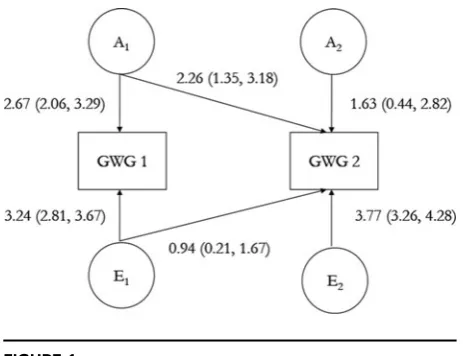
FIGURE 1
Cholesky decomposition AE model with path coefficients (with
95% confidence interval). Note:A1=additive genetic factors
in-fluencing the variation in GWG of both the first and the second
pregnancy (covariance);A2=additive genetic factors influencing
only the variation in GWG of the second pregnancy;E1=unique
environmental factors influencing the variation in GWG of both
the first and the second pregnancy (covariance);E2=unique
en-vironmental factors influencing only the variation in GWG of the second pregnancy.
likelihood measures used (as described in the methods). When comparing a more parsimonious AE model by constraining A2 to zero, that is, additive genetic factors specific to the second pregnancy only, with the full AE model, the change in the model fit was not statistically significant (2test, –2 LL=1.7,df=1,p=.19). However, when fitting the AE model without constraining theA2 com-ponent to zero, the coefficient estimate was 1.63 (95% CI: 0.44, 2.83), thus statistically significantly larger than zero. In light of this, we chose to use the AE model with anA2 component.
As shown inFigure 1, the results from the best-fitting AE bivariate model suggest that there is an overlap (covariance) in both the genetic (A1) and unique environmental (E1) components, although specific unique environmental (E2) and genetic factors (A2) also seem to influence the variation in GWG in the second pregnancy. The variance explained by additive genetic factors in the bivariate model (seeTable 4) seemed to be similar to the heritability estimates obtained from the univariate results, where the estimates were larger in the first pregnancy compared to the second (0.40 and 0.34 respectively). The covariance between GWG of the two pregnancies was to a larger extent explained by additive genetic factors (67%, 95% CI: 41%, 92%) compared to unique environmental factors (33%, 95% CI: 8%, 59%). The additive genetic correlation (rA) was 0.81 (95% CI: 0.55, 1.08), and the unique environmental correlation (rE) was 0.24 (95% CI: 0.06, 0.42). The squared correlations (rA2andrE2) indicated that 66% of the genes and 6% of the unique environmental factors were shared between the two pregnancies.
Sensitivity Analyses
As previously explained, we carried out two sensitivity anal-yses where we excluded mothers who at their first antenatal visit reported to be smokers (N=386 in total, both first and second pregnancy) and mothers with an early-pregnancy or delivery weight of above 98 kg between the years 1982 and 1989 (N=41 in total). None of the results differed from those presented earlier, neither in the univariate nor in the bivariate analyses. The observations from the first analysis where the mothers reported to be smokers were therefore kept in the analyses, and the latter 41 cases were excluded (as mentioned earlier, due to errors in the data). We also analyzed GWG as relative GWG (weight gain per gestational week); however, as there were very small changes in the re-sults, GWG was kept as a continuous measure in kilograms.
Discussion
In our large nation-wide register-based twin study, we showed that GWG was moderately heritable (ranging from approximately 30–40%), based on the best-fitting AE mod-els of the twin mothers’ first and second pregnancies. A combination of environmental factors unique to each twin mother, and possibly also some random measurement er-ror, explained the remaining part of the total variation in weight gain during pregnancy. As stated previously, due to the results from the ACE model (with a non-significant C component) in the first pregnancy, we cannot rule out that the AE models could also include a certain amount of shared environment. We also found that a larger part of the variation in GWG of the mothers’ second pregnancy was explained by unique environmental factors compared to the first pregnancy (72% and 57% respectively). It should also be mentioned that residual variation, such as potential measurement error in GWG (e.g., due to variability in mea-surement routines), is also a part of the unique environ-mental factors. Any potential measurement error should, however, be random within each twin pair. The findings from our bivariate model suggested that separate additive genetic factors influenced the mothers’ GWG in the second compared to the first pregnancy; however, it also suggested that there was a large overlap, where the same genetic fac-tors influenced GWG in both the first and the second preg-nancy. In fact, we found that 66% of the additive genetic factors were shared between the two pregnancies. A similar pattern was also found for the unique environmental vari-ance, where unique environmental factors that influenced the GWG in the first pregnancy also influenced the GWG in the second pregnancy. However, the proportion to which these unique environmental factors were shared between the pregnancies was considerably smaller compared to the additive genetic factors (6%). In addition, there seemed to be non-shared environmental factors influencing the GWG only in the second pregnancy.
TWIN RESEARCH AND HUMAN GENETICS
415
https://www.cambridge.org/core/terms. https://doi.org/10.1017/thg.2015.38
TABLE 4
Relative Variance and Covariance Components of Gestational Weight Gain in the Best-Fitting Adjusted Bivariate Cholesky Model (With 95% Confidence Intervals)
% explained by additive genetic components (A) % explained by unique environmental components (E)
Variance V(GWG) V(GWG)
A1 A2 E1 E2
0.40 (0.25, 0.56) 0.34 (0.17, 0.52) 0.60 (0.44, 0.75) 0.66 (0.49, 0.83)
Covariance Cov(GWG1, GWG2) Cov(GWG1, GWG2)
0.67 (0.41, 0.92) 0.33 (0.08, 0.59)
Note: GWG=gestational weight gain; V(GWG)=variance in gestational weight gain;A1=relative variance component ex-plaining the additive genetic variance in GWG in the first pregnancy;A2=relative variance component explaining the additive genetic variance in GWG in the second pregnancy;E1=relative variance component explaining the unique envi-ronmental variance in GWG in the first pregnancy;E2=relative variance component explaining the unique environmental variance in GWG in the second pregnancy; Cov(GWG1, GWG2)=Covariance in gestational weight gain between the first and the second pregnancy.
Earlier studies in the area of GWG have mainly focused on assessing the environmental determinants of GWG, hence very little is known about the genetic influences on GWG and its heritability (Dabelea et al.,2000; Ludwig & Currie,2010; Power & Jefferis,2002). As previously men-tioned, GWG is associated with offspring child and adult BMI (Cohen et al.,2014; Reynolds et al.,2010; Sridhar et al., 2014), and previous twin studies aiming to determine the heritability of growth-related traits have primarily studied the heritability of BMI. As shown in a recent systematic review and in large national twin studies, the heritabil-ity estimates of BMI are generally high (50–80%) (Elks et al.,2012; Herskind et al.,1996; Hjelmborg et al.,2008; Maes et al.,1997; Schousboe et al.,2003) and fairly stable from early childhood into adulthood (Silventoinen et al., 2007). Despite a relatively high heritability, a recent inter-national genome-wide association study (GWAS) by Locke et al. (2015) found that the 97 loci that were associated with BMI explained less than 3% of the total variation in BMI. This indicates that even in the largest GWAS to date, only a small proportion of the genetic variation can be explained by specific genes. As our findings suggest that GWG has a moderate heritability, it is perhaps not surprising that many previous studies (although not genome-wide) have had dif-ficulties in locating genes or genetic variants related to the trait (Dishy et al.,2003; Lawlor et al.,2011; Stuebe et al., 2010). In addition, as GWG includes several other compo-nents — for example, the fetus, amniotic fluid, and placenta (Butte et al.,2003) — than the maternal increase in adipose tissue, it is likely influenced by other genetic or biological pathways than the general ones related to adiposity.
The pregnancy period is often referred to as a ‘window of opportunity’ in terms of changing lifestyle factors influ-encing the long-term health of both the mother and child (Shapira,2008). Our results support this idea by showing that environmental factors explain more than the major-ity of the variation of GWG. We also observed that the heritability estimate was lower in the mothers’ second preg-nancy compared to the first. A possible biological mech-anism behind this lower estimate could be that the
phys-iological adaptions of the female body during pregnancy play a larger role during the first pregnancy compared to following pregnancies. However, as the estimates did not differ significantly from each other, this finding might also be incidental. Larger twin studies are needed to replicate our results as well as to assess the heritability of GWG in several consecutive pregnancies to see whether the magni-tude of the environmental influence stays constant after the first pregnancy.
We observed that both overlapping and distinct genetic and unique environmental factors influenced the GWG in the first and the second pregnancy. In terms of the genetic effects, the findings could be explained by changes in the mothers’ gene expression; for example, due to epigenetic modifications from one pregnancy to the next. It is also possible that there are genes being switched on or off after the mother’s first pregnancy, which could result in partially different genes playing a role in the GWG of the second pregnancy compared to the first. Regarding the non-shared environmental factors, it seems plausible that lifestyle fac-tors that influence GWG during the first pregnancy (e.g., maternal dietary intake known to be associated with GWG; Rasmussen & Yaktine, 2009) can also influence GWG of the second pregnancy. On the same note, there seem to be unique environmental factors that influence the mothers’ GWG only during the second pregnancy, suggesting that different environmental factors can also influence the vari-ation in GWG in the second compared to the first pregnancy. It is, however, important to mention that the sample size of the bivariate analysis was rather small. Therefore, the results should be interpreted with caution and need replication in future larger twin studies or similar family-based studies.
Heritability of Gestational Weight Gain
Although self-reported height is prone to overestimation, we find it unlikely that such errors would cause over- or underestimation of our adjusted estimates as the magni-tude of the overestimation has been reported to be small and the validity high (Brunner Huber,2007). With regards to generalizing our results to singleton mothers, twins have been shown to be representative of the general popula-tion for most traits after early childhood (Kaprio & Silven-toinen,2011). Our study is also afflicted with some limi-tations. In terms of external validity, our findings may be limited to populations in similar developed countries and to women with early-pregnancy or delivery weight<99 kg. Even though our sample size is rather large, as mentioned in the results section, the C component of the adjusted ACE model was small and non-significant (0.03, 95% CI: 0.00, 0.26). This could indicate that we lack power to detect a possible role of shared environmental factors, as well as making it difficult to distinguish between the familial fac-tors A and C. As previously stated, larger population-based twin studies are needed to replicate our findings.
In conclusion, our study suggests that GWG is mod-erately heritable. The largest part of the variation in the trait was explained by environmental factors unique to each twin. This is of importance for clinicians and public health authorities working to prevent excessive pregnancy weight gain, as it is currently only the environmental factors that can be influenced by, for example, public health initiatives and primary prevention.
Acknowledgments
Information on zygosity was kindly provided by the Swedish Twin Registry, which was supported by a grant from the Ministry for Higher Education. This study was supported by a grant to Finn Rasmussen from the Swedish Research Council for Health, Working Life and Welfare (FORTE) (Grant number: 2010-0671) and Karolinska Institutet Fac-ulty Funds (KID; Grant number: 6549/2010-225). The funding organizations had no role in study design, data collection and analysis, decision to publish, or preparation of the manuscript.
References
Axelsson, O. (2003). The Swedish medical birth register.Acta Obstetricia et Gynecologica Scandinavica,82, 491–492. Beyerlein, A., Nehring, I., Rzehak, P., Heinrich, J., Mluler, M. J.,
Plachta-Danielzik, S., . . . von Kries, R. (2012). Gestational weight gain and body mass index in children: Results from three German cohort studies.PLoS One,7, e33205. Boomsma, D., Busjahn, A., & Peltonen, L. (2002). Classical
twin studies and beyond.Nature Reviews Genetics,3, 872– 882.
Brunner Huber, L. R. (2007). Validity of self-reported height and weight in women of reproductive age.Maternal and Child Health Journal,11, 137–144.
Butte, N. F., Ellis, K. J., Wong, W. W., Hopkinson, J. M., & Smith, E. O. B. (2003). Composition of gestational weight gain impacts maternal fat retention and infant birth weight.
American Journal of Obstetrics and Gynecology,189, 1423– 1432.
Cnattingius, S., Ericson, A., Gunnarskog, J., & K¨all´en, B. (1990). A quality study of a medical birth registry. Scan-dinavian Journal of Social Medicine,18, 143–148.
Cohen, A. K., Chaffee, B. W., Rehkopf, D. H., Coyle, J. R., & Abrams, B. (2014). Excessive gestational weight gain over multiple pregnancies and the prevalence of obesity at age 40.
International Journal of Obesity (London),38, 714–718. Dabelea, D., Hanson, R. L., Lindsay, R. S., Pettitt, D. J.,
Imperatore, G., Gabir, M. M., . . . Knowler, W. C. (2000). Intrauterine exposure to diabetes conveys risks for type 2 diabetes and obesity: A study of discordant sibships. Dia-betes,49, 2208–2211.
Dishy, V., Gupta, S., Landau, R., Xie, H. G., Kim, R. B., Smiley, R. M., . . . Stein, C. M. (2003). G-protein beta(3) subunit 825 C/T polymorphism is associated with weight gain dur-ing pregnancy.Pharmacogenetics,13, 241–242.
Ekbom, A. (2011). The Swedish Multi-generation Register.
Methods in Molecular Biology,675, 215–220.
Elks, C. E., den Hoed, M., Zhao, J. H., Sharp, S. J., Wareham, N. J., Loos, R. J., . . . Ong, K. K. (2012). Variability in the heritability of body mass index: A systematic review and meta-regression.Frontiers in Endocrinology (Lausanne),3, 29.
Fraser, A., Tilling, K., Macdonald-Wallis, C., Hughes, R., Sattar, N., Nelson, S. M., . . . Lawlor, D. A. (2011). Associations of gestational weight gain with maternal body mass index, waist circumference, and blood pressure measured 16 y after pregnancy: The avon longitudinal study of parents and children (ALSPAC).American Journal of Clinical Nutrition,
93, 1285–1292.
Furberg, H., Lichtenstein, P., Pedersen, N. L., Thornton, L., Bulik, C. M., Lerman, C., . . . Sullivan, P. F. (2008). The STAGE cohort: A prospective study of tobacco use among Swedish twins. Nicotine & Tobacco Research, 10, 1727– 1735.
Gaillard, R., Durmus, B., Hofman, A., Mackenbach, J. P., Steegers, E. A., & Jaddoe, V. W. (2013). Risk factors and outcomes of maternal obesity and excessive weight gain during pregnancy.Obesity (Silver Spring),21, 1046–1055. Haugen, M., Brantsaeter, A. L., Winkvist, A., Lissner, L.,
Alexander, J., Oftedal, B., . . . Meltzer, H. M. (2014). As-sociations of pre-pregnancy body mass index and gesta-tional weight gain with pregnancy outcome and postpar-tum weight retention: A prospective observational cohort study.BMC Pregnancy Childbirth,14, 201.
Hedderson, M. M., Gunderson, E. P., & Ferrara, A. (2010). Gestational weight gain and risk of gestational diabetes mel-litus.Obstetrics and Gynecology,115, 1092–1092.
Herskind, A. M., McGue, M., Sorensen, T. I., & Harvald, B. (1996). Sex and age specific assessment of genetic and en-vironmental influences on body mass index in twins. Inter-national Journal of Obesity and Related Metabolic Disorders,
20, 106–113.
TWIN RESEARCH AND HUMAN GENETICS
417
https://www.cambridge.org/core/terms. https://doi.org/10.1017/thg.2015.38
Hjelmborg, J., Fagnani, C., Silventoinen, K., McGue, M., Korkeila, M., Christensen, K., . . . Kaprio, J. (2008). Ge-netic influences on growth traits of BMI: A longitudinal study of adult twins.Obesity (Silver Spring),16, 847–852. K¨all´en, B., K¨all´en, K., & Otterblad Olausson, P. (2003).
The Swedish medical birth register: A summary of content and quality(Research report). Stockholm: Epidemiological Center, Swedish National Board of Health and Welfare. Kaprio, J., & Silventoinen, K. (2011). Advanced methods in
twin studies.Methods in Molecular Biology,713, 143–152. Lawlor, D. A., Fraser, A., Macdonald-Wallis, C., Nelson, S. M.,
Palmer, T. M., Davey Smith, G., . . . Tilling, K. (2011). Ma-ternal and offspring adiposity-related genetic variants and gestational weight gain.American Journal of Clinical Nutri-tion,94, 149–155.
Lichtenstein, P., Sullivan, P. F., Cnattingius, S., Gatz, M., Johansson, S., Carlstrom, E., . . . Pedersen, N. L. (2006). The Swedish Twin Registry in the third millennium: An update.Twin Research and Human Genetics,9, 875–882. Locke, A. E., Kahali, B., Berndt, S. I., Justice, A. E., Pers, T. H.,
Day, F. R., . . . Speliotes, E. K. (2015). Genetic studies of body mass index yield new insights for obesity biology.
Nature,518, 197–206.
Ludwig, D. S., & Currie, J. (2010). The association between pregnancy weight gain and birthweight: A within-family comparison.Lancet,376, 984–990.
Ludwig, D. S., Rouse, H. L., & Currie, J. (2013). Pregnancy weight gain and childhood body weight: A within-family comparison.PLoS Medicine,10, e1001521.
Maes, H. H., Neale, M. C., & Eaves, L. J. (1997). Genetic and environmental factors in relative body weight and human adiposity.Behavior Genetics,27, 325–351.
Mannan, M., Doi, S. A., & Mamun, A. A. (2013). Associa-tion between weight gain during pregnancy and postpar-tum weight retention and obesity: A bias-adjusted meta-analysis.Nutrition Reviews,71, 343–352.
Muth´en, L. K., & Muth´en, B. O. (2010).Mplus. Statistical anal-ysis with latent variables. Los Angeles: Author.
National Board of Health and Welfare. (2014).Pregnancies, deliveries, and newborn infants. The Swedish medical birth register 1973–2013. Assisted Reproduction, treatment 1991–2012. Stockholm, Sweden: Author. Retrieved from
http://www.scb.se/en_/Finding-statistics/Publishing-calendar/Show-detailed-information/?publobjid= 23631+. Accessed 1 April 2015.
Nevitt, J., & Hancock, G. R. (2000). Improving the root mean square error of approximation for non-normal conditions in structural equation modeling. Journal of Experimental Education,68, 251–268.
Nohr, E. A., Vaeth, M., Baker, J. L., Sorensen, T. I., Olsen, J., & Rasmussen, K. M. (2009). Pregnancy outcomes related to gestational weight gain in women defined by their body mass index, parity, height, and smoking status.American Journal of Clinical Nutrition,90, 1288–1294.
Posada, D., & Buckley, T. R. (2004). Model selection and model averaging in phylogenetics: Advantages of Akaike
informa-tion criterion and Bayesian approaches over likelihood ratio tests.Systematic Biology,53, 793–808.
Power, C., & Jefferis, B. J. (2002). Fetal environment and subse-quent obesity: A study of maternal smoking.International Journal of Epidemiology,31, 413–419.
Prysak, M., Lorenz, R. P., & Kisly, A. (1995). Pregnancy out-come in nulliparous women 35 years and older.Obstetrics and Gynecology,85, 65–70.
Rasmussen, K. M., & Yaktine, A. L. (Eds.). (2009).Weight gain during pregnancy: Reexamining the Guidelines.Washington, DC: National Academies Press.
Reynolds, R. M., Osmond, C., Phillips, D. I. W., & Godfrey, K. M. (2010). Maternal BMI, parity, and pregnancy weight gain: Influences on offspring adiposity in young adulthood.
Journal of Clinical Endocrinology & Metabolism,95, 5365– 5369.
Rijsdijk, F. V., & Sham, P. C. (2002). Analytic approaches to twin data using structural equation models.Brief Bioinform,
3, 119–133.
Rokholm, B., Silventoinen, K., Tynelius, P., Gamborg, M., Sorensen, T. I., & Rasmussen, F. (2011). Increasing genetic variance of body mass index during the Swedish obesity epidemic.PLoS One,6, e27135.
Schack-Nielsen, L., Michaelsen, K. F., Gamborg, M., Mortensen, E. L., & Sorensen, T. I. A. (2010). Gestational weight gain in relation to offspring body mass index and obesity from infancy through adulthood.International Journal of Obesity,34, 67–74.
Schousboe, K., Willemsen, G., Kyvik, K. O., Mortensen, J., Boomsma, D. I., Cornes, B. K., . . . Harris, J. R. (2003). Sex differences in heritability of BMI: A comparative study of results from twin studies in eight countries.Twin Research,
6, 409–421.
Shapira, N. (2008). Prenatal nutrition: A critical window of opportunity for mother and child.Women’s Health,4, 639– 656.
Silventoinen, K., Magnusson, P. K., Tynelius, P., Kaprio, J., & Rasmussen, F. (2008). Heritability of body size and muscle strength in young adulthood: A study of one million Swedish men. Genetic Epidemiology, 32, 341– 349.
Silventoinen, K., Pietilainen, K. H., Tynelius, P., Sorensen, T. I., Kaprio, J., & Rasmussen, F. (2007). Genetic and environ-mental factors in relative weight from birth to age 18: The Swedish young male twins study.International Journal of Obesity,31, 615–621.
Sridhar, S. B., Darbinian, J., Ehrlich, S. F., Markman, M. A., Gunderson, E. P., Ferrara, A., . . . Hedderson, M. M. (2014). Maternal gestational weight gain and offspring risk for childhood overweight or obesity.American Journal of Obstetrics and Gynecology. Article ID 524939,211(3). Stuebe, A. M., Lyon, H., Herring, A. H., Ghosh, J., Wise, A.,