Enabling Global Multimedia Distributed Services
based on Hierarchical DHT Overlay Networks
Isaias Martinez-Yelmo
1, Alex Bikfalvi
2, Carmen Guerrero
1, Ruben Cuevas
1, Andreas Mauthe
31
Universidad Carlos III de Madrid
Av. Universidad 30. 28911 Legan´es. Madrid (Spain)
{
imyelmo,guerrero,rcuevas
}
@it.uc3m.es
2
IMDEA Networks Av. Mediterr´aneo 22. 28912 Legan´es. Madrid (Spain)
[email protected]
3
Computing Department at InfoLab 21
Lancaster University. Lancaster LA1 4WA (UK)
[email protected]
Abstract
The provision of innovating multimedia services is a high priority for service providers. Due to the the high traffic volume characteristics of multimedia content, decentralised services are a desired solution for multimedia scenarios.
Based on the ongoing work of the IETF P2PSIP WG this paper defines a simple way to interconnect different do-mains using on peer-to-peer technology. The objective is to provide connectivity between users of different domains and allow decentralised multimedia services to be placed where they can be provided most effectively. Furthermore, the routing performance and routing state is analysed for the proposed hierarchical DHT overlay architecture.
1. Introduction
Nowadays, the provisioning of multimedia services (VoIP, VoD, Video Streaming, IPTV, etc) is one of the most important objectives of ISPs in delivering new and attractive services. However, due to their demanding requirements, these multimedia services have not been as widely deployed as would be expected. The success of applications such as Skype1 [1], [14] is due to their P2P decentralised design
despite their relative complexity. The problem with these applications is that they are closed privative solutions and
1http://www.skype.com
their behaviour is unpredictable. Thus, a standardised de-centralised scalable solution based on P2P overlay networks is desirable to facilitate a more large scale deployment of distributed multimedia services.
Although a number of solutions have been proposed to support decentralised multimedia services, the new ap-proach of the IETF P2PSIP2Working Group is developing
into a reference framework. P2PSIP [3] works on a peer-to-peer overlay based solution that facilitates a decentralised architecture. The developed protocol should be flexible enough [7] to support most of peer-to-peer networks. The idea is to provide a protocol that allows the implementa-tion of any DHT overlay network such as Kademlia [11] or Chord [16]. However, the design of this protocol does not consider the inter-operation between different domains required to provide global multimedia services. In this pa-per we propose a way of solving this problem. Further, the routing performance and maintenance state of the different peers is assessed in order to show the performance of certain key-aspects.
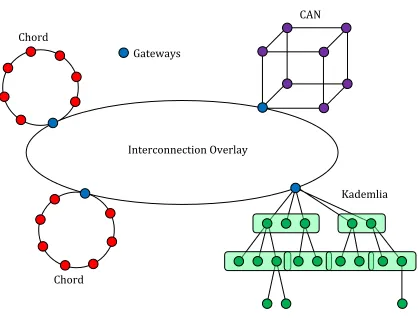
Fig.1 illustrates our approach. The basic idea is that the different domains can deploy their own overlay network but global connectivity between them is established through a dedicated interconnection overlay. In this interconnection overlay each domain is represented through at least one
super-peer. If an item, service or reference, is not in the same domain, a regular peer can asks its super-peer to route the query to the domain of the target peer. To support the
2http://www.p2psip.org
Figure 1. Hierarchical Overlay Architecture
routing between the different domains and the interconnec-tion overlay, an extended identifier is used, which is formed by aprefix IDfor the routing in the interconnection and a
suffix IDfor the routing in each domain.
Some advantages of this architecture are the network iso-lation and the improved scalability, which is intrinsic to the hierarchical architectures. However, issues such as a po-tential super-peer overload [2] have to be considered. This potential problem is limited to these peers since the routing state is not increased in legacy peers. For this reason, su-per peers can be dedicated entities allowing others (such as power-limited handheld devices, e.g. mobile phones) to be efficiently implemented.
We must highlight that in P2PSIP the overlay networks are used to retrieve the information about users and ser-vices, which is distributed across all peers in the overlay. Usually,this is location information (stored as IP address and transport port) and once this information is obtained, the negotiation of the service parameters is done using any suitable signalling protocol. Nevertheless, for compatibility reasons this protocol should be SIP [13].
The paper is structured as follows. Section 2 outlines the proposed hierarchical architecture. An analysis of its rout-ing performance and the advantages of this approach are discussed in section 3. The particular case of a hierarchical Kademlia overlay network is studied in section 4. The theo-retical is validated using the PeerFactSim.Kom framework. Finally, the related work is presented in section 5 and the conclusions and future work are presented in section 6.
2. Hierarchical DHT Overlay Networks
2.1. Hierarchical Space Domain of IDs
In order to provide a hierarchical architecture for inter-connecting different domains and assuming that the main
ȋȌ
ȋȌ
Figure 2. Hierarchical Space of Identifiers
goal of P2PSIP WG is to develop a framework to support any kind of DHT overlay network, we define a hierarchical space domain of identifiers. Thus, theHierarchical ID(see Fig.2) is composed by two sub-identifiers: aprefix IDand a
suffix ID. The prefix ID is used for the routing in the inter-connection overlay between the different domains, whereas the suffix ID is used for routing queries only inside the own domain of a peer. This approach can be easily included in the P2PSIP protocol[7] because each header must contain anoverlay IDwhich can be used asprefix IDand anode ID
which can be used assuffix ID.
2.2. Service Mapping into the Hierarchical ID Space
Domain
One of the main problems in a decentralised archi-tecture is the mapping between the available information and/or services and the peers on the system. For exam-ple, if we consider a multimedia environment where ser-vices and users are identified by URI’s, a resource is iden-tified by [email protected]. Now, the prob-lem is to map these URI’s to the proposed hierarchical ID space domain. In order to do this, the prefix ID is obtained by applying a hash to the domain of the URI:
PrefixID=hash(example.com)
The suffix ID is generated as the hash of the URI:
SuffixID=hash([email protected]). Once the mapping between the URI and the Hierarchi-cal ID has been established, a resource tuple containing the resource hierarchical ID, the URI and the resource itself, is stored at the peer with the closest peer ID. Depending on the DHT protocol this tuple can be also replicated in other peers.
2.3. Hierarchical DHT Overlay Network Operation
When a resource in another domain has to be retrieved, the operation is more complex. For instance, this case could correspond to a VoIP call to a user in a different domain. In this circumstance, it is necessary to obtain the contact information published in the domain where the called party is registered. In the first stage, the initiator sends the search to its own super-peer. Super-peers are selected according to certain characteristics [12] and the selection mechanism can be integrated in the maintenance protocol of each DHT. Since all the peers in a domain know their super-peer, they can send a query to the super-peer in one hop. When the super-peer receives the query, it routes the query through the interconnection overlay using the prefix ID. This query will arrive at the super-peer belonging to the domain match-ing the prefix ID from the query. From this point onwards, the query is forwarded inside the destination domain. If the query reaches a peer that has the desired resource, this peer replies this information to the initiator. This is possible be-cause the query includes an{IP address, port}tuple where the requester is waiting the response. This answer must be compliant with the ongoing design of the P2PSIP protocol [7] that it is being defined by the IETF P2PSIP WG.
2.4. Main Characteristics of the proposed
Hierar-chical DHT Architecture
Our proposal has several advantages. First, the opera-tions or primitives of the used DHT are not changed. Only some modifications are needed in the maintenance opera-tions to include the selection and update of super-peers [12]. Furthermore, the routing state in peers does not increase be-cause the number of peers that are maintained is the same.
If a global domain would be used to provide global con-nectivity, this domain would contain all peers in the dif-ferent domains. If each domain hasM peers andK do-mains want to obtain global connectivity, the number of peers isN =M·K.In many DHT-based overlay networks the routing state has a logarithmic dependency with the number of peers. Therefore, we haveO(logBN)because of the logarithmic property: O(logBM) +O(logBK) =
O(logB(M ·K)). This routing state applies only to super-peers, while regular peers only have to maintain the state of their own domain, which is onlyO(logBM).
The drawback of this approach is the higher load needed to be supported by the super-peers [2] although this load is smaller than in other hierarchical DHT proposals [5], [6], [17], [18].
3. Routing Performance in a Hierarchical DHT
Overlay Network
This section presents the routing performance in a sys-tem based on hierarchical DHT overlay network with the
proposedhierarchical ID. This analysis is an extension of the work in [10] and a more elaborated model is presented.
We define the following notations:
• K: The number of domains.
• Mi: The number of peers in a domaini.
• N: All the peers from all the domains. In our case, it is considered that a peer cannot be attached to multiple domains, henceN =PK
i=1Mi.
• ρij: The probability of launching a query from the
do-mainito the domainj.
• C(x): The number of hops needed to find a super-peer in the interconnection overlay depending on the num-ber of super-peersx. This value depends on the type of overlay used in the interconnection overlay.
• Di(x): The number of hops needed to find a peer in a
flat overlay of typeias function of the number of peers
xbelonging to the domain.
It is assumed that all the peers in a domain know their super-peer from the interconnection overlay. This assump-tion implies that onlyone hopis needed to reach the super-peer.
Taking into account the above definitions, we obtain the routing performance (RP) of this DHT-based hierarchical overlay networks. First of all, we define the cost of finding a peer in each overlay:
• Di(Mi): The cost of finding a peer in its own domain.
• C(K): The cost of finding a super-peer in the inter-connection overlay.
If the probability of obtaining an item in a domain from its super-peer is considered negligible and because the av-erage number of peers in a domain isN/KwithN K, the average routing performance experienced by a peer in domainican be written as follows:
RPi=ρii·Di(Mi) + K
X
j=1,j6=i
ρij·[1 +Dj(Mj) +C(K)]
(1) The first term of the sum is the cost of searching some-thing in the own domain of a peer, whereas the second term is the cost for the searches in the other domains.
The average number of hops is given by the next expres-sion:
RP = 1
N ·
K
X
i=1
If the number of peers is the same in all domains, we have:
RP = 1
K ·
K
X
i=1
·RPi (3)
Because we assumed that the number of peers is equal in all domains and each look-up in the overlay is consid-ered randomly independent, we obtain that the probability of looking for a peer attached to other domain is equally distributed between all the foreign domains. In addition, the probability of looking for a peer in the own domain is dif-ferent from the one of looking for a peer in other domains. Thus, the inter-domain query probability isρij= 1K−−ρii1 and
we can express Eq.1 as follows:
RPi=ρii·Di(M)+ K
X
j=1,j6=i ·1−ρii
K−1·[1 +Dj(M) +C(K)]
(4) This relation is useful for some type of scenarios like VoIP in community networks whereρii > ρij which
im-plies that calls between peers of the same community are more frequent. For other services where the look-up proba-bility in the own domain is the same as for foreign domains (ρii=ρij= K1), we get Eq.5 (which is a simplified version
of Eq.4):
RPi= 1
K·Di(M) +
K
X
j=1,j6=i ·1
K·[1 +Dj(M) +C(K)]
(5) Finally, if the same overlay is used in all domains the sum can be eliminated from the above expression:
RPi = 1
K ·D(M) + K−1
K ·[1 +D(M) +C(K)] =
=D(M) +K−1
K ·[1 +C(K)]
(6)
From Eq.6 and Eq.3 we obtain the next equality:
RP =RPi=D(M) +
K−1
K ·[1 +C(K)] (7)
4. Case Study: A Hierarchical Kademlia
Over-lay Network
In this section, we study the routing performance and the routing state in the case when a Kademlia overlay [11] is used in all domains and in the interconnection overlay. We
selected Kademlia because it is one of the most used DHT-based overlays in peer-to-peer applications like e-Mule, Bit-torent, etc.
Kademlia is an overlay network that has a routing perfor-mance and a routing state with a logarithmic dependency on the number of peers from the overlay, due to its XOR distance-based routing algorithm.
4.1. Analytical Analysis
In order to verify the efficiency of our solution, when the Kademlia protocol is used, we use the next equality: C(x) =D(x)∼logBx+c, whereBis a configuration pa-rameter that allows to adjust the trade-off between the rout-ing performance and the routrout-ing state in the peers.
We are going to substitute this expression in Eq.7, be-cause the validation is performed with assumptions similar to the conditions that are valid for this expression. There-fore:
RP =RPi ∼logB(M) +c+
K−1
K ·[1 + logB(K) +c]
(8) IfK 1and taking into account the properties of the logarithm, we can write:
RP =RPi∼1 + logB(M ·K) + 2c (9)
For the routing state, the number of entries depends on the number of peers and on the setup parameter B. Ac-tually, the number of overlay routing entries depends on O(logBn)wherenis the number of peers in the overlay. Super-peers have to support additional entries for the inter-connection overlay. The total number of routing entries for a super-peer is approximately toO(logB(K·M)).
If a flat overlay is used to connect all peers in different domains, peers would need O(logB(K·M))routing en-tries, but using the hierarchical architecture, legacy peers only needO(logBM). Therefore, the routing state savings are significant if many domains are interconnected.
4.2. Validation via Simulation
In this section, we present several experimental results with the goal to assess the performance of a hierarchical Kademlia overlay network. The results have been obtained with a prototype implementation of the protocol and us-ing the PeerfactSim.KOM3P2P network simulator [4]. The evaluation focused on determining the routing performance and the routing state (the average number of entries in the routing tables) with respect to the theoretical limits given for the canonical (or flat) overlay.
For the simulation results the corresponding 95% con-fidence intervals have been calculated. These concon-fidence intervals give an error interval less than 5% which assures the consistency of the data recollected with the simulations.
4.2.1 Simulation Scenarios
The simulation scenarios considered different values for the number of domains and number of peers in a domain. Due to the capacity limits of the simulator, we simulated 5, 10 and 20 domains, with a number of peers per domain be-tween 10 and 1000.
For these simulations, we have not taken into account the churn rate, although it is important to consider it in some particular scenarios. This simplification is based on the fact that Skype has a low churn rate [14] and we are interested in relatively similar scenarios.
In relation with the setup of the Kademlia overlay, the protocol has been configured withB = 2b = 2,k = 20
andα = 1. Although Kademlia defines a mechanism that accelerates the look-up process by increasing the size of the routing tables and the number ofbbits considered at each hop, the simulation models useb = 1and thus the results obtained reflect the worst case for the routing performance. The reason of usingα = 1is to facilitate the comparison with other overlays that cannot easily parallelize their look-up operations. The value of k is used for the size of the buckets and also for the number of replicas of each item inside the Kademlia overlay.
4.2.2 Routing Performance
The routing performance was calculated for bothnode look-up andvalue look-up operations. The former are the re-sult of the maintenance operations (refresh of the routing tables) and are performed solely inside the domain or inside the interconnection overlay between super peers. The lat-ter are modelled based on peer behaviour of searching for stored values and can span two different domains. In addi-tion, since the value look-ups take advantage of key-value replication, we expect the value look-ups to have a better performance. These operations finish as soon as a key is found.
According to the analytical model, and considering the assumptions on the simulation, the RP is estimated using Eq.8 or Eq.9 and depending on the value ofK.
Figure 3 illustrates the average number of hops for inter-domain value look-up operations versus the number of peers in a domain for 5, 10 and 20 domains. The dependency is logarithmic with the number of peers in a domain (linear on a logarithmic scale), when the number of super peers is kept constant. The difference between the values obtained for each number of domains represents the mean of the extra number of hops needed when the number of super-peers in
the interconnection overlay increases. Because the increase is almost constant while the number of super peers doubles, it also proves the logarithmic dependency of the routing per-formance with the size of the interconnection overlay.
Figure 4 demonstrates the expected difference between value look-up and node look-up (Log2 stands for log2). Because in our scenarios, node look-up operations can-not terminate in acan-nother domain (as they are generated by intra-domain maintenance), only intra-domain routing per-formance data are considered. As expected, in average the value look-ups require fewer hops due to replication. The difference is higher when the number of peers inside the do-main is comparable to the replication parameter (k = 20) and becomes negligible when the number of domain peers is large enough for the replication to have an important ef-fect. The figure also contains the maximum number of hops that were obtained during the same simulation for a visual comparison with the theoretical logarithmic limit (log2M). Finally, we analyse the worst case routing behaviour. Figure 5 compares the maximum number of hops obtained for inter-domain routing for 5 and 10 domains with the the-oretical values given by Eq.8 or Eq.9. The logarithmic de-pendency can be observed as expected.
4.2.3 Routing State
The evaluation of the routing state intends to determine whether the average number of routing entries maintained by the peers lay within the expected ranges and to illustrate the behaviour of the routing state when the number of do-mains changes. For this, we examine the routing tables used for routing inside domains.
Figure 6 shows the obtained results. We have that: N E ∈ [log2N, klog2N], whereN Eis the average num-ber of routing entries. In addition, we can observe a slight dependency between the number of domains and the value of the routing state. Since the routing state is determined solely by the interaction between peers, the explanation for this dependency is that the simulation scenarios use the same number of value look-up operations. In general, the value look-ups are originated in one domain and usually ter-minated in another domain. However, if the number of do-mains is small the number of operations that originate and terminate in the same domain increases and consequently the number of routing entries also increases according to the standard Kademlia protocol to populate the bucket entries. Node look-ups cannot influence the routing state because they take place only inside a domain and have no relation-ship to the number of domains.
0 5 1 1.5 2 2.5 3 3.5 4
Av
e
ra
ge
number
of
hops
20 clusters
10 clusters
0 0.5
10 100 1000
Number of peers per cluster
5 clusters
Figure 3. The routing performance for value look-up operations
2 4 6 8 10 12
Number
of
hops
Log2(N)
Node Lookup Maximum Value Lookup Maximum Node Lookup Average Value Lookup Average
0
10 100 1000
Number of peers per cluster
Figure 4. The routing performance for intra domain value look-up and node look-up op-erations
5. Related Work on Hierarchical Overlay
Net-works
Overlay networks usually requireO(logBN)peer hops to reach the desired destination andO(logBN)routing
tries to maintain the desired structure. This complexity en-sures good scalability but it is desirable to have further im-provements. Thus, hierarchical overlay networks are being proposed because its benefits are clear [9].
The first approach is to delegate all the work to supeers [6], [18]. They maintain the overlay network and per-form all the necessary actions and legacy peers only have to register their information to their peers. Other studies are focused on optimising some parameter like the delay. In [17] a low delay hierarchical overlay network based on Chord is proposed. The drawback is the high routing state
2 4 6 8 10 12 14 16
Number
of
hops
1+Log2(10)+Log2(N) 1+Log2(5)+Log2(N) Value Lookup Max (10 clusters) Value Lookup Max (5 clusters)
0 2
10 100 1000
Number of peers per cluster
Figure 5. The worst case routing performance for value look-up operations0.00%
10.00% 20.00% 30.00%
0 2000 4000 6000 8000 10000 12000 14000 16000 18000
Pe
rc
Node Stress 10 peers
100 peers
1000 peers
70 80 90 100
ries
5 clusters 10 clusters 20 clusters
0 10 20 30 40 50 60 70
10 100 1000
Number
of
ro
u
ti
n
g
en
tr
Number of peers per cluster
Figure 6. Routing state for intra-domain rout-ing tables
needed becauseallthe peers in the overlay are attached to
allthe levels in an-levelhierarchy. A less aggressive design with the same objective is presented in [5] but the hierarchy is built with the constraint of limiting the maintenance cost to the flat counterpart.
The main problem is the selection of super-peers. This selection can be based on the computation capacity of a peer, the available bandwidth to receive and process the queries and the session time to assure a stable set of super-peers [12]. Furthermore some mechanism must be provided to distribute the super-peer related information. One option is to piggyback this information [8].
6. Conclusions and Future Work
to support global decentralised multimedia services. Peers of the same domain are connected via a domain overlay network and by using the
SuffixID=hash([email protected]) to route queries. In order to get connectivity with other domains it is necessary to have at least one super-peer in each domain. An interconnection overlay is maintained be-tween the super-peers where the routing is based on
PrefixID=hash(example.com)values.
The average number of hops that a peer must perform in our architecture is given by Eq.1. However, based on cer-tain justifiable assumptions, it is simplified to Eq.7. Further-more, we consider that the routing state of ”normal” peers does not change. In fact, only super-peers are exposed to a higher load. These super-peers might actually be dedicated entities employed by the domain for this specific task.
Finally, a simulation of hierarchical Kademlia overlay network has been performed. The routing performance is below the worse case expected through the analytical eval-uation. The information related to a specific user or service can be retrieved in 2 to 3.5 hops for a number of domains between 5 and 20 and with a number of peers per domain between 10 and 1000. These results illustrate the scalability of the solution.
In the next step of our research our main goal is to take into account the churn rate based on results presented in [15].
Acknowledgement
This work has been supported by the European Union under the IST Content NoE4 (FP6-2006-IST-038423), by the Regional Government of Madrid under the BioGrid-Net5project (CAM, S-0505/TIC-0101) and by the Ministry of Science and Innovation under the CONPARTE project (MEC, TEC2007-67966-C03-03/TCM).
References
[1] S. A. Baset and H. G. Schulzrinne. An analysis of the skype peer-to-peer internet telephony protocol. INFOCOM 2006. 25th IEEE International Conference on Computer Commu-nications. Proceedings, pages 1–11, April 2006.
[2] B. Beverly Yang and H. Garcia-Molina. Designing a super-peer network. InData Engineering, 2003. Proceedings. 19th International Conference on, pages 49–60, 2003.
[3] D. Bryan, P. Matthews, E. Shim, and D. Willis. Concepts and terminology for peer to peer sip, November 2007. Inter-net Draft draft-ietf-p2psip-concepts-01.txt.
[4] V. Darlagiannis, A. Mauthe, N. Liebau, and R. Steinmetz. An Adaptable, Role-based Simulator for P2P Networks.
4http://www.ist-content.eu 5http://www.biogridnet.org
Proceedings of the International Conference on Modeling, Simulation and Visualization Methods, pages 52–59, 2004. [5] P. Ganesan, K. Gummadi, and H. Garcia-Molina. Canon in
g major: designing dhts with hierarchical structure. In Dis-tributed Computing Systems, 2004. Proceedings. 24th Inter-national Conference on, pages 263–272, 2004.
[6] L. Garces-Erice, E. W. Biersack, K. W. Ross, P. A. Felber, and G. Urvoy-Keller. Hierarchical p2p systems. In Proceed-ings of ACM/IFIP International Conference on Parallel and Distributed Computing (Euro-Par), 2003.
[7] C. Jennings, B. Lowekamp, E. Rescorla, J. Rosenberg, S. Baset, and H. Schulzrinne. Resource location and discov-ery (reload), June 2008. Internet Draft draft-bryan-p2psip-reload-04.txt.
[8] Y.-J. Joung and J.-C. Wang. Chord2: A two-layer chord for reducing maintenance overhead via heterogeneity. Com-puter Networks, 51(3):712–731, Feb 2007.
[9] M. Kwon and S. Fahmy. Synergy: an overlay internetwork-ing architecture. InComputer Communications and Net-works, 2005. ICCCN 2005. Proceedings. 14th International Conference on, pages 401–406, 2005.
[10] I. Martinez-Yelmo, R. Cuevas, C. Guerrero, and A. Mauthe. Routing performance in hierarchical dht-based overlay net-works. InIn Proceedings on 16th Euromicro International Conference on Parallel, Distributed and network-based Pro-cessing, Feb. 2008.
[11] P. Maymounkov and D. Mazieres. IPTPS 2002 Cam-bridge, MA, USA, March 7-8, 2002. Revised Papers, volume 2429/2002 ofLecture Notes in Computer Science, chapter Kademlia: A peer-to-peer information system based on the XOR metric, pages 53–65. Springer, 2002.
[12] S.-H. Min, J. Holliday, and D.-S. Cho. Optimal super-peer selection for large-scale p2p system. InHybrid Information Technology, 2006. ICHIT’06. Vol 2. International Confer-ence on, volume 2, pages 588–593, 2006.
[13] J. Rosenberg, H. Schulzrinne, G. Camarillo, A. Johnston, J. Peterson, R. Sparks, M. Handley, and E. Schooler. SIP: Session Initiation Protocol. RFC 3261 (Proposed Standard), June 2002. Updated by RFCs 3265, 3853, 4320, 4916. [14] D. Rossi, M. Melia, and M. Meo. A detailed measurment of
skype network traffic. InIPTPS 2008, 2008.
[15] M. Steiner, T. En-Najjary, and E. W. Biersack. A global view of kad. InIMC ’07: Proceedings of the 7th ACM SIGCOMM conference on Internet measurement, pages 117–122, New York, NY, USA, 2007. ACM.
[16] I. Stoica, R. Morris, D. Liben-Nowell, D. Karger, M. Kaashoek, F. Dabek, and H. Balakrishnan. Chord: A Scalable Peer-to-Peer Lookup Protocol for Internet Appli-cations. IEEE/ACM TRANSACTIONS ON NETWORKING, 11(1), 2003.
[17] Z. Xu, R. Min, and Y. Hu. Hieras: a dht based hierarchical p2p routing algorithm. InParallel Processing, 2003. Pro-ceedings. 2003 International Conference on, 2003. [18] S. Zoels, Z. Despotovic, and W. Kellerer. Cost-based