A SOFT Way for OpenFlow Switch Interoperability Testing
Maciej Ku´zniar
†Peter Perešíni
†Marco Canini
‡∗Daniele Venzano
†Dejan Kosti´c
•∗ †EPFL, Switzerland ‡TU Berlin / T-Labs, Germany •Institute IMDEA Networks, Spain†{
name.surname
}@epfl.ch
‡ •ABSTRACT
The increasing adoption of Software Defined Networking, and OpenFlow in particular, brings great hope for increasing extensibility and lowering costs of deploying new network functionality. A key component in these networks is the OpenFlow agent, a piece of software that a switch runs to enable remote programmatic access to its forwarding tables. While testing high-level network functionality, the correct behavior and interoperability of any OpenFlow agent are taken for granted. However, existing tools for testing agents are not exhaustive nor systematic, and only check that the agent’s basic functionality works. In addition, the rapidly changing and sometimes vague OpenFlow specifications can result in multiple implementations that behave differently.
This paper presents SOFT, an approach for testing the interoperability of OpenFlow switches. Our key insight is in automatically identifying the testing inputs that cause dif-ferent OpenFlow agent implementations to behave inconsis-tently. To this end, we first symbolically execute each agent under test in isolation to derive which set of inputs causes which behavior. We then crosscheck all distinct behaviors across different agent implementations and evaluate whether a common input subset causes inconsistent behaviors. Our evaluation shows that our tool identified several inconsis-tencies between the publicly available Reference OpenFlow switch and Open vSwitch implementations.
Categories and Subject Descriptors
C.2.6 [Computer-Communication Networks]: Internet-working—Routers; C.4 [Performance of Systems]: Reli-ability, availReli-ability, and serviceability; D.2.5 [Software En-gineering]: Testing and Debugging—Symbolic execution
Keywords
Switches, Bugs, Reliability, OpenFlow, Symbolic execution
∗Work done when the author was with EPFL.
Permission to make digital or hard copies of all or part of this work for personal or classroom use is granted without fee provided that copies are not made or distributed for profit or commercial advantage and that copies bear this notice and the full citation on the first page. To copy otherwise, to republish, to post on servers or to redistribute to lists, requires prior specific permission and/or a fee.
CoNEXT’12,December 10–13, 2012, Nice, France. Copyright 2012 ACM 978-1-4503-1775-7/12/12 ...$15.00.
1.
INTRODUCTION
Software defined networking (SDN) holds the promise to lower the barrier for deploying and managing new function-ality in networks. For example, Google recently outlined how it uses SDN to solve the problem of scheduling bursty traffic among its datacenters [1]. The main thrust in SDN is currently OpenFlow [21]. In OpenFlow, the software run-ning at a logically centralized controller manages a collection of switches hosting programmable forwarding tables.
It is crucial to have reliable networks, and this requirement does not change with SDN. Unfortunately, with the intro-duction of greater programmability, the chances of software faults (or bugs) are also on the rise. Debugging applica-tion software that runs at the controller has recently started receiving attention. For example, NICE [11] subjects the controller software to a wide range of packet streams to un-cover race conditions and other bugs.
However, an aspect that is mostly going unnoticed is that OpenFlow switches also run software, which must behave correctly. This software takes the name ofOpenFlow agent, and its role is to expose a standardized programmatic inter-face to the switch forwarding tables and to handle the com-munication with the controller. However, while testing high-level network functionality, the interoperability and correct behavior of any OpenFlow agent are taken for granted. In practice, a real OpenFlow deployment likely has switches from multiple vendors managed by one or more controllers. To ensure correct network operation,allswitches must work properly. In other words, it may take just one buggy switch to cause problems in the form of lost connectivity, unautho-rized accesses, traffic overload, and so on. If failures start occurring in OpenFlow deployments,the hard-earned ability to innovate in the networking space will be severely hampered by mistrust. In addition, hardware switches run OpenFlow agents in the form of embedded firmware. Firmware is dif-ficult to upgrade due to the impact of downtime, has longer debug cycles than ordinary software, and is notoriously chal-lenging to troubleshoot in the wild [23]. These issues only raise the importance of trying to ensure that the firmware is right during its development stage.
Despite advances in writing provably correct software, test-ing remains the prime technique for ensurtest-ing dependability. We observe that local testing and debugging (e.g., by using OFTest [2]) can get the basic functionality working. Beyond this, the only way of gaining confidence in the behavior of multiple different switches currently is interoperability test-ing. One way of doing this involves placing personnel and switches at a third-party location for several days, and run-ning OFTest and similar test suites [3]. Besides being ex-pensive, this task is complex, in part because the number of new OpenFlow switch implementations is quickly growing. Of course, any new version of the specifications require a new round of interoperability testing.
Moreover, since local test suites are unlikely to be exhaus-tive, the above interoperability testing will not be exhaustive either. For instance, vendors typically test control plane software using manually-composed test cases, refined over time. Evidence shows that critical interoperability bugs sur-vive this process. For example, in two recent episodes, 100% protocol-compliant BGP messages caused significant con-nectivity problems [6, 7]. These examples strongly confirm that local test cases are incomplete even for well-established router software.
Towards achieving exhaustive testing, we propose an ap-proach to interoperability testing that leverages the multi-ple, existing OpenFlow implementations and herein iden-tifies potential interoperability problems by crosschecking their behaviors. Exploring code behaviors in a systematic way is key to observe behavioral inconsistencies. Researchers recently applied symbolic execution [18], a systematic pro-gram code analysis technique, to test systems software with considerable success [8,9,12]. Symbolic execution effectively asks the code itself to provide the test inputs that are needed to traverse all code paths at least once. The reasoning here is that it is sufficient to test each code path once to exercise all behaviors. Doing this is relatively simple for single-machine code, while trying to find memory-related bugs.
While appealing, the use of symbolic execution is gener-ally met with the scalability challenges of exhaustive path coverage, which we must face. In addition, it would not be practical to assume that a tool for interoperability testing would have access to the source code of commercial Open-Flow implementations from all vendors.1
It is then our goal to make symbolic execution scale to crosscheck different OpenFlow implementations and find interoperability issues without having simultaneous access to all source codes.
In this paper, we introduce SOFT (Systematic OpenFlow Testing), a tool that automates interoperability testing of OpenFlow switches. Operating in two phases, SOFT uses symbolic execution and constraint solving. In the first test-ing phase, symbolic execution runs locally on each vendor’s source code. Then, using the outputs of symbolic execution (not the source codes), SOFT determines the input ranges (e.g., fields in OpenFlow messages) that cause two Open-Flow agent implementations to exhibit different behaviors.
Unlike normal execution, symbolic execution runs a pro-gram with symbolic variables as inputs. A symbolic
vari-1
Although modern symbolic execution engines only require access to the binary code, this still needs to be produced with a particular compiler or be interpreted at runtime, which may incur impractical overhead. Also, it may not be possible to simply use the binary form since the execution environment is generally not known a priori.
able initially has no constraints on its actual value. As the execution progresses, the possible values of symbolic vari-ables become constrained based on how the program uses these variables (e.g., in conditional expressions). At every code branch based on a symbolic variable, symbolic execu-tion logically forks and follows both branches, on each path maintaining a set of constraints, called the path condition, which must hold for the execution of that path.
Using symbolic execution as a base for interoperability testing is conceptually similar to checking functional equiv-alence on a per-path basis. Assume we have two functions that take a single argument and implement the same algo-rithm in different ways. We can check functional equiva-lence by simply feeding them the same symbolic argument and verifying they return the same value. In practice, when applying symbolic execution to OpenFlow agent testing, we must address several challenges. First, the input space is theoretically infinite as an OpenFlow agent is a non-termi-nating program. Simply limiting the input space (i.e., Open-Flow messages and data packets) to N symbolic bytes is not effective, given that it means feeding completely un-structured inputs. Intuitively, with such inputs, the sym-bolic execution engine would quickly run into the path ex-plosion problem (number of paths grows exponentially with the number of branches on symbolic inputs). Second, there is no immediate or a standard way to compare the behav-iors of different agents. Demanding modifications to the agents’ source code for inspecting the state is clearly unde-sirable. Third, the straightforward equivalence check out-lined above requires simultaneous access to both OpenFlow agents’ source codes, which is likely to be impossible for commercial implementations.
The contributions of this paper are as follows:
1. We use symbolic execution to systematically identify and collate code paths in OpenFlow agents to determine in-put subspaces that result in the same outin-puts. To achieve this, we address the difficult problems of managing the com-bination of symbolic and concrete inputs, as well as deter-mining internal agent state by observing external actions. This step overcomes the first challenge in applying symbolic execution to interoperability testing.
2. We demonstrate a novel use of a constraint solver to compute an intersection of input subspaces belonging to dif-ferent agent implementations. By doing so, we quickly deter-mine inputs that cause different behavior in multiple agents (inconsistencies). In addition, we do so without ana priori definition of correct behavior and overcome the second chal-lenge (crosschecking implementation behaviors). This phase is separate from symbolic execution and does not require ac-cess to source code. By this virtue, it addresses the third aforementioned challenge.
3. We demonstrate the effectiveness of our approach by applying it to the Reference Switch (55K LoC) and Open vSwitch (80K LoC), the two publicly available OpenFlow agent implementations. SOFT quickly finds several inconsis-tencies between the two. Further, we demonstrate SOFT’s effectiveness in finding manually injected differences.
2.
OVERVIEW
In this section, we first give a brief introduction to sym-bolic execution, the technique our approach is built on. Next, we describe the kind of implementation inconsistencies we target. We then use an example to guide an overview of our approach and discuss the intended usage of SOFT.
2.1
Symbolic execution
Our approach is inspired by the successful use of sym-bolic execution [18] in automated testing of systems soft-ware [8–10, 12, 15]. The idea behind symbolic execution is to exercise all possible paths in a given program. Therefore, unlike normal execution which runs the program with con-crete values, symbolic execution runs program code on sym-bolic input variables, which are initially allowed to take any value. During symbolic execution, code is executed normally until it reaches a branch instruction where the conditional expressionexpr depends (either directly or indirectly) on a symbolic value. At this point, program execution is logically forked into two executions—one path where the variables involved in expr must be constrained to make expr true; another path whereexprmust be false. Internally, the sym-bolic execution engine invokes a constraint solver to verify the feasibility of each path. Then, program execution re-sumes and continues down all feasible paths. On each path, the symbolic execution engine maintains a set of constraints, called the path condition, which must hold for the execution of that path. For every explored path, symbolic execution passes the path condition to a constraint solver to create a test case with the respective input values that led execu-tion on that path. Since program state is (logically) copied at each branch, the symbolic execution engine can explore multiple paths simultaneously or independently.
Like others [19], we observe that, to deal with loops, sym-bolic execution would potentially need to explore an un-bounded number of paths. As described in Section 3.2, we effectively side-step this problem by exploiting knowledge of the OpenFlow message grammar to construct inputs that ensure we explore a bounded number of paths.
Therefore, symbolic execution is a powerful program anal-ysis technique—rather than having a linear execution where concrete values are used, symbolic execution covers a tree of executions where symbolic values are used. However, the usefulness of symbolic execution is limited by its scalability because the number of paths through a program generally grows exponentially in the number of branches on symbolic inputs. This problem is commonly known as the “path ex-plosion” problem. The path explosion is exacerbated by the fact that the program under test interacts with its environ-ment, e.g., by invoking OS system calls and calls to various library functions. External functions present an additional problem if the symbolic execution engine does not have visi-bility into their source code. A typical solution to this prob-lem is to abstract away the complexity of the underlying execution environment using models. These models are typ-ically a simplified implementation of a certain subsystem such as file system, network communication,etc.. Besides using environment models to “scale” symbolic execution, it is possible and often sufficiently practical to selectively mark as symbolic only the inputs that are relevant for the current analysis. As we show later in Section 3, carefully mixing symbolic and concrete inputs is key to being able to sym-bolically execute OpenFlow agents.
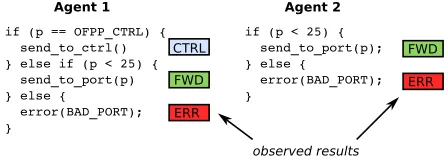
if (p == OFPP_CTRL) { send_to_ctrl() } else if (p < 25) { send_to_port(p) } else {
error(BAD_PORT); }
if (p < 25) { send_to_port(p); } else {
error(BAD_PORT); }
FWD
ERR
ERR FWD CTRL
Agent 1 Agent 2
observed results
Figure 1: Example OpenFlow agents having different PACKET OUT message implementations.
2.2
Defining inconsistencies
Switches that are capable of supporting the OpenFlow Switch Specification [5] do so by running an OpenFlow agent. This agent is a piece of software primarily responsible for state management. It receives and processes control mes-sages sent by OpenFlow controllers (e.g.,Flow Mod,Packet Out, etc.), and configures the switch forwarding tables ac-cordingly to the given commands. In addition, the Open-Flow agent may take part in packet forwarding itself—in a hardware switch, for packets that are forwarded to the con-troller; in a pure software implementation, for every packet. As such, the execution of the OpenFlow agent is mainly driven by external events (e.g., rule installation requests). We call inputs the data reaching the agent as part of either OpenFlow control messages or packets.
Intuitively, an inconsistencyoccurs when two (or more) OpenFlow agents which are presented with the same input sequence produce different results. Here, results refer to both externally observable consequences when processing an input (e.g., replying to a request for flow table statistics), and internal state changes (e.g., updating the flow table with a new entry).
To be able to identify inconsistencies, we assume the agents support the OpenFlow interface and we check for inconsis-tencies in operations at the interface level. To crosscheck behaviors, we rely either on externally observable results or, when necessary, on probe packets to infer the internal state. Note that, in the case of hardware switches, we are not interested to verify the underlying switching hardware cor-rectness. In fact, such verification is typically already part of the ASIC design process. However, we assume that there is a way to execute the OpenFlow agent without the switching hardware,e.g., through an emulation layer that is commonly readily available for development and testing purposes.
2.3
Example
Our approach to automatically finding inconsistencies among OpenFlow agent implementations is most easily introduced through an example.
Consider an input sequence that only includes one control message of type Packet Out. This message instructs the OpenFlow agent to send out a packet on port p, where p
is a 16-bit unsigned integer that identifies a specific port or is equal to one of several preset constants (e.g., flood the packet or send to controller). For the sake of presentation, we assume that only pis symbolic (i.e., pis the only part of this input that varies) and we omit the case p= 0 (for which an error message would be produced).
in-65533
(OFPP_C
TRL)
ERR
FWD ERR
ERR FWD
Agent 1
Agent 2 port:
65535
CTRL
65534
65532
25
1 24
Input partitions
... ...
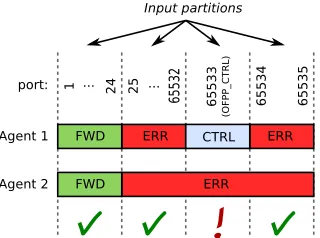
Figure 2: Input space partitions & inconsistency check.
put space ofpinto several subspaces. Each subspace is an equivalence class of inputs that, in this case, describes which values ofp follow the same code path. To make the point more tangible, consider Agent 1 in Figure 1: if p∈ [1,24] the program executes the code path that sends the packet on portp; ifp=OFPP_CTRL(the predefined controller port) the program executes a different code path that encapsu-lates the packet in aPacket Inmessage and sends it to the controller; and so on. Besides determining the input space partition, we log the output results produced when execut-ing each code path (e.g., we log what packet comes out from which port). Therefore, for each input subspace there exists a corresponding output trace.
Next, we symbolically execute a different OpenFlow agent implementation (Agent 2 in Figure 1) and determine the par-titions of input space ofp. However, assume that this second OpenFlow agent does not support the special port number OFPP_CTRL. Instead, the program sends an error message to the controller when it encounters this case. Likewise, we log the output results produced when executing each code path. At this point, we have two input space partitions (one for each OpenFlow agent implementation), as depicted in Figure 2. Within each partition, we then group the sub-spaces by output result (illustrated with different colors in Figure 2). That is, we merge together two subspaces (two code paths), if they produce the same outputs. Such group-ing results in two coarse-grained input space partitions–one for each agent. Next, we consider the cross product of the coarse-grained partitions (i.e., all pair-wise combinations of subspaces between the two partitions). From the cross prod-uct, we exclude pairs of subspaces that correspond to iden-tical output results. Finally, we intersect the two subspaces in every remaining pair. A non-empty intersection defines a subspace of inputs that give different results for different OpenFlow agents: this is an inconsistency. For each in-consistency we discover, we construct a concrete test case that reproduces the observed results. Relative to our cur-rent example, we identify that one inconsistency exists and, to reproduce it, we construct the example with inputp = OFPP_CTRLas illustrated in Figure 2.
2.4
Usage
OpenFlow switch vendors can use SOFT for interoper-ability testing in two phases. In the first phase, each vendor independently runs SOFT on its OpenFlow agent implemen-tation to produce a set of intermediate results that contain the input space partitions and the relative output results.
One benefit of this approach is that a vendor does not re-quire access to the code of other vendors.
In the second phase, SOFT collects and crosschecks these intermediate results to identify inconsistencies. This phase can take place as a part of an inter-vendor agreement (e.g., under an NDA), or during wider interoperability events [3]. Alternatively, a third-party organization such as Open Net-working Foundation (ONF) may conduct the tests.
While we focus the presentation of SOFT on interoper-ability testing, we want to clarify that there exist other ap-plications. For example, SOFT can automate performing regression testing. In addition, it can be used to compare against a well-known set of path conditions that are boot-strapped from unit tests.
We observe that an OpenFlow agent is potentially a soft-ware component of a hardsoft-ware device. As such, some op-erations can install state directly in the switching hardware (e.g., forwarding rules), seemingly outside of SOFT’s reach. We note, however, that vendors typically have a way of run-ning their firmware inside a hardware emulator for testing purposes. We only require that the hardware emulator is in-tegrated with the symbolic execution engine. Previous work (e.g., [12]) demonstrates that it is indeed possible to run complex software systems live, including closed-source de-vice drivers.
3.
SYSTEMATIC OPENFLOW TESTING
Our goal is to enable systematic exploration of inconsis-tencies across multiple OpenFlow agent implementations. In other words, we want to find whether there exists any se-quence of inputs under which one OpenFlow agent behaves differently than another agent. To do this, we require a way of (i) constructing sequences of test inputs that cover all possible executions for each OpenFlow agent, and (ii) comparing the output results that each input produces to identify inconsistencies.
We accomplish the subgoal of finding test inputs by using symbolic execution. The outcome of symbolic execution is twofold: (i) a list of path conditions, each of which summa-rizes the input constraints that must hold during the execu-tion of a given path, and (ii) a log of the observed output results for each path executed.
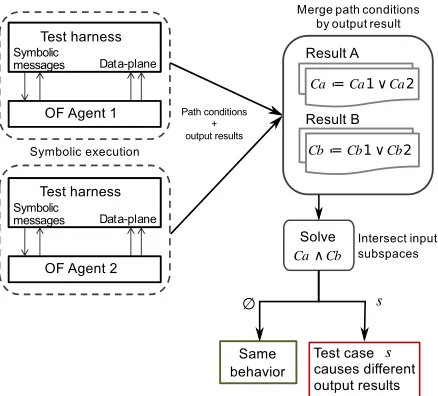
We then identify inconsistencies by grouping the path con-ditions that share the same output results on a per-agent basis and finding the input subspaces that satisfy the con-junction of the path conditions. Figure 3 provides an illus-tration of the operation of SOFT as described above. In the remainder of this section, we discuss our approach in detail. After a brief description of a strawman approach for utiliz-ing symbolic execution in functional equivalence testutiliz-ing, we analyze improvements required to apply it to complex soft-ware such as OpenFlow agents. Finally, we discuss how we solve the second problem, namely collecting and comparing relevant outputs.
3.1
Automating equivalence testing
Our form of interoperability testing can be viewed as check-ing the functional equivalence of different OpenFlow agents at the interface level (i.e., the OpenFlow API). To under-stand how we can use symbolic execution for this purpose, let us first consider a simpler problem.
Figure 3: SOFT overview.
to test if they are indeed functionally equivalent. To do this, it is sufficient to symbolically execute both functions by passing identical symbolic inputs to both of them and checking whether they return the same value. If the results differ, the symbolic execution engine can construct a test case to exercise the problematic code path. In essence, sym-bolic execution enables us to crosscheck the two functions’ results through all possible execution paths. This simple approach is sound, i.e., it identifies all cases where results differ, provided that symbolic execution can solve all con-straints it encounters. It is also relatively straightforward to extend this approach to crosscheck console utility pro-grams by running with the same symbolic environment and comparing the data printed tostdout, as shown in [9].
Challenges and approach. Scaling up this approach to our target system is not an easy task. An OpenFlow agent is a non-terminating, event-driven program that interacts intensely with its environment. In this case, the environment consists of the network data plane, other switch components (e.g., FIB) and the controller.
The first challenge this raises is that the input space is inherently infinite, thus making the problem of comparing OpenFlow agents over unbounded inputs intractable. In-stead, to make our problem tractable, we must limit the length of any input sequence used for testing.
Secondly, crosschecking the results of different OpenFlow agents is challenging because there exists no notion such as “switch return value”. Furthermore, there does not exist a universalstdout format that enables textual comparison unlike console utilities. Instead, we must collect a trace of switchoutput resultsthat enables comparison using detailed information from both the OpenFlow and the data plane interfaces. In other words, we must for example capture packets and OpenFlow messages emitted by the switch, and maintain a non-ambiguous representation of these events.
Third, the approach above works by feeding both func-tions with the same symbolic input. In turn, this requires that both agents be locally available. However, we can-not assume that SOFT will operate on different OpenFlow agents at the same time. Instead, we make a conscious
de-sign choice to decouple the symbolic execution phase from the crosschecking phase.
3.2
Creating symbolic inputs
An OpenFlow agent reacts to OpenFlow messages and data plane packets it receives. Therefore, sequences of such messages can be considered inputs to the agent. In this subsection, we only consider the control channel inputs (the messages sent by the controller) because our goal is to test a switch at the OpenFlow interface (and not the data plane interface).
3.2.1
Structuring inputs
Feeding unstructured inputs is ineffective. As the in-put space containing sequences of arbitrary numbers of arbi-trary messages is infinite, we need to enforce the maximum length of the sequence. A straightforward way to limit the input size would be to useN-byte symbolic inputs, withN
bounded. Unfortunately, this approach quickly hits the scal-ability limits of exhaustive path exploration because these inputs do not contain any information that is of either syn-tactic or semantic value. As a result, symbolic execution must consider all possible ways in which these symbolic puts can be interpreted (most of which represent invalid in-puts anyway) to exhaust all paths. As an example, consider feeding an agent with the mentioned sequence ofNsymbolic bytes. Since there exist different types of control messages, some of which have variable lengths, this stream ofNbytes can be parsed (depending on its content) as: one message of N bytes, or as any combination of two messages whose lengths add up toN, or as combinations of three messages, etc.
Moreover, two messages,Flow Mod and Packet Out, are variable in length. This is because they both contain the actions field which is a container type for possible combina-tions of forwarding accombina-tions. The major issue arises as each individual action is itself variable in length. As such, we are again in the situation where symbolic execution is left to explore all possible combinations in which it can interpret
N symbolic bytes as multiple action items. Although indi-vidual lengths must be multiple of 8 bytes to be valid, the combinatorial growth quickly becomes impractical.
Structuring the inputs improves scalability. We over-come the aforementioned problems by using a finite number of finite-size inputs. Most importantly, we construct inputs that adhere to valid format boundaries of OpenFlow control messages rather than leaving symbolic execution to guess the correct sizes. This means that we feed the agent with one symbolic control message at a time and pass the actual message length as a concrete value in the appropriate header field. In practice, we must also make the message type con-crete before establishing a valid message length, as the latter is essentially determined by the former. This is not an issue, since every message must be identified by a valid code (at present about 20 codes exist, all described in the protocol specifications [5]). In a similar fashion, for messages that have variable length actions, we predetermine the number of action items and the relative lengths as concrete values.
3.2.2
Choosing the size of inputs
tech-nology? Indeed, it is known that the scalability of symbolic execution is limited by the path explosion problem:i.e., the number of feasible paths can grow exponentially with the size of the inputs and number of branches. On the other hand, to make testing meaningful, the chosen inputs need to provide satisfactory coverage of agent’s code and func-tionality. In practice, we seek answers through empirical observations. The input size varies along two dimensions: (i) number of symbolic control messages, and (ii) number of symbolic bytes in each message.
Covering the input space of each message is gener-ally feasible. We first explore to what extent the number of symbolic bytes in each message represents a hurdle to our approach. As we discuss below, we find that the over-head to exhaustively cover the input space of each message is generally acceptable, given the current protocol specifica-tions. We already mentioned that the message length de-pends in the first place on the message type. It should also be clear that the processing code and especially the process-ing complexity varies across message types. For example, it is trivial to symbolically execute a message of typeHello, which contains no message body. On the other hand, the Flow Mod message, which drives modifications to the flow table, carries tens of data fields that need validation and ultimately determine what actions the switch will perform. Indeed, we observe through experimentation that the num-ber of feasible paths varies significantly between different message types (two orders of magnitude betweenFlow Mod andPacket Outmessages). Most importantly, symbolic ex-ecution runs to completion in all cases when testing with the reference OpenFlow implementation.2
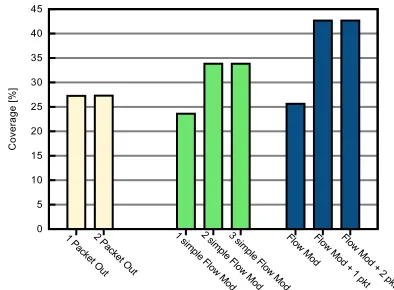
Achieving good coverage requires just two symbolic messages. However, the question remains about how many symbolic control messages we should inject in practice. Again, the answer depends on what type of messages one consid-ers. We find that for complex messages we can at most use a sequence of three messages. This number may seem small, but it is worth noting that we do not need long mes-sage sequences for the type of testing we target. In fact, one symbolic message is already sufficient to cover all fea-sible code paths involved in message processing. With the subsequent message, we augment the coverage to include ad-ditional paths that depend on parts of switch state that are rendered symbolic as a result of running with the first sym-bolic message. Effectively, the second message enables us to explore the cross-interactions of message pairs. In addition, such interactions exist only for a small fraction of possi-ble message type combinations. For example, twoFlow Mod messages may affect the same part of the switch state; that is not true forEcho Requestfollowed byFlow Mod. As such, the increase in instruction coverage due to the second mes-sage is a fraction of what the first mesmes-sage covers. A third message does not significantly improve coverage further as shown in Figure 4. Thus, careful consideration of inputs is key to successfully achieving our goals through symbolic execution.
3.2.3
Defining relevant input sequences.
Exploiting domain specific knowledge is essential to con-struct input sequences that target interesting uses of Open-Flow messages to further reduce the testing overhead. First, although the protocol specifications define about 20
mes-2
Our experimental setup is introduced in Section 5.
Figure 4: Reference switch code coverage as a function of the number of symbolic messages.
sages, some of these are clearly more important than oth-ers. For example, theHelloandEcho messages are simple connection establishment and keep-alive messages, respec-tively. We focus on complex messages such as Flow Mod, Packet Out,Set Configthat require validation and modify the state of an agent. We also note that because these mes-sages are meant to affect different functional aspects of the agent, we find it unnecessarily time-consuming to check all pair-wise combinations of these messages. Section 5 details the actual sequences of messages we use for testing.
3.3
Collecting output results
So far we have shown how our approach uses exhaustive path exploration to obtain the input space partitions (or equivalence classes of inputs). However, we still need to know what end result each partition produces because only the results enable the comparison across different OpenFlow agents.
As we feed a symbolic message to an OpenFlow agent, its state might be updated. Additionally, there are two possi-ble outcomes: (i) the agent outputs some data (i.e., mes-sages back to the controller or data plane packets), or (ii) the agent does not produce externally observable data. In this work we treat only data explicitly returned by an agent (OpenFlow messages and data plane packets) as an output. Instead of directly fetching the internal state, we use addi-tional packets and messages to infer the impact of the state on agent’s behavior.
Capturing output data. To collect the outputs, we make use of the OpenFlow and data plane interfaces to capture data. Specifically, we log all OpenFlow messages and pack-ets emitted by the agent. Note that the entire analysis runs in software (the output data may even contain symbolic in-puts); therefore, with data plane interface we simply mean the socket API (or equivalent) that the agent uses to send packets.
poten-tially state changing symbolic message, we inject a concrete packet through the data plane interface as a simple state probe. The effect of this probe is that it enables symbolic execution to exercise the code that matches incoming pack-ets and the code that applies the forwarding actions. The probe packet is then either forwarded (to a port or con-troller), in which case we log it, or it is dropped, in which case we log an empty probe response.
Normalizing results. Rather than saving the logs verba-tim, we normalize the output results to remove certain data from the results for which spurious differences are expected. For example, the buffer identifiers used by different agents may differ and such a difference should not be considered an inconsistency.
3.4
Finding inconsistencies
In this phase, we seek to find inconsistencies between two OpenFlow agents denotedAandB.
With respect to agentA, we denote withP CAthe set of
path conditions (outcome of symbolic execution). For each
pc∈P CA, let resA(pc) be the normalized output result when
executing the path represented bypc. We denote the set of distinct output results asRESA.
Grouping paths by output results. Our first step
is to group all different path conditions that produce the same output result. Formally,∀r∈RESA we setCA(r) =
W
{pc |pc ∈ P CA; resA(pc) =r}to be the disjunction of
all path conditions that share the same output result.P CB,
RESB, andCB are similarly defined.
Intersecting input subspaces. In our second and last step, for each pair of different outputs of agentsAandB, we check if there exists at least one common input that leads to these inconsistent outputs. For each pair (i, j) of results
i∈ RESA, j ∈RESB s.t. i6= j, we query a satisfiability solver (STP [14]) to obtain an example test case that satisfies the conditionCA(i)VCB(j). If the solver can satisfy this conjunction, then we have an inconsistency.
Discussion. It is easy to note that an upper bound of the number of queries to the solver for our approach is
|RESA| · |RESB|. In addition, note that our approach pro-duces only one inconsistency example per pair of different output results. In other words, we do not provide one ex-ample for each path that produces the inconsistency. If this is desired, one can omit grouping all paths that share the same output. However, doing so has an inherent overhead cost because it increases the number of STP queries. In-stead, our approach amortizes the start-up costs of a multi-tude of solver invocations by using fewer larger queries and enables the solver to apply built-in optimizations to handle such larger queries.
As with any bug finding tool, it is important to know whether our approach incurs in false positives/negatives. We observe that SOFT does not produce false positives: each identified inconsistency is evidence of divergent behavior. Note this does not necessarily mean that one agent does something in violation to the specifications. According to our previous definition, an inconsistency is reported if the tested agents perform different actions when exposed to the same input. However, the tool might have false negatives for two reasons. The first is that our path coverage may not be complete. For instance, symbolic execution might not cover all feasible paths due to path explosion. The second
is that all agent implementations under test might contain the same bug, and therefore produce the same output.
4.
SOFT PROTOTYPE
We built our SOFT prototype on top of the Cloud9 [8] symbolic execution engine. SOFT consists of three major components: (i) a test harness, which drives the testing of OpenFlow agents, (ii) a grouping tool to group path condi-tions that share output results, and (iii) a tool for finding inconsistencies.
4.1
Test harness and Cloud9
To provide the necessary execution environment for the OpenFlow agent, we build a test harness that emulates both a remote controller and the underlying network. The emu-lated controller is capable of injecting symbolic inputs.
As a symbolic execution engine, Cloud9 can symbolically execute only a single binary. We therefore create a test “driver” by linking the OpenFlow agent and our test harness controller together. Upon startup, the test driver forks into two processes, one of which runs the OpenFlow agent while the second runs the test harness itself. The two processes are connected via standard UNIX sockets. Upon startup, the OpenFlow agent connects to the test harness. After the connection setup and exchange of the initialHellomessages, the test harness injects a sequence of several symbolic Open-Flow messages and/or probes, one at a time (we discuss the input sequences in more details in Section 5). Upon con-firming that the switch processed all messages and probes, we kill the execution.
To use Cloud9 for our goal, we had to improve its envi-ronment model. Cloud9 provides a symbolic model of the POSIX environment. Such a model, most importantly, al-lows us to efficiently use the socket API without accessing the entire networking stack. As a result, all symbolic vari-ables remain symbolic after being transferred as data in a packet. However, such a model needs to provide all func-tions used by the tested application. Notably, we needed to implement the RAW socket API which was missing in Cloud9 but is used by the OpenFlow agents in our tests. Moreover, we replace or simplify some library functions as described next.
We assume that the agents correctly use network versus host byte ordering, and we change functionsntohandhton to simply return their argument unchanged. This simpli-fies constraints by removing double-shuffling (first when the test harness creates a message, second when the OpenFlow agent parses the message). We also simplify checksum and hash functions to return constants or identities, because they cannot be reversed or it is computationally very expensive to do so (this is a well-known issue in using a constraint solver). The aforementioned modifications reduce complex-ity and improve symbolic execution efficiency.
capable of working with traces that are only partially cov-ering agents’ code.
4.2
Tools
Apart from the test harness, we provide two tools for ma-nipulating Cloud9 results. Both of these tools are written in C++ and heavily reuse existing Cloud9 code for read-ing, writing and manipulating path conditions. The tools contain less than 200 lines of new code in total.
The group tool reads multiple files (results of Cloud9 ex-ecution), identifies different output results and groups the path conditions by result. To improve performance of fur-ther constraint parsing, we group path conditions by build-ing a balanced binary tree minimizbuild-ing the depth of nested expressions. The inconsistency finder tool expects two di-rectories holding grouped results as its arguments. The tool iterates over all combinations of different results and queries the STP solver to check for inconsistencies. If there is an inconsistency (the condition is satisfiable), the STP solver provides an example set of variables that satisfy the con-dition. This is a test case that can be used to understand and trace the root cause of the inconsistency and verify if a behavior is erroneous.
5.
EVALUATION
We evaluate SOFT using two publicly available OpenFlow agents compatible with the specifications in version 1.0. The first one is a reference OpenFlow switch implementation written in C released with version 1.0 of the specifications. Its main purpose is to clarify the specifications and present available features. Although the reference implementation is not designed for high performance, it is expected to be correct as others will build upon and test against it. We are referring to this version as Reference Switch (55K LoC). The second is Open vSwitch 1.0.0 [4] (80K LoC). It is a produc-tion quality virtual switch written in C and used in several commercial switches.3
OpenFlow is just one the supported protocols. We also created a third OpenFlow agent by mod-ifying the Reference Switch and introducing different corner case behaviors (Modified Switch). This way we can tell how efficiently SOFT finds the injected differences and which of them remain unnoticed.
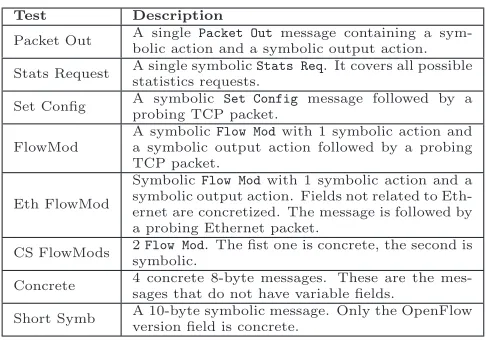
To evaluate SOFT we use the set of tests summarized in Table 1. We run our experiments using a machine with Linux 3.2.0 x86 64 that has 128 GB of RAM and a clock speed of 2.4 GHz. Our implementation does not use multiple cores for a single experiment.
5.1
Can SOFT identify inconsistencies?
In this section, we report and analyze the inconsistencies SOFT detects. We apply a set of tests to all three OpenFlow agents and compare Reference Switch with both Modified Switch and Open vSwitch.
5.1.1
Modified Switch vs. Reference Switch
First, we look for differences between Reference Switch and Modified Switch. Two team members who did not take part in the tool’s implementation and test preparation were designated to introduce a few modifications to the Refer-ence Switch. The modifications were meant to affect the externally visible behavior of the OpenFlow agent. Having
3
For example, in Pica8 products: http://www.pica8.org/.
Test Description
Packet Out A single Packet Outmessage containing a sym-bolic action and a symsym-bolic output action.
Stats Request A single symbolicstatistics requests.Stats Req. It covers all possible
Set Config A symbolic Set Config message followed by a probing TCP packet.
FlowMod
A symbolicFlow Modwith 1 symbolic action and a symbolic output action followed by a probing TCP packet.
Eth FlowMod
SymbolicFlow Modwith 1 symbolic action and a symbolic output action. Fields not related to Eth-ernet are concretized. The message is followed by a probing Ethernet packet.
CS FlowMods 2Flow Mod. The fist one is concrete, the second is symbolic.
Concrete 4 concrete 8-byte messages. These are the mes-sages that do not have variable fields.
Short Symb A 10-byte symbolic message. Only the OpenFlow version field is concrete.
Table 1: Tests used in the evaluation.
purposefully injected changes, we set out to check how many can be detected by SOFT.
SOFT is able to correctly pinpoint 5 out of 7 injected mod-ifications. We further investigate the cases in which SOFT failed to flag the effect of the differences. It turns out that one of them concerns theHellomessage received while es-tablishing a connection to the controller. SOFT does not recognize this problem because it establishes a correct con-nection first and then performs the tests. The second missed modification manifests itself only when a rule is deleted be-cause of a timeout. This occurs bebe-cause the symbolic exe-cution engine is not able to trigger timers. As part of our future work, we plan to extend our approach to deal with time,e.g., similarly to MODIST [24].
5.1.2
Open vSwitch vs. Reference Switch
Knowing that SOFT is capable of finding inconsistencies, we compare the Reference Switch with Open vSwitch to ver-ify how useful SOFT is when applied to a production qual-ity OpenFlow agent. The list of differences between the two major software agents contains a few significant ones. In the following, we present the observed inconsistencies and analyze their root causes.
Packet dropped when action is invalid. This case
describes a Packet Out message containing a packet that is silently dropped by Open vSwitch while the Reference Switch forwards it. The inconsistency appears when the Packet Out control message satisfies the following condi-tions: (i) it contains the packet that the agent should for-ward and (ii) one of the actions is setting the value of VLAN or IP Type of Service field. Further investigation leads us to the conclusion that Open vSwitch validates whether a new VLAN value set by the action fits in 12 bits and similarly whether the last two bits of the TOS value are equal to 0. When an action specified in the message does not pass this strict validation, Open vSwitch silently ignores the whole message. Additional tests withFlow Modmessages reveal a similar issue. These tests also show that thevlan_pcpfield undergoes additional validation in Open vSwitch. Reference Switch does not validate values of the aforementioned fields, but it automatically modifies them to fit the expected for-mat.
men-Test Message count
Reference Switch Modified Switch Open vSwitch
CPU time
Path count
Constraints
CPU time
Path count
Constraints
CPU time
Path count
Constraints
avg max avg max avg max
size size size size size size
Packet Out 1 14s 49 71.57 96 24s 117 74.09 91 44s 241 63.48 79
Stats Request 1 44s 218 53.10 65 46s 218 53.10 65 186s 136 52.63 67
Set Config 2 446s 207 76.89 112 451s 207 76.89 112 569s 207 80.97 116
Eth FlowMod 2 40m 7680 101.12 132 83m 14280 106.62 136 198m 27682 98.56 127
FlowMod 2 373m 87828 109.77 161 >140h >356753 123.09 164 60h 181620 123.28 159
CS FlowMods 2 69m 29179 96.63 136 121m 51419 99.74 139 36h 462488 115.22 173
Concrete 4 6s 1 0 0 6s 1 0 0 8s 1 0 0
Short Symb 1 50s 31 27.9 69 50s 31 27.9 69 12s 14 27.5 50
Table 2: Symbolic execution statistics for selected tests for all 3 OpenFlow agents. We report time, number of explored paths (input equivalence classes) and constraint size (average and maximum size).
tioned fields. Therefore, both implementations might be considered correct. However, such a difference in behavior might cause unexpected packet drops if the controller devel-opers test their applications with switches that are different from those deployed in the network.
Forwarding a packet to an invalid port. Here we de-scribe a case in which the tested OpenFlow agents return error messages concerning incorrect output ports in an in-consistent fashion. According to the specifications, the agent has to return an error message if the output port will never be valid. However, if the port may become valid in the fu-ture, the message might either be rejected with an error, or the agent may drop packets intended for this port while it is not valid. The differences in interpretation when the port will be invalid forever lead to a few differences between OpenFlow agents. First, when the ingress port in the match is equal to the output port, the Reference Switch returns an error, as no packets will ever be forwarded to this port.4
Open vSwitch accepts such a rule and drops all matching packets. On the other hand, Open vSwitch immediately re-turns an error when the action defines an output port greater than a configurable maximum value. Reference Switch does not validate ports this way.
Thus, if the controller application relies on error messages received, it may misbehave when deployed with a different agent than it was tested with. If the agent used in testing considered a port valid but the other agent did not, the con-troller would fail to install rules it was designed to install. The opposite situation is equally unsafe. The rule installa-tion that used to return an error succeeds, but all matching packets get dropped. As a result, some packets will not to be sent to the controller, although they were expected to be. Moreover, such a rule may cover another, lower priority one.
Lack of error messages. We have already presented a few cases when one of the agents silently drops the incorrect message without returning an error. SOFT detects another instance of such a problem in the Reference Switch while testing withPacket OutandFlow Modmessages. When the buffer_idfield refers to a non-existent buffer, the Reference Switch handles the message but does not apply actions to any packet and does not report any error. Open vSwitch replies with an error message, but installs the flow as well. We analyzed the Reference Switch source code and discov-ered that although the error is returned by the message han-dler, it is not propagated further as an OpenFlow message.
OpenFlow agent terminates with an error. There are three independent cases when the Reference Switch crashes.
4
A special OFPP_IN_PORT port must be explicitly used to forward packets back to the port they came from [5].
First, when the OpenFlow agent receives aPacket Out mes-sage with output port set toOFPP_CTRL. This may be a rare case (e.g., when the developer demands such behavior) but it is not forbidden by the specifications. Second, when the agent executes an action setting the vlanfield in aPacket Outmessage the same error appears and the agent crashes. Finally, when the agent receives a queue configuration re-quest for port number 0, it encounters a memory error. All the aforementioned problems are not only inconsistencies, but also major reliability problems in the OpenFlow agent.
Different order of message validation. In this case, the order in which message fields should be validated is not made explicit in the specifications. This vagueness results in externally visible differences in agents’ behavior. The same incorrect message may induce two different error messages, or an error message and a lack of response in case of the mentioned problem. We encountered such a situation for a Packet Outmessage with an incorrect buffer id and output port.
Statistics requests silently ignored. The Reference Switch silently ignores requests for statistics to which it is not able to respond. This behavior is a specific case of the “Lack of error messages” problem. Even though the handler returns an error it is not converted to an OpenFlow message. The problem was detected because Open vSwitch sends an error in response to an invalid or unknown request.
Missing features. SOFT is able to detect features that are missing in one OpenFlow agent, but are present in the other. We were able to automatically infer that Open vSwitch does not support emergency flow entries that are defined in the specifications. Secondly, Reference Switch being purely an OpenFlow switch, does not support the traditional forward-ing paths (OFPP_NORMAL).
5.2
What is the overhead of using SOFT?
In this section, we present the performance evaluation of the two key stages of SOFT’s execution.
execu-Grouping results Inconsist. Test Reference Switch Open vSwitch checking
time #res time #res time #
Packet Out 0.038s 6 0.090s 10 26s 14
Stats Request 0.116s 8 0.061s 9 10s 7
Set Config 0.141s 69 0.43s 69 236s 0
Eth FlowMod 8s 12 23s 31 23m 58
CS FlowMods 79s 4 344m 6 >28h ≥8
Short Symb 0.039s 9 0.01s 7 6s 4
Table 3: Time needed to find overlapping input
sub-spaces and number of created test cases. Each test
case represents one intersection of overlapping input sub-spaces. Additionally, time needed to group constraints by the output and a number of distinct outputs for Ref-erence Switch and Open vSwitch.
tion (we note that it is possible to use even partial results of symbolic execution to look for inconsistencies). As a result of multiple additional validations, the test input space for Open vSwitch is partitioned into 3-15 times more subspaces than for the Reference Switch.
Subspaces intersections. We distinguish between two sub-stages of the second stage: (i) grouping input subspaces by the same output, (ii) intersecting subspaces correspond-ing to potential inconsistencies.
For the first sub-stage we report the time required to group and the number of distinct outputs. As presented in Table 3, this part requires orders of magnitude less time than symbolic execution. Grouping constraints dramatically reduces the number of expressions that need to be checked for satisfiability, as there are only up to 30 distinct outputs (a 1-5 orders of magnitude reduction compared to the initial number of equivalence classes).
The search for overlapping subspaces depends on the com-plexity of constraints and usually finishes within a couple of minutes. There is one exceptional case in which the STP solver is unable to solve the merged constraints in one day. In the future we plan to investigate grouping constraints into smaller groups for such cases.
The achieved results in finding inconsistencies confirm our expectations. Usually one difference manifests itself mul-tiple times and affects many subspaces of inputs. In the extreme example, although there are 58 reported inconsis-tencies, manual analysis reveals only 6 distinct root causes of differences.
5.3
How relevant is input sequence selection?
To quantify the relevance of chosen tests, we measure the instruction and branch coverage provided by Cloud9. The instruction/branch reached at least once in the execution is considered covered, regardless of its arguments. We con-sider only the sections of OpenFlow agent’s code relevant to OpenFlow processing. The initialization that is repeated for each test covers 12% of instructions and 8% of branches. The test specific results, shown in Table 4, are spread between 20 and 40%. To verify that the low reported coverage is a re-sult of the fact that each test targets a few specific message handlers, we manually analyze cumulative coverage of all tests. We observe that SOFT covers approximately 75% of the code and that the remaining instructions belong mostly to code that is not accessible in standard execution (e.g., command line configuration, dead code, cleanup functions, logging functions).
The importance of concretizing inputs. Due to time
Reference Switch Open vSwitch Test Inst.(%) Branch(%) Inst.(%) Branch(%)
No Message 12.21 8.27 19.03 13.34
Packet Out 26.23 19.31 25.68 17.28
Stats Request 30.27 24.15 24.31 16.75
Set Config 26.23 19.31 23.98 16.16
Eth FlowMod 41.74 34.65 38.15 25.49
FlowMod 42.65 34.25 38.24 26.27
Concrete 17.13 11.42 20.16 13.62
Short Symb 19.92 13.39 21.60 14.34
Table 4: Instruction and branch coverage for selected tests for Reference Switch and Open vSwitch.
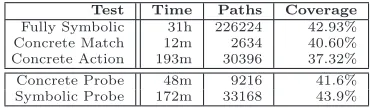
Test Time Paths Coverage
Fully Symbolic 31h 226224 42.93%
Concrete Match 12m 2634 40.60%
Concrete Action 193m 30396 37.32%
Concrete Probe 48m 9216 41.6%
Symbolic Probe 172m 33168 43.9%
Table 5: Effects of concretizing on execution time, gen-erated paths and instruction coverage.
and memory constraints it is often convenient to concretize selected fields in the message. We evaluate the benefits and drawbacks of using the domain knowledge to reduce the in-put space. As a baseline, we choose a test where a single symbolic Flow Mod message containing 2 symbolic actions and 2 symbolic output actions is followed by a TCP probe packet. We then compare the results of: (i) the baseline, (ii) a version of the baseline with a concrete match (wildcard), and (iii) a version of the baseline with a single concrete ac-tion instead of 4 symbolic ones. All values are summarized in the upper part of Table 5. While the drop in the coverage percentage is only 2-5% in comparison to the baseline test, the difference in time and path count is noticeable. Specifi-cally, the tests finish 10 to 50 times quicker, while generating 1 to 2 orders of magnitude less paths.
To verify how much coverage we lose by not using symbolic probes, we create a separate test. This test first installs a partially symbolicFlow Modthat applies actions to Ethernet packets. It then sends a short probe packet that is concrete or symbolic depending on the test version. Results in the lower part of Table 5 show that a symbolic probe adds just 2% to the coverage. The cost is 3.5 times longer running time and 3.5 times more paths.
To summarize, concretizing parts of the inputs signifi-cantly reduces the time needed to conduct the test at the cost of leaving small portion of additional instructions un-covered. Therefore, it is possible to use the concretized inputs to conduct regular tests more often. When com-bined with careful choice of concrete fields, the coverage is marginally affected. The fully symbolic messages can be used just for the final checks before a major release when the best coverage possible is required, and testing time is less of an issue.
6.
RELATED WORK
We present in the following generic techniques that can be applied to testing OpenFlow switches, as well controller applications and networks in general.
6.1
Testing OpenFlow switches
and type of problems they aim for, as well as the process in which the test cases are created. As an exhaustive review is beyond the scope of this paper, we briefly describe a few relevant to our discussion.
System testing. System-level testing is concerned with an integrated system such as an OpenFlow switch. This ap-proach treats the device under test as a black box. To ensure that the tested device does not depend on external factors, the interactions with the controller and other network el-ements are commonly emulated by the testing framework. This approach typically requires a large number of test cases to achieve high coverage. Each test case is carefully de-signed to target a specific feature and checks the correctness of simple functionalities. A developer, using tools such as OFTest [2] or the default OpenFlow Perl testing framework, has to manually provide a step by step execution scenario containing the inputs and expected outputs. This process is time-consuming and additionally makes designing non-trivial and complex test cases complicated.
Symbolic and concolic execution. Others have success-fully applied symbolic execution [9] and selective symbolic execution [12] to testing of systems code. As we already mentioned, blindly applying symbolic execution results in an exponential explosion of code paths. It also requires ex-cessive human effort to specify correct behavior. SOFT ef-fectively overcomes these issues. With these issues resolved, one could use symbolic execution for crosschecking switch behaviors, but it results in excessive, time-consuming over-head. SOFT goes one step further in that eliminates this step by coalescing constraints that result in the same out-put, and using the constraint solver to identify inconsistent behaviors.
Others have considered the problem of manipulating in-puts to conform to an input grammar, in the form of white-box “fuzz” testing [16]. By doing so, the symbolic execution engine can quickly pass over the validation checks to try to reach deeper in the code. The problem that SOFT addresses is even harder, as we need to be careful about the number and type of messages, as well as the nature of individual fields. In addition, we address the problem of observing in-ternal state.
Caniniet al.[10] use a variant of symbolic execution called concolic execution to identify faults in federated, heteroge-neous distributed systems. Their system, called DiCE, tests the impact of feeding various inputs to participating nodes (e.g., BGP routers) in isolation. DiCE and SOFT differ in several ways. DiCE is an online technique, whereas SOFT is used for interoperability testing prior to deployment. More-over, SOFT’s goal is crosschecking of different implemen-tations. Finally, SOFT does not require the definition of correct behavior to be specified. Complementary to SOFT, Kothariet al. [19] use symbolic execution to identify pro-tocol manipulation attacks. The goal here is for a node to try to determine harmful behavior induced upon itself by re-ceived messages from other participants. In contrast, SOFT systematically determines and compares the input subspaces of multiple implementations to find inconsistencies, without prior knowledge of correct behavior.
Performance testing. Performance tests are a subset of system tests used to determine device’s capability under high load. Not only is this type of tests able to detect perfor-mance problems such as slow packet forwarding or control plane communication, but can also be successfully applied
to find correctness problems that may not appear in other scenarios. As shown in OFLOPS [22], a continuous packet stream may be used to check the consistency between data plane and control plane in case of the OpenFlow barrier commands. Moreover, this method is able to discover tim-ing issues that require multiple events occurrtim-ing with a spe-cific time correlation. On the other hand, it may potentially miss functional errors and classify them as correct behavior in some circumstances. Finally, performance testing requires that, while under test, the system works under realistic con-ditions. Packets, for example, need to be injected to the device at the rate and times defined in the scenario. Conse-quently, in addition to the usual setup time, the tests need to be run in real time and cannot be sped up.
6.2
Testing OpenFlow controllers
NICE [11] is a tool for testing unmodified OpenFlow troller applications. It combines model checking and con-colic execution in order to systematically explore the be-havior of the network under a variety of possible event or-derings. The tool starts with the network topology model containing the controller, switches and end hosts, and ex-ercises sequences of state transitions on these network el-ements. NICE and SOFT target fundamentally different parts of the network: controller vs. switches. In NICE, only the controller is running the unmodified application, while other elements (switches, end hosts) are replaced with simplified models. In contrast, SOFT finds inconsistencies among the implementations of OpenFlow agents that run in the switches.
Further, SOFT does not require the specification of rect behavior for the tested software, while NICE uses cor-rectness properties provided by developers or testers.
6.3
Trace-based debugging of a network
OFRewind [23] is a tool that enables temporary consistent network event trace recording in a running system, as well as replaying it later. Despite available mechanisms allowing operators to filter recorded events, the debugging process is still manual. Neither problem detection, nor its root cause localization and analysis is automatic and needs supervision. The operator has to first realize that there is an issue in the network, and then find the root cause by replaying subsets of the recorded trace. Although the tool is directed toward debugging, it should be possible to use a similar technique to create test inputs based on previously recorded traces. The efficiency of using pre-recorded traces for future net-work testing is limited, as the traces explore only one spe-cific execution path (set of network events) and might miss important corner cases.
6.4
Other approaches
fo-cus on testing the network from the data plane perspective whereas we test switch behaviors as driven by the OpenFlow interface.
7.
CONCLUSIONS
Software Defined Networking, and its OpenFlow incarna-tion in particular, stands a real chance of enabling cheap and easy extensibility in networks. OpenFlow owes its increas-ing adoption to the relatively simple changes that enable control over the way packets are forwarded by the Open-Flow switches. With little attention on ensuring reliability of OpenFlow switches, danger exists that failures in produc-tion networks could erode trust in this new technology. In particular, the OpenFlow specification changes rapidly, and allows for different interpretations. As a result, switches from multiple vendors can behave differently and cause an inconsistency in the network.
In this paper, we have described a tool that automates the task of identifying such deviations in behavior among differ-ent switches. We demonstrate the effectiveness of our tool by using it to identify several inconsistencies involving the Ref-erence OpenFlow switch and the Open vSwitch. While the work centered around the specific details of OpenFlow, we posit our approach could find more general application with other router software and heterogeneous networked systems.
8.
ACKNOWLEDGMENTS
We thank our shepherd Christos Gkantsidis and the anony-mous reviewers who provided excellent feedback. We are grateful to Stefan Bucur for supporting us with using Cloud9 and Jennifer Rexford for useful discussions and comments on earlier drafts of this work. The research leading to these results has received funding from the European Research Council under the European Union’s Seventh Framework Programme (FP7/2007-2013) / ERC grant agreement 259110.
9.
REFERENCES
[1] Going With the Flow: Google’s Secret Switch to the Next Wave of Networking.
http://www.wired.com/wiredenterprise/2012/04/ going-with-the-flow-google/all/1.
[2] OFTest.http://oftest.openflowhub.org. [3] ONF Holds Its First Test Event.
https://www.opennetworking.org/?p=249&option= com_wordpress&Itemid=72.
[4] Open vSwitch: An Open Virtual Switch. http://openvswitch.org.
[5] OpenFlow Switch Specification. http://www.openflow.org/documents/ openflow-spec-v1.0.0.pdf.
[6] Research experiment disrupts Internet, for some. http:
//www.computerworld.com/s/article/9182558/ Research_experiment_disrupts_Internet_for_some. [7] Staring Into The Gorge: Router Exploits.
http://www.renesys.com/blog/2009/08/ staring-into-the-gorge.shtml.
[8] S. Bucur, V. Ureche, C. Zamfir, and G. Candea. Parallel Symbolic Execution for Automated Real-World Software Testing. InEuroSys, 2011. [9] C. Cadar, D. Dunbar, and D. R. Engler. KLEE:
Unassisted and Automatic Generation of
High-Coverage Tests for Complex Systems Programs. InOSDI, 2008.
[10] M. Canini, V. Jovanovi´c, D. Venzano, B. Spasojevi´c, O. Crameri, and D. Kosti´c. Toward Online Testing of Federated and Heterogeneous Distributed Systems. In USENIX Annual Technical Conference, 2011.
[11] M. Canini, D. Venzano, P. Pereˇs´ıni, D. Kosti´c, and J. Rexford. A NICE Way to Test OpenFlow Applications. InNSDI, 2012.
[12] V. Chipounov, V. Kuznetsov, and G. Candea. The S2E Platform: Design, Implementation, and Applications.ACM Transactions on Computer Systems, 30(1):1–49, 2012.
[13] N. Feamster and H. Balakrishnan. Detecting BGP Configuration Faults with Static Analysis. InNSDI, 2005.
[14] V. Ganesh and D. L. Dill. A Decision Procedure for Bit-Vectors and Arrays. InCAV, 2007.
[15] P. Godefroid, N. Klarlund, and K. Sen. DART: Directed Automated Random Testing. InPLDI, 2005. [16] P. Godefroid, M. Y. Levin, and D. A. Molnar.
Automated Whitebox Fuzz Testing. InNDSS, 2008. [17] P. Kazemian, G. Varghese, and N. McKeown. Header
Space Analysis: Static Checking for Networks. In NSDI, 2012.
[18] J. C. King. A new approach to program testing. In Proceedings of the international conference on Reliable software, 1975.
[19] N. Kothari, R. Mahajan, T. Millstein, R. Govindan, and M. Musuvathi. Finding Protocol Manipulation Attacks. InSIGCOMM, 2011.
[20] H. Mai, A. Khurshid, R. Agarwal, M. Caesar, P. B. Godfrey, and S. T. King. Debugging the Data Plane with Anteater. In SIGCOMM, 2011.
[21] N. McKeown, T. Anderson, H. Balakrishnan, G. Parulkar, L. Peterson, J. Rexford, S. Shenker, and J. Turner. OpenFlow: Enabling Innovation in Campus Networks.SIGCOMM Comput. Commun. Rev., 38:69–74, March 2008.
[22] C. Rotsos, N. Sarrar, S. Uhlig, R. Sherwood, and A. W. Moore. Oflops: An open framework for openflow switch evaluation. InPAM, 2012. [23] A. Wundsam, D. Levin, S. Seetharaman, and
A. Feldmann. OFRewind: Enabling Record and Replay Troubleshooting for Networks. InUSENIX ATC, 2011.
[24] J. Yang, T. Chen, M. Wu, Z. Xu, X. Liu, H. Lin, M. Yang, F. Long, L. Zhang, and L. Zhou. MODIST: Transparent Model Checking of Unmodified
Distributed Systems. In NSDI, 2009.