The Confluence Approach: Developing scientific literacy through project-based learning and place-based education in the context of NGSS
Mary Engels
University of Idaho, Department of Natural Resources and Society, USA
Brant Miller
University of Idaho, Department of Curriculum and Instruction, USA
Audrey Squires
Middle Fork Willamette Watershed Council, USA
Jyoti S. Jennewein
University of Idaho, Department of Natural Resources and Society, USA
Karla Eitel
University of Idaho, Department of Natural Resources and Society, USA
Abstract
This study evaluates the effectiveness of a newly developed educational framework for enhancing scientific literacy in rural high school classrooms. The Confluence Approach (TCA) is a curriculum aligned to the Next Generation Science Standards (NGSS) that utilizes a combination of project-based learning (PrBL) and place-based education (PlBE). TCA educational activities take place in students’ local watersheds where they interact with local partners and gain experience carrying out science and engineering practices focused on water quality, water quantity, and water use in real world settings. In 2014-15, before and after participation in a year-long TCA program, researchers administered attitudinal surveys to understand the program’s impact on two important aspects of scientific literacy: students’ perceptions of science as important to society and personal decision-making, and student ability to carry out scientific practices. Qualitative and quantitative survey results were analyzed using a mixed methods approach, where qualitative data were coded using both a priori and grounded theories and quantitative data were analyzed with exploratory factor analysis and Mann-Whitney-Wilcoxon tests to compare pre- and post-survey responses. Results show that completion of a TCA program positively changed students’ perceptions of the importance of science, both locally and globally, and it increased their confidence engaging in scientific practices. Recommendations from this work include utilizing local contextual factors as frequently as possible to enhance curriculum relevance for students and to use PrBL curriculum elements to elevate student confidence with scientific practices.
Key words: Place-based education, Project-based learning, Next Generation Science Standards, scientific literacy, watershed science
Introduction
In order to address pressing current and future environmental problems, society needs citizens who understand the nature of scientific knowledge (NGSS Lead States, 2013; Organization for Economic Co-operation and Development [OECD], 2016), and who have well developed critical thinking and problem-solving skills (Hurd, 1998; National Research Council [NRC], 2012; Nargund-Joshi, Liu, Chowdhary, Grant, & Smith, 2013). This concept of a scientifically literate citizenry was first introduced in 1958 by P. DeHart Hurd to encourage discussion of how science education could contribute to the common good (Hurd, 1998). While the definition of scientific literacy continues to evolve, benchmarks include familiarity with scientific tools and practices, the ability to explain phenomena scientifically, and the ability to critically interpret and evaluate scientific data to make informed judgements in human and social contexts (NRC, 1996; Hurd, 1998; Roberts & Bybee, 2014; OECD, 2016).
Research shows that scientifically literate citizens are more likely to be prepared for long-term involvement in science-based issues in their communities (Roth & Lee, 2004), and that public participation in environmental and resource management aids in planning, decision making, and conflict resolution (Diduck, 1999). In addition, developing skills associated with scientific literacy while in high school, such as finding and critically evaluating data, prepares students to be successful in college, in their careers, and as active, engaged members of society (Julien & Barker, 2009).
While the development of scientific literacy is an ongoing process, the primary exposure to scientific topics for many students occurs in formal science classrooms. Science curricula with relevance to students’ lives and applicability in the “real world” have a greater likelihood of achieving scientific literacy goals (Hurd, 1998) than curricula disconnected from the students’ lived experiences.
In 2013, the Next Generation Science Standards (NGSS) provided a contemporary update to how K-12 scientific literacy is approached in the United States (Bybee, 2013; National Science Teachers Association [NSTA], 2013). One of the guiding assumptions of the standards is: “Science is not just a body of knowledge that reflects current understanding of the world; it is also a set of practices used to establish, extend, and refine that knowledge. Both elements- knowledge and practice are essential” (p. 26, NRC, 2012). By approaching standards in more authentic ways to how science and engineering are practiced, NGSS facilitate scientific literacy in students, preparing them for societal and ecological change through the implementation and integration of science and engineering
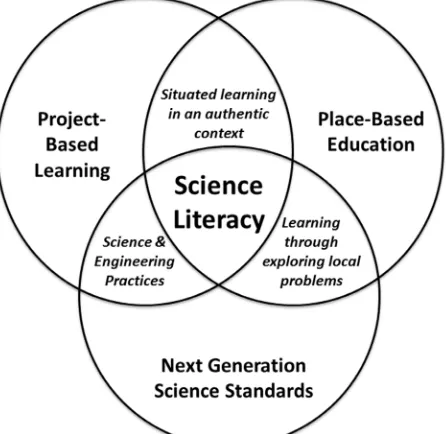
Figure 1: Conceptual model of The Confluence Approach (TCA) to enhancing scientific
practices, crosscutting concepts, and disciplinary core ideas (NRC, 2012; NGSS Lead States, 2013). It follows that development and evaluation of curriculum aligned with NGSS will help ensure that students are exposed to essential concepts and practices that are the foundational building blocks of scientific literacy.
The purpose of this study was to evaluate the effectiveness of a collaborative, NGSS-aligned science curriculum approach designed to enhance essential components of scientific literacy for high school students. The Confluence Approach (TCA, Fig. 1) is an educational framework focused on promoting watershed science education in rural United States Inland Northwest high school science classrooms. Specifically, we were interested in understanding how the student experience of this TCA curriculum changes students’ perceptions of science as important to society and personal decision-making, and how it impacts their ability to utilize scientific practices. This research has the potential to inform other similarly situated educational initiatives interested in enhancing scientific literacy and will provide support for TCA style of student engagement, as described in the following section.
The Confluence Approach
TCA was developed in the context of an established National Science Foundation Graduate STEM Fellows in K-12 Education (GK-12) partnership. Within students’ local watersheds it combines NGSS-aligned hands-on curriculum with the demonstrated benefits of project-based learning (PrBL) and place-based education (PlBE) (Rittenberg et al., 2015; Squires, Jennewein, Engels, Miller, & Eitel., 2016). Overall, the goals of TCA are to: (1) improve student scientific literacy; (2) improve student motivation and engagement; (3) enhance student environmental awareness and connection to place; and (4) help communities protect and restore local water resources.
Foundations of TCA Educational Framework
The NGSS approach differs dramatically from the previous content-focused standards outlined in the 1996 National Science Education Standards (NSES) (NRC, 1996; Reiser, 2013). As such, the established body of curriculum developed for the NSES is not well positioned to address the needs of the new standards. However, several pedagogical approaches show promise as tools for the development of curriculum that aligns with NGSS. Specifically, both PrBL and PlBE present potential pathways for conceptualizing new ways to enact NGSS.
(8) obtaining, evaluating and communicating information (Bybee, 2011; NRC, 2012). Thus, PrBL as a pedagogical approach can support efforts to implement NGSS in meaningful ways.
PlBE, which often includes elements of PrBL, provides students with opportunities to engage in learning that utilizes the context of the local environment (Smith, 2002). This is in contrast to the conventional school environment that often presents content that is disconnected from students’ lived experiences. PlBE seeks to connect students to local knowledge and issues while providing an authentic context to engage students in learning. As a whole, PlBE helps engage all students in STEM learning by using the students’ lived experiences and local environment as a learning resource. Within this setting, students have relevant expertise and can enhance their communities by proposing solutions to local ecological and social problems.
Both these approaches are informed by situated learning theory (Lave & Wenger, 1991) which posits that the most effective learning occurs when students are engaged with activities and experiences that are authentic to local contexts, and interacting with real-world issues (Krajcik & Shin, 2014). Thus, students participating in TCA are effectively engaging in legitimate peripheral practice, which is the cornerstone of situated learning. Legitimate peripheral practice provides opportunities for participants to use language and practices associated with a community of practice, initially engaging in “low risk” tasks and then taking on tasks with more complexity and risk as they move from “novice” to “expert” (Lave & Wenger, 1991). Within TCA curriculum, the community of practice is the scientific community and the tasks are those associated with studying and restoring a local watershed. By positioning students for situated learning that espouses PrBL and PlBE programmatic design elements, the legitimate peripheral practice as experienced in their local watershed is hypothesized to have beneficial impacts on students’ scientific literacy.
Individually, both PlBE and PrBL have shown significant positive impacts on student learning. For example, Harris et al. (2015) used a randomized controlled trial to test a PrBL curriculum in 72 sixth grade classrooms – 46 treatment and 26 comparison classrooms – located in a single urban school district. Results from this assessment demonstrated that sixth grade students who experienced a PrBL curriculum outperformed students that used more traditional approaches. At the high school level, Mioduser and Betzer (2007) compared the learning outcomes of 60 technology students in PrBL structured classrooms with 60 technology students in traditionally structured classrooms. They found that students in PrBL classrooms increased their formal knowledge, expanded their technical knowledge, and had a positive change in attitude toward technology and technological studies compared to their traditionally structured counterparts. These attitude changes are similar to findings seen by Barak and Asad (2012) when looking at the influence of PrBL on 9th grade student interest in learning technical computing skills.
PlBE has also been found to improve performance on standardized-tests (Lieberman & Hoody, 1998; Bartosh, 2004) and yield growth in critical thinking skills (Ernst & Monroe, 2004), which is an important facet of scientific literacy. A recent meta-analysis also found that learning certain kinds of science concepts outdoors in a PlBE context was more effective than learning these concepts indoors, and that learning outdoors enhanced students’ attitudes and interest in science and their environment (Ayotte-Beaudet, Potvin, Lapierre, & Glackin, 2017).
and have been shown to improve student critical thinking and problem-solving skills, their benefits may be synergistically enhanced when they are tied to authentic, situated learning contexts through PlBE. Thus, drawing on the strengths of both of these pedagogies is a natural fit for development of NGSS-aligned curriculum that aims to enhance scientific literacy.
TCA Framework in Practice
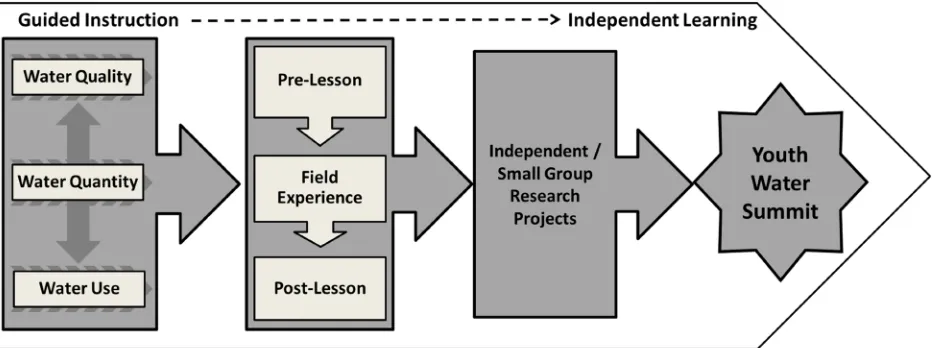
In practice, TCA framework connects high school students to their local watersheds throughout the school year (Fig. 2) through a series of field investigations which integrate PlBE experiences with PrBL practices both in and out of the classroom. Field investigations focus on one of three themes: (1) water quality, (2) water quantity, and (3) water use (with emphasis on agriculture, forestry, and/or watershed restoration). Through these field investigations, students gain experience carrying out science and engineering practices in real world settings. Students collect water quality, snowpack, and soil data, and learn to analyze and interpret these data in the ‘big picture’ of resource management in their communities. Program partners, including agency scientists, extension educators, graduate students, tribal elders, land managers, environmental nonprofit employees, local farmers, and others, support these field investigations by facilitating in-class pre- and post-lessons and working closely with students while in the field. This framing of field investigations with classroom-based lessons helps students become more invested in what they are learning and supports students’ development of an integrated picture of the science, environmental issues, and resource interests in their watersheds.
Figure 2: The Confluence Approach continuum through an academic year
As part of a series of classroom-based pre-lessons before each field experience students are exposed to pertinent science content, explore the issues present at local field sites, read relevant scientific literature, and design the research they will carry out in the field. During the field investigation students participate in data collection framed and facilitated by program partners. These partners are an essential element of the program because they provide students with an opportunity to collaborate with and learn from a wide variety of professionals and community leaders who provide important perspectives on natural resource management, local policy, and diverse community cultural understandings of the environment. After each field investigation, as part of the classroom-based post-lessons, students analyze their data and use the results to discuss how to address the problems they encountered in their watershed.
with the goal that students will be able to conduct their own community-based research projects by the end of the academic year. Students are challenged to creatively communicate the findings of their individual or group research projects, including both the scientific results and their proposed solutions to the watershed issues, at a regional Youth Water Summit (Rittenberg et al., 2015; Squires, Jennewein, Engels, Miller, & Eitel., 2016). Because students investigate topics of their choosing, projects presented at the Youth Water Summit are diverse and unique. For example, projects have ranged from designing off-site watering operations to remove cattle from local creeks, to highlighting lake sediment contamination issues using watercolor paintings, to working with extension agents on the design a road runoff filtering apparatus.
Methods
For this study we employed a concurrent mixed method survey instrument with both qualitative and quantitative questions, which allowed us to triangulate from the literature to qualitative and quantitative perspectives on scientific literacy (Fig. 3). Due to the rich history of scientific literacy there are myriad definitions for the concept (Laugksch, 2000). From our review of TCA foundational literature, and for the purpose of this research, we define scientific literacy in three parts: (1) the knowledge and understanding of scientific concepts and processes (i.e., Knowledge of Science); (2) how science relates to society and personal decision-making (i.e., Relevance of Science); and (3) the ability to carry out scientific practices (i.e., Mechanics of Science) (NRC, 1996; Hurd, 1998; Laugksch, 2000; Blake, 2017). In order to assess if participation in a TCA program positively impacts students’ scientific literacy, we focused this investigation on the latter two parts of this definition, specifically:
Research Question 1 (RQ1): How does participation in a TCA program impact students’ perceptions of science as important to society and personal decision-making?
Research Question 2 (RQ2): How does participation in a TCA program impact student ability to Figure 3: Overview of research design showing how literature,
carry out scientific practices?
Qualitative data were obtained from short-answer questions based on desirable or undesirable science experiences. Quantitative data were derived from an attitudinal survey comprised of a series of five-point Likert-type scale questions based on student concern for local environmental issues, perceptions of science as it relates to their lived experiences, confidence in conducting scientific practices, and ability to use science as a tool to solve problems.
Participants
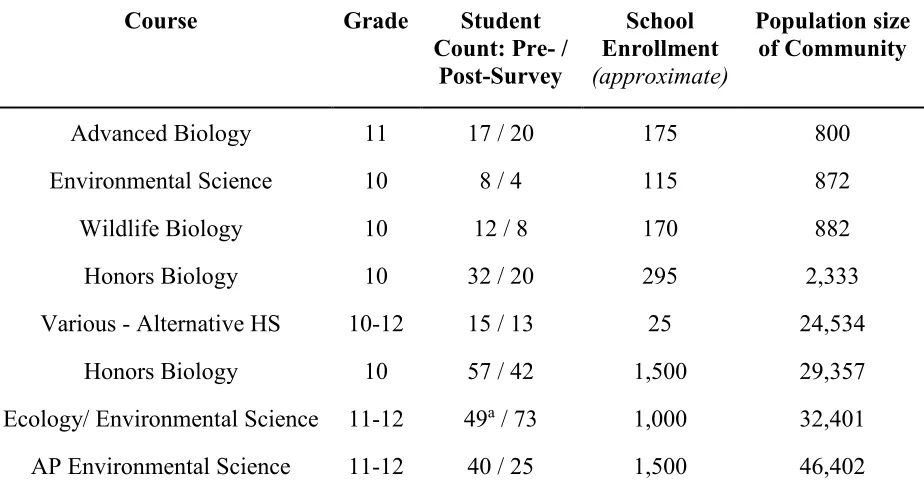
This study focuses on U.S. high school students (grades 10-12) who participated in a TCA classroom. Students were enrolled in a variety of science classes at high schools across eight different Inland Northwest communities (Table 1). The communities were diverse in size and type of economy, including both urban and rural areas and with economies based on mining, agriculture, manufacturing, timber, and tourism. The schools were selected based on their relative proximity to the researchers and the presence of school administrators and teachers interested in participating in the program.
A pre/post program survey containing both qualitative and quantitative components was administered to students during the 2014-15 academic year (n=230 for pre-survey, n=207 for post-survey). Difference in participation between the pre- and post-surveys was due to changes in student enrollment throughout the year, absences when surveys were administered, and scheduling conflicts with survey administration.
Table 1
The Confluence Approach Participant Counts and Demographic Data for 2014-15
Course Grade Student
Count: Pre- / Post-Survey
School Enrollment (approximate)
Population size of Community
Advanced Biology 11 17 / 20 175 800
Environmental Science 10 8 / 4 115 872
Wildlife Biology 10 12 / 8 170 882
Honors Biology 10 32 / 20 295 2,333
Various - Alternative HS 10-12 15 / 13 25 24,534
Honors Biology 10 57 / 42 1,500 29,357
Ecology/ Environmental Science 11-12 49a / 73 1,000 32,401
AP Environmental Science 11-12 40 / 25 1,500 46,402
Data Collection
The survey instrument used in this study was initially developed by the researchers in 2013 for program evaluation of the pilot TCA program. We field tested the instrument in the 2013-14 academic year and modified it in 2014-15 to reduce bias and improve clarity of questions, as well as to better inform the updated research questions and program goals. A convenience sample of program participants was used, as the overall population was small enough that our sample size would have included nearly all students to achieve a confidence interval of 0.95.
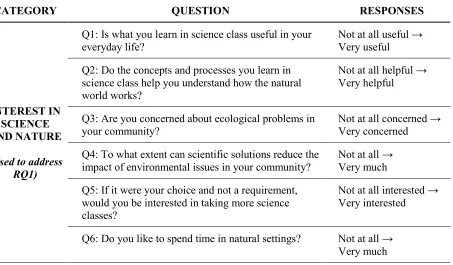
The survey delivered to students was composed of 20 multiple choice, Likert-type scale questions and three open-ended questions. Some quantitative questions specifically targeted program evaluation and were therefore eliminated from consideration for this analysis. We used the remaining subset of 12 Likert-type scale questions to address the research questions pertaining to scientific literacy. All three open-ended questions were coded and then analyzed qualitatively (Table 2).
Teachers in the program administered the surveys to high school participants during class time after receiving both student assent and parental consent for participation in TCA and the surveys. Pre-surveys were administered in September before the first TCA field investigation and post-surveys were administered in April and May after completion of the program. Surveys were administered either on paper or via Google Forms, depending on the technological capabilities of the classroom.
Table 2
Attitudinal Survey Questions and Five-point Likert-scale Response Options
CATEGORY QUESTION RESPONSES
INTEREST IN SCIENCE AND NATURE
(Used to address RQ1)
Q1: Is what you learn in science class useful in your
everyday life? Not at all useful →Very useful Q2: Do the concepts and processes you learn in
science class help you understand how the natural world works?
Not at all helpful → Very helpful
Q3: Are you concerned about ecological problems in
your community? Not at all concerned →Very concerned Q4: To what extent can scientific solutions reduce the
impact of environmental issues in your community? Not at all → Very much Q5: If it were your choice and not a requirement,
would you be interested in taking more science classes?
Not at all interested → Very interested
DOING SCIENCE
(Used to address RQ2)
Q7: How confident are you with using the scientific
method? Not at all confident →Very confident Q8: How confident are you with collecting data? Not at all confident →
Very confident Q9: How confident are you with analyzing data? Not at all confident →
Very confident Q10: How confident are you with presenting your
research? Not at all confident →Very confident Q11: How confident are you with communicating
and collaborating with other students? Not at all confiVery confident dent → Q12: How confident are you with communicating
and collaborating with adults? Not at all confident →Very confident
QUALITATIVE QUESTIONS
Q21: What is your favorite aspect of science class? Open-ended Q22: What is your favorite aspect of science class? Open-ended Q23: Describe a time that you felt really engaged in a
science lesson. Open-ended
Note. Questions 13-20 were not analyzed for this research and therefore are not included.
Qualitative Analysis
We coded qualitative data from the three open-ended questions: (1) what is your favorite aspect of science class? (hereafter “favorite”); (2) what is your least favorite aspect of science class? (hereafter “least favorite”); and, (3) describe a time that you felt really engaged in a science lesson (hereafter “engaged”). These questions were designed to capture slightly different aspects of student thinking. Both the “favorite” and “least favorite” questions aimed to understand which specific areas of science students perceive as important. By contrast, the “engaged” question looked at what specific scientific experiences promote student learning. We asked students about their experiences with science class because, for most students, that is the primary way in which they experience science and formulate attitudes about science (Simpson & Oliver, 1990; Maltese & Tai, 2010). All of these questions have direct relevance to scientific literacy as we have defined it because scientifically literate citizens are more interested and engaged in scientific topics and issues (OECD, 2016).
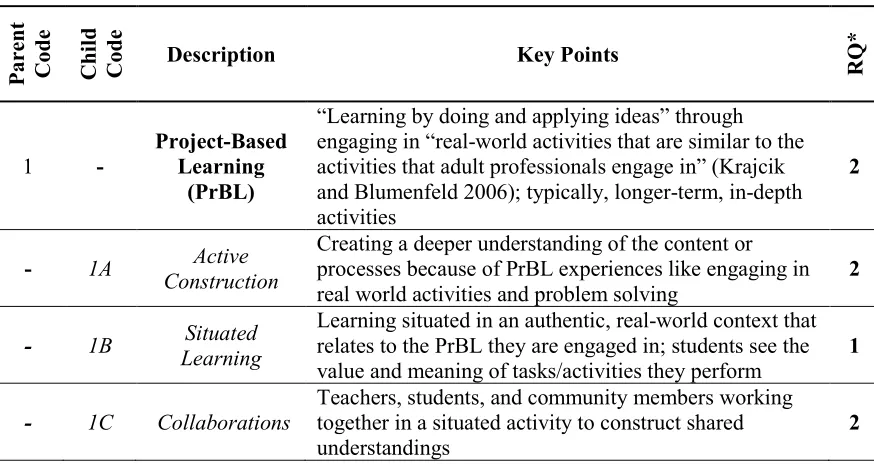
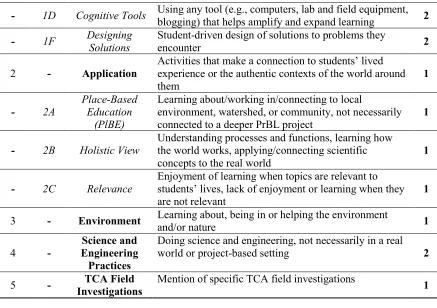
Our initial codebook was developed a priori and kept in mind the lenses of PlBE, PrBL, and NGSS. As coding progressed, we employed a grounded approach to identify further parent codes (indicated by numbers) and child codes (indicated by letters) that emerged in student responses (Table 3; Schwandt, 2001; Weston et al., 2001; Ryan & Bernard, 2003; Charmaz, 2006).
Milstein, 1998; Weston et al., 2001; Krippendorff, 2004). During each round, each researcher worked with approximately five percent of the data for each of the six questions (three pre-survey and three post-survey). Each researcher independently coded the data and adapted the codebook to their understanding of the data.
After each round of coding, the lead coder calculated the code-specific kappa utilizing GraphPad Software (2016) to determine interrater agreement and then the research team discussed any coding disagreements and refined the codebook (MacQueen et al., 1998). After four rounds of coding, kappa values for 75% of all codes exceeded 0.80 while the average kappa was 0.81, providing confidence that the codes were acceptable (Weston et al., 2001). At that point, the code book was finalized through group discussion of the data, then the lead coder finished coding the remainder of the data.
The full list of codes was pared down to six parent codes and 10 child codes pertinent to the research questions (see Table 3 for code definitions). For the remainder of the paper reference to qualitative codes are italicized for convenience. Our qualitative analysis indicated that RQ1 could be best answered using three parent codes and their associated child codes (2: Application, 3: Environment, 5: TCA field investigation) and one child code (1B: Situated learning). For RQ2, two parent codes and their associated child codes (1: PrBL learning, 4: Science and Engineering Practices) were deemed most applicable. Analysis of the qualitative data looked at changes in code frequency from pre- to post-survey in each of the three open-ended survey questions (“favorite,” “least favorite,” “engaged”) across all codes identified as pertinent to the specific research question. For a full description of all qualitative codes and how they were used to address our research questions, refer to Table 3.
Table 3
Codebook for qualitative analysis of the open-ended survey questions
Pa
re
nt
Co
de
C
hi
ld
Co
de Description Key Points
RQ
*
1 - Project-Based Learning (PrBL)
“Learning by doing and applying ideas” through engaging in “real-world activities that are similar to the activities that adult professionals engage in” (Krajcik and Blumenfeld 2006); typically, longer-term, in-depth activities
2
- 1A Construction Active Creating a deeper understanding of the content or processes because of PrBL experiences like engaging in real world activities and problem solving 2
- 1B Learning Situated Learning situated in an authentic, real-world context that relates to the PrBL they are engaged in; students see the value and meaning of tasks/activities they perform 1
- 1C Collaborations Teachers, students, and community members working together in a situated activity to construct shared
- 1D Cognitive Tools Using any tool (e.g., computers, lab and field equipment, blogging) that helps amplify and expand learning 2
- 1F Designing Solutions Student-driven design of solutions to problems they encounter 2
2 - Application Activities that make a connection to students’ lived experience or the authentic contexts of the world around
them 1
- 2A Place-Based Education (PlBE)
Learning about/working in/connecting to local
environment, watershed, or community, not necessarily connected to a deeper PrBL project 1
- 2B Holistic View Understanding processes and functions, learning how the world works, applying/connecting scientific
concepts to the real world 1
- 2C Relevance Enjoyment of learning when topics are relevant to students’ lives, lack of enjoyment or learning when they
are not relevant 1
3 - Environment Learning about, being in or helping the environment and/or nature 1
4 - Engineering Science and Practices
Doing science and engineering, not necessarily in a real
world or project-based setting 2
5 - Investigations TCA Field Mention of specific TCA field investigations 1
Note. *Research Question. Parent codes are shown in bold, child codes are show in italics. Additional codes generated during coding analysis but not relevant to this analysis are not shown
Quantitative Analysis
Quantitative analyses were conducted using R version 3.3.1 (R Core Team, 2016) and Microsoft Excel (Microsoft, 2010). Of the 12 multiple choice survey questions analyzed (Table 3; Table 5), six focused on student perceptions of science and were used to answer RQ1, and six focused on student abilities in conducting scientific practices and communicating scientific topics and were used to answer RQ2. Specifically, questions used for RQ2 assessed student confidence in conducting scientific investigations (i.e., collecting and analyzing data, presenting results, and collaborating with peers and adults).
Results and Discussion
Several major patterns emerge when examining both the qualitative and quantitative data. First, we present results and discuss the qualitative data as they pertain to each of the two research questions, including pre/post percent change in code frequencies to indicate relative trends and direct quotes to provide insight into student thinking. Subsequently, we present and discuss the quantitative data results and assess how these results support and enhance our qualitative findings.
Qualitative Results
RQ1: How does participation in a TCA program impact students’ perceptions of science as important to society and personal decision-making?
When a student answers the questions “What is your favorite/least favorite part of science class” we interpret their response as an indication of which aspects of their science experience are important and relevant to them. Codes related to RQ1 are focused on pedagogical elements of the TCA program that shape the student scientific experience. By looking at changes in code frequency pre- to post-survey in the “favorite” and “least favorite” questions we can begin to build a picture of which pedagogical elements within the TCA program are most important for altering students’ perceptions of science as important. In general, we see that after participation in the TCA program, students find science more important to them when it is situated and relevant, applicable in local contexts, and focused on “real world” problems. This can be seen in the code frequency increases in the “favorite” category across all RQ1 codes (Table 4). By contrast, these same factors seem to have little to no negative impacts on students’ perceptions of science as important, as indicated by the negligible changes in code frequency in the “least favorite” question. 1B: Situated Learning (authentic “real world” context) was the only code that showed an increase in mentions as part of students’ “least favorite” part of science class (1%). Given these limited changes in the “least favorite” question, we will restrict the remainder of the discussion to changes seen the “favorite” and “engaged” questions.
The largest increases in the “favorite” question were seen in both the 1B: Situated Learning and 2C: Relevance codes (+6% for both), suggesting science is perceived by students as more important when it is properly contextualized in the “real world” (1B: Situated Learning)and when it has explicit relevance to them (2C: Relevance) (Table 3). Both of these codes speak to the importance of the student-focused experience in a curriculum, and that being able to see themselves and their concerns reflected in their science classes is an important driver of their interest in science. As one student stated:
When we went on the snow pack field trip, and when we worked on the water summit project, I really felt engaged because I could apply what I was learning to real life situations. It was also really fun and interesting, so I got into it and enjoyed it. When I enjoyed it, I actually learned a lot and I learned how to apply it to real world situations.
(2017) where they note that authenticity of science experiences contributes to students’ connection to their local context, and thus, contributes to relevance and interest in the topic of study.
Increases (3%-4%) were also seen in codes related to science in local contexts (2A: PlBE and 5: TCA Investigations) and science as it relates to more global issues (2B: Holistic View, 3: Environment), suggesting that among students there is an increased perception of science as important to society after participation in a TCA program. For instance, one student wrote:
This year in science class we have gained a lot of knowledge. The part that I like the most is going more in depth with all of the concepts we have been learning about for years. We were also able to tie science into our community through the confluence project. This is a lot better than looking at the book and expecting to learn everything without putting it into a real-world situation.
By design, the TCA program attempts to build explicit connections for students between their local community and scientific concepts, so in some ways this is not a surprising finding. However, the fact that students come out of the program with enhanced appreciation for science as a tool that can be used to address problems both locally and globally does indicate that participation in a TCA program is an important instrument for enhancing scientific literacy among students in this study.
In addition to trying to understand which areas of science students find important after participation in a TCA program we were also interested in which specific experiences within the program enhanced student learning related to RQ1. To answer this question, we look at the data about when students felt “engaged.” Changes in code frequencies indicate that the times students really felt “engaged” in science class were strongly related to participation in science activities in their local communities (Table4). Interestingly, increases occurred only in codes related to student experiences of place-based science (1B: Situated Learning, 2A: Place-based education, 5: TCA field investigation), but not in codes related to experience of more global scientific issues (2B: Holistic view, 3: Environment). This suggests that by providing students hands-on experiences with science in their local community, real opportunities for changing their perceptions of science are realized.
Table 4
Codes, Code Frequency Changes, and Representative Quotes elated to RQ1.
Codes Favorite Change Change Least Favorite
Change
Engaged Student Quotes
1B: Situated
Learning + 6% +1% +7%
solution for that problem is the best part about it.
2A: Place-based
education + 4% 0% +4%
During the [water quality and riparian restoration] part of the year I was interested in what happened simply because it affected us locally. 2B:
Holistic view + 4% 0% 0% Learning new things that will help me understand the world better.
2C:
Relevance + 6% 0% 0%
My favorite part about science class is learning things that we can take to real everyday situations. Things we do on field trips really help me learn about things we can really do to help our earth. In classroom lessons are hard for me to understand how to use them in everyday life. That's why I like outdoor lessons.
3:
Environment +3% 0% 0%
[My favorite part of science class is that] we focus on the environment and real-world examples that involve our regional natural habitat.
5: TCA field
investigation + 3% 0% +17%
The most engaged I think I've ever been in science is when we went on the snow science field trip to [the ski resort]. I was really interested because while we were collecting scientific data, we were having fun, being active, and being outside.
Because students had not yet participated in any TCA field investigations at the time of the pre-surveys, it is only logical that there would be a positive change in engagement around this code. As expected, the largest pre-post code change we saw was in 5: TCA field investigation (17%), suggesting that these trips were a demonstratively positive and important experience for many students. For instance, one student wrote, “I felt fully engaged when we did the confluence project. We actually got to be involved and we had to use our brains to find solutions.” Overall student comments indicate that the experience of science situated in a local, real-world, authentic context enhances students’ perceptions of science as important, both at a personal, local scale and at the larger global scale. This change in perception is an important improvement in scientific literacy.
RQ2: How does participation in a TCA program impact student ability to carry out scientific practices?
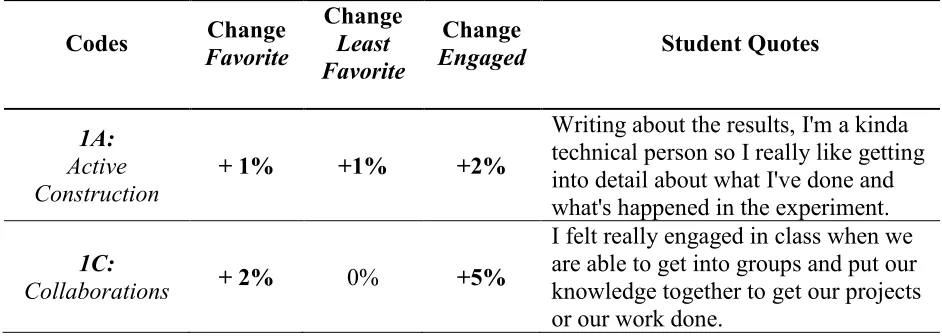
practice as being either their “favorite” part of science class or a time when they felt “engaged” in class. The increase in frequency with which these practices are mentioned occurred across all codes related to RQ2 in both the “favorite” category (1-4%) and the “engaged” category (2-5%). There was an increase in comments coded as 1A: Active Construction in the “least favorite” question category (1%) No other code categories related to this research question showed frequency increases in the “least favorite” question and so the “least favorite” question will not be discussed further.
While the changes in code frequencies related to RQ2 are smaller overall than for RQ1, they do still suggest a TCA program positively impacts student engagement with scientific practices (Tables 4 and 5). In general, increases in code frequency were greater in the “engaged” question than in the “favorite” and “least favorite” questions, indicating that moments which drive student engagement around scientific practices are indeed related to PrBL elements (collaboration, executing scientific experiments, or designing solutions) of the TCA program (refer to Table 4 for code definitions). These experiences, while engaging, seem to only have a modest positive impact on how students feel about executing the mechanics of science (Table 5). In a way this makes sense, since feeling engaged when testing water quality is more likely to lead to an appreciation of the importance of water quality (2C: Relevance) than to an appreciation of how to test water quality. However, since there are positive changes with regard to these PrBL codes in the “favorite” question (Table 5), we can say that there is some greater appreciation among students for the technical components of science. This is born out when looking at student statements about their favorite aspects of science class. For example, one student wrote, “My favorite aspect of science class is the whole process that you have to go through trying to find the results or research of what we are doing in class at the time.” Another student focused on the actual use of scientific equipment and doing science in the field: “When we were learning water quality and we went to [the field site] and we learned to use all of the tools and actually walked in the creek and it was very hands on and I enjoyed it very much.” These comments indicate that after participating in a TCA program, students were more confident and engaged in activities related to carrying out scientific procedures, a key form of scientific knowledge that is foundational to scientific literacy (OECD, 2016).
Table 5
Codes, Code Frequency Changes, and Representative Quotes Related to RQ2.
Codes Favorite Change Change Least Favorite
Change
Engaged Student Quotes
1A: Active
Construction + 1% +1% +2%
Writing about the results, I'm a kinda technical person so I really like getting into detail about what I've done and what's happened in the experiment.
1C:
Collaborations + 2% 0% +5%
1D:
Cognitive Tools + 1% 0% +4%
In the beginning of this year, [a program partner] came to our school with a stormwater model. We got to experiment with the model and see what different materials did to our "aquifer." It was really fun, and it was a great, creative way to get us all engaged in a real life example of a problem.
1F: Designing
Solutions + 4% 0% +2%
The whole thing I like about science class is the fact of finding a problem and making a solution to that problem, and the moment comes to where I can use the scientific method to find a solution for that problem is the best part about it.
4: Science and Engineering Practices
+2% 0% +5% During labs and experiments I always feel engaged because I get to actually do the work instead of hearing about it.
Quantitative Results
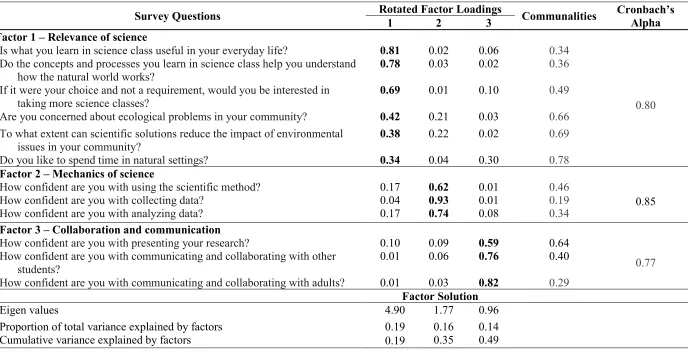
Results of the rotated pattern matrix from the exploratory factor analysis of quantitative data revealed three factors (Table 6). Thematically, factor one contains questions related to students’ perception of science and its efficacy to solve real world issues, as well as student connection to natural settings and view of local ecological problems. Therefore, factor one was named “relevance of science.” Questions in factor two were related to confidence in the initial components of scientific investigation – designing research, collecting and analyzing data. Therefore, factor two was named “mechanics of science.” Factor three included questions associated with communication with peers and adults as well as confidence with presenting results. Hence, factor three was named “communication and collaboration.” All factors had acceptable internal consistency reliability (i.e., Cronbach’s alpha ≥ 0.75), and the rotated factor solution explained 49% of the variance (Table 6). Interestingly this exploratory factor analysis suggests that “mechanics of science” and “communication and collaboration,” both important skill sets for scientifically literate students, are in fact two distinct skill sets and should not be confounded.
We used results from “relevance of science” (rotated factor one) to address RQ1 and “mechanics of science” (rotated factor two) and “communication and collaboration” (rotated factor three) to address RQ2. Factors were tested for pre-/post-survey differences using the Mann-Whitney-Wilcoxon test (Table 7). Of the three factors, only “relevance of science” had a statistically significant difference from pre- to post-survey (W=18838, p < 0.05). This supports our qualitative findings that participation in a TCA program does positively change students’ perceptions of science as important to society and personal decision-making.
Table 6
Results from Exploratory Factor Analysis
Survey Questions Rotated Factor Loadings 1 2 3 Communalities Cronbach’s Alpha
Factor 1 – Relevance of science
Is what you learn in science class useful in your everyday life? 0.81 0.02 0.06 0.34
0.80
Do the concepts and processes you learn in science class help you understand
how the natural world works? 0.78 0.03 0.02 0.36
If it were your choice and not a requirement, would you be interested in
taking more science classes? 0.69 0.01 0.10 0.49
Are you concerned about ecological problems in your community? 0.42 0.21 0.03 0.66
To what extent can scientific solutions reduce the impact of environmental
issues in your community? 0.38 0.22 0.02 0.69
Do you like to spend time in natural settings? 0.34 0.04 0.30 0.78
Factor 2 – Mechanics of science
How confident are you with using the scientific method? 0.17 0.62 0.01 0.46
0.85
How confident are you with collecting data? 0.04 0.93 0.01 0.19
How confident are you with analyzing data? 0.17 0.74 0.08 0.34
Factor 3 – Collaboration and communication
How confident are you with presenting your research? 0.10 0.09 0.59 0.64
0.77
How confident are you with communicating and collaborating with other
students? 0.01 0.06 0.76 0.40
How confident are you with communicating and collaborating with adults? 0.01 0.03 0.82 0.29
Factor Solution
Eigen values 4.90 1.77 0.96
Proportion of total variance explained by factors 0.19 0.16 0.14
Cumulative variance explained by factors 0.19 0.35 0.49
Table 7
Results from the Mann-Whitney-Wilcoxon Tests Relevance of
Science Mechanics of Science Communication and collaboration
Mann-Whitney-Wilcoxon “W” 18838* 21813 21256
Effect size “Z” 2.9348 0.59284 0.9386
Mean pre-survey (SE) 3.48 (0.05) 3.43 (0.06) 3.55 (0.07) Mean post-survey (SE) 3.71 (0.06) 3.48 (0.07) 3.61 (0.07)
Note. *p < 0.05
Synthesis
Based on the triangulated responses from qualitative and quantitative results (Figure 4, RQ1) it is clear that students’ perceptions of science as important to their lives and community is enhanced when science is tied to place, as it is in a TCA program. This finding is supported by both our qualitative and quantitative analyses and is in line with the findings of Liberman and Hoody (1998) who found that studying the environment as an integrating context increased student engagement. Second, further analysis suggests that this finding is in part because students find the science engaging when it is tied to place, and this engagement translates to modest increases in appreciation for the relevance of science both at the local and global scales. According to Hurd (1998), “scientific literacy is seen as a civic competency required for rational thinking about science in relation to personal, social, political, economic problems, and issues that one is likely to meet throughout life” (p. 410). Thus, TCA as designed and implemented gives students experiences that meaningfully contribute to their development as scientifically literate people by engaging them in legitimate peripheral practices (Lave & Wenger, 1991).
Second, we observed an increase in reported student engagement when conducting the ‘mechanics of science’ - designing research, collecting and analyzing data (Figure 5, RQ2). However, despite this reported increase in engagement we only observed a mild increase in student confidence with conducting scientific practices. This finding is in line with works by Gormally et al. (2009 and 2011), who’ve shown that at the college level that it is not uncommon for students participating in inquiry-driven curriculum to demonstrate greater scientific literacy but express less confidence applying their skills than students in traditional courses who have not been challenged in the same manner. Even when students in inquiry-driven courses demonstrate an increase in confidence related to conducting scientific practices, students with the greatest gains in scientific reasoning may not show corresponding increases in their confidence because they are being challenged in new ways (Beck & Blumer 2012).
Figure 5: Triangulation of qualitative and quantitative results for research question two (RQ2).
Limitations
There are several limitations to our study. First, teachers and students who participated in this study were by necessity a convenience sample. Teachers within a several hour proximity of the University were recruited to participate in the program but chose to do so because of their own interest and excitement about TCA curriculum. As such, the classrooms involved in the study consisted of widely varied subjects and grade levels (e.g. AP Environmental Science and 10th grade Biology), and the context for each school was unique (different watersheds, different partner organizations, differing levels of administrative support). Thus, with eight participating schools and a limited population base, it was not feasible to identify or use a representative control group for this study. In the future it may be possible to identify control groups in individual schools, where one teacher instructs multiple sections of the same course, but given the mostly rural context of our setting this is likely to be enrollment dependent.
The second limitation is regarding our survey instrument. Although we based our instrument on previously validated tools, we deemed it necessary to modify the instrument to more closely align with our study context. Although not ideal, modification of the instrument meant that the data collected would align more closely to the research questions we were interested in answering, even if it compromised the strength of the tool used. As we continue this research, validity testing will occur with our modified instrument to mitigate this limitation. Future student surveys may be altered to a single post-survey that also incorporates a retrospective pre-survey component. This retrospective design addresses “pre-test overestimation,” which is a common problem with pre-test/post-test comparisons (Pratt, McGuigan, & Katzev, 2000).
The third and final limitation we would like to discuss is that of pairing pre-/post-surveys to the individual student. Each partner school context presented a unique set of challenges. Given the geographic distances separating schools and the complicated scheduling, it was difficult for the research team to directly oversee data collection. Thus, we relied heavily on our partner teachers to administer the surveys and share the data with us. In a few instances, miscommunication resulted in student codes not being recorded and reused for the post-surveys. This error ultimately resulted in the inability to pair pre-/post-survey responses to individual students.
However, despite limitations to the generalizability of this study, we believe that by triangulating our results with previous findings from the literature this work can help inform future practice and research.
Recommendations
scientific skills. We found with this research that the relevance and the repetition of working through locally significant issues created an atmosphere that fosters student confidence in their emerging scientific skillset. Finally, we recommend developing strong working relationships with local partners to build strategic educational partnerships. Bringing local partners working on watershed-based issues into the classroom and field experiences allows students to clearly see the relevance of the activities they are engaging with. This results in a more seamless interaction with scientific phenomena in their watersheds and contributes to their development of a more grounded scientifically literate perspective.
Conclusion
In summary TCA, which links PrBL and PlBE to NGSS, is an approach to science education that enhances student appreciation for the importance of science in their own lives and communities, engages students in practices of science, and increases student confidence in communicating scientific topics. Therefore, we maintain that enacting PrBL, PlBE, and NGSS aligned curriculum in a local context is a successful approach to enhancing scientific literacy in high school-aged students. NGSS, PrBL, and PlBE proved to be engaging aspects for students within TCA’s educational design, which fits with the assertion of Stage, Asturias, Cheuk, Daro, and Hampton (2013) that through the platform of NGSS, students can become more motivated and inspired within the formal education system. This motivation and inspiration enhances students’ ability to learn and increases their desire to persist in educational pursuits. At the same time, improving teaching and learning in K-12 science education has become a priority in the U.S. as we seek to prepare students for college and careers within an increasingly competitive global economy, and to address the future needs and problems of our society and environment (Hurd, 1998; Nargund-Joshi et al., 2013; OECD, 2016).
We anticipate future research incorporating a stepwise progression that utilizes a design-based implementation research approach that brings the data driven outcomes into the realities of practice that pave the way for utilizing educational interventions such as TCA to foster real educational change (Fishman, Penuel, Allen, Cheng, & Sabelli, 2013). The beauty of TCA and similarly situated approaches is that the tools for implementation are inherent in the places education is delivered. It is our role as educational researchers to provide the scaffolds to effective implementation and remove barriers to new approaches that have real and lasting results.
Acknowledgements
References
Åkerblom, D., & Lindahl, M. (2017). Authenticity and the relevance of discourse and figured worlds in secondary students' discussions of socioscientific issues. Teaching and Teacher Education, 65, 205-214.
Aschbacher, P. R., Li, E., & Roth, E. J. (2009). Is science me? High school students’ identities, participation, and aspirations in science, engineering, and medicine. Journal of Research in Science Teaching, 47, 564-582.
Ayotte-Beaudet, J. P., Potvin, P., Lapierre, H. G., & Glackin, M. (2017). Teaching and Learning Science Outdoors in Schools’ Immediate Surroundings at K-12 Levels: A Meta-Synthesis. EURASIA Journal of Mathematics, Science and Technology Education, 13(8), 5343-5363. Barak, M., & Asad, K. (2012). Teaching image-processing concepts in junior high schools: Boys’ and girls’ achievement and attitudes towards technology. Research in Science & Technological Education, 30, 81–105.
Bartosh, O. (2004). Environmental education: Improving student achievement. Master's thesis, The Evergreen State College, Olympia, Washington. Retrieved from http://www.seer.org/pages/research/Bartosh2003.pdf.
Beck, C. W., & Blumer, L. S. (2012). Inquiry‐based ecology laboratory courses improve student confidence and scientific reasoning skills. Ecosphere, 3(12), 1-11.
Blake, C. (2017). Understanding scientific literacy. Professional Resources. Concordia University Nebraska. Retrieved from http://online.cune.edu/defining-scientific-literacy/.
Blumenfeld, P. C., Soloway, E., Marx, R. W., Krajcik, J. S., Guzdial, M., & Palincsar, A. (1991). Motivating project-based learning: Sustaining the doing, supporting the learning. Educational Psychologist, 26(3-4), 69–398.
Bybee, R. W. (2011). Scientific and engineering practices in K–12 classrooms: Understanding a framework for K–12 science education. The Science Teacher, 78(9), 34–40.
Bybee, R. W. (2013). The Next Generation Science Standards and the life sciences. Science and Children, 50(6), 7–14.
Carlone, H. B., & Johnson, A. (2007). Understanding the science experiences of successful women of color: Science identity as an analytic lens. Journal of Research in Science Teaching: The Official Journal of the National Association for Research in Science Teaching, 44(8), 1187-1218.
Charmaz, K. (2006). Constructing grounded theory: A practical guide through qualitative research. London: Sage.
Creswell, J. W. & Creswell J.D. (2017). Research design: Qualitative, quantitative, and mixed methods approaches(Fifth edition). Thousand Oaks, CA: Sage.
Cronbach, L. J. (1951). Coefficient alpha and the internal structure of tests. Psychometrica, 16, 297–334.
Ernst, J. & Monroe, M. (2004). The effects of environment-based education on students’ critical thinking skills and disposition toward critical thinking. Environmental Education Research, 10(4), 507–522.
Fabrigar, L. R., Wegener, D. T., MacCallum, R. C., & Strahan, E. J. (1999). Evaluating the use of exploratory factor analysis in psychological research. Psychological Methods, 4(3), 272-299.
Fishman, B. J., Penuel, W. R., Allen, A. R., Cheng, B. H., & Sabelli, N. (2013). Design-based implementation research: An emerging model for transforming the relationship of research and practice. Teachers College Record, 115(14), 136–156.
Gormally, C., Brickman, P., Hallar, B., & Armstrong, N. (2009). Effects of inquiry-based learning on students’ science literacy skills and confidence. International journal for the scholarship of teaching and learning, 3(2), 16.
Gormally, C., Brickman, P., Hallar, B., & Armstrong, N. (2011). Lessons Learned About Implementing an Inquiry-Based Curriculum in a College Biology Laboratory Classroom. Journal of College Science Teaching, 40(3), 45-51
GraphPad Software, Inc. (2016). Quantify agreement with kappa. Retrieved from http://www.graphpad.com/quickcalcs/kappa1/.
Harris, C. J., Penuel, W. R., D'Angelo, C. M., DeBarger, A. H., Gallagher, L. P., Kennedy, C. A., Cheng, B. H., & Krajcik, J. S. (2015). Impact of project-based curriculum materials on student learning in science: Results of a randomized controlled trial. Journal of Research in Science Teaching, 52(10), 1362–1385.
Hurd, P. D. (1998). Scientific literacy: New minds for a changing world. Science Education, 82(3), 407–416.
Jick, T. D. (1979). Mixing qualitative and quantitative methods: Triangulation in action. Administrative Science Quarterly, 24(4), 602–611.
Julien, H. & Barker, S. (2009). How high-school students find and evaluate scientific information: A basis for information literacy skills development. Library & Information Science Research, 31(1), 12–17.
Krajcik, J. S., Blumenfeld, P. C., Marx, R. W. & Soloway, E. (1994). A collaborative model for helping middle grade science teachers learn project-based instruction. The Elementary School Journal, 94(5), 483–497.
Krajcik, J. S., Czerniak, C., & Berger, C. (2002). Teaching science in elementary and middle school classrooms: A project-based approach (2nd ed.). McGraw-Hill: Boston, MA. Krajcik, J. S. & Blumenfeld, P. C. (2006). Project-based learning. In R. K. Sawyer (Ed.), The
Cambridge Handbook of the Learning Sciences (pp. 317–334). Cambridge University Press.
Krajcik, J. S., & Shin, N. (2014). Project-Based Learning. In R. K. Sawyer (Ed.), The Cambridge Handbook of the Learning Sciences (pp. 275–297) (2nd ed.). Cambridge University Press. Krippendorff, K. (2004). Reliability in content analysis: Some common misconceptions and
Laugksch, R. C. (2000). Scientific literacy: A conceptual overview. Science Education, 84(1), 71-94.
Lave, J., & Wenger, E. (1991). Situated learning: Legitimate peripheral participation. Cambridge: Cambridge University Press.
Lieberman, G. A. & Hoody, L. L. (1998). Closing the achievement gap: Using the environment as an integrating context for learning. San Diego: State Education and Environment Roundtable.
MacQueen, K. M., McLellan, E., Kay, K., & Milstein, B. (1998). Codebook development for team-based qualitative analysis. Cultural Anthropology Methods, 10(2), 31–36.
Maltese, A. V. & Tai, R. H. (2010) Eyeballs in the Fridge: Sources of early interest in science. International Journal of Science Education, 32(5), 669-685.
Mann, H. B., & Whitney, D. R. (1947). On a test of whether one of two random variables is stochastically larger than the other. The Annals of Mathematical Statistics, 18(1), 50-60. Microsoft. (2010). Microsoft Excel [computer software]. Redmond, Washington: Microsoft Mioduser, D., & Betzer, N. (2007). The contribution of project-based-learning to high-achievers’
acquisition of technological knowledge and skills. International Journal of Technology and Design Education, 18, 59–77.
Nargund-Joshi, V., Liu, X., Chowdhary, B., Grant, B., & Smith, E. (2013). Understanding meanings of interdisciplinary science inquiry in an era of Next Generation Science Standards. Presented at the Annual Meeting of the National Association for Research in Science Teaching, Rio Grande, Puerto Rico.
NGSS Lead States. (2013). Next Generation Science Standards: For states, by states. Washington,
DC: The National Academies Press. Retrieved from
https://www.nap.edu/catalog/18290/next-generation-science-standards-for-states-by-states
National Research Council. (1996). National Science Education Standards. Washington, DC: The National Academies Press. Retrieved from https://www.nap.edu/catalog/4962/national-science-education-standards
National Research Council. (2012). A Framework for K-12 Science Education: Practices, Crosscutting Concepts, and Core Ideas. Committee on a Conceptual Framework for New K-12 Science Education Standards. Board on Science Education, Division of Behavioral and Social Sciences and Education. Washington, DC: The National Academies Press. Retrieved from https://www.nap.edu/catalog/13165/a-framework-for-k-12-science-education-practices-crosscutting-concepts
National Science Teachers Association (NSTA). (2013). Disciplinary Core Ideas in the Next Generation Science Standards (NGSS) Final Release. Retrieved from
http://nstahosted.org/pdfs/ngss/20130509/matrixofdisciplinarycoreideasinngss-may2013.pdf.
literacy. Paris: OECD. Retrieved from http://www.oecd.org/education/pisa-2015-assessment-and-analytical-framework-9789264255425-en.htm
Pratt, C. C., McGuigan, W. M., & Katzev, A. R. (2000). Measuring program outcomes: Using retrospective pretest methodology. American Journal of Evaluation, 21(3), 341–349. R Core Team. (2016). R: A Language and Environment for Statistical Computing. R Foundation
for Statistical Computing, Vienna, Austria. Retrieved from http://www.R-Project.org.
Reiser, B. J. (2013). What professional development strategies are needed for successful implementation of the Next Generation Science Standards? Paper presented at the Invitational Research Symposium on Science Assessment. Washington, DC. Retrieved from https://www.ets.org/Media/Research/pdf/reiser.pdf
Rittenburg, R.A., Miller, B.G., Rust, C., Kreider, R., Esler, J., Squires, A.L., Boylan, R.D. (2015). The community connection: Engaging students and community partners in project-based science. The Science Teacher, 82(1), 47-52.
Roberts, D. A. & Bybee, R. W. (2014). Scientific literacy, science literacy, and science education. In S. K. Abell, & N. G. Lederman (Eds.), Handbook of Research on Science Education (pp. 545–558). New York, NY: Routledge.
Roth, W. M. & Lee, S. (2004). Science education as/for participation in the community. Science Education, 88(2), 263–291.
Ryan, G. W. & Bernard, H. R. (2003). Techniques to identify themes. Field Methods, 15(1), 85– 109.
Schwandt, T. A. (2001). Dictionary of qualitative inquiry (2nd ed.). Thousand Oaks, CA: Sage. Simpson, R. D. & Oliver, J. S. (1990). A Summary of Major Influences on Attitude toward and
Achievement in Science among Adolescent Students. Science Education, 74(1), 1-18. Smith, G. A. (2002). Place-based education: Learning to be where we are. The Phi Delta Kappan,
83(8), 84–594.
Squires, A., Jennewein, J., Engels, M., Miller, B., & Eitel, K. B. (2016). Integrating Watershed Science in High School Classrooms: The Confluence Project Approach. CLEARING, Fall, 14-17.
Stage, E. K., Asturias, H., Cheuk, T., Daro, P. A., & Hampton, S. B. (2013). Opportunities and challenges in Next Generation Standards. Science, 340(6130), 276–277.
Weston, C., Gandell, T., Beauchamp, J., McAlpine, L., Wiseman, C., & Beauchamp, C. (2001). Analyzing interview data: The development and evolution of a coding system. Qualitative Sociology, 24(3), 381–400.