ISSN: 2149-214X
www.jeseh.net
Developing
21
stCentury
Chemistry
Learning through Designing Digital
Games
Ah-Nam Lay1, Kamisah Osman2
1
Institute of Teacher Education
2The National University of Malaysia
To cite this article:
Lay, A.-N. & Osman, K. (2018). Developing 21
stcentury chemistry learning through
designing digital games.
Journal of Education in Science, Environment and Health (JESEH),
4
(1), 81-92.
DOI:10.21891/jeseh.387499
This article may be used for research, teaching, and private study purposes.
Any substantial or systematic reproduction, redistribution, reselling, loan, sub-licensing,
systematic supply, or distribution in any form to anyone is expressly forbidden.
Authors alone are responsible for the contents of their articles. The journal owns the
copyright of the articles.
DOI:10.21891/jeseh.387499
Developing 21
stCentury Chemistry Learning through Designing Digital
Games
Ah-Nam Lay, Kamisah Osman
Article Info
Abstract
Article History
Received: 31 July 2017
The purpose of this study is to investigate the effect of Malaysian Kimia (Chemistry) Digital Games (MyKimDG) module on students‟ achievement and motivation in chemistry as well as 21st century skills. Chemistry education in Malaysia should put greater emphasis on combination of cognitive, sociocultural and motivational aspects to ensure that students are well-equipped with knowledge, skills and values relevant to the new global economy. Previous studies have reported that digital game-based learning (DGBL) provides opportunities for increasing students‟ motivation in learning while enhancing their academic achievement and 21st century skills. Based on the DGBL approach as well as constructivist-constructionist learning theories, MyKimDG was developed as a mechanism for achieving the desired goals. In this study, students were provided opportunities to take on the role of game designers, developing digital games while learning chemistry. This study employed quasi-experimental with non-equivalent control group pretest-posttest control group design. Subjects were composed of 138 secondary students. Results showed that the treatment group outperformed the control group in the chemistry achievement test. In addition, students‟ self-efficacy and high productivity scores improved significantly between pretest and posttest for treatment group. The findings imply that the inclusion of student as game designer approach in chemistry learning is able to help students develop an in-depth knowledge on chemistry and foster their 21st century skills as well as increase students‟ motivation in chemistry.
Accepted: 30 December 2017
Keywords Chemistry learning Constructionism Digital game-based learning Learning through designing
Introduction
Science, technology and innovation (STI) has been recognized as a vital driver of economic and social development (UNCTAD, 2017). People are key for the creation, diffusion and use of knowledge through STI (OECD, 2016). For science and technology innovators it is important to master chemistry knowledge because chemistry is essential for comprehending most of the fields of science, technology and engineering (Balaban & Klein, 2006). Indeed, chemistry is often called the central science (Brown, LeMay, Bursten, Murphy, & Woodward, 2011; Chang, 2007). Apart from knowledge, innovation in the 21st century requires a new range of skills known as 21st century skills. For instance, effective communication and collaboration problem solving skills are crucial for success in today‟s complex world. Increasing levels of complexity require expertise communicate effectively and working together to solve problems or create novel products. For that reason, chemistry education in the 21st century should be given simultaneously on enhancing students‟ knowledge acquisition as well as nurturing of 21st century skills to produce students who are capable of generating science and technology innovation. Meanwhile, students must be highly motivated so that the learning becomes more efficient. According to Deci, Vallerand, Pelletier and Ryan (1991), the acquisition of knowledge is insufficient. At the same time, students also need to be passionate about learning and engage voluntarily in the learning.
reactions occurred (Tan, Goh, Chia, & Treagust, 2002). In the chapter of Salt, chemical reactions and physical changes involved include solubility, precipitation, displacement, thermal decomposition and acid-base reaction. In term of 21st century skills, studies (e.g. Amin, Jaffar, Hood, Saad, & Amin, 2013; Ariffin, 2005; Hew & Leong, 2011; Sukor, Osman, & Abdullah, 2010) have reported that the 21st century skills of Malaysian students are unsatisfactory. It is therefore not surprising that the results of PISA 2012 assessment on creative problem-solving (OECD, 2014) showed Malaysian student performance ranked 39th out of 44 participating countries.
Thus, 21st century chemistry education in Malaysia should put greater emphasis on combination of cognitive, sociocultural and motivational aspects to ensure that students are well-equipped with knowledge, skills and values relevant to the new global economy. In this case, a change in chemistry instructional approaches is critical. This is especially more crucial when educating today‟s students who are „digital wisdom‟ (Prensky, 2012). The teaching and learning approaches must befit the needs of these digital natives and subsequently achieve the desired aspiration (i.e. promote students‟ conceptual understanding and motivation in chemistry) while provide opportunities for 21st century skills development.
Digital Games and Chemistry Learning
One approach suggested by researchers to educate the digital native generation is digital game-based learning (DGBL). Nowadays, DGBL is gaining popularity parallel with their popular reputation among students (Osman & Bakar, 2013). In general, the studies on DGBL were carried out through two approaches, namely (i) student as game consumer or player, and (ii) student as game designer. In the first approach, the students were involved in playing commercial digital games in the market or educational digital games developed by educators. However, there are many obstacles to implementing the student as game consumer approach. For instance, the contents of commercial digital games are inaccurate or incomplete as they are not designed to teach (Van Eck, 2006); and the development of educational digital games is time-consuming because effective learning strategies need to be developed as an integrated part of professional educational digital games (Hwang, Sung, Hung, Yang, & Huang, 2013). One alternative of DGBL approach that has been proposed by some scholars (Jung & Park, 2009; Kafai, 1996; Osman & Bakar, 2013; Papert, 1998) is for students to design their own digital games. Many studies have reported that this approach provide opportunities for students to explore ideas according to their own interests (Kafai & Ching, 1996); become active participants and problem solvers, engage in social interaction by sharing their designs and helping each other and take ownership of their own learning (Baytak & Land, 2010). In addition, the student as game designer approach is a better way to increase students‟ motivation and deep learning compared to the student as game consumer approach (Vos, van der Meijden, & Denessen, 2011). According to them, this might be due to constructing a game demands more student activity than playing a game, which is to some extent a more passive learning activity. Scholars, such as Lim (2008) and Prensky (2008), also recognized the potential of this approach in improving student motivation and engagement. Therefore, an innovation has been initiated to take advantage of the student as game designer approach to support the acquisition of chemical concepts and 21st century skills as well as increase students‟ motivation in chemistry. A module known as Malaysia Kimia (Chemistry) Digital Game, MyKimDG, has been developed in order to assist students in the learning of the Salt chapter and achieve the desired goals.
MyKimDG Module
The MyKimDG was developed based on Kemp Instructional Design Model (Morrison, Ross, Kalman, & Kemp, 2013). Principles derived from constructivist and constructionist learning theories play an important role in guiding MyKimDG development. The authors identified six guiding principles that should be incorporated in MyKimDG:
Knowledge construction: Student constructs new understanding pursuant to his/her existing knowledge (Piaget, 1977).
Collaboration: Peer collaboration may trigger cognitive conflict and this may result in reconstruction of ideas (Vygotsky, 1978).
Exploration: Understanding is lifted when students discover new knowledge themselves (Bruner, 1962). Learning through designing: Learning can be enhanced if students are involved in design projects (Papert,
1991).
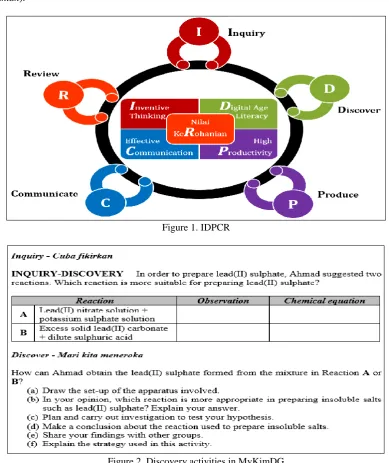
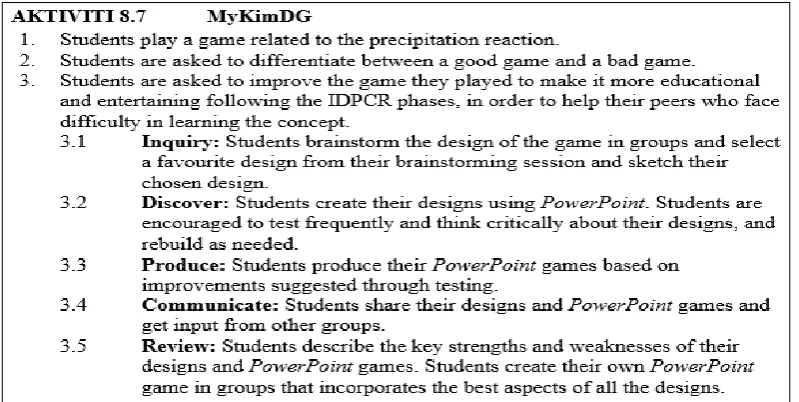
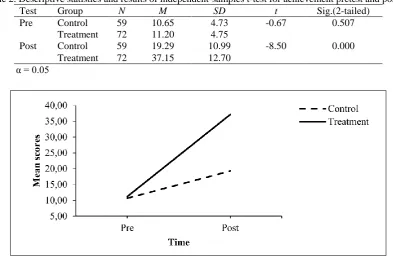
Technological literacy: Leverage contemporary technologies efficiently and effectively to communicate, collaborate, solve problems, accomplish tasks and as construction material (Papert, 1999). However, the focus is not on the technology alone, but on the promoting technological literacy.Based on these principles, activities in MyKimDG were designed so that students engage in discovery activities through teamwork. In addition, they were required to design digital games using ICT to teach their peers who faced problems in the learning of the chemical concept. To assist students in carrying out discovery activities and digital game design projects, they were guided to go through the IDPCR phases (Inquiry-Discover-Produce-Communicate-Review) (see Figure 1). The IDPCR phases are illustrated below with reference to a chemistry unit which involved precipitation reaction. To assist students understand why precipitation reaction used in the preparation of insoluble salt, they were engaged in discovery activity. Figure 2 shows the Inquiry and Discover phases of the discovery activity. To extend students‟ understanding about the observed phenomenon (i.e. precipitation reaction), they were given tasks to design digital games using ICT to teach their peers who faced problems in the learning of the chemical concept. The game-design activities are presented in Figure 3. Students were engaged in designing PowerPoint games to represent the phenomenon at the sub-microscopic level. It was expected that the learning environment created by implementation of MyKimDG would improve students‟ conceptual understanding, motivation in chemistry and 21st century skills. Apart from that, it was expected that the acronym IDPCR could help students remember the five important domains of 21st century skills, i.e. Inventive thinking, Digital-age literacy, high Productivity, effective Communication and spiritual values (nilai keRohanian).
Figure 1. IDPCR
Figure 3. Game-design activities in MyKimDG
Objective of Study
The authors developed the MyKimDG and carried out the study for several objectives as listed below: Identify the effectiveness of MyKimDG on students‟ achievement in Salt chapter.
Identify the effectiveness of MyKimDG on students‟ 21st century skills.
Identify the effectiveness of MyKimDG on students‟ motivation in chemistry.
Method
The study is a quasi-experimental study with a non-equivalent control group pretest-posttest design. There were two intervention groups: the treatment group and the control group. Students in the treatment group learned the Salt chapter using the MyKimDG developed by the authors. On the other hand, the control group students were instructed in conventional method using learning materials (i.e. text book and practical book) mandated by the national curriculum for Chemistry.
Subjects of Study
A total of 138 (56 males and 82 females) Form Four students (16 years old) from four secondary schools in one of the districts in Malaysia were involved in the study. Two schools were randomly selected as the treatment group and another two schools were assigned as the control group. Three classes with some similar characteristics (e.g. the ratio of male and female students; the experience of the Chemistry teacher who taught the class) were chosen from each group. There were 24 males and 35 females in the control group, and 32 males and 47 females in the treatment group. Both groups were taught by chemistry teachers who have more than five years of experience in teaching chemistry. The students then completed the pre-test to ensure that students from the both groups were homogenous in terms of existing knowledge in the Salt chapter, 21st century skills and motivation in chemistry. Independent-samples t-test results (see Table 1) showed that both groups had no significant difference in prior knowledge in the Salt chapter, 21st century skills and motivation in chemistry.
Table 1. Descriptive statistics and results of independent-samples t-test for pretest
Test Group N M SD t Sig.(2-tailed)
Achievement test Control 59 10.65 4.73 -0.34 0.732
Treatment 79 10.93 4.70
21st century skills Control 59 3.76 0.28 -0.66 0.510
Treatment 79 3.79 0.29
Motivation in chemistry Control 59 3.71 0.24 1.24 0.217
Treatment 79 3.65 0.27
Instruments of Study
Achievement Test
The achievement tests were administered in the form of a pretest and posttest before and after the intervention. Items in the pretest and the posttest were equivalent in terms of the level of Bloom‟s taxonomy and the concepts tested. The pretest was used to identify students‟ existing knowledge before interventions. The posttest scores were used to compare the effectiveness of interventions (i.e. conventional method and MyKimDG) in increasing students‟ achievement in the Salt chapter.
SMTSL Questionnaire
This questionnaire is a Likert scale questionnaire. The original version of the questionnaire, Students‟ Motivation towards Science Learning (SMTSL), was developed by Tuan, Chin and Shieh (2005). The word „science‟ in the original SMTSL was substituted for the word „chemistry‟. There are six domains of motivation involved: self-efficacy, active learning strategies, science learning value, performance goal, achievement goal, and learning environment stimulation. The Cronbach‟s alpha of each domain ranged from 0.72 to 0.81. The overall Cronbach‟s alpha of the SMTSL was 0.85. The questionnaire was given to the samples before and after the interventions. The pretest was used to measure students‟ existing motivation level before interventions. The pretest and posttest scores were used to evaluate the impact of the interventions in increasing students‟ motivation in chemistry.
M-21CSI Questionnaire
This questionnaire is a Likert scale questionnaire developed by Soh, Osman, and Arsad (2012). There are five domains of 21st century skills involved: digital age literacy, inventive thinking, effective communication, high productivity, and spiritual values. The five domains of 21st century skills were identified by Osman and Marimuthu (2010). The Cronbach‟s alpha of each domains ranged from 0.80 to 0.93. The overall Cronbach‟s alpha of the M-21CSI was 0.97. The questionnaire was given to the samples before and after the interventions. The pretest was used to measure students‟ existing 21st century skills level before interventions. The pretest and
posttest scores were used to evaluate the impact of the interventions in increasing students‟ 21st century skills
level.
Results
Students’ Achievement in the Salt Chapter
Data screening was carried out prior to statistical procedure. No missing data or outliers were found in the control group. On the other hand, two samples of treatment group in the original sample had missing data on either pre or post achievement test. Five outliers were detected on pretest, posttest or both among the sample in the treatment group. After deletion of cases with missing data and outliers, the numbers of samples in treatment group reduced to 72. Assumption regarding the normality of sampling was met for both pre and posttest scores of control and treatment groups.
T-tests were conducted to evaluate the impact of the interventions on students‟ scores in the achievement test. Table 2 shows the descriptive statistics and results of the independent-samples t-test for achievement pretest and posttest. The results showed that there was no significant difference in pre-test scores for the treatment (M = 11.20, SD = 4.75) and the control groups (M = 10.65, SD = 4.73); t(129) = -0.67, p = 0.507. However, there was a statistically significant difference in posttest scores for the treatment (M = 37.15, SD = 12.70) and the control groups (M = 19.29, SD = 10.99); t(129) = -8.50, p < 0.001.
Table 2. Descriptive statistics and results of independent-samples t-test for achievement pretest and posttest
Test Group N M SD t Sig.(2-tailed)
Pre Control 59 10.65 4.73 -0.67 0.507
Treatment 72 11.20 4.75
Post Control 59 19.29 10.99 -8.50 0.000
Treatment 72 37.15 12.70
α = 0.05
Figure 4. Achievement test scores across time point by intervention group
Students’ 21st Century Skills
Table 3 shows the descriptive statistics for the five domains of 21st century skills by group and time point.
Table 3. Descriptive statistics for the five domains of 21st century skills by group and time point
Domain Group N Pretest Posttest
M SD M SD
Digital age literacy Control 59 3.68 0.31 3.65 0.31
Treatment 79 3.64 0.34 3.72 0.25
Inventive thinking Control 59 3.72 0.33 3.76 0.33
Treatment 79 3.78 0.36 3.87 0.32
Effective communication Control 59 3.70 0.37 3.88 0.34
Treatment 79 3.86 0.39 3.90 0.40
High productivity Control 59 3.60 0.38 3.63 0.36
Treatment 79 3.55 0.33 3.77 0.36
Spiritual value Control 59 4.08 0.48 4.15 0.41
Treatment 79 4.11 0.48 4.22 0.47
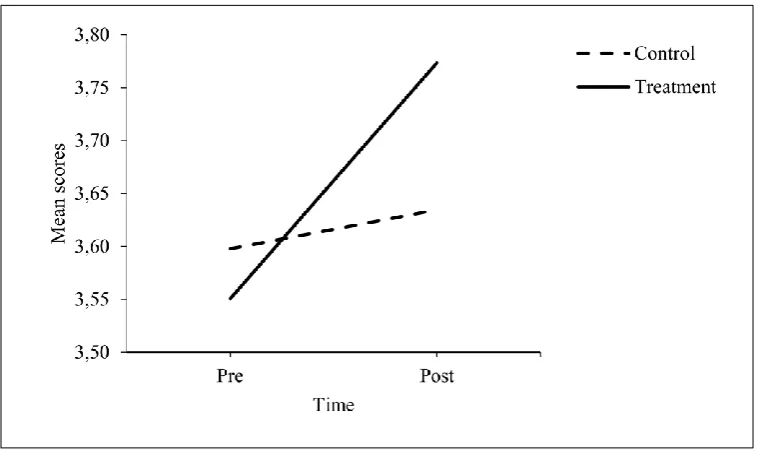
A doubly-multivariate analysis of variance was performed to investigate the group differences in 21st century skills at two time points (pre and post interventions). No data were missing. Preliminary assumption testing for normality, univariate and multivariate outliers, homogeneity of variance-covariance matrices, linearity and multicollinearity showed that no violations were found. Results (Table 4) showed that the interaction between group and time is statistical significant for high productivity [F(1, 136) = 5.375, p = 0.022; partial eta squared = 0.038]. Figure 5 shows the changes of high productivity scores across time point by intervention groups.
Table 4. Univariate test for each domain of 21st century skills
Effect Domains SS df MS F Sig. Partial η2
Time*Group Digital age literacy 0.192 1 0.192 2.497 0.116 0.018
Inventive thinking 0.034 1 0.034 0.342 0.560 0.003
Effective communication 0.258 1 0.258 2.246 0.136 0.016
High productivity 0.586 1 0.586 5.375 0.022 0.038
Spiritual value 0.040 1 0.040 0.178 0.674 0.001
Figure 5. High productivity scores across time point by intervention group
As shown in Table 5, further analyses of the interaction between group and time for high productivity scores revealed that there was no significant differences between groups at pretest [t(136) = 0.782, p = 0.436], but there was a significant differences between groups at posttest [t(136) = -2.266, p = 0.025]. An inspection of the posttest mean scores indicated that treatment group reported slightly higher levels of high productivity (M = 3.77, SD = 0.36) than control group (M = 3.63, SD = 0.36). The magnitude of the differences in the means (mean difference = 0.14, 95% Cl: 0.02 to 0.26) was small (eta squared = 0.04).
Table 5. Descriptive statistics and results of independent-samples t-test for high productivity
Time Group N M SD t Sig. (2-tailed)
Pre Control 59 3.60 0.38 0.782 0.436
Treatment 79 3.55 0.33
Post Control 59 3.63 0.36 -2.266 0.025
Treatment 79 3.77 0.36
α = 0.05
Further analyses as presented in Table 6 also showed that the high productivity scores improved significantly between pretest and posttest for treatment group, t(136) = -3.949, p < 0.001. These findings showed that students who used the MyKimDG were achieving higher in high productivity skill compared with the control groups who were taught in conventional method. Hence, the MyKimDG was proven to have the ability to increase students‟ high productivity skills.
Table 6. Descriptive statistics and results of paired-samples t-test for high productivity
Group Test N M SD t Sig. (2-tailed)
Control Pre 59 3.60 0.38 -0.680 0.499
Post 59 3.63 0.36
Treatment Pre 79 3.55 0.33 -3.949 0.000
Post 79 3.77 0.36
α = 0.05
Students’ Motivation in Chemistry
Table 7. Descriptive statistics for the six domains of motivation in chemistry by group and time point
Domain Group N Pretest Posttest
M SD M SD
Self-efficacy Control 59 3.55 0.57 3.34 0.67
Treatment 79 3.44 0.50 3.66 0.50
Active learning strategies Control 59 3.97 0.33 3.92 0.45
Treatment 79 3.86 0.38 3.92 0.40
Science learning value Control 59 3.99 0.40 3.96 0.52
Treatment 79 4.01 0.39 4.17 0.45
Performance goal Control 59 2.86 0.78 2.96 0.67
Treatment 79 2.83 0.55 3.01 0.80
Achievement goal Control 59 4.01 0.42 4.05 0.59
Treatment 79 4.05 0.50 4.14 0.44
Learning environment stimulation Control 59 3.87 0.41 3.82 0.45
Treatment 79 3.72 0.45 3.84 0.43
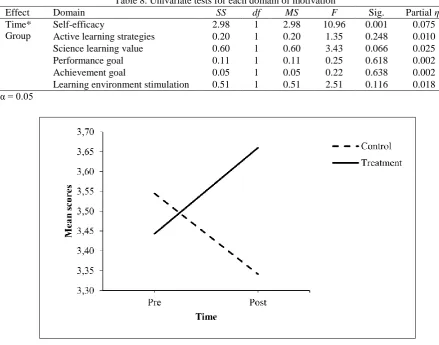
A doubly-multivariate analysis of variance was performed to investigate the group differences in motivation at two time points (pre and post interventions). No data were missing. Preliminary assumption testing for normality, univariate and multivariate outliers, homogeneity of variance-covariance matrices, linearity and multicollinearity showed that no violations were found. Results (Table 8) showed that the interaction between group and time is statistical significant for self-efficacy [F(1, 136) = 10.96, p = 0.001; partial eta squared = 0.075]. Figure 6 shows the changes of self-efficacy scores across time point by intervention groups.
Table 8. Univariate tests for each domain of motivation
Effect Domain SS df MS F Sig. Partial η2
Time* Group
Self-efficacy 2.98 1 2.98 10.96 0.001 0.075
Active learning strategies 0.20 1 0.20 1.35 0.248 0.010
Science learning value 0.60 1 0.60 3.43 0.066 0.025
Performance goal 0.11 1 0.11 0.25 0.618 0.002
Achievement goal 0.05 1 0.05 0.22 0.638 0.002
Learning environment stimulation 0.51 1 0.51 2.51 0.116 0.018 α = 0.05
Figure 6. Self-efficacy scores across time point by intervention groups
control group (M = 3.34, SD = 0.67). The magnitude of the differences in the means (mean difference = 0.32, 95% Cl: 0.11 to 0.53) was moderate (eta squared = 0.06).
Table 9. Descriptive statistics and results of independent-samples t-test for self-efficacy
Test Group N M SD t Sig. (2-tailed)
Pre Control 59 3.55 0.57 1.12 0.265
Treatment 79 3.44 0.50
Post Control 59 3.34 0.67 -3.06 0.003
Treatment 79 3.66 0.50
α = 0.05
Further analyses as presented in Table 10 also showed that the self-efficacy scores improved significantly between pretest and posttest for treatment group, t(136) = -3.40, p = 0.001. These findings showed that the MyKimDG was proven to have the ability to increase students‟ self-efficacy.
Table 10. Descriptive statistics and results of paired-samples t-test for self-efficacy
Group Test N M SD t Sig. (2-tailed)
Control Pre 59 3.55 0.57 1.70 0.095
Post 59 3.34 0.67
Treatment Pre 79 3.44 0.50 -3.40 0.001
Post 79 3.66 0.50
α = 0.05
Discussion
The findings suggested that learning through MyKimDG was more effective than the conventional method at supporting a higher achievement in the Salt chapter, 21st century skills and motivation in chemistry. In particular, it is proven that MyKimDG may improve students‟ high productivity skills and self-efficacy. The high productivity skill in this study consists of three dimensions: (i) prioritize, plan, and manage for results, (ii) effective use of real-world tools, and (iii) ability to produce relevant and high-quality products. Self-efficacy refers to the people‟s beliefs about their ability in producing designated levels of performance (Bandura, 1997).
Generally, the practice in Malaysian science classroom is very much bounded by conventional method that generally focus on knowing content in the learning materials for summative assessment purpose (Ministry of Education Malaysia, 2013). In some science classroom, teachers‟ practices do not reflect the real constructivist learning approach that required by the Malaysian Science Curriculum (Sim & Arshad, 2015; Tan & Arshad, 2014). Teachers normally begin teaching the Salt chapter by explaining the facts in the text book before students engage in experiments. Afterwards, students followed the procedures in practical book to carry out experiments. Teachers then led students to draw conclusions. In this process, students were not given opportunities to discover ideas or concepts for themselves nor think about the chemical concept behind a chemical procedure. In this partially student-centered approach, rote memorization was generally still dominant. As a result, students did not understand the procedures meaningfully. Therefore, students were unable to apply the memorized facts to complete assignments that involve higher order thinking skill – synthesizing salts and qualitative analysis of salts.
In MyKimDG, students were also given opportunities to engage in collaborative PowerPoint Game modifying and designing projects. They were required to carefully plan, utilize time and 21st century tools and resources toward the goal – creating PowerPoint game to help their peers who face difficulty in learning a particular chemical concept. The task were challenging but achievable with reasonable efforts and scaffolding. To help students in developing the PowerPoint game designing skills, the development phases proposed by Rieber, Barbour, Thomas and Rauscher (2008) was used as a guide in MyKimDG (see Figure 3). First, students played an existing game. Afterwards, they were asked to improve the game they played to make it more educational and entertaining. Students then designed their own digital game collaboratively. At the final stage, they were asked to improve and produce higher quality PowerPoint games that incorporate the best aspects of other groups‟ designs. The findings showed that this approach was able to increase students‟ perceived self-efficacy because students were given opportunities to experience successes. Repeated mastery experiences had led to a greater sense of competence (or self-efficacy). The findings also showed that this approach was able to increase students‟ high productivity skill because students were able to immerse themselves in the real-world practice. Besides, the IDPCR phases in MyKimDG can provide students a foundation in engineering design. As students become more fluent with the phases, they are expected to develop more complex projects. Students are also expected to practice the phases in everyday life and in the workplace, and hence, develop not only STEM-literate workforce, but also STEM-STEM-literate citizenry.
Figure 7. Example of dissolution model created by students
For other domains of 21st century skills (digital age literacy, inventive thinking, effective communication, and spiritual value), descriptive statistics (see Table 3) presented that students in the treatment group showed improvement in all these domains, even though not statistically significant. On the other hand, the application of conventional method was able to increase three domains of 21st century skills (inventive thinking, effective communication, and spiritual value), but there was a decrement in digital age literacy scores after intervention. Similarly, based on descriptive statistics (see Table 7), students in the treatment group showed improvement in other five domains of motivation (active learning strategies, science learning value, performance goal, achievement goal, and learning environment stimulation) even though not statistically significant.
By contrast, the application of conventional method was able to increase two domains of motivation (i.e. performance goal and achievement goal). The active learning strategies, science learning value, and learning environment stimulation scores for control group decreased after intervention.The results indicated that the use of the MyKimDG has the potential to further foster 21st century skills and motivation in chemistry compared to the conventional method. In order to draw firm conclusions, however, longitudinal studies are needed to determine long-term effect.
Conclusion
particular, it is proven that MyKimDG may improve students‟ high productivity skills and self-efficacy. However, MyKimDG can likely be improved to increase students‟ achievement in other domains of 21st
century skills and motivation in chemistry. Notwithstanding, this study provide some evidence that the inclusion of student as game designer approach in chemistry learning is able to increase students‟ achievement and motivation in chemistry as well as their 21st century skills.
References
Amin, H. M., Jaafar, J., Hood, Z., Saad, S., & Amin, H. M. (2013). Kemahiran insaniah pelajar prasiswazah: Analisis perbezaan jantina. Jurnal Teknologi (Social Sciences), 61(1), 19–25.
Ariffin, T. F. T. (2005). Gender differences in computer attitudes and skills. Jurnal Pendidikan, 30, 75–91. Balaban, A. T., & Klein, D. J. (2006). Is chemistry “The Central Science”? How are different sciences related?
Co-citations, reductionism, emergence, and posets. Scientometrics, 69(3), 615–637.
Balci, C., & Yenice, N. (2016). Effects of the scientific argumentation based learning process on teaching the unit of cell division and inheritance to eighth grade students. Journal of Education in Science, Environment and Health (JESEH), 2(1), 67–84.
Bandura, A. (1997). Self-efficacy: The exercise of control. New York: Freeman.
Baytak, A., & Land, S. M. (2010). A case study of educational game design by kids and for kids. Procedia - Social and Behavioral Sciences, 2, 5242–5246.
Brown, T. L., LeMay, H. E., Bursten, B. E., Murphy, C., & Woodward, P. (2011). Chemistry: The central science (12th ed.). New Jersey: Prentice Hall.
Bruner, J. S. (1962). On knowing: Essays for the left hand. Cambridge, MA: Harvard University Press.
Capar, G., & Tarim, K. (2015). Efficacy of the cooperative learning method on mathematics achievement and attitude: A meta-analysis research. Educational Science: Theory & Practice, 15(2), 553–559.
Chang, R. (2007). Chemistry (9th ed.). New York, NY: McGraw-Hill.
Deci, E. L., Vallerand, R. J., Pelletier, L. G., & Ryan, R. M. (1991). Motivation and education: The self-determination perspective. Educational Psychologist, 26(3&4), 325–346.
Demircioglu, T., & Ucar, S. (2015). Investigating the effect of argument-driven inquiry in laboratory instruction. Educational Research and Evaluation, 15(1), 267–283.
Gilbert, J. K., & Treagust, D. F. (2009). Introduction: Macro, submicro and symbolic representations and the relationship between them: Key models in chemical education. In J. K. Gilbert & D. Treagust (Eds.), Multiple representations in chemical education (pp. 1–8). Dordrecht: Springer Netherlands.
Hew, T. S., & Leong, L. Y. (2011). An empirical analysis of Malaysian pre-university students‟ ICT competency gender differences. International Journal of Network and Mobile Technologies, 2(1), 15–29. Hwang, G.-J., Sung, H.-Y., Hung, C.-M., Yang, L.-H., & Huang, I. (2013). A knowledge engineering approach to developing educational computer games for improving students‟ differentiating knowledge. British Journal of Educational Technology, 44(2), 183–196.
Iksan, Z., Halim, L., & Osman, K. (2006). Sikap terhadap sains dalam kalangan pelajar sains di peringkat menengah dan matrikulasi. Pertanika Journal of Social Sciences & Humanities, 14(2), 131–147.
Jung, J. Y., & Park, H. (2009). Learning by doing via game making. In D. Gibson & Y. Baek (Eds.), Digital simulations for improving education: Learning through artificial teaching environments (pp. 394–406). Hershey, PA: Information Science Reference.
Kafai, Y. B. (1996). Learning design by making games: Children‟s development of design strategies in the creation of complex computational artifact. In Y. Kafai & M. Resnick (Eds.), Constructionism in practice: Designing, thinking, and learning in a digital world (pp. 71–96). Mahwah, NJ: Lawrence Erlbaum Associates, Inc.
Kafai, Y. B., & Ching, C. C. (1996). Meaningful contexts for mathematical learning: The potential of game making activities. In Proceedings of the 1996 International Conference on Learning Sciences (pp. 164– 171).
Lay, A.-N., & Osman, K. (2015). Framework for 21st century chemistry instruction: A guide to teaching and learning of Qualitative Analysis. Technics Technologies Education Management, 10(2), 216–230. Lee, T. T., & Osman, K. (2014). Development of Interactive Multimedia Module with Pedagogical Agent
(IMMPA) in the learning of electrochemistry: Needs assessment. Research Journal of Applied Sciences, Engineering and Technology, 7(18), 3725–3732.
Lim, C. P. (2008). Spirit of the game: Empowering students as designers in schools? British Journal of Educational Technology, 39(6), 996–1003.
Ministry of Education Malaysia. (2013). Pelan Pembangunan Pendidikan Malaysia 2013-2025. Putrajaya: Kementerian Pendidikan Malaysia.
New York: John Wiley & Sons, Inc.
OECD. (2014). PISA 2012 results: Creative problem solving: Students’ skills in tackling real-life problems (Volume V). PISA, OECD Publishing.
OECD. (2016). Measuring science, technology, and innovation. Paris: OECD Publishing. Retrieved from https://www.oecd.org/sti/STI-Stats-Brochure.pdf
Osman, K., & Marimuthu, N. (2010). Setting new learning targets for the 21st century science education in Malaysia. Procedia - Social and Behavioral Sciences, 2, 3737–3741.
Osman, K., & Bakar, N. A.. (2013). Teachers and students as game designers: Designing games for classroom integration. In S. de Freitas, M. Ott, M. M. Popescu, & I. Stanescu (Eds.), New pedagogical approaches in game enhanced learning: Curriculum integration (pp. 102–113). Hershey, PA: IGI Global.
Osman, K., Iksan, Z., & Halim, L. (2007). Sikap terhadap sains dan sikap saintifik di kalangan pelajar sains. Jurnal Pendidikan, 32, 39–60.
Palmer, D. (2005). A motivational view of constructivist-informed teaching. International Journal of Science Education, 27(15), 1853–1881.
Papert, S. (1991). Situating constructionism. In I. Harel & S. Papert (Eds.), Constructionism (pp. 1–28). Norwood, NJ: Ablex Publishing Corporation.
Papert, S. (1998). Does easy do it? Children, games, and learning. Game Developer Magazine, Jun, 88.
Papert, S. (1999). Eight big ideas behind the constructionist learning lab (Vol. 405). Retrieved from http://stager.org/articles/8bigideas.pdf
Piaget, J. (1977). The development of thought: Equilibration of cognitive structures. New York, NY: Viking Press.
Prensky, M. (2008). Students as designers and creators of educational computer games: Who else? British Journal of Educational Technology, 39(6), 1004–1019.
Prensky, M. (2012). From digital natives to digital wisdom: Hopeful essays for 21st century learning. Thousand oaks, CA: Corwin.
Rieber, L., Barbour, M., Thomas, G., & Rauscher, D. (2008). Learning by designing homemade powerpoint games. In C. T. Miller (Ed.), Games: Purpose and potential in education (pp. 23–42). New York, NY: Springer.
Sim, W. S. L., & Arshad, M. Y. (2015). Inquiry practices in Malaysian secondary classroom and model of inquiry teaching based on verbal interaction. Malaysian Journal of Learning and Instruction, 12, 151– 175.
Soh, T. M. T., Osman, K. & Arsad, N. M. (2012). M-21CSI: A validated 21st century skills instrument for secondary science students. Asian Social Science, 8(16), 38–44.
Sukor, N. S., Osman, K., & Abdullah, M.. (2010). Students‟ achievement of Malaysian 21st century skills in chemistry. Procedia Social and Behavioral Sciences, 9, 1256–1260.
Tan, K. C. D., Goh, N. K., Chia, L. S., & Treagust, D. F. (2002). A cross-age study on the understanding of the reactions involved in basic inorganic chemistry Qualitative Analysis. Journal of Science and Mathematics Education in S.E. Asia, 25(2), 1–14.
Tan, Y. P., & Arshad, M. Y. (2014). Teacher and student questions: A case study in Malaysian secondary school problem-based learning. Asian Social Science, 10(4), 174–182.
Tuan, H.-L., Chin, C.-C., & Shieh, S.-H. (2005). The development of a questionnaire to measure students‟ motivation towards science learning. International Journal of Science Education, 27(6), 639–654. UNCTAD. (2017). Science, technology and innovation for development. Retrieved from
http://unctad.org/en/Pages/DTL/STI_and_ICTs/STI4D.aspx
Van Eck, R. (2006). Digital game-based learning: It‟s not just the digital natives who are restless. EDUCAUSE Review, 41(2), 16–18, 20, 22, 24, 26, 28, 30.
Vos, N., van der Meijden, H., & Denessen, E. (2011). Effects of constructing versus playing an educational game on student motivation and deep learning strategy use. Computers & Education, 56, 127–137. Vygotsky, L. S. (1978). Mind in society: The development of higher psychological processes. Cambridge, MA:
Harvard University Press.
Author Information
Ah-Nam Lay
Institute of Teacher Education
Sultan Abdul Halim Campus, Kedah, Malaysia Contact e-mail: [email protected]
Kamisah Osman
The National University of Malaysia