The mobile library and staff preparedness
Sarah-Jane Saravani Gaby Haddow
Introduction
The use of mobile technologies to support and enhance access to learning presents challenges to individuals and educational institutions in the design and development of engaging, relevant and sustainable programs. Given their history of service delivery beyond the physical ‘campus’ environment, libraries are well positioned to meet these challenges. However, there appears to be a wide variety of approaches taken by tertiary education libraries in the support of and service delivery to mobile devices (Gentry, 2011; Kroski, 2008; Traxler, 2008). The reasons for this disparity may be due to a range of factors including infrastructure, management and resources. It is these three factors; information technology infrastructure, management and human resources on which this chapter focuses.
The provision of access to information and effective delivery of information services is central to the role of librarians. Mobile technologies have added another dimension to this role – one that requires new knowledge, skills and competencies to ensure the needs and expectations of users are met. If libraries are to be successful in developing services for mobile technologies, their managers will have to consider two significant staffing issues. Firstly, it is important to understand what knowledge, skills and competencies are needed by staff to enable them to deliver services through mobile technologies, and secondly, to use that understanding to provide support and training for staff in the use of mobile technologies. In order to explore these issues and to contribute to the planning and professional development in the mobile library environment, a survey was undertaken of librarians working in the vocational education and training (VET) sector in Australia and New Zealand.
Vocational education and training (VET) libraries and mobile technologies
Generally, research into staff development in mobile technologies across the tertiary education library sector has focused on higher education institutions (Adams, 2009; Kealy, 2009; Zauha & Potter, 2009). While there are similarities between university (higher education) libraries and VET (similar to further education in the United Kingdom) libraries, the differences are notable. The VET sector is characterized by a focus upon industry and community engagement and this raises very specific issues for staff providing services to stakeholder cohorts. Libraries in the VET sector are responsible for delivering services to students who tend to be ‘competency’ rather than ‘research’ oriented, and many have ongoing workplace commitments relating to their studies. Mobile library services are particularly important for students who spend little time on campus and especially for the age bracket to which many VET students belong (Douch, Savill-Smith, Parker, & Attewell, 2010).
There are 58 VET institutions (called colleges, institutes of technology, and institutes of
and 78,000 New Zealand (Commonwealth of Australia, 2009; New Zealand Ministry of Education, 2009). These are large and diverse groups which comprise students taking
apprenticeships, non-degree (certificate and diploma) and degree level courses. Library staff from eight ITPs and six of the larger Australian VET institutions were invited to participate in a survey that included a short online questionnaire and an interview (conducted in-person, over the telephone, or via Skype). A purposive sampling method was used to recruit three
professional staff from each institution, representing a management position, a technology or systems-related position, and a position without either of the former responsibilities. A total of 42 librarians participated in the survey, which resulted in a slight skew towards management positions: 16 managers, 13 systems/IT-related, and 13 general librarian positions.
Competence using mobile technologies
For the purposes of establishing the competency of library staff in relation to mobile
technologies, participants were asked to indicate their level of competence on a five point scale from beginner through to advanced. Collapsing this scale to a dichotomous measure of
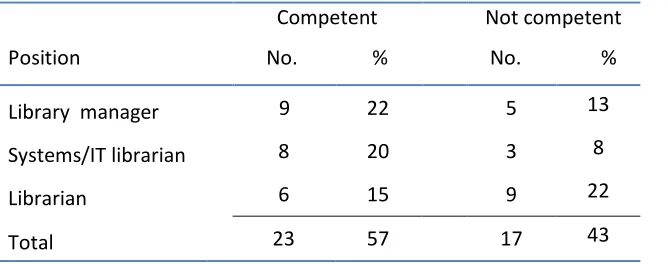
competent or not competent, the findings from the responding 40 participants (displayed in Table 1) show that the staff in management and systems/IT-related positions reported higher levels of competence. Overall, more than half of the sample reported competence using mobile technologies.
Table 1. Competence using mobile technologies by position type (N=40)
The self-reported competence levels were examined against the number of years participants had worked in libraries, with the view that library staff newer to the profession (likely to be younger and to have encountered mobile technologies in their personal life) may report competence at higher rates than those who had been employed in the profession for longer periods. The results suggest there may be some association between length of service and competence, however, the numbers in each age range are too low to reach a firm conclusion. It is notable that of the 39 participants who responded to this question, two-thirds had worked in libraries for 16 years or over. Table 2 presents these findings as raw numbers only.
Table 2. Competence using mobile technologies by length of service (N=39)
Length of service (yrs) Competent Not competent Position
Competent No. %
Not competent No. %
Library manager 9 22 5 13
Systems/IT librarian 8 20 3 8
Librarian 6 15 9 22
1-5 3 1
6-10 3 0
11-15 6 0
16-20 4 6
21+ 7 9
Total 23 16
Knowledge skills and competencies required for staff delivering mobile library services The interviews with the 42 participants were recorded, with additional notes taken by the researcher during the interview. This qualitative data was analysed through an iterative process involving listening to the recordings and reading the notes repeatedly until categories and overarching themes could be identified: a grounded theory approach. The responses to a question asking participants to discuss the knowledge, skills and competencies required for the delivery of mobile library services produced over 40 different types of knowledge, skills and competencies. The top five of these are:
1. Staff access to and competence using a range of devices (n=19): expressed by
participants as “We need to have our own mobile unit - tablet, smart phone – use to see how the services work”, “They need familiarity with the devices available”, and “It would work the best if the staff were up-skilled as the users of the devices”.
2. Willingness to try new technologies (n=11): illustrated in the following comments “a willingness to "press the buttons", ... a willingness to jump in and get your feet wet”, and “The biggest competency is - acceptance of trying things out, being more experimental and curious about trying things out, that is a state of mind not a skill”,
3. Knowledge of student use and expectations in relation to mobile technologies (n=10): as in “Staff would need to be knowledgeable in what devices students are using” and “We have to be in the student space, anticipate what the students are going to use”. 4. Skills to enable delivery of services through mobile technologies (n=9): seen in the
responses “Make sure library resources could be accessed on mobile devices” and “The library will need to adopt the technologies we want to promote our services on and become champions of this if we are to promote mobile technologies”.
5. Knowledge and ability to recognize opportunities using mobile technologies (n=8): with comments such as “The actual practice and experience in the use of these
technologies does help to broaden their horizons and give them ideas people might not have thought possible before” and “Able to identify a need and then find a technology to meet that need and then learning from that”.
At the other end of the scale, categories less frequently discussed included operating systems knowledge (n=5), web-based technology skills (n=2), and an understanding of compatibility issues (n=1).
that describe the type of knowledge, skills and competencies required for the mobile environment. The themes are: Technical - defined as IT, software or hardware skills;
Management - defined as facilitating the attainment of goals; and Adaptability – defined as the ability to engage with opportunity. Individual comments were analysed to determine whether a participant’s role in their library was associated with the different knowledge, skills and
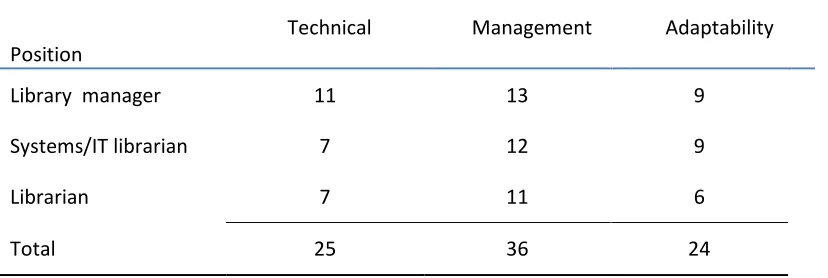
competencies themes, presented in Table 3.
Table 3. Knowledge, skills and competency themes by position type (N=42)
Position Technical Management Adaptability
Library manager 11 13 9
Systems/IT librarian 7 12 9
Librarian 7 11 6
Total 25 36 24
These results indicate that most participants, regardless of position, have noted the facilitation by management to attain knowledge, skills and competencies as the primary means to meet the requirements of the mobile environment. It is interesting to note that the systems/IT participants did not focus on Technical aspects, and nor was this a feature of the general librarian participant responses.
Training required to provide staff with knowledge, skills and competencies for delivering mobile library services
When participants were asked to describe the types of on-the-job training that was required to acquire the knowledge, skills and competencies to effectively develop and deliver mobile services, 39 training categories were identified in the responses. These ranged from hands-on experience with different mobile devices (n=13) to training in matching essential technology with users (n=1). The five most frequently discussed training categories are:
1. Hands-on experience with range of mobile devices (n=13). Illustrated by comments such as “informal, “get your boots on” type of training. Familiarisation with some mobile technology, for example iPads” and “We need time to play with the device and see how the functions work”, this category corresponds with the highest ranked category for the first question and demonstrates the importance participants placed upon having
physical access to the technologies for developing competency.
seen in the following comment “You can't help a student download an e-book unless you know how to do it yourself. However, I would not expect Library staff to need to know how to ... nor require training on using an e-book reader (that should be intuitive)”. 3. Gaining knowledge of applications for mobile devices (n=8). Participants were aware of
the availability of various applications for mobile devices and were particularly interested in library-related applications that could augment existing services. This is seen in the comments: “iPod/iPhone - what these can do, what they mean. Including a look at some popular and library applicable applications” and “Upskilling related to specific applications being used to create and or deliver services to mobile devices ”. 4. Creating mobile-friendly web pages (n=8). These participants focused on providing
access to library resources to a range of devices and, in some cases, mentioned the IT department as a factor, usually in the sense of a barrier to implementation. Comments included: “An understanding of the different ways our resources can be accessed
including mobile friendly web pages. How to create mobile-friendly web page” and “it is a matter at the moment to convince the IT department to get the web page mobile-friendly, this is a priority”.
5. Lack of current training and/or plans to introduce mobile services (n=6). Reasons varied for this response, from the lack of appropriate staff to deliver training to no plans for the introduction of mobile delivery, evident in: “On the job training - at the moment, there is none ... there are no formal training or education programs for mobile” and “I can't say what specific training we would need as we have no specific plans at the moment to implement any new mobile services”.
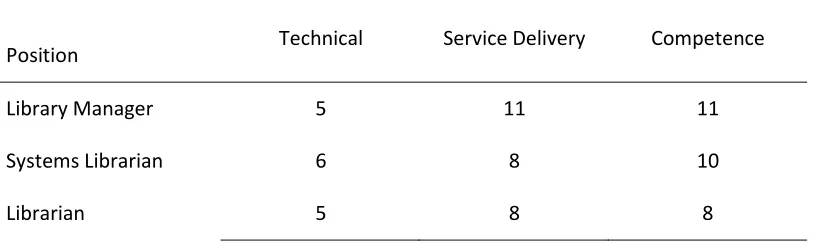
To gain an understanding of how the participants’ responses to this question could be used to inform library managers in their planning for mobile services, the 39 categories were analysed to develop overarching themes. Three training themes emerged: Technical – defined as IT, software or hardware skills; Service Delivery – defined as enabling the provision of services; and Competence – defined as demonstrated ability and understanding. More participants noted Competence than Service Delivery as training needs, but both exceeded the number of participants who mentioned training related to Technical themes. As illustrated in Table 4, there is remarkable agreement between the different position types in terms of the training needs required for developing and delivering mobile services.
Table 4: Training themes by position type (N=42)
Position Technical Service Delivery Competence
Library Manager 5 11 11
Systems Librarian 6 8 10
Total 16 27 29
Discussion and conclusion
The findings indicate that managers and systems/IT librarians are more likely to report
competence in using mobile technologies. It is unclear why more managers, in particular, would be competent in mobile technologies than librarians in generalist positions. Librarians who work directly with students would be expected to have more exposure to mobile devices used in their library than managers. Two explanations are possible. The first is that the non-manager librarians have a better understanding of what they do not know about mobile technologies and therefore under-estimate their competence, and the second is that the managers
interviewed over-estimated their competence because to do the contrary might suggest they were not adequately qualified to perform their role.
A number of the study’s findings indicate ways in which library managers can enable the professional development of their staff in the mobile library environment. In particular, the participants’ need for access to and training in a range of mobile devices is evident in their responses to both questions discussed in this chapter. Almost half the sample believed that competence using mobile devices was a necessary attribute for librarians to deliver mobile services, and close to a quarter of the sample said training in using mobile devices should be provided. For libraries engaged in or considering the implementation of mobile library services facilitation of hands-on experience for staff to develop competence in different devices is clearly an imperative.
Whereas professional development of this nature requires the support of library management, the second most common knowledge, skill and competency reported by participants –
willingness to try new technologies – relates to the personal characteristics of library staff. It suggests that there is a perception, among these librarians at least, that some library staff are reluctant to engage with new technologies. If staff are provided with opportunities to gain knowledge about student use of mobile devices and the applications available (the third most frequent responses to each question), this reluctance may very well be alleviated. In turn, the knowledge gained should lead to an ability to recognize the potential for mobile technologies (the fifth most frequent response to the first question).
A focus on service delivery is implicit in several of the most frequent responses and reflects the key role of library staff – to know the user and what the user wants. It is also interesting to note that ebook readers (identified as a separate category in the training responses) are seen as important technologies in the library; recognition perhaps of their increasing use and the complexities of providing access to resources through them.
While technical skills and adaptability were evenly distributed in the responses, with just over half the sample noting knowledge, skills and competencies in these themes, over three-quarters of the sample described them in terms of facilitation. Surprisingly, technical skills training was the least important theme that emerged when the training categories were analysed. Instead the participants’ responses suggest that knowledge, understanding and ability, as well as a focus on service delivery, are central to the training required for the effective delivery of mobile services.
Finally, at least two of the libraries (based on the number of participants interviewed from each institution) had either not implemented mobile services or had no training in mobile
technologies in place for staff. Given the extent of mobile device use, these libraries will need to move swiftly in order to meet the information access needs of their users.
References
Adams, C. (2009). Library staff development at the University of Auckland Library - Te Tumu Herenga: Endeavouring to "get what it takes" in an academic library. Library
Management, 30(8/9), 593-607.
Commonwealth of Australia. (2009). Australian vocational education and training statistics: Students and courses 2008. Adelaide, SA: NCVER. Retrieved from
http://www.ncver.edu.au/statistics/vet/ann08/students_and_courses_2008.pdf
Douch, R., Savill-Smith, C., Parker, G., & Attewell, J. (2010). Work-based and vocational mobile learning: Making IT work. London: LSN. Retrieved from
https://crm.lsnlearning.org.uk/user/login.aspx?code=100186&P=100186PD&action=pdfdl &src=WEBGEN
Gentry, M. (2011). Handheld mobile device support and training. Information Outlook, 15(1), 16-19.
Kealy, K. (2009). Do library staff have what it takes to be a librarian of the future? Library Management, 30(8/9), 572-582.
Kroski, E. (2008). On the move with the mobile web: Libraries and mobile technologies. Library Technology Reports, 44(5). Retrieved from
http://www.ellyssakroski.com/publications.html
New Zealand. Ministry of Education. (2009). Tertiary education enrolments – 2008. Retrieved from http://www.educationcounts.govt.nz/publications/tertiary_education/42244
Traxler, J. M. (2008). Use of mobile technology for mobile learning and mobile libraries in a mobile society, In Gill Needham and Mohamed Ally (Eds.). M-libraries: Libraries on the move to provide virtual access. London: Facet.