World Maritime University
The Maritime Commons: Digital Repository of the World
Maritime University
World Maritime University Dissertations Dissertations
2015
The legal aspect relating to the offer of port service
business by state owned companies outside the
territory Indonesia
Adi Nurcahya
World Maritime University
Follow this and additional works at:http://commons.wmu.se/all_dissertations
Part of theJurisdiction Commons
This Dissertation is brought to you courtesy of Maritime Commons. Open Access items may be downloaded for non-commercial, fair use academic purposes. No items may be hosted on another server or web site without express written permission from the World Maritime University. For more information, please [email protected].
Recommended Citation
Nurcahya, Adi, "The legal aspect relating to the offer of port service business by state owned companies outside the territory Indonesia" (2015).World Maritime University Dissertations. 497.
WORLD MARITIME UNIVERSITY
Malmö, Sweden
THE LEGAL ASPECT RELATING TO THE
OFFER OF PORT SERVICE BUSINESS BY
STATE OWNED COMPANIES OUTSIDE THE
TERRITORY INDONESIA
By
ADI NURCAHYA
INDONESIA
A Dissertation submitted to the World Maritime University in partial Fulfilment of the requirements for the Award of the Degree of
MASTER OF SCIENCE
In
MARITIME AFFAIRS
(MARITIME LAW AND POLICY)
2015
iii
ACKNOWLEDGEMENTS
On this occasion, the Author would like to give his highest appreciation and thankful
greetings to:
1. Allah the most Merciful and most Compassionate God;
2. My Family for supporting my daily life during my studies in Sweden;
3. The Board of Directors of Pelabuhan Indonesia III (Persero) Limited Company
for granting this opportunity to study and pursue my Masters Degree in
Maritime Affairs at World Maritime University, Malmö-Sweden;
4. The Head of the Legal Bureau Pelabuhan Indonesia III (Persero) Limited
Company that gave me absence permission to continue my further legal
education and also to all the Legal Staff of the Pelabuhan Indonesia III
(Persero) Limited Company;
5. All the staff of the Human Resources and General Affairs Department of
Pelabuhan Indonesia III (Persero) Limited Company, especially the Training
Department for arranging my study in Sweden;
6. All World Maritime University lecturers and ESSP teachers, especially in the
Maritime Law and Policy Specialization, including all staff and those at the
Henrik Smith Residence;
7. All Indonesian Students in S14, S15 and S16 for enhancing my adaptation
during my stay in Sweden and also all my S15 colleagues for the memories
during my study period in Sweden;
8. All persons that cannot be mentioned one by one for supporting my study in
Sweden.
“THE MAIN BODY OF THE DISSERTATION SHOULD NOT EXCEED 20,000
iv
ABSTRACT
Title of Dissertation: The Legal Aspect Relating to the Offer of Port Service Business by State Owned Companies outside the Territory Indonesia
Degree: MSc
This dissertation describes the legal aspect that may involve the strategic plan of a state-owned company that have a core business in port services in Indonesia to deliver port services outside the territory Indonesia. Furthermore, this dissertation have 3 (three) main concern, regarding: the legal aspects that considered by state-owned company; the mechanism of port business operated in the different jurisdictions of law; and the suitable schemes for state-owned company to expand port business overseas.
To response above concern, this dissertation used both normative and comparative method to examine the legal aspects of state-owned company in Indonesia to conduct port business overseas. In addition, list of important considerations was identified: the procedure of the bureaucracy within the state-owned company that shall be obey by the state-owned company; the compliance of the host State law and municipal law as well; the mechanism of procurement in Public Private Partnership (PPP) that shall be followed by state-owned company; and the legal entity of state-owned company itself that must be tenable after conduct port business overseas.
As a result, a state-owned company tends to deliver port business overseas with concession, cross-border cooperation and acquisition methods. In addition, each method has a different legal requirements and arrangements that creates distinguished features between one method and the other methods. On the other hand, there also exists similar legal requirements that are important to considered by a state-owned company to conduct port business overseas.
v
TABLE OF CONTENTS
Declaration ………. ii
Acknowledgements ……… iii
Abstract ……….. iv
Table of Contents ………... v
List of Tables ………. ix
List of Figures ……… x
List of Abbreviations ………. xi
CHAPTER I INTRODUCTION I.1 Background ……… 1
I.2 Objectives ………... 4
I.3 Research Questions ……… 4
I.4 Methodology ……….. 5
I.5 Structure of Dissertation ……… 5
CHAPTER II THE LEGAL REGIME OF PORT BUSINESS IN INDONESIA II.1 Port Business in Indonesia ………. 6
II.2 The Legal Aspect of State-owned company in Indonesia …….….. 8
II.3 A Paradigm Shift related with the Enactment of Law 17/2008 regarding Shipping ……….… 9
II.4 Competition between State-owned company and Private Company in Indonesia ………... 10
vi
CHAPTER III
PORT BUSINESS BY VIRTUE OF CONCESSION
III.1 The Legal Aspects of Port Privatization ……… 13
III.2 Concession Agreement:
III.2.a Definition of Concession ………. 17
III.2.b “Important Clauses” in Concession Agreement ………….. 18
III.2.c Rights and Obligations of The Parties under Concession ... 24
III.3 The Legal Status of Asset during Concession Period:
III.3.a Mechanism of Asset Financing ………... 25
III.3.b Asset Utilization during Concession Period ……… 31
III.3.c Legal Status of Asset after Concession Period ……… 32
III.4 Liability and Insurance of the Asset during Concession Period …… 33
III.5 Management of Risk during Concession Period ……… 35
III.6 Applicable Law and Dispute Resolution Matters ……….. 39
III.7 Compliance Host State Domestic Requirements:
III.7.a Corporate Social Responsibility (CSR) ………... 41
III.7.b Anti-Corruption Law ………... 42
III.8 Example of Port Concession: COSCO Pacific–Piraeus Container
Terminal, Greece ……….... 44
III.9 Field Study: The Opportunity to Deliver Port Business by Virtue of
vii
CHAPTER IV
ALTERNATIVE WAYS TO DELIVER PORT BUSINESS OVERSEAS
APART FROM CONCESSION
IV.1 Cross-Border Cooperation:
IV.1.a Definition and Scope ………... 49
IV.1.b Legal Requirements ………. 52
IV.1.c Example of Cross-border cooperation: Copenhagen
Malmö Port (CMP), Denmark-Sweden ……….. 53
IV.1.d The Possibility of Port of Tenau Kupang (Indonesia) to
Arrange the Cross-border cooperation with Port of Darwin
(Australia) ……….…... 55
IV.2 Acquisition:
IV.2.a Definition and Companies Practices ………..………. 55
IV.2.b Legal Issues and Basic Requirements ………..…... 57
IV.2.c Example of Port Acquisition: Dubai Port World (DPW) –
Maher Fairview Container Terminal, Canada ………. 60
IV.2.d The Possibility for State-Owned Company to Acquire
other Company that have Core Business in Port Services
at Overseas ………..…….... 62
CHAPTER V
LEGAL REQUIREMENTS FOR CONDUCTING PORT BUSINESS
OVERSEAS THROUGH BID/TENDER PROCESS
V.1 Preparation of Bid/Tender Documents by the State-Owned
Company……….. 63
viii
V.3 Negotiations and Legal Drafting Aspect between the Host
Government and State-Owned Company ………..…..…... 66
CHAPTER VI
CONCLUSION ……….. 68
REFERENCES LIST ………. 71
APPENDICES
A The Project Procurement Options ……….. 81
B The Rights and Obligations of the Parties under Concession
Contract ……….. 82
C Field Study: The Opportunity to Conducting Port Business by
Virtue of Concession in Port of Antwerp ………..…….… 84
D The Salient Features of CMP Business ………...……... 87
E Cargo Handling Performance of CMP in 2010-2014 ………..……... 89
F The Possibility of Port of Tenau Kupang (Indonesia) to arrange the
Cross-Border Cooperation with Port of Darwin (Australia) …..…... 90
G The Stages to Conduct Acquisition ………...….. 93
H The Possibility for State-Owned Company to Acquire other
Company that have Core Business in Port Services ………….…..… 96
I The Typical Forms of the Bid Process for Concession …..…….…… 97
J The Examples of Bid/Tender Criteria from various States …….….... 100
K The Examples of Negotiable and Non Negotiable Aspects during
ix
LIST OF TABLES:
Table 1 Geographical Service Coverage of Pelindo I, II, III and IV …… 2
Table 2 Correlation between Investment Amount and the Duration of
Concession in Port of Antwerp ……… 19
Table 3 Comparison between Longer and Shorter Duration of
Concession Contract ……… 20
Table 4 Concession Fee for Different Port based on the Price per Square
Meters in 1997 ………. 22
Table 5 Different Schemes of Assets Financing with Different Sources
of Modalities ……… 26
Table 6 Financing Schemes of Port Infrastructure and Superstructure in
the Different States ……….. 27
Table 7 Responsibilities of Terminal Operator or Port Authority in
accordance with Construction, Financing and Operations of the
Terminal/Port Facility ……….. 29
Table 8 Disaggregation of Cost in Terminal Container Business relating
with the Assets that Provided by Concessionaire ……… 30
Table 9 Port Business Cooperation between one Port and another Port .. 50
Table 10 Cooperation among Port Authority, Terminal Operators and
x
LIST OF FIGURES:
Figure 1 Spectrum of Combination of Public and Private Participation
on Risk during Concession Period ……… 35
Figure 2 Diminishing Risk that Bears by the Concessionaire during
Concession Period ………. 37
Figure 3 The Map of Port of Piraeus including Ship Repair Base,
Commercial Port, Passenger Port and Container Terminal as
Concession Areas ……….. 45
Figure 4 The Photograph of Pier III (left-under construction) and Pier
II (right-already operation) of Piraeus Container Terminal as
Concession Areas ……….. 46
Figure 5 Comparisons between Monthly Throughput per July and Year
to Year Throughput per July of Performance of COSCO
Pacific in Piraeus Container Terminal, Greece ………. 46
Figure 6 Ranks of Global Container Operators in 2014 ……….. 47
Figure 7 Main Differences between Merger and Acquisition …………. 56
Figure 8 View of Maher Fairview Container Terminal (Left) and
(right) Performance of Container Handling at 2008-2013 …… 61
Figure 9 Expansion Area based on the Phase II Project at Maher
xi
LIST OF ABBREVIATIONS:
ADB Asian Development Bank
B2B Business to Business
BLO Build Lease Operate
BOST Build Operate Share Transfer
BOT Build Operate Transfer
BROT Build Rehabilitate Operate Transfer
BTO Build Transfer Operate
CMP Copenhagen Malmö Port
COSCO China Ocean Shipping Company
CSR Corporate Social Responsibility
DCMF Design Construct Manage Finance
DPW Dubai Port World
EBRD European Bank for Reconstruction and Development
ECRP European Commission Regional Policy
EIB European Investment Bank
EPC Engineering Procurement Construction
EPEC European PPP Expertise Centre
EU European Union
FCPA Foreign Corrupt Practice Act
GPA General Agreement on Government Procurement
IBRD World Bank International for Reconstruction and
Development
ICC International Chamber of Commerce
IDA International Development Association
ISPS International Ship and Port Facility Security
MIGA International Finance Corporation; Multilateral Investment
Guarantee Agency
xii
PCT Piraeus Container Terminal
Pelindo/Inaport Pelabuhan Indonesia/Indonesia Port Corporation
PPA Piraeus Port Authority
PPIAF Public-Private Infrastructure Advisory Facility
PPP Public Private Partnership
RFPs Request for Proposals
SOLAS The International Convention for the Safety of Life at Sea
TEU Twenty Equivalent Units
UNCITRAL United Nations Commission on International Trade Law
UNCTAD United Nations Conference on Trade and Development
1
CHAPTER I
INTRODUCTION
I.1 Background
The state-owned company based on Article 1 Law 19/2003 regarding State-owned
company is a company in which majority of the shares are owned by the Indonesian
Government. Furthermore, based on their nature to pursue a profit, every state-owned
company in Indonesia has its own core business such as mining, oil and gas, financing
institution, infrastructure and superstructure provider, agriculture and many more. In
addition, one of the prospective core businesses that has been run by state owned
companies in Indonesia is the port business, which can be divided further into port
services and port supporting services (hereinafter called “port business”). Moreover,
there are only 4 state owned companies that have been conducting port business in
Indonesia, which are: Pelabuhan Indonesia I Limited Company (Pelindo I), Pelabuhan
Indonesia II Limited Company (Pelindo II), Pelabuhan Indonesia III Limited
Company (Pelindo III) and Pelabuhan Indonesia IV Limited Company (Pelindo IV)1.
According to Ray (2008), these state owned companies have already been clustered by
the Indonesian Government for their geographical service operations as listed below2:
1
There are also state owned companies that conduct business in port, but this dissertation only focuses on Pelindo I-IV
2
2
Table 1 Geographical Service Coverage of Pelindo I, II, III and IV (Ray, 2008)
Name Coverage (Province)
Pelindo I/PT Pelabuhan
Indonesia I (Persero)
Aceh, North Sumatera, Riau
Pelindo II/PT Pelabuhan
Indonesia II (Persero)
West Sumatra, Jambi, South Sumatra, Bengkulu,
Lampung, Jakarta
Pelindo III/PT Pelabuhan
Indonesia III (Persero)
Central Kalimantan, South Kalimantan, West Nusa
Tenggara, East Nusa Tenggara
Pelindo IV/PT Pelabuhan
Indonesia IV (Persero)
All Sulawesi, Maluku, Irian Jaya
Port business in Indonesia was supervised and regulated by the Ministry of
Transportation as the representative of the government. As a consequence, the
government has authorized to set up particular criteria for any legal entity to pursue a
licence as a prerequisite to delivering port business in Indonesia. Moreover, the
requirements for pursuing a licence above are complicated and it needs a huge capital
to finance both the infrastructure and superstructure of a port. For this reason, the port
service provider in Indonesia has been dominated by state owned companies as stated
above, because they have an excellent financial capability and good network with the
government. However, this practice changed in 2008, when the government decided to
enhance the competitiveness of port services among state owned companies and
private companies to increase the level of services in port. Furthermore, the Indonesian
Government nowadays is given an equal opportunity to every company, including
private companies to conduct port services and port supporting services, by virtue of
Law 17/2008 regarding Shipping (hereinafter is called “Shipping Law”) which
replaced Law 21/1992. The enactment of Law 17/2008 also gives affect in the event of
tight competition between state owned companies that have core business in port
services with other private companies to provide the same commodity of services
3
Furthermore, in order to face tight competition with private companies as above,
the Board of Directors of state owned companies and the Minister of State-owned
company as a representative of the shareholder, have proposed a concept of conduct
the port business with the “out of the box” principle3. This “out of the box” principle
means that state owned companies as profit oriented companies must run their port
business in a non-ordinary way to maximize profit. One of the implementations of the
“out of the box” principle that can be realized by the state owned companies therefore
is to expand their port business overseas.
In addition, with the port expansion plan as stated above, the mechanism that can
be created by a state-owned company to conduct port business overseas is through a
Public Private Partnership (PPP) that is recognized as a port governance model for
introducing the private companies to finance, build, manage and operate public
infrastructure and superstructure, especially ports in foreign States. Moreover, state
owned companies will then be faced with many requirements including legal,
commercial and also technical requirements that shall be obeyed by the government in
the State where the cooperation of port business will be taken. Recalling the port as
public infrastructure, the cooperation with the local port authority will also cover
utilization schemes and the time period of the port operation, which means that the
public body represented by the local port authority is entrusted to manage the public
services to a third party or in other words, give a mandate to the state-owned company
to operate and manage the port (Report of UNCTAD Secretariat, 1993).
Moreover, state owned companies need a precise benchmark for conducting port
business overseas. In addition, Copenhagen Malmö Port (CMP) Company, COSCO
Pacific and Dubai Port World (DPW) are probably suitable benchmarks for state
owned companies, since they are also conducting port business outside of the law
where they have registered their company4. Subsequently, with the possibility to
3
The 100% of shares of Pelindo I-IV owned by the government 4
4
conduct port business overseas, it would make state owned companies not only expand
their business outside Indonesia to gain maximum profit, but also run the “out of the
box” principle as mandated by the Board of Directors and the shareholders of the state
owned companies.
I.2 Objectives
The objectives of this research are to:
a. Carry out the legal aspects of the state-owned company to conducting port
business outside the territory Indonesia;
b. Compare all relevant methods to conduct port business in the different jurisdiction
of law or operated by a company outside the jurisdiction of the State where the
company was registered;
c. Determine the suitable schemes for the state-owned company to expand port
business outside the territory Indonesia in a legal perspective.
I.3 Research Questions
The questions found within this research are:
a. What are the legal aspects that shall be considered by the state-owned company to
conduct port business outside the territory Indonesia?
b. In the practical field, how is port business operated in the different jurisdictions of
laws operated by a company outside the jurisdiction of the State where the
company is registered?
c. What are the suitable schemes for the state-owned company to expand port
5
I.4 Methodology
The methodologies used to answer the research questions are:
a. The normative method to obtain all relevant information regarding the legal
aspects to deliver port business outside the territory Indonesia;
b. The comparative method to examine the possibility of state owned companies to
conduct port business outside the territory Indonesia based on practical field.
I.5 Structure of Dissertation
This dissertation is structured as follows:
a. Chapter II describes the legal regime of port business in Indonesia;
b. Chapter III comprises port business overseas that was granted by the government
of the host State by the mechanism of concession;
c. Chapter IV examines the alternative ways to deliver port business overseas
through cross-border cooperation and the acquisition method;
d. Chapter V details the aspect of conducting port business overseas by the
tender/bid process mechanism;
e. Chapter VI concludes all the objectives that have been explained in Chapters II-VI
6
CHAPTER II
THE LEGAL REGIME OF PORT BUSINESS IN INDONESIA
II.1 Port Business in Indonesia
The port by virtue of Article 1 point 16 of Shipping Law is defined as a place
which consists of land and/or water with certain limits whereas a government activity
and business activity took place. Moreover, this place is also used to dock ships, load
and unload passengers and/or goods, in the form of terminals and berths, which are
equipped with safety equipment and security facilities. As mentioned in the previous
chapter, there are 4 state owned companies that have core business in port services and
authorized by the government to manage and operate ports in Indonesia. Moreover,
each company has the same role as a port operator in order to provide port services for
customers and by virtue of Article 90 (3) Shipping Law those services are:
A. Port Services related to vessels, passengers and cargo services, which consists of5:
1) Berth services;
2) Bunker and fresh water services;
3) Passenger facilities service and vehicle services;
4) The berth service for unloading/loading cargo and containers;
5) Shed and storage services for cargo, unloading/loading and port equipment;
6) Container, liquid bulk, dry bulk and Ro-Ro services;
7) Unloading/loading services;
8) Cargo distribution and cargo consolidation;
5
7
9) Tug services.
B. Port Supporting Services, which by virtue of Article 90 (4) of Shipping Law are
defined as any business which is related to the port services and can give added
value to the port services. Moreover, the port supporting services consist of6:
1) Offices;
2) Tourist facilities;
3) Hotels;
4) Fresh water installation;
5) Electrical and telecommunication services;
6) Waste water treatment service and sewage services;
7) Bunker services;
8) The locality for vehicle waiting spaces.
Actually, ports in Indonesia are already well operated by Pelindo I-IV, although
the competitiveness level among other foreign ports is not enough to satisfy their
customers. According to Geiger (2011) in Ariadno & Afriansyah & Dewi (2014), ports
in Indonesia have a low competitiveness value which is measured by the Global
Competitiveness Index 2011 issued by the World Economic Forum. This weakness
has been caused by the low quality of “seaport and infrastructure” and “technological
readiness” parameter in Indonesian ports. In addition, in the previous year for
international shipping Indonesia’s rank also dramatically declined from 44 to 80 in
2010 which raised the commitment of the government to deal with the compliance of
international standards, especially for international standards that apply to ports such
as SOLAS and the ISPS Code7.
6
The concession that will be discussed does not relate to port supporting services, only to port service 7
8
There are many stakeholders involved inside the port. Furthermore, these
stakeholders consist of the government institutions as well as private companies. The
government institution has authority and plays as the regulator in port activities.
Moreover, the example of this practice is reflected on the Port Authority that has the
responsibility to govern all aspects related with port activities and state owned
companies conducting port business under their supervision. In other examples, the
Coast Guard is responsible for the safety and security of ships and the same
responsibilities also for ports. Moreover, the Immigration will be responsible for any
issues for the embarkation and disembarkation of passengers, while the Quarantine is
responsible for any issues related to animals or agricultural products that have been
handled by the port operators in their terminals. Other stakeholders from the
government side, such as Customs are responsible for issues regarding tax for any
cargo that has been unloaded/loaded within a port.
On the other side, there can also be found private companies that offer port
services inside the port. These private companies consist of: freight forwarding
companies; companies that offer services of unloading/loading cargo; and companies
which provide labour supply for port operations. Subsequently, all stakeholders as
mentioned above must have a synergy with the state-owned company in order to
deliver excellent services to their customers.
II.2 The Legal Aspect of a State-owned company
There are different types of state owned companies in Indonesia based on the
composition of their shareholders and based on their core business. First, based on the
composition of the shareholders there is a state owned companies that all of the shares
are solely owned by the government and on the other hand there are also state owned
companies where the government holds the majority of shares and the rest of the
shares are owned by the private entity or owned by the society. On the other hand,
based on the type of core business that is being delivered, state owned companies in
9
type of core business that they are committed to, namely: mining; oil and gas;
financing and insurance; agricultural; Engineering Procurement Construction (EPC)
companies; railways; aviation; and ports. In addition, the core business of a state
owned companies is stipulated in their article of association and they cannot conduct
other business which diverges from the type of core business in their article of
association, except only for conducting business which supports their core business.
Moreover, this dissertation will be focused only on the state owned companies that
have a core business in port services.
Related to the plan to conduct of any strategic plan, the Board of Directors of the
state owned companies shall notify the Board of Commissioners and pursue written
approval from the government before they can take any further legal action.
Indonesian law then recognizes this act as a subjective clause that must be obeyed to
give those acts the full power of authorization. Contrast with this consideration, the act
of the Board of Directors without prior notification and approval as mentioned above
will only be categorized as a personal act and not bound as a corporate act that is
binding for the state-owned company8. This means, a state-owned company shall
follow that procedure in order to get the approval of the initial process to execute any
of their strategic plans.
II.3 A Paradigm Shift Related with the Enactment of Shipping Law
The Indonesian shipping law regime was amended in 2008, when the government
enacted the Shipping Law. This Shipping Law has dramatically changed the role of
state owned companies that have core business in port services. Before the enactment
of the Shipping Law, the state owned companies had the power to manage ports with
the delegation of power gained from the Ministry of Transportation. The port business
was conducted by a landlord system which means all operations and the
standardization of port services was decided solely by state owned companies through
8
10
consultation with the Ministry of Transportation. Moreover, state owned companies
can set up a standard of port productivity and they also enjoy the mechanism of
monopoly, since they have the power to manage the port and hire the
unloading/loading companies to perform unloading/loading activities in port with their
own setting of productivity. In this case, however the state-owned company still has to
provide an infrastructure and superstructure for the customer in order to deliver their
port services.
Moreover, after the enactment of the Shipping Law, state owned companies were
allowed by the government to act only as port operators with the concession in one or
more than one terminal within the port. In addition, this affect to the state owned
companies that they have obligations to improve the performance in their terminal.
Furthermore, the productivity of the port will be decided by the Port Authority and the
state-owned company shall pursue their productivity to meet the requirements that are
given by the Port Authority.
II.4 Competition between States Owned Companies and Private Companies in Indonesia
The enactment of the Shipping Law created tight competition for providing port
services between state owned companies and private companies9. Moreover, this
competition often occurs when they have the same interest in the same concession
object that being is auctioned by the government. The government then would choose
the best strategic partner which is suitable for their requirements. In addition, the
competition to get the concession from the government, the competition for building
the port infrastructure as well as the superstructure and the competition for providing
port services are common competitions that happen between state owned companies
and private companies. In more detail, based on the administrative arrangements, state
owned companies will face difficulty relating to the fact that private companies will be
9
11
more adaptive, because they have a simple bureaucracy of business approval rather
than state owned companies which have a long bureaucracy, especially at the
government level.
One of the advantages gained in the tight competition above is the improvement
of port service quality to the customers. Another positive effect is the government will
get cooperation with the best fitting strategic partner for maintaining and developing
the port in order to drive the logistic supply for domestic and international demands
through the trade that is derived from the carriage of goods by sea. The competition
itself will also trigger both state owned companies and private companies to pull-out
their maximum effort when they participate in developing commercial ports that are
under regulated by the government.
II.5 Consideration for Conducting Port Business outside the Jurisdiction of Indonesia
There are many considerations before a state-owned company decides to execute
their strategic plan to deliver port business outside Indonesia. Furthermore, the
experience has shown that the port business in Indonesia has been regulated by the
government and localized as per region. In addition, with the possibility of having a
port business overseas it is a good way to expand the port service business and also
gain more profitable business prospects for the future of a state-owned company.
Worldwide there are many companies that deliver port business outside their
registered State jurisdiction. Moreover, state owned companies should learn about the
successful Dubai Port World (DPW) while they extend the port services outside the
United Arab Emirates jurisdiction. The information taken from Kane (2015) indicates
that the income of DPW increased by 11.7 per cent in 2014 due to the container
volumes increasing within their global ports. In other information, based on Turkey
year-on-12
year net profit increase of US$292.75 million in 2014 related to their global port
business operations at Piraeus-Greece, Guangzhou and Xiamen (China).
Another experience has shown when the company becomes a global port operator
it can develop its business comparing if they only act as terminal operator in their
registered State. Additionally, Notteboom and Rodrigue (2012) has described that
global operators divided further into several categories: stevedore, financial holdings
and maritime shipping companies. For instance, in the stevedore categories, global
terminal operators can expand their business into the new markets to replicate their
expertise and also to diversify their revenue. Moreover, in the financial holdings
categories, global terminal operators can attract several financial interests ranging
from investment in banks and retirement funds to sovereign wealth funds that have
been attracted by the port terminal sector as an asset class with revenue generation
potential. The global terminal operators which come from maritime shipping
companies then also play a contribution role to support their core maritime shipping
13
CHAPTER III
PORT BUSINESS BY VIRTUE OF CONCESSION
III.1 TheLegal Aspects of Port Privatization
A Port is a place where the public interest represented by the government, and the
private interest represented by a private companies come together to provide port
services for the customers. The nature of port business requiring a substantial
investment, is a challenging issue for any government especially regarding on how to
provide those funds, since in some developing States the port infrastructure and
superstructure are not considered as a top priority in the national budgeting of the
State10. Furthermore, this obstacle has then been overcome by the government by
privatization of the port, which means that the management of the port is handover to a
private company. Cruz & Marques (2012) note that in the last 2 decades, the
development of infrastructure has often been supported by public–private partnerships,
particularly under concession arrangements. In addition, UNCTAD (2008) has given a
clear definition of privatization as a transfer of ownership of assets from public to
private sector or the application of private capital to fund investment especially in port
facilities, equipment and systems which may:
a. Improve the management capability of port entities by increasing productivity;
b. Reduce the financial demands on the public sector by employing the private sector
to generate revenue for both the government and private sector;
c. Enhance the service quality offered to the end user.
10
14
Furthermore, according to Tongzon & Heng (2005) port privatization, will
improve port operational efficiency, increase port competitiveness and be more
adaptable regarding the customers demands. Meanwhile, based on Vasigh & Howard
(2012) ideas port privatization will be an effective mechanism in introducing
corporatization into the port infrastructure the origin of which was characterized by
poor competition and direct control by government. The development of ports with the
PPP scheme will also contribute value to the economy when it maintains optimally in
the investment, operational and risk among the parties (Siemonsma & Nus &
Uyttendaele, 2012).Further, in order to have an overall picture regarding the different
schemes in the PPP procurement this can be seen in Appendix A.
Monios & Bergqvist (2015) have given their opinion that the participation of the
private sector in port development is an on-going process of governance reform which
had the advantage to increase efficiency and reduce cost to the public sector.
According to Estache & Gonzalez & Trujillo (2001) in Mexico the port services, such
as towage and pilotage, is also to be delivered by private companies that have
cooperated with the government in the form of license agreements, which means the
government has given a business licence to those private companies to conduct
business that origin recognized as the duties of the government to provided11.
One of the strategies to conduct privatization in the government perspective is
through an administrative decision for granting a concession to the competent private
company that can be registered in the State or it comes from outside the jurisdiction of
the State. However, in much literature the meaning of concession is sometimes
different to privatization. This concept was adopted by Guasch (2004) who mentions 3
aspects that distinguish concession from privatization. The first aspect is the
concession does not involve a sale or transfer of the ownership of physical assets.
Second the concession contracts are limited in duration and third the government as
owner of the assets much closer involved in the concession. Moreover, this
dissertation will not adopt this notion because of the objectives of privatization are
11
15
quite similar with concession and the 3 aspects explained above can also be seen in
privatization depending on the scheme that was adopted by the parties.
Moreover, the privatization of the port is related to the introduction of the concept
of Public Private Partnership (PPP) recognized as a significant way to boost the
development of the port in some countries12. In more detail, there are many rules that
govern the participation of the private sector to the infrastructure and superstructure
development of particular States, as follows (Son, 2012):
a. The United Nations Commission on International Trade Law (UNCITRAL) with
UNCITRAL Legislative Guide to Privately Financed Infrastructure Projects
(PFIP) Guide 2001 and 2003;
b. World Trade Organization (WTO) on General Agreement on Government
Procurement (GPA);
c. The Organisation for Economic Co-operation and Development (OECD) on Basic
Elements of a Law on Concession Agreement;
d. The European PPP Expertise Centre (EPEC) Guide on Guidance;
e. EU Legislation regarding procurement as mentioned in Public Sector Directive
(2004/18/EC) and Utilities Directive (2004/17/EC);
f. National Legislation which may be diverse in States that adopt the civil law
system and the common law system13. The civil law system is likely to be more
prescriptive to regulate the PPP aspect in their national law rather than the
common law system. The civil law system provides more standard clauses that
cannot hindered by the parties. On the other hand, the common law system is
more adaptive and negotiable since the system lies that the notion of PPP aspect
will be decided by the parties rather than formulated on a standard clause.
The legal aspects of port privatization also cannot be separated with the port
privatization principles as proposed by UNCTAD (1998). Subsequently, these
principles that the stakeholders must pay attention to are:
12
More information regarding PPP is available on world bank website 13
16
1. The privatization scheme will also open for the international bidder, who must be
transparent, objective and non-discriminative for all candidates;
2. The privatization scheme shall have to conform with the governments policy. For
instance it is in line with the master plan made by the government and it follows
the provision of the bid/tender process;
3. The Port Authority will be an owner and manager of the landlord port, because
they will no longer be involved in the actual operation of the port;
4. The concessionaires must have an award on the basis of their performance. This
consideration also means that the bidder, who has an excellent financial capability
and strong technical performance should be appreciated by the government during
bid/tender process;
5. The privatization scheme can be executed as full privatization or partial
privatization. In full privatization, the government gives all parts of the
privatization object to be managed by the concessionaire. On the other hand, in
partial privatization only some parts of the privatization object are handled over to
the concessionaire and the government will take further cooperation with the
concessionaire to provide the port services.
Moreover, the nature of a port as a public infrastructure is an important basis to
understand how the PPP arrangement, like the concession plays a vital role in
delivering port business overseas. Notteboom (2007) suggested that in the concession
government it is believed that an enterprise based-port will be more flexible in terms
of services and operations, more efficient in market competition, higher productivity
and also has a better response to the customers’ satisfaction.
The term and conditions of the concession agreement, then shall comply with the
host’s national law, since in the concession agreement legal considerations that are
derived from national law. Further, Phillips (2009) adds information that in the
concession there would be a delegation of power from the government to the private
company to using, operating and developing parts of the state public domain of
17
national law, therefore can be extended into the application of all laws, decrees, rules,
administrative circulars and other regulations that are applicable to the ports, including
all provisions of any international treaty or convention to which the host State has
become a party to.
III.2 Concession Agreement
III.2.a Definition of Concession
One of the strategies to perform port privatization is through a concession
agreement between the government and concessionaire. In order to get more details
about the concession, we should examine the definition of concession as follows:
Definition by Oxford Dictionaries (2015):
“The right to use land or other property for a specified purpose, granted by a
government, company, or other controlling body”
Definition by Cambridge Dictionaries Online (2015):
“A special right to property or land”
Definition by Merriam Webster (2015):
“(1) A grant of land or property especially by a government in return for
services or for a particular use (2): a right to undertake and profit by a specified
activity (3): a lease of a portion of premises for a particular purpose; also: the
portion leased or the activities carried on”
Based on the definitions stated above, the concession can be summarized as a
grant by the government or other controlling body (in this case) to any legal entity for
the utilization of land or other property for the purpose to undertake and generating
profit. Moreover, in the port concession is usually granted by the port authority to a
private operator for providing specific port services, such as terminal operations or
18
The concession in some legislation is also identical with the authorization from
the government to a private entity. Furthermore, this authorization was adopted by
Directive 2014/23/EU of the European Parliament and of the Council of 26 February
2014 on the award of concession contracts, in paragraph 14 which stated that:
“In addition, certain Member State acts such as authorisations or licences,
whereby the Member State or a public authority thereof establishes the
conditions for the exercise of an economic activity, including a condition to
carry out a given operation, granted, normally …….. concession contracts
provide for mutually binding obligations where the execution of the works or
services are subject to specific requirements defined by the contracting authority
or the contracting entity, which are legally enforceable”.
III.2.b “Important Clauses” in Concession Agreement
The concession agreement between government and the concessionaire will
consist of many clauses that join together to form a concession contract. The
concession contract itself will follow the principle of freedom of contract as a basic
principle recognized in the contract of law, but in practice the government has the
privilege to offer their basic standard form to the nominated concessionaire and then
the negotiation of contract will be conducted between them14. Furthermore, this
dissertation tries to extract the important clauses in concession agreement which are
consists of:
1. Concession Period
The concession period is a timeline agreed by the government to the
concessionaire relating to how long the concession will be given to the concessionaire.
The port concession period usually depends on the investment provided by the
concessionaire. Moreover, Indonesia Port Corporation III was giving 72 years of the
concession by the Ministry of Transportation related to the building and development
14
19
of the Multipurpose Terminal of Lamong Bay in Indonesia that cost a total of 500
million USD of company investments (Indonesia Infrastructure Initiatives, 2015).
According to Djakarta Post (2014), Indonesia Port Corporation III also got their
concession for 25 years related to the revitalization of Surabaya West Channel that
connect Port of Tanjung Perak as the second biggest port in Indonesia with an outer
part of shipping route which cost total investment of 73 million USD. This scheme is
also followed by the Antwerp Port Authority that set the concession period to be
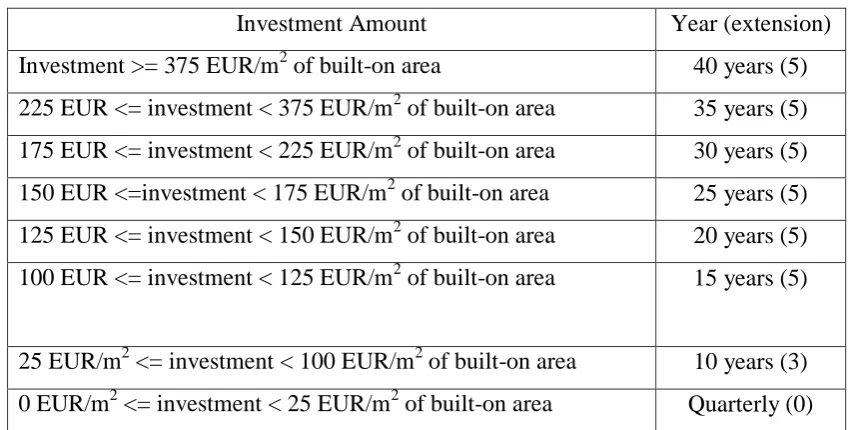
determined by the investment of the concessionaire as mentioned in the table that
follows (Port of Antwerp, 2011).
Table 2 Correlation between Investment Amount and the Duration of Concession
in the Port of Antwerp (Port of Antwerp, 2011)15
Investment Amount Year (extension)
Investment >= 375 EUR/m2 of built-on area 40 years (5)
225 EUR <= investment < 375 EUR/m2 of built-on area 35 years (5)
175 EUR <= investment < 225 EUR/m2 of built-on area 30 years (5)
150 EUR <=investment < 175 EUR/m2 of built-on area 25 years (5)
125 EUR <= investment < 150 EUR/m2 of built-on area 20 years (5)
100 EUR <= investment < 125 EUR/m2 of built-on area 15 years (5)
25 EUR/m2 <= investment < 100 EUR/m2 of built-on area 10 years (3)
0 EUR/m2 <= investment < 25 EUR/m2 of built-on area Quarterly (0)
Beside the determination of the concession period by the amount of the
concessionaire’s investment, other criteria also have been influenced to determine the
concession period. Moreover, the government sets other criteria depending on the kind
of business that will be conducted by the concessionaire. In the Port of Antwerp, the
Port Authority also set criteria for the port concession period, which is given to be 40
years for maritime activities and 30 years for the service activities (Antwerp Port
15
20
Authority, 2011). Apart from the Port of Antwerp, Mundhe (2008) suggests that the
concession period should be determined from the years required for the concessionaire
to recover their investment. Ye & Tiong (2003) also Hanaoka & Phalaphus (2012)
hold the same perspective, from a different point of view which mentions that the
concession period should be determined from the reasonable risk exposure calculation
that may happen during the concession period which may be useful for the
government and the private sector. Furthermore, another criterion to setting up the
duration of the concession was suggested by the European Commission in Pallis &
Notteboom & Langen (2008) which analyses that the maximum concession duration is
8 years when there are no investments made, 12 years in the case of significant
investments in movable assets, and 30 years in the case of significant investments in
immovable assets.
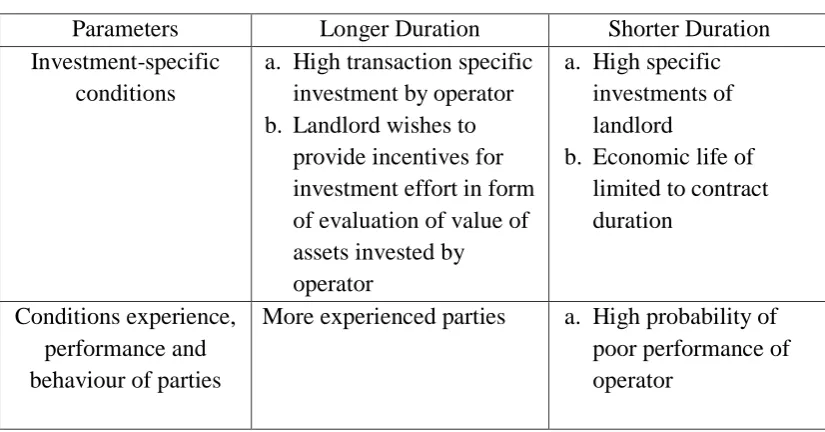
Regarding the further discussion to concession period, Theys & Notteboom
(2010) described on how the investment, field actual condition and contractual
condition were affected by the duration of concession as characterized by below
parameters:
Table 3 Comparison between Longer and Shorter
Duration of Concession Contract (Theys & Notteboom, 2010)
Parameters Longer Duration Shorter Duration
Investment-specific conditions
a. High transaction specific investment by operator b. Landlord wishes to
provide incentives for investment effort in form of evaluation of value of assets invested by operator
a. High specific investments of landlord
b. Economic life of limited to contract duration
Conditions experience, performance and behaviour of parties
21
b. High probability of free riding and hold-up problem
Contractual conditions a. High
transactions/negotiation cost
b.Use properly designed contract
a. High probability of contract renegotiation b. Parties require high
flexibility
c. Landlord requires eviction threats
2. Concession Fee and the Others Financial Obligations of Concessionaire
The concession fee is defined by Phillips (2009) as a fee to be paid by the
concessionaire to the government through conceding authority during the concession
period. The concession fee then will be separated into an entry fee as payment in front
of the concession period and a performance fee that will be paid annually during the
concession period; this performance fee is subject to be re-evaluated based on the rate
of inflation.
Moreover, Brooks & Cullinane (2007) added more information regarding the
concession fee that in some cases, the Port Authority will impose a fixed concession
fee, but the concessionaire has the freedom to set its own charge to be negotiated with
the Port Authority. In addition, the Port Authority also uses a method that was
generated from the two-part system which consists of a fixed concession fee and a
variable royalty fee based on the calculation per ton or per TEU of cargo that has been
handled as the minimum throughput that must be reached by the port operator in a
certain period.
According to Trujillo and Nombela (n.d) in European Ports, the revenue that is
gathered from the ports tariff income is generally higher than the revenue from
concession fees, the margin being around 37%16. The other rational business
consideration beyond this margin is because the risks for conducting port business are
16
22
already shifted to the concessionaire and the concessionaire then must provide the
standard priced services to the customers in order to maintain their cash flow.
However, in practice the Port Authority realized that the concession fee is not solely
depending on the market situation which fluctuates depending on the seaborne trade
volume. For this reason they proposed a new concept that the concession fee can be
calculated by the price per square meters that was used, the subject to be revised
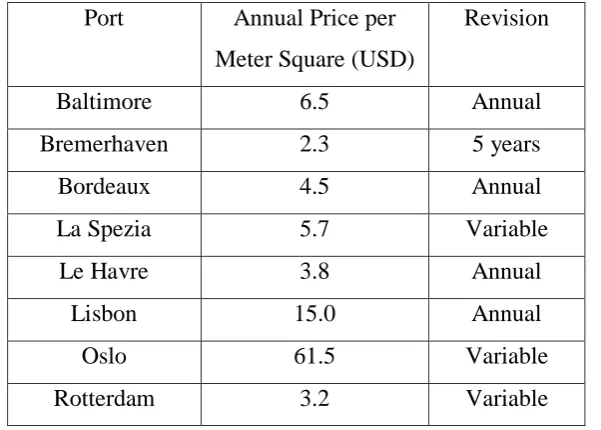
periodically17. To gather more information about this topic, this dissertation tries to
give an example of the concession fee for different ports based on price per square
meters as follows:
Table 4 Concession Fee for Different Ports based on the Price per Square Meters in
1997 (Trujillo and Nombella, n.d)18
Port Annual Price per
Meter Square (USD)
Revision
Baltimore 6.5 Annual
Bremerhaven 2.3 5 years
Bordeaux 4.5 Annual
La Spezia 5.7 Variable
Le Havre 3.8 Annual
Lisbon 15.0 Annual
Oslo 61.5 Variable
Rotterdam 3.2 Variable
The other financial obligations of the concessionaire may vary from one
concession contract to the other. These financial obligations will cover all expenses
that not were covered by the entry fee and performance fee. In addition, other financial
obligations can consist of the requirement to provide an insurance for the whole
infrastructure and superstructure built at the concession area and it can also be stand
for all the expenses related to the maintenance of the infrastructure and superstructure
17
The price per square meter seems not to be interfering with the market situation 18
23
that has been built. Moreover, Phillips (2009) gives a list that the other financial
obligations also consist of:
a. A rehabilitation bond for a specific amount with a specific maturity date to
guarantee the proper and timely performance of the rehabilitation work;
b. A maintenance and performance bond to ensure maintenance and performance
targets meet with the government’s standard;
c. A hand back bond to guarantee the performance of the concessionaire related to
the hand back obligations under the concession contract.
3. Detail of the Asset Build by the Concessionaire
The concession agreement usually contains a clause regarding the detailed aspect
of the assets, including fixed assets and removable assets that shall be built by the
concessionaire under the specific provision. This list of detailed assets is negotiated
during the negotiation stage or it is already requested by the government under the
procurement or bid/tender documents related to the asset utilization under concession.
In addition, the list of the detailed assets is important to be considered by both parties,
since at the end of the concession period some assets will shift to the government and
some assets will remain in the possession of former concession holder that subject to
be re-cooperation with the new concession holder or it subject to incorporate into the
new concessionaire investment if the former concessionaire is appointed for the new
concession period.
The concessionaire has obligations to build neither tangible nor intangible assets
during the concession period. Furthermore, the tangible assets can consist of the
number of berths that have been built, the shipping draft project, which includes the
capital and maintenance dredging project, the build and developments of container
yard, shed, procurements of unloading/loading equipment’s, buildings and area for
cargo consolidation. On the other hand, intangible assets usually relate to the image of
24
market, the port’s productivity of unloading/loading and also it stands for the shorter
dwelling time used to serve ships in port.
Assets built by the concessionaire are owned and managed depending on the
contractual provisions as set out in the concession agreement. For instance, by
following the Build Operate Transfer (BOT) scheme, the assets remain as the
concessionaire’s possession, before at the end of the concession being transferred to
the government with all the attributes linked with those assets.
III.2.c Rights and Obligations of the Parties under Concession
The concession agreement gives the different rights and obligations for the parties
which will be formulated in the standard contract of concession. The rights and
obligations of the government are more likely to be emphasized, since they have
already delegated their authority to serve the public interest in the port business to be
executed and managed by the concessionaire. Furthermore, in practice we
acknowledge that the Business to Business (B2B) model puts equal treatment and
equal position of the parties involved and therefore the interest of the concessionaire
shall also put at the same level as well as the interest of the government. The stigma of
landlord attributes owned by the government through the conceding authority has a
strong effect to diminish the rights of the concessionaires. As a consequence, the
concession contract seems to be non-negotiable between the concessionaire candidate
and government19.
Based on PPP guidance that was provided by the World Bank (n.d), the rights and
obligations of each concessionaire and government under a concession agreement can
be summarized in Appendix B20.
19
Normally in the commercial agreement, each party is treated equally, but in concession agreement the government seems to have privileges rather than concessionaire
20
25
III.3 The Legal Status of Asset during Concession Period: III.3.a Mechanism of Asset Financing
One of the most important aspects for the concessionaire after the concession
agreement was signed is to think about the assets financing plan during the concession
period. Since the concessionaire usually applies for financial arrangements to get a
loan from third parties, such as the bank and other financial institutions, the
concessionaire will have additional obligations to maintain their cash flow during the
concession period in order to repay the loan from the creditor on the due date of the
payment period. Furthermore, Delmon (2010) in Dewulf & Blanken & Bult-Spiering
(2011) gives an alternative way in order to finance the infrastructure and
superstructure in the different schemes as follows:
1. Equity contribution with use share capital and shareholders’ funds in order to
finance the building of both infrastructures and superstructures21;
2. Debt contribution from the lenders that can be in the form of bank or financial
institutions;
3. Mezzanine contribution, which is located between equity and debt. This
contribution usually forms as a quasi-equity such as preference share with fixed
annual dividend (Switala, n.d);
4. Project finance as the common financial arrangement for concession.
Another financing scheme was adopted by Pelindo III that issued a global bond in
order to finance their project. According to Wee (2014) Pelindo III had got funds in
the amount of USD 500 million with Australia New Zealand Bank (ANZ), Credit
Suisse and Standard Chartered Bank acting as joint lead managers, while the Bank
Negara Indonesia (BNI) Securities and Mitsubishi UFJ Financial Group were
appointed as co-managers for executing the company’s strategic plan related with the
financing of infrastructure and superstructure under the concession contract with the
Indonesian Government in the Multipurpose Terminal Lamong Bay project for 75
21
26
years and Surabaya West Channel (Alur Pelayaran Barat Surabaya) project for 25
years22.
In addition, UNCTAD (1993) listed that actually there are 3 main sources for the
financing of port infrastructure and superstructure, which are:
1. Public financing, that uses funds from the government;
2. Private financing that uses funds generated from the PPP;
3. Mixed financing between public and private as a mix combination that uses part
of the government funds and some part of the private funds.
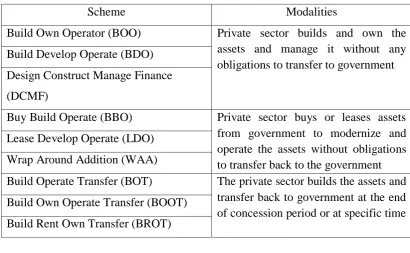
In the other perspective, Hemming (2006) tried to divide the different schemes of
assets financed by PPP with emphasizing on the modalities that can be an option for
the government to financing the infrastructure and superstructure, as shown in the
table 5 below:
Table 5 Different Schemes of Assets Financed with Different Sources of Modalities
(Hemming, 2006)
Scheme Modalities
Build Own Operator (BOO) Private sector builds and own the
assets and manage it without any obligations to transfer to government Build Develop Operate (BDO)
Design Construct Manage Finance
(DCMF)
Buy Build Operate (BBO) Private sector buys or leases assets from government to modernize and operate the assets without obligations to transfer back to the government Lease Develop Operate (LDO)
Wrap Around Addition (WAA)
Build Operate Transfer (BOT) The private sector builds the assets and transfer back to government at the end of concession period or at specific time Build Own Operate Transfer (BOOT)
Build Rent Own Transfer (BROT)
22
27
Build Lease Operate Transfer (BLOT) as mandated by the contract
Build Transfer Operate (BTO)
Trujillo & Nombela (n.d) also described the different ways of financial schemes
in different states related with the investment of port infrastructure and port
superstructure. Moreover, the investment requires the participation of private
companies to contribute funds to build the port infrastructures and superstructures. In
addition, it was indicated that private companies actually can elaborate together with
the local government or port authority to conduct port services with their investment.
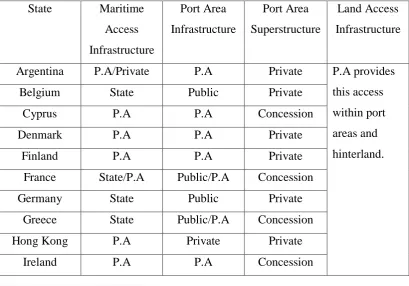
Subsequently, to have more understanding about cooperation among public and
private bodies, we suggest table 6 below that shows a financing scheme in
infrastructures and superstructures related to the port service in different states:
Table 6 Financing Schemes of Port Infrastructure and Superstructure in the
Different States (Trujillo & Nombela, n.d)23
State Maritime
Access
Infrastructure
Port Area
Infrastructure
Port Area
Superstructure
Land Access
Infrastructure
Argentina P.A/Private P.A Private P.A provides
this access
within port
areas and
hinterland.
Belgium State Public Private
Cyprus P.A P.A Concession
Denmark P.A P.A Private
Finland P.A P.A Private
France State/P.A Public/P.A Concession
Germany State Public Private
Greece State Public/P.A Concession
Hong Kong P.A Private Private
Ireland P.A P.A Concession
23
28
Italy State/A.P Public/P.A Concession
Malta State P.A Concession
Mexico P.A P.A Private
Netherlands State P.A Private
Portugal P.A P.A Concession
Spain P.A P.A Concession
Sweden P.A P.A Concession
UK P.A P.A Concession
Venezuela P.A P.A Private
Sources: European Parliament (1993), ESPO (1996) on Trujillo and Nombela (n.d)
Remark: (1) P.A= Port Authority, (2) P= Public/Financed by central, regional or municipal government (3) Concession= superstructures owned by public, but operated by private company
In order to add some information related to the port financing above, there also
exists a different type of cooperation between the government and port operator.
According to Murthy & Notteboom (2002) in Notteboom (2007) there are 4 (four)
types of cooperation being adopted by the government to develop their port with the
participation of a private company or state-owned company. This adoption relies on
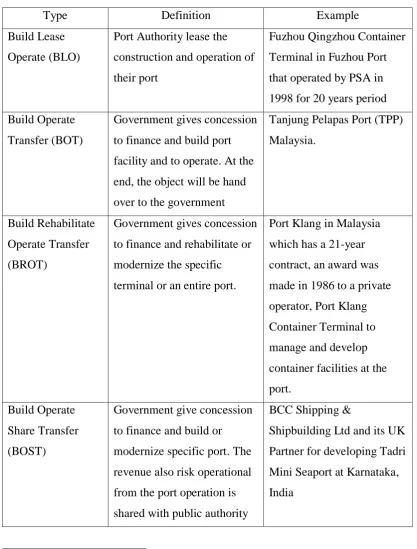
the type of scheme that was suggested by the government. Moreover, table 7 below
shows the different responsibilities of government as well as private companies
29
Table 7 Responsibilities of Terminal Operator or Port Authority in accordance with
Construction, Financing and Operations of the Terminal/Port Facility (Notteboom,
2007)24
Type Definition Example
Build Lease
Operate (BLO)
Port Authority lease the
construction and operation of
their port
Fuzhou Qingzhou Container
Terminal in Fuzhou Port
that operated by PSA in
1998 for 20 years period
Build Operate
Transfer (BOT)
Government gives concession
to finance and build port
facility and to operate. At the
end, the object will be hand
over to the government
Tanjung Pelapas Port (TPP)
Malaysia.
Build Rehabilitate
Operate Transfer
(BROT)
Government gives concession
to finance and rehabilitate or
modernize the specific
terminal or an entire port.
Port Klang in Malaysia
which has a 21-year
contract, an award was
made in 1986 to a private
operator, Port Klang
Container Terminal to
manage and develop
container facilities at the
port.
Build Operate
Share Transfer
(BOST)
Government give concession
to finance and build or
modernize specific port. The
revenue also risk operational
from the port operation is
shared with public authority
BCC Shipping &
Shipbuilding Ltd and its UK
Partner for developing Tadri
Mini Seaport at Karnataka,
India
24