World Maritime University World Maritime University
The Maritime Commons: Digital Repository of the World Maritime
The Maritime Commons: Digital Repository of the World Maritime
University
University
World Maritime University Dissertations Dissertations
11-5-2017
A cost-benefit analysis of the risk control options towards
A cost-benefit analysis of the risk control options towards
mitigating maritime hazards leading to injuries and fatalities in
mitigating maritime hazards leading to injuries and fatalities in
tanker shipping companies: a critical and thought provoking case
tanker shipping companies: a critical and thought provoking case
study
study
Antonios Polyzois
Follow this and additional works at: https://commons.wmu.se/all_dissertations
Part of the Transportation Commons
Recommended Citation Recommended Citation
Polyzois, Antonios, "A cost-benefit analysis of the risk control options towards mitigating maritime hazards leading to injuries and fatalities in tanker shipping companies: a critical and thought provoking case study" (2017). World Maritime University Dissertations. 548.
WORLD MARITIME UNIVERSITY
Malmö, Sweden
A COST-BENEFIT ANALYSIS OF THE RISK
CONTROL OPTIONS TOWARDS MITIGATING
MARITIME HAZARDS LEADING TO INJURIES
AND FATALITIES IN TANKER SHIPPING
COMPANIES:
A critical and thought provoking case study
By
POLYZOIS ANTONIOS
Greece
A dissertation proposal submitted to the World Maritime University in partial fulfilment of the requirements for the award of the degree of
MASTER OF SCIENCE
In
MARITIME AFFAIRS
(MARITIME SAFETY AND ENVIRONMENTAL ADMINISTRATION) 2017
Declaration
I certify that all materials in this dissertation that is not my own work have been
identified and that no material is included for which a degree has previously been conferred on me. The contents of this dissertation reflect my own personal views and
are not necessarily endorsed by the university.
(Signature)
(Date): September 19, 2017
Supervisor: Professor Jens-Uwe Schröder-Hinrichs World Maritime University
Co-supervisor: Armando Graziano World Maritime University
--- Assessor: Professor Dimitrios Dalaklis
Organization/Institution: World Maritime University
Co-assessor: Dr. Floris Goerlandt
Acknowledgments
By thanking every individual who has contributed during the gradual progression of this Msc program, I have to pinpoint my supervisor Professor Jens-Uwe Schröder-Hinrichs and Armando Graziano for their thorough supervision and encouragement during the investigation process.
Abstract
This project aims are (a) to discover how the implementation of Risk Control Options (RCO) reduces the probability of seafarers’ exposure to certain unwanted events and (b) to determine ways to reduce the losses of millions of dollars by mitigating injuries and fatalities on tanker vessels. For this reason, this dissertation will (a) introduce the importance of RCOs, (b) reinforce an incremental progress in defining the negative value of accident costs in a company's budget and (c) will identify the reasons that companies suffer from financial losses. It highlights the
deficiencies leading to injuries and fatalities such as the lack of cost-benefit analysis from the corporate side, combined with the companies' ideology to indirectly reduce the implementation costs of RCOs. Irrespective of the difficulty to calculate (a) the risk reduction percentages of RCOs, (b) all event trees and (c) the tangible and intangible costs of injuries and fatalities, this investigation proves that any implementation in RCOs has a direct impact on reducing the financial losses of tanker shipping companies.
The scope of this case study is a scientific approach toward risk and cost reduction from the implementation of RCOs, with an ulterior incentive of gaining economic benefits. This study probes the knowledge of ten senior managers, who serve as responsible decision makers in ten different tanker-shipping companies, engaged in the Aframax and Panamax sector. It also draws upon interviews with senior managers combined with cost-benefit and risk analysis reports in order to reveal the companies’ reasons for indirectly investing in RCOs. This thesis further outlines
use data from projects of the Marine Environmental Protection Committee (MEPC) and Maritime Safety Committee (MSC).
The current project integrates four collision, grounding, explosion, and fire preventative RCOs so as to extract its conclusions. The important measurable variables of this study are the direct and indirect costs of injuries and fatalities, while
with reference to RCOs, the level of risk reduction of saved lives, the cost of implementing an RCO, the economic benefit deriving from that RCO and finally its
individual GCAF and NCAF. Important variables that are ignored are oil spill reduction in tons and the potential cost of averting one tonne of oil spilled since they are out of the scope of this study. It has been found that RCO1: hot work procedure training and RCO2: engine room additional emergency exit maintain significantly low GCAF rates, and, as a result, are named as cost-effective in comparison to RCO3: active steering gear redundancy and RCO4: navigational sonar. Furthermore, it has been proved that a single fatality in tanker shipping is expected to generate a total loss of $3.400.000, while a disabling injury results in a loss of $82.500. Finally, the current case study benchmarks against previous recommendations, found in similar Formal Safety Assessments (FSA) for tanker vessels, demonstrating novel road-signs towards regaining companies’ capital.
Table of Contents
Acknowledgments ... II Abstract ... III Table of Contents ... V List of Figures ... VII List of Tables ... VIII Glossary ... IX
CHAPTER No1: INTRODUCTION ... 1
1.1 Statement of the problem ... 1
1.2 Purpose and outline ... 3
1.3 Significance of research study ... 4
1.4 Research aim and objectives ... 5
CHAPTER No2: METHODOLOGY ... 7
2.1 Definition of case study ... 7
2.2 Strengths and Weaknesses of Case Studies ... 7
2.3 Justification of the chosen strategy ... 8
2.4 Definition of semi-structured interviews ... 8
2.5 Strengths and weaknesses of interviews ... 9
2.6 Justification of the chosen semi-structured interviews ... 11
2.7 Definition of secondary data ... 11
2.8 Advantages and disadvantages of the secondary data collection tool ... 12
2.9 Justification of the chosen data collection tool ... 12
2.10 Method of analysis of interview data ... 13
2.11 Limitations ... 14
2.12 Validity and Reliability ... 15
2.13 Ethical issues ... 17
CHAPTER No3: PREAMBLE OF LITERATURE REVIEW ... 18
3.1 Background of literature review ... 18
3.2 Barriers that protract the emergence of injuries and fatalities ... 22
CHAPTER No4: ANALYSIS AND DISCUSSION OF COSTS OF INJURIES AND FATALITIES ... 25
4.1 Main Research Literature of this thesis ... 25
4.2 Definition of injury and fatality ... 26
4.3 Definition of direct costs of injuries and fatalities ... 27
4.4 Definition of indirect and unknown costs of injuries and fatalities ... 27
4.6 Quantification of the direct, indirect and employer’s costs from
losses/expenses emerging from disabling injuries and fatalities ... 29
4.7 Discussion on Direct and Indirect costs of injuries and fatalities ... 33
CHAPTER 5: ANALYSIS AND DISCUSSION OF RCOs ... 36
5.1 Definition of RCO and explanation of its interrelated process ... 36
5.2 Identification of the emerging benefits from implementation of RCOs ... 38
5.3 Quantification of the cost of investment and the economic benefit of RCOs . 39 5.4 A comprehensive explanation of four RCOs designed for Panamax and Aframax crude oil tankers ... 41
RCO 1: Active Steering Gear Redundancy ... 43
RCO 2: Navigational Sonar ... 44
RCO 3: Hot Work Procedure Training ... 45
RCO 4: Engine control room additional emergency exit ... 46
5.5 Discussion on the four proposed RCOs ... 47
CHAPTER 6: RESULTS OF INTERVIEWS ... 49
6. Demographics table ... 49
6.1 Interview question No1 “From a financial point of view, which are the emerging expenses for the establishment of an accident prevention program?” ... 50
6.2 Interview question No2 "Based on your professional experience, which are the benefits of investing in RCOs in your company?" ... 52
6.3 Interview question No3 “According to your professional experience, are there any barriers that restrict the investments on RCOs?” ... 54
6.4 Interview question No4 “When there is an injury or fatality incident in your company, what do you think is the cost that the employer is exposed to?” ... 55
CHAPTER No7: DISCUSSION OF INTERVIEWS ... 58
7.1 Discussion of interview question No1 “From a financial point of view, which are the emerging expenses for the establishment of an accident prevention program?” ... 58
7.2 Discussion of interview question No2 “Based on your professional experience, which are the benefits of investing in RCOs in your company?” ... 60
7.3 Discussion of interview question No3 “According to your professional experience, are there any barriers that restrict the investments on RCOs?” ... 61
7.4 Discussion of interview question No4 “When there is an injury or fatality incident in your company, what do you think is the cost that the employer is exposed to?” ... 62
7.5 Summary of discussion section ... 65
CHAPTER 8: CONCLUSIONS & RECOMMENDATIONS ... 66
BIBLIOGRAPHY ... 71
APPENDIX SECTION ... 79
Appendix 1: Interview Guide ... 79
Appendix 2: Interview questions ... 83
Appendix 3: International regulations ... 84
Appendix 4: Basic characteristic of the Panamax tanker ... 84
Appendix 5: Panamax tanker, General arrangement, side and top view ... 85
Appendix 7: Aframax tanker, General arrangement, side and top view ... 86
Appendix 8: Event tree - Collision ... 87
Appendix 9: Event tree - Grounding ... 92
Appendix 10: Event tree - Fire ... 99
Appendix 11: Event tree - Explosion ... 104
Appendix 12: Event tree - Non-Accidental Structural failure ... 111
Appendix 13: DNV experts for RCO decisions ... 113
List of Figures
Figure 1: Navigational Incident rate versus regulations for Aframax tankers between 1978-2003 ... 20Figure 2: Main causes of shipboard marine related injuries from EMSA's reporting vessels between 2011-2015 ... 21
Figure 3: Distribution of shipboard marine fatalities from EMSA's reporting vessels between 2011-2015 ... 22
Figure 4: The analytical process of literature review ... 26
Figure 5: Response aggregation of Interview question No1- Distribution of amount and categories of safety investment ... 51
Figure 6: Response aggregation of Interview question No2- Benefits of investing on RCOs ... 53
Figure 7: Response aggregation of Interview question No3- Barriers that restrict investment on RCOs ... 54
Figure 8: Response aggregation of Interview question No4- Indirect costs of injury and fatality ... 56
Figure 9: Response aggregation of Interview question No4- Employer's costs ... 56
List of Tables
Table 1: Allocation of numbers of ten interviewees ... 13 Table 2: Reported world total losses of ships by age separated at time of loss and by nature of casualty between 2004 - 2015 ... 19 Table 3: Reported world fatalities separated by selected ship type categories between 2004 - 2013 ... 19 Table 4: Average direct cost per disabling injury incident ... 30 Table 5: Average direct cost per fatality incident ... 31 Table 6: Distribution of average disabling injury and fatality costs by applying indirect or employer's costs ($) ... 32 Table 7: Distribution of disabling injury and fatality costs on three different maritime sectors incorporating indirect costs ... 33 Table 8: Difference of percentage analysis by applying indirect costs or employer's costs on injuries and fatalities ... 34 Table 9: Emerging benefits resulting from investing on RCOs... 41 Table 10: Distribution of four selected RCOs of this project for Panamax and
Glossary
ALARP As Low As Reasonably Practicable CAF Cost of Averting a Fatality
CBA Cost Benefit Analysis DNV Det Norske Veritas
DPA Designated Person Ashore ECR Engine Control Room
EMSA European Maritime Safety Agency
ER Engine Room
FP Fire Protection
FSA Formal Safety Assessment GCAF Gross Cost of Averting A Fatality ICF ICF Kaiser Consulting Group
IMO International Maritime Organization
ISGOTT International Safety Guide for Oil Tankers and Terminals LTIR Lost Time Injury Frequency Rate
MEPC Marine Environmental Protection Committee NASF Non Acidental Structural Failure
NCAF Net Cost of Averting A Fatality NSC National Safety Council
NPV Net Present Volume
OCIMF Oil Companies International Marine Forum
OECD Organization for Economic Co-operation and Development PLC Potential Loss of Cargo
PLL Potential Loss of Life PLP Potential Loss of Property
P&I club Protection and Indemnity insurance Club RCO Risk Control Option
SIRE Ship Inspection Report Programme SOLAS Safety of Life at Sea
CHAPTER No1: INTRODUCTION
1.1 Statement of the problem
Nautilus International (2017) disclosed that there has been a large increase in the number of detained ships due to intolerable safety standards on vessels. Additionally, there is a consensus among scientists (Aviva, 2011; Stopford, 2013) that maintaining adequate safety standards in the maritime domain might be challenging, especially by analyzing the last prolonged and deep shipping crisis of 2008 and the subsequent drop in freight rates to 60% less than normal, as reputed.
For as long as shipping evolves, the age-old question remains “Are there any appreciable amounts allocated from the corporate side towards limiting injuries and
fatalities on board?”. There are those who believe that the answer is a profound “NO” (IHS Maritime, 2009-2013; Burkhard, 2016), due to the numerous fatalities on
a world wide scale, leading to the main reason for this analysis and the key problem that this project aims to resolve.
managers, revealing the main cause that leads to insufficient investments on RCOs (Stopford, 2013). Furthermore, evidence showed that 54% of employers would be willing to increase their safety investments if they were aware of a profound return on investment (Aviva, 2011). For all these reasons, there is a need to resolve these obstacles and limit the assumption that there is a blockage in the scientific establishment, speculating "Where is the evidence?".
It is also believed (Oxenburgh & Marlow, 2005) that something stimulated the
absence of proactive thinking as well as the absence of investment on risk prevention framework in shipping companies. Some (Van Erp & Reniers, 2016) say that it is senior managers’ lack the knowledge to illustrate the financial impact of injuries and fatalities, while others claim that it is the high price of RCOs to avert these mishaps. Likewise, what is not yet clear are the financial benefits compared to the financial losses of injuries and fatalities. Doubtless, the existing accounts fail to resolve the contradiction between company’s losses and manager’s financial knowledge.
Investigating the emerging benefits of an accident prevention program, Otway (2001) and Rikhardsson (2004) insist that financial benefits are measurable, verifying once more managers’ limited knowledge on the economic aspect of safety. According to
Van Erp and Reniers (2016), another major problem is that some managers insist that there is no tangible and quantifiable way of explaining the benefits of proactive accident prevention programs.
Furthermore, the so far experimental data is rather controversial, while it seems that there is a lack of general agreement regarding the employer’s costs in case of injuries and fatalities. With shipping companies thinking that insurance companies (in case of an accident) pay everything, they neglect to separately identify the direct, indirect, unknown and employer’s losses (Van Erp & Reniers, 2016).
calculating direct and indirect injury and fatality losses are too generalized or universal instead of being focused on the specific tanker shipping industry per se. Overall, since much of the published research on this issue is indeed problematic, this project aspires to find a remedy among all these aforementioned obstacles.
1.2 Purpose and outline
Initially, the current research is specifically focused on how a tanker shipping company will financially benefit from implementing an RCO or be impaired by not investing in an RCO. In addition, it explores the convergence of two major components, researchers and senior risk managers, so as to reveal why ship-owners remain skeptical towards investing in RCOs (Moore, 2016; Mantel, 2017). It is time to commit to finding RCOs’ benefits, risk reduction percentages as well as pertinent
costs as of the establishment in RCOs.
This research will furnish a critical analysis of senior managers’ financial knowledge and how it influences the economic ‘viability’ of their tanker shipping companies. The purpose of this introduction is to furnish a preliminary overview of the main obstacles that companies are facing with respect to the cost of safety. In this case, costs will be seen from two different angles, (a) cost as an expense/loss and (b) cost as an investment. With respect to the latter, the current study is structured and divided into three main areas:
the direct, indirect and employers’ costs relating to marine injuries and fatalities,
The key purpose is to rank, in a traceable and auditable manner, four proposed RCOs to arrive at a potential decision making mechanism from a cost-efficiency perspective and keep risks As Low As Reasonably Practicable (ALARP).
1.3 Significance of research study
According to Vanroye and Mol (2009), the shipping community faces difficulty in finding qualified individuals on a corporate level. It was further disclosed by Kamil and Deha (2001) that Designated Persons Ashore (DPAs) with several years of experience as ex-captains on vessels are employed in executive positions but maintain insignificant budgetary knowledge as well as accident prevention vision. Similarly, Stopford (2013) has highlighted the need to disseminate financial knowledge from the higher management to the lower ranks. According to Kristensen
(2011), the absence of scientific eagerness backed by lack of safety framework constrains the viability of the shipping company itself.
On this basis, the project’s findings will make an important contribution to the financial safety sector, proving that any pressure allocated on risk managers to abide by commercial interests hampers their innovation and the free flow of knowledge (Kamil & Deha, 2001; Kristiansen, 2013; Stopford, 2013). This is the first study to undertake a longitudinal analysis to clarify the tangible and non-tangible costs that a safety manager should be aware of and the main factors that hinder decision makers from investing in RCOs.
increase profitability and provide ‘contagious’ views in an effort to mitigate financial
losses to companies’ dispensable budgets.
1.4 Research aim and objectives
The central of this investigation is to examine the costs of RCOs, focusing
exclusively on losses emerging from injuries and fatalities in the tanker shipping industry. Any extracted findings and conclusions are intended to contribute to the evolution of safety above the core standpoint of decision makers and stimulate the emergence of a high standard safety investment towards accident prevention programs.
More precisely, the study explores "why" decision makers should invest in RCOs, by providing proof that marine injuries and deaths are indeed avoidable when adequate safety investments are applied. Initially, this dissertation seeks to remedy these problems by analyzing estimates of losses due to injuries and deaths. At the second stage, this research critically examines the magnitude of injuries and fatalities on board ships as well as the monetary weight of RCOs so as to alleviate the financial losses from these marine accidents.
According to Gosselin’s research (2005), there is difficulty correlating one specific accident prevention program with its own benefits when multiple measures are applied at the same time in one shipping company. Thus, the aim of this study is to shine new light on these debates through an examination of significant cost-savings which can emerge from a safety investment. It is important to note that this report was designed in such a way as to reveal that even a minimal investment can produce great results in any maritime related sector and, specifically, the tanker shipping
To make this topic more relevant, this study will review data from some maritime hazards, aiming to reveal that tanker accidents resulting in fatalities are by far the most costly in comparison with barges, tows, tugs and passenger vessels. In the same vein, it will attempt to provoke decision makers by reminding them that Protection and Indemnity (P&I) insurance clubs do not cover the whole cost of injuries or fatalities, but that there are also employers’ costs that are usually unknown to senior
managers (Dorman, 2000).
In addition, this thesis contests the claim that "safety managers do not deviate from safety investment". In fact, the current study addresses the reasons of why managers deviate from safety investments, so as to stimulate tanker shipping companies that have faced huge financial losses to promptly invest in RCOs.
With reference to the latter, the current project will comprise of one main research question, divided into four sub-questions.The main question is:
“Which are the interrelated costs of RCOs with regard to maritime injuries and
fatalities on Panamax and Aframax tankers?”
This question is further divided into four sub-questions with regard to the tanker shipping industry:
1. Why tanker-shipping companies indirectly invest in RCOs?
2. What is the difference of disabling injuries and fatality costs in tanker shipping compared to those in passenger and bow/barge/tug industry?
3. What are the reasons that restrict the decision makers from investing in RCOs? 4. What is the level of senior managers' knowledge with respect to the financial
CHAPTER No2: METHODOLOGY
2.1 Definition of case study
Irrespective of the individual researchers’ background or their wording techniques Numan (1992), Yin (1994) and Stake (1995) coincided in several points with respect to this chosen research strategy, the case study. The initial approach to the subject matter was described by Numan (1992), who classified the case study as “the investigation of a single instance in the context in which it occurs”. Based on this
statement, Yin (1993) went one step further and added that a case study can be defined as “a unit of analysis”. The more precise definition was given by Stake (1995) who developed the claim that it is “a strategy for doing research which involves an empirical investigation of a particular contemporary phenomenon within
its real life context using multiple sources of evidence”.
2.2 Strengths and Weaknesses of Case Studies
As stated by Patton (2014), a case study is surrounded by complexity since often alternative interpretations can emerge from analyzing the same subject. In the same vein, Merriam (1998) revealed that this method is considered to be the ideal method by which to answer a research question. In fact, not only is the data more accessible than in conventional research reports, but important insights can be furnished through such a technique.
studies, revealing that such studies often lack of integrity when it comes to the researchers’ viewpoint. The last author, however, neglected to note that the
researcher becomes the key ‘tool’ who analyzes and collects data, which in fact leaves the researchers dependent on their own abilities.
The principle drawback remains the investigator, who may rely on material of
marginal significance, which has been misjudged or wrongly illustrated. Hence, the author and the reader have a duty to abstain from potential biases involved. With
regard to validity and reliability, Marshall’s and Rossman’s (2006) arguments reveal that numerous case studies have been significantly impaired by the absence of due diligence during the construction, analysis or collection of empirical data.
2.3 Justification of the chosen strategy
Even if Emilia (2008) stated that a case study is mainly chosen due to the complexity of issues involved, Creswell (1994) argued that a case study of exploratory purpose may be used to gather descriptive data that will breed innovative propositions as well as insights. Emilia (2008) further believed that a case study may conceal numerous gaps in research, while Connole, Smith and Wiseman (1993) insisted that it can still serve as a useful tool for investigating multi-faceted phenomena. On this basis, the aim of the chosen strategy is to give shipping companies access to key qualitative data so as to avoid potential bankruptcy due to multiple financial losses from injuries and fatalities. Thus, since data is easy to collect and verify, the case study is flexible enough to enable the researcher to portray and reveal the shipping industry’s reality.
2.4 Definition of semi-structured interviews
describes it as a thorough conversation among two individuals: the interviewer and an informant.
The interviewer aspires to extract key data towards fulfilling his dissertation, which at this point is the so called ‘case study’. Yet this independent piece of work uses this
term interchangeably with Krishhnaswami and Ranganatham (2009) to present the interview as a ‘detailed conversation’ surrounded by an oral ‘examination’ on the
interviewee’s background and standpoint on key issues relevant to the thesis topic. This enables the interviewer to perform primary research in an effort to collect data
directly from the real world.
With respect to the three types of interviews, structured, semi-structured and unstructured, the semi-structured interview is preferable for the this project. Interviewees shall express their perceptions enabling the researcher to gently collect genuine qualitative data. There is a consensus among researchers (Wengraf, 2001;
Myers, 2008) that probing is the technique primarily utilized to amplify an unanswered or partially answered inquiry with the intention of clarifying the interviewee’s response. By drawing on the concept of semi-structured interviews,
Galletta (2013) was able to show that the collection of factual and descriptive data is imperative in order for accurate conclusions to emerge. In his review, he revealed that the interviewer can engage in fruitful testimonies around the chosen ‘argument’, vital for the enhancement of the thesis.
2.5 Strengths and weaknesses of interviews
Panneerselvam (2008) claimed that when an interviewer is passionate about his assigned piece of work, interviewees will be stimulated to genuinely fulfill his scope. The main principle according to Chandrashekara, Shivakumar, and Ramachandra
the interviewee feels undue tension due to sensitive questions. Any facial expression, body language or intonation will instantly reveal to the interview the interviewee’s feelings. This will increase the document’s validity and will give an extra inducement to cautiously examine the issue in depth, by appending new dimensions to the data collection process. Conversely, Kothari (2009) claimed that a right combination of probing accompanied with a neutral manner guarantees that an
important subject is covered, by giving an opportunity to the interviewer to extract controversial information.
Nonetheless, certain drawbacks may emerge that could minimize the efficiency of the final outcome. Based on Gillham’s (2000) viewpoint, the one on one interview could become challenging if it is not approached with caution. Aside from the time necessity as far as the formulation of the inquiry is concerned, wide re-analysis of the interviewees’ responses is inevitably required, so as to elucidate the key concepts.
Similarly, Panneerselvam (2008) emphasized the assessor’s need to appoint the precise place and time for the execution of the interview, which must be adjusted based on the interviewee’s daily timetable.
Interestingly, Gupta (2010) is concerned that when the number of participants is limited, the anonymity of the informant might be threatened. In such cases, any response might be impaired. Bryman and Bell (2007) insisted that personal bias persists as a commonplace issue due to errors which are unconsciously expressed by each side during the interview process. Being more of a hindrance than a help, an assessor must prudently distinguish an arising inconsistency owing to limitation of memory, exaggeration or dishonest statements. As Oppenheim (1992) recognized, respondents may not testify frankly for fear of being criticized, but instead choose to
2.6 Justification of the chosen semi-structured interviews
Personal semi-structured interviews were finally utilized with the intention of exploring safety managers’ and DPAs’ standpoints since such a way intends to strike the desirable equilibrium of freedom and order. Even if it is not as constricting as a survey, or totally unstructured as unstructured interviews, it will reserve the
uniformity of all interviewees involved.
Besides, a structured approach would not add any value because of the presence of
standardized inquiries, which hamper the execution of an in-depth investigation. A noteworthy time for the conduct of the chosen unstructured interviews, in fact, validates the broad range of this investigation. Therefore, it was considered to preserve the main inventory of open-ended questions that will be expressed through semi-structured interviews. In the end, it will precisely furnish evidence of why this case study was carried out, will contrast participants’ experiences and standpoints by separating all principal barriers of the interview so as to provide a more cost effective, timely and concise outcome.
2.7 Definition of secondary data
Denzin and Lincoln (2000) defined the term ‘secondary data’ as the data collected from multiple sources with the aim of creating appropriate conclusions from analyses conducted by individuals, organizations, agencies and other relevant parties.
Taking a middle-ground position, Vartanian (2011) and Crossman (2013) affirmed that non-governmental institutions maintain a tendency of systematically gathering information to the satisfaction of their own exclusive needs. Hence, when data of this kind is used for in depth analysis, filtering of such records seems imperative, since
2.8 Advantages and disadvantages of the secondary data collection tool
Apropos of the advantages of secondary data, Wolcott (2009) highlighted the reduced need for time and financial assistance during the undertaking of the project. However, Russell and Ryan (2009) conclusively showed that quality resources may, in fact, require a small amount of money. Then again, analyzing and mining of data from books could turn out to be a positive process since it may furnish the study with fruitful information which could ultimately stimulate a student to launch an investigation. Silverman (2009) pinpointed that this procedure enables the researcher to discover a large number of sources on any chosen topic.
However, Wolcott (2009) and Crossman (2013) acknowledgedthat even though the framework of a study might appear the similar with that of the investigator, the key topic may contain noticeable dissimilarities. Based on Denzin's and Lincoln's (2000)
discussion, when the focal point of a document does not directly correlate to that of the investigator, extensive research seems prudent to reveal the hidden argument.
2.9 Justification of the chosen data collection tool
Initially, secondary data was initially chosen in order to merge any extracted findings with those of semi-structured interviews and gain insight into the theoretical
researcher was willing to test this hypothesis since such necessary research will enable him to deepen his expertise in such a challenging industry.
2.10 Method of analysis of interview data
Due to (a) the absence of time, (b) the allocation of funds to define and name every single theme, (c) process a computer software program and (d) support the transcription analysis, a coding program was not utilized. The interviews were not been recorded for confidentiality reasons, thus it was not possible to proceed with transcription and coding.
Each interview was between 20 and 45 minutes, with interview questions (see Appendices 1, 2) to serve as the main framework for the investigation. Eight DPAs
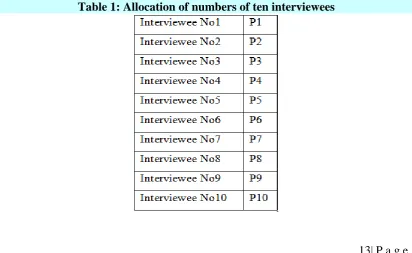
and two Marine superintendents from 10 different Greek tanker shipping companies were investigated and responded to four semi-structured questions. Hence, each interview inquiry had a precise factor in the finding section ranging from 1 to 10 on the numerical axis and 10% to 100% on the percentage axis in the discussion section. For the conduct of this investigation, all ten Greek participants were allocated numbers from P1 to P10 as shown in Table 1.
Owing to the active participation of all interviewees in their companies’ activities, all of them opted for the absence of recording device; thus, notes were taken by hand. On this basis, the findings’ section has been injected with English key-passages in an effort of enhancing reader’s enlightenment.
Each interview was conducted in the respondents’ working environment by previously forwarding an invitation to them through their respective Human
Resource department. Managers were specifically chosen based on exceptional considerations owing to experience with injury, fatality and RCOs costs.
2.11 Limitations
Safety costs are considered in both the maritime domain and the academic realm as a vital cog that encompasses the safety and financial aspect of the shipping industry. Nonetheless, approaches of this kind may entail certain limitations.
This dissertation will not generalize, but will be limited to crude oil Panamax (see Appendices 4, 5) and Aframax tankers (see Appendices 6, 7).
The perspective of this case study excludes the safety regulatory framework,
focusing exclusively on the price and emerging benefits of RCOs.
Any associated risk to other stakeholders, i.e. crew’s life of a third party ship
in case of collision or environmental costs, lies beyond the scope of this study.
The identification of costs, losses or expenses emerging from injuries and
This study will not examine oil spills or property damage incurred by
shipping companies and, as such, the study will focus on the maritime related injuries and fatalities.
The reader should bear in mind that the study is based on IMO circulars,
books, journals, internet sources and annual financial reports from various shipping companies.
Due to the limited time and availability of funds, 10 interviews at 10 Greek shipping companies were conducted in one week at the end of August 2017, when participants had their main annual leave; such a narrow time frame
compelled the researcher to lean on MEPC & MSC technical reports, books and safety journals.
Along the same lines, finite publications might serve as another limitation
since quantity and quality might prove to be insufficient in order to constitute fruitful evidence. Thus, any scarcity of substantial reports reflects the primary difficulty in gathering data for this research. In order to avoid a potential debate, confine any possible criticism, and restrict any general comments on the project’s claims, the topic was strictly focused on crude oil tanker shipping.
After meticulous research on the classified direct and indirect costs of injuries
and fatalities for Aframax and Panamax tankers, the quantification section of this project will have to rely on a study by DeMarco, Frederick, and Thomas (1997).
2.12 Validity and Reliability
When it comes to the validity of a case study, it seems prudent to explain:
1. if the assessor will be able to obtain testimony that corroborates interviewees’
2. if the number of interviewees is efficient to precisely deduce the core argument, or
3. if the interviewer's questions were adequately formed so not to disorient interviewees’ reply.
However, testimonials might be misrepresented or misapprehended even if due consideration has taken place (Erford, 2014).
With respect to the representativeness of the project’s group, the number of
respondents seems sufficient and valid since the topic is confined within the tanker shipping framework. Participant’s standpoints may ultimately display a number of variations if they are compared with other shipping sectors, such as the bulk or container shipping industry. That is why this case study cannot be generalized.
It is essential to test the quality of this research in order to validate its credibility. On this basis, the overall quality of this investigation was considered, in an effort to avoid questions as to “why quality issues were not tackled?”. Besides, according to Veal (2006), a study in order to be reliable it has to also be valid.
Therefore, before the conduct of the interviews, it has to be borne in mind that the reliability of the interviews can be weakened due to provocative remarks or a reciprocal misunderstanding that could cause lack of consistency in participants’ responses. To avoid this problem, and enhance the project’s reliability, the execution of the interview is conducted by utilizing the probing technique. The interview process was conducted in English, despite all interviewees being Greek nationals, so as to avoid misinterpretation of data. Irrespective of the small sample of participants, interviewees’ replies manifested a certain degree of similarity, revealing that signs of
ranks. Moreover, the project’s findings proved to be in line with what has previously been accepted as true by past studies.
2.13 Ethical issues
Due to the conversational nature of interviews, adequate ethical standards ought to be
applied. In fact, Patton (1990) and Traianou and Hammersley (2012) concluded that pre-emptive questions are utilized by individuals who conduct investigations in a
progressive ethical manner in comparison to interviewers who are less vigilant. For this reason, the current project was approved by the Research Ethics Committee of World Maritime University.
In comparison with Patton’s interpretation, Rehi and Nolan (1995) and Fisher
(2007) revealed that the researchers must preserve such a code of conduct that will ensure that those involved in the tanker industry will be incontrovertibly safeguarded. Additionally, the interviewer tries to confront conversational cues and delves deeper into the topic in a manner that common survey research will not allow. Confidentiality is maintained since participants’ identities are kept private and their information is not to be disclosed.
Furthermore, Gillespie (1995) and Bloomberg and Volpe (2015) asserted that it is crucial to obtain consent before publication since the interviewer ought to request permission for stating anonymously the interviewee’s testimonials. Besides, ethical permissions constitute one of the fundamental components of researcher activities. The interviewee must be fully informed regarding the nature of the study by bearing in mind the right to refuse or to reply to any inquiry. An informed consent shall
CHAPTER No3: PREAMBLE OF LITERATURE REVIEW
3.1 Background of literature review
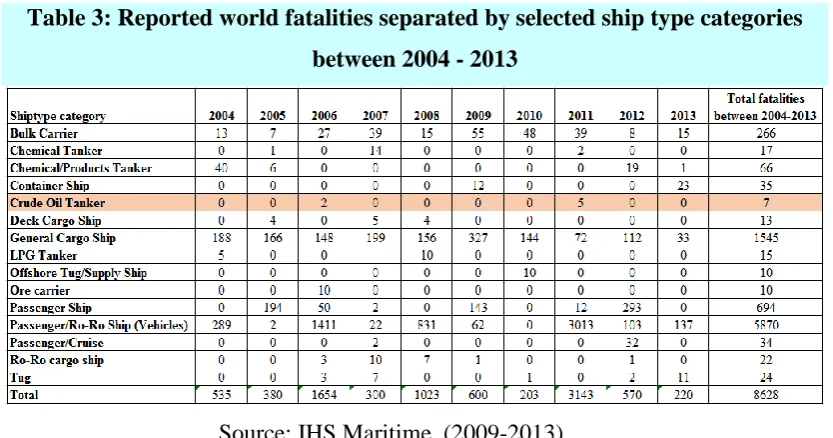
Burkhard (2016), on behalf of the Institute of Shipping Economics and Logistics, provided the figures in Table 2 that reveal a thorough distribution of number and percentages for merchant vessels of 500 gross tons and over, separated into different casualty categories. Based on these results it has been proved that irrespective of the number of fatalities, foundering casualties account for 37.2% of the total share on a worldwide scale followed by grounding (24.2%), collision or contact (15.1%), fire or explosion (12.8%) and machinery casualties (8.9%). Sush data reinforce the key objective of this project on finding the most cost-effective RCOs to mitigate maritime hazards in the crude oil tanker shipping industry. However, as extracted
from IHS Maritime (2009-2013) (Table 3), crude oil tanker vessels experienced the fewest number of fatalites compared to other ship categories on a world wide scale
Table 2: Reported world total losses of ships by age separated at time of loss and
by nature of casualty between 2004 - 2015
Source: Burkhard, (2016) on behalf of Institute of Shipping Economics and Logistics
Table 3: Reported world fatalities separated by selected ship type categories
between 2004 - 2013
Source: IHS Maritime, (2009-2013)
Figure 1: Navigational Incident rate versus regulations for Aframax tankers
between 1978-2003
Source: MEPC, (2008)
Figure 2: Main causes of shipboard marine related injuries from EMSA's reporting vessels between 2011-2015
Source: EMSA, (2017)
In terms of ship operation, injuries are mainly caused during vessels’ contacts, fire/explosions, and collisions. On the other hand, the main shipboard reasons for
Figure 3: Distribution of shipboard marine fatalities from EMSA's reporting vessels between 2011-2015
Source: EMSA, (2017)
On the other hand, with respect to occupational accidents and shipboard related causes, fatalities from slipping and falling of persons are taking the lead. This issue received considerable critical attention when EMSA (2017), exposed that 51% of fatalities occurred on cargo vessels in general, including crude oil tankers.
3.2 Barriers that protract the emergence of injuries and fatalities
This chapter will furnish an initial point of view of the reasons that the
abovementioned injuries and fatalities still exist at high levels.
safety managers would see more money for their departments” if RCOs were supported with convincing financial evidence. It is clear that the absence of a cost-benefit analysis could not support the safety managers in substantiating their point to financial executives so as to approve the initiation of RCOs.
From another perspective, Brody, Litourneau, and Poirier (1990) and Jalon et al.
(2011 a,b) believe that companies allocate very limited capital to safety investments just to cover the fear of being exposed to financial losses from accidents. In contrast,
Dorman (2000) insists that certain companies want to improve their public image by investing in safety, without focusing on enhancement of their working conditions and reduction of their injury and fatality trends. However, the aforementioned authors concur that significant losses occur and that those from injuries and fatalities are not negligible.
The current research is (a) focused on the difficulty of companies expressing the RCOs’ benefits in monetary terms and (b) on the widespread phenomenon of
companies underestimating safety investments (Brody et at., 1990; Kristensen, 2011). On this basis, the constant perception of companies compromising on safety (so as to reduce their annual budgetary expenses) is now combined with the lack of investment on RCOs (since RCOs are considered as an extravagant expense by ship-owners). Due to these obstacles, Jalon et al. (2011 a,b) believe that shipping companies reluctantly sustain their current RCOs without considering that it is important to further their safety performance.
According to Hollnagel's research (2014), using the “Sharp End, Blunt End Model”, on the right side there are the barriers that make the shipping industry struggle. On the left side are the RCOs that safety managers and DPAs have used to deal with the
enhancement. On this basis, it was concluded that they had to trade off one goal for another to be met.
Shanahan’s and Gregory’s (2010) research has further shown that:
1. lack of administrative training,
2. absence of safety culture on the administrative side, 3. negligible investment on RCOs
4. or even recklessness in responding to commercial demands
are just a few of the obstacles that the shipping community is currently facing.
This concept has recently been challenged by Reese’s (2011) studies, demonstrating that any kind of safety investment made by a company is indirectly triggered by the reduction of:
1. P&I premiums, 2. sick leave, 3. hospitalization, 4. lost man hours, and
5. fines from mitigation of workplace accidents.
However, half of Reese’s studies failed to specify whether these incentives are
having a serious effect on company profitability, leaving one to infer that they have not been treated with caution. This debate gained fresh prominence when Stopford (2013) argued that ship-owners are led to believe that any expenditures on preventive accident measures are ‘extravagant’, hence safety projects have been deemed as
CHAPTER No4: ANALYSIS AND DISCUSSION OF COSTS OF
INJURIES AND FATALITIES
4.1 Main Research Literature of this thesis
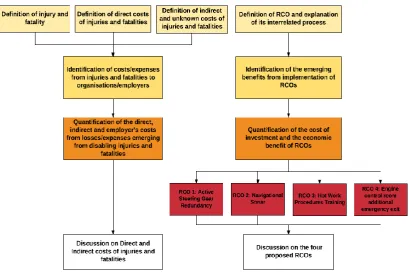
As illustrated in Figure 4, the literature review section (CHAPTER 4, 5) will be separated into five discrete stages. It is vitally important to provide, at stage 1 all the core definitions that this specific case study intends to explore, i.e. maritime injury, direct, indirect and unknown costs of injury, fatality, and RCOs, in order to keep the reader oriented within the boundaries of this project.
This will avoid any misapprehension of confusion in stages 2 and 3 since this thesis will gradually move to the identification and quantification of only the previously mentioned direct, indirect, unknown and employers’ costs/expenses from injuries and fatalities as well as the costs/investment and the economic benefits of RCOs.
Finally, at stage 4, the literature review will furnish a thorough explanation of four RCOs that can be applied on Panamax and Aframax crude oil tankers: RCO1: Active steering gear redundancy, RCO 2: Navigational sonar, RCO 3: Hot work procedure training, RCO 4: Engine control room additional emergency exit.
Figure 4: The analytical process of literature review
4.2 Definition of injury and fatality
In addition, the National Safety Council (NSC) (2015) presented the term disabling injury to refer to an accident that results in “some degree of permanent impairment, or renders the injured person unable to effectively perform his or her regular duties for a full day beyond the day of injury”. According to OCIFM (1997), temporary disability is “a condition that temporarily disables the crewmember from working, while a complete recovery is anticipated”, followed by permanent total disability
and permanent partial disability. Finally, the definition of fatality was suggested as “a death directly resulting from a work injury regardless of the length of time between the injury and death” either to individuals or to a group of individuals.
The terms incident and accident are clarified, for the purposes of this research, as follows: “An incident is an undesired event that downgrades the efficiency of a business operation. An accident is an undesired event that results in physical harm to a person” (Stranks, 2016). However, the current case study will utilize those terms
interchangeably, focusing exclusively on the cost of maritime accidents, i.e. disabling injuries and fatalities in the maritime sector.
4.3 Definition of direct costs of injuries and fatalities
Maniati (2014) revealed that every company that chooses to invest in RCOs would be able to significantly shrink its safety related losses. On the contrary, in case of absence of safety investment, numerous costs will promptly emerge. DeMarco et al. (1997), are certain that as an immediate consequence of an incident, whether an injury or death, direct “insured” and indirect “uninsured” costs/losses will negatively
influence the company. As a rebuttal to this point, Champ and Ornitz (2002) maintains the belief that direct costs are considerably easy to quantify and include insurance premiums, legal sanctions, medical and emergency response costs, property repair costs, workers’ compensation, liability and litigation costs.
4.4 Definition of indirect and unknown costs of injuries and fatalities
According to Morrison (2017), safety managers are inclined to believe that once the insurance is paid, the company is financially safe since the insurance company will cover any accident costs. To their dissatisfaction, it has been revealed that indirect
costs are 2-10 times higher than direct costs and will be paid by the corporate
account rather than the insurance. These indirect costs generally include employer’s cost, replacement costs associated with damaged equipment, supplementary time and
of company’s competitiveness and (c) fees for legal services are major indirect costs that are generally forgotten by safety managers. Further clues can be found by examining Ferrett and Hughes’ (2009) observations, which identified as indirect costs those associated with completing paperwork after an injury or fatality, the costs to replace an injured worker with a trained one and any unknown costs resulting from an incident.
Furthermore, Neumann and Weintrit (2013) act as the common denominator and
revealed that a fatality is almost impossible to quantify in monetary terms and can ruin the success of the shipping company. With reference to the latter, this scientific endeavor reveals that the ‘unknown costs’ serve as a game changer, resulting in the discovery of morale and reputation as key costs of accidents. Moreover, a broader perspective has been adopted by Liaoming (2005) who argued that when a fatality occurs, a negative message is indirectly spread among employees, that “the company does not really care us about us”. Although undetectable, ‘public relations’ damage is there and it impairs employees’ morale as well as the quality of their work. The reputation is also impaired due to the negative evaluation of the shipping company by its crewmembers, owing to unsafe and unhealthy workplaces onboard. On the contrary, a company with low accident records is more likely to retain a large pool of qualified crew members and an underlying competitive advantage against others. Commenting on Liaoming (2005), Maniati (2014) concluded that “the reputation of a company is a reflection of its public image and must be considered as an important
factor influencing its success”.
4.5 Identification of costs/expenses from injuries and fatalities to
organisations/employers
from the employer to the disabled employee. This point of view was further supported by Morrison (2017), who asserted that additionally to the aforementioned expenses, the company generates further losses in an effort to hire another individual to cover the duties of the disabled one. With respect to the uninsured - indirect costs of the employer who is associated with injuries and fatalities, Ferrett and Hughes (2009) additionally outlined that insurance premiums constitute the annual payment
of the ship-owners to the insurance companies in order to financially cover an event or failure. Additionally, Schumann and Schneid (2006) highlighted that production
disturbance covers any unexpected procedure that an organization has to implement to preserve its level of output (e.g. employing temporary personnel). Maniati (2014) and Morrison (2017) further revealed that administrative costs cover the ship-owner’s expenses to administer all the above costs, without excluding the legal costs
imposed on the shipping company from exposing a vessel to a hazard. For example, Ferrett and Hughes (2009) indicated that the monetary value of the work time lost due to absenteeism of the injured person is not easy to quantify. On the contrary, it was exemplified by Neumann and Weintrit (2013) that the ‘money versus time’ spent on the investigation of the particular injury or fatality plays an immense part of the employer’s indirect costs.
4.6 Quantification of the direct, indirect and employer’s costs from
losses/expenses emerging from disabling injuries and fatalities
This project now moves onto the subject of injuries, fatalities, and RCOs by furnishing their precise economic values.
the cost of wage and productivity losses, with respect to temporary disabling injury expenses. According to DeMarco et al. (1997), a disabling injury, (including employer’s costs) accounted for $28.000 and a death for $790.000 in 1997, while
NSC (2015) reveals that costs rose to $39.000 and $1.000.000, respectively in 2015.
There is also a consensus among multiple researchers (Leigh, Markowitz, Fahs, &
Landrigan, 2003; McKinnon, 2007) who validated the NSC’s value of approximately $28.000 as a reasonable approach regarding the average cost of a disabling injury.
However, since DeMarco et al. (1997) wanted to expose more in-depth data, apart from a general rate of $28.000, they revealed, based on the ICF Kaiser Consulting Group’s (ICF) observations, a standard index of $10.000 for direct costs, another index of $27.000 for indirect costs, which validate a globally accepted value of $37.000 as a whole for a disabling injury incident. ICF also performed a comprehensive study, separating the average cost per disabling injury incident
into three different maritime sectors. The results of that correlational analysis are summarized in Table 4:
Table 4:Average direct cost per disabling injury incident
Source: DeMarco et al., (1997)
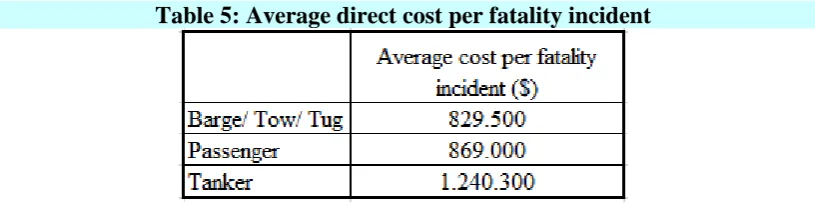
Table 5: Average direct cost per fatality incident
Source: DeMarco et al., (1997)
Another objection coming from Champ and Ornitz, (2002) reflects recent scientific discoveries and corroborates that for every $1 allocated to direct injury costs, namely insurance or medical compensation, a supplementary $1-4 loss will emerge, allocated to indirect – hidden costs. Thus, when the interrelated costs are totalled, an average of $29.960 for injuries and $1.24 million per death incidents in tanker shipping industry will emerge without including the indirect costs.
From another point of view, it can be implied that the findings observed in DeMarco’s et al. (1997) mirror those of Reese (2011). Although Reese’s analysis did
not take into account the indirect costs, his study examined the data as provided by the NSC in 2008, revealing that a serious non-disabling injury represents $22.674, a workplace disabling injury costs $48.000 and death costs $1.310.000. In order to avoid any misinterpretation, DeMarco et al. (1997) went one step further and
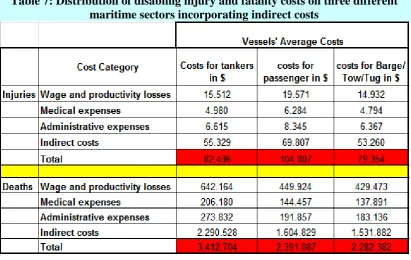
provided two different methods for calculating the costs of disabling injuries as shown in Table 6. The right part of the table incorporates the employer costs, while the left table replaces it with a complete calculation of indirect costs, utilizing a 2.7 ratio between direct and indirect costs, giving a distinct illustration of the average expenses as an aggregate of all vessels. It was further presented by DeMarco et al. (1997) that if employers’ costs are replaced with a complete estimation of indirect
Table 6: Distribution of average disabling injury and fatality costs by applying indirect or employer's costs ($)
Source: DeMarco et al., (1997)
Additionally, post hoc analysis performed by Morrison (2017) detailed that if $1 of direct costs is equivalent to $2.12 for indirect costs, then a single fatal workplace incident of $1.42 million will cost $3 million in total due to the indirect added costs. Hence, it can be implied that there is a direct monetary correlation between Morrison (2017) and Table 6 that DeMarco et al. created in 1997, revealing the comprehensive breakdown of costs pertaining to disabling injuries and deaths in three different maritime sectors. Together these results defy everything that is known about the costs of the three maritime sectors. There are, however, distinct dissimilarities
Table 7: Distribution of disabling injury and fatality costs on three different maritime sectors incorporating indirect costs
Source: DeMarco et al., (1997)
4.7 Discussion on Direct and Indirect costs of injuries and fatalities
This project performed a comparison between DeMarco et al. (1997) and NSC (2015) and revealed that the cost of an average disabling injury (including employer’s costs) has increased by 39.28% from $28.000 to $39.000, while a fatality
incident increased by 26.58% from $790.000 to $1.000.000 within an 18 year period.
Additionally, from Table 6, from DeMarco et al.’s (1997) investigation, it can be clearly seen that:
1. there is an increase of $53.947 for disabling injuries when employer’s costs
and shifted with a complete estimation of indirect costs (from $30.800 to $84.747),
2. there is an increase of $1.618.925 for fatalities (from $924.300 to
3. that such a difference, which is attributed to the “weight” of the cost category, seems relatively unchallenged.
However, past records of costs, do not necessarily correspond to the evolution of maritime knowledge because no one can observe the incremental analysis of accident costs which, in fact, suggests a gap in knowledge. In order to determine the differences among employer’s costs versus indirect costs, the indirect costs of injuries shown in Table 6 are converted into percentages, and presented in Table 8.
Table 8: Difference of percentage analysis by applying indirect costs or employer's costs on injuries and fatalities
Surprisingly, the data yielded from this approach uncovers:
1. a definite proof that DeMarco et al. (1997) is in direct correlation with Champ and Ornitz, (2002) and Leigh et al. (2003), while
2. the percentage analysis in Table 8 reveals a low of 9,52% for employer’s
costs and a high of 51,78% for wage and productivity losses.
By contrast, when employer’s costs are shifted by a complete estimation of indirect costs:
1. indirect costs peak at 67,12% of costs for injuries and fatalities, 2. verifying the heavy burden of indirect costs, and
3. the $1 to $4 approximate ratio between direct and indirect costs as Champ
It is also encouraging to analyze Table 7 because:
1. The average costs of injuries on passenger vessels are $24.653 higher than barge/tow/tug vessels and $21.500 higher than tanker vessels.
2. On the contrary, when fatalities are the subject under discussion, tanker fatalities are significantly higher compared to the others; they are $1.130.322 higher than barge/tow/ tug vessels, and $1.021.617 higher passengers vessels. 3. It is evident that even if disabling injuries on passenger vessels are the most expensive among the three different sectors, tanker vessels are taking the lead
CHAPTER 5: ANALYSIS AND DISCUSSION OF RCOs
5.1 Definition of RCO and explanation of its interrelated process
Ericson (2016) explained that an RCO encompasses (a) the precise action that will intentionally be performed in an effort to mitigate any potential of being exposed to a hazard, or (b) the action that removes the hazard or (c) minimizes any likelihood of being exposed to that hazard. Besides Ericson, Banerjee (2002) insisted that
investments in RCOs are performed in an effort to enhance the safety of seafarers and protect them from injuries and fatalities. From this perspective, the hazard, defined as the condition is the main source that is directed against a target with a potential of threatening or harming it. In this project, the analysed hazards will be collisions, groundings, fires, and explosions.
In an effort to facilitate the IMO decisions, the IMO developed the FSA framework as a way of identifying hazards, analyzing risks, identifying and evaluating RCOs, performing cost-benefit analyses and presenting proposals by ranking RCOs based on their cost-effectiveness (MSC 83/INF.2, 2007). According to Rausand, (2013) whenever the economic benefit of an RCO is more than the sum of its initial investment and its annual maintenance costs, then that RCO is considered as cost-effective. In order to execute a cost-benefit analysis on the proposed RCOs, the FSA guidelines proposed the ‘Cost of Averting a Fatality’ (CAF) criterion.
According to MEPC (58/INF.2) (2008), “the relation between the costs of
compared to a CAF threshold of 3.000.000$”. In an effort to reveal the cost-benefit objective of a cost-benefit analysis and name the RCO as ‘cost effective’, the potential researcher has to prove that the chosen RCO preserves the aforementioned relation at less than the CAF threshold. Likewise, it can be said that the implementation costs are less compared to the extracted benefit gained from the introduction of that RCO over the lifetime of the tanker i.e. 25 years. In order to
predict the level of the cost effectiveness of multiple RCOs, a sensitivity analysis shall also be implemented. Garbatov and Soares (2015) revealed that, as part of FSA,
the following equations quantify the achieved risk reduction in monetary terms:
“ΔC is the cost of RCO per ship during the lifetime of the vessel
ΔΒ is the economic benefit per ship resulting from the implementation of the
RCO during the lifetime of the vessel, being environmental and property benefit
ΔR is the risk reduction per ship, in terms of number of fatalities averted (ΔRs),
implied by the RCO during the lifetime of a vessel”. (Garbatov & Soares, 2015)
MEPC (2008) suggested that in order to reveal the NCAF and GCAF, Net Present Value (NPV) calculations shall be performed to expose the RCO’s costs or its economic benefits over a ship's lifetime using the following equation:
“X = Cost or benefit of RCO for any given year
A= Amount spent initially for implementation of RCO
r = Discount rate
T = 25 (years)
A uniform discount rate of 5% will be used in this case study, based on the ‘real’
above the inflation risk free rate of return i.e. 3% inflation and 8% depreciation)”. MEPC (2008)
5.2 Identification of the emerging benefits from implementation of RCOs
Based on a previous investigation, it has been proved that by marketing companies’
safety commitment, a core benefit is gained by tanker shipping companies in terms
of attracting new charterers and retain existing ones (Polyzois, 2015). Supporters of this view (Aviva, 2011; Maniati, 2014) not only agreed that safety investment further contributed to a company’s marketability but also considered the maximization of the company’s profit (generated from idle investments) as the key benefit of investing in
RCOs. Rosenthal, Kleindorfer, and Elliott (2006) pointed out that any benefit to a company’s safety reputation is an imminent consequence of its transparency and
In support of the aforementioned source, Bottani, Monica, and Vignali (2009) demonstrated that any organization that achieves a low rate of injury could embrace a lower insurance premium and avoid media intervention due to its high safety performance.
Benefits proved to vary according to the size of the organization. Such a distinction was exemplified in Celik’s (2009) case study, which confirmed that in relatively
large organizations reputation will improve, the trademark will gain ground and the
image of the enterprise will be indisputably enhanced. In support of this view, Dorman (2000) claimed that the organization’s commitment towards Corporate Social Responsibility would be revealed, resulting in the reinforcement of its power within the worldwide market. Overall, these cases support the view that reassurance, promotion of investor’s confidence and positive engagement of stakeholders in company’s activities will be enhanced.
In smaller organizations, the benefits are looked at from a different scope. Recent cases reported by Oxenburg and Marlow (2005) also support the hypothesis that benefits are focused on preserving an affordable level of insurance, avoiding the loss of key personnel and business's disruption, motivating and retaining staff commitment with the ultimate aim of winning new and retaining old charterers.
5.3 Quantification of the cost of investment and the economic benefit of RCOs
In this section, safety investments from individual companies will be analysed in order to distinguish the necessary amount of money to ensure a safety improvement along with the interrelated benefits that will emerge as a consequence of the implementation of a safety program.
adding $250.000 to its annual budget. Additionally, the company earmarked $10.000 for bulk carriers and $20.000 for tankers for seafarer training, and $30.000 to $50.000 was invested per annum for the robust educational support of its interdepartmental staff on shore.
Finally, 2.5% of the company’s total annual budget, which is equivalent to $15.000 to $30.000/month per vessel, was allocated for quality assurance mechanisms such as ship’s equipment, communications, and audit fees. Surprisingly, as a result of this
investment Anglo- Eastern has:
improved employee retention by 10%
reduced damage to vessels equipment by 19% grew by 28% in vessels under management reduced its loss of man-hours by 35%
decreased, by 76%, the off-hire time and hours wasted in port or at sea as a consequence of breakdowns and accidents, and
managed to maintain zero fatal incidents for four consecutive years.
According to this case, these definitive results suggest that there is a direct association between safety investment and the emergence of numerous benefits.