Abstract
Integration of F’lac plasmid into chromosome of both
gyrA(Ts) and gyrB(Ts) cells phenotypically suppress the thermo-sensitive mutations of the DNA gyrase enzymes. As the
compara-tive strains isolated from dnaA(Ts), these high frequency of
recombination (Hfr) derivatives were able to transfer chromoso-mal markers to recipient strains, showed a growth rate of about 60 min, and developed filamentous forms when incubated at the tem-perature of 43°C. Conversely to dnaA(Ts) Hfr selected isolates, the great majority of Hfr derivative of gyrase mutants resulted resistant to acridine orange and rifampin. Time-kill experiments carried out at the non-permissive temperature also revealed that nalidixic acid has no antibacterial activity on these Hfr strains while derivatives of dnaA(Ts) mutant, as well as the control strain HfrH, were strongly inhibited by this drug. Therefore F plasmid induced duplication of chromosome in the mutants even if the DNA gyrase enzymes are not working. Of a certain interest is that these bacteria exhibit physiological perturbations that affect the
main cellular functions, however, they do not appear essential for the survival of the strains.
Introduction
Integration of F or other conjugative plasmids such as R1, R100 or ColV2, into the chromosome of a dnaA(Ts) mutant gen-erates Hfr clones which show the concomitant ability of growing
at the restrictive temperature.1In these Hfr derivatives, at high
temperature (43°C), chromosome and cell division are under the control of the F replicative functions, because the plasmid origin replication site replaces that of the chromosome. It has been assumed that this latter genome does not require or utilizes the residual part of the DnaA protein for its duplication. Nishimura et
al.2and Tocchini-Valentini3have found that both acridine orange
and rifampin inhibit cell division at 43°C in dnaA(Ts) derivative Hfr strains, providing evidence that the F replicative system is sensitive to these drugs. It has been suggested that F-messenger synthesis, RNA primer formations or other unidentified plasmid
functions are the preferential targets of rifampicin.3Some classes
of rifampin-resistant mutants have also been shown to be capable
of suppressing a given dnaA(Ts) allele of Escherichia coli and
Salmonella typhimurium as well as gyrB(Ts) phenotypes.4,5 It appears therefore that some specific altered RNA-polymerases or the rifampicin-susceptible F plasmid functions play a role in the growth of these strains at the non-permissive temperature. Since
the products of dnaA, gyrAand gyrBgenes are required in the first
steps of the chromosome duplication, and the regulation of cell division in dnaA(Ts) is under the control of the integrated F plas-mid, this phenomenon suggested of placing gyrA(Ts) and gyrB(Ts) cells under the control of F at the restrictive temperature. In a
pre-vious study,6already, some Hfr strains were selected from all the
thermo-sensitive mutants, but only few strains were tested and chosen on the basis of their ability to grow at the restrictive tem-perature, and the susceptibility to rifampin and acridine orange. These criteria have been suggested by the main traits that are exhibited by Hfr derivatives of dnaA(Ts) mutant. Any other prop-erty of these microorganisms was not explored in detail. Whether F replication system may compensate the thermo-sensitivity of DNA gyrase mutants, in fact, has never been evaluated. Therefore the present study was aimed at the selection of thermo-resistant
clones by integrative suppression in F’laccarrying both gyrA(Ts)
and gyrB(Ts) cells. The characterization of the Hfr derivatives for their donor ability and susceptibility to acridine orange, rifampin and nalidixic acid was also performed.
Correspondence: Eugenio A. Debbia, “C.A. Romanzi” Section of Microbiology, School of Medical and Pharmaceutical Sciences, Department of Surgical Sciences and Integrated Diagnostics, University of Genoa, Largo Rosanna Benzi 10, 16132 Genoa, Italy.
Tel: +39-010-353 38136 - Fax: +39-010-353 7651. E-mail: [email protected]
Key words: F integrative suppression; DNA gyrase; Thermo-resistant; Nalidixic acid-resistant.
Received for publication: 23 January 2017. Revision received: 13 April 2017. Accepted for publication: 5 May 2017.
©Copyright E.A. Debbia and A. Marchese, 2017 Licensee PAGEPress, Italy
Journal of Biological Research 2017; 90:6595 doi:10.4081/jbr.2017.6595
This article is distributed under the terms of the Creative Commons Attribution Noncommercial License (by-nc 4.0) which permits any non-commercial use, distribution, and reproduction in any medium, provid-ed the original author(s) and source are crprovid-editprovid-ed.
Characterization of high frequency of recombination strains selected
by integrative suppression of F’
lac
in
dnaA
,
gyrA
and
gyrB
temperature
sensitive mutants
Eugenio A. Debbia,
1Anna Marchese
1,21
“C.A. Romanzi” Section of Microbiology, School of Medical and Pharmaceutical Sciences, Department of Surgical
Sciences and Integrated Diagnostics, University of Genoa;
2Microbiological Unit, San Martino Polyclinic Hospital,
Genoa, Italy
Non-commercial
Materials and Methods
Bacterial strains
Bacterial strains used in this study are listed in Table 1. The microorganisms used were originally obtained from Mary K.B.
Berlyn7of the E.coliGenetic Stock Center. Strains carrying
rele-vant characteristics for this study were: CTR4610 (dnaA46[Ts]),8
KNK453 (gyrA43[Ts])9 and N4177 (gyrB41[Ts]).10 They were
previously described.6All these mutants cultured at 43°C resulted
defective for functions required for DNA metabolism, but they continued to divide and form non-nucleated cells because the remaining cellular functions are not affected. Plasmid F’lac (F’128) was one of the F’ kit. F’lac plasmid carrying transposon
Tn10that codes for tetracycline resistance was used for strain
con-struction. J-53 and AB1157 were employed as recipient organisms
depending on the experiments. E. coliATCC 25922, was used as
quality control strains, when necessary.
Media and reagents
The rich medium LB and the minimal medium were those
described by Miller.11Agar plates for testing acridine orange were
adjusted to pH 7,6 with 1 N NaOH. Log phase bacterial cultures were streaked on the agar plates with a loop. Media were supple-mented with thymine (25 mg/L) when necessary. Acridine orange, nalidixic acid, rifampin, and tetracycline were obtained from com-mercial sources (Sigma, Milan, Italy) and stock solutions were pre-pared following manufacturer’s instructions.
Selection of high frequency of recombination strains
by integrative suppression
Hfr strains were selected by F’lacintegrative suppression in
gyrA43(Ts), gyrB41(Ts) and dnaA46(Ts).11These strains were fur-ther tested for susceptibility to rifampin and acridine orange at 43°C a condition that provides evidence that cell division is driven
by F mechanism in dnaA46(Ts).2,3
Conjugation of putative high frequency of recombination
with the appropriate recipient
Conjugation was carried out by standard methods employing
2x10⁸cells/mL in Mueller-Hinton broth.12The cells were
incubat-ed for 90 minutes at permissive temperature (32°C) washincubat-ed in saline and plated on minimal media.
Dynamic bactericidal activity
Time-kill experiments were performed by adding the drug at concentrations indicated in the results section, to log-phase
bacte-rial cultures diluted to 106-107 CFU/mL growing in 500 mL flasks
at 43°C. Just before the compounds were added (zero time) and at 2, 6 and 24h thereafter, bacterial counts were carried out. Survivors were evaluated by determining CFU on agar plates. Colonies were counted after 48h of incubation at 35°C.
Results
Selection of high frequency of recombination strains
by integrative suppression
Spontaneous temperature-resistant revertants arose with a
fre-quency which ranged from 3.1X10⁻⁸to 4.5X10⁻⁸in gyrA(Ts) and
gyrB(Ts) cells respectively. When the same experiments were
per-formed with F’lac carrying derivatives the incidence of clones
growing at the restrictive temperature increased to 1.3X10⁻⁷ for
gyrA(Ts) and 7.1X10⁻⁷ for gyrB(Ts). In comparative tests carried
out with a dnaA(Ts) mutant the frequency increased from about
3X10⁻⁶to 9X10⁻⁵(Table 2). Among the colonies found at 43°C, 10
random chosen strains of each different experiment were character-ized for their susceptibility to acridine orange and rifampin at per-missive and non perper-missive temperature (Table 3). As expected the dnaA(Ts) derivatives resulted susceptible to both drugs at the restrictive temperature. When the same experiments were per-formed with the Hfr derivatives from gyrA(Ts) and gyrB(Ts), the number of susceptible strains to acridine orange and rifampin var-ied in an unpredictable way, in particular, the experiments were repeated several times and thermo-resistant clones were selected in separate experiments but the number of susceptible strains to the compounds ranged from 3 to 38% of the isolates. Regardless this different behavior found with dnaA(Ts) derivatives and the thermo-resistant obtained with gyrA(Ts) and gyrB(Ts), all the isolates were considered putative Hfr and were therefore further characterized.
Table 1. List of Escherichia coli strains used in this study.
Strain Main characteristics Source or reference
CTR4610 dnaA46(Ts), leu, thy, thi Marchese and Debbia (2016)6
db1983 Hfr from dnaA46(Ts) This work
KNK453 HF4704 gyrA43(Ts), thyA, polA, uvrA, phx Marchese and Debbia (2016)6
db1873 Hfr from gyrA43(Ts), AO-s, Rif-s This work db1874 Hfr from gyrA43(Ts), AO-r, Rif-r This work
N4177 galK, gyrBII(Ts), cou-r, Sm-r Marchese and Debbia (2016)6
db1607 Hfr from gyrB41(Ts) AO-s, Rif-s This work db1654 Hfr from gyrB41(Ts) AO-r, Rif-r This work
J-53 proB22, metF63 Laboratory collection J-53 (Flac::Tn10) proB22, metF63, Tn10, Tet-r Laboratory collection HfrH prototroph Laboratory collection AB1157 thr-1, leuB6, proA2, argE3, his-4, thi-1, lac Y1, galK2, rpsL31 Marchese and Debbia (2016)6 AO, acridine orange; Rif, rifampicin; Cou, coumermycin; Sm, streptomycin; Tet, tetracycline; s, susceptible; r, resistant.
Non-commercial
Conjugation of putative high frequency of recombination
with the appropriate recipient
The putative Hfr isolates were then mated with an appropri-ated recipient and the results are reported in Table 4. In detail,
Hfr strains derivative of gyrA(ts) were crossed with AB1157
selecting for histidine recombinants at 32°C. At least 50 colonies for each experiment were then analyzed for their ability of grow-ing at 43°C. From 12 to 53% of the clones resulted thermo-sen-sitive. A further experiment was carried out using a spontaneous nalidixic acid resistant of AB1157. After selection for histidine recombinants the strain were also tested for their susceptibility to nalidixic acid, all isolates that lost the resistance to this drug resulted susceptible to 43°C. Similar results were obtained
employing Hfr gyrB(Ts) derivative. In this case the recipient
strain was J-53 and selection was for metionine. The metionine positive isolates found demonstrated a temperature sensitive trait from 33 to 50% of the cases. All the clones that inherited the tem-perature-sensitivity trait manifested also the coumermycin-resis-tance marker, in contrast, all the strains that retained the thermo-resistance of the recipient exhibited susceptibility to this couma-rine. These results provided evidence that donor strains retained the gyrB(Ts) mutation. In comparative experiments carried out with Hfr strains selected by integrative suppression in a dnaA(Ts) cells, the isolates found susceptibility to the temperature ranged from 23 to 56% of the cases. There was no particular difference
in the number of recombinants obtained with rifampin and acri-dine orange resistant or susceptible Hfr (Table 4).
Growth rate and morphology of the high frequency
of recombination strains
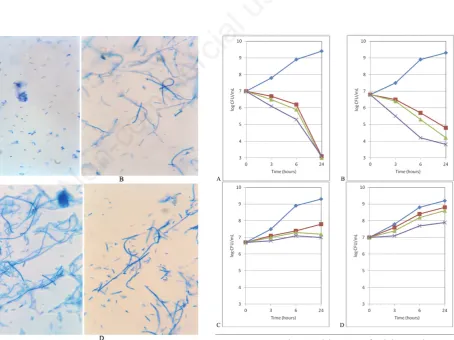
The generation times calculated for all the cultures of the Hfr strains were approximately ranged from 55 to 65 min, while the con-trol strain showed a generation time of about 26 min. In Figure 1 are shown the shape of the Hfr derivative and the control strain
incubat-Table 2. Incidence of thermoresistant strains found in dnaA(Ts),
gyrA(Ts) and gyrB(Ts) mutants with and without F’lacincubated at 43°C.
Strain Incidence of thermo-resistant strains found
dnaA(Ts) 3×10⁻⁶
dnaA(Ts)F’lac 9×10⁻⁵
gyrA(Ts) 3.1×10⁻⁸
gyrA(Ts)F’lac 1.3×10⁻⁷
gyrB(Ts) 4.5×10⁻⁸
gyrB(Ts)F’lac 7.1×10⁻⁷ Mean of at least 3 separate experiments.
Table 3. Susceptibility to acridine orange and rifampicin.
32°C 43°C
Hfr derivative Control AO (20mg/L) Rif (1mg/L) Control AO (20mg/L) Rif (1mg/L)
dnaA(Ts)
db1983 + + + + -gyrA(Ts)
db1873 + + + + -db1874 + + + + + +
gyrB(Ts)
db1607 + + + + -db1654 + + + + + + ATCC25922 + + + + + + HfrH + + + + + +
AO, acridine orange; Rif, rifampicin. Ten isolates randomly selected for at least 5 separate experiments by integrative suppression in a dnaA46(Ts), gyrA(Ts) and gyrB(Ts) mutant.
Table 4. Transfer of the temperature-sensitive marker from the high frequency of recombination derivatives of dnaA(Ts), gyrA(Ts) and
gyrB(Ts) to J-53 or AB1157.
Hfr donor Recipient Selected Range of incidence of Range of thermo-susceptibility strain marker recombination (%)
dnaA(Ts) J-53 Metionine
db1983 2.4×10⁻⁵-1.3×10⁻⁶ 23-54
gyrA(Ts) AB1157 Histidine
db1873 4.6×10⁻⁶-1.6×10⁻⁷ 12-53
db1874 2.1×10⁻⁶-4.1×10⁻⁷ 17-46
gyrB(Ts) J-53 Metionine
db1607 1.4×10⁻⁶-3.2×10⁻⁶ 37-51
db1654 2.4×10⁻⁷-1.6×10⁻⁷ 26-44 Hfr, high frequency of recombination. Representative of at least 5 random selected donor for each group.
Non-commercial
ed at the non permissive temperature. The microscopic observation of the culture revealed the presence of elongated form of all strain derivative by the thermo-sensitive mutants in comparison with the control HfrH. Donor ability of chromosomal markers and in partic-ular for the transfer of the original thermo-sensitive defect which should be present in the putative Hfr strains, produce physiological perturbations in these strains manifested by the growth rate and the morphological alterations.
Bactericidal activity of nalidixic acid against high
frequency of recombination strains
The inactivation of the DNA gyrase enzyme at the restrictive temperature prompt us to evaluated in the Hfr strains selected the activity of nalidixic acid an antibiotic which interferes with the activity of these enzymes. The strains studied HfrH, and the Hfr
strains derivative of dnaA(Ts), gyrA(Ts) and gyrB(Ts) were
cul-tured in broth at 43°C ad exposed to different concentrations of nalidixic acid (0, 25, 50, 100 mg/L). These time-kill experiments demonstrated a strong bactericidal effect against the control strain HfrH, a similar lethal effect on Hfr dnaA(Ts) derivative, while both
Hfr strains selected in gyrA and gyrBmutants grew in all the
cul-ture exposed to the drug also after 24 hours of exposure (Figure 2). These experiments were carried out with Hfr strains that showed susceptibility and resistance to both acridine orange and rifampin and similar results were obtained.
Discussion and Conclusions
Integration of F’lac plasmid into chromosome of both
gyrA(Ts) and gyrB(Ts) cells was shown here to phenotypically sup-press the thermo-sensitive mutations of the DNA gyrase enzymes. Similarly to the comparative strains derived from dnaA(Ts), these Hfr derivatives transferred chromosomal markers to recipient strains, showed a growth rate of about 60 min, and developed fila-mentous forms when incubated at the temperature of 43°C. On the
contrary to dnaA(Ts) Hfr selected isolates, the great majority of
Hfr derivative of DNA gyrase mutants resulted resistant to acridine orange and rifampin. Time-kill experiments carried out at the non-permissive temperature also revealed that nalidixic acid have no antibacterial activity against these Hfr strains while derivatives of dnaA(Ts) mutant as well as the control strain HfrH were strongly inhibited by this antibiotic.
On the basis of the present findings, it should be underlined that
the Hfr strains selected from gyrA(Ts) and gyrB(Ts) mutants differ
significantly from those isolated from dnaA(Ts). The first difference is the susceptibility to acridine orange and rifampin of these latter strains in comparison with those obtained in DNA gyrase mutants where the resistance to these compounds is exhibited by the great majority of the bacterial cells, and varies in an unpredictable way. The other difference is the resistance to nalidixic acid at the
non-permis-Figure 1. Shape of the high frequency of recombination deriv-atives and the control incubated at restrictive temperature (43°C) regardless of their susceptibility or resistance to acri-dine orange or rifampicin. A=HfrH; B=dnaA(Ts); C=gyrA(Ts); D=gyrB(Ts).
Figure 2. Dinamic bactericidal activity of nalidixic acid against high frequency of recombination derivative of A=control HfrH; B=dnaA(Ts); C=gyrA(Ts), and D=gyrB(Ts).
♦
control;■
25 mg/L;▲
50 mg/L; ×100 mg/L. Representative of 3 different isolates regardless of their susceptibility or resistance to acridine orange and rifampicin.Non-commercial
sive temperature shown by the Hfr selected from the DNA gyrase mutant but not the other strains. F replicative functions are employed to duplicate chromosome in both of these cells. Although there is no evidence here in order to recognize specific F-coded proteins involved in the above phenomenon one can hypothesized an impor-tant role for RNA-polymerase because of the following reasons. Rifampin has shown to affect F replication and maintenance at a con-centration too low to prevent bacterial growth suggesting a specific target among the F-messanger synthesis. On the other hand, as
reviewed by Lane,13F plasmid possesses two independent replicative
system called f5 and f7 from the restriction fragments which con-tained the sequence of genes responsible of the primary and second-ary replication system of F respectively. The f7 functions are resistant to acridine orange as well as to rifampicin, while the primary (f5) does not. Therefore, it is reasonable to assume that at the restrictive tem-perature the f7 system is responsible of the growth of the gyrA(Ts) and gyrB(Ts) Hfr derivative strains. It should be considered that in dnaA(Ts) mutants, at the restrictive temperature, the DnaA protein is not working but all the enzymatic pool of the strains is completely operative. Therefore when the integrated F promotes its own DNA synthesis, the chromosome is involved, and all the bacterial functions result operative including DNA gyrase enzymes that can be inhibited by nalidixic acid. On the contrary, when DNA gyrase proteins are inactivated by the temperature all the cellular functions should be compromised because DNA gyrase enzymes modulate global gene expression and are of paramount importance for the physiological
activity of the bacterial cell.14,15The alteration of DNA topology in
particular, affect not only the duplication of the chromosome but tran-scription and gene expression. Although it has been reported that
cer-tain thermo-sensitive mutations in gyrAor gyrBgenes are
compensat-ed by the enzyme produccompensat-ed by topAgene and vice versa,16-19the
pres-ent findings seem to exclude any attenuation or compensatory activity that restore at least in part these functions in the Hfr studied. In par-ticular, growth rate morphological alteration and especially the resist-ance to nalidixic acid suggest that DNA gyrase enzymes are not work-ing in these bacterial cells. It is worth to underline that in spite of these severe defective lesions exhibited by these Hfr strains they were able to survive. The integration of the F factor into the chromosome sup-plies the power to start the duplication of the bacterial genome.
Previous work from this laboratory, however, showed the F’lac
repli-cation is not affected by nalidixic acid or ciprofloxacin at a concentra-tion many times greater than that required to inhibit bacterial cell
growth or promoting plasmid loss.20These results suggest an
interest-ing possibility that DNA gyrase enzymes should not be required for
F’lacreplication and for the Hfr derivative of DNA gyrase mutants
selected here. Under a certain point of view, when the episome inte-grates into the genome it transforms the chromosome in a mega-F-primeor a mega plasmid, a replicon which expresses all its own genetic information for its autonomous replication without taking into account many enzymes or proteins coded by the bacterial DNA.
References
1. McMacken R, Silver L, Georgopoulos C. Escherichia coliand
Salmonella typhimurium. Cell Mol Biol 1987;1:565-612.
2. Nishimura Y, Caro L, Berg CM, et al. Chromosome replication in Escherichia coli, IV. Control of chromosome replication and cell division by an integrated episome. J Mol Biol 1971;55:441-56. 3. Bazzicalupo P, Tocchini-Valentini GP. Curing of an
Escherichia coliepisome by rifampicin. P Natl Acad Sci USA 1972;69:298-300.
4. Bagdasarian MM, Izakowska M, Bagdasarian M. Suppression
of the dnaA phenotype by mutation in the rpoB cistron of
ribonucleic acid polymerase in Salmonella typhimuriumand
Escherichia coli. J Bacteriol 1977;130:577-82.
5. Filutowicz M, Jonczyk P. The gyrBgene product functions in
both initiation and chain polymerization of Escherichia coli
chromosome replication: suppression of the initiation
deficen-cy in gyrB(Ts) mutants by a class of rpoBmutations. Mol Gen
Genet 1983;191:282-7.
6. Marchese A, Debbia EA. The role of gyrA, gyrB, and dnaA
func-tions in bacterial conjugation Ann Microbiol 2016;66:223-8.
7. Berlyn MKB. Linkage map of Escherichia coliK12, edition 10:
the traditional map. Microbiol Mol Biol Rev 1998;62:814-94. 8. Hirota Y, Jacob F, Ryter A, et al. On the process of cellular
division in Escherichia coliI: asymmetrical cell division and
production of deoxyribonucleic acid-less bacteria. J Mol Biol 1968;35:175-92.
9. Kreuzer KN, Cozzarelli NR. Escherichia coli mutants
ther-mosensitive for deoxyribonucleic acid gyrase subunit A: effects on deoxyribonucleic acid replication, transcription, and bacteriophage growth. J Bacteriol 1979;140:424-35.
10. Menzel R, Gellert M. Regulation of the genes of E. coliDNA
gyrase: homeostatic control of DNA supercoiling. Cell 1983;34:105-13.
11. Miller JH. Experiments in molecular genetics. New York, NY: Cold Spring Harbor; 1972.
12. Willetts N. Conjugation. In: Bennett PM, Grinsted J (eds.) Methods in microbiology. London: Academic; 1988. pp. 49-77. 13. Lane HED. Replication and incompatibility of F and plasmids
in the IncFI group. Plasmid 1981;5:100-26.
14. Drlica K, Hiasa H, Kerns R, et al. Quinolones: Action and resistance updated. Curr Top Med Chem 2009;9:981-98. 15. Aldred KJ, Kerns RJ, Osheroff N. Mechanism of quinolone
action and resistance. Biochemistry 2014;53:1565-74. 16. Usongo V, Drolet M. Role of type 1A topoisomerases in
genome maintenance in Escherichia coli. PloS Genet 2014:10: e1004543.
17. Heddler JG, Lu T, Zhao X, et al. gyrB-225, a mutation of DNA gyrase that compensate for topoisomerase I deficiency: inves-tigation of its low activity and quinolone hypersensitivity. J Mol Biol 2001;309:1219-31.
18. Reckinger AR, Kyeong SJ, Arkady B. Khodursky1 and Hiroshi Hiasa RecA can stimulate the relaxation activity of topoiso-merase I: Molecular basis of topoisotopoiso-merase-mediated genome-wide transcriptional responses in Escherichia coli. Nucl Acid Res 2007;35:79-86.
19. Mitscher LA. Bacterial topoisomerase inhibitors: quinolone and pyridone antibacterial agents. Chem Rev 2005;105:559-92.
20. Debbia EA. Filamentation promotes F'lacloss in Escherichia
coliK12. J Gen Microbiol 1992;138:2083-91.