1
Global Partnership for Financial
Inclusion: 2015 Work Plan
Overview
The Global Partnership for Financial Inclusion (GPFI) through its four Subgroups has conducted its work with respect to the Financial Inclusion Action Plan (FIAP) and on the occasion of the Leaders request. The GPFI has updated the FIAP during the Australian Presidency last year and it was approved by the leaders in Brisbane. The 2014 FIAP provides a framework for the GPFI to progress G20 work on financial inclusion and remittances up to year 2018.
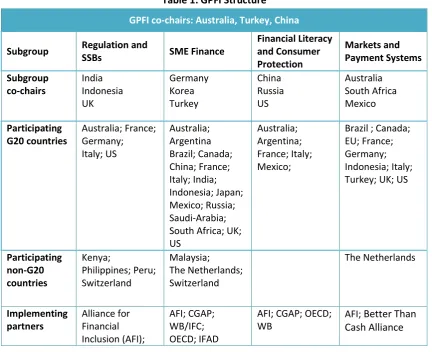
This document presents the key outcomes for the GPFI during 2015. The GPFI organises its work through four subgroups: Regulation and Standard Setting Bodies (SSBs); Small-medium enterprise (SME) Finance; Financial Literacy and Consumer Protection; and the Markets and Payment Systems subgroup. Table 1 summarises the structure of the GPFI and members of each subgroup.
Table 1: GPFI Structure
GPFI co-chairs: Australia, Turkey, China
Subgroup Regulation and
SSBs SME Finance
Financial Literacy and Consumer Protection Markets and Payment Systems Subgroup co-chairs India Indonesia UK Germany Korea Turkey China Russia US Australia South Africa Mexico Participating G20 countries Australia; France; Germany; Italy; US Australia; Argentina Brazil; Canada; China; France; Italy; India; Indonesia; Japan; Mexico; Russia; Saudi-Arabia; South Africa; UK; US
Australia; Argentina; France; Italy; Mexico;
Brazil ; Canada; EU; France; Germany; Indonesia; Italy; Turkey; UK; US
Participating non-G20 countries Kenya; Philippines; Peru; Switzerland Malaysia; The Netherlands; Switzerland The Netherlands Implementing partners Alliance for Financial Inclusion (AFI); AFI; CGAP; WB/IFC; OECD; IFAD
AFI; CGAP; OECD; WB
2
CGAP (lead); BTCA; IFC; OECD; WB
(BTCA); CGAP; IFAD and WB/IFC
Affiliated partners
Women’s World Banking (WWB); Global Banking Alliance for Women (GBA); BTCA; ILO; Child and Youth Finance International (CYFI);
Microinsurance Network
In addition, the GPFI benefits from the support of, and supports, Her Majesty Queen Máxima of the Netherlands, the UN Secretary General’s Special Advocate for Inclusive Finance for Development (UNSGSA) and Honorary Patron of the GPFI.
Outcomes for 2015
The five key areas of FIAP are; (i) innovation; (ii) private sector engagement; (iii) women’s economic empowerment; (iv) communication and outreach; and (vi) data.
In 2015, the GPFI will also focus on following specific priorities under Turkish Presidency:
1. Financial Inclusion and Youth
2. Access to Finance by SMEs
3. Increasing Private Sector’s Role in Financial Inclusion
4. Women’s Economic Empowerment
5. Access to Non-G20 Countries (especially LIDCs)
6. Data
7. Coordination and Outreach
3
Regulation and Standard Setting Bodies Subgroup
Regulation and Standard Setting Bodies (SSBs) Subgroup will provide mainstreaming of financial inclusion in the work of the standard-setting bodies and other relevant global bodies and increased understanding of the interdependence of financial inclusion, stability, integrity and consumer protection. The subgroup will also ensure effective and consistent incorporation of financial inclusion in financial sector assessments.
The subgroup has two main outcomes in 2015.
1. Financial inclusion will be further mainstreamed in the work of the SSBs and other relevant global bodies and increased understanding of the interdependence of financial inclusion, stability, integrity and consumer protection.
1.1. Engaging multiple relevant SSBs to deepen understanding of the crosscutting issues
of innovative financial inclusion. The Subgroup will revisit the financial inclusion issues of crosscutting relevance to multiple SSBs discussed in the 2011 GPFI white paper, Global Standard-Setting Bodies and Financial Inclusion for the Poor – Toward Proportionate Standards and Guidance, and will produce a consultation document for the 2nd edition of the GPFI white paper (to be finalized under the Chinese G20 Presidency).
1.2. Development and dissemination of outputs of individual SSBs and other relevant
global bodies deepening understanding of the implications of financial inclusion for their work and the implications of their work for financial inclusion. The Subgroup will showcase, acknowledge and support SSB-by-SSB activities of relevance to financial inclusion, dovetailing with and reinforcing the SSBs’ respective work plans.
1.3. Increased sharing of information and experiences between SSBs and EMDEs to improve knowledge of “proportionality in practice” in the implementation of global standards. The Subgroup will monitor for opportunities to encourage active participation by EMDEs in relevant activities of outreach bodies of the SSBs such as the BCG Financial Inclusion Workstream, the IOSCO Growth and Emerging Markets Committee, and the FATF Style Regional Bodies. The Subgroup will engage with the membership of the AFI Sub-Committee on Global Standards and Financial Inclusion and AFI Global Standards Proportionality Working Group and encourage their participation in Subgroup activities.
1.4. Outcomes relating to standards, guidance and regulation to facilitate international and domestic remittances and maximize their financial inclusion potential. The Subgroup will consider opportunities to engage with and support the work of the Markets and Payment Systems Subgroup on regulatory issues of relevance to financial inclusion.
4
financial inclusion (I), financial stability (S), financial integrity (I), and financial consumer protection (P) (collectively the “I-SIP” objectives), along with possible preparation for an additional I-SIP rapid research exercise to begin in 2016.
2. Effective and consistent incorporation of financial inclusion in financial sector assessment.
2.1. Incorporation of financial inclusion into methodologies and tools for financial sector assessments. The Subgroup will take stock of the treatment of financial inclusion in assessments under the World Bank/IMF Financial Sector Assessment Program (FSAPs).
2.2. Outputs related to consistency of treatment of financial inclusion in financial sectors assessments. The Subgroup will monitor for opportunities to support improved consistency in the treatment of financial inclusion in FSAPs, and will contribute to knowledge sharing on application of the “effectiveness” component of the FATF Assessment Methodology for mutual evaluations in the context of financial inclusion. The Subgroup will support follow-up from self-assessments regarding the IAIS Application Paper on Regulation and Supervision supporting Inclusive Insurance Markets and will work with IAIS and its implementing partner for inclusive insurance the Access to Insurance Initiative to showcase, acknowledge and support the follow-up from self-assessment-related work. In this context, it will work to build a common understanding of how to address situations where supervisors have multiple mandates, including financial inclusion.
SME Finance Subgroup
The FIAP was approved by the G20 Leaders in 2014 to advance financial inclusion through 10 areas of action over and sets out the following key actions to increase access to finance for formal and informal micro, small and medium enterprises in emerging and developing economies to stimulate business and entrepreneurial activity for income, job creation and poverty reduction:
1. Accelerate and replicate successful policy reforms that facilitate the expansion of financial services to SMEs
2. Establish the SME Finance Forum as global center for good practice knowledge exchange and promotion
3. Improve financial access through the SME Finance Compact, SME Finance Initiative, and key development achievements
Moreover, the Subgroup is going to ensure an effective dialogue with the G20 outreach groups such as B20, T20, Y20, L20 and C20, by taking into consideration their important role to inform the GPFI on the views of various stakeholders and hence enrich and deepen our discussions.
5
1. Realizing access to finance for SMEs at the country level: Implementing the SME Finance Compact in particular in LICs
SME Finance Compact
The implementation of the SME Finance Compact launched in 2012 is ongoing with the Alliance for Financial Inclusion SME Finance Working Group to support peer learning amongst regulators, identify regulatory and policy challenges, develop data indicators for SME finance and document successful policy approaches, as an important initial step and to support further activities under the SME Finance Initiative and the Financial Inclusion Support Framework (FISF). The FISF of the World Bank Group includes actions to improve SME access to financial services in the design of the 7 initial country programs (Indonesia, Rwanda, Mozambique are launched, and a further 4 are in preparation), which will help accelerate the design and implementation of SME finance initiatives, policy reforms, and regulatory measures. The sub-group continued expansion of the SME Finance Initiative in 2014 which will seek to add at least one new investment partner and expand its geographic range of activity during 2015 .
The G20 GPFI in 2015 will promote the development of innovative models and approaches to address SME finance challenges faced by Low Income Developing Countries (LIDCs), and provide a platform for countries which are raising the focus on SME access to finance, including through:
A September workshop session during the GPFI Annual Forum to showcase progress made by G20 and non-G20 countries in line with the SME Finance Compact, including public and private sector representatives.
A workshop report would be prepared as an SME Finance Compact output, synthesizing the models and lessons shared by countries for the workshop. This could also draw from previous analytical work carried out in cooperation with IFC, MFW4A and G20 partners.
A Review of options for scaling-up support to innovative support to SME finance and facilitating new partnerships to implement the SME Finance Compact in 5-10 further developing countries, in particular LIDCs.
Joint Action Plan of GPFI SME Finance Sub-group and IIWG on SMEs
The G20 Investment and Infrastructure Working Group (IIWG) and the G20 GPFI SME finance Sub-group have both been working on topics related to the promotion of SME in emerging and developing countries that are ranging from supporting improvements in investment climate, facilitating financial intermediation, building stable financial systems in countries providing access to finance for SMEs in accordance with responsible finance principles and deepening and sharing knowledge in specific areas.
6
The Joint Action Plan will provide a framework to (a) facilitate a dialogue between the G20 GPFI SME finance Sub-group and the G20 IIWG, (b) extend successful G20 endorsed reforms and policy measures in G20 and non G20 countries in order to increase the availability of finance for SMEs to grow and create jobs, and (c) advance the agenda for SME finance across different G20 work streams with a focus on LIDCs, including additional work from implementing partners and International Organizations (IOs), with the aim of leveraging the G20 for greater investments in and by SMEs. It will be supported by IOs currently active in supporting the work of the IIWG and the GPFI, such as AFI, IFC, the OECD and other relevant implementing partners.
The Joint Action Plan will rest on two pillars (1) moving to country level implementation on the basis of previous diagnostics against international best practices in selected areas of financial markets infrastructure (2) deepening the knowledge and policy agenda in topics with strong potential for improving SME access to finance in LIDCs such as closing the SME finance data gaps; accelerating SME finance through digital finance
Timelines and process for reporting on progress against the activities will be spelt out in the Joint Action Plan.
Innovation in Agricultural Finance
The SME finance Sub-group will prepare an Issues Papers on selected topics for the roundtable workshop in September Istanbul preceding the GPFI Annual Forum. The Issues paper will address (i) agricultural insurance, (ii) value chain finance, (iii) financing for women in the agricultural sector, (iv) ICT solutions for agricultural finance, and (v) smallholder demand for financial services. Following -up to the conference: the issues papers will be revised to reflect the outcome of the discussions. Based on this a synthesis report will be produced that links the five thematic topics to previous work on agricultural finance by the G20, namely the 2011 and 2012 reports.
Financial Inclusion and Youth
CYFI will promote the new focus on youth entrepreneurship within the SME Finance Subgroup agenda in coordination with the other Subgroups, and leveraging the various events in the pipeline culminating with the GPFI Forum.
CYFI aims to contribute to the SME Finance Subgroup, and GPFI Forum, by launching a Global Platform for young entrepreneurs during the September meetings.
The launch and related topics addressed at the event will build on outcomes from Izmir’s workshop in June. The event will gather together young entrepreneurs, public and private sector representatives from GPFI member countries and other countries, with a particular focus on LIDCs to ensure alignment with the SME Finance Compact agenda.
7
2. Scaling up engagement with private sector to deliver innovative financial inclusion solutions to help closing the SME finance gap
Private sector engagement strategy
As asked for by the FIAP and the Turkish Presidency the SME Finance Sub-group will lead and scale-up engagement with the private sector, in order to better harness the potential investment, capacity and reach of financial service providers. Led by the SME Finance Forum, in coordination with the other sub-groups and the B20 Financing Growth and SMEs and Entrepreneurship working groups, the SME finance Sub-group will, in 2015, develop a private sector engagement strategy together with its implementing and affiliated partners which will be presented at the GPFI Forum in September and lay the ground for future action. Lessons learned from the SME Finance Challenge and impact reached by the winning proposals will also be presented at the GPFI Forum.
Additionally, the SME Finance Sub-group will initiate and help structuring a close cooperation of the GPFI with the AFI Global Public-Private Dialogue Platform (PPD) to facilitate a systematic dialogue and inputs from the private sector in the key areas of its focus.
Against this background AFI leaders will hold at its 2015 GPF in Maputo, Mozambique a high-level public-private consultation on SME Finance together with senior private sector executives and representatives from the GPFI. Following that session, a representative from AFI (a member), together with the AFI ED and a senior representative from the private sector (one of AFI’s private sector strategic partners) will be invited to report back at the GPFI Annual Forum in September the key outcomes of the GPF SME Finance session, which will then be discussed and incorporated where appropriate into the GPFI’s SME strategy and work stream.
SME Finance Forum conversion
The sub-group will also assist over this and the coming presidencies, the transformation of the SME Finance Forum into a global membership body for private and public financial institutions (banks, non-bank finance companies, development non-banks, fintech companies, etc). This will provide both a sustainable legacy for the Sub-group’s work and a permanent platform for public-private collaboration in SME Finance knowledge sharing, networking and good practice promotion.
SME Finance Innovation workshop
Workshop to be held June 1-2, 2015 in Izmir to focus on:
Financing start-ups, women or youth owned enterprises, non-traditional models for financing entrepreneurship bank financial services providers , alternative data sources, crowdfunding e, e-commerce and supply chain, long term financing and regulatory perspectives on promoting innovation for SME finance.
8
Financial Literacy and Consumer Protection Subgroup
The objective of the FCPFL Subgroup for the next five years is to build the capacity of developing and emerging economies to implement audience-appropriate, evidence-based financial consumer protection and financial literacy programs. Additionally, the Subgroup will identify best practices, emanating from the public, private, and NGO sectors, in consumer protection and financial education policies that support use of digital financial products and services. The Subgroup will continue its efforts, consistent with the G20’s 2013 St. Petersburg Development Outlook, to increase incentives, financial education, financial literacy, and consumer protection for the poor, with emphasis on vulnerable groups such as women, youth, and migrants.
The subgroup has two main outcomes in 2015.
1. Improve the capacity of public authorities and other relevant stakeholders to develop and implement financial literacy and consumer protection measures.
- The Subgroup will assist implementing partners and others in developing targeted and practical guidance for country-level and private sector FCPFL measures, by promoting voluntary peer review and exchange, coordinated inputs into global FCPFL deliberations, and the identification/filling of gaps that are particularly important in the context of financial inclusion.
2. Promote consumer protection and financial education good practices for digitally delivered financial products and services.
- The Subgroup is recognized as the hub within the GPFI for technical content on FCPFL risks and solutions associated with digitalized finance, and will provide inputs to other GPFI Subgroups developing policy options with direct implications for consumers or that require consumers to have a minimum level of financial literacy when using such a financial product or service.
Markets and Payment Systems Subgroup
The overall goal of the subgroup for the next five years is to advance utilisation of payment systems including remittances in the pursuit of increased and sustainable financial inclusion. The initial focus will be on remittances. The sub-group will focus on emerging technologies and business models and will incorporate strong links to market based approaches through engagement with financial service providers. The sub-group responds to the call in the G20’s St. Petersburg Development Outlook for the GPFI to explore in 2014 “targeted actions to . . . harness emerging mechanisms such as electronic payments and mobile technology that can significantly improve access”.
The subgroup has four main outcomes in 2015.
1. Work on remittances, particularly the cost of sending remittances and the bank account closures issue affecting many money transfer operators
9
institutions; the subgroup will raise awareness of, identify drivers of, and help identify appropriate solutions to, the issue. The subgroup will also identify how best to leverage remittances to further financial inclusion.
2. Undertake a stocktake including an inventory of innovative payment systems and a suggested framework within which implementation issues for harnessing emerging technologies can be considered
- The subgroup will undertake a stocktake including an inventory of innovative payment systems relevant to determining the specific work streams for the subgroup and the key challenges appropriate for the GPFI to address. Secondly, the subgroup will identify a suggested framework within which implementation issues for harnessing emerging technologies to expand financial inclusion can be considered. This work will also identify the roles of government and the private sector in the creation and development of an inclusive payment eco-system.
3. Develop a guidance note for regulators, other government agencies and the private sector on the sustainable provision of inclusive payment eco-systems
- The subgroup will lead work on developing policy options and implementation approaches (incorporating a set of principles, policy guidelines, implementation frameworks and some practical guidelines) for the private sector, regulators, other government agencies and other players in the payment services environment to guide their efforts in using payment systems to sustainably increase financial inclusion. Subsequently, the subgroup will develop a standard approach that would allow countries to aggregate and record agreed indicators of progress on developing inclusive payments.
4. Publicize examples of successful remittance products, to assist stakeholders develop a framework for the use of remittances to further financial inclusion
10
GPFI Outputs
Output Subgroup Date
Agree GPFI involvement in DWG Remittances Plan
M&P
April 2015
Market research on bank account closure issue
M&P
August 2015
Revised version of global mapping of FCPFL activities
FCPFL June 2015
McGraw Hill Global Financial Literacy Index, with support from the World Bank and Gallup, Inc. (covering over 140 countries) and related World Bank paper.
FCPFL June - September 2015
Stocktake of innovative solutions for an inclusive payment eco-system
M&P
November 2015
GPFI Private Sector Engagement Strategy SME 11 September 2015 (GPFI Forum) Partnerships / Programs linked to the SME
Finance Compact
SME 11 September 2015
(GPFI Forum) Youth Entrepreneurship Mapping (regulation,
practices)
SME 11 September 2015
(GPFI Forum)
Alternative data in SME finance SME Izmir for presentation and GPFI Forum for final paper
Joint Action Plan of GPFI SME Finance Sub-Group and IIWG on SMEs
SME For Finance Ministers’ Meeting (final) OECD/INFE Policy handbook on implementing
national strategies for financial education (including a survey on the status and progress of national strategy worldwide)
FCPFL September 2015
OECD/INFE Core competency on financial literacy for youth
(and for adults 2016)
FCPFL September 2015
Outputs relating to vulnerable groups : the OECD/INFE Guidance on financial
empowerment of vulnerable groups
the OECD/INFE report and checklist on financial literacy for migrants and their families (supporting the DWG work on remittances)
11
Output Subgroup Date
OECD/INFE Financial literacy for MSMEs : progress report
(in collaboration with the subgroup on SMEs)
FCPFL September 2015
World Bank Technical Note on FCPFL institutional supervision arrangements
FCPFL September 2015
Agrifinance roundtable workshop including issues papers/synthesis report
SME September/November 2015
BCBS Guidance Paper consultation document on financial inclusion (BCBS output)
SSBs October 2015
A framework for the use of remittances including case studies and an inventory of innovative payment system to further financial inclusion
M&P
October 2015
Consultation document for the 2nd edition of the GPFI white paper on, global standard-setting bodies and financial inclusion
SSBs November 2015
A guidance note for policymakers and regulators on appropriate approaches to governing and enabling inclusive payment eco-systems
M&P
Mid 2016
Updated version of promising and successful initiatives to enhance women's financial inclusion
FCPFL Throughout 2015
OECD/INFE Survey on financial literacy and inclusion
FCPFL 2015
Outputs from G20/OECD Task Force on
Consumer Protection concerning implementation of the G20 High-level Principles on FCP
FCPFL Throughout 2015
Outputs concerning DFS:
World Bank technical note on financial consumer protection (FCP) aspects of DFS
FinCoNet report on financial consumer protection of mobile technology services
OECD/INFE survey on the implication of digital finance for financial literacy and consumer protection
Report of RFF V Conference on DFS
FCPFL Throughout 2015
Capacity building training programs for FCPFL supervisors and regulators (e.g. by World Bank, AFI and Toronto Centre)
FCPFL Throughout 2015
Revised version of World Bank Global Good Practices on Financial Consumer Protection including new section on DFS
12
GPFI Timeline of Events
Date Event Location Activities
4-5 February, 4 May and 20-21 May 2015
Basel Consultative Group (BCG) meetings: Financial Inclusion Guidance Paper
Dubai, Manila, Basel
Consultations on the preparation of the BCG Guidance Paper on financial inclusion
6 March 2015 G20/OECD Task Force on financial consumer protection (FCP)
Paris
9-17 March 2015 Global Money Week Global –
advocacy and social media campaigns in all participating countries
CYFI proposal to coordinate a world-wide awareness initiative at the Global Money Week
26 March 2015 EU Seminar on digital financial inclusion Brussels Contribution to the G20 agenda for financial inclusion and remittances
16-17 April 2015 Spring Meetings – Financial Inclusion Seminar
Washington DC G20 Turkish Presidency to be featured
28 April 2015 G7 Deauville Partnership High Level Conference on Responsible Financial Inclusion for Social Inclusion and Stability
Berlin, Germany Discussion and Action Plan on Responsible Finance, SME finance and digital finance in the region, outreach to G20
6-7 May 2015 INFE technical Committee and OECD/INFE-GFLEC Global Policy research Symposium on Financial literacy : financial literacy and MSMEs
13
Date Event Location Activities
25-27 May 2015 AFI SME Finance Working Group (SMEFWG)
Kuala Lumpur, Malaysia
AFI peer learning activities 1-2 June 2015 GPFI Workshop: Financing
Entrepreneurship-Innovative Solutions
Izmir Focus on “Financing Entrepreneurship-Innovative Solutions”
3 June 2015 GPFI Meeting Izmir Outcomes of the workshop, review of the Subgroups’ work and
the way forward 16-19 June 2015 IFAD/WBG/EU Global Forum on
Remittances and Development
Milan
23-24 June 2015 International Committee on Credit Reporting (ICCR) Meeting
Rio de Janeiro
24-26 June 2015 IFI – DFI SME Working Group / SME Innovation Challenge
London IFC-EBRD co-hosted
Early September 2015
Meetings/calls with SSBs on first draft of the consultation document for the 2nd edition of the white paper
Basel, Paris, or Madrid, TBC
Consultations with multiple SSBs regarding the first draft of the consultation document for the 2nd edition of the white paper 1-4 September 2015 WB Financial Infrastructure Week Istanbul
1-4 September 2015 AFI Global Policy Forum (GPF) Maputo, Mozambique
G20 Turkish Presidency will also organize a “Side Event on SME Finance”
Engagement with the LDICs for SME Finance Compact
7-8 September 2015 ICCR Meeting Istanbul
14
Date Event Location Activities
Evidence and Innovation for Scaling Responsible Digital Finance
and delivery of financial products and services, and regulatory frameworks and codes of conduct
9 September 2015 SMEs and Agrifinance Roundtable Antalya Roundtable to build upon and update on the agrifinance work produced for the G20 in 2011 and 2012 – to present findings of new issues notes that are part of the 2015 workplan.
10 September 2015 SME Finance Compact Showcase / Progress Workshop
Antalya Showcase progress made by G20 and non-G20 countries in line with the SME Finance Compact. Produce recommendations for further G20/GPFI support for country-level work.
10 September 2015 -along the SME Finance Compact
Ye! Global Launch Antalya Event’s concept note and proposal attached
11-12 September 2015
GPFI Forum and Plenary Antalya Main theme is “Private Sector Engagement”
11-12 September 2015
Tentative: programming around the 2nd edition of the white paper draft content at the GPFI Forum or possible side event
Antalya Thematic discussions based on draft white paper content
November 2015 ASEAN remittance and retail payments event
Kuala Lumpur
November 2015 SME Finance Forum launch Antalya SME Finance Forum Global Membership launch
30 September/ 2 October 2015
INFE technical Committee and
OECD/Malaysia international Conference on Financial Literacy
15
Date Event Location Activities
Roundtable on financial literacy and inclusion in Asia
October/November 2015
OECD/India International conference on FCP
Mumbai
October/November 2015
FinCoNet meeting South Africa
(exact location to be
determined) 1-4 December 2015 WB-CPMI Latin America Regional
Payments Week 2015
Santo Domingo
2015 World Bank Work Shop on Digital Financial Services (DFS)