Available online on 25.01.2019 at http://jddtonline.info
Journal of Drug Delivery and Therapeutics
Open Access to Pharmaceutical and Medical Research
© 2011-18, publisher and licensee JDDT, This is an Open Access article which permits unrestricted non-commercial use, provided the original work is properly cited
Open Access
Research Article
Development and characterization of floating microspheres based drug
delivery system for peptic ulcer
Sanjay K. Mishra*1, M. K. Gupta2, N.K Jain,
Oriental College of Pharmacy & Research, Oriental University, Indore M.P., India
ABSTRACT
Gastro-retentive drug delivery system (GRDDS) has gained immense popularity in the field of oral drug delivery recently. It is a widely employed approach to retain the dosage form in the stomach for an extended period of time and release the drug slowly that can address many challenges associated with conventional oral delivery, including poor bioavailability. The main limitations are attributed to the inter- and intra-subject variability of gastro-intestinal (GI) transit time and to the non-uniformity of drug absorption throughout the alimentary canal. It is known that differences in gastric physiology, such as gastric pH, and motility exhibit both intra-as well as inter-subject variability demonstrating significant impact on gastric retention time and drug delivery behavior. This triggered the attention towards formulation of stomach specific (gastro retentive) dosage forms. Floating or hydro dynamically controlled drug delivery systems are useful in such applications. The drugs having absorption window in the upper part of Gastro Intestinal Tract (GIT) have enhanced bioavailability when formulated through these techniques. The recent technological development for enhancing GRT including the physiological and formulation variables affecting gastric retention. The developed system has the dual advantages of being gastro-retentive, to increase oral bioavailability and releasing drug in a controlled manner. Keywords: Floating drug delivery systems, Gastric residence time, in vitro and in vivo.
Article Info:Received 05 Dec 2018; Review Completed 18 Jan 2019; Accepted 20 Jan 2019; Available online 25 Jan 2019
Cite this article as:
Mishra SK, Gupta MK, Jain NK, Development and characterization of floating microspheres based drug delivery system for peptic ulcer, Journal of Drug Delivery and Therapeutics. 2018; 8(6-A):155-162
*Address for Correspondence:
Mr. Sanjay K. Mishra, Assistant Professor, Oriental College of Pharmacy & Research, Oriental University, Indore
INTRODUCTION
Floating systems, first described by Davis in 1968, are low-density systems that have sufficient buoyancy to float over the gastric contents and remain in the stomach for a prolonged period .While the system floats over the gastric contents, the drug is released slowly at the desired rate, which results in increased GRT and reduces fluctuation in plasma drug concentration.
An ulcer is a round or oval shaped hole (also called parietal defect), 2 to 4 cm in diameter with perpendicular borders and a smooth base. A Peptic Ulcer is an ulcer in the gastrointestinal tract that is characteristically acidic and thus extremely painful. It is also called ulcers pepticum or peptic ulcer disease (PUD).Contrary to general belief peptic ulcers happen more often in the duodenum first part of the small intestine than in the stomach.3,17
Floating microspheres are gastro-retentive drug delivery systems based on non-effervescent approach. The oral route is predominant and most preferred route for drug delivery but drug absorption is unsatisfactory and highly variable in the individuals despite excellent in-vitro release pattern. The major problem is in the physiological variability such as GI transit in addition to gastric retention time (GRT), the later
plays a dominating role in overall transit of the dosage forms. The GRT of ever oral controlled release system is less than 12 h. These aspects lead to developing a drug delivery system which will remain in the stomach for prolonged and predictable time.18
These have a bulk density lower than the gastric content. They remain buoyant in the stomach for a prolonged period of time, with the potential for continuous release of drug. Eventually the residual system is emptied from the stomach. Gastric emptying is much more rapid in the fasting state and floating systems rely heavily on the presence of food to retard emptying and provide sufficient liquid for effective buoyancy. The amount, nature and caloric content of the food and the frequency of feeding profoundly affect gastric retention.19
Figure 1: Drug absorption from (a) conventional dosage forms and (b) gastroretentive drug delivery system
MATERIALS AND METHODS
Nizatidine hydrochloride was generously supplied as a gift samples by Dr. Reddy Laboratories Hyderabad and Amoxicillin was a gift sample obtained from biocon, Bangalore (India). Polymethylmethacrylate,
Dichloromethane and Dimethylformamide were purchased from CDH India. All other chemicals and reagents were used of analytical grade.
Preparation of floating microspheres by (solvent evaporation method)
Floating microspheres were prepared by Solvent evaporation (oil-in–water emulsion) technique. In this 225mg polymethyl methacrylate (PMMA) were dissolved in a mixture of dimethyl formamide and dichloromethane (1:1) at room temperature. And 100mg Nizatidine hydrochloride and 75mg Amoxicillin Hydrochloride were added in the above mixture. This was poured into 250ml water containing 0.02% tween 80, maintained at a temperature 30-40oC and
subsequent stirred at ranging agitation speed for 20 minute to allow the volatile solvent to evaporate.16 The
microspheres formed were filtered, washed with water and dried in vaccum.
Dispersed in
Figure 2: Schematic representation of method of preparation of Floating microspheres
Characterization of prepared floating microspheres
The prepared floating microspheres were characterized for shape and surface morphology, size, percent drug loading and in vitro drug release in different GIT PH.
Shape and surface morphology
In order to examine the surface morphology, the formulations were viewed under scanning electron microscopy. The samples for SEM were prepared by lightly sprinkling the floating microspheres powder on a double
225mg of polymethyl methacrylates (PMMA)
dissolved in mixture of dimethylformamide and
dichloromethane. (1:1) ratio.
Mixture of Nizatidine
Hydrochloride (100mg) and
Amoxicillin (75mg)
250ml water containing 0.02% tween 80
Filter
Washing
Drying
Collection of Floating Microspheres
Add
adhesive tape, which stuck to an aluminum stub. The stubs were then coated with gold to a thickness of about 300Å using a sputter water. The samples were then randomly scanned for studying surface morphology but show the images of coating to prove internal surface.4, 6
Particle size determination
The particle size of formulation was determined by optical microscopy using a calibrated ocular micrometer.9
% Drug Entrapment
100 mg of floating microspheres was dissolved in 3 ml of dichloromethane and shaken vigorously for 2 min. The solution was then filtered through 0.45µm syringe filter (Millipore Millex HN, USA). After suitable dilution with PBS (pH 7.4) solution was assayed for combined drug spectrophotometrically.9 The percent drug entrapped was
calculated.
% DE =
100
expected
load
drug
l
Theoretica
present
actually
drug
of
Amount
In Vitro buoyancy test of optimized floating microspheres formulation
The floating test of the prepared optimized floating microspheres formulation was carried out using dissolution test apparatus USP XXII method II. 500 mg of floating microspheres were immersed in 900 ml simulated gastric fluid SGF (pH 1.2) maintained at 37 ± 2°C, which was agitated by a paddle rotated at 100 rpm. The paddle blades were positioned at the surface of dissolution medium. The floating microspheres floating on the surface of SGF (pH 1.2) were recovered with a sieve No. 120 (34µm) at every 1 hr time interval for 8 hours. The floating microspheres so collected were dried and weighed. The floating percentage of the floating microspheres was defined as the weight ratio of the floating microspheres against the total weight of floating microspheres in the floating test.7, 4 The buoyancy of the floating microspheres was calculated by the following equation:
100
s
Q
f
Q
f
Q
(%)
Bouyancy
Where Qf and Qs are the weights of the floating and settled
floating microspheres respectively.
In Vitro Buoyancy of Floating Microspheres In SGF (PH 1.2)
After (0 hr) After (2 hrs.)
After (4 hrs) After (6 hrs.)
After (8 hrs) After (12 hrs.)
Figure 3: Photographs of in vitro buoyancy of floating microspheres in SGF (pH 1.2)
InVitro drug release in different gastrointestinal fluids
Optimized formulation was evaluated for the in vitro drug release study in different GIT fluids. The dissolution test of floating microspheres was carried out by the paddle type dissolution apparatus specified in USP XXIII under perfect sink condition.9
500 mg of floating microspheres was weighed accurately and gently spread over the surface of 500 mL of dissolution medium. The media was rotated at 100 rpm and thermostatically controlled at 372°C. Perfect sink condition was prevailed during the drug dissolution. The release was tested in dissolution medium of pH 1.2, pH 6.8 and pH 7.4 solutions.10 An aliquot of the release medium was withdrawn
at every 1 hr time interval and an equivalent amount of fresh medium was added to the release medium. The collected samples were filtered through 0.45µm-syringe filter (Millipore millex HN) and after suitable dilution sample were analyzed spectrophotometrically. % cumulative drug release are Calculated.
Stability Studies
The stability of the drug-loaded floating microspheres during storage is undoubtedly another important prerequisite for its successful clinical application. Degradation is likely to occur under tropical conditions of higher ambient temperature and humidity. Hence the prepared floating microspheres were subjected to accelerated stability testing.
Effect of storage on structural integrity of optimized floating microspheres formulation 7, 9
The optimized formulation was stored in amber colored glass bottles at 41°C, 251°C and 401°C for a period of 45 days and observed for any change in particle size (optical microscopy) and surface morphology by phase contrast microscope (Leica MPS, Germany).
Effect of storage on residual drug content
Stability of floating microspheres formulations on storage is of great concern as it is the major factor in their development as marketed preparation. The prepared formulation was tested for stability at 41°C, 251°C and 401°C temperatures. Formulation was stored in amber colored glass vials, and then it was evaluated after 15, 30 and 45 days for change in residual drug content.7 For the determination
of residual drug content floating microspheres formulation were dissolved in 3ml dichloromethane filter through polycarbonate membrane (Millipore, USA) of 200 nm pore size than after suitable dilution with PBS (pH 7.4) the drug content estimated spectrophotometrically using UV-visible spectrophotometer (Shimdazu 1800, Japan).2
In Vivo radiographical study 5
In order to assess the gastro retentive efficacy of floating formulations, the Percent buoyancy in a biological system was determined by using barium sulphate X-ray contrast medium containing 15% barium sulphate as a contrast agent were prepared for radio graphical study. The study was carried out with one healthy male rabbits free of detectable gastrointestinal diseases or disorders. The study was carried out under the guidelines compiled by CPCSEA (Committee for the purpose of control) Supervision of Experiments on Animal, Ministry of Culture, Government of India and the local institutional Animal Ethics Committee approved all the study protocols. The rabbits were fasted overnight. The rabbits were administered optimized floating microspheres formulation with 25ml of water and X- ray photograph was taken after every one hour of administration and intragastric behavior of the floating microspheres was observed by taking a series of X- ray photographs at different time intervals.
In-vivo studies
Albino rat of either sex weighing 400 – 450 gm were chosen for the present studies. All in vivo studies on animals were approved by animal ethical committee of the Oriental
University, Indore (MP), India constituted under the guidelines of CPCSEA, New Delhi, India through their vide letter no. animal eths. Comm./10/87/35 dated 20/22-11-17.
Induction of Gastric Ulcer 20, 22
The experiment was conducted on Albino rat, whose average body weight of 400 – 450 gm and age nearly 03 month. Animals were kept in standard cages for constant room temperature at 25 ± 1 0C. Rats were keep in Fasted condition
for 18 hour where no food but water was provided ad-libitum. Gastric Ulcers were induced by administered ethanol in the range of (95%, 01ML/200gm body weight) orally through a feeding tube.
Experimental design:
The animals were divided into three groups and each group consisting of five rats. Group-1: group provided Normal Saline. Group-2: Nizatidine solution (10 mg /ml) was administered orally Group-3: Nizatidine Hydrochloride Loaded Microspheres (equivalent to 10 mg). After administration of above mentioned formulations, animals were sacrificed, and the abdomen was opened by midline incision and stomach was removed, opened along the greater curvature, rinsed gently with water and pinned for macroscopic examination, upon examination gastric lesion were measured and ulcer index (UI) was estimated.20
UI = Ulcerated area (mm2)
Total stomach area (mm2) RESULT AND DISCUSSION
Floating microspheres were prepared by solvent evaporation method. Polymethylmethacrylate (225mg) was dissolved in a mixture of dimethylformamide and dichloromethane (1:1) at room temperature and drug combination (175mg) was dispersed in above mixture. This drug-Polymer mixture was poured into 250ml water containing 0.02% tween 80, maintained at a temperature 30–40oC, and subsequent stirred at ranging agitation speed
300-400rpm to allow the volatile solvent to evaporate. The microsphere formed were filtered, washed and dried in vacuum.
For this floating microspheres formulation were prepared with varying drug concentration viz. 25, 50, 75mg. It was observed that on increasing the concentration of drug, the entrapment efficiency increased. While on further increasing drug concentration the entrapment efficiency gradually decreased.
Average particle size of floating microspheres reduces with increased in temperature. Narrow size distribution 131.41.6µm and 89.51.4% entrapment efficiency was found to formulation at 370C temperature. In vitro floating
Figure 4: SEM photograph of Nizatidine hydrochloride floating microsphere
The results showed that the percentage buoyancy of floating microspheres formulation was significantly decreased after 5 hr.The buoyancy (%) of optimized
Nizatidine hydrochloride floating microspheres formulation in SGF (pH 1.2) are reported.
Figure 5: Percent buoyancy of optimized nizatidine hydrochlorideFloating microspheres formulations in SGF (pH 1.2)
In vitro drug release from optimized floating microspheres were carried out in SGF (pH 1.2), SIF (pH 6.8) and PBS (pH 7.4) by dissolution test of floating microspheres was carried out by the paddle method specified in the U.S.P. XXI. No initial burst release was observed in any medium suggested that the nizatidine hydrochloride molecules are entrapped
over the floating microspheres. The percent Cumulative amount of drug release was found 87.22.6% in SGF (pH 1.2), 90.23.5% in SIF (pH 6.8) and 93.23.5 % in PBS (pH 7.4) upto 24 hrs. The results clearly suggest that floating microspheres formulation could also be utilized for sustained and drug delivery purpose.
Figure 7: Percent cumulative drug release from optimized floating microspheres formulation in SFG SIF (pH 6.8)
Figure 8: Percent cumulative drug release from optimized floating microspheres formulation in PBS (pH 7.4)
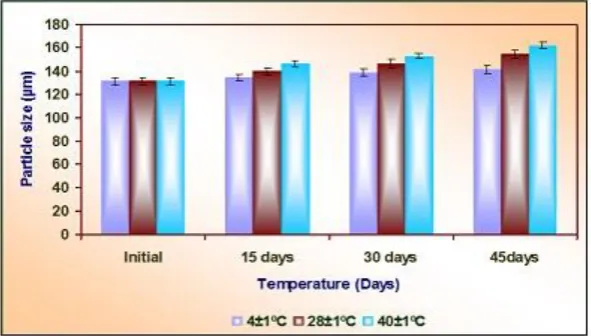
Stability studies were carried out with optimized floating microspheres formulation which was stored for a period of 45 days at 4±1°C, 25±1°C and 40±1°C. The particle size of formulation was determined by optical microscopy using a calibrated ocular micrometer. The particle size of the floating microspheres was found to increase at 25±1°C, which may
be attributed to the aggregation of floating microspheres at higher temperature. At 401°C the floating microspheres aggregated and a no change in spherical shape. to ellipsoidal shape with irregular observed i.e. these floating microspheres were unstable at higher temperature like 401°C.
Figure 9:Effect of storage temperature on particle size of optimized floating microspheres formulation
The selected optimized floating microspheres formulation was stored at 4±1°C, 25±1°C and at 40±1°C and the residual drug content of the formulation was determined after 15, 30 and 45 days. It was observed that the formulation stored at
Figure 10: Percent residual drug content in optimized floating microspheres formulation stored at different temperatures
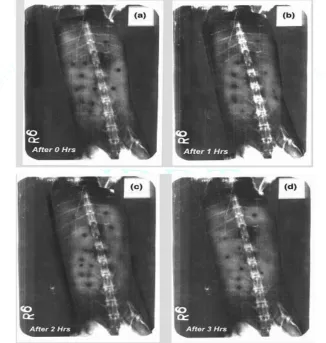
The in vivo study with X-ray contrast medium containing floating microspheres was conducted to determine the in vivo floating performance of optimized floating microspheres formulation. X-ray photograph taken after each 1hr interval shows intragastric behavior of the floating microspheres. It
is clear from the X-ray photographs that floating microspheres remained buoyant even after 4 hrs which is a satisfactory time for a gastro retentive property obtained by floating microspheres formulation.
Figure 11: X-ray photographs showing floating microspheres remained buoyant
In case of Invivo Study the ethanol induced ulcer model, the oral administration of 95% ethanol in control group, produce characteristic lesions in the stomach which shows as the bands of broad red lesions. The In vivo evaluation showed the Ulcer Index (UI) were, 0.64 ± 0.08 for Group 1 (Normal
(a) Control group showing (b)Nizatidine solution–treated (c) Nizatidine loaded normal gastric integrity group (100 mg/kg) Microspheres –treated group Figure 12:Evidence for the protective effect of Nizatidine loaded Microspheres in rats treated with ethanol
Table 1: Anti ulcer effect of Nizatidine Hydrochloride formulation on Ethanol Induced Gastric Ulcer
Values are expressed as Mean±SEM, n = 5 in each group. **p<0.01, ***p<0.001
CONCLUSION
The result obtained from all the experiments perform as a part of project work suggested that it is possible to prepare an intragastric floating and sustained release floating microspheres preparation using Polymethylmethacrylate, solvent evaporation method. Floating microspheres drug delivery system provides the possibility of enhancing the bioavailability and control the release of formulation exhibiting absorption window by prolonging the gastric emptying time of the dosage form ensuring availability of drug at the absorption site for the desired period of time. As the floating microspheres showed a good buoyancy and drug release properties so that it has a great potential for its use both in powder form for dry suspension and granular form for table ting.
REFERENCES
1. Patel Rajanikant, Patel Nrrav, Patel N.M, Patel M A novel approach for dissolution enhancement of Ibuprofen by preparing floating granules, Int). Res. Pharm. Sci., 2010; 1: 57-64.
2. Arza Ramji Anil Kumar, Gonugunta Chandra Sekhara Rao, and Veerareddy Prabhakar Reddy, formulation and evaluation of swellable and floating gastroretentive Ciprofloxacin hydrochloride tablets , AAPS Pharm. Sci. Tech., 2009; (10):124-128.
3. Jain A., Jain C. Buoyant microspheres of famotidine : an approachable dosage form for gastric treatment, Asian Journal of Pharmaceutics 2009; 20-23
4. Jagdale S, Agavekar A, Pandya S, Kuchekar B and Chabukswar A; Formulation and Evaluation of Gastroretentive Drug Delivery System of Propranolol Hydrochloride, AAPS Pharm Sci Tech,2009 ;10, 3.
5. Basavaraj B, Deveswaran R, Bharath S, Sindhu Abraham, Sharon Furtado And Madhavan V, Hollow Microspheres Of Diclofenac Sodium - A Gastroretentive Controlled Delivery System, Pak J. Pharm. Sci., 2008; 21(4): 451-454
6. Gattani Y.S, Bhagwat D.A., Maske A. P. Formulation and evaluation of intragastric floating drug system of diltiazem
hydrochloride , Asian journal of Pharmaceutics, 2009; 228-231 7. Jang S., Lee J., Park S. Gastroretentive drug delivery system of
DA-6034, a new flavonoid derivative, for the treatment of gastritis. Int. J. Pharm.,2008 ; 356:88-94
8. Sahoo S.K., Mallick A.A., Barik B.B., Senapati P.C. Formulation and in vitro Evaluation of Eudragit® Microspheres of Stavudine. Tropical J. Pharm. Sci., 2005; 4:369-375.
9. Jain S.K., Awasthi A.M., Jain N.K., Agrawal G.P. Calcium silicate based microspheres of repaglinide for gastroretentive floating drug delivery: Preparation and in vitro characterization, J Control Release, 2005; 8-10
10. Umamaheshwari R. B., Jain S., Jain N .K. Investigation of a new approach in gastro- retentive drug delivery system in H.pylori
treatment. Int. J. Pharma, 2003; 136-143.
16. Kim B.K., Hwang S.J., Park J.B. Preparation and characterization of drug loadedpolymethacrylate microspheres by an emulsion solvent evaporation method. J. Microencapsul, 2002; 19:811-822.
17. Timmermans J., Moe’s A. J. Factors controlling the buoyancy and gastric retention capabilities of floating matrix capsules: new data for reconsidering the controversy, J. Pharm. Sci., 1994; 83:18–24.
18. Shiv Kr. H.G., Vishakanta G.D., Pramod Kr T. M., I.J.P.E.R., 2004; 38
19. Singh B.M., Kim K.H. Effect of monovalent and divalent cations on the rheological properties of gellan gels, J. Control. Release., 2000; 63:235–259.
20. Arafa HM, Sayed-Ahmed MM, Protective role of carnitine esters against alcohol-induced gastric lesions in rats. Pharmacol Res, 2003; 48:285–90.
21. Sato Y, Kawashima Y, Takeuchi H, Yamamoto H, Physicochemical properties to determine the buoyancy of hollow microspheres (microballoons) prepared by the emulsion solvent diffusion method. Eur J Pharm Biopharm, 2003; 55:297–304.
22. Akiyama Y, Nagahara N, Kashihara T, In vitro and in vivo evaluation of mucoadhesive microspheres prepared for the gastrointestinal tract using polyglycerol esters of fatty acids and a poly(acrylic acid) derivative. Pharm Res, 1995; 12:397– 405.
Group Mean volume of
Gastric secretion Mean P
H Mean total acid Ulcer index
Control (Normal Saline) 3.22 ±0.15 4.53 ±0.04 93.5 ±1.01 0.64 ± 0.08
Nizatidine Hydrochloride
Solution (Standard) 2.54 ±0.15** 5.83 ±0.80*** 108 ±0.04*** 0.49 ± 0.11*** Nizatidine Hydrochloride