ANNUAL CONFERENCE 1982
The 31st annual conference was held in Rotorua during 24-27 August 1982. There were 147 in attend-ance.
First-day workshops were on the role of the Bio-logical Resource Centre and on the management of introduced mammals on islands. The symposium topic for the second day was 'Forest Ecology', and the following papers were presented:
J. L. Nicholls: Indigenous forests of the Mamaku Plateau: Past, present and future.
J. Ogden: On age, structure, birth, mortality and change in composition in lowland forests; a pre-dictive approach.
S. R. June: Rimu regeneration in a North West-land podocarp-hardwood forest.
A. Moeed, M. J. Meads: Invertebrate fauna of four tree species in the Orongorongo Valley, New Zealand.
M. Winterbourn: Effects of forestry practices on West Coast stream faunas.
J. Wightman, D. Whitford: A comparison of litter breakdown rates in native and exotic forests near Reefton.
W. B. Shaw: Impact of the April 1982 cyclone on forests of the Urewera National Park, North Island, New Zealand.
M. Harrison: Bird populations in logged and un-logged indigenous forest areas in Pureora and Whirinaki forests.
E. Spurr: Comparison of bird populations in blocks of similar forest type.
J. Leathwick, R. Hay, A. Fitzgerald: Possums and other introduced animals-their impact on kokako habitat.
B. M. Fitzgerald, A. E. Fitzgerald: Silvereyes as potential competitors with other forest birds.
R. Kleinpaste: Aspects of the feeding ecology of the North Island brown kiwi in Waitangi State Forest.
Thursday, 26 August saw a gratifying 142 people enjoying Pure ora State Forest Park with an all-day field excursion. Speakers covered such topics as vege-tation mapping and structure analysis, kokako ecology, five-minute bird counts, tawa regeneration, tephra chronology, predator research and tree climb-ing, and swamp ecology.
Contributed papers presented on the final day were:
M. D. Wilcox, N. J. Ledgard: Provenance varia-tion in New Zealand Nothofagus.
M. J. A. Bulfin: Seed characteristics of some N .Z. species.
V. Froude: The allelopathic potential of some dominant N.Z. forest and scrub plants.
W. Lee, P. Kennedy: The ecology and distribution of Olearia lyalli on the sub-antarctic Auckland Islands.
H. Best: First observations of food and feeding habits of kakapo on Stewart Island.
D. Merton: Chatham Island black robin cross-fostering programme.
J. B. Cunningham: Singing behaviour of the brown creeper.
D. Ward: A comparison of radio and trap-revealed home ranges of possums in lowland forests.
R. B. Lavers: Food preference and habitat utilisa-tion of a declining populautilisa-tion of red deer in the Murchison Mountains, Fiordland.
J. P. Skipworth: The alien biota of New Zealand-a new perspective.
Fourteen posters were displayed this year. Dinners held at the Rotorua Art Gallery and the Rotorua RSA were well attended and thoroughly enjoyed.
Resumes of papers read at the conference and not published in full elsewhere in the Journal are pre-sented below.
KIWI FOOD STUDY
RUUD KLEINPASTE AND ROGAN COLBOURNE NZ. Forest Service, Private Bag, Auckland,
New Zealand
Foods of the North Island brown kiwi (Apteryx australis mantelli) in Waitangi State Forest, North-land were studied from March 1981 to July 1982. The availability of invertebrates was monitored by monthly soil and litter sampling and pitfall trapping, and the kiwi's diet was studied by faecal and gizzard analysis.
remained penetrable. This was also indicated by the significantly increased consumption of Scirtidae larvae (Coleoptera confined to swampy habitats) dur-ing months of low rainfall. The severe drought con-ditions from December 1981 to mid-February 1982 caused most kiwis to lose weight (some up to 16%) and affected their defecation rate.
The food intake, calculated in terms of dry weight, showed cicada nymphs to be the most important component of the diet (Table 1) and the soil to be the stratum from which most food was extracted.
TA B L E 1. Average dry weight composition of the kiwi's diet in Waitangi State Forest.
% Cicada Nymphs
Scarabaeidae Larvae Annelida
Vegetation Coleoptera Adults Elateridae Larvae Araneae Orthoptera Tipulidae Larvae Miscellaneous
41.7 20.2 14.1 5.2 4.5 2.9 2.9 2.4 1.6 4.5
100
Comparison of droppings from pine plantations with those from native bush gullies revealed differ-ences in diet. Native bush gullies contained signifi-cantly more invertebrate biomass in soil and litter as well as a greater variety of invertebrates. Con-sequently the diet of kiwis inhabiting native bush was found to be more variable than that of kiwis which fed in pine forest. Waitangi State Forest sus-tains a dense North Island brown kiwi population (approximately 1 kiwi per 3 ha) and these birds and their eggs are amongst the heaviest recorded to date. This indicates that ample food is available in the pine plantations.
Clearfelling of compartments in the pine forest effectively results in a gradual drying out of litter and soil due to exposure to wind and direct sunlight. This not only adversely affects soil penetrability but also forces soil invertebrates to migrate to deeper, moister levels of the soil, where they are inaccessible to kiwis. These changes in food availability induced kiwis to vacate the logged areas six-nine weeks after clearfelling.
RIMU REGENERATION IN A NORTH WESTLAND PODOCARP
HARDWOOD FOREST S. R. JUNE
Department of Botany, University of Canterbury, Christchurch, New Zealand
The regeneration of rimu (Dacrydium cupres-sinum) was investigated in lowland podocarp-hard-wood forests occupying dissected hill country in the
lower Grey Valley, North Westland. In these forests, large seedlings, saplings and pole of rimu are in-frequent or, in some places, rare. This phenomenon is commonly referred to as a 'regeneration gap' and is found in rimu populations throughout New Zealand.
Study methods are described in June (1982). Popu-lation size structures were obtained from five stands and an age structure for individuals taller than 1 m was derived from 89 age estimates based on ring counts from basal stem sections from these stands.
Density estimates for different life stages were ob tained as follows (numbers per hectare):
small seedlings 5300-9100
large seedlings 120-1060
saplings and poles 9.3-24
canopy trees 22.3-61
The population age structure had modal peaks in the 400-600 and 0-100 year classes. The structure can be interpreted as representing past fluctuations in the rate of regeneration. Thus, in the 1200-year period covered by the lifespan of existing trees, regeneration proceeded at a constant and relatively high rate from about 780 AD. to 1480 AD. (1200 to 500 years ago), then steadily declined from the period c 1480-1580 AD. through to the period c 1780-1880 AD. In the period c 1880 AD.-present, there has been an up-surge in the regeneration rate but not a return to the level of regeneration pertaining before 1480 AD. There is no evidence for a complete cessation of regeneration at any period during the past 1200 years.
incre-ments of 0.5 cm or less). Seedlings remain vulnerable to desiccation or smothering by litter for a number of years after germination.
Seedlings are recruited to the canopy following a long period of slow, suppressed growth beneath a continuous hardwood canopy. This recruitment takes from 100 to 400 years. Rimu poles do not appear to grow through the hardwood foliage layers but rely on openings created by wind throw or senescence of the hardwood canopy trees.
Differences in population structure from stand to stand suggest that regeneration is more abundant on less well-drained sites, on some soil types (e.g. those derived from calcereous parent materials) and on sites subject to small-scale wind throw. The abun-dance of regeneration is not correlated with gradients of annual rainfall Stands similarly deficient in sap-lings and poles are found, for example, in the 1400-2800 mm isohyet range in the centre of Grey Valley and in the 4000-4800 mm isohyet range in the Lake Brunner-Rotomanu district near the upper altitudinal limits of rimu.
When the forest is grossly disturbed, as during logging, there is a rapid and prolific regeneration of the hardwood tree species, kamahi, Quintinia acuti-folia and, to a lesser extent, southern rata (Metro-sideros umbellata). This regrowth suppresses the growth of any surviving rimu seedlings or saplings and, for a period, prevents new rimu seedling estab-lishment. Catastrophic damage to the forest, there-fore, leads to a suppression of rimu regeneration and not to an upsurge as some authors have suggested (Molloy, 1969; Wardle, 1979). The observed decline in regeneration in the past 400-500 years could have been caused by hardwood suppression following a major, widespread disturbance of the hardwood canopy and subsequent hardwood regeneration.
REFERENCES
JUNE, S. R. 1982. (unpublished). Ecological studies in the indigenous forests of north Westland, New Zealand. Ph.D. thesis, University of Canterbury. 300 pp.
MOLLOY, B. P. J. 1969. Evidence for post-glacial climatic changes in New Zealand. Journal of Hydrology (New Zealand) 8: 56-67.
WARDLE, P. 1979. Forest and climatic change-the status of the 'Holloway Theory'. Royal New Zealand Institute of Horticulture Annual Journal 7: 133-44.
COMPARISON OF TRAP AND RADIO-REVEALED HOME RANGES
OF BRUSHTAIL POSSUMS (TRICHOSURUS VULPECULA KERR) IN NEW ZEALAND LOWLAND FOREST
G. D. WARD
Ecology Division, DSIR, Lower Hutt, New Zealand
Four brushtail possums were fitted with radio-transmitters and located hourly on three successive nights a month for two years in lowland forest in Orongorongo Valley near Wellington. The resulting home ranges were compared with the ranges revealed by live-trapping on a grid extending over 12 ha during the same two-year period. Minimum area, and a modified minimum-area method, range lengths, three boundary-strip methods and a probability-ellipse method were used in the comparisons. Esti-mates of individual home ranges based on the two sets of data differ greatly but statistical tests on pooled data showed no significant differences be-tween the radio-revealed ranges and the trap-revealed ranges measured by the larger boundary-strip methods or when expressed as areas of the larger probability ellipses. Generally, the activity centres of the trap-revealed ranges correspond well with the radio-revealed centres of activity.
ALIENS IN NEW ZEALAND J. P. SKIPWORTH
146
ecologically successful colonists, there are distinct sorts of aliens in New Zealand.
1. Those whose transport to New Zealand has not been assisted by man.
2. Those introduced accidentally by man. 3. Those introduced deliberately by man.
In each of these three categories there is a spec-trum of recipient habitat ranging from unmodified through to strongly or completely modified and it is theoretically possible to place each alien on one or other of these spectra. Yet the degree of man's involvement is not always clear and there are some species, precise knowledge of whose mode of intro-duction, does not exist. A variety of explanations can be evoked to account for the arrival and current existence in New Zealand, of taxa which have made their first appearance here in the past 1000 years.
One author, whose comment is typical of many, has written that in New Zealand there has been ". . . a revolutionary change in the character of a region involving invasions of the area by armies of plants and animals which with the help of man mingled with or displaced the native flora and fauna . . . ." (Clark, 1949). I think it a fair assumption that there is a widespread popular belief that recent aliens have been extraordinarily successful in New Zealand, that they have eliminated substantial num-bers of indigenous species and that they are in a major way ecologically aggressive. But too often too much attention IS placed on the large number of man-introduced aliens and not enough on the fact that it is a very small proportion of them which have, in a noteworthy fashion, entered and influenced indigenous ecosystems. Surely the vast majority of recent aliens are confined to almost totally contrived lowland rural and urban ecosystems. Is it not these situations that harbour virtually all of our 40 recent alien earthworms. 60 alien arachnids, 12 alien land molluscs, with perhaps a dozen prominent exceptions our 1100 recent alien insects and probably at least 95 % of our 1700 introduced flowering plants? (The numbers stated are based on numbers of self sus-taining species as recognised by various reputable authorities and I am indebted to Philip Simpson for assistance with source literature).
It could also be suggested that even among the mammals, widely conceded to be particularly "aggres-ive invaders" (Elton, 1958), success in indigenous habitat is a rather less ubiquitous phenomenon than is sometimes assumed. By 1880 attempts had been made to release at least 12 marsupial species in New Zealand. More than half did not survive and with the conspicuous exception of the brushtail possum (Trichosurus vulpecula) the rest remain in small pockets near their sites of liberation. Similar
com-ment can be made with respect to deer. Ten species were liberated. Approximately 100 years later eight are extant but only red deer (Cervus elaphus) have become at all widespread. It is to be remembered too that many introduced mammals as well as freshwater fish and game birds were at least at first, rigorously protected and came without their full ancestral com-plement of predators, competitors and population controls.
To diminish the magnitude of the influence on in-digenous ecosystems of the likes of black rat (Rattus rattus), red deer, possum, rabbit (Oryctolagus cunicu-lus), stoat (Mustela erminea) and brown ( S a l m o trutta) and rainbow (S. gairdneriz) trouts would be absurd. Likewise it would be irrational to ignore the potential of weeds such as Clematis vitalba, Trades-cant:a fluminensis and Pinus contorta. My opinion remains however, that of several thousands of New Zealand aliens of recent origin, the percentage that have to a significant extent penetrated native forests and grasslands is miniscule. When one considers the widespread occurrence of indigenous and contrived habitat in close proximity, it might even be regarded as remarkable. In view of this it is suggested that were man and his contrived ecosystems to disappear from New Zealand a large number of recent aliens would also disappear.
REFERENCES
C L ARK, A. H. 1949. The invasion of New Zealand by people, plants and animals. Rutgers University Press, New Brunswick. 465 pp.
ELTON, C. S. 1958. The ecology of invasions by animals and plants. Methuen, London.
MARTIN. P. S. 1970. Pleistocene niches for alien animals. Bioscience 20: 218-21.
MEURK, C. D. 1977. Alien plants in Campbell Island's changing vegetation. Mauri Ora 5: 93-118.
SONG VARIATION IN THE BROWN CREEPER JAMES B. CUNNINGHAM
Department of Zoology, University of Canterbury, Christchurch, New Zealand
A study of song variation in male Brown Creepers (Finschia novaeseelandiae) and its relationship to population structure and social behaviour was under-taken from 1979 to 1982. The study was conducted near Kaikoura in four remnants of lowland forest in which Leptospermum ericoides was the dominant tree species.
made of male songs from four areas. Each male typically possesses one song type and may repeat the song several times during a singing bout. These recordings of songs were then analysed by sound spectrography. The duration and frequency of notes and duration of inter-notes making up the songs were measured allowing each song to be characterised by 16 song variables. These variables were: total song length, number of notes, mean length of notes and its standard deviation (S.D.), mean length of inter-notes and its S.D., maximum frequency, minimum frequency, mean frequency and its S.D., mean change in note lengths and its S.D., mean change in inter-note lengths and its S.D., and mean change in fre-quency and its S.D. The data were then analysed by various multivariate techniques.
To study the degree of song stereotypy, the songs of one Kowhai Bush male recorded during all three years of the study were measured and coefficients of variation (C.V.) were calculated. The C.V. range was 0-8.3 % with a mean value of 2.5 %. These data sug-gest a high degree of song stereotypy.
A comparison of song variation between the above male and variation within the Kowhai Bush popula-tion was then conducted. The variance within songs of an individual was significantly less than the vari-ance among songs from the population for all 16 song variables except mean change in frequency, for which the variance was smaller but not significantly so.
To determine whether any clustering of song types occurred, a principal component analysis was per-formed on the song data of 37 males. The results indicated that neighbouring birds possessed more similar songs than did non-neighbours. In addition, the analysis suggested a clustering of the population into neighbourhoods which contained birds singing similar songs.
In order to determine whether or not a significant difference in the structure of the songs existed be-tween the four populations and also determine which variables were important in differentiating the popu-lations, the data was subjected to stepwise discrim-nant analysis. The results indicated that the four populations tested were significantly different (Wilks _ = 0.020, p < 0.001) and that only six song variables contained enough information to contribute to the discrimination. The three classification functions de-rived by the analysis succeeded in classifying 93.8 % of the songs into the population to which they actually belonged, suggesting that the four dialects are easily differentiated.
Field playback experiments similar to those of Harris and Lemon (1974), with the speaker placed in the centre of a territory, were conducted to determine
if male Brown Creepers could differentiate between local and foreign dialects. While most birds respond-ed positively to playbacks of both local and foreign songs, the amount of singing was greater, the approach was nearer and the latency of response was less to the local dialect. These findings are consistent with those reported from other species (Harris and Lemon, 1974).
To determine if males would respond differently to the song of a neighbour and that of a non-neighbour, playback experiments were conducted where territories had been accurately mapped. Again the design was similar to that used by Harris and Lemon (1974) except that the speaker was placed on the territorial boundary. The results suggested that mates sing more frequently and begin singing and approaching the speaker more quickly when played a neighbour's song. In other species tested in a simi-lar way (e.g. Baker, Thompson and Sherman, 1981) males have responded more strongly towards the song of a non-neighbour. The apparent difference may be related to a high degree of breeding site fidelity and low turnover in the population of this species.
To examine how males would respond to a male singing a song structurally different from their own, I transferred five birds from Lake Rotorua into Kowhai Bush. Of the five birds transferred two sub-sequently obtained mates, set up territories and suc-cessfully bred. In both cases there was no evidence of an increase in duration or intensity of interactions between the transferred males and their neighbours. I was also interested to see if males with fully formed songs would alter their song to match the song of their new neighbours. Only one male exhibited any change in his song. These results suggest that the singing of a population-specific song type is not always essential for the establishment and mainten-ance of a territory, or for obtaining and keeping a mate. It also appears that males may learn their song from their neighbours during social interaction and that this learning can occur even after the song has been 'crystallized'.
In summary, the data on Brown Creeper song dia-lects are consistent with both the historical and social adaptation model~ discussed by Payne (1981) to ex-plain the origin and maintenance of song dialects.
REFERENCES
BAKER, M. C.; THOMPSON, D. B.; SHERMAN, G. L. 1981. Neighbourlstranger song discrimination in white-crowned sparrows. Condor 83: 265- 7.
148
PAYNE, R. B. 1981. Population structure and social be-haviour: models for testing the ecological signifi-cance of song dialects in birds. In: R. D. Alexander and D. W. Tinkle (Editors). Natural selection and social behaviour: recent research and new theory pp. 108-20. Chiron Press, New York.
RESPONSES OF STREAM FAUNAS TO FORESTRY PRACTICES IN SMALL, WEST COAST WATERSHEDS
M. J. WINTERBOURN
Zoology Department, University of Canterbury, Christchurch, New Zealand.
A study of the effects of watershed modification on benthic stream faunas is being made in the Maimai hydrology study area, Tawhai State Forest, near Reef ton. Work is centred on six small water-sheds ranging in area from 2.3 to 8.3 ha, and initially supporting dense. podocarp-hardwood-beech forest (for further details see Neary et al., 1978; Mosley and Rowe, 1981). Between 1976 and 1979, five of the watersheds were clearfelled using skidder or hauler techniques and subsequently burnt and replanted with exotic pines and eucalypts. One watershed pro-vides a forested control and riparian strips have been left in two of the others.
Streams are steep and small (< 1 m wide) with predominantly stony beds. Because of their small size, low discharge (except after heavy rainfall) and intermittent surface flow, benthic invertebrate popu-lations are difficult to sample. Comparisons made here are based principally on semi-quantitative hand net collections made on four occasions between November 1981 and April 1982. Stream surveys were also made In three of the watersheds prior to logging and some quantitative data on summer pop-ulation densities were obtained using stone-filled colonisation trays sunk into the stream beds. Measurements of chlorophyll a concentration on sub-merged stones provided estimates of algal standing crops.
Sixty invertebrate species have been collected from the streams. They were predominantly insects and in-cluded 17 Diptera and 13 Trichoptera. Freshwater crayfish (Paranephrops planifrons) occurred in all but the most open stream but no Mollusca or fish were present. The number of species found in individual streams ranged from 26 to 41 and was significantly correlated with watershed area (rs = 0.87, p < 0.05).
Browsing insects predominated in all streams with smaller numbers of leaf and wood shredders and predators. Filter feeders were rare. Numerically
abundant species were the leptopWebiid mayflies, Deleatidium sp. and Zephlebia sp., two species of Tipulidae (Diptera) and two caddisflies, Helicopsyche sp. and Triplectides dolichos.
Community composition was compared with Soren-sen's coefficient (Southwood, 1978) and the coefficient of similarity 'B' of Pinkham and Pearson (1976). The former was calculated from species presence/absence data, whereas relative abundance was incorporated in the latter. A high level of faunal similarity was indicated by Sorensen coefficients, the most divergent fauna being that in the most open stream where few-est species occurred. This stream also had the least abundant fauna as indicated by colonisation tray collections. Differences in the relative abundance of species reduced similarity indices and probably reflected substrate and microhabitat differences as well as catchment modifications. No species wert' present only in streams lacking a riparian strip.
The occurrence of taxonomically similar stream faunas in forested and clear-felled watersheds and where only a riparian strip remained is of interest since forestry practices have the potential to disrupt invertebrate communities in a number of ways. In particular this is through the effects of increasing turbidity, sedimentation, nutrient and light inputs, water temperature and discharge, and by reducing inputs of detritus. Some North American stream ecologists have hypothesized that links may exist be. tween stream faunas and forest type but extensive stream surveys in New Zealand (Rounick and Winter-bourn, 1982) indicate that the faunas of most small forest streams in this country possess a common core of species regardless of forest type. Initial results of the present study suggest that forest removal per se need not lead to a major restructuring of benthic communities although a reduction in faunal diversity can be expected. Carbon sources available to Maimai stream faunas several years after watershed modifi-cation include small amounts of slash and detritus originating from grasses, ferns and other rapidly colonising plants as well as benthic algae. Stable carbon isotope ratios (13C/12C) of stream insects
col-lected in May 1981 indicated a slightly greater dependence on algae in the more open streams, a trend which was most obvious in the stream with the most stable bed and the largest summer standing crop of algae. This ability of 'common core species' to utilize various energy sources emphasises their opportunistic nature.
REFERENCES
Mawheraiti River, Westland. New Zealand Journal of Marine and Freshwater Research 15: 307-20.
NEARY, D. F.; PEARCE, A. l; O'LOUGHLIN, C. L.; ROWE, L. K. 1978. Management impacts on nutrient fluxes in beech-podocarp-hardwood forests. New Zealand Journal of Ecology 1: 19-26.
PINKHAM, C. F. A.; PEARSON, J. G. 1976. Applications of a new coefficient of similarity to pollution sur-veys. Journal of the Water Pollution Control Feder-ation 48: 717-23.
ROUNICK. l S.; WINTERBOURN, M. J. 1982. Benthic faunas of forested streams and suggestions for their man-agement. New Zealand Journal of Ecology 5: 140-7.
SOUTHWOOD, T. R. E. 1978. Ecological methods. Chap man and Hall, London. 2nd edition.
FOODS AND FEEDING HABITS OF KAKAPO ON STEWART ISLAND
H. A. BEST
Wildlife Service, Department of Internal Affairs, Private Bag, Wellington, New Zealand
In the initial stages of research of kakapo (Strigops habroptilus) on Stewart Island (July 1977-January 1980) study of the bird's biology was hampered great-ly as there was no satisfactory way of finding the birds nor of following their movements. The use of dogs to hunt for roosting birds had been banned and without birds in the hand, radio-transmitters could not be fitted. Consequently information on the kakapo's biology was determined from sign left by the birds whilst feeding.
Feeding sign was located by intensive searches over likely areas of habitat. This method produced a bias in assessing the diet of kakapo for only the more conspicuous sign was detected and it was not always possible to determine whether specific ex-amples of feeding sign were made by kakapo, deer (Odocoileus virg'nianus), possums (Trichosurus vul-pecula), or rats (Rattus spp).
Twenty-three plant species were identified as kakapo foods during this preliminary study includ-ing one club moss, one moss, four ferns, seven woody plants, and ten herbs and grass-like plants. Parts of plants taken were leaves or tiller tips, mid portions, bases, petioles, shoots and buds, bark, fruits, berries, seeds, rhizomes, roots and bulbs. Feeding methods encompassed plucking, stripping, gnawing, grinding, chewing, grubbing, wrenching and tearing.
The pattern of feeding was variable. The sign most commonly found was light browsing on a variety of plants as if a bird had sampled food whilst on the move. At other times, feeding sign was more specific, either being limited to one or two species of plant
with only a particular portion of each taken, or re-stricted to individual plants cropped heavily while adjacent members of the same species were ignored or little touched. Though the majority of feeding sign was found on the ground, some occurred on the foliage of woody vegetation several metres above the ground.
Feeding sign was not found in coastal scrub or in the belt of podocarp-hardwood forest within 200-300 m of the coast. Although kakapo sign was distributed widely further inland throughout rolling hill-country to the crest of the Tin Range, it was noted most often in manuka (Leptospermum scoparium) and yellow-silver pine (Dacrydium intermedium) scrub. Rela-tively little sign was seen in areas of inland podocarp-hardwood forest, swampy flats (except on Carex appl'essa in the winter), subalpine scrub and alpine tops. There was often an increase in the amount of sign found where forest, swampy areas and sub-alpine scrub bordered manuka and yellow-silver pine scrub.
NEW ZEALAND JOURNAL OF ECOLOGY, VOL. 6, 1983
THE ECOLOGY AND DISTRIBUTION OF OLEARIA
LYALLII ON THE
SUBANTARCTIC AUCKLAND ISLANDS W. G. LEE1, P. C. KENNEDY2, AND J. B. WILSON3 1 Botany Division, DSIR, Dunedin, New Zealand 2 Department of Lands and Survey, Wellington,
New Zealand
3 Botany Department, University of Otago, Dunedin, New Zealand
Olearia lyallii, a tree asterad, probably arrived on the Auckland Islands early in the 19th Century when the area was regularly visited by whalers and sealers. Currently, it is spreading south and east from the oldest and largest stands on Ewing Island and on the former settlement site at Erebus Cove, in the Port Ross area at the northern end of the island group (Godley, 1965). Recently, Campbell and Rudge (1976) cautioned against allowing the uncontrolled spread of Olearia lyallii on the Auckland Islands be-cause of the potential of this species to replace the dominant extant forest-forming tree, Metrosideros umbellata. The Department of Lands and Survey, which currently administers the islands as a Nature Reserve, sponsored an expedition to the area in Feb-ruary 1982 that enabled W.G.L. and P.C.K. to spend 3t weeks in the vicinity of Port Ross examining the regeneration and spread of Olearia lyallii, and its interaction with Metrosideros umbellata forests.
On the Auckland Islands, Olearia lyallii grows to 15 m tall, attains 110 cm dbh, and possibly has a life span of up to 140 years. Mature Olearia forest, limi-ted to Ewing Island and small pockets on the coastal fringe at Erebus Cove, ranges from 8 - 13 m tall, with basal area values of 141 m2 ha-1, 99 % of the trees
being less than 65 cm dbh. Densities of tree stems (> 2 m tall), shrubs (0.15 - 2 m) and seedlings (< 0.15 m) average 2670, 3900 and 717200 per ha, respective-ly. The ground tier is notably sparse, with Asplenium obtusatum (4% cover) and Olearia seedlings (2%) the major contributing species. Seedlings grow mainly (73 %) on mossy peat surfaces smoothed and com-pressed by sea-lions which appear to favour Olearia stands and are probably responsible for the depau-perate herbaceous ground cover.
Multivariate analysis of 58 0.01 ha plots in differ-ent aged Olearia stands, including pioneer sites, and a sample of Metrosideros umbellata forests around Port Ross, was undertaken using classification and ordination techniques. Results indicate that Olearia has established in and is invading coastal tall tussock grassland, mega-herbfield, shrubland and dwarf mixed
forest. These communities characteristically occur on peat soils having high sodium, potassium and soluble saIt concentrations produced by the extreme maritime conditions and perhaps heavy use by animals. Al-though remarkably salt-tolerant, Olearia seedlings are moderately light-demanding and in general grow successfully only in coastal non-forest communities where the dense herbaceous cover is eliminated by seals or pigs.
Olearia lyaWi does not threaten tall Metrosideros umbellata forest, which typically occupies sheltered sites with distinctive soils high in calcium and mag-nesium, and also having the highest bulk densities. Where the two species have established synchronous-ly on settlement clearings previoussynchronous-ly supporting Metrosideros umbellata forest, canopy trees of Olearia lyallii show premature senescence and are not regenerating. However, Olearia could become co-dominant in open dwarf Metrosideros umbellata forests that occupy central positions on low-lying islands along the eastern perimeter of Port Ross.
REFERENCES
CAMPBELL, D. J.; RUDGE, M. R. 1976. A case for con-trolling the distribution of the tree daisy ( O l e a r i a lyallii Hook. f.) in its type locality, Auckland Islands. Proceedings of the New Zealand Ecological Society 23: 109-15.
GODLEY, E. J. 1965. Notes on the vegetation of the Auckland Islands. Proceedings of the New Zealand Ecological Society 12: 57-63.
SILVEREYES AS POTENTIAL COMPETITORS WITH OTHER FOREST BIRDS B. M. FITZGERALD AND A. E. FITZGERALD Ecology Division, DSIR, Private Bag, Lower Hutt,
New Zealand.
Competition between introduced and native birds has been suggested by some writers as a contributing factor in the decline or extinction of New Zealand forest birds. Other writers have rejected this view. Studies of birds, and of the phenology of plants in the forests of Orongorongo Valley near Welling-ton provide some evidence of competition between the self-introduced silvereye and native species of birds.
varied greatly through the year and in autumn and winter they were, by far, the most common forest bird. In some winters the numbers of silvereyes creased early in winter and in others they did not de-crease until late winter.
Two examples of important foods of silvereyes illustrate potential competition. Climbing rata (Metro-sideros fulgens) was an important food of silvereyes, tuis, and bellbirds throughout autumn and winter. The number of silvereyes in the forest was corre-lated with the amount of flower on climbing rata.
Silvereyes ate the fruit of broadleaf (Griselinia lucida) from January until August. They started eat-ing it before it was fully developed and in years when silvereyes were common no ripe fruit was seen. Other birds ate broadleaf fruit from March until July, and ate more of it when silvereyes were scarce.
Silvereyes have a competitive advantage over other bird species in the forest by their far greater numbers in autumn and winter, by their ability to take food before it is ripe enough to be acceptable to other species and by moving to other habitats, such as suburban gardens when the forest is unsuitable.
FOODS OF RED DEER IN THE MURCHISON MOUNTAINS,
FIORDLAND, NEW ZEALAND R. B. LAVERS1, W. G. LEE2, J. B. WILSON3 AND
J. A. MILLSl
1 Wildlife Service, Department of Internal Affairs,
Wellington, New Zealand.
2 Botany Division, DSIR, Dunedin, New Zealand. 3 Botany Department, University of Otago, Dunedin,
New Zealand.
Competition between introduced red deer (Cervus elaphus) and the endangered takahe (Notornis man-telli) for favoured species of Chionochloa tussock, together with a deterioration of the forest under-story through heavy deer utilization have contributed to the decline of takahe in Fiordland. An opportun-ity to study the foods of deer arose following the introduction of helicopter hunting of deer in 1975.
Rumen samples from 455 red deer shot during the New Zealand Forest Service helicopter and ground culling operations in the Murchison Mountains be-tween 1976 and 1980 were analysed by a volumetric point-score technique. to determine the plant species' composition of the diet and the amount of each spedes eaten. The results were examined by fitting a linear model using region, habitat, season, year, and the age and sex of the animal.
Vegetation surveys over a 500 km2 area across the Murchison Mountains have shown major changes in forest and grassland composition. These differences, which are influenced by a declining west-east rainfall gradient, are reflected in the foods eaten by deer. Grasses, sedges and rushes, the herb Aciphylla taka-hea, Nothofagus spp. and shrubs are taken more in the east while the preferred forest species Griselinia littoralis, Hoheria glabrata, Coprosma ciliata, include-ing mosses and fungi, and the large alpine herbs Ranunculus lyallii, Anisotome haastii, Celmisia ver-baseifolia and Senecio lyallii are important in the central and western regions.
Seasonal differences in foods eaten occurred. Twigs and foliage of trees and shrubs were eaten more in winter, although only Coprosma spp. were identified as contributing to this. Hoheria glabrata and Myrsine nummularia were utilised more in autumn and spring, but Griselinia littoralis and Nothofagus men-ziesii were taken throughout the year. Large herbs as a group showed no seasonal trend, though certain species were taken more in spring (Aciphylla takahea, Celmisia spp), some in summer (Ranunculus lyallii and Senecio spp.) and Anisotome haastii in autumn. Grasses and Polystichum vestitum were taken more in summer, and fungi in autumn.
The decline in deer numbers since 1975, following increased hunting pressure from helicopters, could be expected to affect food selection with the few re-maining deer using different parts of the range and with preferred plants increasing in vigour and abund-ance. A difference between years was detected in the data for some species (e.g. more grasses in 1976 and 1977 samples than in later ones).
More deer were shot in the central tops (i.e. the above tree-line area) than elsewhere (14.8 deer /1000 ha d. 12.3/1000 ha in the east and 9.4/1000 ha in the west) and in this region the large herbaceous dico-tyledons were more abundant in the diet. This group of plants made up the bulk of the food taken in the alpine tussock grasslands. More deer were shot in the western forests than in the remaining forested areas (10.9 deer /1000 ha in the west cf. 6.15/1000 ha in the central region and 3.6/1000 ha in the east) and this is probably associated with the greater con-centration of preferred forest species in samples from that area.
More females than males were shot and the sex ratio of 60% females is consistent with that found in studies of red deer in Scotland and Europe. The diet of the different age and sex categories was similar except for the adult females which took significantly more tussock grasses than the other groups.
NEW ZEALAND JOURNAL OF ECOLOGY, VOL. 6, 1983
numbers during the study period. However, grasses, including the tall tussock species preferred by the takahe, continue to form a major portion of the deer diet and many forest communities are only re-sponding slowly to reduced deer utilization. To en-sure the recovery of the takahe habitat, hunting pressure should be maintained to prevent any in-crease in the deer population in the Murchison Mountains.
TROPHIC ECOLOGY OF LARVAL AND ADULT PAROPSIS CHARYBDIS STÅL (COLEOPTERA:
CHRYSOMELIDAE)-GRAVIMETRIC, ENERGY AND NITROGEN BUDGETS
PENELOPE B. EDWARDS1 AND JOHN A. WIGHIMAN2 1 Botany and Zoology Dept, Massey University,
Palmerston North, New Zealand.
(Present address: CSIRO Dung Beetle Research Unit, Private Bag, X5, East Lynn, Pretoria, 0039,
South Africa).
2 Entomology Division, DSIR, Private Bag,
Christchurch, New Zealand.
Paropsis charybdis, the eucalyptus tortoise beetle, is a serious defoliator of many Eucalyptus spp. grown in New Zealand as wind-breaks, ornamentals and commercial stands. This study (to be published in full in Oecologia) was carried out to provide basic information about its ecology and trophic status that will complement and extend population studies. The research centred upon numerating the basic formulae for: (a) gravimetric and energy budgets
C = P + R + FU (1)
A = P + R = C - FU (2)
(C = consumption, P = production = material in-corporated in animal tissue, R = metabolized en-ergy, FU = egesta and A = assimilate, all terms being cumulative);
(b) nitrogen (= mineral or element) budgets
C = P + FU (3)
P = A (4)
As, in theory, no minerals are lost from a nutrient cycle, there is no equivalent of R in (3) and (4).
Gallenkamp adiabatic and Parr semi-micro calor-imeters and a Gilson respirometer were used for energetic determinations. The Kjeldahl technique was used for nitrogen analysis (Wightman, 1971, 1981; Wightman and Rodgers, 1978). Experiments were carried out at 20°C with insects from one pop-ulation and E. viminalis leaves from the tree at Massey University upon which they lived.
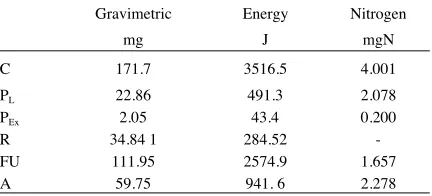
TABLE 1. Components of larval trophic budgets. All weights are dry weights and PL is the gut-free weight.
Gravimetric Energy Nitrogen
mg J mgN
C 171.7 3516.5 4.001
PL 22.86 491.3 2.078
PEx 2.05 43.4 0.200
R 34.84 1 284.52
-FU 111.95 2574.9 1.657
A 59.75 941. 6 2.278
1- by difference; 2 - measured R (R). R by difference = R x 1.43 = 406.9J
LARVAL BUDGETS
The P term for larvae can be segregated into the energy content of the larval body (PL) and the cast skins (exuviae) (PEX). The gut and its contents which
contributed up to 50 % of the larval dry weight are excluded from the estimates presented below (Table 1).
In the nitrogen budget (Table 1) the left hand side of eq 3 = 0.984 x the right hand side, which is well within the normally accepted 5-10% balancing error. This indicates that the gravimetric budget is accurate, hence the estimate of the weight of material respired by larvae can be considered to be reliable.
In the energy budget there is a small deficit of 122.4 J (equivalent to 3.5% of C), a consistent feature of insect energy budgets which still has not been ade-quately explained (Wightman, 1981).
ADULT BUDGETS
As beetles can remain reproductively active for three or more months it is not rational to attempt a 'whole of life' budget. Therefore, we have con-structed daily budgets for female, male and 'average beetles'. Only the latter is shown here.
The basic budget is more comp!ex that (1) and (2) because:
(i) body weight (of females especially) fluctuates according to reproductive status;
(ii) it was not possible to estimate semen production (so that it was assumed to have zero mass); and (iii)it was not possible to obtain natural cadavers
(which is necessary to estimate the full budget of adult insects). Thus, for adults, on a per day basis:
C = (d PAD + PR) + R + FU (5)
(where PR = reproductive products, i.e.. eggs and
associated secretions).
TABLE 2. Components of adult trophic budgets (dPAd not included because it is assumed to be zero on a daily basis)
Gravimetric Energy Nitrogen
mg J mgN
C 21.36 591.1 0.638
PR 2.25 65.4 0.252
R - 82.01
-FU 14.53 362.6 0.285
A (=C=FU) 12.83 228.5 0.353
1 Corrected to RC (=Rm x 1.43).
TABLE 3. Material removed by an average larva during its development and an average beetle/day.
Gravimetric Energy Nitrogen
mg J mgN
Larva: C 171.7 3516.5 4.001
NU 22.6 462.4 0.526
MR 194.3 3978.9 4.527
Adult: C 21.36 591.9 0.638
NU 4.86 99.5 0.113
MR 32.22 659.9 0.751
insects bite off but which drop to the ground as material not used (NU). The actual material removed (MR) = C + NU (Table 3).
This briefly reviews the basic trophic budgets of this species. Their implications, uses and ways of ex-tending them are discussed in the resume which follows.
REFERENCES
WIGHTMAN, J. A. 1977. Respirometry techniques for terrestrial invertebrates and their appLication to energetics studies. New Zealand Journal of Zoology 4: 453-6~.
WIGHTMAN. J . A. 1981. Why insect energy budgets do not balance Oecologia 50: 166-9.
WIGHTMAN, J. A.; RODGERS, V. M. 1978. Growth, energy and nitrogen budgets and efficiencies of the growing larvae of Megachile pacifica (Panzar) (Hymenoptera: Megachilidae). Oceologia 36: 245-57.
TROPHIC ECOLOGY OF LARVAL AND ADULT PAROPSIS CHARYBDIS STÅL, (COLEOPTERA:
CHRYSOMELIDAE)-MODELS BASED ON MASS, ENERGY, NITROGEN AND FOURTEEN OTHER
ELEMENTS
JOHN A. WIGHTMANl AND PENELOPE B. EDWARDS2 1 Entomology Division, DSIR, Private Bag,
Christchurch, New Zealand
2 Botany and Zoology Department, Massey
University, Palmerston North, New Zealand. (Present address: CSIRO Dung Beetle Research Unit,
Private Bag, X5, East Lynn, Pretoria, 0039, South Africa).
Trophic budgets reveal the efficiency with which an animal extracts its requirements from the environ-ment. For a student, their construction is an excel-lent way of developing laboratory skills, a facility for computation, and an understanding of the funda-mentals of ecology. However, they need not be an end point in themselves because they have many ap-plications in applied and basic ecology.
Ecological efficiencies
One of the starting points of learning and teaching ecology is the familiar pyramid of numbers (Phillip-son, 1966) which has plants at the bottom and 'top' predators at the top.
This concept is based on ecological efficiencies, in particular the gross ecological efficiency (GEE) which is defined as the ratio between what an individual (or population) consumes (C) and produces (P), i.e., GEE (as a percentage) = 100 P / C. The other efficiencies that are normally discussed are:
Assimilation efficiency (AE) 100 A/C. The ratio between the amounts of material absorbed and con-sumed. The fate of a quantum of consumed energy or matter is decided at the gut wall. If it is absorbed it is diverted into body tissue (respired), or excreted. If it is defaecated it goes directly to the decomposer guild.
Net biological efficiency 100 P / A. The ratio be tween material converted to tissue and assimilate.
P to R ratio-indicates the amount of energy in-corporated into tissue, compared to the energy used to fuel the metabolic processes.
NEW ZEALAND JOURNAL OF ECOLOGY, VOL. 6, 1983
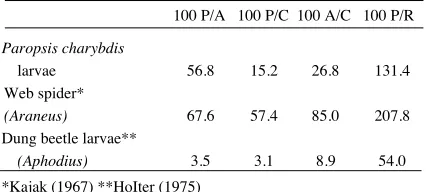
TABLE 1. Ecological efficiencies of arthropods with different life systems.
100 P/A 100 P/C 100 A/C 100 P/R Paropsis charybdis
larvae 56.8 15.2 26.8 131.4
Web spider*
(Araneus) 67.6 57.4 85.0 207.8
Dung beetle larvae**
(Aphodius) 3.5 3.1 8.9 54.0
*Kajak (1967) **HoIter (1975)
involves long periods of waiting motionless for an in-sect to hit their web-hence the high P to R ratio.
The food of dung beetle larvae has passed through the highly efficient digestive system of a cow before they get to it. Their low P to R ratio indicates that they have to work hard for a living.
The efficiencies of Paropsis larvae are similar to those of many other phyllophagous species (Wight-man, 1978), the high P to R ratio indicating that they do not extend much energy searching for food.
POPULATION CONSUMPTION MODELS
The discussion of efficiencies can go one stage fur-ther by looking at the P to MR (material removed, above) ratio. This information can then be combined with population data and models to predict defoli-ation.
Exampie
Our morphometric and energetics data have been combined to relate larval length or live weight to the
total material removed (MR).
log MR = 2.042 + 3.418 (log larval length)
log MR = -0.728 + 1.023 (log larval live weight) Thus, a forest entomologist armed with a ruler,
a portable electronic balance. and a pocket calculator could estimate how much a given population has eat-en whilst in the field and make an instant decision about the need to apply an insecticide. Adults can be included in this estimate; they remove 32.2 mg dry weight (= 130 mg live weight) per day.
HOW MUCH SOLAR ENERGY DOES A LARVAE NEED TO COMPLETE ITS DEVELOPMENT?
This question can be answered using data provided by the energy budget (above) and by standard texts such as Phillipson (1966):
Larval production ...= 534.7 J Larval consumption...= 3516.5 J and total material removed...= 3978.9 J 75% of photosynthate respired
to fuel leaf production. Total
photosynthate therefore ... = 5300 J Only 3 % of the solar radiation impinging
on leaf absorbed;
total incident radiation………… .. = 1.77 X 10⁵ J 2/3 of solar energy reaching
earth's atmosphere is dissipated by the time it arrives at the
earth's surface, therefore total amount of the energy reaching the earth that is needed to fuel the
development of one larva …………... = 5.3 X 10⁵ J In terms of ecological efficiency-this is a mere 0.101 %.
NUTRIENT CYCLES
Energy is rarely the factor that limits the develop-ment of an individual or a population. However, in the case of a phytophage, the nutrient and water status of the host can modify its development rate. The dynamics of the major nutrients therefore may be important in understanding how a community functions.
In the absence of suitable population data the role of P. charybdis in the nitrogen cycle is best illustrated by a simple model.
A hypothetical Eucalyptus viminalis tree has 500,000 leaves suitable for all stages to eat. As the average dry weight of a leaf is 50 mg there are 582.5 gN avaiJable to a P. charybdis population. Two gen-erations of 10,000 larvae eat 80 gN y-l and drop
10.6 gN as NU with the 33.2 gN in their faeces. Two adult generations of 10,000 individuals eating for an average 100 days remove 150.6 gN, consume 128 gN, egest 57 gN and drop 22.6 gN as NU. The cadavers contribute a further 39 gN to the decomposers and 39 gN of the second generation remain to start the first generation of the next year.
Eucalypt leaves do not fall at a fixed time during the year but stay on the tree for perhaps 18 months. Their longevity depends on a number of factors, in-cluding insect attack. Therefore, for the sake of this model, we shall assume that approximately 75% of the leaves that were fed upon by Paropsis fall dur-ing the time the two generations are feeddur-ing and that the insect's feeding is evenly distributed throughout the tree. This means that, of the 582.5 gN that passed up the trunk to contribute to the tissue of the suit-able leaves, only 81 mgN remains after the insects and the resultant dehiscence have taken their toll. If the insects had not been there the leaves on this hypothetical tree would have remained and senesced in situ after 18 months.
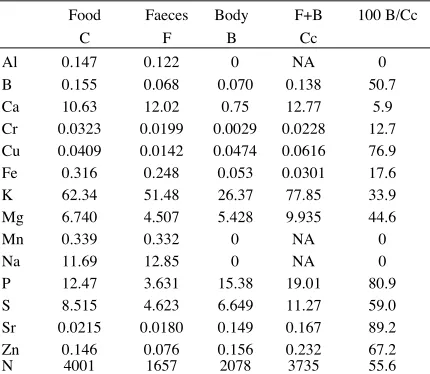
requires for its survival. Dr P. Reay of Applied Bio-chemistry Division has analysed the bodies of fully grown Paropsis larvae, faeces and food. The result, as ppm, have been converted to g egested, ingested and incorporated (Table 2). It will be noted that the 'budget' of C = P + FU does not balance. Although care was taken to ensure that the leaves analysed matched what appeared to be eaten by larvae, it is suspected that proportionally more vascular tissue was analysed than was eaten. It is felt the C is best considered as FU + B.
TABLE 2.Results of an elemental analysis of the food, faeces and bodies of Paropsis charybdis ( gram). The data for N (above) are includedf or comparison. Note that 'B, excludes exuviae. NA=not absorbed.
Food Faeces Body F+B 100 B/Cc
C F B Cc
Al 0.147 0.122 0 NA 0
B 0.155 0.068 0.070 0.138 50.7
Ca 10.63 12.02 0.75 12.77 5.9
Cr 0.0323 0.0199 0.0029 0.0228 12.7
Cu 0.0409 0.0142 0.0474 0.0616 76.9
Fe 0.316 0.248 0.053 0.0301 17.6
K 62.34 51.48 26.37 77.85 33.9
Mg 6.740 4.507 5.428 9.935 44.6
Mn 0.339 0.332 0 NA 0
Na 11.69 12.85 0 NA 0
P 12.47 3.631 15.38 19.01 80.9
S 8.515 4.623 6.649 11.27 59.0
Sr 0.0215 0.0180 0.149 0.167 89.2
Zn 0.146 0.076 0.156 0.232 67.2
N 4001 1657 2078 3735 55.6
This study indicated that Al, Mn and Na are not absorbed at all even though the latter was present in relatively large quantities. Ca, Cr and Fe were ab-sorbed with low efficiency. Much of the small amount of Cu in the leaves was retained. It is noteworthy that Sr, the least abundant element, was absorbed with the highest efficiency. The remaining elements, which include the major nutrients K, P, Sand Mg were absorbed with about the same efficiency as N.
REFERENCES
HOLTER. P. 1975. Energy budget of a neutral population of Aphodills rllfipes larvae (Scarabaeidae). Oikos 20: 177-86.
KAJAK, A. 1967. Productivity of some populations of web spiders. In: Petrusewicz, K. (Editor). S e c o n d a r y productillity of terrestrial ecosystems. Panstowe Wydawnicto Nankowe, Warsaw.
PHILLIPSON, J. 1966. Ecological energetics. Arnold, Lon-don.
WIGHTMAN. J. A. 1978. The ecology of Callosobruchus analis (Coleoptera: Bruchidae): morphometries and energetics of the immature stages. Journal of Animal Ecology47: 117-129
THE IMPACT OF TROPICAL CYCLONE BERNIE ON THE FORESTS
OF UREWERA NATIONAL PARK, NORTH ISLAND, NEW ZEALAND
W. B. SHAW
Department of Biological Sciences, University of Waikato, Private Bag, Hamilton,
New Zealand
On 9 and 10 April, 1982 tropical cyclone Bernie swept down the eastern coast of North Island, New Zealand. This severe storm, which had its origins near the equator, caused damage to both exotic and indigenous forests over approximately 30% of North Island. Indigenous forests are known to have suffered damage in the Raukumara Ranges, the Urewera Ranges (including the Waioeka State forest, Urewera National Park and Whirinaki State Forest), the Kaweka Range, the Kaimanawa Ranges, Tongariro National Park, Egmont National Park, the west Taupo forests and the Waimai-Mamaku forests. Damage also occurred, but on a smaller scale, in the Waikato Basin, on Mayor and Little Barrier Islands and in many small forests adjacent to the areas men-tioned above.
Damage within Urewera National Park was caused by generally southerly winds varying between ESE and SSW (140-210º). Wind peaks associated with the passage of cyclone Bernie were recorded at various locations around U.N.P. viz Rotorua 61, Gisborne 60, Napier 63 and Whakatane 62 knots. These gusts have a mean return period of 8-38 years depending on the station concerned (N.Z. Meteoro-logical Service, pers. comm.). It is likely that more extensive gusts would have occurred at higher alti-tudes over the inland ranges; an estimated 92 knot gust was recorded at East Cape.
Heavy rainfall was associated with the storm, with 220 mm falling at Lake Waikaremoana (A. Ure, pers. comm.). The return period likely for this scale of event is around 10 years (S. Reid, pers. comm.).
Damage within the park was assessed and recorded by aerial reconnaissance, by a survey of people using the park following the event, and by ground recon-naissance.
From the collective accounts of a number of ob-servers it is obvious that damage occurred across the entire forest tract of the park and initial calculations
µ
NEW ZEALAND JOURNAL OF ECOLOGY, VOL. 6, 1983
show that 20 % of the forests suffered noticeable canopy modification. Some forest suffered severe devastation involving practically total blowdown of areas up to 40 ha in extent. Many trees suffered initially non-fatal damage such as defoliation, branch and limb breakage and cracking of stems.
Damage occurred to probably every forest type although Nothofagus-dominant forests in the south and south-eastern sectors of the park were the most extensively damaged.
The damage pattern was very irregular but the apparent randomness of damage can be attributed to local topographic features such as leading ridges, lee slopes, valley funnelling and amplification, as well as to the biotic factors of canopy gaps and tree health.
Cyclone Bernie created canopy gaps in forests throughout the central and eastern parts of North Island. The impact of this one event will be reflected in the regeneration pattern within the affected areas for a very long time. Even the initially 'minor' dam-age (e.g. defoliation, branch breakdam-age) may predis-pose much of the still standing forest to ongoing mortality or 'dieback' from the later effects of fungal pathogens, insects, drought, browsing animals and extremes of c1imate such as frosts, snow and further storms.
The impact of Bernie is an indication of the type and scale of damage that storms may have caused in these forest~ in the past. Other tropical cyclones are
known to have caused damage to indigenous forests over most of North Island and in the northern and north-western parts of South Island. Events causing such damage have been recorded for 1936 (Thomson, 1936; Poole, 1937. Zotov et al., 1938), 1959 (Conway, 1959), 1968 (Dawson. 1970; J. Maryatt, pers. comm.) and 1975 (G. N. Park, pers. comm.). Bernie was, therefore, at least the fifth severe tropical cyclone to have caused damage to forests within the last 50 years. Others may have caused damage which has not been recorded in the literature.
New Zealand is an oceanic and mountainous country where storms of both tropical and extra-tropical origins are relatively frequent, especially when compared with the life spans of our indigenous tree species. These events are potentially major determinants of pattern and structure in forests throughout large parts or all of New Zealand.
REFERENCES
CONWAY, M. F. 1959. Hurricane damage in Northland. New Zealand Journal of Forestry 8 (1): 151-2.
DAWSON, K. 1970. Storm damage on Kapiti Island, Easter 1968. Bulletin of the Natural Sciences 1: 34-44.
POOLE, A. L. 1937. A brief ecological survey of the
Pukekura State Forest, South Westland. New Zea-land Journal of Forestry 4: 78-85.
THOMPSON, A. P. 1936. The recovery of an indigenous forest after windthrow. Te Kura Ngahere 9 (1): 32-3.
ZOTOV, V. D.; ELDER, N. L.; BEDDIE, A. D.; SAINSBURY, G. O. K.; HODGSON, E. A. 1938. An outline of the vegetation and flora of the Tararua mountains Transactions and Proceedings of the Royal Society of New Zealand 68: 259-324.
CROSS-FOSTERING OF THE CHATHAM ISLAND BLACK ROBIN
DON V. MERTON
Wildlife Service, Department of Internal Affairs, Wellington, New Zealand
The Chatham Island black robin (Petroica traversi) is now one of the world's rarest birds. It disappeared from the larger islands of the Chatham group follow-ing European colonisation last century and for about 90 years survived only on Little Mangere Island, a 200 m high islet capped with approximately 5 ha of scrub and forest. In the early 1970's, the forest of Little Mangere degenerated rapidly and the robin population plummetted from 18 birds in 1973 to seven (two pairs, three males) in 1976. The survivors were then relocated in 4 ha of remnant forest on nearby Mangere Island where, prior to their introduction, over 120,000 Olearia traversi had been planted by the Wildlife Service to ultimately establish a new forest habitat for the birds.
During the final three years on Little Mangere Island, only one black robin chick survived to breed-ing age. Although five chicks survived in the first four years following transfer, this was off-set by natural deaths of older birds and the population re-mamed dangerously low.
Like their mainland counterparts, black robins are long-lived (some are presently at least 10-12 years old), take two years to reach sexual maturity and have a low reproductive rate, laying only two eggs per clutch. Since re-nesting occurs following the loss of a clutch, their potential productivity was obviously greater than the 0.5 independent young per pair pro-duced each year on Mangere Island. With this in mind, I developed a cross-fostering program with the aim of increasing the number of chicks raised each year and thereby increasing the population to a safer level.
first clutches to the nests of Chatham Island warblers (Gerygone albofrontata) for incubation and rearing, and the inducement of the robins to re-nest. Before manipulations began urgent studies were carried out in order to establish whether the fostering species would accept alien eggs of a different colour and size, how they would respond to an altered incuba-tion period, whether they would feed a chick of a different species and the many other factors one would normally like to know before embarking on such a highly manipulative program. But the pro-gram commenced with the certain knowledge that to leave the birds alone for a further year would only result in further stagnation or decline. It was literally a do or die situation.
Both the robins and warblers proved extremely tolerant of disturbance at their nests, and could be induced to incubate for twice their normal period. They would accept eggs and nestlings of other small insectivorous passerines at virtually any stage (includ-ing day one) of incubation. The exception was dur(includ-ing nest-building when chicks might become incorporated into the nest!
During the 1980/81 season, the two pairs of robins produced, between them, five clutches totalling 10 egg>. Six eggs hatched, four of them under warblers and four chicks eventually fledged. The manipula-tions had involved transferring eggs to warblers and the chicks back to robins for .rearing once the chicks were 5-8 days old and after the robins had relaid. The important finding was that two robin chicks and a dunnock (Prunella modularis) chick fostered to warblers all died on about their 10th day in warblers' nests.
At the end of the 1980/81 season, the robin popu-lation stood at nine individuals; in the absence of
intervention, only one chick would have been raised to independence.
Two robins died during the winter of 1981--the lone female and a juvenile-leaving three pairs and one female as the basis for further manipulations. One pair--both yearlings--were too young to breed.
During the 1981/82 season the two breeding pairs of robins were each induced to lay three clutches. Because only limited success was achieved using warblers, the Chatham Island tit (Petroica macro-cephala chathamensis) was tried as a foster parent. There were, however, logistic problems to overcome. Prior to the introduction of robins to Mangere, all tits had been eliminated from that island because they were considered to be potential competitors for food and space. To use tits as foster parents requir-ed moving robin eggs or chicks 15 km by boat to South East Island.
Fortunately, the tits proved as tolerant as warblers to interference at their nests. More importantly, they proved able to hatch and rear robins through to inde-pendence, an advance over the warbler's inability to keep chicks alive after 10 days.