RESEARCH ARTICLE
DEVELOPMENT OF SENSOR BASED TOUCH PAD FOR HAND MOVEMENT ANALYSIS
*Ritam Mallick, Saikat Paul and Rahul Prasad
Department of Electronics and Instrumentation Engineering College, SRM Institute of Science and Technology,
Potheri, Chennai, Tamil Nadu
ARTICLE INFO
ABSTRACT
The purpose of the project is to design a sensor that can analyse the pressure while writing and simultaneously detect the direction of hand movement. The main principle involved in the designing of the sensor is whenever the sensor will undergo a pressure while writing, electrical output will be produced which will be converted to a certain voltage. This voltage will be directly proportional to the pressure and will be displayed by using a PC, an accelerometer will be employed with the sensor to measure the speed and direction of the hand movement while writing. The accelerometer is an electromechanical device used to measure acceleration forces that might be static like the continues force of gravity or as in the case of many mobile devices, dynamic to sense movement or vibrations. This are actually MEMS where the displacement of a small proof mass etched into the silicon surface of the integrated circuit is suspended by small beams. The main aim of this project is to detect movement disorders of aged individuals at an early stage. According to current report the aged individuals from the age group of 60 and above faces hand movement disorders. So to curb this problem at an early stage a sensor based pad is develop which will analyse the pressure that should be possess by the age group of 60 and above by comparing with the normal individuals of that age group with the help of medical data.
Copyright © 2018,Xiao-Fei Gao et al. This is an open access article distributed under the Creative Commons Attribution License, which permits unrestricted use, distribution, and reproduction in any medium, provided the original work is properly cited.
INTRODUCTION
Movement disorders are clinical syndromes with either an excess of movement or a paucity of voluntary and involuntary movements, unrelated to weakness or spasticity (Fahn, 2011). Movement disorders are synonymous with basal ganglia or extra pyramidal diseases (Bradley and Walter George, 2004). Movement disorders are conventionally divided into two major categories- hyperkinetic and hypokinetic. Hyperkinetic movement disorders refer to dyskinesia, or excessive, often repetitive, involuntary movements that intrude upon the normal flow of motor activity. Hypokinetic movement disorders refer to akinesia (lack of movement), hypokinesia (reduced amplitude of movements), bradykinesia (slow movement) and rigidity. In primary movement disorders, the abnormal movement is the primary manifestation of the disorder. In secondary movement disorders, the abnormal movement is a manifestation of another systemic or neurological disorder (Flemming, 2015). A functional movement disorder means that there is abnormal movement or positioning of part of the body due to the nervous system not working properly (but not due to an underlying neurological disease). When an arm or leg shakes uncontrollably. In functional tremor this is often quite variable.
*Corresponding author: Ritam Mallick,
Department of Electronics and Instrumentation Engineering College, SRM Institute of Science and Technology, Potheri, Chennai, Tamil Nadu
It may even disappear when you are distracted but at other times be very disabling. Some people experience jerky types of movements. This may be particularly in response to loud noises, certain kinds of lighting or bursts of pain.Some people find that their hands or feet develop abnormal postures which are hard to overcome. This may be a temporary intermittent problem (a spasm) or may be more chronic (this is usually called fixed / functional dystonia or contracture). Patients with functional dystonia often have a ‘clenched hand’ or a twisted
foot (Singer et al., 2015). The diagnosis of a functional
movement disorder is usually made by a neurologist. It can be a particularly difficult diagnosis to make because it requires expert knowledge of the full range of movement disorders due to neurological disease, many of which are unusual or even bizarre. It is therefore difficult to summarise all of the clinical features of functional movement disorders. They often occur in
relation to injury and the onset can be sudden (Poewe et al.,
2014).
Literature survey
A tremor is an involuntary, somewhat rhythmic, muscle contraction and relaxation involving oscillations or twitching movements of one or more body parts. It is the most common of all involuntary movements and can affect the hands, arms, eyes, face, head, vocal folds, trunk, and legs. Most tremors occur in the hands. In some people, a tremor is a symptom of another neurological disorder. A very common tremor is the teeth chattering, usually induced by cold temperatures or by
ISSN: 0976-3376
Vol. 09, Issue, 02, pp.7522-7528, February,Asian Journal of Science and Technology 2018SCIENCE AND TECHNOLOGY
Article History:
Received 18th November, 2017
Received in revised form
26th December, 2017
Accepted 06th January, 2018
Published online 28th February, 2018
fear. Tremor can be a symptom associated with disorders in those parts of the brain that control muscles throughout the body or in particular areas, such as the hands. Neurological disorders or conditions that can produce tremor include multiple sclerosis, stroke, traumatic brain injury, chronic kidney disease and a number of neurodegenerative diseases that damage or destroy parts of the brainstem or the cerebellum, Parkinson's disease being the one most often associated with tremor. Tremors can also be seen in infants with phenylketonuria (PKU), overactive thyroid or liver failure. Tremors can be an indication of hypoglycemia, along with palpitations, sweating and anxiety. Tremor can also be caused from lack of sleep, lack of vitamins, or increased stress
(Jim Folk, 2017). Deficiencies of magnesium
and thiamine have also been known to cause tremor or shaking, which resolves when the deficiency is corrected. See magnesium in biology. Some forms of tremor are inherited and run in families, while others have no known cause. Tremors can also be caused by some spider bites, e.g. the redback spider of Australia. Characteristics may include a rhythmic shaking in the hands, arms, head, legs, or trunk; shaky voice; and problems holding things such as a fork or pen. Some tremors may be triggered by or become exacerbated during times of stress or strong emotion, when the individual is physically exhausted, or during certain postures or movements. Tremor may occur at any age but is most common in middle-age and older persons. It may be occasional, temporary, or occur intermittently. Tremor affects men and women equally.
MATERIALS AND METHODS
The Raspberry Pi we used here is a series of small single-board computers developed in the United Kingdom by the Foundation to promote the teaching of basic computer science in schools and in developing countries. The original model became far more popular than anticipated, selling outside its target market for uses such as robotics. It does not include peripherals (such as keyboards, mice and cases).
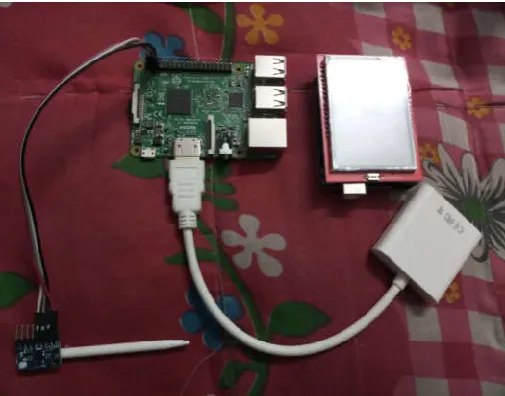
Figure a. The sensor pad setup
However, some accessories have been included in several official and unofficial bundles. Several generations of Raspberry Pis have been released. All models feature a Broadcom system on a chip (SoC) with an integrated ARM compatible central processing unit (CPU) and on-chip graphics processing unit (GPU). Processor speed ranges from 700 MHz to 1.2 GHz for the Pi 3; on-board memory ranges from 256 MB to 1 GB RAM. Secure Digital (SD) cards are used to store the operating system and program memory in either SDHC or Micro SDHC sizes. The MPU 6050 we are using here is a 3-axis MEMS gyroscope, a 3-axis MEMS accelerometer. It is very useful for some motion detecting. This small module integrate the logic level converter circuit (makes it compatible with 3.3V-5V voltage level) together with the MPU6050 sensor, you can integrate it to your project conveniently. The Raspberry Pi is interfaced with a Touch Pad which consist of a touch sensor and a MPU6050 which is a 3-axis MEMS gyroscope and accelerometer. Both reads data of the input signal and store as an image file in the memory card of the Raspberry Pi.
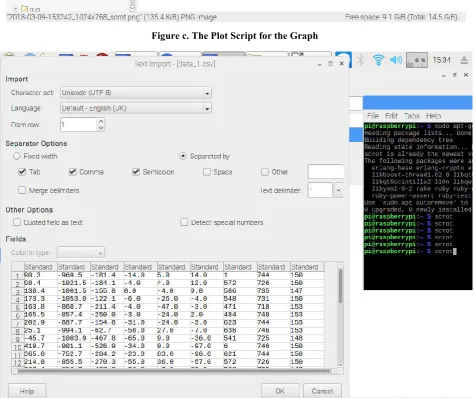
Figure c. The Plot Script for the Graph
The Graphic User Interface(GUI) is used to display the pressure as well as direction and acceleration of hand movement.
System Requirements
The requirement of Sensor Based Touch Pad for hand movement analysis is summarised in Table 1. The requirement of Hand Movement Analysis using sensor based touch pad are decided by the parameters such as pressure, linear acceleration and angler velocity. For this purpose Raspberry Pi 3 is used which is interfaced with MPU 6050 and with 2.5 TFT Display and is connected with an active pen, which processes the input data and convert it into suitable value in human readable form. When the hand is stable, the variations in the consecutive gyro sensor outputs and accelerometer outputs are subtle i.e. very small.
When there is a slight movement of hand the variations in the gyro sensor outputs and accelerometer outputs are comparatively larger than in stable condition.
Raspberry Pi 3
The Raspberry Pi we used here is a series of small single-board computers developed in the United Kingdom by the Raspberry Pi Foundation to promote the teaching of basic computer science in schools and in developing countries. The original model became far more popular than anticipated, selling outside its target market for uses such as robotics. It
does not include peripherals (such as keyboards,
mice and cases). Secure Digital (SD) cards are used to store
the operating system and program memory in either SDHC or
MicroSDHC sizes.
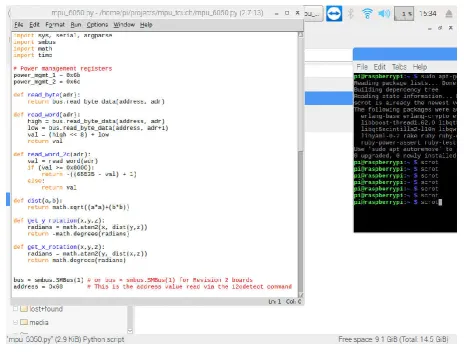
Figure e. The MPU 6050 Script
Table 1. Requirements of Sensor Based Touch Pad
Devices Specifications
Raspberry Pi 3 Processor Speed Range- 700 MHz to 1.2GHz
On Board Memory Range-256 Mb to 1 Gb Storage- MicroSDHC Slot
Power-1.5 W
Processor-Broadcom BCM2835
MPU 6050 12C Interface
Operating Voltage-3.3V-5.0V
Embedded with 3-axis Mems Gyroscope and Accelerometer
LCD 2.5 TFT NTSC/PAL Driver board
Operating Voltage- 6-12V dc
80mA power draw at 12V, 150mA at 6V Resolution-320RGBx240high
Figure 1. Raspberry Pi 3
MPU 6050-
The MPU 6050 we are using here is a 3-axis MEMS
gyroscope, a 3-axis MEMS accelerometer. It is very useful for
some motion detecting. consecutively. It is the world’s first
motion processing solution with integrated 9-axis sensor fusion using its field proven and proprietary Motion Fusion engine for handset and tablet applications, Game controllers and other consumer device. It is a Digital Motion Processor hardware accelerator engine with an auxiliary I^2C or SPI port (SPI is available on MPU6000 only). The MPU6050 combines acceleration and rotational motion plus heading information into a single data stream for the application. The MPU6050 features three 16bit analog to digital convertors for digitising the gyroscope outputs and three 16 bit ADCs for digitising the accelerometer outputs. For precision tracking of both fast and slow motions, the parts feature a user programmable gyroscope full scale range of + - 250, +- 500, +- 1000 and +- 2000 degree per/sec (dps) and a user programmable accelerometer full scale range of +- 2g,+- 4g,+- 8g and +- 16g. The MPU6050 supports the I^C serial interface only and has a separate VLOGIC reference pin.
Figure 2. MPU 6050
System Architecture
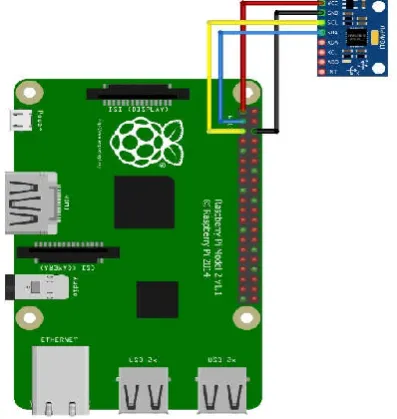
The main purpose of the Raspberry Pi is to process the input signal from the MPU6050 embedded with gyro sensor and accelerometer and active pen and convert it into suitable value. When we write in a touch panel using the active pen, the signal of the accelerometer and gyrosen sor is sent to the Raspberry Pi with the help of 12C communication protocol through the SCL and SDA port to the GPIO2 and GPIO3 port of Raspberry
Pi, with the help pf Phyton script using Phyton 3(IDLE), the Raspberry Pi processes the signal from the accelerometer and gyro sensor of MPU6050 into certain values.
Figure 3. MPU 6050 Architecture
Table 2. MPU 6050 Specification
Part/Item MPU 6050
VDD 2.375V-3.46V
VLOGIC 1.71V to VDD
Serial Interfaces Supported I^2C
Pin8 VLOGIC
Pin9 AD0
Pin23 SCL
Pin 24 SDA
Circuit Diagram
An on-chip 1024 byte FIFO buffer helps lower system power consumption by allowing the system processor to read the sensor data in bursts and then enter a low power mode as the MPU collects more data. With all the neccesary on-chip processing and sensor components required to support many motion based use cases.
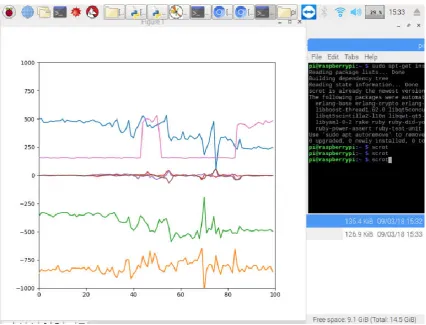
The below graph shows a deviation in the three parameters when the hand is in stable condition i.e. no involuntary shaking of hand occurs.
The below graph shows a deviation in the three parameters when the hand is in unstable condition i.e. involuntary shaking of hand occurs:
Communication with all the registers of the device is performed using either I^C at 400KHz or SPI at 1MHz. For application requiring faster communication the sensor and the interrupt registers may be read using SPI at 20MHz(MPU6000 only).For power supply flexibility, the MPU6050 operates from VDD power supply voltage range of 2.375 to 3.46V. Additionally the MPU6050 provides a VLOGIC reference pin which sets the logic levels of its I^2C interface. The VLOGIC voltage may be 1.8V+-5% or VDD. The MPU6000 and MPU6050 are identical, except that the MPU6050 supports the I^2C serial interface only and has a separate VLOGIC reference pin. The MPU6050 supports the both I^2C and SPI interfaces and has a single supply pin, VDD, which is both the device’s logic reference supply and the analog supply for the part.
Simulation Result
The below given graph is obtained when something is written on the touch pad using active stylus it hence give three parameters i.e. pressure, linear acceleration and angular velocity.
The colour represenation of the graph is given as follows:
Blue- X-axis Acceleration Red- X-Axis Gyro Green- Y-axis Acceleration Grey- Y-Axis Gyro Yellow- Z-axis Acceleration Purple- Z-Axis Gyro Pink- Pressure
Conclusion
Hence the prototype for detecting the hand movement disorder is successfully designed and the difference between the normal hand movement of a person and abnormal hand movement of a person is successfully distinguished.
REFERENCES
Bradley, Walter George, 2004. Neurology in Clinical Practice: Principles of diagnosis and management. Taylor & Francis. ISBN 9789997625885.
Fahn, Stanley, Jankovic, Joseph, Hallett, Mark, 2011. Principles and Practice of Movement Disorders. Elsevier Health Sciences, ISBN 1437737706.
Flemming, Kelly, Jones, Lyell, 2015. Mayo Clinic Neurology Board Review: Clinical Neurology for Initial Certification
and MOC.OxfordUniversity Press. ISBN 9780190244934.
Jim Folk, Marilyn Folk, BScN. "Body Tremors, Shaking, Trembling, Vibrating Anxiety Symptoms". Anxietycentre. com. Retrieved December 16, 2017.
Poewe, Werner; Jankovic, Joseph, 2014.Movement Disorders in Neurologic and Systemic Disease. Cambridge University Press. ISBN 9781107024618.
Singer, Harvey S., Mink, Jonathan, Gilbert, Donald L.,
Jankovic, Joseph, 2015. Movement Disorders in