© 2018 IJSRSET | Volume 4 | Issue 6 | Print ISSN: 2395-1990 | Online ISSN : 2394-4099 Themed Section : Engineering and Technology
Experimental Study on the Behaviour of Concrete by Using
Recycled Aggregates and Enhancing Its Self Healing Properties
by Using Bacteria
Neha Rupawate, Shweta Yadav, Mukul Patil VOGCOE, Mumbai Maharashtra, India
ABSTRACT
Concrete is a vital construction material. However, the continuous extraction of coarse aggregate has led to decrease in quantity of primary and quality aggregates. Recycling concrete wastes will lead to reduction in landfill spaces and preserves natural resources. Not only that, concrete which is a brittle material tends to crack which exposes the reinforcement to atmosphere which in turn induce problems and affect the structural integrity of the structure. Self-Healing concrete in general rectifies these flaws. The strength properties will be compared with the conventional concrete after the curing period of 7, 14 and 28 days by partially replacing coarse aggregate by recycled aggregates for a percentage of 0%, 10%, 20% and 30%. The grade of concrete used in this project is M20. The bacteria Bacillus Subtilis of concentration 105cells/ml of mixing water is used.
Keywords : Bacteria, Concrete, Recycled Aggregates, SCM, Self-Healing.
I.
INTRODUCTION
oncrete is a vital building material that is an essential component of public infrastructure and most buildings. It is a very brittle material, so it is commonly expected to crack with time. These cracks, do expose the steel reinforcement leading to corrosion which heightens maintenance costs and compromises structural integrity over long periods of time. Self-healing concrete in general seeks to rectify these flaws in order to extend the service life of any given concrete structure. Supplementary cementing materials (SCMs) are often used in concrete mixes to reduce cement contents, improve workability, increase strength and enhance durability. Crushing concrete to produce coarse aggregate for the production of new concrete is one common means for achieving a more environmentally friendly concrete. The aim of this project is to use recycled aggregates partially as a replacement for coarse aggregate in the range of 0%, 10%, 20%, 30% and also to add bacterial solution to all the concrete mix .The Bacteria Bacillus Subtilis is to be used in this project. The bacterial concrete makes use of calcite precipitation by
bacterial in the presence of the suitable media results in microbially induced calcite precipitation. The strength properties will be compared with the conventional concrete after the curing period of 7, 14 and 28 days. The grade of concrete used in this project is M20.The usage of recycled aggregates in the field of construction preserves the natural resources and also the cost of them is comparatively low when compared with conventional aggregates.
1.1. Literature Review
recycled aggregates a maximum compressive strength of 26.67 and 24.95 N/mm2 which is more than the conventional concrete was obtained. The other results showed a progressive increase for 10% and 20% replacement beyond which the strength was about equal to conventional.
Further increment of concentration of Bacillus Subtilis to the percentages of Recycle Aggregates could further increase the strength of concrete.
Usage of Recycle aggregates is eco friendly and by using the recycle aggregates the usage of coarse aggregate is partially reduced in concrete, thereby the mining activities can be minimized and also minimising the waste by reusing the materials.
Microbial Concrete technology have proved to be better than conventional technologies because of its eco-friendly nature, self healing abilities and very convenient for usage.
The optimum percentage obtained are 10%
Dharmesh K. Bhagat, etc all , From the experimental work “Experimental Study of Compressive Strength of Recycled Aggregate Concrete”, the following conclusion are made:
Recycling and reuse of building wastes have been found to be an appropriate solution to the problems of dumping hundred of thousands tons of debris accompanied with shortage of natural aggregates. The use of recycled aggregates in concrete prove to be a valuable building materials in technical, environment and economical respect. Use of RCA in concrete save the disposal and land filling cost and produce a sustainable concrete for construction.
From the material testing, it can be concluded that, RCA exhibits comparatively less specific gravity than NA. As the water absorption of RCA was found greater then NA, because of adhering mortar and cement paste. This need to be compensated during
mix design. On the other hand, RCA is having comparatively same Bulk Density as NA. But, the impact and crushing value of RCA are comparatively less than NA.
The results of compressive strength shows that, the use of RCA up to 40% affect the functional requirements of concrete structure. Also the result of slump test shows there is continuous decrease in workability of concrete mix, as the cement mortar paste is attached to RCA.
The cost analysis indicates that, the cost of construction per m3 reduces up to certain extents. This research concludes that RCA can be used as constructional material.
The test results showed that the flexural, compressive and split tensile strength of the recycled aggregate concrete is found to be lower than the natural aggregate. However the strength of recycled aggregate concrete can be improved by the water and acid treatments. Furthermore Recycled aggregate treated with nitric acid displayed the decent result compared to the hydrochloric and sulphuric acid and from economical point of view; water and acid treated recycled aggregates can be used in place of natural aggregates for temporary structures.
Goudappa Biradar, Conducted experiments and compared the results of recycled aggregate concrete and natural aggregate concrete; the compressive strength of recycled aggregate was decreased by 18.76%. The recycled aggregate treated with water has increased 4.93%, nitric acid by11.88%, sulphuric acid increased by 5.38% and hydrochloric acid increased by 7.17% than the recycled aggregate. Based on the results obtained from the experiment the conclusions are drawn,
1. The test results showed that the compressive of the recycled aggregate concrete is found to be lower than the natural aggregate.
2. The strength of recycled aggregate concrete can be improved by the water and acid treatments. 3. Recycled aggregate treated with nitric acid
displayed the decent result compared to the hydrochloric and sulphuric acid and from economical point of view; water and acid treated recycled aggregates can be used in place of natural aggregates for temporary structures.
Ashwija K.C., et al, investigated the variation in compressive strength of concrete using two different bacteria, Bacillus Subtilis and Bacillus Sphaericus. Three different cell concentrations 105, 106 and 107
cells/ml of mixing water for each bacterium. It was shown that the addition of bacteria with cell concentration of 105 cells/ml of mixing water
increases the compressive strength. The compressive strength results of concrete cube test specimens with
Bacillus Subtilis gives a strength of about 19.11 Mpa for 7 day and for cube test specimen with Bacillus Sphaericus 20.6 Mpa for 7 days.
Sudhir P.Patil.,et al, In this research concrete waste is from demolished structure had been collected and coarse aggregate of different % was used for preparing fresh concrete. And concluded that the slump of recycled aggregate concrete is more than the normal concrete. At the end it can be said that the RCA upto 50 % can be used for obtaining good quality concrete. The compressive strength of concrete containing 50% RCA has strength in close proximity to that of normal concrete.
II.
MATERIAL PROPERTIES AND
DESCRIPTION
2.1.Recycled Aggregates
Reusing the aggregates from demolished buildings for the manufacture of new concrete is known as Recycled Aggregates. The main reasons for the increase of this volume of demolition concrete waste are:
Many old buildings and other structures have over- come their limit of use and need to be demolished.
Structures even adequate to use are under demolition because there are new requirements and necessities.
Creation of building wastes which result from natural destructive phenomena (earthquakes, storms etc).
final results. The results of several studies presented in the past have caused the existing codes concerning recycled aggregates for concrete production to strongly limit the use of these products.
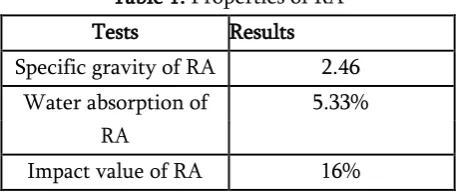
Table 1. Properties of RA
Tests Results
Specific gravity of RA 2.46
Water absorption of 5.33%
RA
Impact value of RA 16%
2.2. Bacteria
In this study Bacteria Bacillus Subtilis is used. The micro-organism used for manufacturing of microbial concrete should be able to possess long term effective crack sealing mechanism during its lifetime serviceability. The principle behind bacterial crack healing mechanism is that the bacteria should be able to transform soluble organic nutrients into insoluble inorganic calcite crystals which seals the cracks. For effective crack healing, both bacteria and nutrients incorporated into concrete should not disturb the integrity of cement sand matrix and also should not negatively affect other important fresh and hardened properties of concrete. Only spore forming gram positive strain bacteria can survive in high pH environment of concrete sustaining various stresses. It was reported that when bacteria is added directly to the concrete mix in suspension, their lifetime is limited due to two reasons; one is continuing cement hydration resulting in reduction of cement and sand matrix pore diameter and other is due to insufficient nutrients to precipitate calcite crystals. However, a novel method of protecting the bacterial spores by immobilization before addition to the concrete mixture appeared to substantially prolong their
life-time.
III. EXPERIMENTAL INVESTIGATION
The total experimental investigations involved in this dissertation work have been done in details. The details ofthe work are given below.
A. Materials
The materials used in the entire investigations is as follows
i. Cement:
Cement used is 53 grade Ordinary Portland Cement (OPC) and the results of various preliminary tests conducted on this cement are as given in Table I below.
Table 2. Preliminary Tests Results of Cement
SI No.
Particulars
Results
1.
Normal Consistency
34%
2.
Initial Setting Time
30 min
3.
Final Setting Time
2.42 min
4.
Specific Gravity
3
5.
Soundness
3 mm exp
6.
Compressive strength of
cement for 28 days of
curing
47.28N/mm2
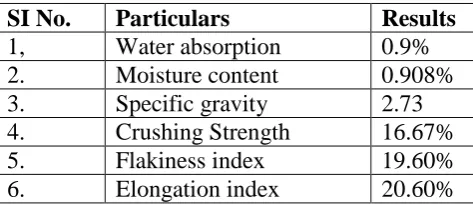
ii. Natural Coarse Aggregates:
Table 3. Preliminary test results of N.C.A
SI No.
Particulars
Results
1,
Water absorption
0.9%
2.
Moisture content
0.908%
3.
Specific gravity
2.73
4.
Crushing Strength
16.67%
5.
Flakiness index
19.60%
6.
Elongation index
20.60%
iii. Natural Fine Aggregate:
The source for fine aggregate used is from natural river bed, the details regarding test conducted on it are as given in Table 3 below.
Table 4. Preliminary test results of N.F.A
SI No.
Particulars
Results
1.
Water absorption
1.2%
2.
Moisture Content
2%
3.
Specific gravity
2.614
iv. Recycled Aggregate Concrete:
The waste concrete was brought from the demolished structure situated at city bus stand. The coarse aggregate (C.A) is separated from the concrete by hammering. Mortar adhered to the aggregate is also removed from the aggregate as much as possible.
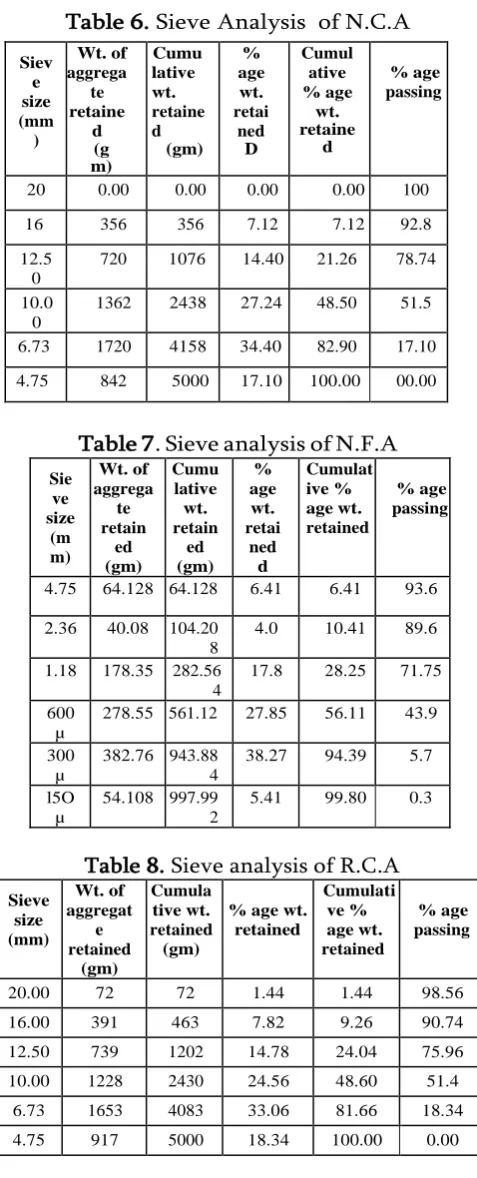
Obtained C.A is sieved under 20mm sieve (passing) and 4.75mmsieve (retained), later these aggregates can be used as R.C.A for further work. Details regarding sieve analysis of RCA are given in Table VII.
Preliminary tests conducted on Recycled Coarse Aggregates:
After obtaining the R.C.A from original concrete, preliminary tests such as sieve analysis, water absorption, moisture content, specific gravity and crushing strengths have been carried out. The results of above tests are as given in Table IV below
Table 5. Preliminary tests results of R.C.A
SI No.
Particulars
Results
1.
Moisture content
1.2%
2.
Water absorption
2.55%
3.
Specific gravity
2.55
4.
Crushing strength
19.64%
B. Casting, curing and testing work:
For each mix six cubes of 150mm x 150mm x 150mm in size, six cylinders of 150mm diameter and 300mm height and six flexural beams of size 100mmx100mmx500mm were cast using steel moulds. The cast specimens were kept in ambient temperature for 24 hours. After 24 hours they were de moulded and placed in water for curing. Cubes were used to determine the compressive strength of concrete at 7 days and 28 days. Six cylinders were used to determine the split tensile strength of concrete at 7 days and 28 days. Flexural beam were used to find out the flexural strength of concrete at 7days and 28 days by two point bending test with a supporting span of 133.33mm, using a universal testing machine of capacity 1000 KN.
Quantities of the concrete ingredients which are obtained based on N.C.A and R.C.A have been co-related with each other.
Using the material quantities obtained after co-relation, cubes cylinders and flexural beams are cast. Here, six different mixes are made and in each mix the N.C.A are replaced by R.C.A by 20% i.e., in the 1st mix 100% N.C.A are used in concrete mix where as in 2nd, 3rd, 4th and 5th mix, 20%, 40%, 60% and
80% replacement of N.C.A by R.CA is made. In the final 6th mix N.C.A are completely replaced 100% by R.C.A.
Table 6. Sieve Analysis of N.C.A Siev e size (mm ) Wt. of aggrega te retaine d (g m) Cumu lative wt. retaine d (gm) % age wt. retai ned D Cumul ative % age wt. retaine d % age passing
20 0.00 0.00 0.00 0.00 100
16 356 356 7.12 7.12 92.8
12.5 0
720 1076 14.40 21.26 78.74
10.0 0
1362 2438 27.24 48.50 51.5
6.73 1720 4158 34.40 82.90 17.10
4.75 842 5000 17.10 100.00 00.00
Table 7. Sieve analysis of N.F.A
Sie ve size (m m) Wt. of aggrega te retain ed (gm) Cumu lative wt. retain ed (gm) % age wt. retai ned d Cumulat ive % age wt. retained % age passing
4.75 64.128 64.128 6.41 6.41 93.6
2.36 40.08 104.20 8
4.0 10.41 89.6
1.18 178.35 282.56 4
17.8 28.25 71.75
600 µ
278.55 561.12 27.85 56.11 43.9
300 µ
382.76 943.88 4
38.27 94.39 5.7
l5O µ
54.108 997.99 2
5.41 99.80 0.3
Table 8. Sieve analysis of R.C.A
Sieve size (mm) Wt. of aggregat e retained (gm) Cumula tive wt. retained (gm)
% age wt. retained Cumulati ve % age wt. retained % age passing
20.00 72 72 1.44 1.44 98.56
16.00 391 463 7.82 9.26 90.74
12.50 739 1202 14.78 24.04 75.96
10.00 1228 2430 24.56 48.60 51.4
6.73 1653 4083 33.06 81.66 18.34
4.75 917 5000 18.34 100.00 0.00
IV. RESULTS AND DISCUSSION
The results of various experiments which were carried out in the dissertation work are given in this chapter. Based on the obtained results, some of the salient points are discussed below.
The results showing sieve analysis carried out for
N.C.A, N.F.A and R.C.A are given in Table V, VI, and VII respectively.
The variation in pass percentage under various sieve sizes for N.C.A and R.C.A is shown in figure 1. Table VII review the shape test conducted on N.C.A
It can be noted that there is a little variations in the percentage passing (sieve analysis) between N.C.A and R.C.A. Before using R.C.A as concrete ingredients, the aggregates are sieved under 20mm (passing) and 4.75mm (retaining) sieve sizes.
Also surface of R.C.A are rubbed thoroughly using dry cloth to remove the surface dirt as much as possible, because of which little variation in percentage is observed between N.C.A. and R.C.A.
A. Compressive strength:
The results show that the concrete specimens with more replacement of recycled aggregate have the lowest compressive strength when compared to the concrete specimens with less recycled aggregate for both 7 days and 28 days of curing. 7 days compressive strength is generally 60-80% of the 28 days compressive strength. Figure2 shows that the compressive strength at 28 days for 20% replacement of R.C.A has dropped around 5.14%. Even up to 60% replacement of recycled aggregate, the compressive strength gets reduced only to a maximum of 10.79% with respect to that of control concrete. There is a drop of 29.11% compressive strength for the 100% recycled aggregate.
The compressive strength of the concrete specimens for 60% recycled aggregate is 27.61N/mm2, which meets the target strength of 27.6N/mm2. From the obtained results, it is clear that there is a possibility to use 60% recycled coarse aggregate in applications like concrete blocks and pavements.
B. Split tensile strength:
when the percentage of recycled aggregate is increased. Table X represents the tensile strength values for mixes at7 days and 28 days of curing. The figure-3 shows that the 28 days split tensile strength is significantly greater than 7 days split tensile strength. The concrete specimen with 100% recycled coarse aggregate at 28 days of curing has the lowest tensile strength, which was only 1.952 N/mm2.
It is around 38.81% drop when compared to control concrete specimen. There is a drop in tensile strength of 10.66%, 18.18%, 24.76% and 34.79% for the concrete specimens with 20%, 40%, 60% and 80% recycled coarse aggregate respectively. Even up to 60% replacement, the split tensile strength gets reduced to a maximum of 24.76% with respect to that of control concrete.
C. Flexural strength:
The flexural strength for all the mixes at 7 days and 28 days of curing is presented in Table XI. The results show that the concrete specimens with more replacement of recycled aggregate have the lowest flexural strength when compared to the concrete specimens with less recycled aggregate. Figure 4 shows that there is a drop in flexural strength of 7.9%, 13.58%, 24.20%, 35.31% and 43.45% for the concrete specimens with 20%, 40%, 60%, 80% and 100% coarse aggregates respectively.
D. Modulus of elasticity:
By comparing all the mixes as given in Table XII, the specimen with natural coarse aggregates has the highest value of modulus of elasticity while the specimens with 100% recycled aggregate has the lowest. From the experimental results, the modulus of elasticity of full natural coarse aggregate specimens as indicated from figure 5 was 27.816 GPa, while the modulus of elasticity of full R.C.A specimens was 23.42 GPa. It indicates a drop of 4.4 GPa, which is 15.8% difference between the 0% and 100% recycled coarse aggregate batches. There is a drop in modulus of elasticity of 2.6%, 4.56%, 5.55% and 11.57% for the concrete specimens with 20%, 40%, 60% and 80% of
recycled aggregate respectively.
V.
ACIDIC TREATMENT
Coarse Aggregate. 20mm down size coarse aggregate was used in the present work which met the grading requirements as per IS 383-1970.
Fine Aggregates. Locally available sand was used in the present work. The sand belongs to zone – II as per IS 383-1970.
Recycled Coarse Aggregates. Crushed concrete aggregate waste passing through 20mm and retained on 4.75mm I.S sieve were used as recycled coarse aggregate and they met the grading requirements.
Water. Potable tap water available in the college laboratory was used in the present experimental work.
Acid Properties. The recycled aggregates were crushed and soaked in water for 24 hours for water treatment then kept for drying. Similarly the recycled aggregate soaked with diluted sulphuric hydrochloric and nitric acids separately and then those aggregates were used for casting of concrete cubes, prisms and cylinders. The acid which was bought was highly concentrated so 0.1ml of concentrated acid was mixed with 150 ml of water.
VI. CONCLUSION
Experimental investigations were conducted to determine the Characteristics and Strength of concrete by replacing of coarse aggregate with Recycled Aggregates. Concrete specimens were casted and tested to determine the Compressive strength, Split tensile strength and Flexural strength. Based on the test results it was inferred, which percentage gave better results than the conventional concrete with respect to 7,14 and 28 days Compressive strength, Split tensile strength and Flexural strength when replaced with Recycled Aggregates.
1. According to the comparative studies undertaken it is clear that with 10% and 20% replacement of coarse aggregate by recycled aggregates a maximum compressive strength of 26.67 and 24.95 N/mm2 which is more than the conventional concrete was obtained. The other results showed a progressive increase for 10% and 20% replacement beyond which the strength was about equal to conventional.
2. Further increment of concentration of Bacillus Subtilis to the percentages of Recycle Aggregates could further increase the strength of concrete.
3. Usage of Recycle aggregates is ecofriendly and by using the recycle aggregates the usage of coarse aggregate is partially reduced in concrete, thereby the mining activities can be minimized and also minimizing the waste by reusing the materials.
4. Microbial Concrete technology have proved to be better than conventional technologies because of its eco-friendly nature, self-healing abilities and very convenient for usage.
5. The optimum percentage obtained are 10% .
6. The strength of concrete using OPC with fresh coarse aggregate in general increases slightly when the equal proportion of river sand & stone dust are used in place of sand. While the strength of concrete using PPC with fresh coarse aggregate in general decreases when the equal proportion of river sand & stone dust are used in place of sand..
7. The strength of concrete using OPC with recycled coarse aggregate in general decreases when the equal proportion of river sand & stone dust are used in place of sand.
8. The test results showed that the compressive of the recycled aggregate concrete is found to be lower than the natural aggregate.
9. The strength of recycled aggregate concrete can be improved by the water and acid treatments.
10. Recycled aggregate treated with nitric acid displayed the decent result compared to the hydrochloric and sulphuric acid and from economical point of view; water and acid treated recycled aggregates can be used in place of natural aggregates for temporary structures.
11. Little variation in %age passing (Sieve Analysis) is observed between N.C.A and R.C.A. this is mainly because of carrying out proper sieve analysis of R.C.A and by removing the surface dirt present on R.C.A by rubbing with dry cloth
12.Water absorption of RCA is more than the water absorption of NCA due to the older mortar adhered to the surface of
aggregate which contribute towards
decrease of strengths
13. For achieving target mean strength 17.37% of extra quantity of cement is to be added in the concrete mix.
VII.
REFERENCES
[1].Yong, P.C. and Teo, D.C.L. "Utilization of Recycled Aggregate as Coarse Aggregate in concrete" UNIMAS E-Journal of Civil Engineering, Vol. 1: issue 1 August 2009.
[2].Parekh D. N. and Dr.Modhera.C.D "Assessment of Recycled Aggregate Concrete" Journal of Engineering Research and Studies, E-ISSN 0976-7916.
[3].Kim Van Tittelboom , Nele De Belie, Willem De Muynck and Willy Verstraete, "Use of bacteria to repair cracks in concrete", Cement and Concrete Research 40 (2010) 157–166.
SelfHealing Construction Material " Research Journal of Engineering Sciences ISSN 2278 – 9472 Vol. 2(6), 45-51, June (2013) .
[5].Ashwija.K.C., and Jayaprakash Narayan.K.S" Experimental Study on The Strength Variation of Concrete Using Bacteria" International Journal of Advanced Biotechnology and Research ISSN 0976-2612, Vol 3, Issue 1, 2012,pp 541-544
[6].Ashwija.K.C., and Jayaprakash Narayan.K.S " Experimental Study on The Strength Variation of Concrete Using Bacteria" International Journal of Advanced Biotechnology and Research ISSN 0976-2612, Vol 3, Issue 1, 2012, pp 541-544.