IJSRSET1734131 | Received : 15 August 2017 | Accepted : 31 August - 2017 | July-August-2017 [(3)5: 565-569]
© 2017 IJSRSET | Volume 3 | Issue 5 | Print ISSN: 2395-1990 | Online ISSN : 2394-4099 Themed Section: Engineering and Technology
565
Domain Sensitive Recommendation using both User Item
Subgroup Analysis and Social Trust Network
J. Swarna Latha
1, A. Sureshbabu
21M. Tech Scholar,
CSE Department, JNTUCEA, Ananthapuramu, Andhra Pradesh, India 2Associate Professor,
CSE Department, JNTUCEA, Ananthapuramu, Andhra Pradesh, India
ABSTRACT
Collaborative Filtering is a conventional technique and a booming Concept in recommendation systems to handle with overload information in the real world. In which the preference of a user on an item is predicted on the strength of the preferences of other users with homogeneous interests. CF attains relationships in between the users and suggests the items to other users. This paper introduces Social matrix factorization, to establish the rating matrix for the user and item. In which everyone convey their ratings on some items beyond creating social connection with other users. Domain clusteringis used for find the domains. The domain clustering model is rendered to make full use of the high- rated users and items are gathering them into groups.
Keywords
: Recommender system, Social trust Network, User-item subgroup
.
I.
INTRODUCTION
Now-a-days, mostly information is overloaded in World Wide Web. It is difficult to find needed information fast and efficiently. A recommendation system is absolutely necessary, which helps to solve this problem by recommending items to users based on their preferences. Collaborative Filtering is a widely used recommender system. CF approach [1], is used to forecast by just using the user-item data such as transaction antiquity or item fulfilment conveying in the ratings etc. This approach is also used for users to rate comparably on halfway items and thus they will rate on various items correspondingly. This one is always not fit because there is a limited performance in the Collaborative filtering process. It is automatically mine dissimilar area of interest and implement domain sensitive CF for the recommender approach.
Innumerable attempt have been paid on this regulation mostly these attempts can be split into two types. First, find domains with the use of Exterior statistics like social trust network [2], product information [3] etc. Second clustering CF, that utilizes the user item information and notice the domain by grouping Process. Maximum of CF grouping methods every user or item is
allocated to a one group (area of interest). Yet, in the real world the user interest and item features are not regularly absolute. For example if a user like comedy movies it doesn’t mean user doesn’t like other category movies and may be that comedy movie could be a horror movie or an action movie. Beyond maximum this clustering scheme is performed two phase successive process domain recognition by clustering and rating forecast by classic CF inside the group. One benefit of this concept is to conquer the issue of scalability came up by multiple memory based CF method. Nevertheless such as divide and conquer manner brings a current problem, that is the algorithm couldn’t handle full advantage of the up hold value which is little and valuable. To overcome above the issues we suggest a domain sensitive recommendation, which serves with the user item sub group survey, that combine rating forecast and domain recognition in to a unified structure.
for each item; Social matrix reveals the interconnection among the users.
Domain clustering representation is used for detecting the domain. This model is detailed to make filled utilization of the position among users and items to gathering them into subcategories. The high rating user-item pair should be grouped jointly.
The rest of this paper is arranged as follows: In Section 2, overview about the related work is presented. Sections 3, represents the proposed work. The results presented in the Section 4. In Section 5, we conclude the paper.
II. RELATED WORK
1. Collaborative filtering
Collaborative filtering has been classified into 2 classes, they are memory based method and model based method. Memory construct strategy discovering correspondent users or items and it follow the steps. First one is enumerate the similarity which considers the correlation enclosed by two users or two items [4]. Second one is breed and figuring the dynamic user, built on score of identical users initiate, built on the computed data of items identical. The drawbacks of this process are inadequacy and also scalability. To overcome this issue using a model based method, this method uses the recognized ratings that can adapt given data and forecast the unfamiliar rating. By using learning models to make the rating process. Matrix factorization representation [5] is an optimum one to control huge amount of datasets and good attainment in other execution.
2. Clustering collaborative filtering
A cluster is a group of information that is like one other inside the likewise group and is distinctive. The activity of clustering used in clustering CF, is to find the area of interests [6].Interests are cached by using different fraternal information and also the rating matrix [7].
The Clustering CF approach contains three classes they are user side, item side and both sides CF of clustering. User side is to split users into dissimilar subgroups. Use the divide and conquer to address the scalability problem. Item side clustering CF avenue cluster items into distinctive subgroups, which make use of current
data subdivide and clustering principle to split the set of items subject to user rating data.
There are also many principles taking in to account both sides concurrently which are more related to our methods. Clustered users and items are distinctly used in adaption of K-means. Their CF performance on artificial data is good, but not worthy on absolute data. Present clustering algorithms for CF by grouping the combine of the user & item at a time, certifying each user & items to be in different groups and making the groups of users and items alone. Unified frame work is used to increase the conventional CF algorithms by exploiting the subgroups information to develop the top N testimonial behaviour.
One another approach is contradict from the above clustering CF approaches. Initially, each user or item maybe grouping into one unique group only, while some recommendation strategy may show from the capability of grouping users and items into a few clusters at the equal time. Our user-item subgroup examination permits a user or an item to continue viewing in collective groups. In distant, this manner is detached into two liberated stages: first thing is to gather the users and items in to groups, then give the rating forecast inside every group. This successful processing may not be applicable to the detected information completely. So we combine the both rating model and detection model.
III. PROPOSED WORK
In this section, we use both user-item interaction information and some outside information concurrently for domain detection.
1. Social trust network
The people are interested in the recommendations of a particular product where certain trust relation exists among people. These systems, so called Social Trust Networks (STNs), are attracting more attention recently as they can be utilized for a more accurate recommendation generation. In order to improve the prediction quality social trust network is used. Social recommendation, it basically does not use any social network data. It just explores comparative users to generate suggestions.
We can utilize that data to make suggestions to other users about whom they in turn should trust. In these contexts, knowing whom to Social recommendation is gathering the user’s social network in order to provide customized recommendation. In user item matrix consist of ratings of every user for every item he favour and in social recommendation systems have an extra data source that is social network matrix or trust network. This matrix demonstrates the relation among users.
Figure 1: User trust relation and matrix
The figure1 shows the user trust relation and the matrix among the users, here the nodes or vertices represent the users and the edge represents the relation among users. The matrix shows the user trust relation. User1 trust user2, user4 and also user5 vice versa.Figure2 shows Network based recommendation system; here users are connected to other members only if he accepts the user’s request. Consider, we have an undirected social-trust network graph, where a node represents a customer; a weighted edge represents the relation strength among customers. If users have set to 1 then there is a trusted relation and if it sets to 0 there is no trusted relation among them.
Figure 2: Social Rating Network
Inspite of, these strategies don’t consider the circulation of trust. We additionally mean a factorization of the matrix model for suggestion in social rating networks is known as Social MF. We consist of the spread of trust in our model to progress the worth of recommendation [8].
User recommended the items to others by using the Recommender factor. The Recommender factor is the ratio of product ratings by all users /total users.
For detection of domains includes:
Search for connected users
Give the product rating
Recommend products
Find the domains
2. Domain discovery model
Bob, iPhone, and the android should belong to the same group.
IV. RESULT
In this section, we detect the domains by using the users give reviews to their familiar products but also maintain a relation among the users presents a social-trust network.
Figure 3: Items with ratings
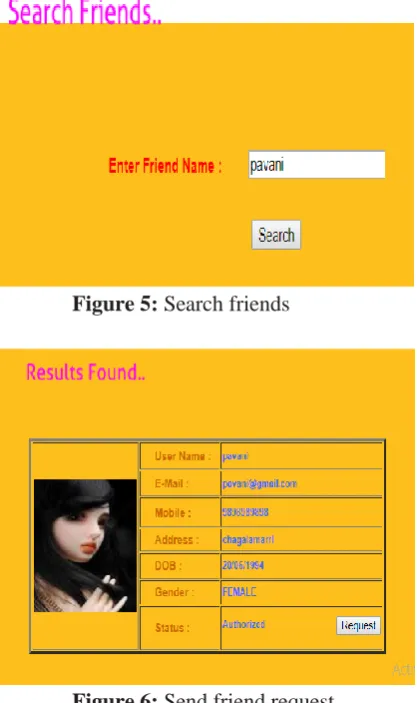
The figure3 shows the items with related ratings. The x axis represents the items or products like Laptops, OS, mobiles, home related things, etc. And the y axis represents the user ratings to the items. Whenever the user login is done then user can search friends and send friend request to others. Before sending the friend request the user should be authorized.
Recommendation Factor is used to recommend the product to users. Product Recommendation Factor is calculated by product ratings by all users/total users. A matrix factorization model is used for the product rating in the social network which is called as Social MF. Domain discovery is accomplished by clustering model. This model incorporates utilizing of dual connecting users and items to group them into subgroups. High rated user-item pair should be gathered together.
Figure 4: Login page
Figure 5: Search friends
Figure 6: Send friend request
Figure 7: Recommend product 0
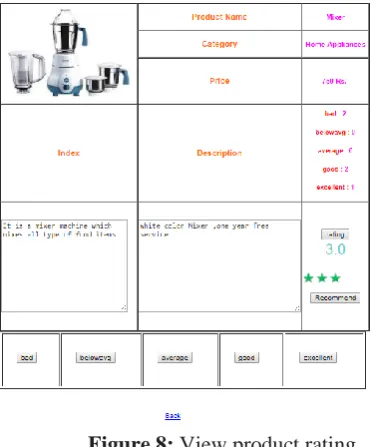
Figure 8: View product rating
Figure 9 : Product interested by users
V. CONCLUSION
This
paper
implements
a
Domain-sensitive
Recommendation to develop rating forecast by the
user-item subgroup analysis. A social matrix
factorization model called as Social MF is used for
product
rating
in
social
network.
Matrix
factorization provides trust proliferation in Social
MF. DsRec integrates a social factorization model
(rating forecast for both user item information and
trust relation) with domain-clustering model for
domain discovery.
Social matrix factorization model deals with the
trust propagation and transitive relation. It also
improves the effective recommendations for social
network users. This model performs better than
previous method as the proposed system uses
domain discovery model to easily find the user’s
area of interest.
REFERENCES
[1] Jia, D., Zhang, F., & Liu, S. (2013). A Robust Collaborative Filtering Recommendation Algorithm Based on Multidimensional Trust Model. JSW, 8(1), 11-18.
[2] Jamali, M., & Ester, M. (2010, September). A matrix factorization technique with trust propagation for recommendation in social networks. In Proceedings of the fourth ACM conference on Recommender systems (pp. 135-142). ACM.
[3] Yuan, W., Guan, D., Lee, Y. K., Lee, S., & Hur, S. J. (2010). Improved trust-aware recommender
system using small-worldness of trust
networks. Knowledge-Based Systems, 23(3), 232-238.
[4] Sarwar, B., Karypis, G., Konstan, J., & Riedl, J. (2001, April). Item-based collaborative filtering recommendation algorithms. In Proceedings of the 10th international conference on World Wide Web (pp. 285-295). ACM.
[5] De Cock, M., & da Silva, P. P. (2005). Propagation of Trust and Distrust. Lecture Notes in Computer Science.
[6] Pham, M. C., Cao, Y., Klamma, R., & Jarke, M. (2011). A clustering approach for collaborative filtering recommendation using social network analysis. J. UCS, 17(4), 583-604.
[7] Mnih, A., & Salakhutdinov, R. R. (2008). Probabilistic matrix factorization. In Advances in neural information processing systems (pp.1257-1264).