International Journal of Trend in Scientific Research and Development (IJTSRD)
International Open Access Journal |
www.ijtsrd.com
ISSN No: 2456 - 6470 | Conference Issue – ICDEBI-2018
INTERNATIONAL CONFERENCE ON DIGITAL ECONOMY AND
ITS IMPACT ON BUSINESS AND INDUSTRY
Organised By: V. P. Institute of Management Studies & Research, Sangli
Digitalisation in The Banking Sector
Laxmikanthanayaka T. O1,2, Prof. Laxmana P3
1Research Scholar, Department of Studies and Research in Commerce, Davangere University, Karnataka, India 2Asst. Professor, KLE’s Basavaprabhu Kore College, Chikodi, Belagavi Dist, Karnataka, India
3Chairman and Research Supervisor, Department of Studies and Research in Commerce, 3Davangere University, Karnataka, India
ABSTRACT
It was only in the late 1980s that Indian banks took to computer is at ion seriously. They had to improve customer service and tone up book-keeping and MIS reporting. Their large customer base (in terms of numbers) was mostly comprised of “low balance” accounts. An effective but low-cost tool that could handle the transactions was needed. It led them to embrace digital is at ion. They started with standalone PCs and migrated to Local Area Network (LAN) connectivity. Core Banking Solution (CBS) platforms followed that transformed branch banking into bank banking. CBS helped banks to provide “anywhere and anytime banking” service to customers. The researcher set out to ascertain the implications of such digital is at ion for bank customers. He interviewed bank officers and bank customers for the purpose. He concluded that digital banking was customer-centric in design and purpose. As a result, banks were in a position to offer an “experience” to their customers as against the “convenience” they offered presently. One such “experience” banks lately offer is worth citing here. To access information about account balance or to receive a mini statement through SMS, all that the customer has to do is to give a missed call to the bank concerned by dial ling a bank-designated mobile phone number. Another digital product innovation, namely, UPI/Aadhaar-based payments make banking seamless for customers, particularly rural customers, who are not familiar with the English language. Thus, digital is at ion has proved to be positive sum game for all stakeholders. The penetration of banking services into rural India is still on the low side but mobile penetration is on the higher side. By
leveraging this advantage banks can afford to raise their rural penetration since they can ensure the financial viability of their rural operations.
KEYWORDS: Book-keeping; CBS; digitalization;
leverage; LAN; MIS reporting; SMS; tool
1.1 INTRODUCTION
In the late 1980s Indian banks embraced computerisation. They had to improve customer service and tone up book-keeping. Their large customer base was mostly comprised of “low balance” accounts. An effective but low-cost tool that could handle the transactions was needed. It led them to embrace digitalisation. They started with standalone PCs and graduated to Local Area Network (LAN) connectivity and Core Banking Solution (CBS) platforms, in that order, transforming branch banking into bank banking. The penetration of banking services into rural India is still on the low side but mobile penetration is on the higher side. By leveraging this advantage, banks can afford to raise their rural penetration without affecting the financial viability of their rural operations.
1.2 Statement of the problem
1.3 Review of literature
1. G Shainesh and Avijit Choudhary in their article study the role of technological changes and advancements in the form of automated teller machines, internet banking, tele-banking, mobile banking, internet banking, etc Invalid source specified.. They conclude that reaching the customers through various channels contribute a lot to meet the competitive challenges.
2. China and India boast of the highest percentages (55-60 per cent) of Gen Y and tech-savvy customers that use financial services from non-traditional firms (The Hindu Business Line, 2017). The governments of the two countries continue to prioritise digital initiatives. Hence, the tech-savvy individuals will become more relevant.
3. Affordable, small but powerful computers and other hand-held gadgets and higher Internet bandwidth gradually facilitated easy access to banking products and effortless banking transactions (The Banking & Finance Post, 2017). The rise of call centres and phone banking services added to customer comfort. A major change in banking practices was facilitated by directing banking transactions through different electronic channels and by helping customers access their bank accounts directly.
1.4 Research gap
The reviewed literature has not dealt with the review exercise undertaken by the banks, upon digitalisation. It is this gap the present study proposes to bridge.
1.5 Scope of the present study
The study confines itself to 60 bank officers (30 from Pr SBs and 30 from PSBs), based in Bangalore (Rural and Urban) districts
1.6 Objectives of the study
The objective of the study is to analyse the implications of the digitalisation exercise for banks and their customers
1.7 Hypothesis proposed to be tested
The study proposes to test the following hypotheses: “Banks have been more receptive to complaint sand closure of transactions, post digitalisation”
1.8 Research design
1.8.1 Research methodology
The study is descriptive in nature and has used the ‘fact-finding’ survey method
1.8.2 Sources of data
Primary data has been collected from 60 bank officers (30 from Pr SBs and 30 from PSBs, based in Bangalore (Rural and Urban) districts
Secondary data has been collected from reputed banking journals, finance journals, magazines and newspapers, in hard and soft versions.
1.8.3 Sampling plan
Pr SB officers: Given the limited number of Pr SBs operating in the vicinity where the researcher lives and the time constraint, purposive or judgement sampling under the non-probability method has been employed. Applying a minimum business experience of five years as the criterion, the researcher selected 30 such officers.
PSB officers: Given the limited number of PSBs operating in the vicinity where the researcher lives and the time constraint, purposive or judgement sampling under the non-probability method has been employed. Applying a minimum business experience of five years as the criterion, the researcher selected 30 such officers.
The criteria applied is the most appropriate one for the present study. What is important is the typicality and the relevance of the sampling units to the study and not their overall representativeness to the population. Thus, it guarantees inclusion of the relevant elements in the sample. Probability sampling plans cannot give such a guarantee.
1.8.4 Data collection instruments
Interview schedules, specially designed for the purpose, were administered to the respondents for collection of primary data.
1.8.5 Data processing and analysis plan
Non-parametric statistical units were used to test the association between qualitative characters and conclusions were drawn on the basis of formation of Ho and H1.
1.8.6 Limitations of the study
respondents. Possibly, a certain degree of subjectivity, even if negligible, has influenced their views.
1.9 Pr SB officers
In the following paragraphs, the primary data collected from the Pr SB officers is analysed.
1.9.1 Banks can easily seek out new retail customers, post digitalisation
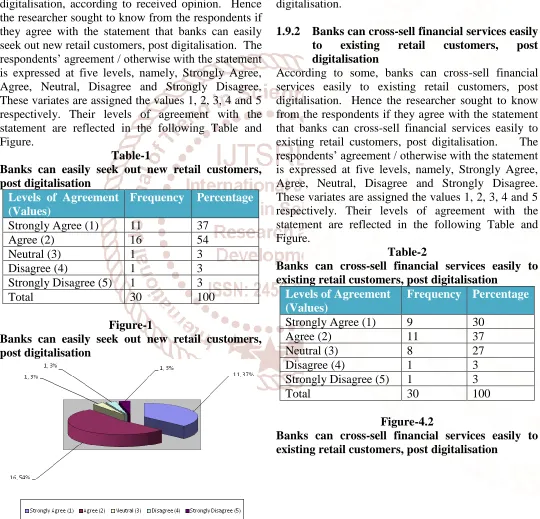
Bank scan easily seek out new retail customers, post digitalisation, according to received opinion. Hence the researcher sought to know from the respondents if they agree with the statement that banks can easily seek out new retail customers, post digitalisation. The respondents’ agreement / otherwise with the statement is expressed at five levels, namely, Strongly Agree, Agree, Neutral, Disagree and Strongly Disagree. These variates are assigned the values 1, 2, 3, 4 and 5 respectively. Their levels of agreement with the statement are reflected in the following Table and Figure.
Table-1
Banks can easily seek out new retail customers, post digitalisation
Levels of Agreement (Values)
Frequency Percentage
Strongly Agree (1) 11 37
Agree (2) 16 54
Neutral (3) 1 3
Disagree (4) 1 3 Strongly Disagree (5) 1 3
Total 30 100
Figure-1
Banks can easily seek out new retail customers, post digitalisation
37 percent strongly agree with the statement that banks can easily seek out new retail customers, post digitalisation. 54 percent agree with the statement that
banks can easily seek out new retail customers, post digitalisation. Three percent disagree with the statement that banks can easily seek out new retail customers, post digitalisation. Three percent strongly disagree with the statement that banks can easily seek out new retail customers, post digitalisation. Three percent remain neutral.
91 percent agree with the statement that banks can easily seek out new retail customers, post digitalisation.
1.9.2 Banks can cross-sell financial services easily
to existing retail customers, post
digitalisation
According to some, banks can cross-sell financial services easily to existing retail customers, post digitalisation. Hence the researcher sought to know from the respondents if they agree with the statement that banks can cross-sell financial services easily to existing retail customers, post digitalisation. The respondents’ agreement / otherwise with the statement is expressed at five levels, namely, Strongly Agree, Agree, Neutral, Disagree and Strongly Disagree. These variates are assigned the values 1, 2, 3, 4 and 5 respectively. Their levels of agreement with the statement are reflected in the following Table and Figure.
Table-2
Banks can cross-sell financial services easily to existing retail customers, post digitalisation
Levels of Agreement (Values)
Frequency Percentage
Strongly Agree (1) 9 30
Agree (2) 11 37
Neutral (3) 8 27
Disagree (4) 1 3 Strongly Disagree (5) 1 3
Total 30 100
Figure-4.2
30 percent strongly agree with the statement that banks can cross-sell financial services easily to existing retail customers, post digitalisation.37 percent agree with the statement that banks can cross-sell financial services easily to existing retail customers, post digitalisation. Three percent disagree with the statement that banks can cross-sell financial services easily to existing retail customers, post digitalisation. Three percent strongly disagree with the statement that banks can cross-sell financial services easily to existing retail customers, post digitalisation.27 percent remain neutral.
67 percent agree with the statement that banks can cross-sell financial services easily to existing retail customers, post digitalisation.
1.9.3 Banks caneasily cross-sell insurance and banking products, post digitalisation
Additionally, it is said that banks can easily cross-sell insurance and banking products, post digitalisation. Hence the researcher sought to know from the respondents if they agree with the statement that banks can easily cross-sell insurance and banking products, post digitalisation. The respondents’ agreement / otherwise with the statement is expressed at five levels, namely, Strongly Agree, Agree, Neutral, Disagree and Strongly Disagree. These variates are assigned the values 1, 2, 3, 4 and 5 respectively. Their levels of agreement with the statement are reflected in the following Table and Figure.
Table-3
Banks can easily cross-sell insurance and banking products, post digitalisation
Levels of Agreement
(Values) Frequency Percentage
Strongly Agree (1) 9 30
Agree (2) 14 46
Neutral (3) 3 10 Disagree (4) 2 7 Strongly Disagree (5) 2 7
Total 30 100
Figure-4.3
Banks can easily cross-sell insurance and banking products, post digitalisation
30 percent strongly agree with the statement that banks can easily cross-sell insurance and banking products, post digitalisation.46 percent agree with the statement that banks can easily cross-sell insurance and banking products, post digitalisation. Seven percent disagree with the statement that banks can easily cross-sell insurance and banking products, post digitalisation. Seven percent strongly disagree with the statement that banks can easily cross-sell insurance and banking products, post digitalisation.10 percent remain neutral.
76 percent agree with the statement that banks can easily cross-sell insurance and banking products, post digitalisation.
1.9.4 Banks find it easier to cultivate younger retail customers, capturing them when they are young, to cross-sell products later on
post digitalisation
post digitalisation. Hence the researcher sought to know from the respondents if they agree with the statement that banks find it easier to cultivate younger retail customers, capturing them when they are young, to cross-sell products later on post digitalisation. The respondents’ agreement / otherwise with the statement is expressed at five levels, namely, Strongly Agree, Agree, Neutral, Disagree and Strongly Disagree. These variates are assigned the values 1, 2, 3, 4 and 5 respectively. Their levels of agreement with the statement are reflected in the following Table and Figure.
Table-4
Banks find it easier to cultivate younger retail customers, capturing them when they are young, to cross-sell products later on post digitalisation
Levels of Agreement (Values)
Frequency Percentage
Strongly Agree (1) 11 37
Agree (2) 14 47
Neutral (3) 3 10
Disagree (4) 1 3 Strongly Disagree (5) 1 3
Total 30 100
Figure-4
Banks find it easier to cultivate younger retail customers, capturing them when they are young, to cross-sell products later on post digitalisation
37 percent strongly agree with the statement that banks find it easier to cultivate younger retail customers, capturing them when they are young, to cross-sell products later on post digitalisation.47 percent agree with the statement that banks find it easier to cultivate younger retail customers, capturing them when they are young, to cross-sell products later on post digitalisation. Three percent disagree with the
statement that banks find it easier to cultivate younger retail customers, capturing them when they are young, to cross-sell products later on post digitalisation. Three percent strongly disagree with the statement that banks find it easier to cultivate younger retail customers, capturing them when they are young, to cross-sell products later on post digitalisation.10 percent remain neutral.
84 percent agree with the statement that banks find it easier to cultivate younger retail customers, capturing them when they are young, to cross-sell products later on post digitalisation.
1.9.5 Banks have been more receptive to complaint sand closure of transactions post digitalisation
According to received opinion, banks have been more receptive to complaint sand closure of transactions post digitalisation. Hence the researcher sought to know from the respondents if they agree with the statement that banks have been more receptive to complaint sand closure of transactions post digitalisation. The respondents’ agreement / otherwise with the statement is expressed at five levels, namely, Strongly Agree, Agree, Neutral, Disagree and Strongly Disagree. These variates are assigned the values 1, 2, 3, 4 and 5 respectively. Their levels of agreement with the statement are reflected in the following Table and Figure.
Table-5
Banks have been more receptive to complaint sand closure of transactions post digitalisation
Levels of Agreement
(Values) Frequency Percentage
Strongly Agree (1) 9 30
Agree (2) 11 37
Neutral (3) 4 13 Disagree (4) 3 10 Strongly Disagree (5) 3 10
Total 30 100
Figure-5
30 percent strongly agree with the statement that banks have been more receptive to complaint sand closure of transactions post digitalisation.37 percent agree with the statement that banks have been more receptive to complaint sand closure of transactions post digitalisation.10 percent disagree with the statement that banks have been more receptive to complaint sand closure of transactions post digitalisation.10 percent strongly disagree with the statement that banks have been more receptive to complaint sand closure of transactions post digitalisation.13 percent remain neutral.
67 percent agree with the statement that banks that banks have been more receptive to complaint sand closure of transactions post digitalisation.
1.10 PSB officers
In the following paragraphs, the primary data collected from the PSB officers is analysed.
1.10.1 Banks can easily seek out new retail customers, post digitalisation
Banks can easily seek out new retail customers, post digitalisation, according to received opinion. Hence the researcher sought to know from the respondents if they agree with the statement that banks can easily seek out new retail customers, post digitalisation. The respondents’ agreement / otherwise with the statement is expressed at five levels, namely, Strongly Agree, Agree, Neutral, Disagree and Strongly Disagree. These variates are assigned the values 1, 2, 3, 4 and 5 respectively. Their levels of agreement with the statement are reflected in the following Table and Figure.
Table-6
Banks can easily seek out new retail customers, post digitalisation
Levels of Agreement
(Values) Frequency Percentage
Strongly Agree (1) 8 27
Agree (2) 11 36
Neutral (3) 5 17 Disagree (4) 3 10 Strongly Disagree (5) 3 10
Total 30 100
Figure-6
Banks can easily seek out new retail customers, post digitalisation
27 percent strongly agree with the statement that banks can easily seek out new retail customers, post digitalisation. 36 percent agree with the statement that banks can easily seek out new retail customers, post digitalisation. 10 percent disagree with the statement that banks can easily seek out new retail customers, post digitalisation. 10 percent strongly disagree with the statement that banks can easily seek out new retail customers, post digitalisation. 17 percent remain neutral.
63 percent agree with the statement that banks can easily seek out new retail customers, post digitalisation.
1.10.2 Banks can cross-sell financial services easily
to existing retail customers, post
digitalisation
The respondents’ agreement / otherwise with the statement is expressed at five levels, namely, Strongly Agree, Agree, Neutral, Disagree and Strongly Disagree. These variates are assigned the values 1, 2, 3, 4 and 5 respectively. Their levels of agreement with the statement are reflected in the following Table and Figure.
Table-7
Banks can cross-sell financial services easily to existing retail customers, post digitalisation
Levels of Agreement (Values)
Frequency Percentage
Strongly Agree (1) 6 20
Agree (2) 9 30
Neutral (3) 11 36 Disagree (4) 2 7 Strongly Disagree (5) 2 7
Total 30 100
Figure-7
Banks can cross-sell financial services easily to existing retail customers, post digitalisation
20 percent strongly agree with the statement that banks can cross-sell financial services easily to existing retail customers, post digitalisation. 30 percent agree with the statement that banks can cross-sell financial services easily to existing retail customers, post digitalisation. Seven percent disagree with the statement that banks can cross-sell financial services easily to existing retail customers, post digitalisation. Seven percent strongly disagree with the statement that banks can cross-sell financial services easily to existing retail customers, post digitalisation. 36 percent remain neutral.
50 percent agree with the statement that banks can cross-sell financial services easily to existing retail customers, post digitalisation.
1.10.3 Banks can easily cross-sell insurance and banking products, post digitalisation
It is also believed that banks can easily cross-sell insurance and banking products, post digitalisation. Hence the researcher sought to know from the respondents if they agree with the statement that banks can easily cross-sell insurance and banking products, post digitalisation. The respondents’ agreement / otherwise with the statement is expressed at five levels, namely, Strongly Agree, Agree, Neutral, Disagree and Strongly Disagree. These variates are assigned the values 1, 2, 3, 4 and 5 respectively. Their levels of agreement with the statement are reflected in the following Table and Figure.
Table-8
Banks can easily cross-sell insurance and banking products, post digitalisation
Levels of Agreement (Values)
Frequency Percentage
Strongly Agree (1) 5 17
Agree (2) 8 27
Neutral (3) 10 33 Disagree (4) 4 13 Strongly Disagree (5) 3 10
Total 30 100
Figure-8
Banks can easily cross-sell insurance and banking products, post digitalisation
statement that banks can easily cross-sell insurance and banking products, post digitalisation. 33 percent remain neutral.
44 percent agree with the statement that banks can easily cross-sell insurance and banking products, post digitalisation
1.10.4 Banks find it easier to cultivate younger retail customers, capturing them when they are young, to cross-sell products later on post digitalisation
Some maintain that banks find it easier to cultivate younger retail customers, capturing them when they are young, to cross-sell products later on post digitalisation. Hence the researcher sought to know from the respondents if they agree with the statement that banks find it easier to cultivate younger retail customers, capturing them when they are young, to cross-sell products later on post digitalisation. The respondents’ agreement / otherwise with the statement is expressed at five levels, namely, Strongly Agree, Agree, Neutral, Disagree and Strongly Disagree. These variates are assigned the values 1, 2, 3, 4 and 5 respectively. Their levels of agreement with the statement are reflected in the following Table and Figure.
Table-9
Banks find it easier to cultivate younger retail customers, capturing them when they are young, to cross-sell products later on post digitalisation
Levels of Agreement (Values)
Frequency Percentage
Strongly Agree (1) 6 20
Agree (2) 8 27
Neutral (3) 6 20
Disagree (4) 6 20 Strongly Disagree (5) 4 13
Total 30 100
Figure-9
Banks find it easier to cultivate younger retail customers, capturing them when they are young, to cross-sell products later on post digitalisation
20 percent strongly agree with the statement that banks find it easier to cultivate younger retail customers, capturing them when they are young, to cross-sell products later on post digitalisation.27 percent agree with the statement that banks find it easier to cultivate younger retail customers, capturing them when they are young, to cross-sell products later on post digitalisation.20 percent disagree with the statement that banks find it easier to cultivate younger retail customers, capturing them when they are young, to cross-sell products later on post digitalisation.13 percent strongly disagree with the statement that banks find it easier to cultivate younger retail customers, capturing them when they are young, to cross-sell products later on post digitalisation.20 percent remain neutral.
47 percent agree with the statement that banks find it easier to cultivate younger retail customers, capturing them when they are young, to cross-sell products later on post digitalisation
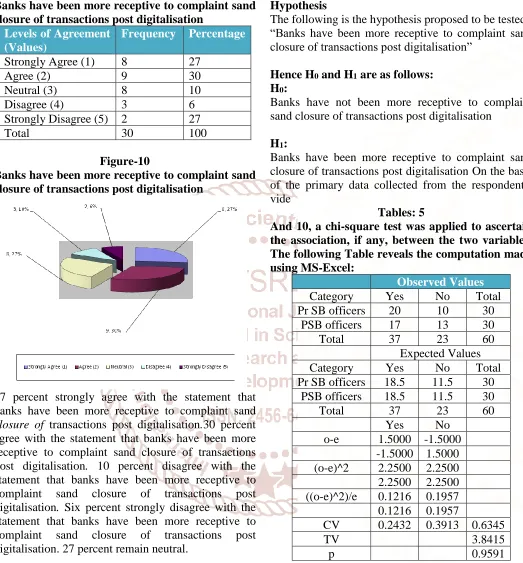
1.10.5 Banks have been more receptive to complaint sand closure of transactions post digitalisation
Table-10
Banks have been more receptive to complaint sand closure of transactions post digitalisation
Levels of Agreement (Values)
Frequency Percentage
Strongly Agree (1) 8 27
Agree (2) 9 30
Neutral (3) 8 10
Disagree (4) 3 6 Strongly Disagree (5) 2 27
Total 30 100
Figure-10
Banks have been more receptive to complaint sand closure of transactions post digitalisation
27 percent strongly agree with the statement that banks have been more receptive to complaint sand closure of transactions post digitalisation.30 percent agree with the statement that banks have been more receptive to complaint sand closure of transactions post digitalisation. 10 percent disagree with the statement that banks have been more receptive to complaint sand closure of transactions post digitalisation. Six percent strongly disagree with the statement that banks have been more receptive to complaint sand closure of transactions post digitalisation. 27 percent remain neutral.
57 percent agree with the statement that banks that banks have been more receptive to complaint sand closure of transactions post digitalisation.
1.11 Conclusions
Conclusions relate to the hypotheses. They are answers to the research questions.
1.12.1 Hypothesis testing Hypothesis
The following is the hypothesis proposed to be tested: “Banks have been more receptive to complaint sand closure of transactions post digitalisation”
Hence H0 and H1 are as follows:
H0:
Banks have not been more receptive to complaint sand closure of transactions post digitalisation
H1:
Banks have been more receptive to complaint sand closure of transactions post digitalisation On the basis of the primary data collected from the respondents, vide
Tables: 5
And 10, a chi-square test was applied to ascertain the association, if any, between the two variables. The following Table reveals the computation made using MS-Excel:
Observed Values
Category Yes No Total Pr SB officers 20 10 30
PSB officers 17 13 30 Total 37 23 60
Expected Values Category Yes No Total Pr SB officers 18.5 11.5 30
PSB officers 18.5 11.5 30 Total 37 23 60
Yes No o-e 1.5000 -1.5000
-1.5000 1.5000 (o-e)^2 2.2500 2.2500 2.2500 2.2500 ((o-e)^2)/e 0.1216 0.1957 0.1216 0.1957
CV 0.2432 0.3913 0.6345
TV 3.8415
p 0.9591
The calculated value of
2
is 0.6345, lower than the
1.12 Researcher’s recommendations
1. Banks should exploit the “digitalisation advantage” to augment their customer base; not to tone up only housekeeping.
2. While exploiting the digitalisation-driven cross-selling and up cross-selling, banks should neither hard sell nor mis sell their products and services and turn bank sters.
3. Banks have been able to be more receptive to customer grievances in the post digitalisation phase. But there is scope for the banks to be even more receptive to customer grievances and transaction closures.
1.13 References
1) Alys, F. (2014, October 29). News: devex.com. Retrieved July 19, 2015, from devex.com Web site: https://www.devex.com/news/india-s- pioneering-csr-law-could-have-promise-but-progress-is-slow-84220
2) IANS. (2014, April 3). Companies: The Business Standard. Retrieved July 18, 2015, from The Business Standard Web site: http://www.business- standard.com/article/companies/india-now-only-country-with-legislated-csr-114040300862_1.html
3) India Forbes. (2015, June 24). Blogs: Forbesindia.com. Retrieved July 19, 2015, from Forbesindia.com Web site:
http://forbesindia.com/blog/the-good-company/the-changing-landscape-of-csr-in-india/
4) The Banking & Finance Post. (2017, July 23). Home: The Banking & Finance Post. Retrieved from The Banking & Finance Post Web site: http://bfsi.eletsonline.com/tech-driven-indian-banking-industry-aiming-for-zenith/
5) The Hindu Business Line. (2017, June 19). Money & Banking: The Hindu Business Line. Retrieved from The Hindu Business Line Web site: http://www.thehindubusinessline.com/money-and- banking/banking-blues-gen-y-increasingly-opting-