Original Research Article
In Vitro
Antimicrobial and Phytochemical Study of
Plant Extract
Upadhyay P S
Assistant Professor, Kaumarbhritya Department, Faculty of Ayurveda, IMS BHU, Varanasi, UP, India
ABSTRACT
Background and Aim: Micro-organisms have developed resistance to many antibiotics and this have created immense clinical problem in the treatment of infectious disease. This resistance has increased due to indiscriminate use of commercial anti-microbial drugs commonly used in the treatment of infectious disease. Present study was conducted to investigate antibacterial properties as well as phytochemical study of extract of the Musta, Pippali, Ativisha and Karkatshringi.
Material and method- Methanolic extract of each drug was collected in separate sterile vial and preserved at temperature 40C. Kirby-Bauer method was used as suggested by NCCLS (National Committee for Clinical Laboratory Services), USA, 2000 for antimicrobial study. For phytochemical study the dried samples were re-suspended in HPLC grade Methanol for HPLC analysis. Result- Six phenolic acids were detected in the four plant samples. The MIC of active extracts was determined by tube dilution method. After incubation the inhibition was observed on Escherichia coli ATCC 25992, V. cholerae 01 Classical and Enterococcus faecalis. Escherichia coli ATCC 25992 was sensitive to alcoholic as well as aqueous extract of Pippali.
Conclusion:- it means these plant extracts having high antioxidant property and antibacterial effect as well.
Key Wards: Plant extract, Micro-organisms, Anti-microbial, Phytochemical.
INTRODUCTION
Bacterial pathogens were identified in majority of patients in developing countries. Etiological spectrum varies during different seasons and different geographic settings. In the developed countries, it is estimated that over 50% of acute diarrhea are caused by viruses including Rotavirus, Norwalk virus and corona virus. Human Rotavirus is most important etiological agents of acquired diarrhea in infants and young children world-wide. [1] The bacterial agent that are known to cause diarrhea is Escherichia coli (20% of all cases of acute diarrhea are due to E. coli, V. cholerae (Cholera accounts for 5-10% cases), Clostridium difficile, Shigella, Salmonella (3-7% of childhood
diarrhea), Campylobacter and Yersinia enterocolitica. [2]
developing countries. Etiological spectrum varies during different seasons and different geographic settings. Diarrheal disease remains an important cause of death and morbidity in developing countries with an estimated 1.5 million episodes and 1.5 million to 2.5 million deaths each year among children younger than 5 years. [7] It still continues to be a major cause of hospitalization and death in <5 years old children and has severe economic consequences. [8]
Aim of study: Present study was conducted to investigate antibacterial properties as well as phytochemical study of extract of the Musta, Pippali, Ativisha and Karkatshringi. All these drugs have been described to have anti-diarrheal properties and anti-microbial properties in different texts. Present in-vitro study was initiated to evaluate the efficacy of these drugs on different pathogens causing diarrhea which may help in ascertaining the mode of action as well as further specific use of the present combination in future in vivo studies.
MATERIALS AND METHODS
Plant Materials: For this study fruits of Piper longum L., rhizome of Cyperus rotundus L, root of Aconitum heterophyllum and galls of Pistacia integerrima were collected from Haridwar, Uttarakhand. The plant was identified and authenticated by the Professor N. K. Dubey, Department of Botany, Banaras Hindu University, Varanasi, with the voucher specimen no: 1. P. integerrima Stewart ex Brandis- Anacard. 2014/1
2. C. rotundus L.- Cyper 2014/1 3. P. longum L. - Piper 2014/1
4. A. heterophyllum Wall. Cat. - Ranun 2014/1.
Preparation of Extracts: For the study dry extract of each drug was prepared in the laboratory of the Department of Medicinal Chemistry, IMS BHU. Aqueous extract of drugs was prepared by Water Decoction method and Alcoholic extract was prepared by Soxhlet method of extraction. Both the
extracts were collected in separate sterile vials and preserved at 40C temperature. Phytochemical Study: The phytochemical study was carried out in department of Mycology and plant Pathology, Institute of Agricultural sciences, BHU Varanasi. The dried samples were re-suspended in HPLC grade methanol for HPLC analysis. Shimadzu LC-10A (Japan) was used that was equipped with dual pump LC-10A binary system, UV detector SPD-10A, Phenomenex (Torrance, USA) C18 column (RP-Hydro, 4 μm, 250mm× 4.6mm). Shimadzu Class VP series software was used to integrate the data. Separation of
phenolics was achieved with
acetonitrile/water (1:1 v/v) containing 1% acetic acid in a linear gradient program (Singh et al., 2009). The solvent flow rate was 1.0 ml min−1.
Anti-microbial Study: Anti-microbial susceptibility testing was carried out in department of Microbiology, Institute of Medical Sciences, BHU Varanasi, by- Dilution method and Diffusion method. Diffusion method was done by two methods 1. Stoke’s method and 2. Kirby-Bauer method. In routine laboratory modified Kirby-Bauer method was used as suggested by NCCLS (National Committee for Clinical Laboratory Services), USA, 2000. Test Micro-organisms: For antimicrobial study, E. coli ATCC 25992., Enterococcus faecalis, Pseudomonas aeruginosa TCC 10662., Salmonella Typhi, Staphylococcus aureus, Salmonella paratyphi A., S. Paratyphi B, S. Typhimurium, V. cholerae 01 classical were obtained from the Department of Microbiology, Institute of Medical Sciences, Banaras Hindu University, Varanasi, India.
Procedures:
1. M.H.A. plate taken and particular organism grown on plate:
Bacterial Lawn made on plate (0.5 OD)(1.5x10⁸ cfu/ml)
For alcoholic extract to be placed on the plate, disc diffusion method used and for aqueous extract serial double dilution method was used.
Then incubated over night at 370C. Determination of minimum inhibitory concentration (MIC): The MIC of active extracts was determined by tube dilution method. Successive tubes filled with 15 ml nutrient broth containing 1000µg/ml, 500µg/ml, and 250µg/ml up to 31.75µg/ml
respective concentrations of extracts were inoculated with 100µl of the bacterial suspension containing 108 CFU/ml of respective test organisms. The tubes were incubated at 37ºC in an incubator and observed for change in turbidity after 24 h. A tube containing nutrient broth without extract was taken as control. The least extract concentration which inhibited the growth of the test organisms was taken as MIC.
OBSERVATIONS AND RESULT
Phytochemical Study: Concentration of the phenolic compounds in the four plants is as follows
Table 1.
Sr. no. Phenolic compounds Musta Pippali Ativisha Karkatshringi
1. Shikimic acid 140µg/ml 1068µg/ml 498.5 µg/ml - 2. Gallic acid 31.9µg/ml 265µg/ml - - 3. Syringic acid - 4.5µg/ml - 38.6 µg/ml 4. Quercetin 8.3µg/ml - - - 5. Cinnamic acid 10.9µg/ml 1.4 µg/ml - 22.5 µg/ml 6. IAA 46.5µg/ml 92.8 µg/ml - -
Table 1 shows six phenolic acids were detected in the four plant samples. Out of the 6 phenolic standards used, Ativisha contained only one phenolic compound i.e. Shikimic acid whereas Musta and Pippali contained 5 compounds as shown in the table. Syringic acid was not detected in Musta and Quercetin was not detected in Pippali. Only two phenolic compounds i. e. Syringic and Cinnamic acids were detected in Karkatshringi.
Antimicrobial Study: After incubation the inhibition was observed on
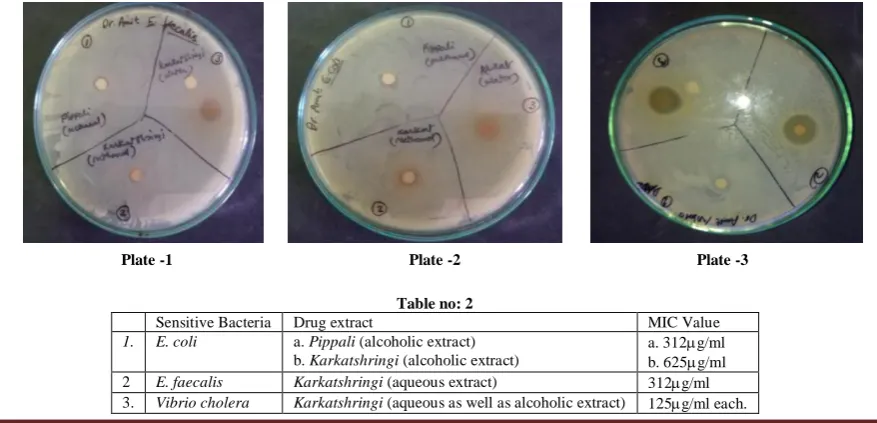
Escherichia coli ATCC 25992, V. cholerae 01 Classical and Enterococcus faecalis. Escherichia coli ATCC 25992 was sensitive to alcoholic as well as aqueous extract of Pippali (Plate 1) and Karkatshringi. E. faecalis was sensitive to aqueous extract of Karkatshringi (Plate 2). Vibrio cholerae was sensitive to both extract of Karkatshringi (Plate 3). It may be possible that these alcoholic extracts of these drugs can show inhibitory effect on higher concentration or it may be possible that these drug my show inhibitory effect.
Plate -1 Plate -2 Plate -3
Table no: 2
Sensitive Bacteria Drug extract MIC Value
1. E. coli a. Pippali (alcoholic extract)
b. Karkatshringi (alcoholic extract)
a. 312g/ml b. 625g/ml
2 E. faecalis Karkatshringi (aqueous extract) 312g/ml
Table no. 2 shows, MIC value of alcoholic extract Pippali for E. coli is 312g/ml and MIC value of water extract of karkatshringi for E. coli is 625g/ml. MIC value of water extract of Karkatshringi for E.faecalis is 312g/ml and MIC values of aqueous as well as alcoholic extract for Vibrio cholerae are 125g/ml each.
In the pictures provided, plate number 1 is for alcoholic extract of Pippali, plate number 2 for alcoholic extract of Karkatshringi and plate number 3 for aqueous extract of Karkatshringi.
DISCUSSION
Antimicrobial study of Balchatur bhadradi Yoga was previously done by Niraj et al at BHU in 2007. That study showed Escherichia coli ATCC 25992 and Staphylococcus aureus was sensitive to Pippali, MIC value for E. coli was 80g/ml and MIC value for Staphylococcus aureus was 40g/ml. Vibrio cholerae was sensitive to Karkatshringi and inhibitory effect for Vibrio cholerae was started from 40mg/ml to minimum of 320g/ml (MIC). [9]
In the present study antimicrobial study showed that Escherichia coli ATCC 25992 was sensitive to alcoholic as well as aqueous extract of Pippali and Karkatshringi. Vibrio cholerae was sensitive to both extract of Karkatshringi. E. faecalis was sensitive to aqueous extract of Karkatshringi. It may be possible that these alcoholic extracts of these drugs can show inhibitory effect on higher concentration or it may be possible that these drugs may show inhibitory effect. MIC value of alcoholic extract of Pippali for E. coli was 312g/ml and MIC value of water extract of Karkatshringi was 625g/ml. MIC value of Karkatshringi for E. faecalis is 312g/ml and for Vibrio cholerae was125g/ml.
In phytochemical study, Out of the 6 phenolic standards used, Ativisha contained only one phenolic compound i.e. Shikimic acid where as Musta and Pippali contained 5 compounds as shown in the table 1. Only two phenolic compounds i.e. Syringic and
Cinnamic acids were detected in Karkatshringi. The beneficial effects derived from phenolics compounds have been attributed to their antioxidant acivity.
[9]
It means balchatur bhdradi yoga have high antioxidant property. [10]
CONCLUSION
Six phenolic acids were detected in the four plant samples. Out of the 6 phenolic standards used, Ativisha contained only one phenolic compound i.e. Shikimic acid whereas Musta and Pippali contained 5 compounds as shown in the table 1. Syringic acid was not detected in Musta and Quercetin was not detected in Pippali. Only two phenolic compounds i. e. Syringic and Cinnamic acids were detected in Karkatshringi.
Out of four test drugs, Escherichia coli ATCC 25992 were sensitive to alcoholic as well as aqueous extract of Pippali and Karkatshringi. Vibrio cholerae was found sensitive to both extract of Karkatshringi. E. faecalis was sensitive to aqueous extract of Karkatshringi. The present study has revealed encouraging results but study needs further evaluation in large sample size.
REFERENCES
1. Chang HG, Glass RI, Smith PF, Cicirello HG, Holman RC, Morse DL. Disease burden and risk factors for hospitalizations associated with rotavirus infection among children in New York State, 1989 through 2000. Pediatr Infect Dis J 2003; 22 (9): 808 – 814
2. GHAI Essential Pediatrics, 18th edition, CBS publishers, 2013, New delhi.
3. Million Death Study Collaborators, Bassani DG, Kumar R, Awasthi S, Morris SK, Paul VK, et al. Causes of neonatal and child mortality in India: A nationally representative mortality survey. Lancet 2010;376:1853-60.
4. Wolfe MI, Nolte KB, Yoon SS. Fatal infectious disease surveillance in a medical Examiner Database. Emerg Infect Dis. 2004 Jan; 10(1): 48–53.
Publishers and Distributers Pvt., Ltd.; 2013. p. 291.
6. Ameta T, Nayak VH, Goyal SC. Prevalence and Seasonal distribution of Rotavirus Diarrhea in hospitalized children less than 5 year old in South Rajasthan. Int J Biomed Res 2015;6:214-8.
7. Duggan C, Fontaine O, Pierce NF, Glass RI, Mahalanabis D, Alam NH, et al. Scientific rationale for a change in the composition of oral rehydration solution. Am Med Assoc JAMA 2004;291:2629-31.
8. Bhan MK. Current Concepts in Management of Acute Diarrhea,
Department of Pediatrics. New Delhi, India: All India Institute of Medical Sciences; 2005.
9. Dr. Neeraj et al., Evaluation of Balchaturbhadradi Yoga in Krimijanya Atisar, Deptt. Of Kaumarbhritya/ Balrog, Institute of Medical Sciences, BHU, Varanasi, 2007.
10. Wright RJ, Cohen RT, Cohen S, the Impact of Stress as a predictor of wheezing in infancy, a prospective study. American Journal of Respiratory and critical care medicine,2002;165:358-665.
******