Available online on 19.09.2018 at http://jddtonline.info
Journal of Drug Delivery and Therapeutics
Open Access to Pharmaceutical and Medical Research© 2011-18, publisher and licensee JDDT, This is an Open Access article which permits unrestricted non-commercial use, provided the original work is properly cited
Open
Access
Review Article
COMPUTER AIDED DRUG DESIGN: AN OVERVIEW
Surabhi
1*, B. K. Singh
21
PG Scholar, Department of Pharmaceutical Sciences, Kumaun University Nainital, India 2
Head & Dean, Department of Pharmaceutical Sciences, Kumaun University Nainital, India
ABSTRACT
Discovery and development of a new drug is generally known as a very complex process which takes a lot of time and resources. So now a day’s computer aided drug design approaches are used very widely to increase the efficiency of the drug discovery and development course. Various approaches of CADD are evaluated as promising techniques according to their need, in between all these structure-based drug design and ligand-based drug design approaches are known as very efficient and powerful techniques in drug discovery and development. These both methods can be applied with molecular docking to virtual screening for lead identification and optimization. In the recent times computational tools are widely used in pharmaceutical industries and research areas to improve effectiveness and efficacy of drug discovery and development pipeline. In this article we give an overview of computational approaches, which is inventive process of finding novel leads and aid in the process of drug discovery and development research.
Keywords: computer aided drug discovery, structure-based drug design, ligand-based drug design, virtual screening and molecular docking.
Article Info:Received 02 Aug, 2018; Review Completed 11 Sep 2018; Accepted 18 Sep 2018; Available online 19 Sep 2018
Cite this article as:
Surabhi, Singh BK, Computer Aided Drug Design: An Overview, Journal of Drug Delivery and Therapeutics. 2018; 8(5):504-509 DOI:http://dx.doi.org/10.22270/jddt.v8i5.1894
*Address for Correspondence:
Surabhi, PG Scholar, Department of Pharmaceutical Sciences, Kumaun University Nainital, India
INTRODUCTION
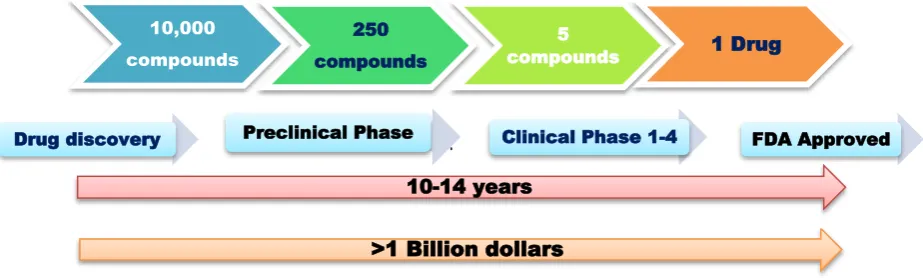
Computational approaches in drug design, discovery and development process gaining very rapid exploration, implementation and admiration.Introducing a new drug in a market is a very complex, risky and costly process
in terms of time, money and manpower. Generally it is found that drug discovery and development process takes around 10-14 years and more than 1 billion dollars capital in total 1.
Figure 1: Traditional process of drug discovery and development. 10,000
compounds
250 compounds
5
compounds 1 Drug
Drug discovery Preclinical Phase Clinical Phase 1-4 FDA Approved
10-14 years
So for reducing time, cost and risk borne factors computer aided drug design (CADD) method is widely used as a new drug design approach. It has been seen that by the use of CADD approaches we can reduced the
cost of drug discovery and development up to 50% 2. CADD consist use of any software program based process for establishing a standard to relate activity to structure 3.
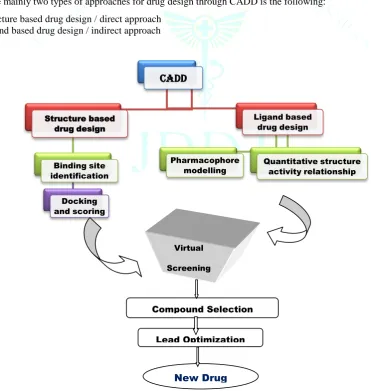
Figure 2: General Principle for Drug design through CADD.
Major types of approaches in CADD
There are mainly two types of approaches for drug design through CADD is the following:
1. Structure based drug design / direct approach 2. Ligand based drug design / indirect approach
Figure 3: General Representation of workflow for CADD.
CADD
Structure based drug design
Binding site identification
Docking and scoring
Ligand based drug design
Pharmacophore
modelling Quantitative structure activity relationship Drug
candidate
Virtual
Screening
1. Structure-based drug design
In SBDD, structure of the target protein is known and interaction or bio-affinity for all tested compounds
calculate after the process of docking; to design a new drug molecule, which shows better interaction with target protein 4.
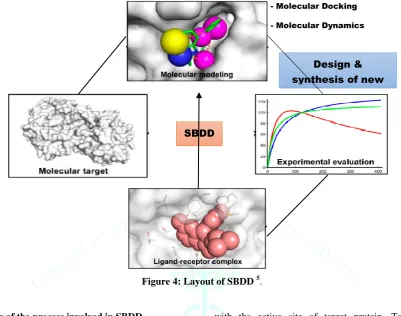
Figure 4: Layout of SBDD 5.
Overview of the process involved in SBDD
SBDD runs through multiple cycles before the optimized lead reached into clinical trials. The first cycle comprises isolation, purification and structure determination of the target protein by one of three key methods: like X-ray crystallography, homology modeling or NMR. Using compounds comes through virtual screening of different databases are placed into a selected region (active site) of the protein. These compounds are scored and ranked on the bases of steric, hydrophobic, electrostatic interaction of these molecules
with the active site of target protein. Top ranked compounds are tested with biochemical assays.
Second cycle comprises structure determination of the protein in complex with the most optimistic lead of the first cycle, the one with minimum micro-molar inhibition in-vitro, and shows sites of the compound which can be optimized for further increment in the potency. After several additional cycles like synthesis of lead, further optimization of lead through complex structure of protein with lead compound, the optimized compounds generally show marked increment in the target specificity and binding affinity 6.
Figure 5: Steps involved in SBDD.
SBDD
Design & synthesis of new
ligands - Molecular Docking
- Molecular Dynamics
Target Identification& validation
Lead Validation &Optimization
Analyze structure for potential ligand binding sites
Lead Identification& Molecular Docking
2. Ligand-Based drug design
In LBDD, 3D structure of the target protein is not known but the knowledge of ligands which binds to the desired
target site is known. These ligands can be used to develop a pharmacophore model or molecule which possesses all necessary structural features for bind to a target active site.
Figure 6: Outline of process involved in LBDD 7.
Generally ligand-based techniques are pharmacophore based approach and quantitative-structure activity relationships (QSARs). In LBDD it is assumed that compounds which having similarity in their structure also having the same biological action and interaction with the target protein 8.
Virtual screening
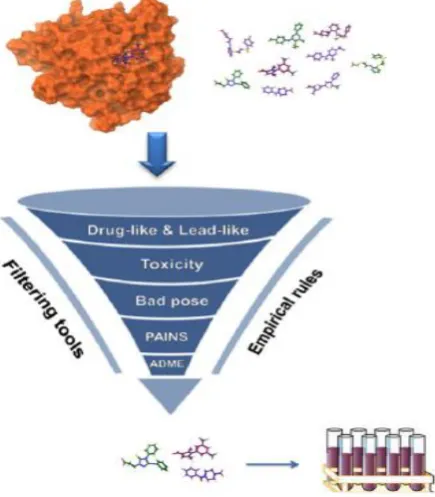
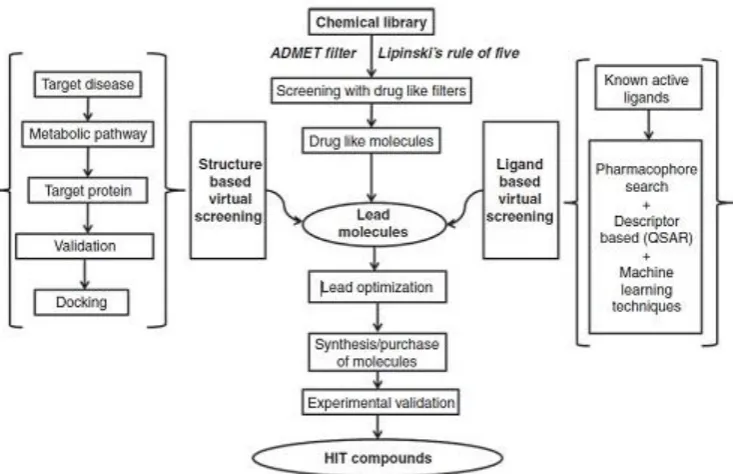
Virtual screening has been worked as a most convenient tool now a day to find out the most favorable bioactive compounds with the help of information about the protein target or known active ligands. In the recent time virtual screening is known as a mind blowing alternative of high-throughput screening mainly in terms of cost effectiveness and probability of finding most appropriate novel hit through filter the large of libraries of compounds9.
Figure 7: Overview of Virtual screening process 10.
There are generally two types of virtual screening approaches like structure-based virtual screening (SBVS) and ligand-based virtual screening (LBVS), SBVS method rely on the structure of target protein
Figure 8: Schematic diagram of VS process for SBDD & LBDD 11
Molecular docking
Molecular docking is in-silico method which predicts the placement of small molecules or ligands within the active site of their target protein (receptor). It is mainly
used to accurate estimation of most favorable binding modes and bio-affinities of ligands with their receptor, presently it has been broadly applied to virtual screening for the optimization of the lead compounds.
Figure 9: Process of Docking 12
Molecular docking methodology comprises mainly three goals which are interconnected to each other like: prediction of binding pose, bio affinity and virtual screening. In the molecular docking method the basis tools are search algorithm and scoring functions for creating and analyzing conformations of the ligand 13.
ADVANTAGES OF CADD
Through it we can reduce the synthetic and biological testing efforts 14.
It gives the most promising drug candidate by eliminate the compounds with undesirable properties (poor efficacy, poor ADMET etc.) through in silico filters 15.
It is a Cost-effective, time saving, Rapid and automatic process.
Through it we can know about the drug-receptor interaction pattern.
It gives compounds with high hit rates through searching huge libraries of compounds in silico in comparison to traditional high throughput screening 16.
These approaches minimize chances of failures in the final phase.
CONCLUSION AND FUTURE ASPECTS
REFERENCES
1. Daina A, Blatter MC, Baillie Gerritsen V, Palagi PM, Marek
D, Xenarios I, et al. Drug Design Workshop: A Web-Based Educational Tool To Introduce Computer-Aided Drug Design to the General Public. Journal of Chemical Education. 2017; 94(3):335-44.
2. Xiang M, Cao Y, Fan W, Chen L, Mo Y. Computer-aided drug
design: lead discovery and optimization. Combinatorial chemistry & high throughput screening. 2012; 15(4):328-37.
3. Hopfinger AJ. Computer-assisted drug design. Journal of
medicinal chemistry. 1985; 28(9):1133-9
4. Imam SS, Gilani SJ. Computer Aided Drug Design: A Novel
Loom To Drug Discovery. Org. Med. Chem. 2017; 1(4):1-6.
5. Ferreira LG, dos Santos RN, Oliva G, Andricopulo AD.
Molecular docking and structure-based drug design strategies. Molecules. 2015; 20(7):13384-421.
6. Anderson AC. The process of structure-based drug design.
Chemistry & biology. 2003; 10(9):787-97.
7. Hoque I, Chatterjee A, Bhattacharya S, Biswas R. An
Approach of Computer-Aided Drug Design (CADD) Tools for
In Silico Pharmaceutical Drug Design and Development. Int. J.
Adv. Res. Biol. Sci. 2017; 4(2) 60-71.
8. Macalino SJ, Gosu V, Hong S, Choi S. Role of
computer-aided drug design in modern drug discovery. Archives of pharmacal research. 2015; 38(9):1686-701.
9. Lill M. Virtual screening in drug design. In Silico Models for
Drug Discovery. 2013 Vol. 993, pp. 1-12. Humana Press, Totowa, NJ.
10. Maithri G, Manasa B, Vani SS, Narendra A, Harshita T.
Computational drug design and molecular dynamic studies—a review. Biomedical Data Mining. 2016; 5:1-7.
11. Kar S, Roy K. How far can virtual screening take us in drug
discovery? Expert Opin. Drug Discov. 8(3), pp. 245-261.
12. Hernández-Santoyo A, Tenorio-Barajas AY, Altuzar V,
Vivanco-Cid H, Mendoza-Barrera C. Protein-protein and protein-ligand docking. InProtein engineering-technology and application 2013. InTech.
13. Guedes IA, de Magalhães CS, Dardenne LE. Receptor–ligand
molecular docking. Biophysical reviews. 2014; 6(1):75-87.
14. Zhang S. Computer-aided drug discovery and development. In
Drug Design and Discovery. 2011; 716:23-38.
15. Kapetanovic IM. Computer-aided drug discovery and
development (CADD): insilico-chemico-biological approach.
Chemico-biological interactions. 2008; 171(2):165-76.
16. Shekhar C. In silico pharmacology: computer-aided methods