R E V I E W
Open Access
A meta-analysis of randomized control
trials of surgical methods with
osteosarcoma outcomes
Xiaojun He
1, Zhenzhen Gao
2, Hongwei Xu
1, Zhongwei Zhang
1and Peng Fu
1*Abstract
Background:Osteosarcoma is a high malignant neoplasm, and conflicting findings have been reported on the survival and function recovery of osteosarcoma patients experiencing limb salvage or amputation. In the present study, we compared limb salvage surgery (LSS) with amputation in clinical outcomes of osteosarcoma patients by a meta-analysis. Methods:The survival rate of osteosarcoma patients was collected from research reports from CNKI, MEDLINE, EMBASE, the Cochrane Database, and Google Scholar till April 30, 2016. The quality of including articles was evaluated by two independent reviewers. Differences between patients undergoing limb salvage surgery and amputation were analyzed based on postoperative survival rates.
Results:Ten articles were included according to selection criteria. There were 1343 patients in total from these studies. Our results showed that there was no significant difference between limb salvage surgery and amputation according to local recurrence; however, patients with limb salvage surgery had a higher 5-year overall survival.
Conclusions:LSS results in higher 5-year survival rates and better survival, while not increasing the risk of local recurrence. This study provided more evidences to support limb salvage surgery as a considerable treatment of osteosarcoma patients.
Keywords:Limb salvage surgery, Amputation, Local recurrence, 5-year overall survival, Meta-analysis
Background
Osteosarcoma is one rare kind of malignant tumors originated from mesenchymal tissue, which appears most commonly in young men between the ages 10 and 30 [1]. Prior to neoadjuvant chemotherapy, amputations and disarticulations were the dominant treatments for osteo-sarcoma with a 5-year overall survival (OS) rate of only about 20% [2]. Currently, osteosarcoma chemotherapy mainly consists of five drugs, high-dose methotrexate (HDMTX) with leucovorin rescue, doxorubicin (adriamy-cin), cisplatin, ifosfamide, and etoposide. With the use of effective neoadjuvant chemotherapy in the 1970s, limb salvage surgery (LSS) has been taken as a potential treat-ment for osteosarcoma [3]. Usually, LSS has functional and physiological advantages over traditional amputative
procedures when combined with neoadjuvant or adjuvant chemotherapy [4].
Previous studies have shown that LSS is applicative for localized osteosarcoma, while amputation is suitable for aggressive malignant osteosarcoma [5, 6]. However, there are still some surgeons holding an opposite view, consi-dering that immediate and expanded resection of the tumor will prevent the progression of fracture-induced disease. Consequently, amputation is considered to be a better option for osteosarcoma patients with pathologic fracture [7, 8]. It has been reported that the risk of local recurrence and the 5-year OS rate did not differ signifi-cantly between LSS and amputation in osteosarcoma patients with pathological fractures [9]. Han et al. has reported that the risk of local recurrence and the 5-year OS rate did not differ significantly between LSS and amputation in osteosarcoma patients [10]. Other stud-ies also reported a worse prognosis with osteosarcoma associated with pathologic fractures [11].
* Correspondence:[email protected]
1Department of Orthopedics, The Second Affiliated Hospital of Jiaxing
College, 1518 Huancheng Rd, 314000 Jiaxing, China
Full list of author information is available at the end of the article
There were disputes on the survival and function recov-ery between treatments of LSS and amputation in patients with osteosarcoma [6, 12]. We conducted a meta-analysis on survival and function in limb osteosarcoma patients treated by LSS compared with amputation or rotation-plasty [13]. In addition, our study investigated whether LSS improved survival based on 5-year rates and local cancer recurrence in osteosarcoma patients with LSS or amputation treatment [5, 14].
Through searching more abundant osteosarcoma litera-ture, we conduct this meta-analysis to get a comprehen-sive conclusion in osteosarcoma patients treated by LSS and amputation. These results will help us to determine the most appropriate method to treat osteosarcoma [15].
Methods Literature search
MEDLINE, Cochrane, EMBASE, and Google Scholar databases were searched for relevant data till April 30, 2016. The reference lists of relevant studies were also hand-searched. Keywords used for searching included limb surgery, salvage surgery, amputation, osteosarcoma, bone cancer, recurrence, and metastasis occurrence.
Included studies
Studies were included if they were contrastive research between LSS and amputation groups, patients with osteosarcoma in their four limbs, and a mass of data in regard to local recurrence or 5-year overall survival rate. Exclusion standard is as follows: studies including data related to LSS or amputation groups without a
comparison, case series with less than 20 total patients, letters, case reports, editorials, or reviews [16].
Study selection and data extraction
Outcomes were collected from the articles by two authors of our study. The authors made a structured table and then collected all the data into a database. The following data were extracted from articles according to the inclusion criteria: the name of the first author, year of publication, design scheme, number of patients in each group, patients’ age and gender, local recurrence rates, and 5-year OS rates. Any disagreement was resolved by sequential discussions until an agreement was reached. Two reviewers independ-ently assessed the quality of every included study according to the Newcastle-Ottawa Scale (NOS).
Statistical analysis
The outcome of measurement used in our study was local recurrence and 5-year overall survival rate, which were all dichotomous data. We used the software of the Cochrane Collaboration (ReviewManager5.2) to calculate odds ratios (ORs) and 95% confidence intervals (CIs) for all outcomes. Statistical heterogeneity among the included studies was evaluated by theI2tests. Statistically significant heterogen-eity was defined as anI2value >0.5 [9]. I2illustrates the percentage of the total variability in effect estimates among trials that is due to heterogeneity rather than to chance. A random effects model was selected for hetero-geneous data; otherwise, a fixed effect model was selected. Funnel plots were used to test the possibility of publica-tion bias, which exhibited the intervenpublica-tion effect from the
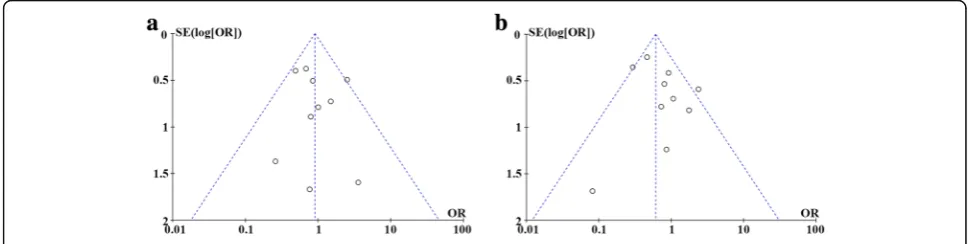
individual study against the respective standard error. A symmetrical plot represents no bias, and any asymmetry of the plot suggests the existence of publication bias.
Results
Study selection and characterization
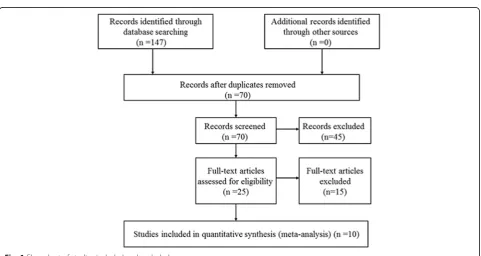
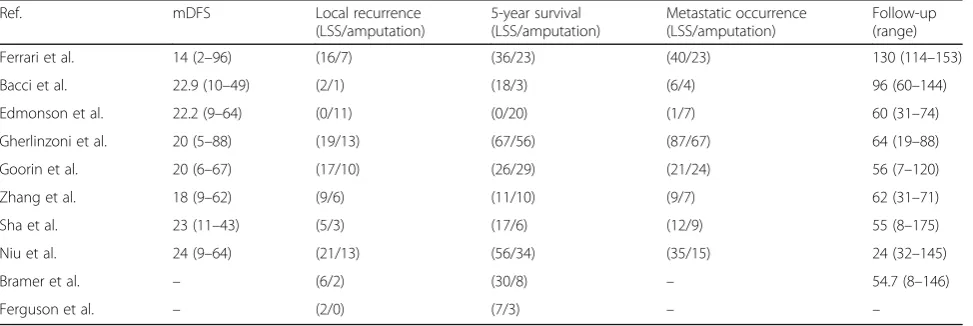
In the primary literature search, 147 relevant articles were retrieved and 77 were excluded based on the exclusion criteria (Fig. 1). The abstracts of the remaining 70 were screened, and 45 were excluded based on the exclusion cri-teria. After all the reviews of the remaining 25 studies, 15 were excluded due to lacking outcomes of interest (n= 10) and duplication in the study population with other articles (n= 5). In a word, a total of ten articles were included in the meta-analysis. Characteristics of the studies are summa-rized in Table 1, and outcomes are summasumma-rized in Table 2.
Local recurrence rate after surgery
All the ten studies reported the local recurrence rate. Our studies reported no patients with local recurrence data for either the amputation group or the LSS group. Therefore, only ten studies with complete local recurrence rate data were included in the analysis (Fig. 2). A fixed-effects
model of analysis was used [17]. There was no difference in the local recurrence rate between LSS and amputation (OR = 0.87, 95% CI 0.62–1.37,P= 0.42).
5-year overall survival and test of heterogeneity
Among these eligible studies, a total of ten studies with 5-year survival rate data were included in the analysis (Fig. 3). Totally, there was significant heterogeneity for the compari-son of 5-year overall survival between the amputation group and LSS group (QtestPvalue = 0.07,I2= 43%). Ac-cording to the result of stratification analysis, we explored the source of heterogeneity from the subgroup analyses of European (Fig. 4) (QtestPvalue = 0.41,I2= 2%) and Asian people (QtestPvalue = 0.009,I2= 79%).
Sensitivity analysis
Sensitivity analyses indicated that included studies were performed to determine the reliability of the results, with each study removed in turn [17]. The direction and mag-nitude of the combined estimates did not change mark-edly with the exclusion of individual studies, indicating that the results of the meta-analysis are reliable and sug-gesting that the results of this meta-analysis are stable. Table 1Characteristics of the included studies
Ref. Study period Patient number Male/female Median age (range) Enneking stage Country
Ferrari et al. 1983–1986 127 (91/35) 72/55 15 (5–43) Stage IIB Austria
Bacci et al. 1986–1993 29 (25/4) 20/9 46 Stage IIB Italy
Edmonson et al. 1976–1980 38 (1/37) 24/14 17 (9–62) Stage IIB Austria
Gherlinzoni et al. 1983–1988 355 (239/116) – – Stage IIA Italy
Goorin et al. 1976–1989 74 (36/38) – – Stage IIA Austria
Zhang et al. 1981–1997 31 (17/14) 26/5 15 (7–42) Stage IIB China
Sha et al. 1989–2006 56 (35/21) – 18 (2–46) Stage IIA China
Niu et al. 1992–2001 189 (140/49) 125/64 18 (4–39) Stage IIB China
Bramer et al. 1983–2003 56 (44/12) 36/20 16 (3–36) Stage IIB America
Ferguson et al. 1989–2006 31 (19/12) 14/17 30 (11–32) Stage IIB America
Table 2Outcomes of the included studies
Ref. mDFS Local recurrence
(LSS/amputation)
5-year survival (LSS/amputation)
Metastatic occurrence (LSS/amputation)
Follow-up (range)
Ferrari et al. 14 (2–96) (16/7) (36/23) (40/23) 130 (114–153)
Bacci et al. 22.9 (10–49) (2/1) (18/3) (6/4) 96 (60–144)
Edmonson et al. 22.2 (9–64) (0/11) (0/20) (1/7) 60 (31–74)
Gherlinzoni et al. 20 (5–88) (19/13) (67/56) (87/67) 64 (19–88)
Goorin et al. 20 (6–67) (17/10) (26/29) (21/24) 56 (7–120)
Zhang et al. 18 (9–62) (9/6) (11/10) (9/7) 62 (31–71)
Sha et al. 23 (11–43) (5/3) (17/6) (12/9) 55 (8–175)
Niu et al. 24 (9–64) (21/13) (56/34) (35/15) 24 (32–145)
Bramer et al. – (6/2) (30/8) – 54.7 (8–146)
Publication bias
Funnel plots of the local recurrence rates and 5-year OS rates were shown in Fig. 5. The results indicate that there is no evidence of publication bias for each of the two measures.
Discussion
Osteosarcoma is a kind of cancerous tumor in bones [10]. Specifically, it is an aggressive malignant neoplasm that arises from primitive transformed cells of mesen-chymal origin (and thus a sarcoma) and that exhibits osteoblastic differentiation and produces malignant oste-oid. Osteosarcoma tends to affect regions around the knee in 60% of cases, 15% around the hip, 10% at the shoulder, and 8% in the jaw [18]. The tumor is solid, hard, and irregular due to the tumor spicules of calcified bone radiating in right angles.
Following the implementation of chemotherapy in the 1970s, the treatment of high-grade malignant osteosarcoma has made an important progress [18]. Recently, most chemotherapy regimens applied for osteosarcoma have been based around four drugs: high-dose methotrexate (HDMTX) with leucovorin rescue, doxorubicin (adriamy-cin), cisplatin, and ifosfamide. These agents were integrated into various chemotherapy protocols. The range of dosages most commonly used are as follows: doxorubicin (cumula-tive dose from 240 to 480 mg/m2), methotrexate (cumula-tive dose from 48 to 168 g/m2) [19, 20], cisplatin (cumulative dose from 480 to 600 mg/m2), and ifosfamide (cumulative dose from 30 to 69 g/m2) [21].
Complete surgical resection, if feasible, remains essen-tial for cure [22]. Current surgical strategies focus on re-fining the nature and scope of resection to preserve uninvolved tissues. Advances in imaging techniques and positive effects of preoperative chemotherapy have led to a major shift away from amputation to limb salvage (conservative) surgery, which is expanded to limb sal-vage (conservative) surgery, which is expanded to around 80% of patients. Local recurrence rates of 2–3% after amputation and 5–7% after conservative surgery have been reported [22–24], while with no significant differences. The incidence of local recurrence has been closely related to the achieved surgical margins, with only a wide margin being considered appropriate. Gener-ally, for patients who achieved complete surgical remis-sion with adequate margins, surgical margin width in the bone did not correlate with the local recurrence rate. With the improved efficacy of chemotherapy, the num-ber of patients with osteosarcoma who received LSS in-stead of amputation has significantly increased recently. It was summarized that patients treated with LSS had a similar local recurrence compared with those treated with amputation. In the meta-analysis, we found that LSS had a similar 5-year survival compared with those treated with amputation. However, after excluding the three studies [9, 14, 25], which may be the main source of the heterogen-eity and whose subjects were Asian, we found the hetero-geneity reducing notably and P value (P= 0.0001) in the comparison of LSS with amputation, which proved that 5-year overall survival rate of patients treated with LSS was
Fig. 2Forest plot of comparison. Local recurrence of LSS or amputation for the treatment of osteosarcoma
higher than those treated with amputation. Then in the heterogeneity test, we found that there was apparent het-erogeneity among all of the eligible studies. Thus, we made a subgroup analysis, certifying that racial clas-sification did lead to the heterogeneity. Funnel plot did not show any evidence of publication bias. Therefore, our results provide more powerful evidence to support LSS as the treatment of osteosarcoma patients.
We found that the LSS is better than amputation in functional outcomes, which are consistent with other studies [26, 27]. Johansen et al. [28] had reported notably higher functional scores after LSS compared with amputation respectively (P= 0.001). Another study which evaluated the long-term physical function of the patients treated with LSS found that amputees have poorer function as assessed by the MSTS score [26]. However, a study by Mei et al. [22] showed no difference in functional scores and QOL between the two types of surgical management. More clinical trials are needed to compare the functional recovery of different surgical methods.
Some limitations of this meta-analysis should be men-tioned. Firstly, the lack of detailed data form in original stud-ies made it hard to adjust estimate by age, menopausal, lifestyle, smoking, race, and so on, while more precise analysis needed this kind of adjusting. Secondly, there was no detailed data for functional recovery. Thirdly, not all control included studies were in Hardy-Weinberg equilibrium (HWE) [28].
Otherwise, our meta-analysis also has some advantages. Firstly, a systematic review of the association of survival and function in limb osteosarcoma patients with LSS or amputation treatment was statistically more powerful than any single study. Secondly, all of the case-control studies had a high quality and conformed to our inclusion criteria.
Conclusions
In the end, our meta-analysis emphasized that LSS can im-prove survival of osteosarcoma patients with lower metastatic occurrence and better survival, while not increasing the risk of recurrence. Our meta-analysis also supported the hypoth-esis that LSS can be a new option for osteosarcoma patients.
Fig. 4Forest plot of comparison 5-year overall survival of LSS or amputation for the treatment of osteosarcoma with excluding three studies
Abbreviations
HDMTX:High-dose methotrexate; HWE: Hardy-Weinberg equilibrium; LSS: Limb salvage surgery; NOS: Newcastle-Ottawa Scale; OS: Overall survival
Acknowledgements
None.
Funding
None.
Availability of data and materials
Please contact author for data requests.
Authors’contributions
FP participated in the design of the study and performed the statistical analysis. HXJ and GZZ conceived of the study, participated in its design and coordination, and helped to draft the manuscript. All authors read and approved the final manuscript.
Competing interests
The authors declare that they have no competing interests.
Consent for publication
Not applicable.
Ethics approval and consent to participate
Not applicable.
Author details
1Department of Orthopedics, The Second Affiliated Hospital of Jiaxing
College, 1518 Huancheng Rd, 314000 Jiaxing, China.2Department of Oncology, The Second Affiliated Hospital of Jiaxing College, Jiaxing, China.
Received: 18 September 2016 Accepted: 9 December 2016
References
1. Samardziski M, Zafiroski G, Tolevska C, Zafirova-Ivanovska B, Kostadinova-Kunovska S, Kalicanin-Markovska M. Treatment of non-metastatic high-grade osteosarcoma (study of 30 cases treated with Scandinavian osteosarcoma protocol XIV and surgery). Prilozi. 2008;29(2):309–23.
2. Simon MA, Aschliman MA, Thomas N, Mankin HJ. Limb-salvage treatment versus amputation for osteosarcoma of the distal end of the femur. 1986. J Bone Joint Surg Am. 2005;87(12):2822.
3. Carty CP, Dickinson IC, Watts MC, Crawford RW, Steadman P. Impairment and disability following limb salvage procedures for bone sarcoma. Knee. 2009;16(5):405–8.
4. Ferrari S, Palmerini E. Adjuvant and neoadjuvant combination
chemotherapy for osteogenic sarcoma. Curr Opin Oncol. 2007;19(4):341–6. 5. Rodan SB, Imai Y, Thiede MA, Wesolowski G, Thompson D, Bar-Shavit Z,
Shull S, Mann K, Rodan GA. Characterization of a human osteosarcoma cell line (Saos-2) with osteoblastic properties. Cancer Res. 1987;47(18):4961–6. 6. Fuchs N, Bielack SS, Epler D, Bieling P, Delling G, Korholz D, Graf N, Heise U,
Jurgens H, Kotz R, et al. Long-term results of the co-operative German-Austrian-Swiss osteosarcoma study group’s protocol COSS-86 of intensive multidrug chemotherapy and surgery for osteosarcoma of the limbs. Ann Oncol. 1998;9(8):893–9.
7. Scully SP, Ghert MA, Zurakowski D, Thompson RC, Gebhardt MC. Pathologic fracture in osteosarcoma: prognostic importance and treatment
implications. J Bone Joint Surg Am. 2002;84-A(1):49–57.
8. Abudu A, Sferopoulos NK, Tillman RM, Carter SR, Grimer RJ. The surgical treatment and outcome of pathological fractures in localised osteosarcoma. J Bone Joint Surg British. 1996;78(5):694–8.
9. Li X, Zhang Y, Wan S, Li H, Li D, Xia J, Yuan Z, Ren M, Yu S, Li S, et al. A comparative study between limb-salvage and amputation for treating osteosarcoma. J Bone Oncol. 2016;5(1):15–21.
10. Han G, Bi WZ, Xu M, Jia JP, Wang Y. Amputation versus limb-salvage surgery in patients with osteosarcoma: a meta-analysis. World J Surg. 2016. 11. Ferguson PC, McLaughlin CE, Griffin AM, Bell RS, Deheshi BM, Wunder JS.
Clinical and functional outcomes of patients with a pathologic fracture in high-grade osteosarcoma. J Surg Oncol. 2010;102(2):120–4.
12. Bruns J, Luessenhop S, Behrens P. Cost analysis of three different surgical procedures for treatment of a pelvic tumour. Langenbecks Arch Surg. 1998; 383(5):359–63.
13. Natarajan MV, Govardhan RH, Williams S, Raja Gopal TS. Limb salvage surgery for pathological fractures in osteosarcoma. Int Orthop. 2000;24(3):170–2. 14. Niu XH, Ding Y. The surgical treatment and outcome of nonmetastatic
osteosarcoma of the extremity with pathologic fractures. Zhonghua Wai Ke Za Zhi. 2008;46(22):1730–3.
15. Papagelopoulos PJ, Mavrogenis AF, Savvidou OD, Benetos IS, Galanis EC, Soucacos PN. Pathological fractures in primary bone sarcomas. Injury. 2008; 39(4):395–403.
16. Gherlinzoni F, Picci P, Bacci G, Campanacci D. Limb sparing versus amputation in osteosarcoma. Correlation between local control, surgical margins and tumor necrosis: Istituto Rizzoli experience. Ann Oncol. 1992;3 Suppl 2:S23–7.
17. Hudson M, Jaffe MR, Jaffe N, Ayala A, Raymond AK, Carrasco H, Wallace S, Murray J, Robertson R. Pediatric osteosarcoma: therapeutic strategies, results, and prognostic factors derived from a 10-year experience. J Clin Oncol. 1990;8(12):1988–97.
18. Ekert H, Tiedemann K, Waters KD, Ellis WM. Experience with high dose multiagent chemotherapy and autologous bone marrow rescue in the treatment of twenty-two children with advanced tumours. Aust Paediatr J. 1984;20(3):195–201.
19. Winkler K, Beron G, Kotz R, Salzer-Kuntschik M, Beck J, Beck W, Brandeis W, Ebell W, Erttmann R, Gobel U, et al. Adjuvant chemotherapy in osteosarcoma—effects of cisplatinum, BCD, and fibroblast interferon in sequential combination with HD-MTX and adriamycin. Preliminary results of the COSS 80 study. J Cancer Res Clin Oncol. 1983;106(Suppl):1–7. 20. Bacci G, Ferrari S, Donati D, Longhi A, Bertoni F, Di Fiore M, Comandone A,
Cesari M, Campanacci M. Neoadjuvant chemotherapy for osteosarcoma of the extremity in patients in the fourth and fifth decade of life. Oncol Rep. 1998;5(5):1259–63.
21. Bielack SS, Smeland S, Whelan JS, Marina N, Jovic G, Hook JM, Krailo MD, Gebhardt M, Papai Z, Meyer J, et al. Methotrexate, doxorubicin, and cisplatin (MAP) plus maintenance pegylated interferon alfa-2b versus MAP alone in patients with resectable high-grade osteosarcoma and good histologic response to preoperative MAP: first results of the EURAMOS-1 Good Response Randomized Controlled Trial. J Clin Oncol. 2015;33(20):2279–87. 22. Mei J, Zhu XZ, Wang ZY, Cai XS. Functional outcomes and quality of life in
patients with osteosarcoma treated with amputation versus limb-salvage surgery: a systematic review and meta-analysis. Arch Orthop Trauma Surg. 2014;134(11):1507–16.
23. Meyers PA, Schwartz CL, Krailo M, Kleinerman ES, Betcher D, Bernstein ML, Conrad E, Ferguson W, Gebhardt M, Goorin AM, et al. Osteosarcoma: a randomized, prospective trial of the addition of ifosfamide and/or muramyl tripeptide to cisplatin, doxorubicin, and high-dose methotrexate. J Clin Oncol. 2005;23(9):2004–11.
24. Bacci G, Longhi A, Versari M, Mercuri M, Briccoli A, Picci P. Prognostic factors for osteosarcoma of the extremity treated with neoadjuvant chemotherapy: 15-year experience in 789 patients treated at a single institution. Cancer. 2006;106(5):1154–61.
25. Yin K, Liao Q, Zhong D, Ding J, Niu B, Long Q, Ding D. Meta-analysis of limb salvage versus amputation for treating high-grade and localized
osteosarcoma in patients with pathological fracture. Exp Ther Med. 2012; 4(5):889–94.
26. Aksnes LH, Bauer HC, Jebsen NL, Folleras G, Allert C, Haugen GS, Hall KS. Limb-sparing surgery preserves more function than amputation: a Scandinavian sarcoma group study of 118 patients. J Bone Joint Surg British. 2008;90(6):786–94.
27. Gaston CL, Nakamura T, Reddy K, Abudu A, Carter S, Jeys L, Tillman R, Grimer R. Is limb salvage surgery safe for bone sarcomas identified after a previous surgical procedure? Bone Joint J. 2014;96-B(5):665–72. 28. Johansen R, Nielsen OS, Keller J. Functional outcome in sarcomas treated