R E S E A R C H
Open Access
Text mining and semantics: a systematic
mapping study
Roberta Akemi Sinoara
*, João Antunes and Solange Oliveira Rezende
Abstract
As text semantics has an important role in text meaning, the term semantics has been seen in a vast sort of text mining studies. However, there is a lack of studies that integrate the different research branches and summarize the developed works. This paper reports a systematic mapping about semantics-concerned text mining studies. This systematic mapping study followed a well-defined protocol. Its results were based on 1693 studies, selected among 3984 studies identified in five digital libraries. The produced mapping gives a general summary of the subject, points some areas that lacks the development of primary or secondary studies, and can be a guide for researchers working with semantics-concerned text mining. It demonstrates that, although several studies have been developed, the processing of semantic aspects in text mining remains an open research problem.
Keywords: Systematic review, Text mining, Text semantics
Introduction
Text mining techniques have become essential for sup-porting knowledge discovery as the volume and variety of digital text documents have increased, either in social net-works and the Web or inside organizations. Text sources, as well as text mining applications, are varied. Although there is not a consensual definition established among the different research communities [1], text mining can be seen as a set of methods used to analyze unstruc-tured data and discover patterns that were unknown beforehand [2].
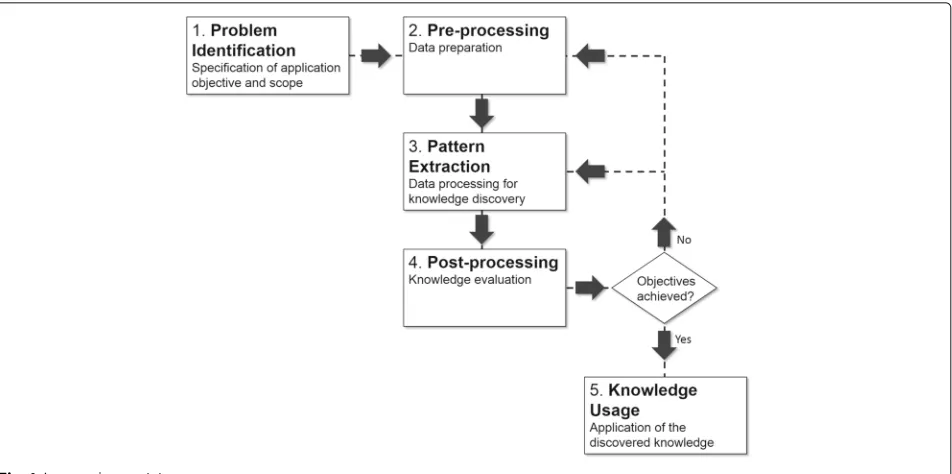
A general text mining process can be seen as a five-step process, as illustrated in Fig. 1. The process starts with the specification of its objectives in the problem identifi-cation step. The text mining analyst, preferably working along with a domain expert, must delimit the text min-ing application scope, includmin-ing the text collection that will be mined and how the result will be used. The spec-ifications stated in the problem identification step will guide the next steps of the text mining process, which can be executed in cycles of data preparation (pre-processing
*Correspondence: [email protected]
Laboratório de Inteligência Computacional (LABIC), Instituto de Ciências Matemáticas e de Computação (ICMC), Universidade de São Paulo (USP), P.O. Box 668, 13561-970 São Carlos, SP, Brazil
step), knowledge discovery (pattern extraction step), and knowledge evaluation (post-processing step).
The pre-processing step is about preparing data for pattern extraction. In this step, raw text is transformed into some data representation format that can be used as input for the knowledge extraction algorithms. The activ-ities performed in the pre-processing step are crucial for the success of the whole text mining process. The data representation must preserve the patterns hidden in the documents in a way that they can be discovered in the next step. In the pattern extraction step, the analyst applies a suitable algorithm to extract the hidden patterns. The algorithm is chosen based on the data available and the type of pattern that is expected. The extracted knowledge is evaluated in the post-processing step. If this knowledge meets the process objectives, it can be put available to the users, starting the final step of the process, the knowledge usage. Otherwise, another cycle must be performed, mak-ing changes in the data preparation activities and/or in pattern extraction parameters. If any changes in the stated objectives or selected text collection must be made, the text mining process should be restarted at the problem identification step.
Text data are not naturally in a format that is suitable for the pattern extraction, which brings additional chal-lenges to an automatic knowledge discovery process. The meaning of natural language texts basically depends on
Fig. 1A general text mining process
lexical, syntactic, and semantic levels of linguistic knowl-edge. Each level is more complex and requires a more sophisticated processing than the previous level. This is a common trade-off when dealing with natural language processing: expressiveness versus processing cost. Thus, lexical and syntactic components have been more broadly explored in text mining than the semantic component [2]. Recently, text mining researchers have become more interested in text semantics, looking for improvements in the text mining results. The reason for this increas-ing interest can be assigned both to the progress of the computing capacity, which is constantly reducing the pro-cessing time, and to developments in the natural language processing field, which allow a deeper processing of raw texts.
In order to compare the expressiveness of each level of text interpretation (lexical, syntactic, and semantic), consider two simple sentences:
1. Company A acquired Company B. 2. Company B acquired Company A.
Sentences 1 and 2 have opposite meanings, but they have the same terms (“Company”, “A”, “B”, “acquired”). Thus, if we analyze these sentences only in the lexical level, it is not possible to differentiate them. However, considering the sentence syntax, we can see that they are opposite. They have the same verb, and the subject of one sentence is the object of the other sentence and vice versa. If we analyze a little deeper, now considering the sentence semantics, we find that in sentence 1, “Company A” has the semantic role ofagentregarding the verb “acquire” and
“Company B” has the semantic role oftheme. The same can be said to a third sentence:
3. Company B was acquired by Company A.
Despite the fact that syntactically sentences 1 and 3 have opposite subjects and objects, they have the same seman-tic roles. Thus, at the semanseman-tic level, they have the same meaning. If we go deeper and consider semantic relations among words (as the synonymy, for example), we can find that sentence 4 also expresses the same event:
4. Company A purchased Company B.
Besides, going even deeper in the interpretation of the sentences, we can understand their meaning—they are related to some takeover—and we can, for example, infer that there will be some impacts on the business environment.
Traditionally, text mining techniques are based on both a bag-of-words representation and application of data mining techniques. In this approach, only the lexical com-ponent of the texts are considered. In order to get a more complete analysis of text collections and get better text mining results, several researchers directed their attention to text semantics.
step, the extracted patterns can be evaluated based on semantic aspects. Either way, text mining based on text semantics can go further than text mining based only on lexicon or syntax. A proper treatment of text semantics can lead to more appropriate results for certain appli-cations [2]. For example, semantic information has an important impact on document content and can be crucial to differentiate documents which, despite the use of the same vocabulary, present different ideas about the same subject.
The term semantics has been seen in a vast sort of text mining studies. However, there is a lack of studies that integrate the different branches of research performed to incorporate text semantics in the text mining process. Sec-ondary studies, such as surveys and reviews, can integrate and organize the studies that were already developed and guide future works.
Thus, this paper reports a systematic mapping study to overview the development of semantics-concerned stud-ies and fill a literature review gap in this broad research field through a well-defined review process. Semantics can be related to a vast number of subjects, and most of them are studied in the natural language processing field. As examples of semantics-related subjects, we can mention representation of meaning, semantic parsing and interpretation, word sense disambiguation, and corefer-ence resolution. Nevertheless, the focus of this paper is not on semantics but on semantics-concerned text min-ing studies. As the term semantics appears in text minmin-ing studies in different contexts, this systematic mapping aims to present a general overview and point some areas that lack the development of primary studies and those areas that secondary studies would be of great help. This paper aims to point some directions to the reader who is inter-ested in semantics-concerned text mining researches.
As it covers a wide research field, this systematic map-ping study started with a space of 3984 studies, identified in five digital libraries. Due to time and resource limi-tations, except for survey papers, the mapping was done primarily through information found in paper abstracts. Therefore, our intention is to present an overview of semantics-concerned text mining, presenting a map of studies that has been developed by the research com-munity, and not to present deep details of the studies. The papers were analyzed in relation to their applica-tion domains, performed tasks, applied methods and resources, and level of user’s interaction. The contribu-tion of this paper is threefold: (i) it presents an overview of semantics-concerned text mining studies from a text mining viewpoint, organizing the studies according to seven aspects (application domains, languages, external knowledge sources, tasks, methods and algorithms, repre-sentation models, and user’s interaction); (ii) it quantifies and confirms some previous feelings that we had about
our study subject; and (iii) it provides a starting point for those, researchers or practitioners, who are initiating works on semantics-concerned text mining.
The remainder of this paper is organized as follows. The “Method applied for systematic mapping” section presents an overview of systematic mapping method, since this is the type of literature review selected to develop this study and it is not widespread in the text mining community. In this section, we also present the protocol applied to conduct the systematic mapping study, including the research questions that guided this study and how it was conducted. The results of the system-atic mapping, as well as identified future trends, are presented in the “Results and discussion” section. The “Conclusion” section concludes this work.
Method applied for systematic mapping
The review reported in this paper is the result of a system-atic mapping study, which is a particular type of systemsystem-atic literature review [3, 4]. Systematic literature review is a formal literature review adopted to identify, evaluate, and synthesize evidences of empirical results in order to answer a research question. It is extensively applied in medicine, as part of the evidence-based medicine [5]. This type of literature review is not as disseminated in the computer science field as it is in the medicine and health care fields1, although computer science researches can also take advantage of this type of review. We can find important reports on the use of systematic reviews spe-cially in the software engineering community [3, 4, 6, 7]. Other sparse initiatives can also be found in other com-puter science areas, as cloud-based environments [8], image pattern recognition [9], biometric authentication [10], recommender systems [11], and opinion mining [12]. A systematic review is performed in order to answer a research question and must follow a defined protocol. The protocol is developed when planning the systematic review, and it is mainly composed by the research ques-tions, the strategies and criteria for searching for primary studies, study selection, and data extraction. The protocol is a documentation of the review process and must have all the information needed to perform the literature review in a systematic way. The analysis of selected studies, which is performed in the data extraction phase, will provide the answers to the research questions that motivated the liter-ature review. Kitchenham and Charters [3] present a very useful guideline for planning and conducting systematic literature reviews. As systematic reviews follow a formal, well-defined, and documented protocol, they tend to be less biased and more reproducible than a regular literature review.
type of systematic review named systematic mapping study [3, 4]. Systematic mapping studies follow an well-defined protocol as in any systematic review. The main differences between a traditional systematic review and a systematic mapping are their breadth and depth. While a systematic review deeply analyzes a low number of pri-mary studies, in a systematic mapping a wider number of studies are analyzed, but less detailed. Thus, the search terms of a systematic mapping are broader and the results are usually presented through graphs. Systematic mapping studies can be used to get a mapping of the publications about some subject or field and identify areas that require the development of more primary studies and areas in which a narrower systematic literature review would be of great help to the research community.
This paper reports a systematic mapping study con-ducted to get a general overview of how text semantics is being treated in text mining studies. It fills a litera-ture review gap in this broad research field through a well-defined review process. As a systematic mapping, our study follows the principles of a systematic map-ping/review. However, as our goal was to develop a general mapping of a broad field, our study differs from the pro-cedure suggested by Kitchenham and Charters [3] in two ways. Firstly, Kitchenham and Charters [3] state that the systematic review should be performed by two or more researchers. Although our mapping study was planned by two researchers, the study selection and the information extraction phases were conducted by only one due to the resource constraints. In this process, the other researchers reviewed the execution of each systematic mapping phase and their results. Secondly, systematic reviews usually are done based on primary studies only, nevertheless we have also accepted secondary studies (reviews or surveys) as we want an overview of all publications related to the theme.
In the following subsections, we describe our systematic mapping protocol and how this study was conducted.
Systematic mapping planning
The first step of a systematic review or systematic map-ping study is its planning. The researchers conducting the study must define its protocol, i.e., its research questions and the strategies for identification, selection of stud-ies, and information extraction, as well as how the study results will be reported. The main parts of the protocol that guided the systematic mapping study reported in this paper are presented in the following.
Research question: the main research question that guided this study was “How is semantics consid-ered in text mining studies?” The main question was detailed in seven secondary questions, all of them related to text mining studies that consider text semantics in some way:
1. What are the application domains that focus on text semantics?
2. What are the natural languages being
considered when working with text semantics? 3. Which external sources are frequently used in
text mining studies when text semantics is considered?
4. In what text mining tasks is the text semantics most considered?
5. What methods and algorithms are commonly used?
6. How can texts be represented?
7. Do users or domain experts take part in the text mining process?
Study identification: the study identification was per-formed through searches for studies conducted in five digital libraries: ACM Digital Library, IEEE Xplore, Science Direct, Web of Science, and Scopus. The following general search expression was applied in both Title and Keywords fields, when allowed by the digital library search engine:semantic* AND text* AND (mining OR representation OR clustering OR classification OR
association rules).
Study selection: every study returned in the search phase went to the selection phase. Studies were selected based on title, abstract, and paper informa-tion (as number of pages, for example). Through this analysis, duplicated studies (most of them were stud-ies found in more than one database) were identified. Besides, studies which match at least one of the fol-lowing exclusion criteria were rejected: (i) one page papers, posters, presentations, abstracts, and edito-rials; (ii) papers hosted in services with restricted access and not accessible; (iii) papers written in lan-guages different from English or Portuguese; and (iv) studies that do not deal with text mining and text semantics.
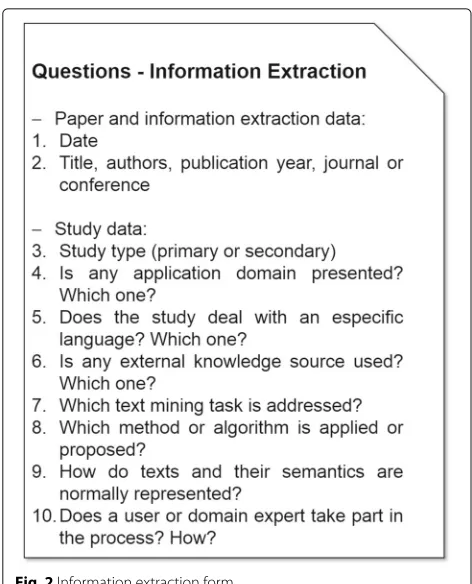
Information extraction: the information extraction phase was performed with papers accepted in the selection phase (papers that were not identified as duplicated or rejected). The abstracts were read in order to extract the information presented in Fig. 2.
Fig. 2Information extraction form
title and abstracts. It is not feasible to conduct a literature review free of bias. However, it is possible to conduct it in a controlled and well-defined way through a systematic process.
Systematic mapping conduction
The conduction of this systematic mapping followed the protocol presented in the last subsection and is illustrated in Fig. 3. The selection and the information extraction phases were performed with support of the Start tool [13]. This paper reports the results obtained after the exe-cution of two cycles of the systematic mapping phases. The first cycle was executed based on searches performed in January 2014. The second cycle was an update of the first cycle, with searches performed in February 20162. A
total of 3984 papers were found using the search expres-sion in the five digital libraries. In the selection phase, 725 duplicated studies were identified and 1566 papers were rejected according to the exclusion criteria, mainly based on their title and abstract. Most of the rejected papers match the last exclusion criteria (Studies that do not deal with text mining and text semantics). Among them, we can find studies that deal with multimedia data (images, videos, or audio) and with construction, description, or annotation of corpus.
After the selection phase, 1693 studies were accepted for the information extraction phase. In this phase,
information about each study was extracted mainly based on the abstracts, although some information was extracted from the full text. The results of the accepted paper mapping are presented in the next section.
Results and discussion
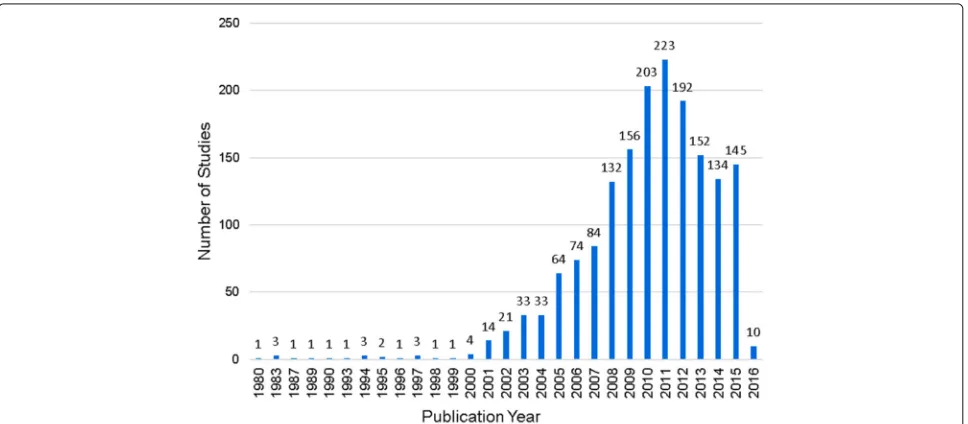
The mapping reported in this paper was conducted with the general goal of providing an overview of the researches developed by the text mining community and that are con-cerned about text semantics. This mapping is based on 1693 studies selected as described in the previous section. The distribution of these studies by publication year is presented in Fig. 4. We can note that text semantics has been addressed more frequently in the last years, when a higher number of text mining studies showed some inter-est in text semantics. The peak was in 2011, with 223 identified studies. The lower number of studies in the year 2016 can be assigned to the fact that the last searches were conducted in February 2016.
The results of the systematic mapping study is pre-sented in the following subsections. We start our report presenting, in the “Surveys” section, a discussion about the eighteen secondary studies (surveys and reviews) that were identified in the systematic mapping. Then, each following section from “Application domains” to “User’s interaction” is related to a secondary research question that guided our study, i.e., application domains, languages, external knowledge sources, text mining tasks, methods and algorithms, representation model, and user’s inter-action. In the “Systematic mapping summary and future trends” section, we present a consolidation of our results and point some gaps of both primary and secondary studies.
Some studies accepted in this systematic mapping are cited along the presentation of our mapping. We do not present the reference of every accepted paper in order to present a clear reporting of the results.
Surveys
In this systematic mapping, we identified 18 survey papers associated to the theme text mining and semantics [14–31]. Each paper exploits some particularity of this broad theme. In the following, we present a short overview of these papers, which is based on the full text of the papers.
Fig. 3Systematic mapping conduction phases. The numbers in theshadedareas indicate the quantity of studies involved
representations are manipulated (technique dimension), we have the methods and algorithms that can be used, including machine learning algorithms, statistical anal-ysis, part-of-speech tagging, semantic annotation, and semantic disambiguation. In the representation dimen-sion, we can find different options for text representation, such as words, phrases, bag-of-words, part-of-speech, subject-predicate-object triples and semantically anno-tated triples.
Grobelnik [14] also presents the levels of text repre-sentations, that differ from each other by the complexity of processing and expressiveness. The most simple level is the lexical level, which includes the common bag-of-words and n-grams representations. The next level is the syntactic level, that includes representations based on word co-location or part-of-speech tags. The most complete representation level is the semantic level and includes the representations based on word relationships,
as the ontologies. Several different research fields deal with text, such as text mining, computational linguistics, machine learning, information retrieval, semantic web and crowdsourcing. Grobelnik [14] states the importance of an integration of these research areas in order to reach a complete solution to the problem of text understanding. Stavrianou et al. [15] present a survey of semantic issues of text mining, which are originated from natural language particularities. This is a good survey focused on a linguis-tic point of view, rather than focusing only on statislinguis-tics. The authors discuss a series of questions concerning natu-ral language issues that should be considered when apply-ing the text minapply-ing process. Most of the questions are related to text pre-processing and the authors present the impacts of performing or not some pre-processing activ-ities, such as stopwords removal, stemming, word sense disambiguation, and tagging. The authors also discuss some existing text representation approaches in terms of features, representation model, and application task. The set of different approaches to measure the similar-ity between documents is also presented, categorizing the similarity measures by type (statistical or semantic) and by unit (words, phrases, vectors, or hierarchies).
Stavrianou et al. [15] also present the relation between ontologies and text mining. Ontologies can be used as background knowledge in a text mining process, and the text mining techniques can be used to generate and update ontologies. The authors conclude the survey stating that text mining is an open research area and that the objec-tives of the text mining process must be clarified before starting the data analysis, since the approaches must be chosen according to the requirements of the task being performed.
Methods that deal with latent semantics are reviewed in the study of Daud et al. [16]. The authors present a chronological analysis from 1999 to 2009 of directed prob-abilistic topic models, such as probprob-abilistic latent semantic analysis, latent Dirichlet allocation, and their extensions. The models are classified according to their main func-tionality. They describe their advantages, disadvantages, and applications.
Wimalasuriya and Dou [17], Bharathi and Venkatesan [18], and Reshadat and Feizi-Derakhshi [19] consider the use of external knowledge sources (e.g., ontology or the-saurus) in the text mining process, each one dealing with a specific task. Wimalasuriya and Dou [17] present a detailed literature review of ontology-based informa-tion extracinforma-tion. The authors define the recent informainforma-tion extraction subfield, named ontology-based information extraction (OBIE), identifying key characteristics of the OBIE systems that differentiate them from general infor-mation extraction systems. Besides, they identify a com-mon architecture of the OBIE systems and classify existing systems along with different dimensions, as information
extraction method applied, whether it constructs and updates the ontology, components of the ontology, and type of documents the system deals with. Bharathi and Venkatesan [18] present a brief description of several studies that use external knowledge sources as back-ground knowledge for document clustering. Reshadat and Feizi-Derakhshi [19] present several semantic similarity measures based on external knowledge sources (specially WordNet and MeSH) and a review of comparison results from previous studies.
Schiessl and Bräscher [20] and Cimiano et al. [21] review the automatic construction of ontologies. Schiessl and Bräscher [20], the only identified review written in Por-tuguese, formally define the term ontology and discuss the automatic building of ontologies from texts. The authors state that automatic ontology building from texts is the way to the timely production of ontologies for current applications and that many questions are still open in this field. Also, in the theme of automatic building of ontologies from texts, Cimiano et al. [21] argue that auto-matically learned ontologies might not meet the demands of many possible applications, although they can already benefit several text mining tasks. The authors divide the ontology learning problem into seven tasks and discuss their developments. They state that ontology population task seems to be easier than learning ontology schema tasks.
Jovanovic et al. [22] discuss the task of semantic tag-ging in their paper directed at IT practitioners. Semantic tagging can be seen as an expansion of named entity recognition task, in which the entities are identified, dis-ambiguated, and linked to a real-world entity, normally using a ontology or knowledge base. The authors compare 12 semantic tagging tools and present some characteris-tics that should be considered when choosing such type of tools.
Specifically for the task of irony detection, Wallace [23] presents both philosophical formalisms and machine learning approaches. The author argues that a model of the speaker is necessary to improve current machine learning methods and enable their application in a general problem, independently of domain. He discusses the gaps of current methods and proposes a pragmatic context model for irony detection.
be able to find results that are indirectly related to the user’s keywords, considering the semantics and relation-ships between possible search results. They point that a good source for synonyms is WordNet.
Leser and Hakenberg [25] presents a survey of biomed-ical named entity recognition. The authors present the difficulties of both identifying entities (like genes, pro-teins, and diseases) and evaluating named entity recogni-tion systems. They describe some annotated corpora and named entity recognition tools and state that the lack of corpora is an important bottleneck in the field.
Dagan et al. [26] introduce a special issue of theJournal of Natural Language Engineering on textual entailment recognition, which is a natural language task that aims to identify if a piece of text can be inferred from another. The authors present an overview of relevant aspects in textual entailment, discussing four PASCAL Recognis-ing Textual Entailment (RTE) Challenges. They declared that the systems submitted to those challenges use cross-pair similarity measures, machine learning, and logical inference. The authors also describe tools, resources, and approaches commonly used in textual entailment tasks and conclude with the perspective that in the future, the constructed entailment “engines” will be used as a basic module by the text-understanding applications.
Irfan et al. [27] present a survey on the application of text mining methods in social network data. They present an overview of pre-processing, classification and clustering techniques to discover patterns from social net-working sites. They point out that the application of text mining techniques can reveal patterns related to peo-ple’s interaction behaviors. The authors present two basic pre-processing activities: feature extraction and feature selection. The authors also review classification and clus-tering approaches. They present different machine learn-ing algorithms and discuss the importance of ontology usage to introduce explicit concepts, descriptions, and the semantic relationships among concepts. Irfan et al. [27] identify the main challenges related to the manipulation of social network texts (such as large data, data with impuri-ties, dynamic data, emotions interpretations, privacy, and data confidence) and to text mining infrastructure (such as usage of cloud computing and improvement of the usability of text mining methods).
In the context of semantic web, Sheth et al. [28] define three types of semantics: implicit semantics, for-mal semantics, and powerful (or soft) semantics. Implicit semantics are those implicitly present in data patterns and is not explicitly represented in any machine pro-cessable syntax. Machine learning methods exploit this type of semantics. Formal semantics are those represented in some well-formed syntactic form and are machine-processable. The powerful semantics are the sort of semantics that allow uncertainty (that is, the representation
of degree of membership and degree of certainty) and, therefore, allowing abductive or inductive reasoning. The authors also correlates the types of semantics with some core capabilities required by a practical semantic web application. The authors conclude their review asserting the importance of focusing research efforts in representa-tion mechanisms for powerful semantics in order to move towards the development of semantic applications.
The formal semantics defined by Sheth et al. [28] is com-monly represented by description logics, a formalism for knowledge representation. The application of description logics in natural language processing is the theme of the brief review presented by Cheng et al. [29].
The broad field of computational linguistics is pre-sented by Martinez and Martinez [30]. Considering areas of computational linguistics that can be interesting to statisticians, the authors describe three main aspects of computational linguistics: formal language, information retrieval, and machine learning. The authors present com-mon models for knowledge representation, addressing their statistical characteristics and providing an overview of information retrieval and machine learning methods related to computational linguistics. They describe some of the major statistical contributions to the areas of machine learning and computational linguistics, from the point of view of classification and clustering algorithms. Martinez and Martinez [30] emphasize that machine translation, part-of-speech tagging, word sense disam-biguation, and text summarization are some of the identi-fied applications that statisticians can contribute.
Bos [31] presents an extensive survey of computational semantics, a research area focused on computationally understanding human language in written or spoken form. He discusses how to represent semantics in order to capture the meaning of human language, how to construct these representations from natural language expressions, and how to draw inferences from the semantic rep-resentations. The author also discusses the generation of background knowledge, which can support reasoning tasks. Bos [31] indicates machine learning, knowledge resources, and scaling inference as topics that can have a big impact on computational semantics in the future.
Application domains
Research question:
What are the application domains that focus on text semantics?
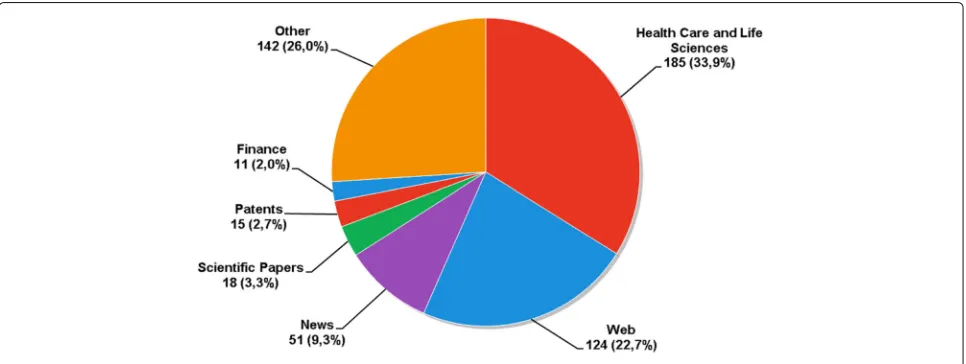
Figure 5 presents the domains where text semantics is most present in text mining applications. Health care and life sciences is the domain that stands out when talking about text semantics in text mining applications. This fact is not unexpected, since life sciences have a long time concern about standardization of vocabularies and tax-onomies. The building of taxonomies and ontologies is such a common practice in health care and life sciences that World Wide Web Consortium (W3C) has an interest group specific for developing, evaluating, and supporting semantic web technologies for this field [32]. Among the most common problems treated through the use of text mining in the health care and life science is the informa-tion retrieval from publicainforma-tions of the field. The search engine PubMed [33] and the MEDLINE database are the main text sources among these studies. There are also studies related to the extraction of events, genes, pro-teins and their associations [34–36], detection of adverse drug reaction [37], and the extraction of cause-effect and disease-treatment relations [38–40].
The second most frequent identified application domain is the mining of web texts, comprising web pages, blogs, reviews, web forums, social medias, and email filtering [41–46]. The high interest in getting some knowledge from web texts can be justified by the large amount and diversity of text available and by the difficulty found in manual analysis. Nowadays, any person can create con-tent in the web, either to share his/her opinion about some product or service or to report something that is taking place in his/her neighborhood. Companies, organizations, and researchers are aware of this fact, so they are increas-ingly interested in using this information in their favor.
Some competitive advantages that business can gain from the analysis of social media texts are presented in [47–49]. The authors developed case studies demonstrating how text mining can be applied in social media intelligence. From our systematic mapping data, we found that Twitter is the most popular source of web texts and its posts are commonly used for sentiment analysis or event extraction. Besides the top 2 application domains, other domains that show up in our mapping refers to the mining of spe-cific types of texts. We found research studies in mining news, scientific papers corpora, patents, and texts with economic and financial content.
Languages
Research question:
What are the natural languages being considered when working with text semantics?
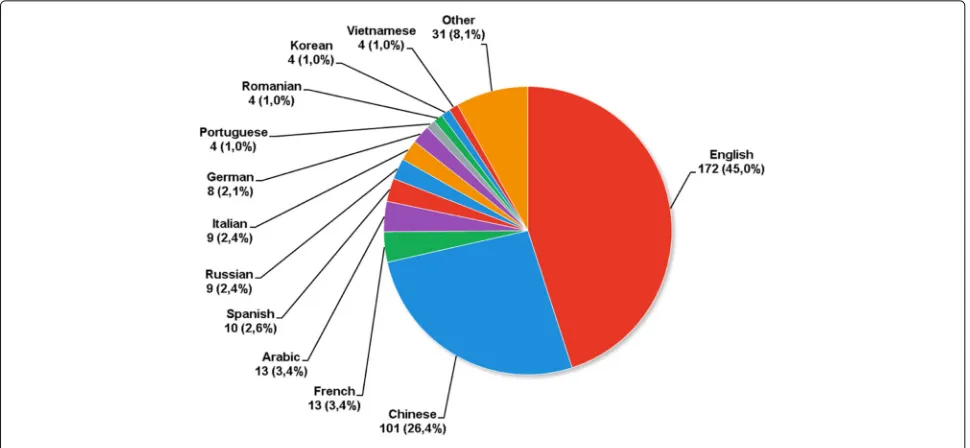
Whether using machine learning or statistical tech-niques, the text mining approaches are usually language independent. However, specially in the natural language processing field, annotated corpora is often required to train models in order to resolve a certain task for each specific language (semantic role labeling problem is an example). Besides, linguistic resources as semantic net-works or lexical databases, which are language-specific, can be used to enrich textual data. Most of the resources available are English resources. Thus, the low number of annotated data or linguistic resources can be a bottleneck when working with another language. There are impor-tant initiatives to the development of researches for other languages, as an example, we have the ACM Transac-tions on Asian and Low-Resource Language Information Processing [50], an ACM journal specific for that subject. In this study, we identified the languages that were mentioned in paper abstracts. The collected data are sum-marized in Fig. 6. We must note that English can be seen as
Fig. 6Languages identified in the literature mapping accepted studies
a standard language in scientific publications; thus, papers whose results were tested only in English datasets may not mention the language, as examples, we can cite [51–56]. Besides, we can find some studies that do not use any linguistic resource and thus are language independent, as in [57–61]. These facts can justify that English was mentioned in only 45.0% of the considered studies.
Chinese is the second most mentioned language (26.4% of the studies reference the Chinese language). Wu et al. [62] point two differences between English and Chinese: in Chinese, there are no white spaces between words in a sentence and there are a higher number of frequent words (the number of frequent words in Chinese is more than twice the number of English frequent words). These characteristics motivate the development of methods and experimental evaluations specifically for Chinese.
This mapping shows that there is a lack of studies con-sidering languages other than English or Chinese. The low number of studies considering other languages sug-gests that there is a need for construction or expan-sion of language-specific resources (as discussed in “External knowledge sources” section). These resources can be used for enrichment of texts and for the devel-opment of language specific methods, based on natural language processing.
External knowledge sources
Research question:
Which external sources are frequently used in text min-ing studies when text semantics is considered?
Text mining initiatives can get some advantage by using external sources of knowledge. Thesauruses, taxonomies,
ontologies, and semantic networks are knowledge sources that are commonly used by the text mining community. Semantic networks is a network whose nodes are concepts that are linked by semantic relations. The most popu-lar example is the WordNet [63], an electronic lexical database developed at the Princeton University. Depend-ing on its usage, WordNet can also be seen as a thesaurus or a dictionary [64].
There is not a complete definition for the terms the-saurus, taxonomy, and ontology that is unanimously accepted by all research areas. Weller [65] presents an interesting discussion about the termontology, including its origin and proposed definitions. She concluded the dis-cussion stating that: “Ontologies should unambiguously represent shared background knowledge that helps peo-ple within a community of interest to understand each other. And they should make computer-readable indexing of information possible on the Web” [65]. The same can be said about thesauruses and taxonomies. In a general way, thesauruses, taxonomies, and ontologies are nor-mally specialized in a specific domain and they usually dif-fers from each other by their degree of expressiveness and complexity in their relational constructions [66]. Ontology would be the most expressive type of knowledge represen-tation, having the most complex relations and formalized construction.
Fig. 7External sources identified in the literature mapping accepted studies
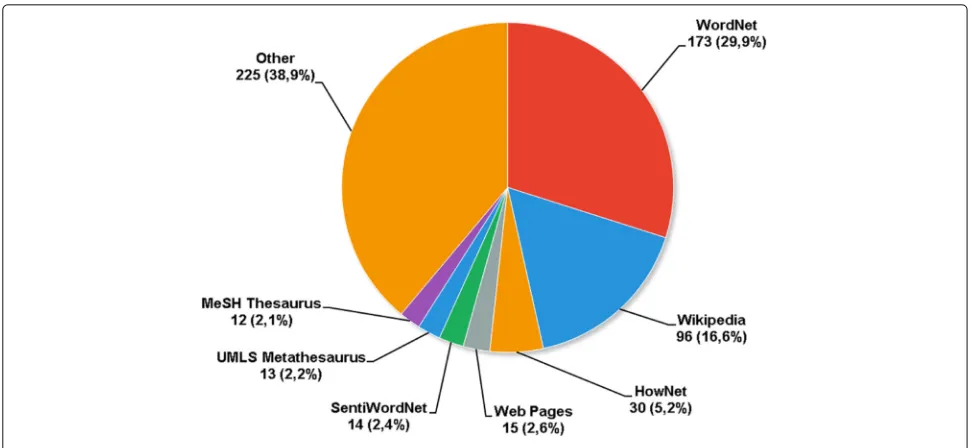
or clustering. The use of features based on WordNet has been applied with and without good results [55, 67–69]. Besides, WordNet can support the computation of seman-tic similarity [70, 71] and the evaluation of the discovered knowledge [72].
The second most used source is Wikipedia [73], which covers a wide range of subjects and has the advantage of presenting the same concept in different languages. Wikipedia concepts, as well as their links and categories, are also useful for enriching text representation [74–77] or classifying documents [78–80]. Medelyan et al. [81] present the value of Wikipedia and discuss how the com-munity of researchers are making use of it in natural language processing tasks (in special word sense disam-biguation), information retrieval, information extraction, and ontology building.
The use of Wikipedia is followed by the use of the Chinese-English knowledge database HowNet [82]. Find-ing HowNet as one of the most used external knowledge source it is not surprising, since Chinese is one of the most cited languages in the studies selected in this mapping (see the “Languages” section). As well as WordNet, HowNet is usually used for feature expansion [83–85] and computing semantic similarity [86–88].
Web pages are also used as external sources [89–91]. Normally, web search results are used to measure similar-ity between terms. We also found some studies that use SentiWordNet [92], which is a lexical resource for senti-ment analysis and opinion mining [93, 94]. Among other external sources, we can find knowledge sources related to Medicine, like the UMLS Metathesaurus [95–98], MeSH thesaurus [99–102], and the Gene Ontology [103–105].
Text mining tasks
Research question:
In what text mining tasks is the text semantics most considered?
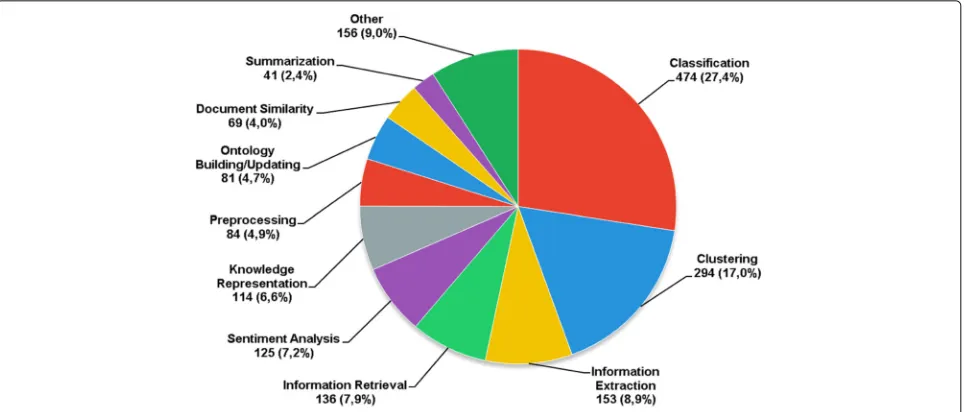
The distribution of text mining tasks identified in this literature mapping is presented in Fig. 8. Classification and clustering are the most frequent tasks. Classification corresponds to the task of finding a model from exam-ples with known classes (labeled instances) in order to predict the classes of new examples. On the other hand, clustering is the task of grouping examples (whose classes are unknown) based on their similarities. Classification was identified in 27.4% and clustering in 17.0% of the studies. As these are basic text mining tasks, they are often the basis of other more specific text mining tasks, such as sentiment analysis and automatic ontology build-ing. Therefore, it was expected that classification and clustering would be the most frequently applied tasks.
Besides classification and clustering, we can note that semantic concern are present in tasks as information extraction [106–108], information retrieval [109–111], sentiment analysis [112–115], and automatic ontology building [116, 117], as well as the pre-processing step itself [118, 119].
Methods and algorithms
Research question:
What methods and algorithms are commonly used?
Fig. 8Text mining tasks identified in the literature mapping accepted studies
the most common approach deals with latent semantics through Latent Semantic Indexing (LSI) [2, 120], a method that can be used for data dimension reduction and that is also known as latent semantic analysis. The Latent Seman-tic Index low-dimensional space is also called semanSeman-tic space. In this semantic space, alternative forms expressing the same concept are projected to a common representa-tion. It reduces the noise caused by synonymy and poly-semy; thus, it latently deals with text semantics. Another technique in this direction that is commonly used for topic modeling is latent Dirichlet allocation (LDA) [121]. The topic model obtained by LDA has been used for representing text collections as in [58, 122, 123].
Beyond latent semantics, the use of concepts or top-ics found in the documents is also a common approach. The concept-based semantic exploitation is normally based on external knowledge sources (as discussed in the “External knowledge sources” section) [74, 124–128]. As an example, explicit semantic analysis [129] rely on Wikipedia to represent the documents by a concept vec-tor. In a similar way, Spanakis et al. [125] improved hier-archical clustering quality by using a text representation based on concepts and other Wikipedia features, such as links and categories.
The issue of text ambiguity has also been the focus of studies. Word sense disambiguation can contribute to a
better document representation. It is normally based on external knowledge sources and can also be based on machine learning methods [36, 130–133].
Other approaches include analysis of verbs in order to identify relations on textual data [134–138]. However, the proposed solutions are normally developed for a specific domain or are language dependent.
In Fig. 9, we can observe the predominance of tra-ditional machine learning algorithms, such as Support Vector Machines (SVM), Naive Bayes, K-means, and k-Nearest Neighbors (KNN), in addition to artificial neural networks and genetic algorithms. The application of nat-ural language processing methods (NLP) is also frequent. Among these methods, we can find named entity recogni-tion (NER) and semantic role labeling. It shows that there is a concern about developing richer text representations to be input for traditional machine learning algorithms, as we can see in the studies of [55, 139–142].
Text representation models
Research question:
How can texts be represented?
The most popular text representation model is the vector space model. In this model, each document is represented by a vector whose dimensions correspond to features found in the corpus. When features are sin-gle words, the text representation is called bag-of-words. Despite the good results achieved with a bag-of-words, this representation, based on independent words, can-not express word relationships, text syntax, or semantics. Therefore, it is not a proper representation for all possible text mining applications.
The use of richer text representations is the focus of several studies [62, 79, 97, 143–148]. Most of the stud-ies concentrate on proposing more elaborated features to represent documents in the vector space model, includ-ing the use of topic model techniques, such as LSI and LDA, to obtain latent semantic features. Deep learning [149] is currently applied to represent independent terms through their associated concepts, in an attempt to nar-row the relationships between the terms [150, 151]. The use of distributed word representations (word embed-dings) can be seen in several works of this area in tasks such as classification [88, 152, 153], summarization [154], and information retrieval [155].
Besides the vector space model, there are text represen-tations based on networks (or graphs), which can make use of some text semantic features. Network-based repre-sentations, such as bipartite networks and co-occurrence networks, can represent relationships between terms or between documents, which is not possible through the vector space model [147, 156–158].
In addition to the text representation model, text semantics can also be incorporated to text mining process
through the use of external knowledge sources, like semantic networks and ontologies, as discussed in the “External knowledge sources” section.
User’s interaction
Research question:
Do users or domain experts take part in the text mining process?
Text mining is a process to automatically discover knowledge from unstructured data. Nevertheless, it is also an interactive process, and there are some points where a user, normally a domain expert, can contribute to the pro-cess by providing his/her previous knowledge and inter-ests. As an example, in the pre-processing step, the user can provide additional information to define a stoplist and support feature selection. In the pattern extraction step, user’s participation can be required when applying a semi-supervised approach. In the post-processing step, the user can evaluate the results according to the expected knowledge usage.
Despite the fact that the user would have an impor-tant role in a real application of text mining methods, there is not much investment on user’s interaction in text mining research studies. A probable reason is the diffi-culty inherent to an evaluation based on the user’s needs. In empirical research, researchers use to execute several experiments in order to evaluate proposed methods and algorithms, which would require the involvement of sev-eral users, therefore making the evaluation not feasible in practical ways.
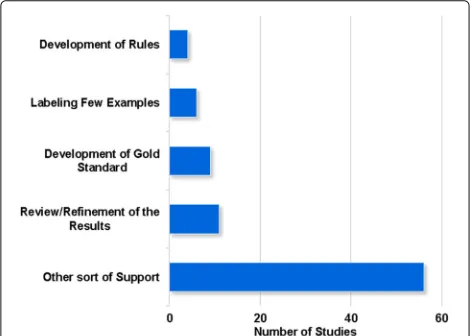
Less than 1% of the studies that were accepted in the first mapping cycle presented information about requir-ing some sort of user’s interaction in their abstract. To better analyze this question, in the mapping update per-formed in 2016, the full text of the studies were also considered. Figure 10 presents types of user’s participation
identified in the literature mapping studies. The most common user’s interactions are the revision or refinement of text mining results [159–161] and the development of a standard reference, also called as gold standard or ground truth, which is used to evaluate text mining results [162–165]. Besides that, users are also requested to man-ually annotate or provide a few labeled data [166, 167] or generate of hand-crafted rules [168, 169].
Systematic mapping summary and future trends
Research question:
How is semantics considered in text mining studies?
Semantics is an important component in natural lan-guage texts. Consequently, in order to improve text min-ing results, many text minmin-ing researches claim that their solutions treat or consider text semantics in some way. However, text mining is a wide research field and there is a lack of secondary studies that summarize and integrate the different approaches. How is semantics considered in text mining studies? Looking for the answer to this question, we conducted this systematic mapping based on 1693 studies, accepted among the 3984 studies iden-tified in five digital libraries. In the previous subsections, we presented the mapping regarding to each secondary research question. In this subsection, we present a con-solidation of our results and point some future trends of semantics-concerned text mining.
As previously stated, the objective of this systematic mapping is to provide a general overview of semantics-concerned text mining studies. The papers considered in this systematic mapping study, as well as the mapping results, are limited by the applied search expression and the research questions. It is not feasible to cover all pub-lished papers in this broad field. Therefore, the reader can miss in this systematic mapping report some previously known studies. It is not our objective to present a detailed survey of every specific topic, method, or text mining task. This systematic mapping is a starting point, and surveys with a narrower focus should be conducted for review-ing the literature of specific subjects, accordreview-ing to one’s interests.
The quantitative analysis of the scientific production by each text mining dimension (presented from the “Applica-tion domains” sec“Applica-tion to the “User’s interac“Applica-tion” sec“Applica-tion) confirmed some previous feelings that we had about our study subject and highlighted other interesting charac-teristics of the field. Text semantics is closely related to ontologies and other similar types of knowledge represen-tation. We also know that health care and life sciences is traditionally concerned about standardization of their concepts and concepts relationships. Thus, as we already expected, health care and life sciences was the most cited application domain among the literature accepted studies. This application domain is followed by the Web domain,
what can be explained by the constant growth, in both quantity and coverage, of Web content.
It was surprising to find the high presence of the Chi-nese language among the studies. ChiChi-nese language is the second most cited language, and the HowNet, a Chinese-English knowledge database, is the third most applied external source in semantics-concerned text mining stud-ies. Looking at the languages addressed in the studies, we found that there is a lack of studies specific to languages other than English or Chinese. We also found an expres-sive use of WordNet as an external knowledge source, fol-lowed by Wikipedia, HowNet, Web pages, SentiWordNet, and other knowledge sources related to Medicine.
Text classification and text clustering, as basic text min-ing tasks, are frequently applied in semantics-concerned text mining researches. Among other more specific tasks, sentiment analysis is a recent research field that is almost as applied as information retrieval and information extraction, which are more consolidated research areas. SentiWordNet, a lexical resource for sentiment analy-sis and opinion mining, is already among the most used external knowledge sources.
The treatment of latent semantics, through the appli-cation of LSI, stands out when looking at methods and algorithms. Besides that, traditional text mining methods and algorithms, like SVM, KNN, and K-means, are fre-quently applied and researches tend to enhance the text representation by applying NLP methods or using external knowledge sources. Thus, text semantics can be incor-porated to the text mining process mainly through two approaches: the construction of richer terms in the vec-tor space representation model or the use of networks or graphs to represent semantic relations between terms or documents.
In real application of the text mining process, the par-ticipation of domain experts can be crucial to its success. However, the participation of users (domain experts) is seldom explored in scientific papers. The difficulty inher-ent to the evaluation of a method based on user’s interac-tion is a probable reason for the lack of studies considering this approach.
The mapping indicates that there is space for secondary studies in areas that has a high number of primary studies, such as studies of feature enrichment for a better text rep-resentation in the vector space model; use of classification methods; use of clustering methods; and the use of latent semantics in text mining. A detailed literature review, as the review of Wimalasuriya and Dou [17] (described in “Surveys” section), would be worthy for organization and summarization of these specific research subjects.
have some level of user’s interaction to bring his/her needs and interests to the process. This is particularly valuable for the clustering task, because a considered good clus-tering solution can vary from user to user [170]. We also expect a raise of resources (linguistic resources and anno-tated corpora) for non-English languages. These resources are very important to the development of semantics-concerned text mining techniques. Higher availability of non-English resources will allow a higher number of stud-ies dealing with these languages. Another future trend is the development and use of graph-based text representa-tion. Nowadays, there are already important researches in this direction, and we expect that it will increase as graph-based representations are more expressive than traditional representations in the vector space model.
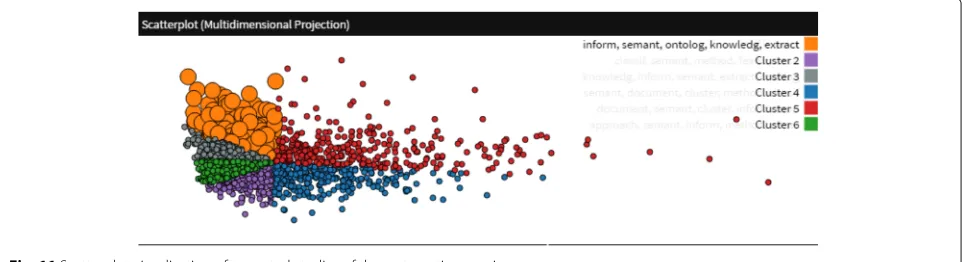
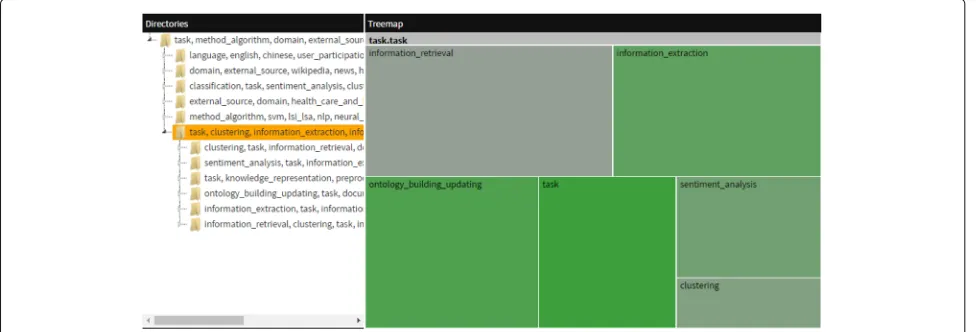
As an alternative summary of this systematic map-ping, additional visualizations of both the selected studies and systematic mapping results can be found online at http://sites.labic.icmc.usp.br/pinda_sm. For this purpose, the prototype of the Pinda tool was adapted for hierar-chical visualization of the textual data, using K-means algorithm to group the results. The tool allows the analysis of data (title + abstract of selected studies or information extracted from them) through multiple visualization tech-niques (Thumbnail, Snippets, Directories, Scatterplot, Treemap, and Sunburst), coordinating the user’s interac-tions for a better understanding of existing relainterac-tionships. Figure 11 illustrates the Scatterplot visualization of studies accepted in this systematic mapping. Some of the possi-ble visualizations of the systematic mapping results are presented in Fig. 12.
Conclusion
Text semantics are frequently addressed in text mining studies, since it has an important influence in text mean-ing. However, there is a lack of secondary studies that consolidate these researches. This paper reported a sys-tematic mapping study conducted to overview semantics-concerned text mining literature. The scope of this
mapping is wide (3984 papers matched the search expres-sion). Thus, due to limitations of time and resources, the mapping was mainly performed based on abstracts of papers. Nevertheless, we believe that our limitations do not have a crucial impact on the results, since our study has a broad coverage.
The main contributions of this work are (i) it presents a quantitative analysis of the research field; (ii) its con-duction followed a well-defined literature review protocol; (iii) it discusses the area regarding seven important text mining dimensions: application domain, language, exter-nal knowledge source, text mining task, method and algo-rithm, representation model, and user’s interaction; and (iv) the produced mapping can give a general summary of the subject and can be of great help for researchers working with semantics and text mining. Thus, this work filled a gap in the literature as, to the best of our knowl-edge, this is the first general literature review of this wide subject.
Although several researches have been developed in the text mining field, the processing of text semantics remains an open research problem. The field lacks secondary stud-ies in areas that has a high number of primary studstud-ies, such as feature enrichment for a better text representa-tion in the vector space model. Another highlight is about a language-related issue. We found considerable differ-ences in numbers of studies among different languages, since 71.4% of the identified studies deal with English and Chinese. Thus, there is a lack of studies dealing with texts written in other languages. When considering semantics-concerned text mining, we believe that this lack can be filled with the development of good knowledge bases and natural language processing methods specific for these languages. Besides, the analysis of the impact of languages in semantic-concerned text mining is also an interesting open research question. A comparison among semantic aspects of different languages and their impact on the results of text mining techniques would also be interesting.
Fig. 12Directories and Treemap visualizations of the systematic mapping results
Endnotes
1A simple search for “systematic review” on the
Sco-pus database in June 2016 returned, by subject area, 130,546 Health Sciences documents (125,254 of them for Medicine) and only 5,539 Physical Sciences (1328 of them for Computer Science). The coverage of Scopus publica-tions are balanced between Health Sciences (32% of total Scopus publication) and Physical Sciences (29% of total Scopus publication).
2It was not possible to perform the second cycle of
searches in ACM Digital Library because of a change in the interface of this search engine. However, it must be notice that only eight studies that was found only in this database was accepted in the first cycle. All other studies was also retrieved by other search engines (spe-cially Scopus, which retrieved more than 89% of accepted studies.)
3Word cloud created with support of Wordle [171].
Acknowledgements
The authors would like to thank the financial support of grant #132666/2016-2, National Council for Scientific and Technological Development (CNPq); grants #2013/14757-6, #2014/08996-0, and #2016/07620-2, São Paulo Research Foundation (FAPESP); and Coordination for the Improvement of Higher Education Personnel (CAPES).
Authors’ contributions
RAS and SOR planned this systematic mapping study. RAS conducted its first cycle (searches performed in January 2014). JA and RAS conducted its second cycle (searches performed in February 2016). RAS and SOR analyzed the results and drafted the manuscript after the first cycle and updated it after the second cycle. JA was involved in updating the manuscript with the second cycle results. All authors revised and approved the final manuscript.
Competing interests
The authors declare that they have no competing interests.
Publisher’s Note
Springer Nature remains neutral with regard to jurisdictional claims in published maps and institutional affiliations.
Received: 24 March 2017 Accepted: 1 June 2017
References
1. Miner G, Elder J, Hill T, Nisbet R, Delen D, Fast A (2012) Practical text mining and statistical analysis for non-structured text data applications. 1st edn. Academic Press, Boston
2. Aggarwal CC, Zhai C (eds) (2012) Mining text data. Springer, Durham 3. Kitchenham B, Charters S (2007) Guidelines for performing systematic
literature reviews in software engineering. EBSE Technical Report EBSE-2007-01. Keele University and Durham University Joint Report, Durham, UK
4. Petersen K, Feldt R, Mujtaba S, Mattsson M (2008) Systematic mapping studies in software engineering. In: EASE 2008: Proceedings of the 12th International Conference on Evaluation and Assessment in Software Engineering. EASE’08. British Computer Society, Swinton, UK. pp 68–77 5. Brereton P, Kitchenham BA, Budgen D, Turner M, Khalil M (2007) Lessons
from applying the systematic literature review process within the software engineering domain. J Syst Softw 80(4):571–583
6. Kitchenham B, Pretorius R, Budgen D, Brereton OP, Turner M, Niazi M, et al (2010) Systematic literature reviews in software engineering—a tertiary study. Inf Softw Technol 52(8):792–805
7. Felizardo KR, Nakagawa EY, MacDonell SG, Maldonado JC (2014) A visual analysis approach to update systematic reviews. In: EASE’14:
Proceedings of the 18th International Conference on Evaluation and Assessment in Software Engineering. ACM, New York. pp 4:1–4:10 8. Moghaddam FA, Lago P, Grosso P (2015) Energy-efficient networking
solutions in cloud-based environments: a systematic literature review. ACM Comput Surv 47(4):64:1–64:32
9. Pedro RWD, Nunes FLS, Machado-Lima A (2013) Using grammars for pattern recognition in images: a systematic review. ACM Comput Surv 46(2):26:1–26:34
10. Pisani PH, Lorena AC (2013) A systematic review on keystroke dynamics. J Braz Comput Soc 19(4):573–587
11. Park DH, Kim HK, Choi IY, Kim JK (2012) A literature review and classification of recommender systems research. Expert Syst Appl 39(11):10059–10072
12. Khan K, Baharudin BB, Khan A, et al (2009) Mining opinion from text documents: a survey. In: DEST’09: Proceedings of the 3rd IEEE International Conference on Digital Ecosystems and Technologies. IEEE. pp 217–222 13. Laboratory of Research on Software Engineering (LaPES) - StArt Tool.
http://lapes.dc.ufscar.br/tools/start_tool. Accessed 8 June 2016 14. Grobelnik M (2011) Many faces of text processing. In: WIMS’11:
Proceedings of the International Conference on Web Intelligence, Mining and Semantics. ACM. p 5
16. Daud A, Li J, Zhou L, Muhammad F (2010) Knowledge discovery through directed probabilistic topic models: a survey. Front Comput Sci China 4(2):280–301
17. Wimalasuriya DC, Dou D (2010) Ontology-based information extraction: an introduction and a survey of current approaches. J Inf Sci 36(3):306–323 18. Bharathi G, Venkatesan D (2012) Study of ontology or thesaurus based
document clustering and information retrieval. J Eng Appl Sci 7(4):342–347 19. Reshadat V, Feizi-Derakhshi MR (2012) Studying of semantic similarity
methods in ontology. Res J Appl Sci Eng Technol 4(12):1815–1821 20. Schiessl M, Bräscher M (2012) Do texto às ontologias: uma perspectiva
para a ciência da informação. Ciência da Informação 40(2):301–311 21. Cimiano P, Völker J, Studer R (2006) Ontologies on demand?—a
description of the state-of-the-art, applications, challenges and trends for ontology learning from text. Inf Wiss Prax 57(6-7):315–320 22. Jovanovic J, Bagheri E, Cuzzola J, Gasevic D, Jeremic Z, Bashash R (2014)
Automated semantic tagging of textual content. IT Prof 16(6):38–46 23. Wallace BC (2015) Computational irony: a survey and new perspectives.
Artif Intell Rev 43(4):467–483
24. Winnenburg R, Wächter T, Plake C, Doms A, Schroeder M (2008) Facts from text: can text mining help to scale-up high-quality manual curation of gene products with ontologies? Brief Bioinform 9(6):466–478 25. Leser U, Hakenberg J (2005) What makes a gene name? Named entity
recognition in the biomedical literature. Brief Bioinform 6(4):357–369 26. Dagan I, Dolan B, Magnini B, Roth D (2009) Recognizing textual
entailment: rational, evaluation and approaches. Nat Lang Eng 15(04):i–xvii
27. Irfan R, King CK, Grages D, Ewen S, Khan SU, Madani SA, et al. (2015) A survey on text mining in social networks. Knowl Eng Rev 30(02):157–170 28. Sheth A, Ramakrishnan C, Thomas C (2005) Semantics for the semantic
web: the implicit, the formal and the powerful. Int J Semant Web Inf Syst 1(1):1–18
29. Cheng XY, Cheng C, Zhu Q (2011) The applications of description logics in natural language processing. Adv Mater Res 204:381–386
30. Martinez A, Martinez W (2015) At the interface of computational linguistics and statistics. Wiley Interdiscip Rev Comput Stat 7(4):258–274 31. Bos J (2011) A survey of computational semantics: representation,
inference and knowledge in wide-coverage text understanding. Lang Linguist Compass 5(6):336–366
32. W3C - Semantic Web Health Care and Life Sciences Interest Group. https://www.w3.org/blog/hcls/. Accessed 8 June 2016
33. National Center for Biotechnology Information - PubMed. http://www. ncbi.nlm.nih.gov/pubmed/. Accessed 8 June 2016
34. Miwa M, Thompson P, McNaught J, Kell DB, Ananiadou S (2012) Extracting semantically enriched events from biomedical literature. BMC Bioinforma 13(1):1–24
35. Ravikumar KE, Liu H, Cohn JD, Wall ME, Verspoor K (2011) Pattern learning through distant supervision for extraction of protein-residue associations in the biomedical literature, vol. 2. pp 59–65. IEEE, Honolulu. http://ieeexplore.ieee.org/document/6147049/.
36. Xia N, Lin H, Yang Z, Li Y (2011) Combining multiple disambiguation methods for gene mention normalization. Expert Syst Appl 38(7):7994–7999
37. Sarker A, Gonzalez G (2015) Portable automatic text classification for adverse drug reaction detection via multi-corpus training. J Biomed Inform 53:196–207
38. Wu JL, Yu LC, Chang PC (2012) Detecting causality from online psychiatric texts using inter-sentential language patterns. BMC Med Inform Dec Making 12(1):1–10
39. Abacha AB, Zweigenbaum P (2011) A hybrid approach for the extraction of semantic relations from MEDLINE abstracts. Lect Notes Comput Sci (Incl Subseries Lect Notes Artif Intell Lect Notes Bioinforma) 6609 LNCS(PART 2):139–150
40. Yu LC, Wu CH, Jang FL (2007) Psychiatric consultation record retrieval using scenario-based representation and multilevel mixture model. IEEE IEEE Trans Inf Technol Biomed 11(4):415–427
41. Musto C, Semeraro G, Lops P, Gemmis MD (2015) CrowdPulse: a framework for real-time semantic analysis of social streams. Inf Syst 54:127–146
42. García-Moya L, Kudama S, Aramburu MJ, Berlanga R (2013) Storing and analysing voice of the market data in the corporate data warehouse. Inf Syst Front 15(3):331–349
43. Eugenio BD, Green N, Subba R (2013) Detecting life events in feeds from Twitter. In: ICSC 2013: Proceedings of the IEEE Seventh International Conference on Semantic Computing. IEEE, Irvine, pp 274–277. http:// ieeexplore.ieee.org/document/6693529/.
44. Torunoglu D, Telseren G, Sagturk O, Ganiz MC (2013) Wikipedia based semantic smoothing for twitter sentiment classification. In: INISTA 2013: Proceedings of the IEEE International Symposium on Innovations in Intelligent Systems and Applications. IEEE, Albena. pp 1–5
45. Cao Q, Duan W, Gan Q (2011) Exploring determinants of voting for the “helpfulness” of online user reviews: a text mining approach. Decis Support Syst 50(2):511–521
46. Levi A, Mokryn O, Diot C, Taft N (2012) Finding a needle in a haystack of reviews: cold start context-based hotel recommender system. In: RecSys’12: Proceedings of the sixth ACM Conference on Recommender Systems. ACM, New York. pp 115–122
47. He W, Shen J, Tian X, Li Y, Akula V, Yan G, et al (2015) Gaining competitive intelligence from social media data: evidence from two largest retail chains in the world. Ind Manag Data Syst 115(9):1622–1636 48. He W, Tian X, Chen Y, Chong D (2016) Actionable social media
competitive analytics for understanding customer experiences. J Comput Inf Syst 56(2):145–155
49. Tian X, He W, Tao R, Akula V (2016) Mining online hotel reviews: a case study from hotels in China. In: AMCIS 2016: Proceedings of the 22nd Americas Conference on Information Systems. pp 1–8
50. ACM - Asian and Low-Resource Language Information Processing (TALLIP). http://tallip.acm.org/. Accessed 8 June 2016
51. Chen CL, Liu CL, Chang YC, Tsai HP (2011) Mining opinion holders and opinion patterns in US financial statements. In: TAAI 2011: Proceedings of the International Conference on Technologies and Applications of Artificial Intelligence. IEEE, Chung-Li, pp 62–68
52. Chen J, Liu J, Yu W, Wu P (2009) Combining lexical stability and improved lexical chain for unsupervised word sense disambiguation. In: KAM’09: Proceedings of the Second International Symposium on Knowledge Acquisition and Modeling. IEEE, Wuhan Vol. 1. pp 430–433. http://ieeexplore.ieee.org/document/5362135/.
53. Rusu D, Fortuna B, Grobelnik M, Mladenic D (2009) Semantic graphs derived from triplets with application in document summarization. Informatica (Slovenia) 33(3):357–362
54. Krachina O, Raskin V, Triezenberg K (2007) Reconciling privacy policies and regulations: ontological semantics perspective. In: Human Interface and the Management of Information. Interacting in Information Environments. Springer, Berlin, pp 730–739
55. Mansuy T, Hilderman RJ (2006) A characterization of WordNet features in Boolean models for text classification. In: AusDM 2006: Proceedings of the fifth Australasian Conference on Data Mining and Analystics. Australian Computer Society, Inc, Darlinghurst, pp 103–109 56. Ciaramita M, Gangemi A, Ratsch E, Šaric J, Rojas I (2005) Unsupervised
learning of semantic relations between concepts of a molecular biology ontology. In: IJCAI’05: Proceedings of the 19th International Joint Conference on Artificial Intelligence. Morgan Kaufmann Publishers Inc., San Francisco, CA. pp 659–664
57. Kim K, Chung BS, Choi Y, Lee S, Jung JY, Park J (2014) Language independent semantic kernels for short-text classification. Expert Syst Appl 41(2):735–743
58. Gujraniya D, Murty MN (2012) Efficient classification using phrases generated by topic models. In: ICPR 2012: Proceedings of the 21st International Conference on Pattern Recognition. IEEE, Tsukuba, pp 2331–2334
59. Du C, Zhuang F, He Q, Shi Z (2012) Multi-task semi-supervised semantic feature learning for classification. In: ICDM 2012: Proceedings of the IEEE 12th International Conference on Data Mining. IEEE, Brussels, pp 191–200. http://ieeexplore.ieee.org/document/6413903/. 60. Wu Q, Zhang C, Deng X, Jiang C (2011) LDA-based model for topic
evolution mining on text. In: ICCSE 2011: Proceedings of the 6th International Conference on Computer Science & Education. IEEE, Singapore, pp 946–949
61. Lu X, Zheng B, Velivelli A, Zhai C (2006) Enhancing text categorization with semantic-enriched representation and training data augmentation. J Am Med Inform Assoc 13(5):526–535