R E S E A R C H A R T I C L E
Open Access
Qualitative thematic analysis of consent forms
used in cancer genome sequencing
Clarissa Allen
1,2and William D Foulkes
1*Abstract
Background:Large-scale whole genome sequencing (WGS) studies promise to revolutionize cancer research by identifying targets for therapy and by discovering molecular biomarkers to aid early diagnosis, to better determine prognosis and to improve treatment response prediction. Such projects raise a number of ethical, legal, and social (ELS) issues that should be considered. In this study, we set out to discover how these issues are being handled across different jurisdictions.
Methods:We examined informed consent (IC) forms from 30 cancer genome sequencing studies to assess (1) stated purpose of sample collection, (2) scope of consent requested, (3) data sharing protocols (4) privacy protection measures, (5) described risks of participation, (6) subject re-contacting, and (7) protocol for withdrawal. Results:There is a high degree of similarity in how cancer researchers engaged in WGS are protecting participant privacy. We observed a strong trend towards both using samples for additional, unspecified research and sharing data with other investigators. IC forms were varied in terms of how they discussed re-contacting participants, returning results and facilitating participant withdrawal. Contrary to expectation, there were no consistent trends that emerged over the eight year period from which forms were collected.
Conclusion:Examining IC forms from WGS studies elucidates how investigators are handling ELS challenges posed by this research. This information is important for ensuring that while the public benefits of research are
maximized, the rights of participants are also being appropriately respected.
Background
The past decade has been characterized by a breathtak-ing acceleration in genome sequencbreathtak-ing technology [1]. While at the beginning of the decade it took years to sequence the first complete human genome, over 200 human genomes have been sequenced in the past year alone, and experts predicts that approximately 25,000 will be sequenced by the end of 2011 [2]. One of the most exciting applications of this new technology is deciphering the genetic basis of complex diseases [3]. Cancer in particular provides an ideal and noteworthy focus for this approach. As a highly heterogeneous genetic disease mainly driven by somatic mutations that can occur at a multitude of locations, cancer is particu-larly amenable to this type of study. By enabling researchers to compare the host genome to that of the
cancer itself, whole genome sequencing (WGS) technol-ogy promises to not only identify predictors of, and tar-gets for, therapy, but also discover novel molecular biomarkers to aid in the early detection of cancer. In combination, these will likely positively influence prog-nosis [4]. Consequently, a number of large-scale research studies using WGS technology to identify genetic components of cancer have recently been initiated. Projects such as The Cancer Genome Atlas and the International Cancer Genome Consortium are obtaining biological samples from thousands of subjects around the world in an attempt to catalogue the myriad genetic and genomic alterations that are critical to carci-nogenesis. This research raises a number of ethical, legal, and social (ELS) issues that need to be addressed.
Investigators engaged in large-scale WGS research projects must consider how to manage issues such as sample and data sharing, protecting participant privacy and confidentiality, communicating the risks and bene-fits of research to participants, returning individual
* Correspondence: [email protected] 1
Program in Cancer Genetics, Departments of Oncology and Human Genetics, McGill University, Montreal, Quebec, Canada
Full list of author information is available at the end of the article
results, and enabling participant withdrawal from research when requested. These issues are common to the majority of human subject research, but the unpre-cedented volume of genomic data that is being collected through WGS, the inherent unpredictability of what this technology will reveal in comparison to targeted sequen-cing and the rapid rate at which our interpretive abilities are advancing obliges us to re-examine these issues in the context of this research. Our goal in this study therefore was to perform a qualitative analysis of con-sent forms in order to discern how investigators cur-rently engaged in cancer genome sequencing across a variety of jurisdictions are addressing these issues. Focusing on cancer genome research enables compari-son across studies, allowing us to add to knowledge of current practices, identify similarities and differences, and determine whether common practices are emerging. As informed consent (IC) documents are the main vehi-cle through which information about ELS issues is com-municated to research participants, we chose to focus our study on the analysis of these forms. We anticipated that trends would emerge both across jurisdictions and over time.
Methods
We obtained contact details for researchers engaged in cancer genome sequencing by visiting the websites of large-scale WGS projects, found by doing internet searches for ‘whole genome sequencing’ and navigating the website of the National Institute of Health. We also searched http://Pubmed.gov for papers reporting studies that involved sequencing whole cancer genomes, using the key words ‘whole genome sequencing’ and ‘ next-generation sequencing’ and limiting the searches to humans only, within the past five years, under the sub-set ‘cancer’. Additional file 1, Table 1 presents a list of these studies that is current at the time of publication, with a succinct summary of their key findings. Our per-sonal knowledge of ongoing research projects provided further guidance in this search.
We contacted researchers via email and/or phone. Indi-viduals were selected on the basis of either being listed as a primary contact at tissue source sites for large-scale WGS projects, or as corresponding authors for journal articles. We explained the details of our research pro-ject, and requested that the researchers send us tem-plates of the informed consent documents used by their institutions or research groups when obtaining tissue samples for cancer genome sequencing research. It was explained to potential participants that neither specific institutions nor individuals would be identified in our results or discussion. In total 54 researchers were identi-fied. Of these, 12 were excluded on the basis of being part of the same research groups as other researchers
on the list. Of the 42 remaining researchers, 30 sent informed consent documents, giving us a response rate of 71.4%.
We performed a qualitative thematic analysis on the IC forms that were received. We assigned each docu-ment a value under the following headings: (1) stated purpose of sample collection, (2) scope of consent requested, (3) data sharing protocols (4) privacy protec-tion measures, (5) described risks of participaprotec-tion, (6) subject re-contacting, and (7) protocol for withdrawal. Values were specific to each heading, and represented what was stated in the informed consent document in relation to the topic at hand.
Results
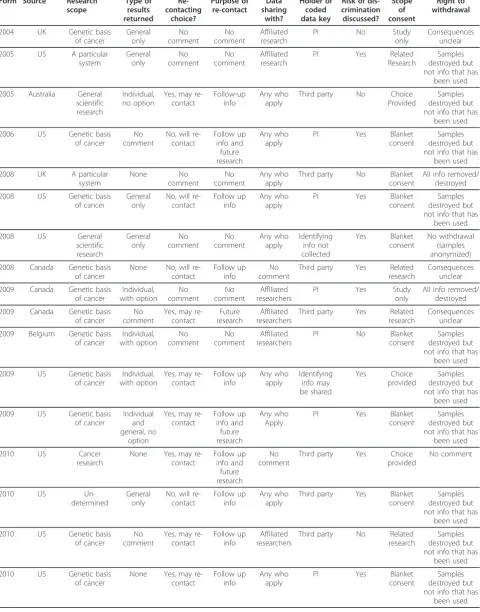
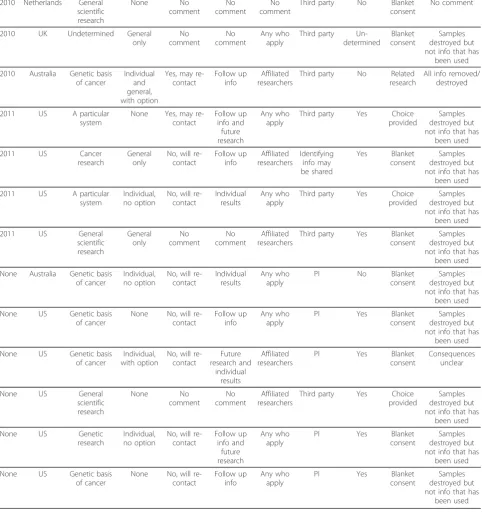
For the 30 informed consent documents obtained, the country-of-origin breakdown was as follows: one from Belgium, one from the Netherlands, three from Austra-lia, three from Canada, three from the UK and nineteen from the US. The most recently dated form was from May 2011, while the oldest was dated March 2004. Six of the forms were not dated, while three others were from 2011, six were from 2010, five were from 2009, five were from 2008, one was from 2006, and two were from 2005. The key findings from our thematic analysis, in summary form, are presented in Table 1.
We divided the IC forms into three categories based on the described purpose of tissue sample acquisition. Of the 30 documents obtained, the majority (n = 17) stated that samples were being collected for the purpose of cancer genetics research. Six were seeking samples for the purpose of broader medical research on a parti-cular system or tissue type. Five were seeking blanket consent for any type of generalized medical research. Two forms were templates, in which the purpose of research was to be filled in upon use.
In addition to the stated purpose of the sample collec-tion, we identified the scope of the consent that was being requested. Only two of the documents were seek-ing consent exclusively for the specific study described. Six were seeking consent to use the samples collected for research related to the study at hand, for example on the same disease, and intended to keep the samples indefinitely for this purpose. Six documents provided a choice as to the scope of consent, while sixteen stated that once obtained, samples might be used for any type of research at any future date.
Table 1 Summary of Results
Form Source Research scope Type of results returned Re-contacting choice? Purpose of re-contact Data sharing with? Holder of coded data key
Risk of dis-crimination discussed? Scope of consent Right to withdrawal
2004 UK Genetic basis of cancer General only No comment No comment Affiliated research
PI No Study
only
Consequences unclear
2005 US A particular system General only No comment No comment Affiliated research
PI Yes Related
Research
Samples destroyed but not info that has
been used
2005 Australia General scientific research
Individual, no option
Yes, may re-contact
Follow-up info
Any who apply
Third party No Choice Provided
Samples destroyed but not info that has
been used
2006 US Genetic basis of cancer
No comment
No, will re-contact Follow up info and future research Any who apply
PI Yes Blanket
consent
Samples destroyed but not info that has
been used
2008 UK A particular system None No comment No comment Any who apply
Third party No Blanket consent
All info removed/ destroyed
2008 US Genetic basis of cancer
General only
No, will re-contact
Follow up info
Any who apply
PI Yes Blanket
consent
Samples destroyed but not info that has
been used
2008 US General
scientific research General only No comment No comment Any who apply Identifying info not collected Yes Blanket consent No withdrawal (samples anonymized)
2008 Canada Genetic basis of cancer
None No, will re-contact
Follow up info
No comment
Third party Yes Related research
Consequences unclear
2009 Canada Genetic basis of cancer Individual, with option No comment No comment Affiliated researchers
PI Yes Study
only
All info removed/ destroyed
2009 Canada Genetic basis of cancer
No comment
Yes, may re-contact
Future research
Affiliated researchers
Third party Yes Related research
Consequences unclear
2009 Belgium Genetic basis of cancer Individual, with option No comment No comment Affiliated researchers
PI No Blanket
consent
Samples destroyed but not info that has
been used
2009 US Genetic basis of cancer
Individual, with option
Yes, may re-contact Follow up info Any who apply Identifying info may be shared Yes Choice provided Samples destroyed but not info that has
been used
2009 US Genetic basis of cancer
Individual and general, no
option
Yes, may re-contact Follow up info and future research Any who Apply
PI Yes Blanket
consent
Samples destroyed but not info that has
been used
2010 US Cancer
research
None Yes, may re-contact Follow up info and future research No comment
Third party Yes Choice provided
No comment
2010 US
Un-determined
General only
No, will re-contact
Follow up info
Any who apply
Third party Yes Blanket consent
Samples destroyed but not info that has
been used
2010 US Genetic basis of cancer
No comment
Yes, may re-contact
Follow up info
Affiliated researchers
Third party No Related research
Samples destroyed but not info that has
been used
2010 US Genetic basis of cancer
None Yes, may re-contact
Follow up info
Any who apply
PI Yes Blanket
consent
Samples destroyed but not info that has
data could be shared with anyone, though more sensi-tive data would be placed in secure databases to which researchers would need to apply in order to gain access. Three of the documents did not reference data sharing at all.
Although many of the documents asked for broad consent and stated fairly liberal data sharing intentions, all but one (which did not collect identifying
information) of the documents stated that data would be coded, with personal identifiers removed, and only a single person or small group of people having access to keys for linking coded information to specific research subjects. Although in three cases it was not stated, in approximately half (n = 13) of the forms the primary investigator was identified as the person with key access, while the other half (n = 13) stated that only data bank Table 1 Summary of Results(Continued)
2010 Netherlands General scientific research None No comment No comment No comment
Third party No Blanket consent
No comment
2010 UK Undetermined General only No comment No comment Any who apply
Third party Un-determined
Blanket consent
Samples destroyed but not info that has
been used
2010 Australia Genetic basis of cancer
Individual and general, with option
Yes, may re-contact
Follow up info
Affiliated researchers
Third party No Related research
All info removed/ destroyed
2011 US A particular system
None Yes, may re-contact Follow up info and future research Any who apply
Third party Yes Choice provided
Samples destroyed but not info that has
been used
2011 US Cancer
research
General only
No, will re-contact Follow up info Affiliated researchers Identifying info may be shared Yes Blanket consent Samples destroyed but not info that has
been used
2011 US A particular system
Individual, no option
No, will re-contact
Individual results
Any who apply
Third party Yes Choice provided
Samples destroyed but not info that has
been used
2011 US General
scientific research General only No comment No comment Affiliated researchers
Third party Yes Blanket consent
Samples destroyed but not info that has
been used
None Australia Genetic basis of cancer
Individual, no option
No, will re-contact
Individual results
Any who apply
PI No Blanket
consent
Samples destroyed but not info that has
been used
None US Genetic basis of cancer
None No, will re-contact
Follow up info
Any who apply
PI Yes Blanket
consent
Samples destroyed but not info that has
been used
None US Genetic basis of cancer
Individual, with option
No, will re-contact Future research and individual results Affiliated researchers
PI Yes Blanket
consent
Consequences unclear
None US General
scientific research None No comment No comment Affiliated researchers
Third party Yes Choice provided
Samples destroyed but not info that has
been used
None US Genetic
research
Individual, no option
No, will re-contact Follow up info and future research Any who apply
PI Yes Blanket
consent
Samples destroyed but not info that has
been used
None US Genetic basis of cancer
None No, will re-contact
Follow up info
Any who apply
PI Yes Blanket
consent
Samples destroyed but not info that has
personnel, not researchers, would be able to re-link per-sonal identifiers to information generated from research. Despite these confidentiality measures, twenty-one of the documents, predominantly those from North Amer-ica, stated the danger of information of research partici-pation and even individual results becoming known, and noted potentially associated repercussions, such as dis-crimination, as a risk of providing samples. Nine docu-ments did not specify such socio-economic factors as a risk of participation in research, while one left the‘risks’ section blank, to be filled in at the time of use.
Nine of the documents provided potential subjects with the choice to be re-contacted. In five cases this was to obtain follow-up health and demographic informa-tion, in one case to solicit participation in future research studies, and in three cases for both follow-up and future studies. Eleven of the documents stated sim-ply that participants would be re-contacted; six for fol-low-up information, two to return individual results, one for both follow-up information and future studies, and two for both future studies and to return individual research results. Ten of the documents did not refer to re-contacting research participants.
Ten of the documents collected stated that general study results would be made available to participants. Of those ten, one stated that individual results would also be returned, one provided participants with a choice in obtaining individual results, seven stated that no individual results would be returned, and one did not discuss individual results. Of the remaining twenty, four stated that individual results would be returned, four provided participants with a choice regarding the return of individual results, nine stated that individual results would not be returned, and three did not discuss this issue.
Finally, we looked at the documents’ explanation of subjects’ability to withdraw from research participation. Two documents did not refer to the option to withdraw. Of the remaining twenty-eight, three stated that should subjects choose to withdraw, all samples would be destroyed and information removed from the research project. Twenty stated that upon withdrawal samples would be destroyed, but information that had already been incorporated into research would not be removed. One document stated that as no identifying information would be collected, withdrawal would not be possible. The remaining four documents described participants’ right to withdraw from research, but were ambiguous about what effect this would have on samples and data.
Discussion
Informed consent in a research context is an autono-mous action by a subject that authorizes a professional to involve that subject in a particular research endeavor
[5]. To facilitate this authorization, IC forms must describe the purpose and scope of the study, potential risks and benefits of participation, how issues of privacy and confidentiality will be addressed, whether samples and/or data will be available to other researchers and whether research results will be available to participants and/or the public [6]. General information on informed consent can be found in guidance documents such as the United Nations’Ethical, Social, and Cultural Organi-zations’ “Universal Declaration on the Human Genome and Human Rights”(1997) and the Council for Interna-tional Organization of Medical Sciences’ “Ethics and Research on Human Subjects: International Guidelines” (1992). Examining how these issues are addressed in IC forms that are being used in current cancer genome sequencing research however provides a more up-to-date and informative illustration of how investigators in this domain are balancing their ethical obligations to research subjects with the ultimate goal of research, which is to produce generalizable scientific knowledge for the benefit of society at large [7].
Obtaining Informed Consent for Future Research and Data Sharing
The goal of large-scale genome sequencing projects is to create databases of genomic and phenotypic information to be widely disseminated in support of research advances [8]. Maximizing the utility of these databases by making as much information available to as many researchers as possible is undoubtedly beneficial to the advancement of science and so to the public good. This is especially true when databases are linked to identifi-able and regularly updated personal information, such as medical records, so that correlations between genetic factors, treatment strategies and health outcomes can be made [6]. Broad consent from participants enables the future application of data to novel contexts that are not foreseeable at the time of collection [9]. The IC forms collected for this study illustrate a trend towards the broad sharing of samples and data, as 73% of the forms articulated the intention to use the samples for future, possibly unrelated research and 90% expressed the intention to share their research data with other, possi-bly unaffiliated, researchers. However, this otherwise laudable strategy must be balanced with ethical and legal obligations to obtain adequately informed consent from individual participants [6].
especially true considering the extended period of time for which samples are being maintained and the rapid rate at which technology is advancing. Consent that is broad enough to cover all of the potential, unknown future of uses of research data is arguably too broad to be meaningful [8]. As a result of this, there is a growing body of literature in biomedical journals calling for a re-conceptualization of the role of autonomy and informed consent in research in order to accommodate the needs of science. Proponents argue that these databases are a revolutionary platform for medical research, and can exist only by relying on models of open consent and public data access [9]. Obtaining broad consent to mul-tiple purposes of research and future consent to as yet unspecified research, as the majority of the forms we collected did, is therefore being proposed as a legitimate mechanism for the advancement of science [11].
The Unites States federal research regulations, referred to as 45CFR46, do not consider research involving only coded private information or specimens to involve human subjects, and so does not require informed con-sent for such research (45CFR46.102(f)). Thirteen of the forms we examined stated that researchers would not have access to the codes linking data to individuals, and so research arising from data sharing in these cases falls into this category. That being said, there are a number of reasons to advocate for stronger subject protections in relation to genomic databases. Especially when geno-typic data are linked to regularly updated phenogeno-typic data, which many argue is an essential feature of these databases [6], there is a risk that even de-identified sequence data can be matched against third party data-base to effectively re-identify an individual, and so priv-acy and confidentiality cannot be guaranteed [12]. Additionally, as WGS data becomes amenable to the study of complex traits beyond disease, such as beha-viour, there may be significant risk to both individual autonomy and cultural identity [8]. Most research ethics guidelines, including the Declaration of Helsinki, agree that the objectives of science should not supersede indi-vidual rights. As the control over information that implicates personal integrity is recognized as a funda-mental human right [6], the role of open-access geno-mic databases in advancing medical research alone is insufficient to trump the ethical obligation to obtain truly informed consent. The tension between individual and social interests in this context therefore remains a hotly debated issue [13].
Genetic Research and Socio-economic Risk
Ensuring that potential research participants are provid-ing consent that is substantially informed requires that the foreseeable risks and benefits of research are fully disclosed. These include the risk that an individual’s
participation in WGS research and resulting genetic information could become known to unauthorized par-ties. While all of the documents we collected stated that personal identifiers would be removed from samples and data so as to protect individual privacy, 70% of the forms also warned potential subject that privacy and confidentiality measures were not infallible. As each individual’s genomic code is unique, knowledge of even a small number of genetic variants can result in samples being matched to individuals with a relatively high level of confidence [14]. Even when research data are de-identified, the increasing linking and interoperability of various health information databases heightens the pos-sibility that individuals may be re-identified [15]. The ease with which research data can be disseminated via the internet increases the possibility that such informa-tion may be obtained by entities not subject to privacy regulations [14]. It is therefore appropriate for research-ers to warn potential participants that privacy and confi-dentiality cannot be guaranteed [9]. What is less clear, however, is what dangers the potential disclosure of individual genetic information presents.
Re-contacting Research Subjects and Returning Individual Results
The forms we collected discussed re-contacting for three purposes; to suggest further research participation, to obtain further information about participants, and to return individual research results. While some commen-tators argue that re-contacting participants is unduly burdensome in terms of the time and resources it con-sumes [19], it can also provide valuable information. One of the greatest challenges that genetic research cur-rently faces is elucidating the gene-environment interac-tions that contribute to health outcomes and so contacting participants to update this information may be invaluable to research [20,21]. Investigators must consider however that particularly in the context of can-cer genome sequencing, participants may not wish to be re-contacted. All of the documents we examined requested samples of tissue that was being removed for treatment purposes regardless of participation in research. Tumor removal surgery can obviously be a stressful time for patients and their families and even those who agree to have their samples used in research may not want to be reminded of this period through re-contacting. Nine of the forms we analyzed provided par-ticipants with a choice as to whether they wanted to be re-contacted; researchers should consider providing such an option if they would like to re-contacting their participants.
Re-contacting participants in order to return indivi-dual results is an issue that has recently been highly debated in the literature. Some argue that individual results should only be returned if they have clear clinical utility, and as the contribution of genetics to disease is still fairly rudimentary, the danger of returning unsub-stantiated or even inaccurate results outweighs the ben-efits of returning results that are believed to be valid [22]. Furthermore, returning individual results may pro-mote a therapeutic misconception, where the subject believes that the primary aim of the research is to advance their own best interests, rather than generate generalizable knowledge [23]. Additionally, in order to disclose individual results responsibly, participants must have access to genetic counselors who can explain to them the implications of their results, as well as to necessary follow up treatment [24]. Commentators argue that these requirements place too great a burden on the research endeavor [25]. Finally, cancer genome sequencing poses a particular difficulty in this respect, as the disease is caused by somatic mutations that may occur in a multitude of locations. Researchers sequen-cing cancer genomes are generally not seeking germline susceptibility loci, as is the case in research on other genetic diseases. The wide breadth of investigation to identify the point of carcinogenesis however may well
identify such susceptibility loci incidentally. The issue of how to manage such incidental results is controversial [26], but was not mentioned in any of the forms we collected.
Despite these arguments, in recent years there has been growing consensus that researchers have an ethical obligation to return individual research results [27]. Arguments based in such fundamental ethical principles as respecting participant autonomy, beneficence and reciprocity, in conjunction with the scientific advances that are making it increasingly feasible for research to produce analytically valid and clinically useful results, substantiate this claim [28]. In addition, providing parti-cipants of large-scale genomic studies with the option to receive individual results promises to improve public understanding of genetics [29], which in turn may help to reduce the risk of genetic discrimination. Researchers ought to consider these arguments when designing their research protocols. One third of the forms we collected provided participants with individual results or the option to obtain them, which indicates that doing so is a feasible endeavor in this context.
Withdrawing from Research
disseminated for use by third parties, in all likelihood it will be impossible to effect a meaningful retraction at a later date [9].
Conclusion
This study illustrates that there is a high degree of simi-larity in how cancer researchers engaged in WGS are protecting participant privacy and also there is a strong trend towards both using samples for additional, unspe-cified research and sharing data with other researchers. IC forms were more varied in terms of how they dis-cussed re-contacting participants, returning results, and facilitating participant withdrawal from research. While this variability might arise as a result of differences in local ethics review board requirements, the research ethics literature makes a number of recommendations in respect to these issues, which if taken into considera-tion may facilitate a degree of standardizaconsidera-tion across studies.
Some limitations of this study include that restricting our analysis to the examination of IC documents means that some relevant ethical issues, such as for example participant recruitment, the selection of research ques-tions, and potential conflicts of interest, could not be addressed.
Additionally, while WGS is a relatively new technol-ogy, we compared forms across a period of eight years. However, as no particular trends seem to emerge over time, our conclusion that the IC forms vary in a number of respects is clearly not a reflection of the time period chosen. It is also worth noting that while we focused on WGS that is occurring as a part of cancer research stu-dies in order to facilitate comparison, the majority of the documents we analyzed were seeking consent for broader research. As a result of this, our results are highly generalizable to other studies involving WGS.
As WGS has the advantage of identifying effectively all genetic changes (i.e. mutation, rearrangement and copy number) in a genome, it is quickly becoming the ‘gold standard’ of genetic analysis [32]. However, while the technology is advancing at a rapid pace, challenges to its implementation (i.e. to“clinical-grade genomic sequen-cing”) remain. WGS produces a huge amount of infor-mation; development of computational analysis and storage techniques through advances in bioinformatics is required in order to manage these data. Advances in our currently limited knowledge of the functional signif-icance of many human genes, as well as in our under-standing of gene-environment interactions, are also needed before the full value of WGS can be realized [33]. Finally, ELS issues associated both with WGS research and the implementation of WGS in clinical care must be addressed if this research is to proceed in
such a way as to both maximize the social good, and simultaneously respect the rights of participants.
We hope that efforts to generate IC forms that can be generalizable across jurisdictions will be aided by the-matic analyses such as the one conducted here.
Additional material
Additional file 1: Summary of published cancer genome sequencing projects. Provides information on notable cancer genome sequencing projects that have been published.
Acknowledgements
Funding for this article was provided by the APOGEE-Net/CanGèneTest Research Network and by Susan G. Komen for the Cure. Additional file 1, Table 1, which is a summary of published cancer genome sequencing projects, was provided by Andrew Shuen, MD. We would also like to thank those who kindly provided us with informed consent documents for our research, including in no particular order the Guy’s & St Thomas’Research Tissue & Data Bank; Sheila Shurtleff, James Downing, and Charles Mullighan of the Tissue Resources Facility of St Jude Children’s Research Hospital, which is funded by the American Lebanese Syrian Associated Charities (ALSAC) of St Jude; Peter Simpson and Sunil Lakhani of the University of Queensland, UQ Centre for Clinical Research & the School of Medicine and The Royal Brisbane & Women¹s Hospital; the Roswell Park Cancer Institute; Hani Gabra of Imperial College London; the Australian Pancreatic Cancer Genome Initiative; Daniel Auclair at The Broad Institute of MIT and Harvard University; Beth Y. Karlan and her research team at the Women’s Cancer Program at the Samuel Oschin Comprehensive Cancer Institute, Cedars-Sinai Medical Center; The Tissue Bank of the Cambridge NIHR Biomedical Research Centre; Michael J. Birrer and Nilsa Ramirez of The Gynecologic Oncology Group; and the Breast Cancer Translational Research Laboratory of the Jules Bordet Institute. All other contributors either declined to be acknowledged or did not reply to queries regarding acknowledgement.
Author details 1
Program in Cancer Genetics, Departments of Oncology and Human Genetics, McGill University, Montreal, Quebec, Canada.2Biomedical Ethics Unit, McGill University, Montreal, Quebec, Canada.
Authors’contributions
CA collected and analyzed informed consent documents, and drafted the manuscript. WDF revised the manuscript critically for important intellectual content. Both authors participated in the design of the study and read and approved the final manuscript.
Competing interests
The authors declare that they have no competing interests.
Received: 30 March 2011 Accepted: 19 July 2011 Published: 19 July 2011
References
1. Collins F:Has the Revolution Arrived?Nature2010,464:674-675. 2. Drmanac R:The Advent of Personal Genome Sequencing.Genet Med
2010,13:188-190.
3. Bonetta L:Whole-Genome Sequencing Breaks the Cost Barrier.Cell2010,
141:917-919.
4. Stratton MR, Campbell PJ, Futreal PA:The cancer genome.Nature2009,
458:719-724.
5. Faden RR, Beauchamp TL:A History and Theory of Informed Consent.
New York: Oxford University Press; 1986.
7. Meltzer LA:Undesirable Implications of Disclosing Individual Genetic Results to Research Participants.Am J Bioeth2006,6:28-30.
8. McGuire AL, Caulfield T, Cho MK:Research Ethics and the Challenge of whole-genome sequencing.Nat Rev Genet2008,9:152-156.
9. Lunshof JE, Bobe J, Aach J, Angrist M, Thakuria JV, Vorhaus DB, Hoehe MR, Church GM:Personal genomes in progress: from the Human Genome Project to the Personal Genome Project.Dialogues Clin Neurosci2010,
12:34-44.
10. Secko DM, Preto N, Niemeyer S, Burgess MM:Informed consent in biobank research: A deliberative approach to the debate.Social Science & Medicine2008,68:781-789.
11. Hansson M, Dillner J, Bartram CR, Carlson J A, Helgesson G:Should donors be allowed to give broad consent to future biobank research?Lancet Oncology2006,7:266-269.
12. Malin BA:An evaluation of the current state of genomic data privacy protection technology and a roadmap for the future.J Am Med Inform Assoc2005,12:28-34.
13. Caulfield T, Upshur R, Daar A:DNA databanks and consent: a suggested policy option involving an authorization model.BMC Medical Ethics2007,
4.
14. McGuire AL, Fisher R, Cusenza P, Hudson K, Rothstein MA, McGraw D, Matteson S, Glaser J, Henley DE:Confidentiality, privacy, and security of genetic and genomic test information in electronic health records: points to consider.Genet Med2008,10:495-499.
15. TCGA:Human Subjects Protection and Data Access Policies.2011 [http:// cancergenome.nih.gov/abouttcga/policies/policiesguidelines].
16. Barlow-Stewart K, Taylor SD, Treloar SA, Stranger M, Otlowski M:Verification of consumers’experiences and perceptions of genetic discrimination and its impact on utilization of genetic testing.Genet Med2009,
11:193-201.
17. Ries NM, LeGrandeur J, Caulfield T:Handling ethical, legal and social issues in birth cohort studies involving genetic research: responses from studies in six countries.BMC Med Ethics2010,11:4-12.
18. Slaughter LM:The Genetic Information Nondiscrimination Act: Why your Personal Genetics are Still Vulnerable to Discrimination.Surg Clin N Am
2008,88:723-738.
19. Wade CH, Kalfoglou AL:When Do Genetic Researchers Have a Duty to Re-contact Study Participants?Am J Bioeth2006,6:26-27.
20. Chin L, Gray JW:Translating insights from the cancer genome into clinical practice.Nature2008,452:553-563.
21. Guttmacher AE, McGuire AL, Ponder B, Stefansson K:Personalized genomic information: preparing for the future of genetic medicine.Nat Rev Genet
2010,11:161-165.
22. Murphy J, Scott J, Kaufman D, Geller G, Hudson K:Public Expectations for Return of Results from Large-Cohort Genetic Research.Am J Bioeth2008,
8:36-43.
23. Applebaum PS, Roth LH, Lidz CW, Benson P, Winslade W:False hopes and best data: consent to research and the therapeutic misconception. Hasting Center Rep1987,17:20-24.
24. Ravitsky V, Wilfond BS:Disclosing Individual Genetic Results to Research Participants.Am J Bioeth2006,6:8-17.
25. Bovenberg JA, Meulenkamo T, Smets EM, Gevers JKM:Your Biobank, Your Doctor? The Right to full disclosure of population biobank findings. Genomics, Society and Policy2009,5:55-79.
26. Miller FG, Mello MM, Joffe S:Incidental findings in human subjects research: What do investigators owe research participants?J Law Med Ethics2008,36:271.
27. Knoppers BM, Joly Y, Simard J, Durocher F:The emergence of an ethical duty to disclose genetic research results: international perspectives.Eur J Hum Genet2006,13:1170-1178.
28. McGuire AL, Lupski JR:Personal genome research: what should the participant be told?Trends Genet2010,26:199-201.
29. Bredenoord AL, Kroes HY, Cuppen E, Parker M, van Delden JJM:Disclosure of individual genetic data to research participants: the debate reconsidered.Trends Genet2011,27:41-7.
30. United Nations Educational,Scientific and Cultural Organization:International Declaration on Human Genetic Data2003 [http://www.unesco.org/new/en/ unesco], human-sciences/themes/bioethics/human-genetic-data/. 31. World Medical Association:Declaration of Helsinki, Ethical Principles for
Medical Research involving Human Subjects, as amended by the 59th
WMA General Assembly in Seoul.2008 [http://www.wma.net/en/ 30publications/10policies/b3/index.html].
32. Robison K:Application of second-generation sequencing to cancer genomics.Brief Bioinform2010,11:524-534.
33. Ciruli ET, Goldstein DB:Uncovering the roles of rare variants in common disease through whole-genome sequencing.Nat Rev Genet2010,
11:415-425.
Pre-publication history
The pre-publication history for this paper can be accessed here: http://www.biomedcentral.com/1472-6939/12/14/prepub
doi:10.1186/1472-6939-12-14
Cite this article as:Allen and Foulkes:Qualitative thematic analysis of consent forms used in cancer genome sequencing.BMC Medical Ethics
201112:14.
Submit your next manuscript to BioMed Central and take full advantage of:
• Convenient online submission
• Thorough peer review
• No space constraints or color figure charges
• Immediate publication on acceptance
• Inclusion in PubMed, CAS, Scopus and Google Scholar
• Research which is freely available for redistribution