StreamAligner: a streaming based
sequence aligner on Apache Spark
Sanjay Rathee
1*†and Arti Kashyap
1,2†Introduction
The trend of using latest computer technology to manage biological information is on the rapid rise during last decade. Currently, computers are used to collect, store, manage, analyze and integrate genetic and biological information. Therefore, bioinformatics has emerged as a very popular research area in last decade. Sequence alignment is like the heart of bioinformatics field and has attracted huge attention by researchers. Sequence alignment is a way to identify regions of similarity between two sequences of genome data. Sequence alignment has various applications like identifying homologous proteins,
Abstract
Next-Generation Sequencing technologies are generating a huge amount of genetic data that need to be mapped and analyzed. Single machine sequence alignment tools are becoming incapable or inefficient in keeping track of the same. Therefore, distrib-uted computing platforms based on MapReduce paradigm, which uses thousands of commodity machines to process and analyze huge datasets, are emerging as the best solution for growing genomics data. A lot of MapReduce-based sequence alignment tools like CloudBurst, CloudAligner, Halvade, and SparkBWA are proposed by various researchers in recent few years. These sequence aligners are very fast and efficient. These sequence aligners are capable of aligning billions of reads (stored as fasta or fastq files) on reference genome in few minutes. In the current era of fastly growing technology, analyzing huge genome data fast is not enough. We need to analyze data in real time to automate alignment process. Therefore, we propose a MapReduce-based sequence alignment tool StreamAligner which is implemented on Spark stream-ing engine. StreamAligner can align stream of reads on reference genome in real time. Therefore, it can be used to automate sequencing and alignment process. It uses suffix array index for read alignment which is generated using distributed index generation algorithm. Due to distributed index generation algorithm, index generation time is very less. It needs to upload index only once when StreamAligner is launched. After that index stays in Spark memory and can be used for an unlimited times without reload-ing. Whereas, current state-of-the-art sequence aligner either generate (hash index based) or load (sorted index based) index for every task. Hence, StreamAligner reduces time to generate or load index for every task. A working and tested implementation of streamAligner is available on GitHub for download and use. We tested the effective-ness, efficiency, and scalability of our aligner for various standard and real-life datasets. Keywords: Sequence alignment, Apache Spark, Hadoop, Distributed computing frameworks
Open Access
© The Author(s) 2018. This article is distributed under the terms of the Creative Commons Attribution 4.0 International License (http://creat iveco mmons .org/licen ses/by/4.0/), which permits unrestricted use, distribution, and reproduction in any medium, provided you give appropriate credit to the original author(s) and the source, provide a link to the Creative Commons license, and indicate if changes were made.
METHODOLOGY
*Correspondence: [email protected] †Sanjay Rathee and Arti Kashyap contributed equally to this work.
1 School of Computing and Electrical Engineering, IIT Mandi, Kamand Campus, Mandi, India
analyzing gene expressions and mapping variations between individuals. Sequence alignment helps bioinformaticians to understand genome and find the answers related to similarity and dissimilarity between two genomes. Recently, Riccardo Sabatini [1] in his TEDx talk, showed how they are able to read the genome and build a human from this information. They find out the sequences which are responsible for dissimilarity between humans and used this information to make a human face from his/her DNA.
A large number of sequence aligners have been proposed by researchers during last decade. Most of these sequence aligners were either hash based or sorted index based.
Hashing based aligners use hash trees or hash tables to store hash values of either the query genome or the reference genome and then use the un-hashed genome as a single probe against the hash table. Techniques like MAQ [2], Eland [3], SeqMap [4], ZOOM [5] and RMAP [6] use hashing techniques to hash the read sequence and scan through the reference genome. These techniques have the drawback of having to scan the entire genome even when very few reads need alignment, which results in longer computation times. Tools like NovoAlign [7], SOAPv1 [8], PASS [9], MOM [10], BFAST [11] and ProbeMatch [12] also employ hashing techniques to hash the genome. While these methods can easily be parallelized, they require a lot of memory to store the index built for the reference genome.
To bypass the large memory requirement, slider [13] proposes a sequence alignment by merge-sorting the reference genome subsequences and read sequences. Recently, string matching algorithms based on the Burrow-Wheeler Transformation (BWT) [14], which is a string compression technique, has drawn the attention of many research groups. Techniques like Bowtie [15], BWA [16] and BWA-SW [17] which are based on BWT [14], have also become very popular due to their vastly improved memory effi-ciency and their support for flexible seed lengths. These BWT-based sequence alignment tools provide fast mapping of short reads of DNA sequences against a reference genome sequence with small memory footprint using a data structure like FM-Index [18] built atop the BWT. These studies use sorting algorithms for matching. Therefore, they are highly accurate with accuracies as high as 99.9%.
Most of these sequence alignment tools were very efficient and accurate until the introduction of Next-Generation Sequencing (NGS). NGS has led to a huge amount of sequencing data which has rendered many existing sequence alignment tools obsolete. For example, NGS technologies like Illumina HiSeqX can easily generate nearly 6 billion sequence reads per run. After sequencing, mapping these read sequences onto a refer-ence genome is the most important task in a sequrefer-ence analysis work-flow. Alignment of such large volumes of read data onto a reference genome is a very time consuming task. Many state-of-the-art sequence aligners are developed to handle this huge amount of data efficiently but NGS platforms are evolving so rapidly that they push sequencing capacity to unprecedented levels. Therefore, sequence alignment still remains a bottle-neck for bioinformaticians.
alignment have already been taken, such as CloudBurst [22], CloudAligner [23], BlastRe-duce [24], BigBWA [25] and SparkBWA [26] to name a few. The results are very effective and promising.
Sequence alignment tools with distributed computing capabilities like CloudBurst and CloudAligner are faster and more efficient with short reads but they have lower accu-racy and are unable to handle long reads. Sequence alignment tools like BigBWA [25], Halvade [27] and SparkBWA [26] are very accurate but they suffer from high time/space complexity for index generation.
Current state-of-the-art sequence aligners are very accurate and efficient. They are capable to handle large genomes very efficiently. They can align billions of reads in few minutes. But, future technologies are converging towards automated and real-time pro-cessing tools. Nearly all state-of-the-art sequence aligners start alignment process when whole read data is available. They can not process stream of reads. Therefore, we pro-pose a new sequence aligner which can align stream of reads on reference genome in real time. It will help in making DNA matching process automated where a read can be aligned as soon as it is produced by NGS machines. It uses a partitioned suffix array index to align reads on reference genome.
StreamAligner has two main advantages over state-of-the-art sequence aligners. Firstly, it is the only sequence alignment tool which can align stream of reads on refer-ence genome to give real time results. Secondly, it needs to upload sorted suffix index only once for unlimited tasks whereas all state-of-the-art sequence aligners either need to generate (hash based aligners) or upload (sorted index based aligners) index for every task.
In this paper, we discuss capabilities of Spark Streaming engine and some important related works. Then, we give a detailed description of our MapReduce based tool Strea-mAligner and its API. Thereafter, we focus on the evaluation of StreaStrea-mAligner for dif-ferent datasets on the available cluster. At last, we talk about conclusions and future directions.
Mapreduce and Spark streaming
With the availability of cloud computing technologies like Amazon EC2 cloud and Microsoft Azure, as evolutions to accommodate computing and storage service as a util-ity at very affordable prices, users can use these cloud services via Internet from home or workplace by paying for resources consumed without worrying about availability, main-tenance and flexibility issues. Cost is based on the type of service and time of service. Therefore, cloud computing has emerged as a very promising solution for demands of storage and computation in bioinformatics eliminating the need of powerful and high computing capacity server. But to achieve efficiency, performance, and scalability for processing huge data, a highly parallel distributed computing model is required. There-fore, a parallel computing framework called MapReduce [21] was designed by Google which allows using thousands of commodity machines in parallel. MapReduce frame-work frame-works on a basic idea of the flow of key,value pairs through map and reduce
phases. Input is split into fixed size chunks and distributed over available mappers. Every mapper processes its chunk of data and generates key,value pairs. These key,value
key,value pairs where all values with same key are grouped together. Reducers take
intermediate key,value pairs and combine all values for a key to generate final results.
MapReduce framework can handle huge datasets because all map and reduce opera-tions are executed concurrently on many machines. All map tasks need to finish to start reduce tasks. Many MapReduce framework based tools like Hadoop, Spark, and Flink are available to analyze huge datasets with ease for different applications [28]. Hadoop is widely used MapReduce based model in bioinformatics in recent few years [29]. Sequence alignment tools like CloudBurst [22], CloudAligner [23] and BlastReduce [24] used Hadoop for heavy analysis. Though Hadoop provides a highly parallel computing environment but has a limitation of high I/O time during various iterations. Apache Spark [20] overcomes this limitation of Hadoop by using its in-memory computing tech-nique with help of RDD storage. I/O operations on Spark RDD [20] are very efficient and fast due to which sometimes it outperforms Hadoop by 100 times [30]. These advantages of Apache Spark ignited an interest in us to use Apache Spark for sequence alignment tool StreamAligner. In recent few years, technologies which can process data in real-time has gained a lot of attention [31, 32]. Therefore, we implemented StreamAligner in such a way so that it can process real-time stream data. Spark streaming API strengths our aligner because it enables scalable, high-throughput, fault-tolerant stream process-ing of live data streams. It can take stream of data from many sources like HDFS, Kafka, Flume, Kinesis, or TCP sockets. It uses distributed computing to process this stream data and can store results on filesystem, databases or dashboard.
Related work
A large number of sequence alignment tools can be found in literature which are very efficient and powerful in mapping reads to the reference genome. With the evolution of NGS machines, the size of reads data has increased so fast that single machine based sequence aligners were unable to keep track with same. Therefore, sequence align-ment tools based on parallel and distributed computing architecture evolved as the best option for bioinformaticians. MapReduce [21] based platforms like Apache Hadoop [19] and Spark [20] has gained a lot of attention in recent few years as distributed computing based platforms. Many sequence aligners which use big data technologies like Apache Hadoop and Spark were implemented in last few years. CloudBurst [22], CloudA-ligner [23], Halvade [27], SEAL [33], BigBWA [25] and SparkBWA [26] are mostly used sequence aligners which use big data technologies.
new sequence alignment tool CloudAligner. It has better performance, user-friendly interface, and support for long reads. CloudAligner is very promising sequence aligner still it is not so efficient and accurate as Burrow-Wheeler based sequence aligners which use distributed computing based architectures to enhance BWA [16] performance.
SEAL is one of the best MapReduce based sequence aligners which is implemented in Python and runs on Hadoop platform. It uses Python to write program and wrap-per to call BWA. It has some limitations like it works with only a few modified ver-sion of BWA and doesnot support BWA-MEM [17] algorithm for long reads.
Francesco Versaci came with a tool which takes raw data (BCL files) as input and produces aligned DNA sequences [37]. It uses a Flink based tool to convert BCL format into fastq format. Then, SEAL API align reads to the reference genome. It suffers from the limitation that it still uses Hadoop based sequence aligner whereas many faster aligners based on more promising and faster distributed computing platform like Spark exist.
Halvade also works on top of Hadoop platform. It has some limitations like mappers needs to call BWA as an external process which can cause timeout dur-ing execution of Hadoop. Therefore, task timeout parameters need to be config-ured adequately which need a priori knowledge about application execution time. Later, many parallel programming based aligners like pBWA [38] which uses MPI to parallelize BWA, were designed. Lack of fault tolerance and no support for BWA-MEM [17] were the main drawback of pBWA.
Many sequence aligners used the power of GPUs to enhance the performance of BWA. BarraCUDA [39], as suggest by name works on CUDA programming model. It supports BWA version 0.5.x. and still, have the limitation that it supports only BWA-backtrack algorithms for short reads.
Most of these tools used Hadoop for distributed computing which has the lim-itation of high I/O time during iteration. Therefore, a highly distributed comput-ing based platform Apache Spark which outperformed Hadoop by a huge margin for various machine learning problems has got a lot of attention these days. Already many Spark based sequence aligners are proposed by researchers. MetaSpark is one of these sequence aligners which is implemented on Spark [40]. It aligns metagen-omic reads on reference genome quite fastly. It constructs k-mers for reference genome and reads and save it in Spark RDD. Seeding, filtering and banded alignment process on reference seeds and read k-mers produce final alignment results. It has a limitation that it will become inefficient for large datasets because Spark need to store k-mers in memory (RAM) and memory usage for storing k-mers is too high.
Methods
StreamAligner is a MapReduce based sequence alignment tool implemented on Apache Spark. It uses a suffix array index to map reads onto a reference genome. It uses three iterations to build an index and map a read onto a reference genome.
Reference preprocessing
In the first iteration, we clean and transform the reference genome so that it can be pro-cessed using distributed computing. Most of the state-of-the-art index based sequence aligners like SparkBWA, BigBWA, and Halvade use a BWA tool to generate their index using a sequential approach. Therefore, index generation time for BWA is higher on a large cluster too. To combat this aforementioned issue, StreamAligner uses a distributed algorithm to generate a suffix array index. Therefore, StreamAligner must get data which can be processed independently.
Index generation
In the second iteration, we generate a suffix array index for cleaned and transformed reference genome. StreamAligner uses a distributed algorithm to generate a suffix array index. Therefore, StreamAligner outperforms nearly all existing state-of-the-art index-ing tools like BWA in terms of index build time. Additionally, the StreamAligner index generation time decreases linearly with increase in the size of the cluster. Suffix array indexes generated in our first iteration are stored in different partitions depending on the prefix of our suffixes, i.e., indexes for suffixes starting with a, c, g, n and t will be mapped to different partitions.
Read mapping
In the third iteration, we map streams onto the reference genome. SparkBWA, BigBWA, and Halvade use the entire genome BWT index to map reads onto the reference genome. In contrast, StreamAligner uses only a single partition of the index based on the first character of the read to map reads onto the reference genome. With a higher number of partitions, the mapping computations become much fewer in number which results in quicker mapping.
Phase I‑Reference preprocessing
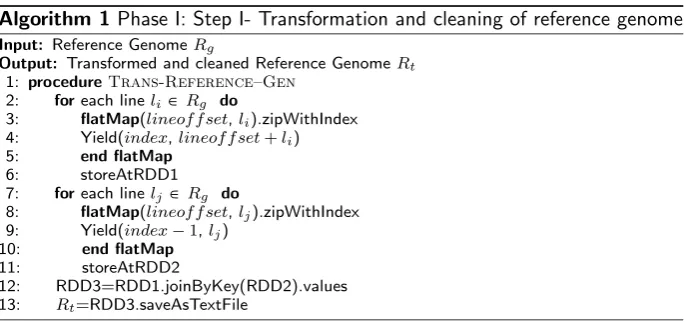
Initially, the reference genome which is stored on HDFS1 [19], is given as input to the
mappers. The reference genome file is chunked and distributed across the mappers, where each mapper receives a set of lines. The detailed process of generating a suffix-array for the reference genome is outlined in Algorithm 1.
We use the Hadoop configuration function so that every line in the file has an index associated with it, where this index represents the location of the first character of the line in the reference genome (lines 2). Subsequently, a sortByKey function on refer-ence genome JavaRDD generates key,value pairs where value denotes concatenation
string of location of first character of line and line itself and key is the number for line in reference genome starting from 1 for first line (lines 3–5). Output key,value
pairs stored at JavaRDD1 (line 6). Parallely, a sortByKey function on reference genome
JavaRDD generates key,value pairs where value denotes the line and key is the
num-ber for line in reference genome starting from 0 for first line (lines 8–11). Output
key,value pairs stored at JavaRDD2 (line 12). At last, a joinByKey function joins
JavaRDD1 and JavaRDD2 to produce key,value pairs where key denotes line number
and value is the concatenation string of values from JavaRDD1 and JavaRDD2 (line
14). All the values from key,value pairs will be stored on HDFS as a text file (line 15).
The lineage graph in Fig. 1 shows the functional flow of Algorithm 1.
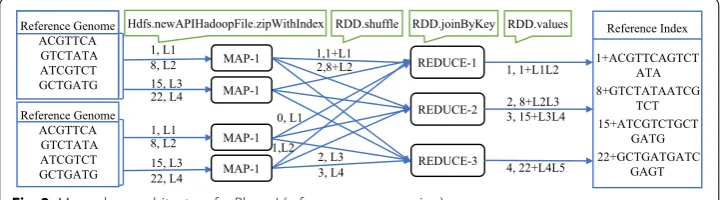
Figure 2 shows an example of the reference preprocessing step. A reference genome stored on HDFS is treated as the input. The mappers in the first round receive a set of lines (e.g. mapper MAP-1 receives lines L1–L3) and apply zipWithIndex function on each line and generate corresponding key,value pairs. For example, Line L1 (ACG TTC A) is mapped to �1, 1+ACGTTCA� . Output key,value pairs stored at JavaRDD1 . The mappers in the second round receive a set of lines (e.g. mapper MAP-1 receives lines L1–L3) and apply zipWithIndex function on each line and generate correspond-ing key,value pairs. For example, Line L1 (ACG TTC A) is mapped to 0,ACGTTCA .
Output key,value pairs stored at JavaRDD2 . Subsequently, a joinByKey
func-tion joins JavaRDD1 and JavaRDD2 to produce corresponding key,value pairs. For
Reference Genome Index, offset+line
flatMap(_.split(“\n”))
Index, offset+line
Index, offset+line flatMap(_.zipWithindex)
Offset, lines Index, offset, line
Reference Genome Offset, lines Index, offset, line
map()
flatMap(_.split(“\n”)) flatMap(_.zipWithindex) map()
join().values
example, tuple �1, 1+ACGTTCA� from JavaRDD1 will join with tuple 1,GTCTATA in JavaRDD2. Output will be stored on HDFS as text file.
Now, to estimate the time complexity, let us take, n as the total number of base pairs in reference genome and p as the number of base pairs in every line of reference genome. Then algorithm takes total n/p cycles to generate RDD1. For a cluster with m number of mappers (cores), mapper1 will take n/mp cycles. The time complexity for mapper2
will also be same as mapper1 . For a cluster with r number of reducers, join func-tion will take n / rp cycles. Hence, total complexity for reference preprocessing will be
(2nr+mn)/(mrp).
Phase II‑Index generation
Preprocessed reference genome will be chunked and distributed across mappers, where each mapper receives a set of lines. The detailed process of generating a suffix-array for the reference genome is outlined in Algorithm 2.
We use simple readTextFile for loading preprocessed reference genome on JavaRDD
of Spark. A flatMap task on this JavaRDD will yield keyn,valuen pairs where keyn is a
string of characters of length k starting from the position in the reference genome given by the valuen field (lines 2–9). Now, these keys are sorted in the shuffle task (sortByKey) and reducers combine all the outputs of the shuffle task and partition the final sorted results according to the prefix of the suffixes (lines 12–15). The lineage graph in Fig. 3
shows the functional flow of Algorithm 2.
Reference Genome ACGTTCA GTCTATA ATCGTCT GCTGATG Reference Index 1+ACGTTCAGTCT ATA 8+GTCTATAATCG TCT 15+ATCGTCTGCT GATG 22+GCTGATGATC GAGT MAP-1 REDUCE-1 REDUCE-2 REDUCE-3 Hdfs.newAPIHadoopFile.zipWithIndex RDD.shuffle RDD.joinByKey
1, L1 15, L3 22, L4 1, L1 15, L3 22, L4 2,8+L2 1,1+L1 2, L3 3, L4 Reference Genome ACGTTCA GTCTATA ATCGTCT GCTGATG Reference Genome ACGTTCA GTCTATA ATCGTCT GCTGATG MAP-1 MAP-1 MAP-1 8, L2 8, L2 1, 1+L1L2
0, L1 3, 15+L3L42, 8+L2L3
4, 22+L4L5 RDD.values
1,L2
Figure 4 shows an example of the index generation step. A preprocessed reference genome stored on HDFS is treated as the input. The mappers in the first round receive a set of lines (e.g. mapper MAP-2 receives lines L2–L3) and apply flatMap task on each line and generate corresponding key,value pairs like ACG, 1 for every line where ACG denotes a
suffix of fixed size and 1 is the starting location of that suffix in the reference genome. Thus, for line L1 (ACG TTC A), the mapper produces ACG, 1 , CGT, 2 , GTT, 3 , TTC, 4 , TCA, 5 , CAG, 6 , and AGT, 7 . These keys are then sorted in the shuffle task (sortByKey)
and the reducers combine all the outputs of the shuffle task and partition the final sorted results according to the prefix (a, c, g, n, t) of the suffixes. For line L1, the reducer outputs
ACG, 1 , AGT, 7.
In this phase, mappers will take preprocessed reference having n/p lines as input. For every line of preprocessed reference genome, map task will take 3p cycles to generate suf-fixes. With a cluster of m mappers, it will take 3n/m ( 3p∗(n/p)∗(1/m) ) cycles to generate
all suffixes. Now, a filter and sortByKey function will add (n+np)/m cycles to make total time complexity to be (4n+np)/m.
Phase III‑Read mapping
The second iteration of AVLR-Mapper finds the location of reads in the reference genome by using the suffix array index of that reference genome. Algorithm 3 describes the pro-cess of mapping stream of reads on the reference genome. Initially, a stream of reads from sources like Kafka, HDFS or flume are distributed across mappers and each read is parti-tioned into seeds (Algorithm 3, lines 2–6). Let r and s denote a read and a seed, respectively. Additionally, let L:Z→Z represent a length function. Then, L(s)=L(r)/(e+1) , where e is the number of allowed errors.
Offset + Line*Next-Line
flatMap(_.sortByKey.value) flatMap(_.split(“+”))
Offset , Line*Next-Line Suffix, Offset Offset
flatMap(_.generateSuffix())
Fig. 3 Lineage graph for Phase II (suffix index generation)
Reference Index 40 41 58 68 51 14 42 46 1 MAP-1 MAP-2 MAP-3 REDUCE-1 REDUCE-2 REDUCE-3 RDD.filter(A).sortByKey RDD.values CGT,2 ACG,1 CAA,43 AAT,44 Reference Index 1+ACGTTCAGTCT ATA 8+GTCTATAATCG TCT 15+ATCGTCTGCT GATG 22+GCTGATGATC GAGT 1+L1L2 8+L2L3 15+L3L4 22+L4L5 RDD.flatMap(_.split) GTC,8 ATC,15 AAA,40 AAC,1 AAG,58 AAT,68 AAT,51 AAT,14 Hdfs.readTextFile
For every seed s, the mapper finds its corresponding match in the reference genome by using the suffix array index (Algorithm 4) and generates a key,value pair, where key is
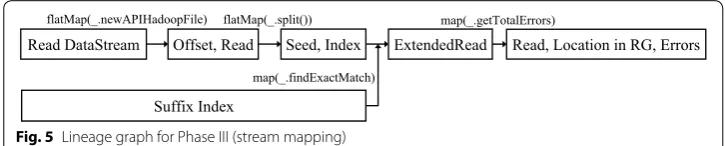
the seed s and value is the location of the seed s in the reference genome (Algorithm 3, lines 7–8). If an exact match of a seed s exists, then we extend it to the whole read and find mismatches for the whole read (Algorithm 3, lines 9–11). If mismatches are less than e then a read with its location in the reference genome is yielded (Algorithm 3, lines 12–13). If the mismatches are more than e then the edit distance for the whole read is calculated and if this computed edit distance is less than e, then a read with its loca-tion in the reference genome is outputted (Algorithm 3, lines 14–17). Finally, reducers combine all intermediate results and output every read with its location in the reference genome. Lineage graph (Fig. 5) for phase III shows the flow of reads during Phase III.
Read DataStream Offset, Read Seed, Index flatMap(_.newAPIHadoopFile) flatMap(_.split())
ExtendedRead
map(_.findExactMatch) Suffix Index
Read, Location in RG, Errors map(_.getTotalErrors)
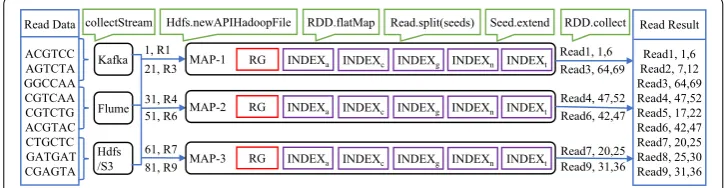
Figure 6 shows a MapReduce architecture for an exemplary read data alignment on the reference genome using a partitioned suffix-array index. Initially, a stream of reads from data sources like Kafka, HDFS or flume are taken as input and stored as JavaRDD
A flatMap function on this JavaRDD distributes reads to different mappers. For example, mapper MAP-1 takes as input reads R1–R3. Reads are split into many seeds depending on the number of errors allowed. For example, read R1 (ACG TCC ) is split into two seeds (ACG and TCC ), if the number of permitted errors is 1. Exact matches for each seed is then sought in a suffix array partition depending on the start character of the seed. For example, if a seed begins with token t, then the exact match for this seed is searched only in Indext . The search for exact matches for Seed1 (ACG ) and Seed2
(TCC ) is now restricted to only indices indexa and indext , respectively. If an exact match
exists for the seed, then the seed is extended to the entire read. Continuing with our example, seed1 (ACG ) has an exact match at location 1–3 in the reference genome and hence it gets extended to the entire read, i.e., ACG TCC . Now, the edit distance between the extended read and reference location 1–6 is computed. A match is successful and is emitted when it is less than our allowed error threshold. For example, read1 yields read1, 1, 7 . Results for all reads are collected and stored in a text file on HDFS.
Finding the exact location of a seed in a reference genome is the most time-consuming task. But due to the indexed genome (suffix array), a maximum of 32 searches ( log2(3×10⁹) ) are required to search a seed in a reference genome, like a human
genome, that contains 3 billion characters. We further reduce the cost of finding exact matches for seeds by partitioning our index. Our partitioning scheme requires that
Read Data
ACGTCC AGTCTA GGCCAA CGTCAA CGTCTG ACGTAC CTGCTC GATGAT CGAGTA
Read Result
Read1, 1,6 Read2, 7,12 Read3, 64,69 Read4, 47,52 Read5, 17,22 Read6, 42,47 Read7, 20,25 Raed8, 25,30 Read9, 31,36 MAP-1
MAP-2
MAP-3
Hdfs.newAPIHadoopFile RDD.flatMap Read.split(seeds) Seed.extend RDD.collect
1, R1 21, R3
31, R4 51, R6
61, R7 81, R9
RG INDEXa INDEXc INDEXg INDEXn INDEXt
RG INDEXa INDEXc INDEXg INDEXn INDEXt
RG INDEXa INDEXc INDEXg INDEXn INDEXt
Read1, 1,6 Read3, 64,69
Read4, 47,52 Read6, 42,47
Read7, 20,25 Read9, 31,36 Kafka
Flume
Hdfs /S3 collectStream
suffixes starting with similar characters are placed in the same sorted partition. For example, if we have 5 partitions, then every read will be searched in nearly 1 / 5-th of the index, which reduces the number of searches for every read from 32 to nearly 30 or fewer. If the length of a read is 1000 bp then partitioning the suffix array saves nearly 2000 computations for every read. As the volume of reads is also massive (i.e., billions of reads), the time savings in computation are also quite significant. Let us assume that R is the size of a reference genome, q is the number of reads in a query sequence, n is length of a read, and the number of partitions p of our index is set to 5 (with prefix a, c, g, t, n). Then, the number of searches required to find a read in the whole genome is log2R .
Therefore, the number of searches required to find a read in a single partition is log2Rp
and the number of searches reduced in a single partition is log2p . As the total number of comparisons to search a read is n, the reduction in a total number of computations amounts to nqlog2p.
StreamAligner Api
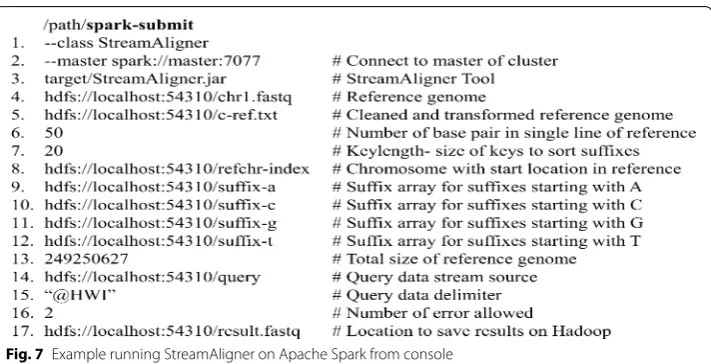
One of the main targets of StreamAligner is to provide bioinformaticians an easy, simple and powerful way to perform sequence alignments using distributed computing based big data technology like Apache Spark. To achieve this goal, a basic API for StreamA-ligner is provided. StreamAStreamA-ligner can be started from Spark console. In Spark console, a Spark-submit command with necessary arguments is used to run StreamAligner. An example of a Spark-submit command with necessary arguments is shown in Fig. 7. All required commands to use StreamAligner are available in commands.txt file on GitHub directory. StreamAligner takes input as a stream of reads. These streams of reads can come from many sources like Kafka, HDFS/S3, and kinesis. The current version of Strea-mAligner is taking input from HDFS and storing results back to HDFS after processing. In the example given in readme.txt file on GitHub directory for StreamAligner, a sample query genome dataset is taken from HDFS as input. Results after processing are stored in a particular HDFS directory. Source code for StreamAligner is publicly available for users on GitHub directory so that users can edit the code to take streams from different sources according to their needs. We are flexible to get a request from users to add sup-port from other stream sources in future.
Results and discussion
We evaluated performance of StreamAligner for index generation and read mapping with different number of computing nodes and using several datasets of different sizes.
Cluster and dataset
We evaluated performance of StreamAligner on a cluster having five nodes where each node have 32 cores and 64 GB RAM. All computing nodes are running on Ubuntu 16.04.3 LTS operating system. Oracle Java 8 is used to build project. Spark 2.2.0 and
Hadoop 2.7 are used to run StreamAligner.
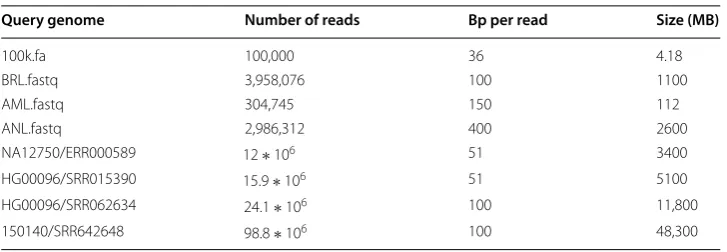
Mainly two types of datasets are required in sequence alignment applications. First one is reference genome and other one is query genome. Reference genome is a continuous string of millions of characters. Query genome contains reads of various length. We have used human chromosome 1, chromosome 2, chromosome 3, chromosome 5, chromosome 21, a full human genome (hg19), elephant genome (loxAfr3), rabbit genome (oryKun2) and cat genome (felCat8) as reference genomes for our experiments. All these refer-ence genomes are sourced from the NCBI project [41]. Different subsets of AML.fastq, BRL.fastq, GCAT, ERR000589, SRR015390, SRR062634, SRR642648 and 100k.fa have been used as a query sequence. 100k.fa was downloaded from the Cloudburst website, while AML.fastq, ANL.fastq and BRL.fastq are real-world datasets from Agilent Tech-nologies [42]. The ERR000589, SRR062634 and SRR642648 dataset is from 1000genomes project website [43]. Detailed description of various datasets is given in Table 1.
Index generation
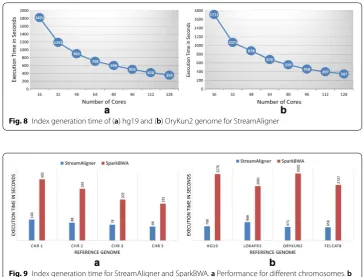
We evaluated StreamAligner’s index generation tool in terms of scalability and efficiency. The scalability of the index generation phase is evaluated by increasing the number of compute cores for Spark. Fig. 8 clearly shows that the index generation time decreases linearly with increasing compute cores.
Currently, BWA is one of the best index generation tools. Most of the recent sequence aligners like BigBWA, SparkBWA, and Halvade use BWA for index generation. We also compared the index generation times for StreamAligner and BWA for a fixed number of compute cores (64 cores) and different datasets. Figures 9 clearly shows that the index generation time of StreamAligner is nearly three times less than BWA.
Table 1 Query datasets description
Query genome Number of reads Bp per read Size (MB)
100k.fa 100,000 36 4.18
BRL.fastq 3,958,076 100 1100
AML.fastq 304,745 150 112
ANL.fastq 2,986,312 400 2600
NA12750/ERR000589 12∗106 51 3400
HG00096/SRR015390 15.9∗106 51 5100
HG00096/SRR062634 24.1∗106 100 11,800
Read mapping
StreamAligner is the only sequence aligner which can align stream of reads. Therefore, we can not show any comparative results for StreamAligner with any other sequence aligner for data streams. Still, we evaluated StreamAligner performance for static data (by feeding static read data as stream) and compared it with state-of-the-art sequence aligners. We evaluated StreamAligner in terms of performance, scalability and accuracy.
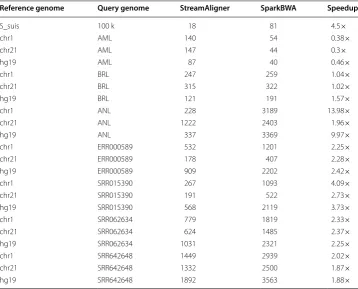
Execution time for mapping different read datasets on different reference genome is shown in Table 2. StreamAligner is capable to map millions of reads on large reference genome like human genome in few minutes. StreamAligner will perform better than SparkBWA when read length is high as we can see that speedup is high for ANL data-set. Results also show that performance of StreamAligner gets better in comparison to SparkBWA as the size of query dataset increases.
We evaluated scalability of read mapping phase by increasing number of comput-ing nodes for Spark from 1 to 5. Figure 10 clearly shows that mapping time decreases as number of computing nodes increases. Therefore, we can say that StreamAligner is highly scalable and can align reads more efficiently as cluster size increases.
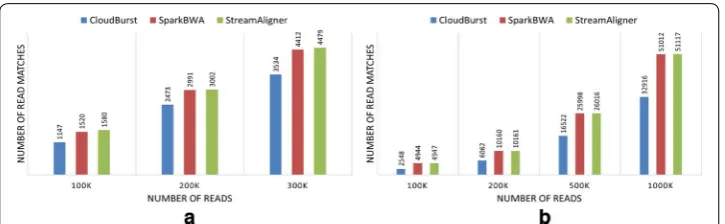
StreamAligner finds exact matches for non-overlapping seeds using binary search on sorted suffix array index. Therefore, it provides 100% accuracy for mapping reads with fixed number of allowed errors. Figures 11 and 12 show number of read matches found by StreamAligner, CloudBurst and SparkBWA for different datasets. We find all read mathces for different datasets with a fixed number of allowed errors. All query datasets of length below 100 bp are allowed to have one error (mismatch or indel) while others are allowed to have two errors. Read matches shown for CloudBurst are both forward
Fig. 8 Index generation time of (a) hg19 and (b) OryKun2 genome for StreamAligner
Fig. 9 Index generation time for StreamAligner and SparkBWA. a Performance for different chromosomes. b
Table 2 StreamAligner performance (times reported in seconds)
Reference genome Query genome StreamAligner SparkBWA Speedup
S_suis 100 k 18 81 4.5×
chr1 AML 140 54 0.38×
chr21 AML 147 44 0.3×
hg19 AML 87 40 0.46×
chr1 BRL 247 259 1.04×
chr21 BRL 315 322 1.02×
hg19 BRL 121 191 1.57×
chr1 ANL 228 3189 13.98×
chr21 ANL 1222 2403 1.96×
hg19 ANL 337 3369 9.97×
chr1 ERR000589 532 1201 2.25×
chr21 ERR000589 178 407 2.28×
hg19 ERR000589 909 2202 2.42×
chr1 SRR015390 267 1093 4.09×
chr21 SRR015390 191 522 2.73×
hg19 SRR015390 568 2119 3.73×
chr1 SRR062634 779 1819 2.33×
chr21 SRR062634 624 1485 2.37×
hg19 SRR062634 1031 2321 2.25×
chr1 SRR642648 1449 2939 2.02×
chr21 SRR642648 1332 2500 1.87×
hg19 SRR642648 1892 3563 1.88×
Fig. 10 Execution time for StreamAligner to map (a) ANL and (b) ERR000589 datasets on Chr1
and backward search matches. SparkBWA is using BWA-SW to find matches with given number of allowed errors.
Figure 11 shows number of read matches found by CloudBurst, SparkBWA and Strea-mAligner during mapping of different datasets (taken from 1000 genome project) on Chr1 and Chr21 genome respectively.
Figure 12 shows number of read matches found by CloudBurst, SparkBWA and Strea-mAligner during mapping of AML and BRL datasets on Chr1.
Conclusions and future work
We have presented a MapReduce based sequence alignment tool called StreamAligner. It has three main features which makes it attractive in comparison to all existing state-of-the-art sequence aligners. Firstly, it aligns stream of reads on reference genome in real-time, hence can be used to automate sequencing and alignment process. The output of sequencing (reads) is given as input to StreamAligner as a stream of reads. StreamA-ligner aligned stream of reads on reference genome in real-time and store results, there-fore avoiding the need to store huge sequencing data. Secondly, it uses suffix array index for read alignment which is generated using distributed index generation algorithm. Due to distributed index generation algorithm, index generation time is very less. Results show that index generation algorithm is highly scalable. Hence, it will generate index in few seconds on large clusters. Third, it needs to upload index only once when StreamA-ligner is launched. After that index stays in Spark memory and can be used for an infi-nite time without reloading. Whereas, current state-of-the-art sequence aligner either generate (hash index based) or load (sorted index based) index for every task. Hence, StreamAligner reduces time to generate or load index for every task. A tested version of StreamAligner is available on GitHub with streaming support. StreamAligner is com-pared to best existing sequence aligners in terms of speed and accuracy and it outper-forms all existing sequence aligners. StreamAligner is publicly available to use at GitHub repository: (https://github.com/sanjaysinghrathi/StreamAligner).
In future, the API can be extended to add support for input from different sources like Flume and S3. Further, implementation of StreamAligner on Apache Flink [44], another big data platform will be useful to test the performance comparison.
Authors’ contributions
SR performed the literature review, implemented the proposed algorithm and conducted the experiments. AK advised SR all aspects of the paper development. Both authors read and approved the final manuscript.
Authors’ information
Sanjay Rathee received the B.Tech degree in computer engineering from Maharshi Dayanand University, Rohtak,Harayana, India, in 2011, and the M.Tech degree in computer engineering from Kurukshetra University, Haryana,India, in 2013. He is currently working toward the Ph.D. degree in computer engineering from Indian Institute ofTechnology, Mandi, India. He has developed several distributed algorithms related to business strategies andbioin-formatics sector. His research interests include distributed computing algorithms and platforms, association rulemining and sequence alignment. Arti Kashyap received the B.Sc degree from Himachal Pradesh University, Shimla,H.P., India, in 1989, the M.Sc and Ph.D. degree from Indian Institute of Technology, Roorkee, India, in 1991 and1996 respectively. She is currently working as associate professor at Indian Institute of Technology Mandi, India. Herresearch interests include distributed algorithms, big data analytics, sequence alignment and magnetic materials.
Author details
1 School of Computing and Electrical Engineering, IIT Mandi, Kamand Campus, Mandi, India. 2 School of Basic Sciences, IIT Mandi, Kamand Campus, Mandi 175005, India.
Acknowledgements
Not applicable.
Competing interests
The authors declare that they have no competing interests.
Availability of data and materials
Not applicable.
Consent for publication
I allow journal to publish it.
Ethics approval and consent to participate
Not applicable.
Funding
Not applicable.
Publisher’s Note
Springer Nature remains neutral with regard to jurisdictional claims in published maps and institutional affiliations.
Received: 15 November 2017 Accepted: 16 January 2018
References
1. Sabatini R. Ted Talk. (2017). https://www.ted.com/talks/
riccardo_sabatini_how_to_read_the_genome_and_build_a_human_being
2. Li H, Ruan J, Durbin R. Mapping short dna sequencing reads and calling variants using mapping quality scores. Genome Res. 2008;18(11):1851–8. https ://doi.org/10.1101/gr.07821 2.108.
3. Cox A. ELAND: Efficient local slignment of nucleotide data (unpublished).
4. Jiang H, Wong WH. Seqmap: mapping massive amount of oligonucleotides to the genome. Bioinformatics. 2008;24(20):2395. https ://doi.org/10.1093/bioin forma tics/btn42 9.
5. Lin H, Zhang Z, Zhang MQ, Ma B, Li M. ZOOM! Zillions of oligos mapped. Bioinformatics. 2008;24(21):2431–7. https :// doi.org/10.1093/bioin forma tics/btn41 6.
6. Smith AD, Chung WY, Hodges E, Kendall J, Hannon G, Hicks J, Xuan Z, Zhang MQ. Updates to the rmap short-read mapping software. Bioinformatics. 2009;25(21):2841. https ://doi.org/10.1093/bioin forma tics/btp53 3.
7. Novocraft Technologies Sdn Bhd: NovoAlign. Novocraft Technologies Sdn Bhd. 2008. http://www.novocraft.com. 8. Li R, Li Y, Kristiansen K, Wang J. Soap: short oligonucleotide alignment program. Bioinformatics. 2008;24(5):713–4.
https ://doi.org/10.1093/bioin forma tics/btn02 5.
9. Campagna D, Albiero A, Bilardi A, Caniato E, Forcato C, Manavski S, Vitulo N, Valle G. PASS: a program to align short sequences. Bioinformatics. 2009;25(7):967–8. https ://doi.org/10.1093/bioin forma tics/btp08 7.
10. Eaves HL, Gao Y. Mom: maximum oligonucleotide mapping. Bioinformatics. 2009;25(7):969–70. https ://doi. org/10.1093/bioin forma tics/btp09 2.
11. Homer N, Merriman B, Nelson SF. Bfast: an alignment tool for large scale genome resequencing. PLoS ONE. 2009;4(11):1–12. https ://doi.org/10.1371/journ al.pone.00077 67.
12. Kim YJ, Teletia N, Ruotti V, Maher CA, Chinnaiyan AM, Stewart R, Thomson JA, Patel JM. Probematch: rapid alignment of oligonucleotides to genome allowing both gaps and mismatches. Bioinformatics. 2009;25(11):1424–5. https :// doi.org/10.1093/bioin forma tics/btp17 8.
13. Malhis N, Butterfield YSN, Ester M, Jones SJM. Slider—maximum use of probability information for alignment of short sequence reads and snp detection. Bioinformatics. 2009;25(1):6–13. https ://doi.org/10.1093/bioin forma tics/ btn56 5.
14. Burrows M, Wheeler DJ. A block-sorting lossless data compression algorithm. 1994. http://cites eerx.ist.psu.edu/ viewd oc/summa ry?doi=10.1.1.121.6177. Accessed 15 Mar 2016.
16. Li H, Durbin R. Fast and accurate short read alignment with Burrows–Wheeler transform. Bioinformatics. 2009;25(14):1754–60. https ://doi.org/10.1093/bioin forma tics/btp32 4.
17. Li H, Durbiin R. Fast and accurate long-read alignment with Burrows–Wheeler transform. Bioinformatics. 2010;26(5):589. https ://doi.org/10.1093/bioin forma tics/btp69 8.
18. Ferragina P, Manzini G. Opportunistic data structures with applications. In: Proceedings of the 41st annual sympo-sium on foundations of computer science. FOCS ’00, IEEE computer society, Washington, DC; 2000. p. 390. http:// dl.acm.org/citat ion.cfm?id=79566 6.79654 3
19. Apache Hadoop. http://hadoo p.apach e.org/.
20. Zaharia M, Chowdhury M, Franklin MJ, Shenker S, Stoica I. Spark: cluster computing with working sets. In: Proceed-ings of the 2nd USENIX conference on hot topics in cloud computing. HotCloud’10. USENIX Association, Berkeley; 2010. p. 10–10. http://dl.acm.org/citat ion.cfm?id=18631 03.18631 13.
21. Dean J, Ghemawat S. Mapreduce: simplified data processing on large clusters. In: Proceedings of the 6th conference on symposium on operating systems design & implementation, Vol 6. OSDI’04. USENIX Association, Berkeley, CA, USA; 2004. p. 10–10. http://dl.acm.org/citat ion.cfm?id=12512 54.12512 64.
22. Schatz MC. Cloudburst: highly sensitive read mapping with mapreduce. Bioinformatics. 2009;25(11):1363–9. https :// doi.org/10.1093/bioin forma tics/btp23 6.
23. Nguyen T, Shi W, Ruden D. Cloudaligner: a fast and full-featured mapreduce based tool for sequence mapping. BMC Res Notes. 2011;4:171. https ://doi.org/10.1186/1756-0500-4-171.
24. Schatz MC. BlastReduce: high performance short read mapping with MapReduce.
25. Abuin JM, Pichel JC, Pena TF, Amigo J. BigBWA: approaching the Burrows-Wheeler aligner to Big Data technologies. Bioinformatics. 2015;31(24):4003–5. https ://doi.org/10.1093/bioin forma tics/btv50 6.
26. Abuin JM, Pichel JC, Pena T, Amigo J. Sparkbwa: speeding up the alignment of high-throughput dna sequencing data. PLoS ONE. 2016;11(5):1–21. https ://doi.org/10.1371/journ al.pone.01554 61.
27. Decap D, Reumers J, Herzeel C, Costanza P, Fostier J. Halvade: scalable sequence analysis with mapreduce. Bioinfor-matics. 2015;31(15):2482–8. https ://doi.org/10.1093/bioin forma tics/btv17 9.
28. Congosto M, Basanta-Val P, Fernández LS. T-hoarder: a framework to process twitter data streams. J Netw Comput Appl. 2017;83:28–39.
29. Lv Z, Song H, Basanta-Val P, Steed A, Jo M. Next-generation big data analytics: state of the art, challenges, and future research topics. IEEE Trans Ind Inf. 2017;13(4):1891–9. https ://doi.org/10.1109/TII.2017.26502 04.
30. Rathee S, Kaul M, Kashyap A. R-apriori: an efficient apriori based algorithm on spark. In: Proceedings of the 8th work-shop on Ph.D. workwork-shop in information and knowledge management. PIKM. ACM, Melbourne, Australia. 2015;15: 27–34. https ://doi.org/10.1145/28098 90.28098 93
31. Basanta-Val P, Fernández-García N, Basanta-Val P, Fernández-García N, Sánchez-Ferná ndez L, Arias-Fisteus J. Pat-terns for distributed real-time stream processing. IEEE Trans Parallel Distrib Syst. 2017;28(11):3243–57. https ://doi. org/10.1109/TPDS.2017.27169 29.
32. Basanta-Val P, Fernández-García N, Wellings AJ, Audsley NC. Improving the predictability of distributed stream processors. Future Gener Comput Syst. 2015;52(C):22–36. https ://doi.org/10.1016/j.futur e.2015.03.023. 33. Pireddu L, Leo S, Zanetti G. Seal: a distributed short read mapping and duplicate removal tool. Bioinformatics.
2011;27(15):2159–60. https ://doi.org/10.1093/bioin forma tics/btr32 5.
34. Li Y, Zhong S. Seqmapreduce: software and web service for accelerating sequence mapping. Critical assessment of massive data analysis (CAMDA). 2009.
35. Langmead B, Schatz MC, Lin J, Pop M, Salzberg SL. Searching for snps with cloud computing. Genome Biol. 2009;10(11):134. https ://doi.org/10.1186/gb-2009-10-11-r134.
36. Amazon EC2 Cloud: Amazon Web Services Genomics. Amazon EC2 Cloud. 2017. https ://aws.amazo n.com/healt h/ genom ics/.
37. Versaci F, Pireddu L, Zanetti G. Scalable genomics: from raw data to aligned reads on apache yarn. EEE Int Conf Big Data. 2016;12:1232–41. https ://doi.org/10.1109/BigDa ta.2016.78407 27.
38. Peters D, Qiu K, Liang P. Faster short dna sequence alignment with parallel bwa. AIP Conf Proc. 2011;1368(1):131–4. https ://doi.org/10.1063/1.36634 77.
39. Klus P, Lam S, Lyberg D, Cheung MS, Pullan G, McFarlane I, Yeo GS, Lam BY. Barracuda—a fast short read sequence aligner using graphics processing units. BMC Res Notes. 2012;5(1):27. https ://doi.org/10.1186/1756-0500-5-27. 40. Zhou W, Li R, Yuan S, Liu C, Yao S, Luo J, Niu B. Metaspark: a spark-based distributed processing tool to recruit
metagenomic reads to reference genomes. Bioinformatics. 2017;33(7):1090. https ://doi.org/10.1093/bioin forma tics/ btw75 0.
41. National Center for Biotechnology Information. Reference Genomes. National Center for Biotechnology Information. 2017. http://www.ncbi.nlm.nih.gov.
42. Agilent Inc. USA. Query Datasets. Agilent Inc. USA. 2017. https ://cloud .iitma ndi.ac.in/d/2ba90 9564a /. 43. 1000genomes Project: Genome Dataset Project. 1000genomes Project. 2017. ftp://ftp-trace .ncbi.nih.gov/1000g
enome s/ftp/.