R E V I E W
Open Access
A systematic review and meta-analysis of
Harmonic Focus in thyroidectomy
compared to conventional techniques
Hang Cheng
1, Ireena Soleas
2, Nicole C. Ferko
2, Jeffrey W. Clymer
1*and Joseph F. Amaral
1Abstract
Introduction:Several meta-analyses have been performed comparing the use of a variety of ultrasonic devices in thyroidectomy to conventional procedures. These studies have shown the superiority of ultrasonic devices for most outcomes studied including faster operative time and less blood loss, and equivalent or better safety for recurrent laryngeal nerve paresis and hypocalcemia. The current work is the first to examine a single ultrasonic device specifically designed for thyroid surgery, the Harmonic Focus, in order to confirm its efficacy and safety in thyroidectomy.
Methods:A comprehensive literature search without language restrictions was performed for randomized clinical trials comparing Harmonic Focus and conventional clamp, cut and tie in thyroidectomy. Outcome measures included operating time, blood loss, post-operative pain, length of hospital stay, hypocalcemia and recurrent laryngeal nerve paresis. Risk of bias was analyzed for all studies. Meta-analysis was performed using random effects models with the inverse-variance method for mean differences of continuous variables and the Mantel-Haenszel method for risk ratios of dichotomous variables.
Results:A total of 14 studies met the inclusion criteria. Harmonic Focus reduced operative time by 29 min, a 31 % decrease (p< 0.001), intra-operative blood loss by 45 ml (p< 0.001), post-operative pain (p< 0.001), length of hospital stay by 0.68 days (p= 0.005), drainage volume by 29 ml (p= 0.01), and occurrence of transient
hypocalcemia by 40 % (p= 0.001). There were no significant differences between Harmonic Focus and conventional procedures in rate of persistent hypocalcemia, or rates of transient and persistent recurrent laryngeal nerve paresis. Conclusion:This is the first meta-analysis of Harmonic Focus in thyroid surgery. In agreement with meta-analyses previously performed on ultrasonic devices, use of the Harmonic Focus has been shown to be a more effective surgical procedure compared to conventional methods in thyroidectomy. The low occurrence of hypocalcemia and recurrent laryngeal nerve paresis confirms that Harmonic Focus can improve thyroidectomy efficiency without increasing the risk of complications.
Keywords:Harmonic Focus, Ultrasonic, Meta-analysis, Thyroidectomy
* Correspondence:[email protected]
1Ethicon Inc, 4545 Creek Rd, Cincinnati, OH 45242, USA Full list of author information is available at the end of the article
© 2015 Cheng et al.Open AccessThis article is distributed under the terms of the Creative Commons Attribution 4.0 International License (http://creativecommons.org/licenses/by/4.0/), which permits unrestricted use, distribution, and reproduction in any medium, provided you give appropriate credit to the original author(s) and the source, provide a link to the Creative Commons license, and indicate if changes were made. The Creative Commons Public Domain Dedication waiver (http://creativecommons.org/publicdomain/zero/1.0/) applies to the data made available in this article, unless otherwise stated. Chenget al. Thyroid Research (2015) 8:15
Introduction
Ultrasonic cutting and coagulation of soft tissues was intro-duced in 1991 with a primary focus on laparoscopic surgery in general and cholecystectomy in particular [1, 2]. There then followed a rapid evolution and adoption of the tech-nology for vessel sealing that resulted in widespread use in a variety of intra-abdominal procedures including colec-tomy [3], fundoplication [4], and hystereccolec-tomy [5]. By the late 1990s and early 2000’s, endocrine and head and neck surgeons had adopted such devices for thyroid surgery not-ing decreased operatnot-ing times [6]. Since then numerous randomized control trials (RCTs), large case series and nu-merous meta-analyses have been published confirming the reduction in operating time [7]. Furthermore, they have shown less blood loss (albeit not clinically significant), smaller incisions, less postoperative pain, reduced hospitalization and less drainage. Perhaps most im-portantly, studies that have evaluated the economic impact of using ultrasonic energy have concluded that there is overall cost savings when using such devices [8, 9].
A drawback of these studies is that they have used a variety of ultrasonic devices including Ultracision, Ace and Focus. However, since its introduction in 2007, the only specifically designed and approved device for use in thyroid and head and neck surgery is Harmonic Focus® (Ethicon Inc., Cincinnati OH). No meta-analysis or sys-tematic review has been published to date evaluating specifically the impact of Harmonic Focus on the out-comes of thyroid surgery. Furthermore, some contro-versy exists in the literature concerning the impact of ultrasonic devices in general and Harmonic Focus in particular on parathyroid gland and recurrent laryngeal nerve function when these devices are used.
The purpose of this systematic review and meta-analysis is to answer two questions. First, what is the im-pact of Harmonic Focus on overall thyroid surgery out-comes when compared to the most commonly used clamp, cut and tie method that includes monopolar and or bipolar electrosurgery? Second, what impact does Harmonic Focus have on parathyroid and recurrent la-ryngeal nerve function following thyroid surgery?
Methods
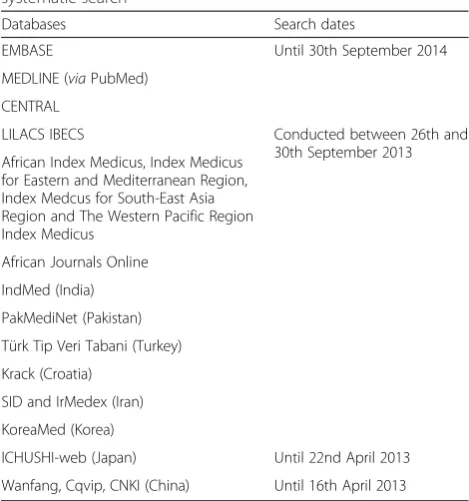
Twenty-one databases were systematically searched, in-cluding MEDLINEviaPubMed, EMBASE, the Cochrane Central Register of Controlled Trials (CENTRAL), and 18 other national databases (Table 1). Reference lists of retrieved articles were reviewed and additional compre-hensive searches were conducted through Google Scholar and Research-Gate. Publications of all languages were considered in the systematic review.
The PICOS categories (i.e., population, intervention, comparator, outcomes, and study design) were used to
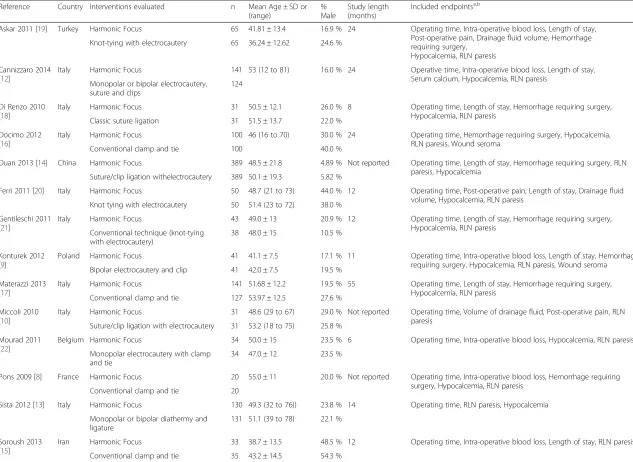
define study inclusion criteria. All published RCTs comparing the use of Harmonic surgical devices to con-ventional methods, such as monopolar or bipolar elec-trosurgery and suture, clips, or knot-tying in human subjects, for all surgery types, were considered for inclu-sion (Table 2). Benign and malignant disease were included if no lymph node dissection was performed. Full-text papers were excluded if, they were not a RCT, the principal surgical procedure was not thyroidectomy, devices other than the Harmonic Focus were used, and if lymphadenectomy, or only partial thyroidectomy, was conducted. The eligibility of each publication was evalu-ated by two independent reviewers (IS, NCF) and a third reviewer (HC) was consulted in the case of disagree-ments regarding study inclusion. When necessary, study authors were contacted for additional methodological details to confirm whether the study was randomized.
Study details (i.e., baseline characteristics and out-comes) of included publications were extracted through a standardized data extraction form. Two reviewers ex-tracted data independently and any inconsistencies were resolved by consensus or by consultation with a third re-viewer. Non-English publications were translated and data extraction was completed. Data extraction by one reviewer was subsequently cross-checked by a second reviewer.
The following clinical outcome measures were included: (1) operating time, (2) intra-operative blood loss, (3) post-operative pain, (4) length of hospitalization, (5) volume of drainage fluid, (6) hemorrhage requiring surgery, (7) Table 1List of databases and search periods included in systematic search
Databases Search dates
EMBASE Until 30th September 2014
MEDLINE (viaPubMed) CENTRAL
LILACS IBECS Conducted between 26th and
30th September 2013 African Index Medicus, Index Medicus
for Eastern and Mediterranean Region, Index Medcus for South-East Asia Region and The Western Pacific Region Index Medicus
African Journals Online IndMed (India) PakMediNet (Pakistan) Türk Tip Veri Tabani (Turkey) Krack (Croatia)
SID and IrMedex (Iran) KoreaMed (Korea)
Table 2Study and baseline characteristics for studies meeting inclusion criteria for open total thyroidectomy Reference Country Interventions evaluated n Mean Age ± SD or
(range)
% Male
Study length (months)
Included endpointsa,b
Askar 2011 [19] Turkey Harmonic Focus 65 41.81 ± 13.4 16.9 % 24 Operating time, Intra-operative blood loss, Length of stay, Post-operative pain, Drainage fluid volume, Hemorrhage requiring surgery,
Hypocalcemia, RLN paresis Knot-tying with electrocautery 65 36.24 ± 12.62 24.6 %
Cannizzaro 2014 [12]
Italy Harmonic Focus 141 53 (12 to 81) 16.0 % 24 Operative time, Intra-operative blood loss, Length of stay, Serum calcium, Hypocalcemia, RLN paresis
Monopolar or bipolar electrocautery, suture and clips
124
Di Renzo 2010 [18]
Italy Harmonic Focus 31 50.5 ± 12.1 26.0 % 8 Operating time, Length of stay, Hemorrhage requiring surgery, Hypocalcemia, RLN paresis
Classic suture ligation 31 51.5 ± 13.7 22.0 %
Docimo 2012 [16]
Italy Harmonic Focus 100 46 (16 to 70) 30.0 % 24 Operating time, Hemorrhage requiring surgery, Hypocalcemia, RLN paresis, Wound seroma
Conventional clamp and tie 100 40.0 %
Duan 2013 [14] China Harmonic Focus 389 48.5 ± 21.8 4.89 % Not reported Operating time, Length of stay, Hemorrhage requiring surgery, RLN paresis, Hypocalcemia
Suture/clip ligation withelectrocautery 389 50.1 ± 19.3 5.82 %
Ferri 2011 [20] Italy Harmonic Focus 50 48.7 (21 to 73) 44.0 % 12 Operating time, Post-operative pain, Length of stay, Drainage fluid volume, Hypocalcemia, RLN paresis
Knot tying with electrocautery 50 51.4 (23 to 72) 38.0 %
Gentileschi 2011 [21]
Italy Harmonic Focus 43 49.0 ± 13 20.9 % 12 Operating time, Length of stay, Hemorrhage requiring surgery, Hypocalcemia, RLN paresis
Conventional technique (knot-tying with electrocautery)
38 48.0 ± 15 10.5 %
Konturek 2012 [9]
Poland Harmonic Focus 41 41.1 ± 7.5 17.1 % 11 Operating time, Intra-operative blood loss, Length of stay, Hemorrhage requiring surgery, Hypocalcemia, RLN paresis, Wound seroma Bipolar electrocautery and clip 41 42.0 ± 7.5 19.5 %
Materazzi 2013 [17]
Italy Harmonic Focus 141 51.68 ± 12.2 19.5 % 55 Operating time, Length of stay, Hemorrhage requiring surgery, Hypocalcemia, RLN paresis
Conventional clamp and tie 127 53.97 ± 12.5 27.6 %
Miccoli 2010 [10]
Italy Harmonic Focus 31 48.6 (29 to 67) 29.0 % Not reported Operating time, Volume of drainage fluid, Post-operative pain, RLN paresis
Suture/clip ligation with electrocautery 31 53.2 (18 to 75) 25.8 %
Mourad 2011 [22]
Belgium Harmonic Focus 34 50.0 ± 15 23.5 % 6 Operating time, Intra-operative blood loss, Hypocalcemia, RLN paresis
Monopolar electrocautery with clamp and tie
34 47.0 ± 12 23.5 %
Pons 2009 [8] France Harmonic Focus 20 55.0 ± 11 20.0 % Not reported Operating time, Intra-operative blood loss, Hemorrhage requiring surgery, Hypocalcemia, RLN paresis
Conventional clamp and tie 20
Sista 2012 [13] Italy Harmonic Focus 130 49.3 (32 to 76)) 23.8 % 14 Operating time, RLN paresis, Hypocalcemia
Monopolar or bipolar diathermy and ligature
131 51.1 (39 to 78) 22.1 %
Soroush 2013 [15]
Iran Harmonic Focus 33 38.7 ± 13.5 48.5 % 12 Operating time, Intra-operative blood loss, Length of stay, RLN paresis
Conventional clamp and tie 35 43.2 ± 14.5 54.3 %
a
Length of stay endpoint refers to length of hospitalization stay
b
Reported endpoints that did not separate total and partial thyroidectomy results were excluded from the analysis
Cheng
et
al.
Thyroid
Research
(2015) 8:15
Page
3
of
hypocalcemia (transient and persistent), (8) recurrent la-ryngeal nerve (RLN) paresis (transient and persistent), and (9) wound seroma. Inclusion criteria for the persistent RLN paresis parameter required at least six months follow-up unless RLN paresis was not reported prior to six months. RLN paresis needed to be determined via laryngoscopy. In studies where results were reported for transient RLN paresis, but not persistent RLN paresis, it was assumed that there were zero cases of the persistent type. The same assumption was applied to the transient and persistent hypocalcemia outcome. Both clinically- and chemically-determined hypocalcemia were included in the hypocalcemia parameter. The standard deviation (SD) variance measure was not reported in one study [10] for operating time. Study authors were not contacted to re-trieve missing data, however, standard methods provided by Cochrane [11] were used to impute the missing vari-ance measure in this study.
The Cochrane Collaboration tool [11] for assessing risk of bias was used to evaluate the quality of the in-cluded studies. Based on seven pre-specified domains (sequence generation, allocation concealment, blinding of participants and personnel, blinding of outcome as-sessment, incomplete outcome data, selective outcome reporting, and other sources of bias), publications were scored as having low, unclear, or high risk of bias. Final quality assessments were based on the combination of these factors and individual study characteristics. Two authors independently assessed the study quality and inconsistencies were resolved through consensus or by discussion with a third author.
Review Manager (Version 5.3, The Nordic Cochrane Centre, The Cochrane Collaboration, Copenhagen, Denmark, 2014) was used to perform the meta-analysis. The inverse-variance method was used to calculate the mean differences (MD) for continuous outcomes (oper-ating time, intra-operative blood loss, post-operative pain, length of hospitalization, volume of drainage fluid). Risk ratios (RR) were calculated for dichotomous outcomes (hemorrhage requiring surgery, wound ser-oma, transient hypocalcemia, persistent hypocalcemia, transient RLN paresis, persistent RLN paresis) using the Mantel-Haenszel method. The meta-analysis used a random effects model and forest plots for all included outcomes were generated using Review Manager. Study heterogeneity was evaluated through the χ2 test andI2 measure.
The Harmonic Focus was compared to conventional methods in the primary analysis. Sensitivity analyses were conducted for the imputation of missing variance mea-sures, where studies requiring imputation were excluded [10]. Further sensitivity analyses were completed for study quality, where studies with unclear or high risk of bias across several measures were excluded [8, 12–15]. Sensi-tivity analyses excluding studies that did not include electrocautery as part of the conventional technique [8, 15–18] were also performed.
Results
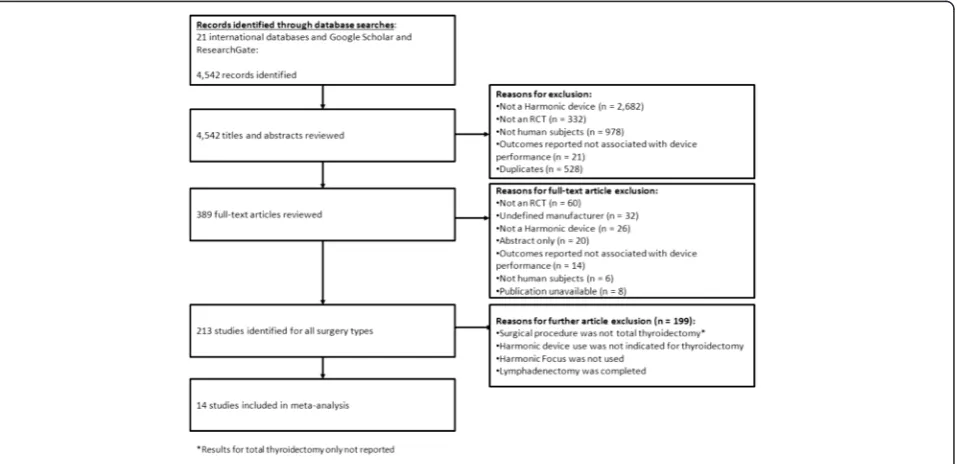
The systematic search resulted in the identification of 4542 total records, of which 4153 were excluded follow-ing title and abstract screenfollow-ing (Fig. 1). Of the 389 full text articles retrieved and reviewed, 375 were further
excluded if studies were non-RCTs, had an undefined manufacturer, did not use Harmonic Focus, the publica-tion was unavailable and had nonhuman subjects, or the surgical procedure was not total thyroidectomy. Overall, 14 studies consisting of 2516 patients in total reporting on Harmonic device (Focus) use in total thyroidectomy were included in the meta-analysis [8–10, 12–22].
Study characteristics are summarized in Table 2. The in-cluded studies ranged in sample size from 40 to 778, and study length spanned from 6 to 55 months. In all studies, the Harmonic Focus surgical device was compared to con-ventional thyroidectomy techniques. In total, four studies [8, 15–17] compared the Focus to conventional clamp and tie; one study [18] compared to classic suture ligation; three studies [19–21] compared to knot tying with elec-trocautery; and six studies [9, 10, 12–14, 22] compared to monopolar or bipolar electrocautery with one or more of sutures, clips, or clamp and tie. Total and partial thyroid-ectomy was performed in one study [13]; however, out-come results for partial thyroidectomy were not included. Of the 14 included studies, the majority were European, with 8 studies from Italy alone. Studies typically reported a wide range of outcomes. All included studies assessed operating time [8–10, 12–22], while intra-operative blood loss was reported in six studies [8, 9, 12, 15, 19, 22]. Three studies assessed post-operative pain based on a visual analogue scale (VAS) [10, 19, 20], nine studies reported the length of hospitalization [9, 12, 14, 15, 17–21] and three studies reported on drainage volume [10, 19, 20]. Overall complication rate was not estimable as the two studies informing the analysis were assumed to have zero complications [9, 13]. Instead, separate out-comes were reported for hemorrhage requiring sur-gery [8, 9, 14, 16–19, 21], transient and persistent hypocalcemia [8, 9, 12–14, 16–22], transient and per-sistent RLN paresis [8–10, 12, 14–22], and wound seroma [9, 16]. Hypocalcemia was chemically-determined in 11 studies [8–10, 12, 14, 16–20, 22] and clinically-determined in two studies [13, 21]. One
study did not specify whether hypocalcemia was chemically- or clinically-determined [15].
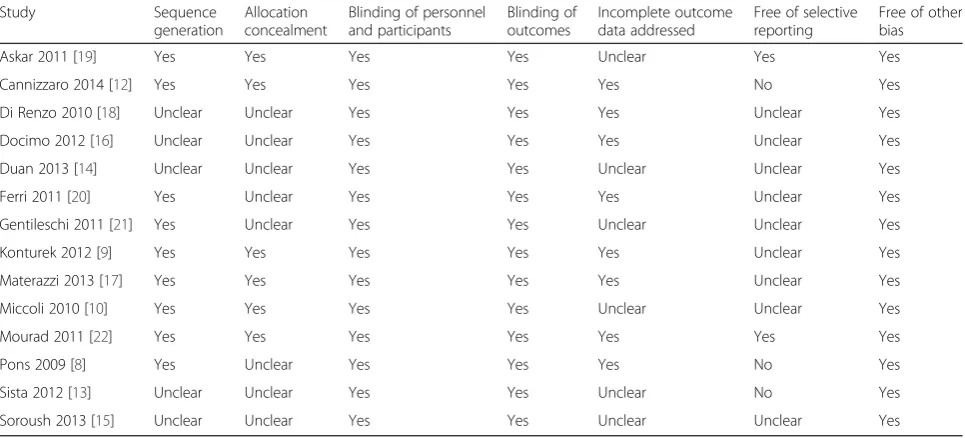
The risk of bias varied across the included studies. The overall results of the risk of bias assessments are reported in Fig. 2 and individual study quality assessments are sum-marized in Table 3. Randomization method was known in nine studies [8–10, 12, 16, 17, 19–22]. Three studies described randomization through the use of enve-lopes [10, 12, 17], two used a random permuted block design [9, 22], and two described the use of a drawing technique [8, 21]. One study used a computer-generated schedule [19] and one described a fixed simple randomization method [20]. Six stud-ies [9, 10, 12, 17, 19, 22] described concealment of the randomization sequence. Blinding of patients to the surgical technique was reported in six studies [8–10, 14, 15, 20], one study [22] reported blinding of the surgeon to the surgical technique, and three studies [9, 10, 19] described blinding of outcome as-sessors. Risk of performance bias was deemed low in non-blinded studies, as outcomes were considered objective and unlikely to be affected by a lack of blinding. There were no patient withdrawals in seven studies [8, 9, 12, 16–18, 20] and one study [22] re-ported exclusions, but was assumed to have no clin-ically relevant impact. Reporting of attritions or exclusions was insufficient in six studies [10, 13–15, 19, 21]. Selective reporting remained unclear in nine studies [9, 10, 14–18, 20, 21], while three studies were deemed to have a high risk of bias as certain out-comes noted in protocol were not included in the re-sults [8, 12, 13].
Operating time
Mean operating time (Harmonic Focus: 66.08 min, con-ventional technique: 95.26 min) was statistically signifi-cantly reduced by 29.13 min (95 % CI:−36.73 to−21.53; P< 0.00001; 14 studies;I2= 96 %), a 30.6 % decrease with
Fig. 2Risk of bias assessment for studies meeting inclusion criteria
the Harmonic Focus compared to conventional methods in total thyroidectomy (Fig. 3).
Intra-operative blood loss
Mean intra-operative blood loss (Harmonic Focus: 29.84 mL, conventional technique: 75.34 mL) was statisti-cally significantly reduced by 45.54 mL (95 % CI:−72.20 to −18.89; P= 0.0008; 6 studies; I2= 98 %), a 60.4 % de-crease with the Harmonic Focus compared to conven-tional methods in total thyroidectomy (Fig. 4).
Post-operative pain
On the basis of three studies comparing the Harmonic Focus to conventional techniques in total thyroidectomy, a statistically significant reduction in mean VAS reported post-operative pain (Harmonic Focus: 2.54, conventional technique: 3.87) by 1.33 points (95 % CI:−1.99 to−0.67;
P< 0.0001; 3 studies; I2= 85 %) was observed with the Harmonic Focus (Fig. 5).
Length of hospital stay
Results demonstrated a statistically significant reduc-tion of 0.68 days in the mean postoperative length of hospitalization (Harmonic Focus: 1.89 days, conven-tional technique: 2.58 days) with the Harmonic Focus (95 % CI:−1.16 to−0.20;P= 0.005; 9 studies;I2= 98 %), a 26.4 % decrease, compared to conventional tech-niques in total thyroidectomy (Fig. 6).
Drainage volume
In contrast to conventional methods in total thyroidectomy, mean drainage volume (Harmonic Focus: 16.25 mL, con-ventional technique: 45.63 mL) was statistically significantly Table 3Qualitative risk of bias assessment summary
Study Sequence
generation
Allocation concealment
Blinding of personnel and participants
Blinding of outcomes
Incomplete outcome data addressed
Free of selective reporting
Free of other bias
Askar 2011 [19] Yes Yes Yes Yes Unclear Yes Yes
Cannizzaro 2014 [12] Yes Yes Yes Yes Yes No Yes
Di Renzo 2010 [18] Unclear Unclear Yes Yes Yes Unclear Yes
Docimo 2012 [16] Unclear Unclear Yes Yes Yes Unclear Yes
Duan 2013 [14] Unclear Unclear Yes Yes Unclear Unclear Yes
Ferri 2011 [20] Yes Unclear Yes Yes Yes Unclear Yes
Gentileschi 2011 [21] Yes Unclear Yes Yes Unclear Unclear Yes
Konturek 2012 [9] Yes Yes Yes Yes Yes Unclear Yes
Materazzi 2013 [17] Yes Yes Yes Yes Yes Unclear Yes
Miccoli 2010 [10] Yes Yes Yes Yes Unclear Unclear Yes
Mourad 2011 [22] Yes Yes Yes Yes Yes Yes Yes
Pons 2009 [8] Yes Unclear Yes Yes Yes No Yes
Sista 2012 [13] Unclear Unclear Yes Yes Unclear No Yes
Soroush 2013 [15] Unclear Unclear Yes Yes Unclear Unclear Yes
Yeslow risk of bias,Nohigh risk of bias
reduced by 29.38 mL (95 % CI:−52.46 to−6.30;P= 0.01; 3 studies;I2= 99 %) with the Harmonic Focus (Fig. 7).
Hemorrhage requiring surgery
Five of the eight studies examining post-operative bleeding requiring re-operation reported on hemorrhage events. Re-sults demonstrated no statistically significant difference in bleeding events requiring re-operation between the Har-monic Focus and conventional methods (RR = 0.68; 95 % CI: 0.19 to 2.46;P= 0.55; 8 studies;I2= 0 %) (Fig. 8).
Hypocalcemia
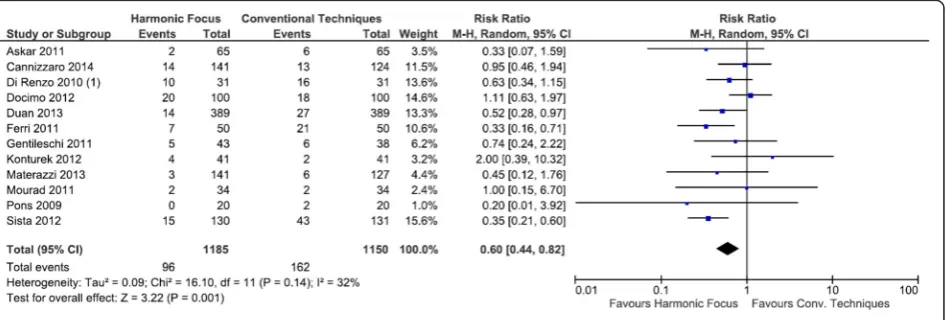
Compared to conventional techniques in total thyroidec-tomy, the Harmonic Focus resulted in a statistically sig-nificant reduction in transient hypocalcemia with a RR of 0.60 (95 % CI: 0.44 to 0.82;P= 0.001; 12 studies;I2= 32 %) (Fig. 9). Persistent hypocalcemia events were reported in only two of the twelve studies examining this outcome. Results demonstrated a lower risk of persistent hypocalce-mia with the Harmonic Focus than with conventional methods, although not statistically significant (RR = 0.35; 95 % CI: 0.07 to 1.91; P= 0.23; 12 studies; I2= 0 %) (Fig. 10).
RLN paresis
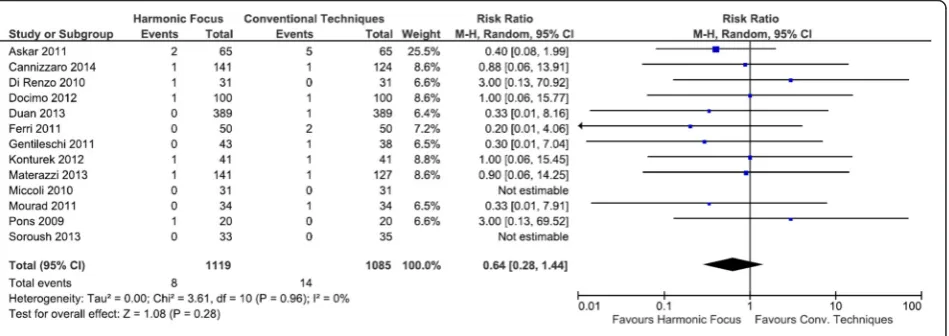
Harmonic Focus use was associated with fewer transient RLN paresis events compared with conventional thyroid-ectomy techniques, but these results were not statistically significant (RR = 0.64; 95 % CI: 0.28 to 1.44; P= 0.28; 13 studies;I2= 0 %) (Fig. 11). Of the thirteen studies exam-ining persistent RLN paresis, only one study reported an event. In this study, the Harmonic Focus reduced the risk of persistent RLN paresis, although results
were not statistically significant (RR = 0.33; 95 % CI: 0.01 to 8.03; P= 0.50) (Figure not shown).
Wound seroma
No significant differences were reported between Har-monic Focus and conventional methods for the outcome of wound seroma in total thyroidectomy (RR = 0.57; 95 % CI: 0.12 to 2.65; P= 0.47; 2 studies; I2= 0 %) (Fig. 12).
Sensitivity analyses
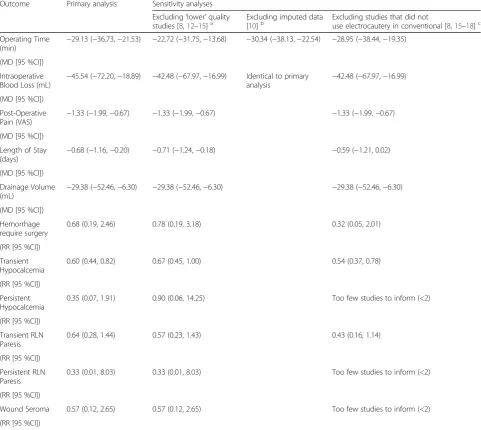
Sensitivity analyses demonstrated results similar to the primary analysis and were relatively robust to variables tested. Results for operating time, intraoperative blood loss, post-operative pain, length of hospitalization and transient hypocalcemia remained statistically signifi-cantly lower with the Harmonic Focus when studies with a higher risk of bias were excluded (Table 4). Addition-ally, primary analysis results were relatively robust to the exclusion of studies with conventional techniques that did not utilize monopolar or bipolar electrocautery or when imputed results by Miccoli et al. [10] were ex-cluded for operating time.
Discussion
Although thyroidectomy was not one of the initial applica-tions of ultrasonic surgery, it was realized that use of the Harmonic scalpel provides many advantages over the con-ventional procedures. Because of the high vascularization of the thyroid gland, efficient and meticulous hemostasis is required to reduce the risk of complications and post-operative morbidity. As with any surgical procedure, a re-duction in operative time will typically lessen the chance of surgical-site infection and may lead to faster patient
Fig. 4Forest plot of meta-analysis results for intra-operative blood loss (mL)
Fig. 5Forest plot of meta-analysis results for post-operative pain (VAS)
recovery time [23]. Rapid coagulation with the Harmonic Focus can substantially increase the speed of the oper-ation. In addition, the precision of the Harmonic Focus can ensure that the risk of the two principal adverse events, namely hypocalcemia and recurrent laryngeal nerve paresis, are not elevated, or may even be reduced.
Five standard meta-analyses have compared ultrasonic devices to conventional techniques in thyroidectomy. These previous findings are in general similar to those in this study. In analyzing 9 studies, Melck [24] observed significantly faster operative time (−23.1 min, p< 0.001), and less transient hypocalcemia (RR 0.69, p= 0.01) for use of ultrasonic devices compared to conventional methods. In 7 studies, Cirocchi [25] found significantly faster operative time (−18.7 min, p< 0.001), less blood loss (−60.1 ml, p= 0.04), and less drainage volume (−35.3 ml,p< 0.001). In 11 studies, Zhang [26] found sig-nificantly faster operative time (−22.4 min, p< 0.001), and less intraoperative bleeding (−26.6 ml,p= 0.02). In 12 stud-ies, Ecker [27] observed significantly faster operative time (−22.7 min,p< 0.001), less blood loss (−20.0 ml,p< 0.001), less post-operative pain (−0.86 units,p= 0.02), and reduced length of hospital stay (−0.12 days,p= 0.05). Finally, in 13 studies, Zhao [28] found significantly faster operative time (−21.1 min, p< 0.001), less intra-operative blood loss (−14.4 ml,p< 0.001), less drainage (−7.5 ml,p< 0.001), and lower hospitalization charges (−118 USD,p< 0.001). None of these meta-analyses found a higher rate of transient or persistent RLN paresis for ultrasonic devices compared to conventional techniques.
Recently two network meta-analyses have been per-formed. In these studies, ultrasonic devices were com-pared to both conventional techniques and advanced bipolar technology. In one of these network meta-analyses, Contin [7] evaluated 21 studies and found sig-nificantly faster operative time (−22.3 min,p< 0.001), less intraoperative blood loss (−28.5 ml, p< 0.001), shorter hospital stay (−0.28 days, p= 0.016) and less post-operative bleeding (−11.2 ml,p< 0.001) for ultrasonic de-vices. There was a trend toward lower transient hypocal-cemia (p= 0.066) for ultrasonic, and importantly no difference in rates of transient RLN paresis (p= 0.847) or persistent RLN paresis (p= 0.711). Interestingly, the mean difference of operative time for investigator-initiated trials was greater than for industry-sponsored trials, belying the notion in this case that industry trials are necessarily biased toward their own commercial product.
In the other network meta-analysis, Garas [29] claimed to use 25 RCT’s, although one of the studies misidenti-fied an electrosurgical device as ultrasonic and another study was not randomized [7, 30]. In comparing ultra-sonic to conventional, they reported significantly faster operative time (p< 0.01), less blood loss (p< 0.01), less drain output (p= 0.03), and lower cost (p= 0.03), but a trend towards higher persistent RLN paresis (p= 0.08) for ultrasonic. A re-tabulation of the studies included in the Garas analysis [30] indicated 1/1006 (0.1 %) cases of persistent RLN paresis for ultrasonic versus 2/992 (0.2 %) for conventional surgery. In the current work, which included only studies where Harmonic Focus was
Fig. 6Forest plot of meta-analysis results for length of hospitalization stay (days)
used, there was no difference in the rate of persistent RLN paresis (p= 0.50), with zero cases among a total of 1119 subjects for Harmonic (0.0 %) and one case among 1085 subjects for conventional techniques (0.1 %). This lack of difference was also confirmed in the Contin net-work meta-analysis [7], which suggested that the results of Garas“should be read with caution.”Based on the re-sults of the standard and network meta-analyses, includ-ing re-analysis of the Garas study, and the current study, all of which show no difference between ultrasonic de-vices and conventional techniques, there should be high confidence that Harmonic Focus can be used thyroidec-tomy with a low risk of RLN paresis, equivalent to con-ventional clamp, cut and tie.
In contrast to all previous efforts, the current study was limited to only Harmonic Focus as the ultrasonic device of interest. The Harmonic Focus is designed for use in open procedures and is specifically cleared for ap-plications in head and neck surgery. A small end effector enables precise placement and the ultrasonic energy pro-vides rapid dissection and coagulation. As evidenced in all studies to date, the design of the Harmonic Focus
gives substantial advantages over conventional tech-niques in thyroidectomy.
In the current study, we observed operative time was significantly faster for Harmonic Focus compared to conventional clamp, cut, and tie. This speed increase is a result of both faster dissection and better hemostasis. Shorter operative time can lead to improved patient out-comes and faster recovery, and provide operative and overall hospital cost savings [8, 9]. The difference of 29 min observed in this study represents a 31 % decrease in operative time compared to conventional technique. Other measures related to the hemostasis capabilities are intra-operative blood loss and drainage volume, where use of Focus led to decreases of 60 % and 64 %, respectively, compared to clamp, cut and tie.
Post-operative pain was 34 % lower for Harmonic Focus than clamp, cut, and tie. This advantage may be related to shorter operative time noted above and obser-vations that ultrasonic devices generally cause less in-flammation [31–33]. The decrease of 1.33 points represents a 34 % reduction in pain compared to con-ventional surgery. The decrease in length of hospital
Fig. 8Forest plot of meta-analysis results for hemorrhage requiring surgery
Fig. 9Forest plot of meta-analysis results for transient hypocalcemia
stay, a 26 % reduction relative to conventional proce-dures, may be related to shorter operative time, lessened blood loss and drainage and less post-operative pain.
For the dichotomous results evaluated, namely, hemorrhage requiring surgery, hypocalcemia, RLN par-esis, and wound seroma, all were less frequent with Harmonic than conventional technique, but because of the low frequency of all these events, only for transient hypocalcemia was there a significant difference, with Harmonic having a 40 % lower rate of occurrence than conventional clamp, cut, and tie. This significantly lower rate of transient hypocalcemia may be a result of the shorter operative time and reduced overall systemic impact of surgery with Harmonic Focus compared to conventional surgery. A drop in calcium blood levels may result not just from unintended damage to the parathyroid gland by clamp, cut and tie, but also be a typical systemic response to longer, more involved sur-gical procedures. While Harmonic Focus provides a lower rate of transient hypocalcemia, there does not
appear to be a long-term difference, as the rate of per-sistent hypocalcemia is not significantly different from conventional procedures.
As demonstrated in this and all other reliable meta-analyses, the rate of both transient and persistent RLN paresis with ultrasonic devices is not greater than with clamp, cut & tie procedures. In fact, the trend with Har-monic Focus suggests that with more data it may be possible to show a reduction in transient RLN paresis. The cause of transient RLN paresis is generally assigned to excess traction. Use of continuous intra-operative nerve monitoring with stimulation to the vagus nerve can avoid paresis if the traction is reduced when the electromyographic reading has decreased by 50 % or more [34]. The improved dissecting ability of ultrasonic devices may decrease the amount of traction compared to clamp, cut and tie. The etiology of persistent paresis is typically prolonged thermal, electrical or direct con-tact with transection of the RLN. To avoid this compli-cation, it is critical to visually identify the RLN during
Fig. 10Forest plot of meta-analysis results for persistent hypocalcemia
Fig. 12Forest plot of meta-analysis results for wound seroma
Table 4Summary of primary and sensitivity analyses
Outcome Primary analysis Sensitivity analyses Excluding‘lower’quality
studies [8,12–15]a Excluding imputed data[10]b Excluding studies that did notuse electrocautery in conventional [8,15–18]c Operating Time
(min) −
29.13 (−36.73,−21.53) −22.72 (−31.75,−13.68) −30.34 (−38.13,−22.54) −28.95 (−38.44,−19.35)
(MD [95 %CI]) Intraoperative Blood Loss (mL) −
45.54 (−72.20,−18.89) −42.48 (−67.97,−16.99) Identical to primary
analysis −
42.48 (−67.97,−16.99)
(MD [95 %CI]) Post-Operative
Pain (VAS) −
1.33 (−1.99,−0.67) −1.33 (−1.99,−0.67) −1.33 (−1.99,−0.67)
(MD [95 %CI]) Length of Stay
(days) −
0.68 (−1.16,−0.20) −0.71 (−1.24,−0.18) −0.59 (−1.21, 0.02)
(MD [95 %CI]) Drainage Volume
(mL) −
29.38 (−52.46,−6.30) −29.38 (−52.46,−6.30) −29.38 (−52.46,−6.30)
(MD [95 %CI]) Hemorrhage require surgery
0.68 (0.19, 2.46) 0.78 (0.19, 3.18) 0.32 (0.05, 2.01)
(RR [95 %CI]) Transient Hypocalcemia
0.60 (0.44, 0.82) 0.67 (0.45, 1.00) 0.54 (0.37, 0.78)
(RR [95 %CI]) Persistent Hypocalcemia
0.35 (0.07, 1.91) 0.90 (0.06, 14.25) Too few studies to inform (<2)
(RR [95 %CI]) Transient RLN Paresis
0.64 (0.28, 1.44) 0.57 (0.23, 1.43) 0.43 (0.16, 1.14)
(RR [95 %CI]) Persistent RLN Paresis
0.33 (0.01, 8.03) 0.33 (0.01, 8.03) Too few studies to inform (<2)
(RR [95 %CI])
Wound Seroma 0.57 (0.12, 2.65) 0.57 (0.12, 2.65) Too few studies to inform (<2) (RR [95 %CI])
CIConfidence Interval,LOSLength of Stay,MDMean Difference,RRRelative Risk,VASVisual Analog Scale,minminutes,mLmilliliters
a
Lower quality study defined as:≥4“unclear”OR one“No”listed in any risk of bias assessment category: Cannizzaro [12], Pons [8], Sista [13], Duan [14], Soroush [15]
b
Miccoli [10]
c
Di Renzo [14], Docimo [16], Materazzi [17], Pons [8], Soroush [15]
surgery. Use of an ultrasonic device eliminates electrical current and gives a wider margin of error for thermal ef-fects compared to monopolar electrosurgery.
Numerous preclinical studies have evaluated the im-pact of Harmonic technology when used close to a nerve [32]. All studies to date have shown an effect on nerve function similar to that of cold steel scalpel when used up to 2 mm from the nerve. Important caveats to re-member are that activation time should be less than 15 s and the nerve itself should never be touched directly ei-ther during activation or immediately afterwards. As all energy technologies generate heat, they must be carefully managed. In contrast to ultrasonic energy, monopolar and bipolar technologies produce at minimum transient injury when used up to 5 mm from the nerve. Recently, the potential adverse effects of advanced bipolar tech-nologies were demonstrated with a doubling of β -amyloid precursor protein, a marker of impaired axonal transport, and a 133 % increase in neural inflammation when compared to ultrasonic energy [35].
Despite the comfort that can be developed from stud-ies evaluating Focus, it must be stressed that no technol-ogy will replace meticulous surgical techniques and no technology is fool-proof. In that regard, the important elements must always be kept foremost in the surgeon’s mind when using Harmonic Focus. First, activations should occur as far from nerves or glands as possible, and no closer than 2 mm. Second, continuous activation should be less than 15 s as one approaches the nerve. Fi-nally, the heat of the instrument must be actively man-aged by cooling, and an activated instrument should never touch the nerve during dissection.
Conclusions
The Harmonic Focus is a more effective surgical device compared to conventional techniques in thyroidectomy. Its use offers several clinical advantages, including re-duced operating time, intra-operative blood loss, drain-age volume, post-operative pain, length of hospital stay, and transient hypocalcemia which can ultimately benefit the surgeon, patient and hospital, without the addition of safety concerns.
All studies performed to-date have used Harmonic Focus, prior to the introduction of an improved version, Harmonic Focus+, which has a substantially smaller end effector and produces a significantly smaller thermal ef-fect [35]. All of the benefits observed in this study are expected to be maintained or even improved upon with the increased precision of the new device.
Competing interests
HC, JWC, and JFA are employees of Ethicon, Inc., manufacturer of the Harmonic Focus. IS and NCF are employees of Cornerstone Research Group, who were sponsored to perform this study by Ethicon, Inc.
Funding
This work was supported by Ethicon, Inc., manufacturer of the Harmonic Focus, who provided funding to conduct the analysis and prepare the manuscript.
Author details
1Ethicon Inc, 4545 Creek Rd, Cincinnati, OH 45242, USA.2Cornerstone Research Group, 204-3228 South Service Road, Burlington, ON L7N 3H8, Canada.
Received: 8 September 2015 Accepted: 21 September 2015
References
1. Amaral JF. The experimental development of an ultrasonically activated scalpel for laparoscopic use. Surg Laparosc Endosc. 1994;4(2):92–9. 2. Amaral JF. Laparoscopic cholecystectomy in 200 consecutive patients
using an ultrasonically activated scalpel. Surg Laparosc Endosc. 1995;5(4):255–62.
3. Heimann TM, Kurtz RJ, Shen S, Aufses Jr AH. Mucosal proctectomy using an ultrasonic scalpel. Am J Surg. 1984;147(6):803–6.
4. Soares RS, Amaral JF. Laparoscopic nissen fundoplication using ultrasonic cutting and coagulation. Surg Technol Int. 1998;7:119–23.
5. Robbins ML, Ferland RJ. Laparoscopic-assisted vaginal hysterectomy using the laparosonic coagulating shears. J Am Assoc Gynecol Laparosc. 1995;2(3):339–43.
6. Miccoli P, Berti P, Raffaelli M, Materazzi G, Conte M, Galleri D. Impact of harmonic scalpel on operative time during video-assisted thyroidectomy. Surg Endosc. 2002;16(4):663–6.
7. Contin P, Goossen K, Grummich K, Jensen K, Schmitz-Winnenthal H, Buchler MW, et al. ENERgized vessel sealing systemsversusCONventional hemostasis techniques in thyroid surgery–the ENERCON systematic review and network meta-analysis. Langenbecks Arch Surg. 2013;398(8):1039–56. 8. Pons Y, Gauthier J, Ukkola-Pons E, Clement P, Roguet E, Poncet JL, et al.
Comparison of LigaSure vessel sealing system, harmonic scalpel, and conventional hemostasis in total thyroidectomy. Otolaryngol Head Neck Surg. 2009;141(4):496–501.
9. Konturek A, Barczynski M, Stopa M, Nowak W. Total thyroidectomy for non-toxic multinodular goiter withversuswithout the use of harmonic FOCUS dissecting shears - a prospective randomized study. Wideochir Inne Tech Maloinwazyjne. 2012;7(4):268–74.
10. Miccoli P, Materazzi G, Miccoli M, Frustaci G, Fosso A, Berti P. Evaluation of a new ultrasonic device in thyroid surgery: comparative randomized study. Am J Surg. 2010;199(6):736–40.
11. Higgins J, Green S. The Cochrane handbook for systematic reviews of interventions. 2011. http://handbook.cochrane.org/ Accessed August 13, 2015.
12. Cannizzaro MA, Bianco SL, Borzi L, Cavallaro A, Buffone A. The use of FOCUS Harmonic scalpel compared to conventional haemostasis (knot and tie ligation) for thyroid surgery: a prospective randomized study. SpringerPlus. 2014;3:639.
13. Sista F, Schietroma M, Ruscitti C, De Santis G, De Vita F, Carlei F, et al. New ultrasonic dissectorversusconventional hemostasis in thyroid surgery: a randomized prospective study. J Laparoendosc Adv Surg Tech A. 2012;22(3):220–4.
14. Duan YF, Xue W, Zhu F, Sun DL. FOCUS harmonic scalpel compared to conventional hemostasis in open total thyroidectomy - a prospective randomized study. J Otolaryngol Head Neck Surg. 2013;42:62. 15. Soroush A, Pourbakhtyaran E, Allame S, Zamani MM, Etemadi M, Nasiri S.
Harmonic scalpel is more secure than conventional methods in total thyroidectomy: a randomized clinical trial. J Minim Invasive Surg Sci. 2013;2(3):23–7.
16. Docimo G, Ruggiero R, Gubitosi A, Casalino G, Bosco A, Gili S, et al. Ultrasound scalpel in thyroidectomy. Prospective randomized study. Ann Ital Chir. 2012;83(6):491–6.
17. Materazzi G, Caravaglios G, Matteucci V, Aghababyan A, Miccoli M, Miccoli P. The impact of the Harmonic FOCUS on complications in thyroid surgery: a prospective multicenter study. Updat Surg. 2013;65(4):295–9.
19. Askar W, Roshdy H, El Nakeeb A, Moatamed A, El Lithy R, Hayes S. The use of harmonic scalpelversusknot tying for total-thyroidectomy. A prospective randomized study. Egypt J Surg. 2011;30(2):48–54.
20. Ferri E, Armato E, Spinato G, Spinato R. Focus harmonic scalpel compared to conventional haemostasis in open total thyroidectomy: a prospective randomized trial. Int J Otolaryngol. 2011;2011:357195.
21. Gentileschi P, D'Ugo S, Iaculli E, Gaspari AL. Harmonic Focusversus“knot tying”during total thyroidectomy: a randomized trial. Updat Surg. 2011;63(4):277–81.
22. Mourad M, Rulli F, Robert A, Scholtes JL, De Meyer M, De Pauw L. Randomized clinical trial on Harmonic Focus shearsversusclamp-and-tie technique for total thyroidectomy. Am J Surg. 2011;202(2):168–74. 23. Elfenbein DM, Schneider DF, Chen H, Sippel RS. Surgical site infection after
thyroidectomy: a rare but significant complication. J Surg Res. 2014;190(1):170–6.
24. Melck AL, Wiseman SM. Harmonic scalpel compared to conventional hemostasis in thyroid surgery: a meta-analysis of randomized clinical trials. Int J Surg Oncol. 2010;2010:396079.
25. Cirocchi R, D'Ajello F, Trastulli S, Santoro A, Di Rocco G, Vendettuoli D, et al. Meta-analysis of thyroidectomy with ultrasonic dissectorversusconventional clamp and tie. World J Surg Oncol. 2010;8:112.
26. Zhang ZJ, Zhang P, Tian JH, Li J, Li L, Tian J, et al. Ultrasonic coagulator for thyroidectomy: a systematic review of randomized controlled trials. Surg Innov. 2010;17(1):41–7.
27. Ecker T, Carvalho AL, Choe JH, Walosek G, Preuss KJ. Hemostasis in thyroid surgery: harmonic scalpelversusother techniques–a meta-analysis. Otolaryngol Head Neck Surg. 2010;143(1):17–25.
28. Zhao JZ, Gao M, Yu Y, Li YG, Li XL, Wei SF, et al. Harmonic scalpelversus conventional resection in thyroid surgery: a meta analysis on the safety outcomes. Zhonghua Er Bi Yan Hou Tou Jing Wai Ke Za Zhi. 2013;48(9):752–7. 29. Garas G, Okabayashi K, Ashrafian H, Shetty K, Palazzo F, Tolley N, et al.
Which hemostatic device in thyroid surgery? A network meta-analysis of surgical technologies. Thyroid. 2013;23(9):1138–50.
30. Amaral JF, Hinoul P, Schwiers ML, Clymer JW. Comment on Garas et al.,
“Which hemostatic device in thyroid surgery? A network meta-analysis of surgical technologies”. Thyroid. 2014;24(4):778–9.
31. Rubino LJ, Konstantakos EK, Stills Jr HF, Dudley ES, Grunden BK, Malaviya P. Healing of iatrogenic skeletal muscle wounds is affected by incision device. Surg Innov. 2010;17(2):85–91.
32. Chen C, Kallakuri S, Vedpathak A, Chimakurthy C, Cavanaugh JM, Clymer JW, et al. The effects of ultrasonic and electrosurgery devices on nerve physiology. Br J Neurosurg. 2012;26(6):856–63.
33. Nanduri B, Pendarvis K, Shack LA, Kumar R, Clymer JW, Korvick DL, et al. Ultrasonic incisions produce less inflammatory mediator response during early healing than electrosurgical incisions. PLoS One. 2013;8(9), e73032. 34. Wu CW, Dionigi G, Sun H, Liu X, Kim HY, Hsiao PJ, et al. Intraoperative
neuromonitoring for the early detection and prevention of RLN traction injury in thyroid surgery: a porcine model. Surgery. 2014;155(2):329–39. 35. Bertke BDSP, Welling AL, Widenhouse TV, Chen C, Kallakuri S, Cavanaugh
JM, et al.Ex vivoandin vivoevaluation of an ultrasonic device for precise dissection, coagulation, and transection. Open Access Surgery. 2014;8:1–7.
Submit your next manuscript to BioMed Central and take full advantage of:
• Convenient online submission
• Thorough peer review
• No space constraints or color figure charges
• Immediate publication on acceptance
• Inclusion in PubMed, CAS, Scopus and Google Scholar
• Research which is freely available for redistribution
Submit your manuscript at www.biomedcentral.com/submit