2014 | VOLUME 10 | 161 © ARCHIVES OF BUDO | SCIENCE OF MARTIAL ARTS
Changes in body composition, anthropometric
indicators and maximal strength due to weight
reduction in judo
Klára Coufalová
1ABCDE, Darryl J. Cochrane
2CD, Tomáš Malý
2CD, Jan Heller
1E1
Charles University in Prague, Faculty of Physical Education and Sport, Czech Republic
2School of Sport and Exercise, Massey University, Palmerston North, New Zealand
Source of support:
This work was supported by SVV 2014-260115, Programme for the Development of Fields of Study at
Charles University, No. P38 Biological aspects of the investigation of human movement and GAČR P407/11/P784
Received:
27 May 2014;
Accepted:
22 June 2014;
Published online:
30 June 2014
ICID:
1111254
Abstract
Background
The pre-competitive weight reduction is very common in combat sports and it can have negative impact not only on performance but also on health. The purpose of this study was the knowledge about the impact weight reduction pre-competitive judo on indicators of body composition, anthropometric variables and maximum isometric strength. The purpose of this study was to know about the effects of weight reduction pre-compet-itive judo on indicators of body composition, anthropometric variables and maximum isometric strength.Material & Methods:
Nine national level Czech judoists (mean age 22.3 ± 2.4 years) from five weight categories (except category -100 and +100) took part in this study. Body composition was measured by bioelectrical impedance and an-thropometrical indicators from skinfold thickness and body circumferences. Maximal isometric strength was assessed in upper and lower extremities, trunk and handgrip. All participants were assessed before reduction and then in the last day of body weight reduction. These two occasions were 5 days apart.Results:
A reduction of body weight of 4.6% (an average 3.4 kg) was observed with the greatest changes were detect-ed in the fat free mass (FFM) and total body water (TBW). No significant change in body fat was detectdetect-ed. Weight reduction was also reflected in changes of skinfold thickness and body circumferences. A significant decrease in maximal trunk strength was observed, but the weight reduction did not affect the maximal iso-metric strength of upper or lower extremities.Conclusions:
Ideally, athletes should reduce body fat without decreasing skeletal musculature. Although we didn’t find any significant decrease of maximal isometric strength, we suppose that strength endurance can be greatly influenced. Keywords: body weight loss, combat sports, bioimpedance analysis, skinfold thicknessAuthor’s address: Klára Coufalová, Faculty of Physical Education and Sport, Charles University in Prague, José Martího 31, 16252 Prague, Czech Republic; e-mail: [email protected]
Authors’ Contribution: A Study Design B Data Collection C Statistical Analysis D Manuscript Preparation E Funds Collection
I
ntroductIonJudo is an Olympic sport with a competitive weight class system. It is a martial art where two individuals compete in hand-to-hand combat, using a grip that incorporates complex technical and tactical actions to leverage the power of the opponent, all of which requires a great deal of both physical and psycholog-ical skill [1]. Judo is an intermittent sport, which on average takes 3.30 ± 0.17 minutes to complete [2].
In grip combat constant dynamic changes occur, which requires a combination of strength and endur-ance to control the distendur-ance between the opponents [3-5]. In all official competitions, judo athletes are paired with opponents of similar body weight from a weight class system. This ensures fairness and pro-motes even-handed combats in terms of strength, leverage and agility [6].
To gain an advantage over opponents, many judoists try to achieve a weight category that is below their usual body weight and will undertake cycles of weight loss before competition and weight gain post-petition. The reduction of body weight prior to com-petition typically involves fluid and food restriction, increased exercise, and exercise in warmer conditions such as saunas [7-9].
It is common practice in many judoists to undertake weight reduction strategies. Horswill [10] reported that 70-80% of judoists reduce their weight for inclu-sion in a lower weight category. However, the effects of weight cycling can have a negative impact of energy metabolism, endocrine, immune function [11] and performance. Fogelholm et al. [12] observed that a decrease of over 5% in body weight over 3 weeks cause a deterioration of physical performance in judoists.
It has been well documented that pre-competitive body weight reductions decrease total body water, body fat and lean body mass [13]. A decrease of fat free mass (FFM) can reflect a reduction of muscle strength, which can affect the athlete’s ability to train at the required intensity. Body weight reduction has serious consequences on an athlete’s health and per-formance, where negative effects of rapid weight loss can have detrimental effects on physiological aspects such as increased heart rate, decreased circulatory and respiratory functions, impaired thermoregula-tory processes, decreased renal blood flow, and salt imbalance. Further, a reduction in circulating blood can decrease cardiac output and lead to a reduction in muscle strength and decreases the length of intense performances [14].
Furthermore, the body structure can play a deter-mining role in the achievement of top judo perfor-mance [8,15]. During gradual reduction of body weight, the anaerobic efficiency does not decrease, but decelerated re-syntheses of glycogen and loss of protein from muscles may influence sports per-formance [16]. It has been reported that a sudden reduction of 5% of body weight decreases physical efficiency to 30%, irrespective of the body weight reduction method applied [16].
Muscle strength is important in judo, and its decrease due to weight loss is disadvantageous [17], especially the ability to develop a strong grip and maintain it during a judo match has become an important ele-ment for judo athletes [18]. Dynamic grip strength endurance seems to be an important attribute between judo athletes, probably because judo combat involves many elbow extensions and flexions in order to avoid the opponent’s grip and to subdue them [18]. Also other authors consider strength as potential predic-tor of judo performance [15,19,20]. Rankin et al. [21] have shown that a 3 to 4% reduction in body weight reduces high-intensity intermittent arm power per-formance. Generally we can say, that body weight loss has a negative impact on the amount of body cellular mass and it can decrease the muscle strength. These components are also part of health oriented fitness and are closely related to health [22].
It had been well documented about changes in body composition due to weight reduction [23-25], how-ever, little research has been conducted on competi-tive judo athletes that have examined changes in body composition, anthropometry indicators and muscle strength concurrently. The purpose of this study was the knowledge about the impact weight reduction pre-competitive judo on indicators of body com-position, anthropometric variables and maximum isometric strength. It was hypothesised that the pre-competitive body weight reduction decreases total body water and muscle mass and these changes neg-atively affect the muscle strength.
M
aterIalandM
ethodsNine national level Czech judo athletes (age 22.3 ± 2.4 years, weight 79.1 ± 9.0 kg, height 181.0 ± 6.2 cm) from five weight categories (except category - 100 and + 100) volunteered for the study and gave their written consent where ethical approval was granted by the University Human Ethics. The athletes had been involved in judo for 15.5 ± 2.3 years, were currently training 7.0 ± 2.0 trainings/week and
Body weight loss – reduction of the total body mass. In combat sports it is used for preparation to start in a lower weight category.
Bioimpedance analysis – the method for estimating body composition.
Skinfold thickness – the measurement of subcutaneous fat.
had participated in 11 competitions during the cal-endar year where they had reduced their body weight in seven competitions.
Study Design
The national top-level judo athletes attended the lab-oratory on two different occasions (pre- and post-reduction period) 5 days apart. Athletes reported their weight reduction method as exercise-induced sweating and concurrently decreased energy intake or changed their diet. Athletes stated that their usual reduction period lasts on average 5.7 ± 2.8 days. Both testing sessions were made at the same time of the day where each athlete underwent body composition and anthropometric evaluation. Following this maxi-mal isometric strength of upper, lower extremities and trunk was assessed. Athletes were asked not to eat for two hours and drink two hours before the measure-ment. They were also instructed to abstain from alco-hol and caffeine in the 24 h and exercise in the 12 h preceding their assessments.
Body Composition
Body composition was evaluated using the multi-frequency, whole-body bioimpedance (Inbody 720, Biospace Co Ltd., Korea) device. The calculation of body fat percentage was determined from prediction equation supplied by manufacturer (Biospace Co., Ltd., Korea). The device provided fluid distribution of five body segments (left and right arm, trunk, left and right leg). Previous research [25,26] supports the validity of using BIA to determine % BF in the wres-tling population.
The following anthropometric measurements were carried out: body weight, body height, skinfold thick-ness (cheek, neck, pectoral, triceps, subscapula, midax-illa, abdomen, suprailiac, front thigh and medial calf), circumferences (upper arm, waist, hips, thigh and medial calf). For skinfold measurements a calliper (Best II K-501, Trystom, Czech Republic) (constant pressure 28.5 g·mm-1) was used and to ensure
inter-reliability the main investigator performed all anthro-pometric measurements.
Maximal isometric strength
Isometric strength of arm, leg and trunk flexion and extension was measured as the peak forced produced by the maximal voluntary isometric contraction at defined positions. Isometric strength of hands was determined by a hand grip dynamometer (Takey Kogi, Japan) that assessed static grip strength of the right and left hand. Athletes stood upright with arms down the side of the body. Always 3 maximal
trials were performed and the best score used for data analysis.
Data analysis
Data are presented as mean ± standard deviation (M ± SD). The Wilcoxon sign rank test was used to the differences of observed parameters. Rejection of the null hypothesis was assessed at the level of p <0.05, or p <0.01. Cohen’s coefficient of effect size “d”. It was calculated as the difference of the means of the com-pared parameters and divided by a „pooled” standard deviation (1) [27]. The coefficient was assessed as fol-lows: d = 0.20 – a small effect, d = 0.50 – medium effect and d = 0.80 – large effect [28].
Statistical analysis was performed using SPSS (version 20.0, IBM, New York, USA).
r
esultsThe pre-competitive reduction was in average 4.6% of initial body weight. The analysis of the results showed significant changes in all indicators of body composi-tion except fat mass and edema exam (Table 1).
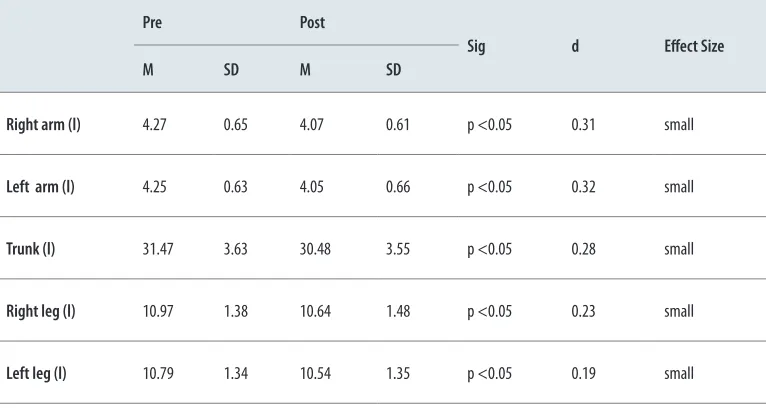
In segmental fluid distribution we observed signif-icant decrease in all measured indicators (p <0.05) (Table 2).
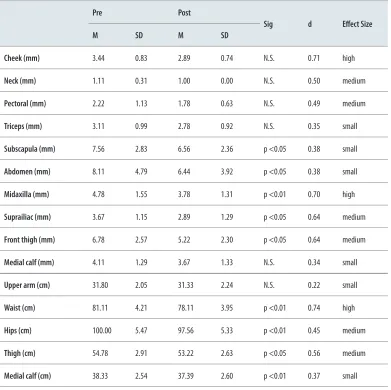
Furthermore, it was found significant changes in sev-eral skinfold thickness (subscapular, abdomen, midax-illa, suprailiac and front thigh) and in circumferences of waist, hips, thigh and medial calf (Table 3).
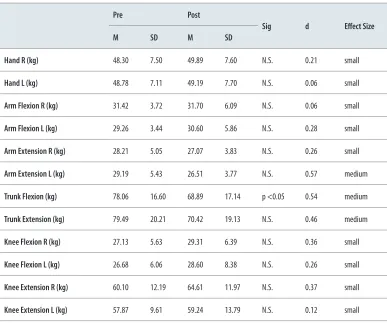
In contrast, there were no significant differences in isometric strength except trunk flexion (Table 4).
d
IscussIonTable 1. Changes in body composition from weight reduction (M ± SD) (n = 9)
Pre Post
Sig d Effect Size
M SD M SD
Body weight (kg) 79.14 8.97 75.74 9.51 p <0.01 0.37 small
Body Mass Index (kg.m-2) 24.16 1.85 22.99 1.87 p <0.01 0.63 medium
Fat Free Mass (kg) 71.10 8.38 68.66 8.58 p <0.05 0.29 small
Fat Mass (kg) 8.07 3.29 7.09 2.40 N.S. 0.34 small
Fat Mass (%) 10.16 3.99 9.29 2.90 N.S. 0.25 small
Protein mass (kg) 14.14 1.64 13.72 1.65 p <0.05 0.26 small
Total Body Water (l) 52.20 6.17 50.38 6.32 p <0.05 0.29 small
Intracellular Water (l) 32.70 3.79 31.77 3.85 p <0.05 0.24 small
Extracellular Water (l) 19.49 2.52 18.62 2.63 p <0.05 0.34 small
one mass (kg) 3.89 0.48 3.75 0.50 p <0.01 0.28 small
Body Cell Mass (kg) 46.83 5.44 45.47 5.51 p <0.05 0.25 small
Muscle mass (kg) 40.64 4.93 39.40 5.04 p <0.05 0.25 small
Basal Metabolic Rate (kcal) 1904.78 180.93 1853.03 185.25 p <0.05 0.28 small
Edema exam 0.327 0.002 0.323 0.004 N.S. 1.08 high
Table 2. Changes in segmental fluid distribution from weight reduction (M ± SD) (n = 9)
Pre Post
Sig d Effect Size
M SD M SD
Right arm (l) 4.27 0.65 4.07 0.61 p <0.05 0.31 small
Left arm (l) 4.25 0.63 4.05 0.66 p <0.05 0.32 small
Trunk (l) 31.47 3.63 30.48 3.55 p <0.05 0.28 small
Right leg (l) 10.97 1.38 10.64 1.48 p <0.05 0.23 small
(n=53) regularly decrease their body weight about 5.4% (average body loss was 3.9 ± 2.3 kg, range from 1 kg to 10 kg). According to Fogelholm [31] if the time between weigh in and starting the competition is shorter than 5 hours, as in judo, it is not recommended to reduce body weight by more than 4%; where a 3 to 4% reduction in body weight reduces high-intensity intermittent arm power performance [21].
It was hypothesised that the pre-competitive body weight reduction decreases total body water and cle mass and these changes negatively affect the mus-cle strength. Presented results show that decrease of total body water and muscle mass was confirmed against muscle mass, where it was not found any sig-nificant changes except trunk flexion.
Significant changes were observed in the current in all body composition parameters except body fat;
however, a decrease of almost one kilogram of fat mass (i.e. almost 1% of body fat) was noted. Contrary, Umeda et al. [29] found a significant decrease of body fat (from 9.1 ± 4.7 kg to 7.9 ± 4.1 kg) what meant a decrease of relative body fat from 11.1 ± 4.5% to 10.1 ± 4.5%. This discrepancy can be explained by shorter time of reduc-tion of our file, when our contestants reduced body weight for 5 days compared to weight reduction lasting 20 days in Umeda’s study. A significant difference was evident in fat free mass (FFM), where participants lost on average 2.44 kg of active mass (1.36 kg of body cell mass, 1.24 kg of muscle mass and 0.42 kg in protein mass). This decrease can negatively influence sport per-formance, as muscle mass is positively related to anaer-obic performance [32]. According to other research [23,33,34] acute weight reduction induces proteoly-sis of muscle tissue, resulting in a decrease in fat-free mass and physical strength. The loss of fat free mass observed in the present study was similar to that found
Table 3. Changes in skinfold thickness and circumferences from weight reduction (M ± SD) (n = 9)
Pre Post
Sig d Effect Size
M SD M SD
Cheek (mm) 3.44 0.83 2.89 0.74 N.S. 0.71 high
Neck (mm) 1.11 0.31 1.00 0.00 N.S. 0.50 medium
Pectoral (mm) 2.22 1.13 1.78 0.63 N.S. 0.49 medium
Triceps (mm) 3.11 0.99 2.78 0.92 N.S. 0.35 small
Subscapula (mm) 7.56 2.83 6.56 2.36 p <0.05 0.38 small
Abdomen (mm) 8.11 4.79 6.44 3.92 p <0.05 0.38 small
Midaxilla (mm) 4.78 1.55 3.78 1.31 p <0.01 0.70 high
Suprailiac (mm) 3.67 1.15 2.89 1.29 p <0.05 0.64 medium
Front thigh (mm) 6.78 2.57 5.22 2.30 p <0.05 0.64 medium
Medial calf (mm) 4.11 1.29 3.67 1.33 N.S. 0.34 small
Upper arm (cm) 31.80 2.05 31.33 2.24 N.S. 0.22 small
Waist (cm) 81.11 4.21 78.11 3.95 p <0.01 0.74 high
Hips (cm) 100.00 5.47 97.56 5.33 p <0.01 0.45 medium
Thigh (cm) 54.78 2.91 53.22 2.63 p <0.05 0.56 medium
in other studies. Umeda et al. [24] observed a signifi-cant decrease of fat free mass (~ 1.7 kg) after reduction of 2.8 kg of body weight and reported an average body mass reduction of 4.9 kg from pre-season to mid-sea-son in college wrestlers. Similarly, Yoshioka et al. [35] observed reduction of 2.0 kg fat free mass, (relative body fat ~ 2.9%), while the total body weight reduc-tion was 2.8 kg.
From the significant changes in total body water (TBW), it was able to confirm that judo athletes commonly use dehydration techniques to achieve a target body weight. It was observed significant (p <0.05) decrease of fluid in all body segments due to body weight reduction. Loss of body water occurred in extracellular (ECW), which was simi-lar to intracellusimi-lar water (ICW). However, from our previous study [36] of 11 elite judo athletes, body weight was reduced by 4.7 % (~ 3.8 kg), which is a larger than the current extracellular water (ECW), where we observed a loss of 3.7 l, but on the other side we observed an increase of intracellular water (ICW) of 0.4 l.
In the present study a significant loss of bone mass was reported however, it is difficult to postulate a valid reason for this after weight regain. Proteau et al. [13] found that weight loss negatively affected bone meta-bolic status and a net increase in bone resorption rela-tive to formation. This phenomenon was reversed with subsequent weight regain. Furthermore, weight loss has been shown to induce acute as well as chronic increases in bone resorption [37], but the exact mechanisms by which bone resorption increases have yet to be clari-fied. Elevated bone formation pertaining to judo ath-letes lent protection from alterations in bone metabolic balance with weight cycling. This observation suggests that high osteogenic stimuli provided by judo’s unique biomechanical environment may help prevent bone loss associated with weight loss interventions.
Houston et al. [38] reported a gradual decrease in muscle strength during and after 4 days of weight loss in college wrestlers. However, the present findings suggest that pre-competition body weight reduction does not affect maximal isometric muscle strength of upper or lower limbs despite significant lower
Table 4. Changes in maximal isometric strength from weight reduction (M ± SD) (n = 9)
Pre Post
Sig d Effect Size
M SD M SD
Hand R (kg) 48.30 7.50 49.89 7.60 N.S. 0.21 small
Hand L (kg) 48.78 7.11 49.19 7.70 N.S. 0.06 small
Arm Flexion R (kg) 31.42 3.72 31.70 6.09 N.S. 0.06 small
Arm Flexion L (kg) 29.26 3.44 30.60 5.86 N.S. 0.28 small
Arm Extension R (kg) 28.21 5.05 27.07 3.83 N.S. 0.26 small
Arm Extension L (kg) 29.19 5.43 26.51 3.77 N.S. 0.57 medium
Trunk Flexion (kg) 78.06 16.60 68.89 17.14 p <0.05 0.54 medium
Trunk Extension (kg) 79.49 20.21 70.42 19.13 N.S. 0.46 medium
Knee Flexion R (kg) 27.13 5.63 29.31 6.39 N.S. 0.36 small
Knee Flexion L (kg) 26.68 6.06 28.60 8.38 N.S. 0.26 small
Knee Extension R (kg) 60.10 12.19 64.61 11.97 N.S. 0.37 small
Knee Extension L (kg) 57.87 9.61 59.24 13.79 N.S. 0.12 small
circumferences and muscle mass reduction. Contrary, Kurakake et al. [17] reported a decrease in handgrip, which was significantly lower on the right side 4 days before the competition in judo in the marked weight reduction group (≥6% of body weight). However, we observed a significant decrease in maximal mus-cle strength of trunk. Currently, to our knowledge no study has observed muscle strength of these main body segments.
c
onclusIonsReduction of body weight is an integral part of disci-plines, in which competition is performed with divi-sion into weight categories. According to our results pre-competitive weight reduction is reflected in vary-ing degrees in all parameters of body composition and anthropometric indicators, what can greatly affect sports performance and athletes’ health.
There appears to be a lack of knowledge on how to lose weight successfully without it negating an ath-lete’s performance. Optimally, the judoists should be
able to lose the necessary amount of weight with-out reducing performance. As rapid weight loss is not free of risk to health, rule changes should be imple-mented to prevent serious adverse occurrences. The official weighing of competitors is now one day before competition and is not in morning the same day as competition, what allows for a longer time to regen-erate. Notwithstanding, we believe that shortening the duration between the weighing and competition, could possibly reduce the radical weight loss. Judo rule changes should be implemented to prevent seri-ous adverse occurrences. In parallel, educational pro-grams should aim at increasing athletes’, coaches’ and parents’ awareness about the risks of aggressive nutri-tional strategies as well as healthier ways to properly manage body weight.
c
oMpetIngI
nterestsAuthors declare that we do not have any finan-cial or personal relationships with other people or organisations that could inappropriately influence our paper.
r
eferences1. Sánchez ÁG, Domínguez AS, Turpin JAP et al. Importance of hand-grip strength as an indicator for predicting the results of competitions of young judokas. Arch Budo 2011; 7(3): 167-172 2. Laskowski R, Kujach S, Smaruj M et al. Lactate
concentration during one-day male judo compe-tition: A case study. Arch Budo 2012; 8(1): 51-57 3. Franchini E, Nunes AV, Moraes JM et al. Physical
fitness and anthropometrical profile of the Brazilian male judo team. J Physiol Anthropol 2007; 26(2): 59-67
4. Calmet M, Miarca B, Franchini E. Modeling approaches of grasps in judo competition contests. Int J Perf Anal Spor 2010; 10(3): 229-240 5. Marcon G, Franchini G, Jardim JR et al. Structural
analysis of action and time in sports – judo. J Quant Anal Sport 2010; 6: 1-13
6. Artioli GG, Franchini E, Nicastro H et al. The need of a weight management control program in judo: a proposal based on the successful case of wrestling. J Int Soc Sport Nutr 2010; 7:15
7. Claessens A, Beunen G, Wellens R et al. Somatotype and body structure of world top judoists. J Sport Med Phys Fit 1987; 27(1): 105-113
8. Lambert CP, Frank LL, Evans WJ. Macronutrient considerations for the sport of bodybuilding. Sport Med 2004; 34(5): 317-327
9. Boguszewski D, Kwapisz E. Sports massage and local cryotherapy as a way to reduce negative effects of rapid weight loss among kickboxing contestants. Arch Budo 2010; 6: 45-51
10. Horswill CA. Making Weight in Combat Sports. Combat Sports Medicine. London: Springer; 2009 11. Yaegaki M, Umeda T, Takahashi I et al. Change in
the capability of reactive oxygen species production by neutrophils following weight reduction in female judoists. Brit J Sport Med 2007; 41(5): 322-327 12. Fogelholm GM, Koskinen R, Lakso J et al. Gradual
and rapid weight loss: effects on nutrition and per-formance in male athletes. Med Exerc 1993; 25(3): 371-377
13. Proteau S, Pelle A, Collomp K et al. Bone Density in Elite Judoists and Effects of Weith Cycling on Bone Metabolic Balance. Med Sci Sports Exerc 2006; 38(4): 694-700
14. Nedorostová J. Shazování váhy. Československý sport. 1977 [in Czech]
15. Krstulovic S, Zuvela F, Katic R. Biomotor systems in elite junior judoists. Collegium Antropol 2006; 30(4): 845-851
16. Ziemlański S. Zarys fizjologii człowieka, ze szcze-gólnym uwzględnieniem sportowców. Warszawa: Akademia Wychowania Fizycznego; 1987 [in Polish]
17. Kurakake S, Umeda T, Nakaji S et al. Changes in Physical Characteristics, Hematological Parameters and Nutrients and Food Intake during Weight Reduction in Judoists. Environ Health Prev Med 1998; 3: 152-157
18. Franchini E, Miarka B, Matheus L et al. Endurance in judogi grip strength tests: Comparison between elite and non-elite judo players. Arch Budo 2011; 7(1): 1-4
19. Aruga S, Nakanishi H, Yamashita Y et al. A study on the training method for improving judo players’ kumite strength – on the judogi chin-up method. Tokai J Sport Med Sci 2006; 18(1): 44-53 20. Franchini E, Del Vecchio FB, Matsushigue KA et
al. Physiological profiles of elite judo athletes. Sports Med 2011; 41(2): 147-166
21. Rankin JW, Ocel JV, Craft LL. Effect of weight loss and refeeding diet composition on anaerobic per-formance in wrestlers. Med Sci Sport Exer 1996; 28(10): 1292-1299
22. Baláš J, Strejcová B, Malý T et al. Changes in upper body strength and body composition after 8 weeks
indoor climbing in youth. Isokinetics and Exercise Science 2009; 17: 173-179
23. Filaire E, Maso F, Degoutte F. Food restriction, per-formance, psychological state and lipid values in judo athletes. Int J Sports Med 2001; 22: 454–459 24. Umeda T, Nakaji S, Shimoyama T et al. Adverse
effects of energy restriction on myogenic enzymes in judoists. J Sport Sci, 2004; 22(4): 329-338 25. Utter AC, Scott JR, Oppliger RA et al. A
compari-son of leg-to-leg bioelectrical impedance and skin-folds in assessing body fat in collegiate wrestlers. J Strength Cond Res 2001; 15(2): 157-160 26. Oppliger RA, Nielsen DH, Hoegh JE et al.
Bioelectrical impedance prediction of fat free mass for high school wrestlers validated. Med Sci Sports Exer 1991; 23(4): 73
27. Thomas JR, Nelson JK. Research methods in physi-cal activity. Champaign, IL: Human Kinetics; 1996 28. Cohen J. Statistics a power primer. Psychology Bull
1992; 112: 115-159
29. Umeda T, Nakaji S, Sugawara K, et al. Gender dif-ference in physical and psychological stress responses among college judoists undergoing weight reduc-tion. Environ Health Prev Med 1999; 4(3): 146-150 30. Coufalová K, Prokešová E, Malý T et al. Body
weight reduction in combat sports. Arch Budo 2013; 9(3): 267-272
31. Fogelholm M. Effects of bodyweight reduction on sports performance. Sports Med 1994; 18(4): 249-267
32. Kim J, Cho HC, Jung HS et al. Influence of per-formance level on anaerobic power and body com-position in elite male judoists. J Strength Cond Res 2011; 25(5): 1346-1354
34. Krotkiewski M, Grimby G, Holm G et al. Increased muscle dynamic endurance associated with weight reduction on a very-low-calorie diet. Am J Clin Nutr 1990; 51(3): 321-330
35. Yoshioka Y, Umeda T, Nakaji S et al. Gender Differences in the Psychological Response to Weight Reduction in Judoists. Japan. Int J Sport Nutr Exe 2006; 16: 187-198
36. Coufalová K, Kinkorová I, Malá L et al. Předsoutěžní redukce tělesné hmotnosti a její vliv na tělesné složení [Precontest weight loss and its effect on body compo-sition]. Studia Sportiva 2012; 6(2): 99-105 [in Czech] 37. Ricci TA, Heymsfield SB, Pierson RN et al.
Moderate energy restriction increases bone resorp-tion in obese postmenopausal women. Am J Clin Nutr 2001; 73(2): 347-352
38. Houston ME, Marrin DA, Green HJ et al. The effect of rapid weight loss on physiological functions in wrestlers. Physician Sportsmed 1981; 9(11): 73-78
Cite this article as: Coufalová K, Cochrane DJ, Malý T et al. Changes in body composition, anthropometric indicators and maximal strength due to weight reduction in