DOI: 10.14738/abr.512.3972.
Kubaev, K. E., & Baisholanova, K. S. (2017). Designing Rhythmic Industrial Production. Archives of Business Research, 5(12), 306-315.
Designing Rhythmic Industrial Production
Kazila Еrikenovich Kubaev Doctor of Economic Science, Professor
Member of the International Informatization Academy
Corresponding Member of the Russian Academy of Natural Sciences
Al-Farabi Kazakh National University,71 al-Farabi Ave., Almaty, Republic of Kazakhstan, 050040.
Karlygash Sovetovna Baisholanova Doctor of Economic Science,
Professor Al-Farabi Kazakh National University, 71 al-Farabi Ave., Almaty, Republic of Kazakhstan, 050040.
ABSTRACT
Rhythmic production is provided through a combination of operational planning, company’s organizational structure and production management. We consider and use the rational operational planning based on performance estimates as a major instrument, a fundamental principle of rhythmic operation of industrial production. Operational planning and the management mechanism are linked and agreed with the planned decision to ensure continuity of rhythmic industrial production.
Key words: management mechanism, industrial production, rhythmicity of operational plans and production.
JEL Classifications: A12, C516, D24, D33.
INTRODUCTION
Transition of economy to the industrial and innovative development places a priority on the issues of justification of rates and proportions of reproduction, requires searching for optimal options of balance of material, labour and financial flows.
Due to dynamic, scale and multifactorial features of the current production, optimization of the production operation becomes an essential condition and further improvement of economy performance has got a current importance. The planning function plays an important role in economy management. Scientists prioritize the trends of continuous improvement of forms and methods of strategic economy planning.
Therefore this work has the following purpose: developing a mechanism of combination of operational planning and production management ensuring continuous and rhythmic industrial production. In accordance with the purpose, the following objectives were determined:
1) studying the issue of continuous production;
2) using a value of rhythmicity of planned tasks and decisions in calculations;
3) introducing a parameter of production rhythmicity in order to ensure continuity; 4) making the production rhythmicity the major organizational parameter and link all
business processes of such production therewith;
6) making calculations using the method developed based on the automotive manufacturing and checking the capacities of the method.
PREVIOUS STUDIES RELATED TO THE ISSUE
Planning is one of the leading management functions. Since the Republic of Kazakhstan became independent, much attention has been paid to planning, in particular, strategic planning (Order, 1999). The state conducts planning based on the global practices, state of the global economy and peculiarities of Kazakhstan. The evidence of the fact that the state paid adequate attention to planning and forecasting at the initial stage of development was the National Council for Sustainable Development of the Republic of Kazakhstan established by the Order of and reporting directly to the President of the country (Order, 2006).
Current planning is equally important. In this regard, based on the estimates and scientific forecasting the Government submits a three-year indicative plan of social and economic development of Kazakhstan to the Parliament on an annual basis (Governmental Rules, 2002). This approach approved by the global practices ensures a cyclical pattern of planning where three-year estimates and forecasts are specified and adjusted annually. Strategy and long-term priorities serve as a basis for the state indicative planning.
Top political departments try combining all types of planning, such as strategic, economic and budget, in a single state authority, as it is a single process having a common goal, which is to provide the national welfare.
However, planning is considered mostly from the point of improvement of methods and means of keeping and developing plans and to a lesser extend – as linking planning and economic management mechanism. In spite of the fact that the author has been working on this issue for a long time, works of other researchers in the area (e.g. Anopchenko et al., 2016; Bussygin, 2008; Demchenko, 2006; Drucker, 2012; Coulman, 1993; Novikov, 2011; 2004; Savinykh, 2016; Shikin, 2004; Walter Nicholson and Christopher Snyder, 2010) were previously reviewed and studied.
RESEARCH PROBLEMS
On one hand, planning is a management function; on the other hand, planning is a management method. It serves as an instrument to implement economic policy(Kubaev, 2013). As an integrating basis, planning links all administrative and directive, economic, social and psychological management methods.
Just as management, planning has a hierarchical structure – from a strategic plan to operational and production planning. In total, it is the economy planning system that should operate as a unit and provide a system of stable planned tasks with balanced labour, material, financial and time resources.
In this regard, the challenges of efficient operation consist in a dynamic nature of production and financial processes. Under these circumstances we suggest introducing a parameter of rhythmicity of provision with planned tasks and decisions in-house ). First of all, it will be determined by pace and nature of production processes, production rhythmicity . We believe, rhythmicity of planned decisions should be so that to ensure rhythmicity of production process. A condition to ensure continuity of operation is as follows
(1)
where is a period of organizational breaks on area of work; is a number of areas. Condition (1) will be provided, if
(2)
where is a maximum rate of production rhythmicity.
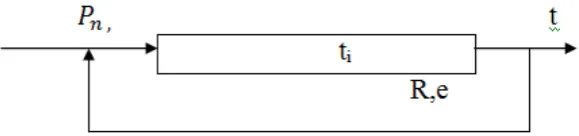
In such a case, a value of error is . The system will operate in the mode of automatic control. Control is performed by operating speed . It will ensure rhythmic output or rhythmic completion of work phases (Figure 1).
Figure 1. Operation Model of the System Operational Planning – Production Management
For the purpose of ensuring of suggested mode of operation of the production management mechanism, operational planning improvement and enhancement should be an obvious prerequisite. First of all, it is coordination of operational planning and production management mechanism, coordination of rhythmicity of new decisions with production rhythmicity
.
Now the initial idea that planning improvement is an essential part, a fundamental principle of operation of dynamic mechanism of production management is getting more and more convincing.
This production management mechanism should be considered in forming an organizational structure of the company’s management. The organizational management structure is a synthesis of arrangement thereof and the company’s organization. The structure determines positions in the system; organization determines a way of connections between them in the course of production of ultimate products. As the latest practical experience shows, the new phase of the development of the organizational structure of management resulted in certain positive outcome. However, the management system keeps being reformed in Kazakhstan (Kubaev, 2013).
Production management is improved based on the principle of the fullest reflection of the system of production relations and correspondence to the reproduction process (set by its organizational structure (set ):
(3)
Deepening differentiation of labour in manufacture of industrial products due to scientific and technological advance determines the need in consistent improvement of the management organizational structure. Improvement of management organizational structures is a prerequisite and condition for a new phase of improvement of the management system. Management organizational structure is formed in line with the production structure according to model (4) based on the determination of central phases ,
in the course of spatial-temporal transformation of natural potential and flow of resources into final product . The fullest provision of production is a target function of . A combination of elements of the structure of social production is determined by management functions ,:
, or ; (4)
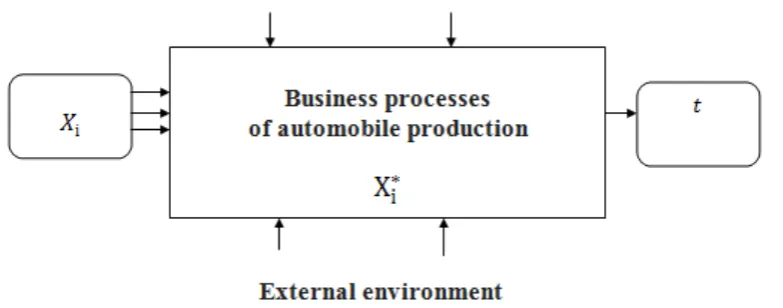
The management organizational structure is built based on the relations (R) between set Х and Ү- ХRY, determining direct and reverse relations between the elements of the production structure and management functions. Figure 2 demonstrates a dynamic model of formation of organizational structure of production management.
Figure. 2. Model of Formation of Organizational Structure of Industrial Production Management.
cars; there are a lot of business processes. They take different time and number of operational units.
Firstly, we will show an economic essence of such business based on the famous diagram of monetary movement ) and commodity ) production ).
(5) where
Secondly, component parts (p – commodities) are purchased at the beginning of the production process, then a car ) is manufactured using such component parts and sold for a price higher than amount of costs of component parts and receive profit ).
We should include the basic organizational criteria – t – production rhythm in time in order to ensure production rhythmicity. Other business processes should be connected to this parameter. Then based on the market signals and company’s potential capacities we should include economic parameters, such as - market price for the product (in this particular case, a car); – expected profitability, %;
- annual reserve of labour time of assembly workshop, time; – annual production program, units.
Then the production rhythm can be calculated according to the formula: (6)
Now we should perform all business processes according to – production rhythm so that production operated rhythmically (like clockwork). It can be demonstrated with the help of the following model (Figure 3).
Then we should designate major business processes of the car assembly: • , – body purchase and installation;
•
, – engine production and installation;•
, – gearbox purchase and installation;•
, – rear axle purchase and installation;•
, – front axle purchase and installation;•
, – facing purchase and installation;•
, – steering gear purchase and installation;•
, – wheel purchase and installation;•
, – brake system purchase and installation; and•
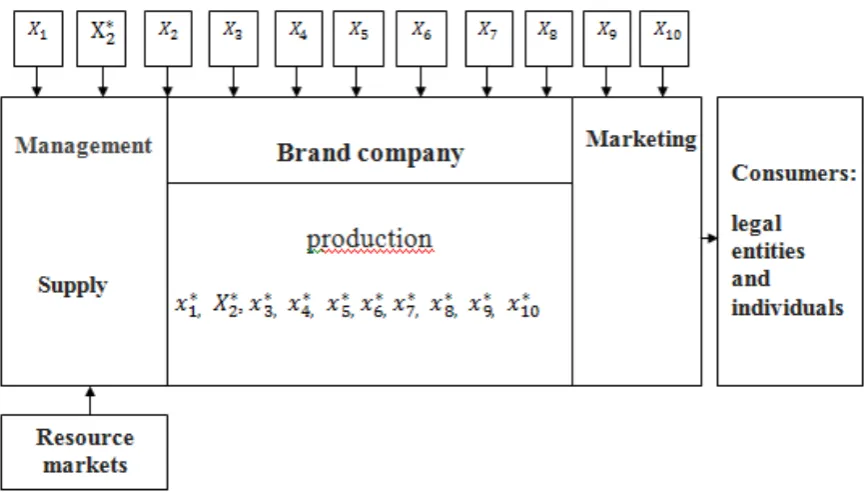
– paint purchase and painting.Now we will demonstrate it as a structural model of organization of modern automotive manufacturing (Figure 4).
Figure 4. Structural Model of Organization of Modern Automotive Manufacturing using Information Technologies
Let us determine key economic parameters of the company’s operation:
–
income from sale of products with indirect taxes - Iх;–
total annual income – TAI = Iх-(VAT- excise taxes);–
taxable income – TI = (TAI – all deductions);–
balance-sheet profit – P (reserve fund + insurance fund + dividend fund).All calculations were made in a table form known to financiers (appendix).
The company’s goal. The company has a potential that enable the top management to believe that the company can operate within the following profitability limits:
The managerial objective of the company’s CEO and CEO’s team:
between and .
Profitability r in this objective depends on 20 factors:
The abovementioned big number of factors affects the company’s profitability:
Now let us calculate the company’s profitability:
ANALYSIS OF THE RESEARCH RESULTS
Now we should determine earlier values of business processes ( , car manufacture and assembly:
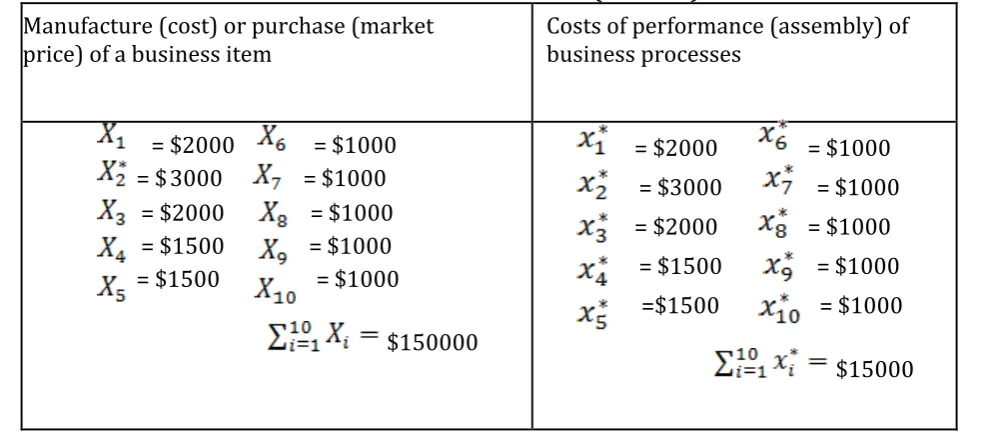
Table 1
Values of Business Processes (Х1….Х10)
Manufacture (cost) or purchase (market
price) of a business item Costs of performance (assembly) of business processes
= $2000 = $1000 = $ 3000 = $1000
= $2000 = $1000 = $1500 = $1000
= $1500 = $1000
$150000
= $2000 = $1000 = $3000 = $1000 = $2000 = $1000
= $1500 = $1000
=$1500 = $1000
Let us confirm the annual production program – 520 units per year. The classical formula of car (С) production cost is as follows:
С = М + ЗР + А + Н; (7)
where М – cost of purchase Хi(М1) and installation (М2) - Х*I; М = М1 + М2); of machines; S– cost of base (B) and additional (As) salary;
А– costs of depreciation expenses for fixed assets of automotive manufacture; O– overhead expenses.
Thus, as a result of calculations we obtained the following company’s parameters:
–
income from sale of cars (Iх) – US$26,000K;–
total annual income (TAI) – US$234,000K;–
cost of car production (С) – US$15,600K;–
income (TI) – US$7,800K;–
profit from sale of one car – US$10K;–
balance-sheet profit (Pr) - US$16,720K;–
market price for a car – US$50K;–
company’s profitability – 33.3 %.CONCLUSION
Operational planning, management organizational structure and production management are connected through a single economic management mechanism.
1. Rational operational planning is considered and used herein as a major instrument, a fundamental principle of rhythmic operation of industrial production.
2. Operational planning is linked to the production management herein to ensure production rhythmicity.
3. Continuity of processes of operational planning and production management is ensued in operation.
References
Anopchenko T. Y., Boyeva К. Y., Volodin R. S. Modern Management Methods. Teaching Aid for Bachelors. M.: Knorus, 2016. – 316 p.
Bussygin А. V. Economic Mechanism of an Enterprise and Profitability Management – М.: Econom-Inform, 2008. – 160 p.
Demchenko О. F. Economic and Mathematical Simulation of Organizational Structure of Russian Aviation Industry Enterprise//Newsletter of M.F. Reshetnev Siberian State Aerospace University No. 6, 2006, p. 231-237.
Drucker P. Management Challenges for the 21st Century. / Translated from English by Natalya Makarova.-М.: Mann, Ivanov and Ferber, 2012. – 256 p.
Kubayev К.Y. Efficient Public Management. / Monograph. – Almaty, Sagaudinova Publishing House, 2013. – 234 p. Coulman А. Economic Mechanisms: Translated from French; under the general editorship of N.I. Khrustaleva. М.: Progress; Universe, 1993. – 92 p.
Management Mechanisms: / Under the editorship of D. А. Novikov – М.: Editorial URSS, 2011. (Smart Management). – 216 p.
The Governmental Rules dated June 14, 2002 No. 647 The Rules for Development of Indicative Plans of Social and Economic Development of the Republic of Kazakhstan.
Savinykh V.N. Mathematical Simulation in Production and Financial Management. Teaching Aid. Knorus, 2016, – 192 p.
Order of the President of the Republic of Kazakhstan On the Concept of Transition of the Republic of Kazakhstan to Sustainable Development for Years 2007 – 2024.
Shikin Y.V., Chkhartishvili А.G. Mathematical Methods and Models in Management. – М.:Delo, 2004 – 440 p. Walter Nicholson and Christopher Snyder. Intermediate Microeconomics and Its Application. South-Western Cengage Learning. 2010, – 653 p.
Description of income and expenses Formula Value, K USD 1. Income from sale of products with
indirect taxes (Iх) Iх = N*Р 26 000
2. а) VAT 10% of Line 1 2 600
c) Excise taxes 0
3. Income from sale of products without 23 400
indirect taxes 0
4. Other income
5. Total annual income (TAI) Line 3 +Line 4 23400 6. Deductions:
7. Cost of cars sold Line 8 + Line 9 +Line 10 15 600
including: + Line 11+ Line 12
8.Salary fund 13000
9.Deductions for public social insurance 2 690
9а) pension fund 10% of MCI (24,459) 2446
9b) Social Insurance Fund Line 9*5%
9c) Compulsory Health Insurance Fund Line 9* 5 % 122
10.Deductions to the employment fund Line 8*2 122 11. Deductions to the road fund Line 1*0.1%
12. Other expenses (material costs, 2600
depreciation expenses, repair expenses, etc.):
12а) Buildings and facilities 10% of cost
12б) Machines and equipment 25% of cost 10% of 500 млн.
12в) Computers and software 40% of cost = 50 000.
13. Percentage to cost 25% of 250 000 =
62 500
10 000 14. Local taxes and charges, including 14а)
vehicle tax 14b) land tax
14c) property tax 15. Total deductions 16. Taxable income (TI)
17. Income tax from legal entities (%) 18. Other taxes and charges, total
including:
-
tax for securities transactions;-
bonuses;-
water charge;- royalty;
- import customs duties;
- export customs duties;
- customs control and procedures;
- stamp duties;
- nature conservation fund
Line 7+Line 14
Line 5- Line 15 23 400 23 400 20% of TI
4 680 2 000
19. Total tax withholdings Line 2+Line 9+ Line10 22 300 20. Percentage of tax withholdings in +Line 11+Line 14+
total amount of TAI with indirect taxes, Line 19/ (Line 1+ Line 85,8%
% 4)*100%
21. Percentage of tax withholdings in
TAI without indirect taxes, % 92,3%
22. Percentage of tax withholdings in
total volume of net product (TAI with Line 19/ Line 5*100% 92,3% indirect taxes less other expenses)
23. Profit left in the company’s Line 16- Line 17- Line.18 16 720 Possession
24. Percentage of profit left in the