Published online May 2, 2013 (http://www.sciencepublishinggroup.com/j/ijmsa) doi: 10.11648/j.ijmsa.20130203.12
A practical electrode for microwave plasma processes
Hiromichi Toyota*, Shinfuku nomura, Shinobu Mukasa
Graduate School of Science and Engineering, Ehime University, 3 Bunkyo-cho, Matsuyama, Ehime 791-8577, Japan
Email address:
[email protected] (H. Toyota), [email protected] (S. Nomura), [email protected] (S. Mukasa)
To cite this article:
Hiromichi Toyota, Shinfuku nomura, Shinobu Mukasa. A Practical Electrode for Microwave Plasma Processes, International Journal of Materials Science and Applications. Vol. 2, No. 3, 2013, pp. 83-88. doi: 10.11648/j.ijmsa.20130203.12
Abstract:
In-liquid plasma chemical vapor deposition (CVD) method is useful for high speed production of high quality diamond films. The method is simple and secure comparing usual CVD methods. In this paper, new electrodes for in-liquid plasma CVD by receiving microwaves are developed and introduced. This paper examines the fabrication of electrodes that enable the generation of plasma by effectively receiving microwaves. The fabricated electrodes are used to generate plasma in a waste liquid and the performance of the electrode is evaluated by the speed at which gases are created by decomposing the liquid. By using experiments in decomposing n-dodecane using in-liquid plasma and through detailed investigation into the length of the electrode used, it is confirmed that the half wavelength is optimal for the generation of plasma. The fabri-cated electrodes are used to test the formation of diamond film by plasma CVD in the microwave oven. Diamond film is successfully created inside microwave oven by using the vapor from a mixture of methanol and ethanol.Keywords:
In-Liquid Plasma, Electrode, Microwave, Plasma CVD1. Introduction
Currently, technologies using plasma are being widely used in the field of materials processing. Plasma has unique physical and chemical characteristics and is being used in a wide range of fields including electric power generation, light source, processing and decomposing materials. Plas-ma chemical vapor deposition (CVD), which uses the high chemical reactivity of plasma, is used in the formation of films and etching and has become an indispensable tech-nology for the manufacturing of solar cells and liquid crys-tal displays. And it is being widely researched as a method for synthesizing new materials [1-4].
The methods for generating plasma include methods that use AC or DC high voltage and methods that use micro-waves. When microwaves are being used for plasma CVD, highly dense plasma can be achieved and films can be formed at high speeds [5]. Plasma CVD in which electrodes are combined with microwaves has also been widely used [6,7]. With this method, if efficient electrodes are used, starting and maintaining the discharge becomes easy and plasma can be generated with low electrical power. Plasma can also be generated in under high atmospheric pressures or in liquids, which have high molecular density and make it easier to start and maintain the generation of plasma, which enables faster film formation than plasma CVD that does not use electrodes. Furthermore, once plasma has been
generated in liquid the temperature of the plasma gas reaches 3000K, so there is much anticipation about this high temperature condition being used as a method for ex-tracting fuel gases such hydrogen by decomposing toxic liquids such as waste oil [8].
forma-tion of diamond film by plasma CVD in the microwave oven.
2. Examination of the Electrodes
When a 60 mm length, 1 mm diameter metal rod is placed inside a microwave oven, plasma will be created at both ends of the rod. Based on this, it is thought that in addition to the minute conductive properties of the rod, the length of the rod also affects the field strength at the ends of the rod. The
wavelength λ of the electromagnetic waves inside the
mi-crowave oven can be calculated by using the following formula.
1
r
c f λ
ε
= ⋅ (1)
Where, c is the speed of light in a vacuum, f is the
oscil-lating frequency, and εr is the relative permittivity of the
medium. The frequency of microwaves in a microwave oven is stipulated by law at 2.45 GHz, so the wave length in air inside the microwave oven is 122.4 mm. The 60 mm long metal rod referenced above is nearly a half a wave length. It is thought that the length of the rod being near a half a wave length is one of the causes of generation of the plasma. Based on this, when a flat sheet of copper measur-ing 0.2 mm thick and 3 mm wide is machined to have sharpened ends and be the length of half a wave length (61.2 mm), the ends of that copper sheet will generate plasma when placed in a microwave oven. Based on these results, research was conducted into the dimensions and shape of an electrode that is suitable for the generation of plasma. First, in order to confirm that the half wave length is the most suitable for the generation of plasma, the length of the electrode was changed from 30 mm to 250 mm, 1 mm at time, and the behavior of the plasma was observed for each length. The results showed that plasma was only generated when the electrode length was near 2λ, 3λ/2, λ,
λ/2. Next, the shape of the electrode was investigated. The
shape of the electrode that was suitable for the generation of plasma was investigated by creating different shapes, such as ring shapes or cross shapes formed from the com-bination of two rods.
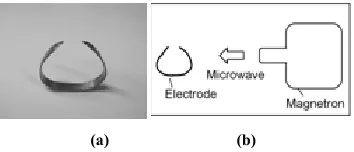
Figure 1 shows the shape when the largest and most stable plasma was generated. An electrode in the shape shown in Fig. 1 was placed in a microwave oven. Figure 2 is a pho-tograph of it generating plasma. The length of the electrode
for generating stable plasma at this shape was around λ/2 and
within 3 mm. Stable plasma was not generated at other lengths. The above reason is that the microwave resonance occurs by the adequate length of the electrode and the elec-tric field strength between the twin tops of the electrode of Fig.1 is amplified by the positive and negative twin charges. This electrode is capable of generating a large amount of stable plasma in different atmospheres, such as nitrogen, hydrogen and argon. Moreover, the same type of plasma can be generated in liquid. For example, if the liquid is
n-dodecane, which does not have electrical dipole moment in its molecular structure, plasma can be generated if the length of the electrode has been determined by calculating the wavelength by using the dielectric constant of the liquid. However, when the molecular structure has electrical dipole moment, such as water or alcohol, plasma cannot be gener-ated because the microwaves are absorbed by the liquid.
(a) (b)
Figure 1. (a) A picture of the optimal shape of an electrode for generating plasma. (b) The relationship between the direction of the electrode and the generation of the microwaves. The direction of the electrode is also a critical factor in the stable generation of plasma.
Figure 2. Photograph of plasma generation in air.
3. Performance of the Electrodes
The performance of the electrode shown in Fig.1 was investigated by generating in-liquid plasma in a microwave and conducting experiments on the decomposing of liquids. Detailed investigation into the optimal length of the elec-trode was conducted. The length of the elecelec-trode was set using the standard of one half the wave length attained from equation (1), which was changed to ± 3 mm, in increments of 0.5 mm. Experiments into the decomposing of liquids were then conducted. Here, n-dodecane was used as the base material for the solution for generating the in-liquid plasma. n-dodecane can be broken down to hydrogen and carbon by the in-liquid plasma. The performance of the electrode and its optimal length could be investigated by examining its efficiency in generating hydrogen.
Figure 3. Outline of experimental equipment for decompose of n-dodecane.
The procedure of the experiment is shown below. First, 500 ml of n-dodecane is placed in the container and the tubing is set up. For safety, the inside of the container is filled with argon gas to dispel any air. Once the charging with argon gas is stopped, the power for the microwave is turned on and the gases generated are collected by above-water exchange. Measurement is taken until 1000 ml has accumulated. Using the above-referenced procedure, the length of the electrode is changed up or down from 46 mm in increments of 0.5 mm and used as an electrode and the hy-drogen generation speeds are compared based on the dif-ference in length.
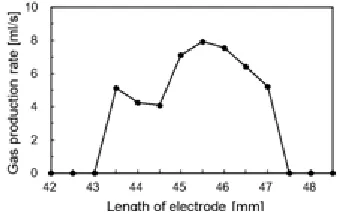
The results of the experiment are shown in Fig. 4. The electrode that was slightly shorter than the theoretical wa-velength had the highest hydrogen generation speed. Since the wavelength from a commercial microwave oven is not necessarily 2.45 GHz and can be different among models, an electrode length that is half a wave length is considered to be best. In addition, when the electrode was made into the round shape as shown in Fig. 1, it did not affect the maxi-mum length.
Figure 4. Length of the electrode and production speed of gas.
Next, investigation was made into whether increasing the number of electrodes would improve the efficiency of ge-nerating hydrogen. The results of the experiment are shown in Fig. 5. The arrangement of the electrodes at that time is shown in Fig. 6. Increasing the number of electrodes in-creased the speed at which the hydrogen was generated. The results are explained by the propagating properties of mi-crowaves in a microwave oven. When there was only one electrode, it could not receive all the microwaves inside the microwave oven, and after plasma ignition, the distribution of the electromagnetic field became non-uniform. Therefore,
increasing the number of electrodes could allow reception of all of the microwaves and enable plasma to be efficiently generated. However, it was found that at seven electrodes, the efficiency of hydrogen generation dropped. This led to the conclusion that electromagnetic power loss by the re-sonant current of the electrodes increased, therefore de-creasing the efficiency of hydrogen generation. During this testing, hydrogen was generated most efficiently when there were six electrodes. It required 560 kJ to make 1 mol of hydrogen. [=(0.5kW×37.4 s/l) / (0.0446 mol/l×0.74(74%))]. In experiments in the past using different electrodes in ex-periments for decomposing n-dodecane, the generation of hydrogen required 640 kJ/mol [8].
Figure 5. The number of the electrodes and production speed of gas.
Figure 6. Arrangement of the electrode.
Therefore, it could be said that the electrodes created for this experiment manufactured hydrogen at high efficiency. Further improvement in the efficiency of manufacturing hydrogen can be expected by a better arrangement of the electrodes.
4. Utilizing in microwave plasma CVD
The fabricated electrodes are used to test the formation of diamond film by plasma CVD. It is well known that a mixture of hydrogen and a small amount of methane in the raw material is used when creating diamond film by plasma CVD [11-15,19]. However, since metal parts cannot be used inside the microwave oven, high levels of sealing cannot be ensured. Because of this, there are issues with safety in this method in which large amounts of hydrogen gas are flowing. There has been research into forming amond film without using hydrogen gas, but quality di-amond film has not been achieved when using them [16,17]. On the other hand, with the in-liquid plasma CVD method, when the raw material is being handled as a liquid, it is easy to handle [18]. When diamonds are created using in-liquid plasma, a solvent that has methanol as its main ingredient is used, but since methanol has a molecular structure that has electrical dipole moment, it absorbs the microwaves, making it difficult to generate stable plasma. The conditions for the raw material for creating diamond film by plasma CVD were determined based on a large amount of past data in which the mol ratios for the base elements are determined by using the Bachmann C-H-O diagram [19]. There is no liquid without polarity that has a mol ratio for synthesizing being absorbed. In this research, a mixture of methanol and ethanol was vaporized and used as the base material for the diamonds. Vaporizing reduces the friction among the molecules so the microwaves can reach the electrodes without being absorbed. This enables stable plasma to be generated.
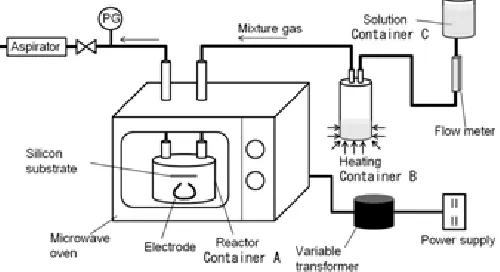
An outline of the equipment used in the experiment is shown Fig. 7. Pyrex® glass container A is placed in the microwave oven. An electrode that has been fabricated to the shape shown in Fig. 1 from a 0.1 mm sheet of tungsten is secured in position. In addition, a sheet of silicon sub-strate that has undergone a diamond polishing treatment is secured in position at 1.5 mm at the top of the electrode. The dimensions of the silicon substrate are 30 mm long, 10 mm wide and 0.67 mm thick. The parts used for securing the electrode and substrate in container A have been made using PTFE and ceramics. One end of the hose that has been passed to container A is connected to the aspirator and the pressure inside the container is reduced. The other hose is connected to glass container B. Glass container B is heated as usual and when the liquid mixture that has been drawn by the aspirator flows into glass container B, it im-mediately vaporized and becomes vapor in reaction con-tainer A. A flow regulating device was installed between container B and container C, which is used for supplying the solution, and the amount of the solution that is flowing into the heater section of container B is adjusted. An ad-justable transformer was connected to the microwave oven and the high voltage to the magnetron is changed to adjust the output of the microwaves. By adjusting the output of the microwaves, the strength of the plasma can be trolled, enabling the temperature of the substrate to be con-trolled. The temperature of the substrate is measured by an infrared thermometer. The creation of the film was moni-tored by a scanning electronic microscope (SEM) and the formation of the crystals was investigated by using Raman spectroscopy.
Figure 7. Outline of experimental equipment for microwave plasma CVD.
The test conditions were set as follows. When a liquid mixture of methanol and ethanol is used to create diamonds by in-liquid plasma, the optimal temperature of the
sub-strate is 650 ℃ [20]. However, in this experiment the
temperature of the substrate was set to 750 ℃ because it is
expected that in the case of in-liquid plasma the bubbles that are generated and surrounding liquid will cause a tem-perature that is lower than the actual temtem-perature to be measured. The mixture ratio of the solution is 95:5 metha-nol: ethanol, which is the optimal mixture for in-liquid plasma. The pressure inside the container was set at 20 kPa
because if it is too low, plasma will be generated from the substrate or other unanticipated locations. The amount of fluid used was 20 ml/min and the duration of the experi-ment was 10 minutes. The bluish-white light region of the plasma came in contact with the substrate whose reverse side became red from the plasma heat, and this condition was maintained for a synthesizing time of 10 minutes.
par-ticle formations. A clear peak at 1333 cm-1 could be con-firmed, which indicates diamonds on the Raman spectrum. The FWHM of the peak is 6.1 cm-1, which indicates that the synthesized diamonds have the same average qualities as the diamonds synthesized using general plasma CVD. From this it could be determined that diamonds had been formed. Based on the above, it is possible to create di-amonds by using the electrode in the shape shown in Fig. 1 to receive the microwaves that are flying about in the open space inside a microwave oven and generate the plasma. It became clear that diamonds could be created by using pulse-shaped microwaves that have been oscillated by a magnetron that is operating on the half-wave rectified DC voltage that is used in commercially available microwave ovens.
(a) (b)
(c)
Figure 8. (a) Overall SEM photograph of the film created. (b) SEM pho-tograph of the center section of the film created. (c) Raman spectrum of the center section.
5. Conclusions
In this research a method for generating plasma inside a microwave oven was investigated and an electrode suitable for generating plasma was fabricated. By using experiments in decomposing n-dodecane using in-liquid plasma and through detailed investigation into the length of the elec-trode used, it was confirmed that the half wavelength was optimal for the generation of plasma. It is possible to crease the efficiency of decomposing n-dodecane by in-creasing the number of electrodes. Tests were conducted into creating diamond film by using these electrodes in plasma CVD. Diamond film was successfully created inside microwave oven by using the vapor from a mixture of me-thanol and eme-thanol.
Acknowledgements
This work was partially supported by Grants-in-Aid from
the Ministry of Education, Culture, Sports, Science and Technology of Japan (No.23360326).
References
[1] S. Yugo, T. Kanai, T. Kimura, and T. Muto, “Generation of diamond nuclei by electric field in plasma chemical vapor deposition,” Appl. Phys. Lett., vol. 58, pp. 1036-1038, Sep-tember 1990.
[2] Z. Sun, C.H. Lin, Y.L. Lee, J.R. Shi, B.K. Tay, X. Shi, “Ef-fects on the deposition and mechanical properties of di-amond-like carbon film using different inert gases in me-thane plasma,” Thin Solid Films, pp. 198-202, 2000.
[3] L.C. Qin, D. Zhou, A.R. Krauss, and D.M. Gruen, “Growing carbon nanotubes by microwave plasma-enhanced chemical vapor deposition,” Appl. Phys. Lett., vol. 72, pp. 3437–3439, November 1997.
[4] H.S. Kim, Y.J. Parka, I.H. Choi, Y-.J. Baik, “β-SiC Thin film growth using microwave plasma activated CH4-SiH4 sources,” Thin Solid Films,vol. 341, pp. 42-46, 1999.
[5] J. Wei, H. Kawarada, J. Suzuki and A. Hiraki, “Growth of diamond films at low pressure using magneto-microwave plasma CVD,” J. Crystal Growth, vol. 99, 1201-1205, 1990.
[6] K. Mitani, “The direct current associated with microwave gas discharge between coaxial cylinders,” J. Phys. Society of Japan, vol. 7, No. 6, pp. 634-636, July 1952.
[7] L. Bardosh and Yu. A. Lebedev, “Spherical microwave elec-trode discharge. Phenomenology and results of probe mea-surements,” TECHNICAL PHYSICS, vol. 43, No. 12. pp. 1428-1431, July 1997.
[8] S. Nomura, H. Toyota, S. Mukasa, H. Yamashita, T. Maeha-ra, and A. Kawashima, “Production of hydrogen in a con-ventional microwave oven,” J. Appl. Phys., vol. 106, pp. 073306-1-073306-4, June 2009.
[9] M. Miosan, G. Sauve, Z. Zakrewski and J. Hubert, “An atmospheric pressure waveguide-fed microwave plasma torch: the TIA design,” Plasma Source Sci. Technol., vol. 3, pp. 584-592, August 1994.
[10] B. Cranganu-Cretua, F. I. Hantila, T. Leuca, “Microwave ovens electromagnetic field analysis by means of boundary element method,” Journal of Materials Processing Technol-ogy, vol. 161, pp. 305-310, 2005.
[11] M. Kamo, “Synthesis of diamond from gas phase and its properties,” THE RIGAKU JOURNAL, vol. 7, No. 2, pp. 22-27, 1990.
[12] V. Mortet, A. Kromka, R. Kravets, J. Rosa, V. Vorlicek, J. Zemek, M. Vanecek, “Investigation of diamond growth at high pressure by microwave plasma chemical vapor deposi-tion,” Diamond Relat. Mater., vol. 13, pp. 604-609, 2004.
[13] A. Chayahara, Y. Mokuno, Y. Horino, Y. Takasu, H. Kato, H. Yoshikawa, N. Fujimori, “The effect of nitrogen addition during high-rate homoepitaxial growth of diamond by mi-crowave plasma CVD,” Diamond Relat. Mater., vol. 13, pp. 1954-1958, September 2004.
high-quality homoepitaxial diamond (100) films,” Diamond Relat. Mater., vol. 14, pp. 255-260, January 2005.
[15] X. Li, J. Perkins, R. Collazo, R. J. Nemanich, Z. Sitar, “In-vestigation of the effect of the total pressure and methane concentration on the growth rate and quality of diamond thin films grown by MPCVD,” Diamond Relat. Mater., vol. 15, pp. 1784-1788, November 2006.
[16] Y. Tzeng, Y. K. Liu, “Diamond CVD by microwave plasmas in argon-diluted methane without or with 2% hydrogen ad-ditive,” Diamond Relat. Mater., vol. 14, pp. 261-265, De-cember 2004.
[17] S. Hiraga, S. Shimada, Y. Takagi, K. Kuribayashi, T. Haya-shi, “Hydrogen-free CVD diamond synthesis,” Superlattices and Microstructures, vol. 40, pp. 519–525, September 2006.
[18] H. Toyota, S. Nomura, S. Mukasa, H. Yamashita, T. Shimo, S. Okuda, “A consideration of ternary C–H–O diagram for diamond deposition using microwave in-liquid and gas phase plasma,” Diamond Relat. Mater., vol. 20, pp. 1255-1258, July 2011.
[19] P. K. Bachmann, D. Leers, H. Lydtin, “Toword a general concept of diamond chemical vapour deposition,” Diamond Relat. Mater., vol. 1, pp. 1-12, July 1991.