http://www.sciencepublishinggroup.com/j/ss doi: 10.11648/j.ss.20180705.12
ISSN: 2326-9863 (Print); ISSN: 2326-988X (Online)
Structural Analysis of the Cooperation Network Among the
Tourist Accommodation Actors in Santa Clara City, Cuba
Kenia Alvarez Cepero
1, Hallén Boffil López
1, Roberto Muñoz González
21Department of Tourism, Faculty of Economic Sciences, Central University “Marta Abreu” of Las Villas, Santa Clara, Cuba 2Department of Economics, Faculty of economic Sciences, Central University “Marta Abreu” of Las Villas, Santa Clara, Cuba
Email address:
To cite this article:
Kenia Alvarez Cepero, Hallén Boffil López, Roberto Muñoz González. Structural Analysis of the Cooperation Network Among the Tourist Accommodation Actors in Santa Clara City, Cuba. Social Sciences. Vol. 7, No. 5, 2018, pp. 211-215. doi: 10.11648/j.ss.20180705.12
Received: June 15, 2018; Accepted: August 16, 2018; Published: October 11, 2018
Abstract:
Today’s world is experiencing how the hospitality and travel industry takes off, tourism has become into the revitalizing activity of many emerging economies, and this is the reason for its constant evolution and complexity. The Accommodation Section as the operative base of the hospitality sector has started a development in a series of steps, at the same time that managing it turns even more difficult if the deepest characteristics aren´t studied properly. In Cuba, specifically in Santa Clara City there are problems to carry out an efficient management of the tourist accommodations section, due to the lack of more complex studies showing important structural aspects regarding to the relationships between the accommodation actors. This circumstance leads, necessarily, to set in motion new analytical perspectives of tourist accommodation which go beyond the traditional ones. Taking into consideration the above expressed it is proposed a structural analysis of the relationship networks between the tourist accommodation actors in Santa Clara Municipality, taking as methodological foundation the procedure presented by Alvarez 2015, using quantitative and qualitative techniques, data processing will be made in The UCINET 6 Software for analyzing social networks, using also the Complete Networks Method. The results show difference in interests, low centrality measures, and low density that is why analytical fundaments are proposed in order to improve the existent network.Keywords:
Tourism, Accommodation, Actors, Networks, Centrality Measures1. Introduction
Network analysis is a thriving research area that has been incorporated into the study of tourism systems. In tourism, there are four remarkable actors, which have a great capacity to influence and shape the territory: the local community, the state sector, the private sector and the tourist, which are not part of the territory, formed as a destination, however, the symbolic appropriation power they exert in that space is very important [11]. The scientific literature has been insisting that the capacity of tourism development in a territory is directly related to the willingness of the actors to establish connections among themselves [3] being involved in a coordinated and joint way in the improvement of the conditions of the territory to assume the challenges derived from these processes [16]. At the same time, the cooperation encourages the private additional investment, as well
contributes to diminish the public deficits, delivers public resources for other purposes, and in general stimulates the economy as a whole [13].
province due to the number of tourist attractions present in the municipality, mainly the historical-cultural and architectural providing a tourist offer of quality and consistent with the demands of today's world. The geographical location in the center of the country and the presence of the Abel Santamaría International Airport, give the municipality the possibility of easy national and international access.
The Tourist Offer of the territory includes various activities, such as accommodation, catering, leisure and recreation, transportation, and other tourism support services. In terms of tourist accommodation, there are to date 338 private homes operating in convertible currency (CUC), 98 more than on the same date in 2016; and four hotels, three of them operate under the brand named Cubanacán (Los Caneyes, Villa la Granjita and América) and one under the Islazul (Santa Clara Libre) chain. Note that particularly in this territory, as in others within the country, the private-individual offer of accommodation is higher than state offer in the number of rooms and growth trends, in this case the difference is 194 rooms. The number of rooms ascribed to this sector is 24000 according to official figures published in
FITUR1 2018, which represents 35.2% of the existing rooms
in Cuba. [14]
Note that visitors to the municipality organize their trip either individually or through travel agencies. Mainly the people, culture and heritage give the main travel reason for those who choose to visit Santa Clara. In this aspect, the worldwide influence of the figure of Ernesto ‘Che’ Guevara in the history of the nation is relevant.
The average stay does not show high numbers in the territory, since the tourism that develops is mostly transit, and is in the range of 1.6 and 1.8 days in hotels. Although it is remarkable average stay in private homes, which is about 2.4 days.
2. Methods
In general, the municipality presents a medium tourism potential, highlighting the tourist and anthropic indicators, especially the equipment and services available, as well as the receptivity and human qualities of the local population with the environmental and perception indicators being the most unfavorable. The implementation of the guidelines of the Economic and Social Policy of the Party and the Cuban Revolution, approved at the 6th Congress of the PCC, has allowed the increase of the housing fund with the development of new options for private-individual accommodation and diversification of the offer gastronomic. Despite local development initiatives, centralization and concentration remain to make specific decisions
In the consulted bibliography, you can find different authors who present their methodologies for the analysis of networks that present differences and similarities. One of the methodological approaches is based on the identification of
1 FITUR 2018. International Tourism Fair, Cuba 2018
tourism stakeholders in a territory and from there to operate on the relationships established between them [16], another proposes a procedure where establishes 6 stages with their respective techniques in each of them [4] and also some authors use matrixes of analysis for the study of relationships [6]. The debate on the relevance of qualitative or quantitative approaches applied to networks is also present in tourism, as in other areas of study. Although there is an increasing number of investigations that include the analysis process in which the interested actors participate, there is still no methodological body of scientifically agreed analysis. Therefore, the procedure for the definition of integrated cooperation strategies among the actors of the tourist accommodation of a territory, provided by Alvarez, 2015[2, 3], is proposed. This proposal would facilitate as a result the necessary strategies to establish the relational structure oriented on the side of establishing the principles for the management of relations between actors of the tourist accommodation in Cuba. It consists of five (5) stages and twelve (12) tasks. Each stage includes objectives to be developed and the tasks define how to achieve the proposed objectives Stage four (4) aims to evaluate the current network of tourism cooperation between public and private actors of the tourist accommodation in the municipality of Santa Clara from the use of scientifically based procedures for the formation of cooperation networks. For the analysis of networks applied statistical tools and measurement of relational dynamics between said actors: Centrality measures and relationship dynamics of possible networks to conform.
3. Result and Discussion
Identification and characterization of the public and private-individual actors of the tourist accommodation in the territory.
The private-individual tourist accommodation sector consists of households with permission to offer existing tourist accommodation in the town (338 houses), with an average of 2.6 rooms, for 591 rooms for tourist explotation.
The public actors of the tourist accommodation are all those hotels that are in the city, whose administration and direction is the responsibility of the state. Currently there are four hotels, operating under two hotel chains, which together has 359 rooms.
center of the city where most of the houses that provide accommodation services for tourism are located. The selection of the actors was made under the criteria of proximity to the historic center of the city, importance and relevance in the field of accommodation in the municipality, most of the lessors of rooms in private homes (32), four (4) hotels and four (4) travel agencies that operate in the city.
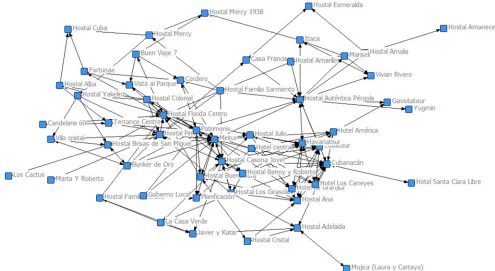
From the determination of the associative interests, it was possible to determine that the main areas where the actors involved are willing to collaborate are: Supply of raw materials, Research and information supply, as well as Promotion and Advertising; and the network of relations among actors of the tourist accommodation in the Municipality of Santa Clara is drawn.
Figure 1. Current network of relations of the actors of the tourist accommodation in the municipality of Santa Clara Own elaboration from UCINET 6.
In the graphical representation of the network there is not defined a single central actor but there are several actors who tend to be central, so that the network tends to be multicentral. Can be seen a clear tendency to move away from the type of star, which marks the intense links that maintain a high number of actors for the development of tourism activities in the municipality. The index of centralization of the network (Centralization of the network (Output) = 15.785%; Centralization of the network (Input) = 17.868%, data of the UCINET 6) have very low values meaning that the network does not respond to a specific center by what, the positional advantages of the actors in the network are distributed in a similar way.
In the section of centrality that the software provides us with the values for each one of the actors that make up the network. It can be noticed that there is no significant difference between the degree of each one, which is to say that each one is related as average with the same number of actors. We conclude that there is more than one central actor in the network, that is, there is more than one leader in the accommodation activity in the municipality. All the actors have a low degree of centrality; even those who lead the list of centrality. It is also necessary to point out that there are actors who do not present an output centrality degree. The normalized centrality, from the descriptive statistics, shows
that each actor is related as an average with 4 actors in the network. The maximum value of actors with which each node in the network is related is 11 and the minimum is 0, that is, there are no loose nodes in the network, but each one has a relationship with at least one actor.
If we distinguish between the Input and Output Degree, we appreciate that there is actor 6 (Hostal Florida Centro) whose NInDegree exceeds everyone’s in the network. This makes him the most prominent or prestigious actor in the network, which means that there is a considerable percentage of the actors who resort to him to start joint tourist activities. Calculating the coefficient of variation of the Network (72%), starting from: σ ̅ 100, where σ is the standard deviation and ̅ is the mean, indicates that there is dispersion in the network, given by the peripheral nodes. The center of the network is not defined and several nodes have similar positions in the network.
Another of the analyzed indicators is the Relational Density that determines the volume of relationships established between the housing stakeholders of the municipality and that is determined as follows:
( -1) 100 = 1 where (y) is the number of
existing relations and (x) the number of nodes, like this:
There is a low relational level; the links are very poor considering the number of actors we are working with. Making an estimate of the mean per interval, we have that:
1) = { ̅ ± } Where ̅ is the mean of relations, K
is the confidence percentile in this case for 95% and E is the error
2) = σ√ 2.747.07 = 0.38
Substituting 2 in 1
Im = 3.42 1.96 x 0.38 = 3.42 - 1.96 x 0.38
Im = 4.16≈5 = 2.68 ≈2
[2; 5]
This result shows a low level of network density since 95% of the actors will be connected on average with 2, 3, 4, or 5 actors of the network.
Another important and widely accepted indicator is the Bonacich Power Index; in this case, Bonacich proposes a modification of the traditional centrality approach. The graph of the network shows that the most powerful actors are precisely those who connect with others not connected with others. Bonacich's degree-based centrality and power approach is a natural extensions of the idea of the Centrality degree. One simply takes into account the connections of your connections as well as your connections. The notion that power arises through connections with weak, as opposed to strong ones, is interesting and points to another way in which the position of the actors in the network structure gives them different potentialities.
It is considered necessary to expose some fundamentals that constitute basic premises to establish relations between public-private individual actors in a Cuban tourist municipality
(a)Public-private approach that fosters the establishment of relationships based on the acceptance of individual private housing as a generator of wealth and added value for tourism in the current Cuba
(b)Flexibilization of business policies carried out by the local government and involving the private housing sector through the search for relational alternatives to raise the average of these in the municipality
(c)Periodic research issues affecting the sector by
facilitating regular meetings between local government and individual private owners or their representatives, in order to exchange ideas and evaluate solutions to problems and acting proactively in the search for solutions
(d)Approach of the main suppliers of raw materials in the
municipality lessors for materialization houses a wholesale market that satisfies the demand for individual private sector and encourage the signing of contracts between public and private-individual entities that provide tourist accommodation service
(e)Orientation of the advertising efforts of the city as a product that integrates not only public facilities but also private infrastructure that also contributes to good city tourism with the improvement of the
organizational communication of public companies, so that they also include within their to the private individual sector of the tourist accommodation
4. Conclusions
In the municipality of Santa Clara are characterized and identify private-individual public actors and organizations that interact in the activity of tourist accommodation in the town.
The evaluation from the quantitative point of view made it possible to evaluate the relations between both sectors of the tourist accommodation as scarce, disorganized and multicentric in a scenario of coexistence where the local government lacks mechanisms that regulate the relations between these sectors.
The analysis of the networks of actors of the existing housing in the municipality showed low values in the indicators of centrality, density and centralization, while the isolated position of the local government in it is evident from the lack of autonomy to manage tourism at the local level.
The analytical foundations will allow a possible modification of network into optimal network, which would mean that the local government would take center stage in the management of accommodation in the municipality of Santa Clara, bringing the structure of the network to the star graph ideal, gaining leadership, organization and more efficiency in the accommodation sector.
References
[1] Borgatti, Everett, & Freeman, R. E. (2002). Ucinet for Windows: Software for Social Networks Analysis. Harvard
University, Harvard.
[2] Cepero, K. A. (2015). Procedimiento para la definición de Estrategias de Cooperación Integrada entre los actores de alojamiento turístico en un territorio. Departamento de
Turismo. Universidad Central "Marta Abreu" de las Villas. Cuba.
[3] Cepero, K. Á., González, R. M., & Chaviano, E. L. M. (2017). Relaciones entre los actores públicos y privado individual del alojamiento turístico en Remedios. Teoría y Praxis. doi: 10.22403/UQROOMX/TYP23/03.
[4] Cortijo, G. I. M., & Mogollón, J. M. H. (2011). Los Stakeholders del Turismo Vol. 1. Retrieved from.
[5] Cruz, G. M. (2011). Análisis del entramado institucional involucrado en la gestión de destinos turísticos. Los casos de Villa Gesell y Pinamar (Argentina). (Máster), Universidad
Internacional de Andalucía.
[6] Freeman, R. E. (1984). Stakeholder Theory of the Modern Corporation General Issues in Business Ethics.
[7] Gallicchio, E. (2004). El desarrollo local en America Latina Estrategia política basada en la construccion de capital social. [8] García, O. C. (2014). Redes y Sistemas Complejos Ciencias de
[9] Guyer-Freuler, E. (1874). Das Hotelwesen der Gegenwart. [10] Hanneman, R. A. (2013). Introducción a los métodos del
análisis de redes sociales. Departamento de Sociología de la
Universidad de California Riverside. Universidad de California Riverside. EE. UU.
[11] Long, R. (2013). Development sociology. Actors Perspectives
(Routledge Ed.). Nueva York.
[12] Mazón, A. M., & Moradela, L. F. (2013). La Cooperación público-privada en el ambito de la promoción de los destinos. El análisis de redes sociales como propuesta metodológica.
Cuadernos de turismo, 31, 199-223.
[13] Moscoso, F. V. (2015). El papel de los actores territoriales en la definición y configuración de modelos de desarrollo turístico. Instituto de Investigaciones en Turismo. Universidad
de La Plata. Argentina.
[14] OMT. (2001). Cooperación entre los Sectores Público y Privado. Para una Mayor Competitividad del Turismo. OMT.
[15] ONEI. (2016). Anuario Estadistico de Cuba 2015. Retrieved
from Cuba
[16] ONU. (2011). Public-Private Partnerships: A New Concept for Infrastructure Development.
[17] Quiroga, Á. (2003). Introducción al análisis de datos reticulares. Universidad Pompeu Fabra, Barcelona.
[18] Rodríguez, R. M. (2011). Redes de actores y desarrollo turístico: estudio de casos en Portugal. Revista de análisis turístico.
[19] Rodríguez, R. M., & Fernández, J. I. P. (2009). Desarrollo turístico y dinámica relacional. Metodología de análisis para la gestión activa de destinos turísticos. Cuadernos de turismo
(23), 173-194.
[20] Sheehan, L., & Ritchie, B. (2005). Destination stakeholders. Exploring identity and salience Annals of Tourism Research, 35.
[21] Torres, L. L. P. (2016). Valoración entre los sectores público y privado individual del alojamiento en Santa Clara.
(Licenciatura), Universidad Central "Marta Abreu" de Las Villas, Santa Clara.
[22] Velázquez, A. O. Á., & Aguilar, N. G. (2005). Manual introductorio al análisis de redes sociales.