218 | P a g e
DEVELOPMENT OF MOTION BASED MULTIPLE
HUMAN DETECTION AND TRACKING USING
BACKGROUND SUBTRACTION ALGORITHM
S. Govardhan Naidu
1, S. Srilakshmi
21
Department of ECE, MRITS, Hyderabad, India
2
Assistant Professor, Department of ECE, MRITS, Hyderabad, India
ABSTRACT
Recent research in computer vision has increasingly focused on building systems for observing humans and understanding their look, activities, and behavior providing advanced interfaces for interacting with humans, and creating sensible models of humans for various purposes. In order for any of these systems to function, they require methods for detecting people from a given input image or a video. Visual analysis of human motion is currently one of the most active research topics in computer vision. In which the moving human body detection is the most important part of the human body motion analysis, the purpose is to detect the moving human body from the background image in video sequences, and for the follow-up treatment such as the target classification, the human body tracking and behavior understanding, its effective detection plays a very important role. Human motion analysis concerns the detection, tracking and recognition of people behaviors, from image sequences involving humans. According to the result of moving detection research on video sequences. This paper presents a new algorithm for detecting moving objects from a static background scene to detect moving object based on background subtraction. We set up a reliable background updating model based on statistical. After that, morphological filtering is initiated to remove the noise and solve the background Interruption difficulty. At last, contour projection analysis is combined with shape analysis to remove the effect of shadow; the moving human bodies are accurately and reliably detected. At last the motion of each track is estimated by a Kalman filter. The filter is used to predict the track's location in each frame, and determine the likelihood of each detection being assigned to each track. Kalman Filter operates by Predicting the new state and its uncertainty and Correcting with the new
measurement
. The experiment results show that the proposed method runs rapidly, exactly and fits for the concurrent detection.Keywords:
Background subtraction, Background updating, static background, moving object detection, Kalman filter.I. INTRODUCTION
An important stream of research within computer vision which has gained a lot of importance in the last few
years is the understanding of human activity from a video. The growing interest in human motion analysis is
strongly motivated by recent improvements in computer vision, the availability of low-cost hardware such as video
cameras and a variety of new promising applications such as personal identification and visual surveillance. It aims
219 | P a g e
body motion analysis has been an interesting research for its various applications, such as physical performance,evaluation, medical diagnostics, virtual reality, and human–machine interface. In general, three aspects of research
directions are considered in the analysis of human body motion: tracking and estimating motion parameters,
analyzing of the human body structure, and recognizing of motion activities. At present methods used in moving
object detection are mainly the frame subtraction method, the background subtraction method and the optical flow
method. The presence of moving objects determined by calculating the difference between two consecutive images,
in the frame subtraction method. Its calculation is simple and easy to implement. For a variety of dynamic
environments, it has a strong adaptability, but it is generally difficult to obtain complete outline of moving object,
responsible to appear the empty phenomenon, as a result the detection of moving object is not accurate. Optical flow
method is to calculate the image optical flow field, and do clustering processing according to the optical flow
distribution characteristics of image. This method can get the complete movement information and detect the
moving object from the background better, however, a large quantity of calculation, sensitivity to noise, poor
anti-noise performance, make it not suitable for real-time demanding occasions. The background subtraction method is to
use the difference method of the current image and background image to detect moving objects, with simple
algorithm, but very sensitive to the changes in the external environment and has poor anti- interference ability.
However, it can provide the most complete object information in the case of the background is known. In this paper,
in a single static camera condition, we combine dynamic background modeling with threshold selection method
based on the background subtraction, and update background on the basis of exact detection of object, this method is
effective to improve the effect of moving object detection. Any motion detection system based on background
subtraction needs to handle a number of critical situations such as:
1. Noise image, due to a poor quality image source;
2. Gradual variations of the lighting conditions in the scene;
3. Small movements of non-static objects such as tree branches and bushes blowing in the wind;
4. Undeviating variations of the objects in the scene, such as cars that park (or depart after a long period);
5. Sudden changes in the light conditions, (e.g. sudden raining), or the presence of a light switch (the change from
daylight to non-natural lights in the evening);
6. Movements of objects in the background that leave parts of it different from the background model;
7. Shadow regions that are projected by foreground objects and are detected as moving objects.
8. Multiple objects moving in the scene both for long and short periods;
The main objective of this paper is to develop an algorithm that can detect human motion at certain
distance for object tracking applications. We carry out various tasks such as motion detection, background modeling
and subtraction, shadow detection and removal.
II. ARCHITECTURE OF HUMAN TRACKING SYSTEM
This section describes the development of a visual surveillance system which has the ability to detect and
track human in the camera field of view. The image capture from the camera needs to preprocess to reduce the
220 | P a g e
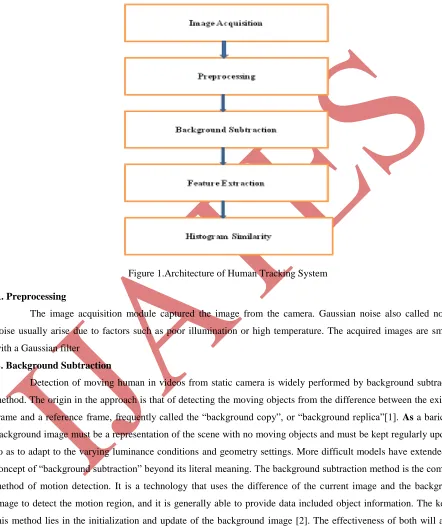
further analysis. Color histogram is calculates from the moving object at feature extraction stage. Last but not least,feature matching approach is used to establishing consistent labels across single camera FOV. Figure1 shows the
architecture of the human tracking system
Figure 1.Architecture of Human Tracking System
A. Preprocessing
The image acquisition module captured the image from the camera. Gaussian noise also called normal
noise usually arise due to factors such as poor illumination or high temperature. The acquired images are smooth
with a Gaussian filter
B. Background Subtraction
Detection of moving human in videos from static camera is widely performed by background subtraction
method. The origin in the approach is that of detecting the moving objects from the difference between the existing
frame and a reference frame, frequently called the “background copy”, or “background replica”[1]. As a baric, the
background image must be a representation of the scene with no moving objects and must be kept regularly updated
so as to adapt to the varying luminance conditions and geometry settings. More difficult models have extended the
concept of “background subtraction” beyond its literal meaning. The background subtraction method is the common
method of motion detection. It is a technology that uses the difference of the current image and the background
image to detect the motion region, and it is generally able to provide data included object information. The key of
this method lies in the initialization and update of the background image [2]. The effectiveness of both will affect
the accuracy of test results. Therefore, this paper uses an effective method to initialize the background, and update
221 | P a g e
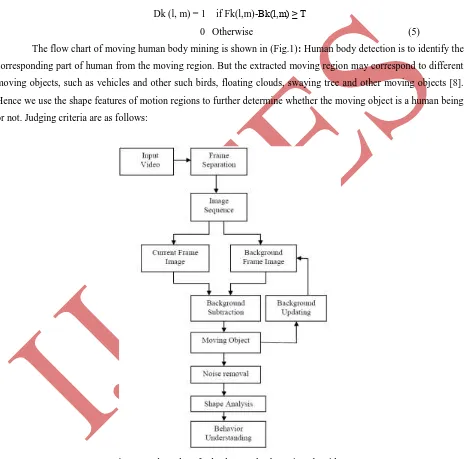
The process algorithm is described as follow:1. Sequences of Video Frames
2. Frame Separation
3. Image Sequence
4. Separation of Image Sequence in Current Frame Image and Background Frame Image
5. Perform Background subtraction
6. Detection of Moving Object
7. Perform Background updating
8. Noise Removal
9. Shape Analysis
C. Feature extraction
A color histogram is a popular form of representation of the object appearance one of the human feature in
object tracking [5]. It is also independent from scaling and rotation of the object and robust to the partial occlusion.
This method makes a model of color histogram according to the appearance of the human shape extracted from the
image. The color histogram can be calculated in a grey level space, in RGB or any other color space. In this paper,
we proposed using Hue channel of HSV color space to build the color histogram model. The HSV color space
corresponds closely with the way humans describe and interpret color. Hue (H) channel represents the “color”. Saturation (S) channel is the “amount” of color and Value (V)is the brightness of the color. HSV model has their
information stored in hue, saturation and value respectively. Hence, by using Hue channel (color information) is
sufficient for the human tracking. The moving object is extracted out by using the binary image obtained from the
background subtraction stage. The binary image will act like a mask to filter out non interested region and the
histogram model will only build at the moving object region. If the pixel in the mask image is not zero, the pixel
from the current frame will copy to a new image as the foreground. Expression is as follow:
(1)
Where Ifore is the foreground color image, Icurrent is the current color image and Imask is the binary image. The foreground image Ifore is converted to HSV color space.1D hue channel histogram h(rk) is calculated as representation space for the appearance of the object. The histogram hue Levels range from 0 until 255. Expression
is as follow:
h(Rm) = Nm = 0,1,2,...255 (2)
Where Rmis the mth hue level and Nm is the number of pixels in the hue image.D. Histogram Similarity
Histogram similarity is the method of measuring the similarity between the histogram of a reference
histogram and the histogram of the tracked image. There are few histogram comparison methods such as Chi-square
222 | P a g e
Chi-square and Bhattacharyya work best for slower but more accurate matches. In this test, Bhattacharyya distanceis used to compare the histogram of the whole person region in the consecutive frame. After the matching, the
similarity of moving object is determine by a threshold value Ts. Experiments with indoor and outdoor environment found out that the threshold value Ts of 0.4 is acceptable. A score that lower than the threshold value indicate a good match, a unique color boundary box will be constantly labeled at the moving object. Otherwise, the moving object
will Label with a white boundary box. Expression of Bhattacharyya histogram comparison is as follows:
(3)
Where H,H2 are previous and current histograms respectively.
III. BACKGROUND SUBTRACTION ALGORITHM
The flowchart for background subtraction algorithm is given below.
3.1 Flow chart for Background Subtraction Algorithm
Background subtraction algorithm consists of several stages. Those are listed below.
1. Background Image Initialization
2. Moving Object Mining
3. Noise Removal
4. Extraction of Moving Human Body
5. Behaviour Understanding
The above stages are briefly explained as follows.
A. Background Image Initialization
There are many civilizations to obtain the initial background image. For instance, with the first frame as the
background directly or, the average pixel brightness of the first few frames as the background or using a background
image sequences without the hope of moving objects to approximate the background model parameters and so on.
From these methods average method is commonly used for background Image initialization [3], but there are many
shadow problems will occur which can be removed by median method, So the median method is selected in this
paper to initialize the background.
Expression is as follows:
Binit (L, M) = median Fk (l, m) k =1,2 ….n (4)
Where Binit is the initial background, n is the total number of frames selected.
B. Moving Object Mining
Background subtraction is a popular technique to fragment out the interested objects in a frame. This
technique involves subtracting an image that contains the object, with the previous background image that has no
foreground objects of interest. The area of the image plane where there is a significant difference within these
223 | P a g e
pixel, are then separated from the background image by using threshold technique. After the background imageB(l,m) is obtained, subtract the background image B(l,m) from the current frame Fk(l,m).If the pixel difference is greater than the set threshold T , then determines that the pixels appear in the moving object, otherwise, as the background pixels. The moving object can be detected after threshold operation.
Expression is as follows:
Dk (l, m) = 1 if Fk(l,m)-Bk(l,m) ≥ T
0 Otherwise (5)
The flow chart of moving human body mining is shown in (Fig.1): Human body detection is to identify the
corresponding part of human from the moving region. But the extracted moving region may correspond to different
moving objects, such as vehicles and other such birds, floating clouds, swaying tree and other moving objects [8].
Hence we use the shape features of motion regions to further determine whether the moving object is a human being
or not. Judging criteria are as follows:
Figure 2: Flow chart for background subtraction algorithm
1. The object area is larger than the set threshold
2. The aspect ratio of the object region should conform to the set ratio.
If these two conditions are met, the moving object is the moving human body or not a human body is
224 | P a g e
C. Noise Removal
Since the difficulty of the background, the discrepancy image obtained contains the motion region as well
as large number of noise. These noises might be included in the image due to environmental factors, illumination
changes, during transmission of video from the camera to the further processing. Therefore, noise needs to be
removed. In this paper we adopts median filter with the 3 X 3 window for filtering noise.
As we know, motion region just not includes human being, but also it may include moving cars, flying
birds, flowing clouds and swaying trees and other non body parts. Morphological methods are used for further
processing. Corrosion operation is taken to effectively filter out non-human activity areas and by using the
development operation they can filter out most of the non-body motion regions while preserving the shape of human
motion without injury. After expansion and corrosion operations, some inaccessible spots of the image and some
intrusion of small pieces are eliminated, and we get more accurate human motion region.
D. Extraction of Moving Human Body
Some accurate edge regions will be got after median filtering, corrosion and expansion operations, but the
region belongs to the moving human body could not be determined. Through inspection, we can find out that when
moving object appears, shadow will appear in some regions of the scène. Accurate mining of the moving object
affected by the presence of shadow. By analyzing the characteristics of motion detection, we combine the projection
operator with the previous methods.
Based on the results of the methods above, height of the motion region will get detected by adopting the
method of combining horizontal with vertical projection. This can eliminate the impact of the shadow to a certain
level. Then we analyze the vertical projection value and set the threshold value to remove the pseudo-local
maximum value and the pseudo-local minimum value of the vertical projection to determine the number and width
of the body in the motion region, we will get the moving human body with precise edge. This paper assumes that
people in the scene are all in upright-walking state.
E. Behavior Understanding
After successfully detecting the moving humans from one frame to another in an image sequence, the
problem of understanding human behaviors from image sequences follows naturally. Behavior understanding
involves action identification and description. Human behavior understanding can guide the development of many
human motion analysis systems. Behavior understanding is to analyze and recognize human motion patterns, and to
produce high-level description of actions and interactions. The behavior understanding will be the most important
area of future research in human motion analysis.
F. Kalman Filter
The filter is used to predict the track's location in each frame, and determine the likelihood of each
detection being assigned to each track. A Kalman filter estimates the state of a dynamic system recursively at each
time in the linear minimum mean square error sense. The motion of each track is estimated by a Kalman filter. The
225 | P a g e
assigned to each track. Kalman Filter operates by Predicting the new state and its uncertainty and Correcting withthe new measurement.
Figure3: Prediction and Correction updating
IV. RESULTS:
The below given results shows how to detect and track people in a video sequence with a stationary background
using the following process:
1. Use the first few frames of the video to estimate the background image.
2. Separate the pixels that represent the people from the pixels that represent the background.
3. Group pixels that represent individual people together and calculate the appropriate bounding box for each
person.
4. Match the people in the current frame with those in the previous frame by comparing the bounding boxes
between frames
(a) (b)
(c)
(d)
Figure 4 a) Original or input video (b)Background Image (c) Detected image (d)Tracked image
V. CONCLUSION
The system presented herein is successful as a robust detector of human motion. The proposed method has
described a technique for tracking the movement of Humans in consecutive video frames. The proposed method of
226 | P a g e
the problems approaching in moving object detection, we use threshold method to detect moving object, backgroundinitialization and update the background in real time. At last, shadow effect removed by combining projection
analysis with shape analysis. This method has also a very good effect on the elimination of noise and shadow, and
be able to extract the complete and accurate picture of moving human body.
VI. FUTURE IMPROVEMENT
In this paper, we have considered static background; in future it can be improved for changing/non-static
background.
REFERENCES
[1]Neeti A. Ogale, “A Survey of Techniques for Human Detection from Video”.
[2]Prithviraj Banerjee Somnath Sengupta, “Human Motion Detection and Tracking for video Surveillance”.
[3]Xiaofei Ji, Honghai Liu, “Advances in View-Invariant Human Motion Analysis: A Review,” in IEEE Trans.on Systems, Man, Cybernetics, vol. 40, no.1, 2010.
[4]Murat Ekinci “Silhouette Based Human Motion Detection and Analysis For Real Time Automated Video
Surveillance, “in Turk J Elec Engin, vol.13, no.2, 2005.
[5]HaziWang and David suter,“Background Subtraction Based on a Robust Consensus Method,” Monash
University, Clayton Vic. 3800, Australia.
[6]SumerJabir, Zoran Duric, Harry Wechsler, Azriel Rosenfeld “Detection and Location of People in Video Images
Using Adaptive fusion of color and edge information.”
[7]Jing Li, Zhaofa Zeng, Jiguang Sun and Fengshan Liu, "Through Wall Detection of Human Being’s Movement by
UWB Radar," in IEEE Geoscience and Remote Sensing Letters,Vol.9, no.6, Nov 2012.
[8]EyupGedikli,“Human Motion Detection, Tracking and Analysis for Automated Surveillance”.
[9]Wang Weiqiang, Yang Jie and Gao Wen, "Modeling Background and Segmenting Moving Objects from
Compressed Video," Circuits and Systems for Video Technology, IEEE Transactions on Vol.18, Issue 5, May
2008, pp.670 - 681.
[10]Qi Zang, Reinhard Klette “Object Classification and Tracking in Video Surveillance.”
Biographical Notes
Mr. S. Govardhan Naidu is presently pursuing M.Tech. Final year in Electronics & Communication Engineering
from Malla Reddy Institute of Technology and Science, Hyderabad, India.
Ms. S. Srilakshmi is working as a Assistant Professor in Electronics & Communication Engineering Department,