University of Pennsylvania
ScholarlyCommons
Publicly Accessible Penn Dissertations
2017
From Discourse Structure To Text Specificity:
Studies Of Coherence Preferences
Junyi Li
University of Pennsylvania, [email protected]
Follow this and additional works at:
https://repository.upenn.edu/edissertations
Part of the
Artificial Intelligence and Robotics Commons
This paper is posted at ScholarlyCommons.https://repository.upenn.edu/edissertations/2443 For more information, please [email protected].
Recommended Citation
Li, Junyi, "From Discourse Structure To Text Specificity: Studies Of Coherence Preferences" (2017).Publicly Accessible Penn Dissertations. 2443.
From Discourse Structure To Text Specificity: Studies Of Coherence
Preferences
Abstract
To successfully communicate through text, a writer needs to organize information into an understandable and well-structured discourse for the targeted audience. This involves deciding when to convey general statements, when to elaborate on details, and gauging how much details to convey, i.e., the level of specificity. This thesis explores the automatic prediction of text specificity, and whether the perception of specificity varies across different audiences.
We characterize text specificity from two aspects: the instantiation discourse relation, and the specificity of sentences and words. We identify characteristics of instantiation that signify a change of specificity between sentences. Features derived from these characteristics substantially improve the detection of the relation. Using instantiation sentences as the basis for training, we propose a semi-supervised system to predict sentence specificity with speed and accuracy. Furthermore, we present insights into the effect of underspecified words and phrases on the comprehension of text, and the prediction of such words.
We show distinct preferences in specificity and discourse structure among different audiences. We investigate these distinctions in both cross-lingual and monolingual context. Cross-lingually, we identify discourse factors that significantly impact the quality of text translated from Chinese to English. Notably, a large portion of Chinese sentences are significantly more specific and need to be translated into multiple English sentences. We introduce a system using rich syntactic features to accurately detect such sentences. We also show that simplified text is more general, and that specific sentences are more likely to need simplification. Finally, we present evidence that the perception of sentence specificity differs among male and female readers.
Degree Type Dissertation
Degree Name
Doctor of Philosophy (PhD)
Graduate Group
Computer and Information Science
First Advisor Ani Nenkova
Second Advisor Mitchell P. Marcus
Keywords
Subject Categories
FROM DISCOURSE STRUCTURE TO TEXT SPECIFICITY:
STUDIES OF COHERENCE PREFERENCES
Junyi Jessy Li
A DISSERTATION
in
Computer and Information Science
Presented to the Faculties of the University of Pennsylvania
in
Partial Fulfillment of the Requirements for the
Degree of Doctor of Philosophy
2017
Supervisor of Dissertation
Ani Nenkova, Associate Professor, Computer and Information Science
Graduate Group Chairperson
Lyle Ungar, Professor, Computer and Information Science
Dissertation Committee:
Mitchell P. Marcus, Professor, Computer and Information Science (Chair)
Mark Liberman, Professor, Linguistics, Computer and Information Science
Bonnie Webber, Adjunct Professor, Computer and Information Science; Professor, School of Informatics,
University of Edinburgh
Marine Carpuat, Assistant Professor, Computer Science, University of Maryland (External)
Jacob Eisenstein, Assistant Professor, School of Interactive Computing, Georgia Institute of Technology
FROM DISCOURSE STRUCTURE TO TEXT SPECIFICITY:
STUDIES OF COHERENCE PREFERENCES
COPYRIGHT
2017
Acknowledgements
First of all, I would like to thank my advisor Ani Nenkova. I started working with Ani
when I was a masters student at Penn. If it were not for her encouragement and support,
and the endless fun working with her, I would not even have started my Ph.D. I thank her
for her constant dedication and nurturing: her patient teachings and guidance in research,
our weekly meetings, rounds of comments for my writing pieces, and advice in serving the
research and education community at Penn and beyond. I am forever grateful for her belief
in me, and I hope to pass on her passion for research and mentorship to my future students.
I am grateful to Bonnie Webber for her guidance since the early years of my Ph.D.
Bonnie has given invaluable advice for many pieces of my then half-baked work and met
with me during her visits to Penn. Her mentorship helped to shape my research. I thank
Mitch Marcus and Mark Liberman for their steadfast support throughout my years at Penn;
discussions with them are always filled with insights and delights. I thank Marine Carpuat
and Jacob Eisenstein, whose generous help and valuable feedback improved this thesis.
I would like to thank my collaborators, without whom many projects would not have
happened: Sumit Basu, Leila Bateman, Marine Carpuat, Charles Jacobs, Matthew Lease,
Iain Marshall, An Thanh Nguyen, Ben Nye, Bridget O’Daniel, Julia Parish-Morris, Amanda
Stent, Kapil Thadani, Lucy Vanderwende, Byron Wallace, Yi Wu, Yinfei Yang, and Wenli
Zhao.
I thank my mentors during my internships, whose support has made these internships
wonderful experiences: Sumit Basu and Lucy Vanderwende at Microsoft Research, Amanda
Stent and Kapil Thadani at Yahoo! Labs. I thank Yashar Mahdad, Dragomir Radev and
Joel Tetreault for the fun and constructive conversations when I was at Yahoo! Labs, and
I am honored to be a part of the outstanding linguistics and computational linguistics
community at Penn. I enjoyed many conversations with Aravind Joshi, who has guided
and influenced me with his knowledge, wisdom and enthusiasm. I have also received much
support from Chris Callison-Burch, Ariani Di Felippo, Florian Schwarz, Muffy Siegel, Lyle
Ungar, and Charles Yang. I would like to thank my wonderful fellow students and colleges
in the NLP group: Houwei Cao, Spencer Caplan, Anne Cocos, Paramveer Dhillion, Jie Gao,
Kai Hong, Jordan Kodner, Constantine Lignos, Xi Victoria Lin, Annie Louis, Ellie Pavlick,
Emily Pitler, Daniel Preotiuc, Neville Ryant, Andy Schwartz, Joao Sedoc, and Wei Xu.
Penn has amazing staff who have helped me on numerous occasions with patience,
accuracy and efficiency. Special thanks to Mike Felker, Cheryl Hickey and Rita Powell
from the department of Computer and Information Science, and Amanda Phipps from the
International Student and Scholar Services.
I am grateful to those who have inspired me in my earlier education. Special thanks
to Eytan Adar (University of Michigan), for introducing me to research as an
undergrad-uate student; Shensheng Zhang (Shanghai Jiao Tong University), for introducing me to
programming; and Wenjian Wang (Shanghai Wei Yu High School), for his patient and
constant guidance throughout my high school years.
I would like to thank other colleagues and friends, including Arthur Azevedo De Amorim,
Waleed Ammar, Ang Chen, Chen Chen, Sanjian Chen, Loris D’Antoni, Luheng He, Yuening
Hu, Jennifer Hui, Charlie Jin, Sarfraz Khurshid, Sungjin Lee, Xiang Li, Daniella Marinov,
Darko Marinov, Lara Marinov, Fei Miao, Sasa Misailovic, Salar Moarref, Lu Pan, Ankur
Parikh, Jennifer Paykin, Venetia Pliatsika, Robert Rand, Jenn Ruiz, Nick Ruiz, Hongbo
Zhang, Yemin Tang, Zhongni Tang, Shan Wang, William Wang, Steven Wu, Meng Xu,
Mark Yatskar, Mabel Zhang and Nan Zheng.
Above all, my deepest gratitude goes to my family. I thankMilos, my fatherGongsheng
and my mother Qiufang for their unwavering love, support and encouragement. I thank
Davidfor bringing so much wonder and joy into my life. I thank my extended family and
ABSTRACT
FROM DISCOURSE STRUCTURE TO TEXT SPECIFICITY:
STUDIES OF COHERENCE PREFERENCES
Junyi Jessy Li
Ani Nenkova
To successfully communicate through text, a writer needs to organize information into
an understandable and well-structured discourse for the targeted audience. This involves
deciding when to convey general statements, when to elaborate on details, and gauging
how much details to convey, i.e., the level of specificity. This thesis explores the automatic
prediction of text specificity, and whether the perception of specificity varies across different
audiences.
We characterize text specificity from two aspects: theinstantiationdiscourse relation,
and the specificity of sentences and words. We identify characteristics of instantiation
that signify a change of specificity between sentences. Features derived from these
charac-teristics substantially improve the detection of the relation. Usinginstantiationsentences
as the basis for training, we propose a semi-supervised system to predict sentence specificity
with speed and accuracy. Furthermore, we present insights into the effect of underspecified
words and phrases on the comprehension of text, and the prediction of such words.
We show distinct preferences in specificity and discourse structure among different
au-diences. We investigate these distinctions in both cross-lingual and monolingual context.
Cross-lingually, we identify discourse factors that significantly impact the quality of text
translated from Chinese to English. Notably, a large portion of Chinese sentences are
sig-nificantly more specific and need to be translated into multiple English sentences. We
introduce a system using rich syntactic features to accurately detect such sentences. We
also show that simplified text is more general, and that specific sentences are more likely to
need simplification. Finally, we present evidence that the perception of sentence specificity
Contents
Acknowledgements iv
1 Introduction 1
1.1 Thesis contributions . . . 3
1.2 Thesis organization . . . 5
2 Notions of specificity in text 8 2.1 Discourse relations . . . 9
2.2 Information organization . . . 11
2.3 Fine-grained linguistic structure . . . 13
3 From discourse relation to text specificity 15 3.1 Discourse relations in the Penn Discourse Treebank . . . 17
3.2 Recognizinginstantiation . . . 18
3.2.1 Data and methodology . . . 20
3.2.2 Characteristics ofinstantiation. . . 20
3.2.3 Experiments . . . 23
3.2.4 Discussion: textual entailment ininstantiation . . . 25
3.2.5 Conclusion . . . 26
3.3 Speciteller: predicting sentence specificity . . . 26
3.3.1 Data . . . 27
3.3.2 Light features . . . 27
3.3.3 Supervised learning results . . . 29
3.3.5 Semi-supervised learning results . . . 33
3.3.6 Discussion . . . 34
3.3.7 Conclusion . . . 36
3.4 Discussion: instantiationvs.specification . . . 36
4 Fine-grained text specificity and its connection with discourse 41 4.1 Annotation and corpus analysis . . . 43
4.1.1 Goal . . . 43
4.1.2 Methodology and corpus summary . . . 44
4.1.3 Corpus statistics . . . 45
4.1.4 Discourse analysis of underspecification . . . 48
4.1.5 Conclusion . . . 52
4.2 Predicting subsentential specificity . . . 52
4.2.1 Related work . . . 54
4.2.2 Attention network for token specificity . . . 55
4.2.3 Named entities and pronouns . . . 56
4.2.4 Systems and settings. . . 57
4.2.5 Sentence specificity prediction. . . 58
4.2.6 Predicting question tokens . . . 59
4.2.7 Conclusion . . . 64
4.3 Discussion and future work . . . 64
5 Coherence preferences: cross-lingual 66 5.1 Assessing the Discourse Factors that Influence the Quality of Machine Trans-lation . . . 67
5.1.1 Data and experiment settings . . . 68
5.1.2 Sentence length and HTER . . . 69
5.1.3 When a sentence becomes discourse . . . 70
5.1.4 Explicit discourse relations . . . 71
5.1.5 Number of connectives . . . 72
5.1.7 Human edits of discourse connectives . . . 73
5.1.8 Discussion and conclusion . . . 75
5.2 Discourse vs. sentence: identifying content-heavy sentences . . . 76
5.2.1 Data . . . 78
5.2.2 Content-heavy sentences: definition . . . 79
5.2.3 A challenge for MT . . . 80
5.2.4 Comma usage and heavy sentences . . . 81
5.2.5 Features to characterize content-heavy sentences . . . 84
5.2.6 Recognizing content-heavy sentences . . . 86
5.2.7 A challenge for MT: revisited . . . 88
5.2.8 Conclusion . . . 89
5.3 Discussion and future work . . . 89
6 The organization of specific information 91 6.1 Data and settings . . . 92
6.2 Specificity . . . 93
6.2.1 Consistency across reference translations . . . 93
6.2.2 Heavy vs. non-heavy sentences . . . 95
6.2.3 Intra-sentential specificity . . . 96
6.3 Instantiation and other discourse relations . . . 96
6.3.1 Implicit Instantiation in Chinese . . . 97
6.3.2 Content-heavy sentences and Instantiation arguments . . . 98
6.3.3 Relations across split components of heavy sentences . . . 99
6.4 Predicting heaviness . . . 100
6.5 Conclusion . . . 102
7 Coherence preferences: monolingual 103 7.1 Sentence specificity and text simplification . . . 104
7.1.1 Specificity as simplification objective . . . 104
7.1.2 Identifying simplification targets . . . 106
7.2 Gender, Autism Quotient scores and the perception and production of text
specificity . . . 107
7.2.1 Overview . . . 108
7.2.2 Subjects . . . 109
7.2.3 Specificity perception . . . 110
7.2.4 Specificity of text produced . . . 113
7.2.5 Discussion and conclusion . . . 114
7.3 Discussion and future work . . . 115
8 Conclusion 116 8.1 Summary of contributions . . . 116
8.2 Future work . . . 118
List of Tables
2.1 Definition ofelaborationin Rhetorical Structure Theory (Mann and
Thomp-son, 1988). . . 9
2.2 Definition ofinstantiationandspecificationin the Penn Discourse
Tree-bank (Miltsakaki et al., 2008). . . 9
3.1 Average numbers of words, percentages of rare words and percentages of
gradable adjectives per sentence for: first sentences ofinstantiation, second
sentences ofinstantiation, and non-instantiationsentences. An asterisk
(∗) denotes significant differences (p <0.05) compared to non-instantiation
sentences. First sentences of instantiation are significantly shorter, have
fewer rare words and more gradable adjectives. . . 21
3.2 Part-of-speech tags used significantly (p <0.05) more often in the first
sen-tences of instantiation compared to the second (s1 > s2), significantly
more often in the second sentences of instantiation compared to the first
(s2 > s1), and significantly more (+) or less (−) often compared to
non-instantiationsentences. A dagger (†) denotes that for non-instantiation
sentence pairs the difference is significant in the other direction. . . 21
3.3 Average Jaccard similarity between sentences and their immediate context.
Column 1 & 2: the first and second sentences of instantiation sentence
pairs and of non-instantiationpairs; column 3: the change between columns
1 and 2. An asterisk (∗) denotes significant differences (p <0.05) compared to
non-instantiationsentence pairs. Instantiationsentences are less similar
3.4 Precision, recall, F-measure and balanced accuracy of identifying
instan-tiation. Inst.: our system; Vote: soft voting between our system and Li
and Nenkova (2014);L&N: Li and Nenkova (2014);B&M: Biran and
McKe-own (2015);Lin et al.: Lin et al. (2014); Brown-concat: reimplementation of
concatenation of Brown clusters as in Braud and Denis (2015). . . 23
3.5 Supervised learning results for sentence specificity prediction: accuracy,
pre-cision, recall and F measure on general sentences, for sentence surface features
(SF), word properties (WP), combined shallow features (SF+WP), Brown
clusters (BC), word embeddings (WE), and unigrams (Word identity). It
is feasible to predict specificity based on cheaply computable features alone;
non-sparse representations of lexical information are more suitable for the
relatively small training set. . . 30
3.6 Performance for sentence specificity prediction at the final stage of co-training,
for shallow features (shallow), Brown clusters and word embeddings (BC+WE),
the combination of the two (combined), unigrams (word identity) and Louis
and Nenkova (2011a) (L&N). An asterisk (*) denotes significant improvement
from L&N (p <0.05, sign test). The co-training system performs the best.
The performance of word identity features also improves when more data is
added. . . 33
3.7 Examples of general and specific sentences newly labeled during the
co-training procedure. . . 34
3.8 Average numbers of words, percentages of rare words and percentages of
grad-able adjectives for: each sentence ofspecificationandinstantiation, and
of non-specification sentences. An asterisk (∗) denotes significant
differ-ences (p < 0.05) compared to non-specification sentences. A dagger (†)
denotes significant differences compared to the correspondinginstantiation
sentence. Characteristics in specificationdo not stand out as much as in
3.9 Part-of-speech tags used significantly (p <0.05) more often in the first
sen-tences of specification compared to the second (s1 > s2), significantly
more often in the second sentences of specification compared to the first
(s1 < s2), and significantly more (+) or less (−) often compared to
non-specificationsentences. A dagger (†) denotes that for non-specification
sentence pairs the difference is significant in the other direction. . . 38
3.10 Part-of-speech tags used significantly more or less often in instantiation
than inspecification. . . 38
3.11 Average Jaccard similarity between relation sentences and their immediate
context before the first sentence, forspecificationandinstantiation(row
1) and sentences not of the corresponding relation (row 2). The last columns
of each relation show the change betweens1 ands2’s similarities. An asterisk
(∗) denotes significant differences (p < 0.05) compared to sentences not of
the relation. Specificationsentences are more similar to their context than
instantiation. . . 39
4.1 Number of question interrogatives used by the three annotators and
percent-ages of the context status associated with each question. Largest values in
each row are bolded. “How”, “why” and “when” questions have stronger
association with answers not present in prior context. . . 50
4.2 Percentages of part of speech tags that are not highlighted (specified) and
those that are marked as underspecified with associated context status (
im-mediate, previous, none). Most of the underspecification are from content
words; among them, adjectives, adverbs and verbs have stronger association
4.3 Performances for sentence specificity prediction on the same data as in
Ta-ble 3.6. Attn-withnum: attention network without processing numbers;attn:
with special symbol for numbers (default); attn-ne: with special symbol for
named entities;attn-pron: with special symbol for unresolved pronouns;
attn-ne-pron: with both named entity and unresolved pronoun symbols. Precision
and recall are on general sentences. First and second best values for each
measure are bolded. . . 58
4.4 Performance for sentence specificity prediction on our annotated data
de-scribed in Section 4.1. Attn: attention network with special symbol for
numbers (default); attn-ne: with special symbol for named entities;
attn-pron: with special symbol for unresolved pronouns; attn-ne-pron: with both
named entity and unresolved pronoun symbols. Precision and recall are on
general sentences. . . 59
4.5 Average and standard deviation of the number of question tokens per
sen-tence, for all question tokens and question tokens that are not-in-context. . 60
4.6 Accuracy and F measure for token specificity prediction, when the number
of question tokens is known. Column all shows all question tokens; column
N context shows question tokens that are not-in-context. . . 60
5.1 Pearson (Spearman) correlation coefficient between lengths of source
sen-tences and HTER values of three MT systems, for Chinese (ZH) and Arabic
(AR). There is no strong relationship between sentence length and HTER
values. . . 69
5.2 Left: ANOVA with type of segment (1-1 or 1-many) as independent variable
and the three MT systems as subjects. Right: average HTER values for the
three Chinese to English systems for 1-1 and 1-many segments. An asterisk
(∗) denotes significance atp <0.05. 1-many segments is a significant factor
5.3 Number of discourse connectives and MT quality. An asterisk (∗) or a plus
(+) sign denotes significance at 95% and 90% confidence levels, respectively.
Using more than one connective vs. no connective is a significant factor in
Chinese to English MT quality. . . 72
5.4 Relation sense and MT quality. An asterisk (∗) or plus (+) sign denotes
significance at 95% and 90% confidence levels, respectively. The presence
of a contingency relation is a significant factor in Chinese to English MT
quality; the interaction between comparison and temporal is significant
for both Chinese and Arabic. . . 73
5.5 The impact of discourse connective mismatch between human edits and
sys-tem translations on MT quality, for 1-1 and 1-many segments. An asterisk
(*) denotes significance atp <0.05. This mismatch is a significant factor in
MT quality from both Chinese and Arabic to English. . . 75
5.6 Examples of Chinese sentences expressed in multiple English sentences. . . 77
5.7 Percentage of Chinese sentences for which a given number of translators (#
ref multi) prefer to use multiple sentences in English (% data), along with
percentage of times a multi-sentence translation was selected as most fluent
and comprehensible by readers (% best multi). . . 79
5.8 Percentage of content-heavy Chinese sentences, along with BLEU scores for
heavy and non-heavy sentences and their difference. The BLEU score for
content-heavy sentences are much lower. . . 81
5.9 Counts of heavy (Y) and non-heavy (N) sentences with and without full-stop
commas. . . 81
5.10 Performance to identify heavy sentences using multiple reference data
(paral-lel) vs. full-stop comma oracle labels (oracle comma) and predicted full-stop
commas (predicted comma). It is more advantageous to learn from multiple
reference data. . . 83
5.11 Accuracy, precision and recall of classifying content-heavy sentences, using
MTC and/or OpenMT as training data. Baseline: sentence length; full set:
5.12 Number of segments, precision, recall and posterior probability for examples
where at least 0, 1, 2, 3 or 4 translators split the sentence. When more
translators split the sentence, the classifier is more confident and achieves
better performance. . . 87
5.13 For each criterion to separate heavy and non-heavy sentences, the
percent-age of heavy sentences (%data(Y)), BLEU scores for heavy and non-heavy
sentences, and their differences. The criteria are: fs-comma: whether the
sentence contains a full-stop comma; length threshold: whether it is longer
than the length threshold; pred-heavy (prob): whether it is predicted
pre-dicted content heavy with the posterior probability cutoff prob;oracle heavy:
whether it is content heavy according to the oracle definition. Our system
can more reliably identify sentences that are harder to translate. . . 89
6.1 Average specificity of heavy (H) and non-heavy (¬H) reference translations
given a length range of the source sentence: for all references (all), for only
one-sentence translations (excl multi), when all references are treated as
one-sentence translations (all, as-one-sent), and the corresponding specificity
per-token (token specificity). Bold font means significance (p <0.05) when
compared to non-heavy sentences. Content-heavy sentences have higher
per-token specificity but translating them into multiple sentences leads to lower
overall specificity. . . 95
6.2 Patterns of general and specific sentences within each multi-sentence
trans-lation among the heavy Chinese sentences. The least frequent pattern is
general-specific, hence an instantiation relation is not likely to hold
be-tween two split components of a heavy sentence. . . 96
6.3 Number of sentence pairs with an implicit instantiationper 200 words in
Chinese and English. The PDTB-Gold column shows the numbers for
gold-standard annotations in the PDTB; others are predicted with the system in
Section 3.2. The rate of predicted implicit instantiation is much lower in
6.4 Specificity of identified implicitinstantiationarg1s vs.arg2s for 5 random
draws among the 4 reference translations. The second arguments of identified
instantiationare significantly less specific. . . 98
6.5 Counts of predictedinstantiationarguments that are content-heavy, along
with percentages of such sentences among all heavy sentences, among all
arg1s and among all arg2s. There is a strong association between
content-heavy sentences andarg2s ofinstantiation. . . 98
6.6 Average counts (#) and average percentages (%) of explicit discourse
rela-tions whose arguments are: between whole Chinese sentences, between split
components within a sentence and within a split component. Larger
percent-ages in each row are bolded. The distribution of discourse relations across
split components is very different from that of relations that do not trigger
a split. . . 99
6.7 Number of predicted implicitinstantiationrelations within multi-sentence
translations, along with its percentages among heavy sentences, for each
translator separately (Ref1-4) and averaged among all translators (avg).
Im-plicit instantiationis not a strong trigger for splitting heavy sentences. . 100
6.8 Accuracy, precision, recall and F-measure for content heavy sentence
predic-tion. P: posterior probability from our content-heavy classifier in Section 5.2;
L: sentence length; S: specificity; ST: per-token specificity; I: probability of
being a predictedinstantiationarg2. Specificity information complements
L and P in predicting heavy sentences. . . 101
7.1 Percentages of original-simplified sentence pairs with lower attribute values
for the simplified side (%pairs), along with mean values for each attribute
among simplified and original sentences. Specificity of simplified sentences
are remarkably lower. . . 105
7.2 Precision for identifying sentences to simplify. Specificity and ARI
outper-form other attributes. . . 106
7.3 Spearman correlation for the attributes in original sentences. The correlation
7.4 Numbers of male and female subjects, 95% confidence intervals and mean/standard
deviation of specificity perception values. Male subjects rate sentences
sig-nificantly less specific than female subjects. . . 111
7.5 Cutoff AQ scores for the high-AQ group and number of subjects for control
(G1) and high-AQ (G2) groups. . . 112
7.6 Spearman correlations of specificity perception values and AQ scores,
aver-age perception values among subjects for each group, and fractions of raw
sentence ratings outside 95% confidence intervals of crowd ratings. There is a
non-significant trend that subjects with higher AQ scores give more specific
ratings. . . 112
7.7 Numbers of male and female subjects, 95% confidence intervals and mean/standard
deviation of summary specificity. There is a non-significant trend that female
subjects tend to write less detailed summaries. . . 113
7.8 Spearman correlation of summary specificity and AQ scores, average
sum-mary specificity ratings among subjects for each group. There is a
non-significant trend for Article 2 that subjects with higher AQ scores tend to
List of Illustrations
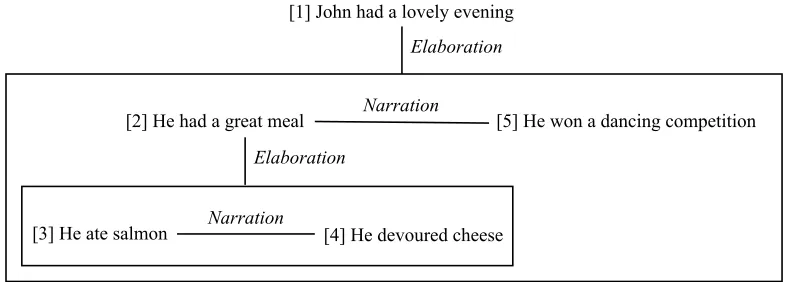
2.1 An example of elaboration and narration from Lascarides and Asher
(2007). . . 10
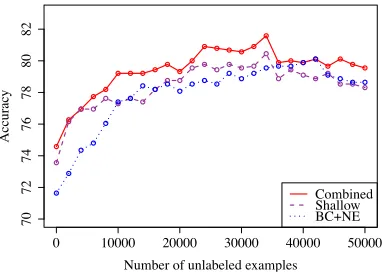
3.1 Co-training accuracies of sentence specificity prediction with increasing
num-ber of unlabeled sentences. . . 32
3.2 Scatter plot of sentence length (x-axis) and posterior probabilities of sentence
specificity prediction (y-axis) on the test data. Our system gives more
prob-abilities towards 0 and 1, hence the higher correlation with sentence length
than Louis and Nenkova (2011a). . . 35
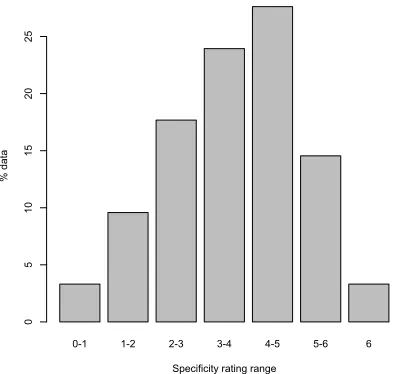
4.1 Distribution of sentence specificity ratings among the three annotators. . . 46
4.2 Average fraction of tokens marked as underspecified vs. average sentence
specificity ratings. . . 48
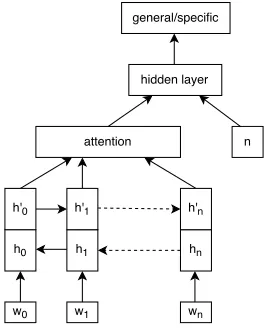
4.3 Architecture of the attention network for sentence specificity prediction. . . 55
4.4 Precision at 3, 6, 9, 12 tokens for token specificity prediction. X-axis: number
of tokens; y-axis: precision. . . 61
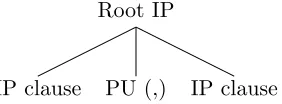
5.1 Commas separating coordinating IPs at the root. These full-stop commas
6.1 Histograms of pairwise specificity differences of reference translations of the
same Chinese sentence; showing only pairs where both translations are
single-sentence or multi-single-sentence. X-axis: pairwise specificity difference; y-axis:
number of sentence pairs. Red lines indicate the average difference between
1000 randomly selected sentences. For the same source sentence, the
speci-ficity of translations of the same type (either one- or multi-sentence) is much
more consistent compared to those of different types (Figure 6.2). . . 93
6.2 Histograms of pairwise specificity differences of reference translations of the
same Chinese sentence; showing only pairs where one translation is
single-sent and the other is multi-single-sent. X-axis: pairwise specificity difference;
y-axis: number of sentence pairs. Red lines indicate the difference between 1000
randomly selected sentences. For the same source sentence, the specificity of
translations of different types (one- or multi-sentence) is much more different
compared to those of the same type (Figure 6.1). . . 94
7.1 Boxplots of AQ scores among subject groups. Red line: median; red dot:
mean; green arrows: 95% confidence intervals; boxes/whiskers: 75%-95%
quantiles. AQ scores do not differ significantly across gender but differs for
non-native speakers. . . 110
7.2 Distribution of AQ scores. Vertical lines indicate cutoff AQ scores of the
Chapter 1
Introduction
To communicate effectively through language, a writer needs to organize the content to be
conveyed into intelligible text that flows naturally. Often, ways of organization that are
considered proper among one group of audience are not conventional for another audience.
Consider the following example:
The Dutch, under the leadership of Jan Pieterszoon Coen, captured and razed the city in 1619, after which the capital of the Dutch East Indies — a walled township named Batavia — was established on the site. (Encyclopedia Britannica)
The Dutch captured and destroyed the city in 1619. They then constructed a new town and named it Batavia. (Britannica Elementary)
In addition to the lexical and syntactic simplifications usually modeled in automatic text
simplification systems (Siddharthan, 2014), the authors of Britannica Elementary selectively
removed details, made some generalizations, and reorganized the content into two different
sentences. Consequently, the text is more accessible to children.
Furthermore, the use of discourse devices that organize information into complex
sen-tences differ across languages:
来自美国、日本、新加坡的外资增加较多,新项目中外商投资比例越来越高,独
[Translation]The foreign investment from U.S., Japan, and Singapore has increased more. In new projects, the proportion of foreign funded ones is getting higher and higher, and wholly foreign owned enterprises have considerably increased.
The single Chinese sentence is expressed in two English sentences. The conjunction
relation, signaled by the discourse connective “and”, is expressed implicitly in Chinese.
Again, these differences are separate from lexical choice and syntactic transformations that
Machine Translation systems are more adept at.
The above phenomena demonstrate an interplay betweenthe amount of detail in text,the
organization of information into sentences, as well asthe expression of discourse relations.
This thesis presents techniques and insights that capture factors among the three discourse
aspects that play significant roles in proper text understanding and communication. We
study how audiences react to text in this respect among broadly applicable groups: readers
who speak different languages, have lower reading ability (e.g., children, language learners),
or have impaired communication ability.
Well-organized text involves careful arrangements of general statements and details,
as well as decisions about the appropriate amount of detail to express, i.e., the level of
specificity. For example, in the news snippet below, the first sentence invokes a reader’s
interest by drawing a general picture of the situation while the second sentence supplies
details:
Evidence of widespread cheating has surfaced in several states in the last year or so. California’s education department suspects adult responsibility for erasures at 40 schools that changed wrong answers to right ones on a statewide test.
The organization of general and specific content follows patterns that ensure both the main
purpose of the text and the interpretation of details are efficiently and correctly
communi-cated (Dixon, 1987), hence impacting the coherence and the quality of text (Scanlan, 2000;
Higgins et al., 2004; Louis and Nenkova, 2013b). In addition, different target audiences
(e.g., non-experts vs. experts) can vary in their perception of specificity and the amount
of detail they are comfortable to comprehend. Text that lacks specificity also often relies
specificity and efficiency and scalability in specificity prediction, making this property
prac-tically accessible for other applications and studies. We also identify lexical and coherence
characteristics concerning the flow of general and specific content in adjacent sentences, in
particular, those that have an instantiationdiscourse relation.
We study differences in the packaging of general and specific content into sentences
across two languages, Chinese and English. We found that a significant portion of Chinese
sentences needs to be reorganized into multiple English sentences for proper intelligibility
(we name them content-heavy sentences). Sentence length is not a sufficient indicator to
correctly decide if a sentence is content-heavy. These sentences are also associated with
higher specificity per-word. We develop a novel system to accurately identify
content-heavy sentences. We further present compelling evidence that without properly handling
discourse-related variabilities across languages, the quality of translated text can be affected.
It can be especially problematic for Machine Translation (MT) systems, which normally
translate a sentence in one language into a single sentence in another.
Within the same language, our studies indicate that the perception of specificity is
influenced by an individual’s gender and traits. We found that a decrease in the level of
specificity is a steady characteristic in human simplification that targets language learners
and children. We also discovered links between gender and a reader’s perception of text
specificity. Finally, we performed a pilot study, investigating text specificity perception
and production in adults with varying scores in a diagnostic test for the Autism Spectrum
Disorder (ASD), a neuro-developmental disorder characterized by impaired ability in verbal
and non-verbal communication. The preliminary results indicate weak trends and reveal
necessary adjustments in the experimental design for future studies.
1.1
Thesis contributions
In this thesis, we present novel techniques for text specificity prediction and cast new insight
into the packaging of general and specific information in discourse structure. We show that
different groups of target audiences follow distinct conventions in discourse organization and
diverge in text specificity perception, and that it is possible to identify these conventions
Techniques for text specificity prediction. We presentSpeciteller(Section 3.3), a
semi-supervised system for sentence specificity prediction. Speciteller targets three key
aspects of improvement from traditional approaches. It uses lightweight text processing,
scalable representations for words and bypasses expensive human annotation. It relies only
on the surface text string with no overhead from costly analysis such as syntactic parsing
and named entity recognition. Specitelleryields significant improvement over prior work
and is currently the only system publicly released to predict sentence specificity.
We also present the first work to predict tokens within a sentence that need further
elaboration (Section 4.2). Our system is trained for sentence specificity prediction and
ranks token specificity in an unsupervised manner using an attention network. We show
promising results and discuss practical steps for extensions.
Insights into specificity and discourse structure. The lack of specificity can be
rec-ognized through various discourse factors, for example, referring expressions to entities or
events, adjectives with previously established degrees, expressions to get a reader’s
atten-tion, etc. We develop an annotation schema that enables systematic analysis on the degree
of sentence specificity, the location of underspecified expressions and the reason for the lack
of specificity (Section 4.1). We find that lack of specificity impacts text understanding by
frequently invoking high-level comprehension questions among readers.
We further reveal distinct lexical and coherence characteristics associated with the
in-stantiationdiscourse relation, which set it apart from all other relations and make it an
ideal training source for sentence specificity. Additionally, features capturing these
char-acteristics alone result in an improvement of 8% in accuracy when predicting the relation
(Section 3.2).
Coherence preferences in cross-lingual communication. We identify discourse
fac-tors that significantly impact the quality of translations from Chinese to English, challenging
the traditional sentence-to-sentence view of machine translation systems. A large portion
of Chinese sentences can lead to poor understanding when translated as a single sentence
into English, which we define as content-heavy. We observe that these sentences are more
novel system to effectively identify these sentences and show that the predicted sentences
are associated with substantially worse MT performance (Section 5.2). We further identify
other discourse factors, such as the use of discourse connectives, that are different in the
two languages and can significantly impact MT quality (Section 5.1). This is the first work
in this direction for translation from Chinese to English.
Coherence preferences in monolingual communication. We investigate the
influ-ence of three group characteristics in text specificity perception: gender, reading abilities
and autism traits. We found that sentence specificity is an effective indicator of sentences
that are hard to understand and need simplification. The specificity of simplified sentences
is lower, suggesting that beginner readers are more comfortable with fewer details
(Sec-tion 7.1).
We design and conduct the first study that investigates the connection between the
per-ception and production of text specificity among male and female, and people with varying
autism-like symptoms. We observe significant gender differences in specificity perception.
Further, there are non-statistically significant tendencies among people with more
autism-like symptoms to rate sentences to be more detailed than others would, and to produce less
detailed summaries for popular science articles (Section 7.2).
Publicly available resources. We release the following tools and datasets:
• Speciteller, a fast and accurate semi-supervised sentence specificity predictor:
http://www.cis.upenn.edu/~nlp/software/speciteller.html
• Corpus of sentence specificity ratings and underspecified segments along with their
locations in text:
http://www.cis.upenn.edu/~nlp/corpora/lrec16spec.html
1.2
Thesis organization
Chapter 2 presents an overview on concepts and systems related to text specificity. The
chapter covers three main topics: (a) discourse relations, (b) the organization of general
Chapter 3 discusses the connection between discourse relation and sentence specificity
prediction. An implicit instantiation relation between two sentences signals that the
second sentence discusses in further details some aspects of the content in the first
sen-tence. Previously this relation was shown to have significantly less entity overlap between
its two arguments (Louis and Nenkova, 2010). We discover that this lack of coherence
ex-tend to smaller overall word overlap between the two sentences. Instead, patterns in word
usage are highly distinctive and set apart the relation’s first sentence and the sentence pair
from all other discourse relations, including the one that is closest in definition,
specifica-tion. Exploiting these characteristics substantially improves the prediction of the relation.
Furthermore, instantiation’s characteristics can be extended and generalized to predict
specificity in all sentences by means of bootstrapping, resulting in our highly effective system
Speciteller.
Chapter 4 presents our annotation and corpus study on the connection between the
lack of specificity within a sentence and prior context. The annotation scheme marks
underspecified expressions within a sentence and records how they can be specified via a
question-answering exercise. We found that a third of the expressions marked underspecified
are not elaborated anywhere in prior context, and that they are much more likely to trigger
high-level questions such as “how” and “why”. This chapter also describes the first system
to predict these marked tokens within a sentence. The system learns to predict sentence
specificity and ranks words using an attention network.
Chapter 5 describes divergences in discourse organization between Chinese and English
that highly impact the quality of Machine Translation from Chinese to English. One of
the most notable divergences is the mismatch of the acceptable amount of information in
one sentence between the two languages. We define content-heavysentences to be Chinese
sentences whose content is too much to be packed into one English sentence and describe
our system to reliably identify such sentences. We also identify differences in the
expres-sion of discourse relations, such as the use of connectives, that also influence MT quality
Chapter 6 discusses the three aspects of organizing information studied in the
previ-ous chapters: the discourse relation instantiation, text specificity, and content-heavy
sentences. We show that content-heavy sentences in Chinese are associated with higher
specificity per-word and share similar properties with the instantiation relation in
En-glish. The two aspects are complementary to the syntactic characteristics of heavy sentences
explored in Chapter 5. Their translations into multiple English sentences are further
associ-ated with a distinct distribution of explicit discourse relations involved in sentence splitting,
demonstrating additional differences in content organization between the two languages.
Chapter 7 presents two studies that investigate specificity and characteristics of readers.
First, we target beginner readers such as children and language learners by studying data
for sentence simplification. We find that specificity for simplified sentences is lower, and
that sentence specificity is an effective indicator in determining whether a sentence needs
to be simplified. Second, this chapter reports findings from our study which examines
associations between each subject’s gender and assessments for autism-like symptoms, and
their sentence specificity judgements and specificity of their summaries of news articles.
Chapter 2
Notions of specificity in text
Text specificity discussed in this thesis captures the level of details in text. This broad
definition is motivated by the necessity to properly organize general and specific content in
discourse. We develop tools to harness text specificity so that they can be used for tasks
such as recognition of important information, characterizing readability, and assessing text
quality.
Our work is related to several existing notions of specificity in semantics and pragmatics,
for example, certain discourse relations, generic expressions, and entity instantiation. They
capture specificity of text from different and more specific angles. In later chapters, we will
look back to these concepts and elicit in more detail how our work is related.
First, we discuss discourse relations that indicate changes in the level of details in text:
elaboration and instantiation. This is most related to our work, since we used
an-notated instantiation as training data for sentence specificity prediction (Chapter 3).
Although these relations are well-defined and annotated, we point out that current work is
limited in linking text specificity and discourse relations, and motivate our work to
charac-terize instantiation.
We review prior studies that show how proper flow of specificity in text and in
conversa-tions is essential for effective communication. In our work, we examine the cause and effect
of the lack of specificity when reading an article (Chapter 4), and complement prior studies
by developing annotation guidelines and tools to automate word specificity prediction given
Constraints on the N+S combination: S presents additional detail about the situation or some element of subject matter which is presented in N or inferentially accessible in N in one or more of the ways listed below. In the list, if N presents the first member of any pair, then S includes the second:
1. set : member 2. abstract : instance 3. whole : part 4. process : step 5. object : attribute 6. generalization : specific
The effect: Reader recognizes the situation presented in S as providing additional detail for N. Reader identifies the element of subject matter for which detail is provided.
Locus of the effect: N and S
Table 2.1: Definition ofelaboration in Rhetorical Structure Theory (Mann and
Thomp-son, 1988).
Instantiation: arg1 evokes a set of events and arg2 picks up one of these events and
describes it in further detail. In logical terms, we have exemplif y0(arg2, λx.x∈ g(arg1))
where g is a function that extracts the set of events from the semantics of arg1, x is a
variable ranging over them, examplif y0 asserts that arg2 further describes one element in
the extracted set.
Specification: The semantics ofarg2 restates the semantics of arg1 and the situations
described in arg1 and arg2 hold true at the same time. Further, arg1 ← arg2 where ←
denotes logical implication.
Table 2.2: Definition ofinstantiationandspecificationin the Penn Discourse Treebank
(Miltsakaki et al., 2008).
Finally, we discuss other, more specific notions of text specificity which applies to clauses
and phrases: generic expressions and entity instantiations. We point out how prior work in
these areas are related to ours. Additionally, we distinguish the senses of “specificity” and
“underspecification” used in this thesis from those in semantics.
2.1
Discourse relations
The flow of general (less detailed) and specific (more detailed) content in text is often
captured by certain discourse relations. Theelaborationrelation in Rhetorical Structure
Theory (RST) (Mann and Thompson, 1988), defined as in Table 2.1, clearly demonstrates a
change in specificity across the two text spans it connects. In the Penn Discourse Treebank
(PDTB) (Prasad et al., 2008), the instantiation and specification relations—defined
Figure 2.1: An example ofelaborationandnarrationfrom Lascarides and Asher (2007).
relations, instantiation shows clearer characteristics of general and specific information
and is the better choice to be used as training data for sentence specificity prediction. We
will discuss in detail the difference between the two relations in Section 3.4.
Consider the example in Figure 2.1 from Lascarides and Asher (2007). Each
elab-oration gives rise to more detailed descriptions1; e.g., the great meal and winning the
competition to further explain “a lovely evening”, “salmon” and “cheese” to further explain
“a great meal”. In contrast, the narrationrelation, which “reflects temporal progression
between events” (Lascarides and Asher, 2007), does not capture specificity changes across
their connected text spans.
Attempts to detect discourse relations fall under the rubric “discourse parsing”, but
identifying these relations, particularly for the purpose of harnessing specificity, is little
ex-plored. Current RST discourse parsers treatelaborationas a single class during training
and prediction (Ji and Eisenstein, 2014; Feng and Hirst, 2014; Joty et al., 2015); however,
the most common subclass elaboration-addition, which was added in the RST
Dis-course Treebank, does not necessarily signify a change in specificity (Carlson and Marcu,
2001), e.g.,
Under a proposal by Democrats to expand Individual Retirement Accounts, a $2,000 contribution by a taxpayer in the 33% bracket would save $330 on his taxes. The savings was given incorrectly in Friday’s edition.
1Note that the definition of
The same issue exists forinstantiation: many state-of-the-art PDTB parsers only identify
expansion, which subsumes instantiation with other relations irrelevant for specificity
(e.g.,conjunction) (Rutherford and Xue, 2014; Braud and Denis, 2015; Liu and Li, 2016;
Ji et al., 2016). More importantly, about 83% of the time, aninstantiationrelation is not
signaled by cues such as “for example” and needs to be inferred from adjacent sentences.
Identifying implicit discourse relations is a well-known difficult task, with best F-measures
around 0.4 across the standard set of relations in CoNLL shared tasks (Xue et al., 2015;
Xue et al., 2016).
One approach that can be applied particularly to elaboration and instantiation
utilizes textual entailment. In Rus et al. (2009), theelaboration relation is treated as a
type of textual entailment wherearg2entailsarg1 by providing more material toarg1, hence
the relation can be recognized with a graph-based entailer ifarg1 is subsumed in the graph
ofarg2. However, we found that out of the 1,457 instances of implicitinstantiationin the
PDTB, only 20 were tagged entailment with the Excitement Open Platform for Recognizing
Textual Entailments (Magnini et al., 2014). Hence identifying instantiation with this
approach is not reliable. In Section 3.2.4, we will explore in detail why the recognized
entailment rate in instantiationis low.
Although there is clear overlap between specificity and discourse relations, prior work
at the intersection of the two is limited. In this thesis, we focus on characterizing
instan-tiationand utilizing the relation for sentence specificity prediction (Chapter 3).
2.2
Information organization
Prior work has revealed that the organization of general and specific content is important
for achieving communication goals. Dixon (Dixon, 1982; Dixon, 1987) considered the order
of presentation of two types of information in procedural directions: more general,
orga-nizational information (such as [a] below) and the specific step descriptions (such as [b]
below):
[a] This will be a picture of a wagon.
He showed that reading time is shorter when organizational information was presented
before the step descriptions. He further showed that by presenting the more specific, step
descriptions first will cause the reader to mentally make guesses about the high-level picture,
making reading more effortful. This indicates that the proper flow of general information
and details helps reading comprehension.
At the same time, in natural, effective communication, the specificity of utterances
vary as more context is established. Djalali et al. (2011) studied conversations between
two players in a domain-restricted card game under the Question Under Discussion (QUD)
framework (Beaver and Clark, 2009; Roberts, 1996). A QUD is the current implicit or
explicit question that the interlocutors are set to resolve, given the common ground they
share. Questions vary in specificity, as shown below from general to specific:
Depth 1How do I interact with the game world?
Depth 3What is the expertise of my fellow player?
Depth 7Have we obtained a particular winning sequence?
Djalali et al. (2011) gathered 439 chat histories of gameplay and categorized each utterance
into 7 depths. They showed that the more expertise the players had with the game, the
more specific questions they asked at the start of the game. In other words, the more
gaming context the players had established, the more specific their interchanges were.
Our work seeks to understand how general, underspecified information impacts
com-prehension as one reads an article; i.e., what questions readers may have in mind when
they encounter such information. Contrary to prior approaches, we carry out our
analy-sis with the goal of developing annotation guidelines, datasets and systems for automatic
specificity prediction of text within a sentence. In our pilot annotation for text specificity
(Section 4.1), we explore the effect of the lack of specificity on reading comprehension
as a question-answering exercise. We show that the lack of specificity triggers high-level
questions. We also present the first system to predict word specificity given a sentence
(Section 4.2). Furthermore, we find that the cause of lack of specificity changes as readers
get more into an article, aligning with findings in Djalali et al. (2011). We will discuss this
2.3
Fine-grained linguistic structure
Generics and habituals. Prior work has explored two important phenomena related to
general and specific information: whether an expression describes a class of entities instead
of specific individuals (i.e.,generics), and whether an expression describes regularities rather
than specific events (i.e.,habituals) (Carlson, 2005):
• generic: Sugar maples also have a tendency to color unevenly in fall. (Friedrich and Pinkal, 2015)
• non-generic: Potatoes are on the kitchen counter.
• habitual: After 1971 Paul Erdos also took amphetamines. (Reiter and Frank, 2010)
• non-habitual: Paul Erdos was born [...] on March 16, 1913. (Reiter and Frank, 2010)
Computational approaches to identify generics and habituals adopt a variety of
statis-tical models with elaborate feature engineering, including Decision Trees and Naive Bayes
(Mathew and Katz, 2009), Maximum Entropy (Palmer et al., 2007), Bayes Net (Reiter
and Frank, 2010) and Conditional Random Fields (Friedrich and Pinkal, 2015). Reiter and
Frank (2010) found that certain word usages such as numbers and plural nouns are among
the most indicative features for classifying generics. This echoes our finding that numbers
are more likely to associate with specific sentences and numbers with general sentences
(Section 3.2).
With our tools developed for predicting text specificity, we found that habituals, generic
clauses, and clauses that are led by generic noun phrases are significantly less specific
per-word than others. We discuss this in detail in Section 3.3.6.
Entity instantiation. Entity instantiation is a type of entity relation “in which a set of
entities is introduced, and either a member or subset of this set is mentioned afterwards”
(McKinlay and Markert, 2011). By jumping from a set to a member or a subset, entity
instantiations also signal a change in specificity. Some examples from McKinlay and Markert
(2011) are shown below:
surged to a startling 120% premium.
[set-subset]Bids totalling $515 millionwere submitted. Accepted offersranged from 8.38% to 8.395%.
McKinlay (2013) studied the co-occurrence between discourse relations and entity
in-stantiation across the two arguments of a relation, using their own annotation over part
of the PDTB corpus. They found that the instantiation relation has significantly more
overlap with entity instantiations than other discourse relations. In our work, we explore
the detection of theinstantiationrelation, which signals a change between two sentences
instead of phrases.
Referents and underspecification in semantics Finally, we would like to differentiate
our use of the terms “specificity” and “underspecification” from that in semantics. In
semantics, specificity refers to “the degree of individuation of an entity” or “the uniqueness
of an entity” (Frawley, 1992). A specific noun phrase refers to a particular entity that the
speaker has in mind in a given context; a non-specific noun phrase refers to a class instead
of an individual entity. In our work, we use “specificity” to refer to the level of details in
text.
“Underspecification” in semantics refers to a technique used when the interpretation of
the meaning of a proposition is ambiguous. Underspecification uses one single representation
to include all possible readings given by the ambiguity (van Deemter and Peters, 1996). This
is quite different from our work; we refer to a text segment as underspecified if the reader
Chapter 3
From discourse relation to text
specificity
Discourse relations are semantic relations between text spans. For example, sentences
S1 and S2 below have aninstantiation relation, withS2 elaborating on one of the cases
in which McDonald’s needed more eggs:
S1: With the national announcement last week of plans to sell some breakfast items all
day long, the company expects to buy even more eggs.
S2: For example, the Egg McMuffin, which uses one egg per sandwich, is among the
company’s most popular menu items.
Researchers have demonstrated the value of discourse relations in a number of natural
language processing tasks, for example, content selection in abstract and compressive
sum-marization (Hirao et al., 2013; Kikuchi et al., 2014; Gerani et al., 2014; Durrett et al.,
2016), assessing machine translation quality (Li et al., 2014; Guzm´an et al., 2014), question
generation and answering (Chai and Jin, 2004; Prasad and Joshi, 2008; Agarwal et al.,
2011) and sentiment analysis (Bhatia et al., 2015; Hogenboom et al., 2015).
Text specificity on the other hand is a property associated with a single textual unit
(words, phrases, sentences, etc.). Clearly written texts tailor the specificity of content to the
intended reader and exhibit clear patterns in the flow of specificity (Scanlan, 2000; Higgins
et al., 2004). Consider the following two sentences, talking about test cheating:
[general]Evidence of widespread cheating has surfaced in several states in the last year or so.
[specific]California’s education department suspects adult responsibility for erasures at 40 schools that changed wrong answers to right ones on a statewide test.
Both sentences convey the information that (exam) cheating is taking place. The first
sentence is rather general: it contains a vague piece of information on the extent of cheating
(widespread), the location of cheating (several states) and time of the cheating (in the last
year or so) and says nothing about exactly what cheating consisted of. The second is more
specific, conveying that it was not students who did the cheating and that 40 schools in
California were suspected and what activities constituted the cheating, making the extent,
location and exact events much more precise.
The specificity of text is expressed on multiple levels, and can be quantified at the level
of words (people vs. students vs. Mary Smith) (Reiter and Frank, 2010; Krahmer and van
Deemter, 2012), sentences, as in the example above (Mathew and Katz, 2009; McKinlay and
Markert, 2011), or full texts or paragraphs, where the distinction boils down to determining
if the intended audience of a text are lay people or experts (Elhadad et al., 2005). In practice,
Louis and Nenkova (2011a) showed that changes in sentence and overall text specificity are
strongly associated with perceptions of text quality. Science writing of the best quality in
the New York Times is overall more general than regular science pieces in NYT and contain
fewer stretches of specific content (Louis and Nenkova, 2013a). Automatic summaries,
which are often judged to be incoherent, are significantly more specific than same length
human-written summaries for the same events (Louis and Nenkova, 2011b). It is also a
stable predictor in identifying high-quality arguments in online discussions (Swanson et al.,
2015) and in characterizing informativeness in political discourse (Cook, 2016).
In this chapter we focus on the the discourse relation instantiation and its
impor-tant role in deriving sentence level specificity. We catalog characteristics that set apart
definition,specification. Such information not only gives rise to the substantial
improve-ment of predicting this mostly-implicit relation, but also can be successfully generalized in
unlabeled dataset to derive sentence-level specificity with high accuracy. In our sentence
specificity prediction system Speciteller, we forgo costly processing such as syntactic
parsing and named entity recognition, and extract lightweight string surface features with
dictionary lookups. Speciteller achieves significant improvement over prior work (Louis
and Nenkova, 2011a) that uses a much more complicated set of features.
3.1
Discourse relations in the Penn Discourse Treebank
The Penn Discourse Treebank (PDTB) (Prasad et al., 2008) contains annotations for five
types of discourse relations over the Penn Treebank corpus (Marcus et al., 1993). It is by
far the largest lexical based discourse relation annotation corpus.
In the PDTB, discourse relations are viewed as a predicate with two arguments. The
predicate is the relation, the arguments correspond to the minimum spans of text whose
interpretations are the abstract objects between which the relation holds. Consider the
following example of a contrast relation. The italic and bold fonts mark the arguments of
the relation.
Commonwealth Edison saidthe ruling could force it to slash its 1989 earnings by$1.55 a share. [Implicit = BY COMPARISON]For 1988, Commonwealth Edison reported earnings of $737.5 million, or $3.01 a share.
For explicit relations, the predicate is marked by a discourse connective that occurs in
the text, e.g.,because,however,for example.
Implicit relations are annotated between adjacent sentences in the same paragraph.
They are inferred by the reader but are not lexically marked. Alternative lexicalizations
(AltLex) are the ones where there is a phrase in the sentence implying the relation but the
phrase itself is not one of the explicit discourse connectives. The annotators were asked
to come up with a connective that could have been inserted to connect the two sentences.
There are 16,224 and 624 examples of implicit andAltLex relations, respectively.
iden-tify the most fine-grained relation, and then backed off to one level higher when there was
disagreement. The top level relations are comparison (arg1 and arg2 holds a contrast
relation),contingency(arg1 and arg2 are causally related),expansion(arg2 further
de-scribes arg1) and temporal (arg1 and arg2 are temporally related). Some of the largest
second-tier relations are under expansion, including conjunction (arg2 provides new
information toarg1),instantiation (arg2 exemplifies arg1) and restatement(arg2
se-mantically repeats arg1).
Finally, 5,210 pairs of adjacent sentences were marked as related by an entity relation
(EntRel), by virtue of the repetition of the same entity or topic. EntRels were marked only
if no other relation could be identified and they are not considered a discourse relation,
rather an alternative discourse phenomenon related to entity coherence (Grosz et al., 1995).
There are 254 pairs of sentences with no discourse relation identified.
Pitler et al. (2008) showed that accuracy as high as 93% can be easily achieved predicting
explicit relations, largely because the connective itself is a highly informative feature. Efforts
in identifying the argument spans have also yielded high accuracies (Lin et al., 2014).
However, in the absence of a connective, recognizing non-explicit relations has shown to
be a real challenge (Liu and Li, 2016; Xue et al., 2016; Braud and Denis, 2015; Ji and
Eisenstein, 2015; Xue et al., 2015; Rutherford and Xue, 2014; Biran and McKeown, 2013;
Park and Cardie, 2012; Lin et al., 2009; Pitler et al., 2009). In our work of text specificity,
theinstantiationrelation is the most related. It is predominantly implicit.
3.2
Recognizing
instantiation
In aninstantiation relation, one text span explains in further detail the events, reasons,
behaviors and attitudes mentioned in the other (Miltsakaki et al., 2008), as illustrated by
the segments below:
[a]Other fundamental “reforms” of the 1986 act have been threatened as well.
[b]The House seriously considered raising the top tax rate paid by individuals with the highest incomes.
are the reforms or how they are threatened. Sentence [b] provides sufficient detail for the
reader to infer more concretely what has happened.
The instantiation relation has some special properties. A study of discourse
rela-tions as indicators for content selection in single document summarization revealed that the
first sentences from instantiation pairs are included in human summaries significantly
more often than other sentences (Louis et al., 2010) and that being a first sentence in an
instantiation relation is the most powerful indicator for content selection related to
dis-course relation sense. Instantiation is also one of the relations where their first sentences
contain more sentiment expressions than other sentences (Trnavac and Taboada, 2013),
making the relation useful for sentiment analysis applications. Moreover, instantiation
relations appear to play a special role in local coherence (Louis and Nenkova, 2010), as the
flow between instantiation sentences is not explained by the major coherence theories
(Kehler, 2004; Grosz et al., 1995). Many of the sentences in instantiationrelation
con-tain entity instantiations (complex examples of set-instance anaphora), such as “several EU
countries”—“the UK”, “footballers”—“Wayne Rooney” and “most cosmetic purchase”—
“lipstick” (McKinlay and Markert, 2011), raising further questions about the relationship
betweeninstantiations and key discourse phenomena.
Detecting an instantiation, however, is hard. In the PDTB, Instantiationis one of
the few relations that are more oftenimplicit, i.e., expressed without a discourse marker such
as “for example”. Of the 1,747 annotated instances, 1,445 of them are implicit. Identifying
implicit discourse relation is an acknowledged difficult task, but the challenge is exacerbated
due to the lack of explicit instantiations: explicit relations are shown to improve their
implicit counterparts using data source expansion (Rutherford and Xue, 2015).
We identify a rich set of factors that set apart each sentence in an implicitinstantiation
and the pair as a whole. These factors are not word unigrams or their related non-sparse
representations but arepatternsin the usage of words with higher levels of abstraction. We
show that these factors improve the identification of implicitinstantiationby at least 5%