411 | P a g e
EEG COMPRESSION USING WAVELET BASED
EBCOT ALGORITHM
Gayathri V. K.
1, Prof. Paul Thomas
21,2
Department of Electronics and Communication Engineering,
Mar Baselios College of Engineering and Technology, Trivandrum (India)
ABSTRACT
Electroencephalogram (EEG) is a common technique used to monitor the electrical activities of the human brain. In some applications, EEG is recorded for a long time. Since it is time consuming to analyze this EEG, further processing requires a lossless compression of this long term EEG. This paper addresses effective compression of EEG using EBCOT algorithm. EBCOT is an advance technique for image compression, but no work is reported on the compression of EEG using this EBCOT encoder. The performance measure used here is compression ratio.
Keywords:
Compression Ratio, Discrete Wavelet Transform (DWT), Electroencephalogram (EEG), EmbeddedBlock Coding with Optimized Truncation (EBCOT).
I. INTRODUCTION
Electroencephalogram (EEG) is used to diagnose various neurological and physiological conditions. There are so many diseases that can be diagnosed by analyzing EEG, mainly epilepsy, Alzheimer’s disease, sleep disorders, brain hemorrhage etc. In some cases like telemedical and ambulatory applications, EEG is recorded for a long time. These applications require acquiring, archiving, transmitting and automatic processing of EEG over an extended period of time. Such long term recording results in large datasets [1]. Hence compression becomes an important area in the analysis of this long term EEG.
412 | P a g e
Trees). But this method has some disadvantages such as memory requirements are more, only implicitly locates position of significant coefficients and also does not provide optimal quality.
The proposed method is based on using EBCOT algorithm for compression of EEG signal. The signals from University of Bonn database are taken for the compression process. In the proposed scheme, initially the EEG signal is converted into a matrix form. Then wavelet based embedded coding, that is EBCOT is applied to this matrix. The wavelet coefficients that are obtained can be coded using various encoding methods, namely Set Partitioning in Hierarchial Trees (SPIHT) and Embedded Zerotree Wavelet (EZW). The coefficients’ ordering which is done by magnitudes is used by both SPIHT and EZW to encode the self-similarity of coefficients across subbbands. Both SPIHT and EZW can be applied only to the wavelet decomposition, where at a decomposition level, only low pass coefficients are analysed further. Hence wavelet packets cannot be incorporated into these two algorithms in general. More flexible decomposition of low pass and high pass components is possible by using wavelet packets. That is, high pass components can also be decomposed here. Also, these two approaches only offer SNR scalability and do not offer resolution scalability.
In this paper, the approach used is to code the wavelet coefficients obtained using embedded wavelet coding, which is called Embedded Block Coding with Optimized Truncation, is used [5]. This algorithm has modest complexity and can compete with other state-of-the-art compression algorithms, considerably showing better performance than the SPIHT compression algorithm. Wavelet packets can be incorporated into this wavelet based EBCOT coding approach and also offers both resolution and SNR scalability. EBCOT algorithm is an image compression technique and in this paper this algorithm is applied to EEG signal for compression.
In this method, each subband after wavelet decomposition is partitioned into non-overlapping blocks of samples of small size, which are called code blocks. This algorithm uses code blocks that have the size of
with subblocks of size . An embedded bit-stream is generated by EBCOT for each code block.
The truncation of the bit-stream associated with each code block to optimized truncation points is done. A layered bit-stream concept is used by EBCOT algorithm, where each layer corresponds to a particular quality. The rate-distortion optimized image can be formed by a collection of these layers [5].
II. MATERIALS
413 | P a g e
III. METHOD
3.1.Pre Processing technique
In the method used here, EEG signal is arranged as a matrix of size . Segments of length are formed from
the EEG signal by cutting the EEG signal and they are arranged as rows to form a matrix. The EEG signal
slowly varies and as it also contains rhythms [8], correlation among entries of matrix is achieved. In this 2D based
compression algorithm, EEG signal of 4096 samples are arranged as a matrix. The compression process
is performed on this matrix formed. The compression scheme used in this paper is shown in Fig. 1.
3.2.Discrete Wavelet Transform
Due to the ability of DWT to simultaneously represent the signal in both frequency and time domain, wavelet transform is applied in most of the compression algorithms. The signal is decomposed by DWT to form a set that contains basis functions which are called wavelets [9, 10]. All the other wavelets are constructed using the mother wavelet (ψ) by the use of dilation and shifting. The coefficients obtained after wavelet decomposition gives an alternative representation of the signal, achieving better localisation of energy components of the signal when analysed in both time and frequency domain. In this paper, db1 or Haar wavelet, wavelet packet and biorthogonal wavelet are used for the three level decomposition of the signal.
Fig.1. Compression scheme
3.3.Quantization
Quantization is a nonlinear method which maps a large and finite sequence of numbers onto a smaller scale. In quantization, signals are sampled and converted into a digital format [2]. Quantization bit-rate used in this paper is 8 bit.
3-Level Decomposition
using wavelet
Quantization Tier-1
Encoder
Compressed block bit-stream
Tier-2 Encoder Single channel EEG
Arrange sample EEG as
414 | P a g e
3.4.EBCOT
Two coding steps are present in the generation of the compressed bit-stream in this algorithm, which are Tier-1 encoding and Tier-2 encoding.
The two-tier coding structure to encode code block is as shown in the following figure Fig. 2.
Fig.2. Coding structure of EBCOT algorithm
3.4.1. Tier-1 Encoding
After the quantization process, each subband obtained is divided into rectangular shaped blocks, which are known as code blocks. Decomposition of code block into p bit-planes is performed and the encoding of these bit-planes is done starting from the most significant bit-plane to ending at the least significant bit-plane sequentially. Here, Embedded Block Coding with Optimized Truncation (EBCOT) is used for the bit-plane coding mechanism [11]. Quantization coefficients that are within each of the code block are decomposed further into required bit-planes. Each bit corresponding to the code block is passed through one of the passes depending on the bit’s significance or insignificance in the previous bit-plane [11].
EBCOT algorithm encodes each bit-plane in four coding passes as given below.
1) Forward Significance Propagation Pass:
Here, the coefficient that is in a code block which is insignificant for all the previous bit-planes and has a preferred neighbourhood is encoded and the rest of the coefficients are skipped.
2) Reverse Significance Propagation Pass:
This pass is similar to the previous pass except for the fact that the order of the scanning of the coefficients is reverse.
Embedded Block Coding
Coding of block contributions to each
quality layer
Embedded block bit-stream
Compressed block bit-stream
Organization of bit-stream Each code block
415 | P a g e
3) Magnitude Refinement Pass:
In this pass, encoding is performed on the coefficients which are already obtained as significant by the use of the magnitude refinement primitive.
4) Normalization Pass:
Here, all the coefficients which were skipped in the previous three passes are further encoded. This encoding includes coefficients that are insignificant till the previous bit-plane and for those for which no preferred neighbourhood existed. For encoding such coefficients, Run-length Coding (RLC) and Sign Coding (SC) are used.
These four passes can be reduced to three passes by using only one of the significance pass instead of using forward significance pass and reverse significance passé and by using eight neighbors of a coefficient for a preferred direction.
3.4.2. Tier-2 Encoding
The embedded bit-stream and the related summary information of each code block in the first stage is used by the stage two of the two-tier coding structure for the formation of quality layers. The formation of quality layers are shown in Fig. 3.
Consider there are five code blocks to . Each code block is encoded into the embedded bit-stream in the
first stage and this embedded bit-stream contains a collection of corresponding quality layers where are the indices of the quality layers arranged in the increasing order of the quality.
In the increasing order of , bit-stream obtained, which is truncated to specific truncation points and which corresponds to each quality layer is arranged. This composition of bit-stream corresponding to each quality layer is done by passing the code blocks through in the corresponding scanning order and by adding the corresponding contributions to the corresponding quality layer.
416 | P a g e
3.5.Rate-Distortion Optimization
EBCOT partitions the subbands representing the image into a collection of relatively small code blocks, . The
rate and the distortion corresponding to code block that associates with this point of truncation are given by and respectively, where is the truncation point [5]. The distortion metric is usually given by the mean square error and it is additive when obtained over all the code blocks. Hence the overall distortion can be given by Eq. 1.
(1)
which is to be minimized by considering the constraint on maximum bit-rate , given by Eq. 2.
(2)
Minimization of is done in the rate-distortion optimization problem, where is a Lagrange multiplier.
It is not possible to exactly make because the points of truncation are discrete, i. In practical cases, the code blocks are small and there are so many points of truncation. It is enough to obtain the least value of so that
. For each code block , different minimization problems are used.
Quality layer consists of contributions of optimized code block having corresponding lengths that
minimize subject to length constraint . layer consists of additional contribution
from each code block having corresponding lengths that minimize and similarly further
quality layers are formed.
IV.EXPERIMENTAL RESULTS
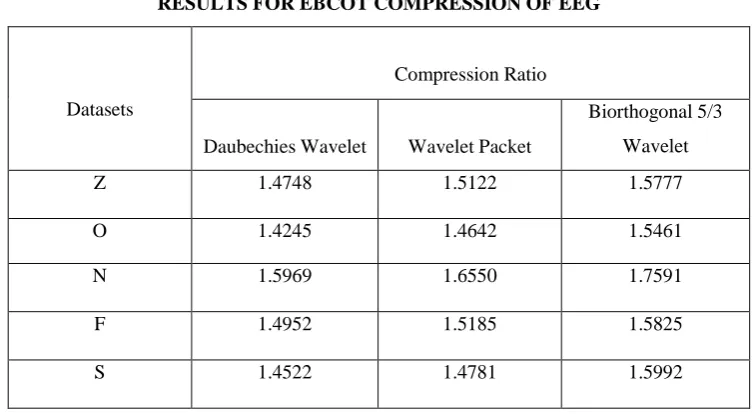
The proposed method is implemented in MATLAB R2015a. The performance measure used here to evaluate the performance of the EBCOT compression algorithm of EEG is compression ratio (CR). It is the ratio of the length of compressed signal to the length of original signal. EEG signal of 4096 samples are converted into a matrix of
size before compression. The computed results are shown in Table.1.
From the table, it can be observed that for datasets Z and O, the correlation coefficients obtained are less when compared to the other datasets (N, F, S).
417 | P a g e
TABLE 1RESULTS FOR EBCOT COMPRESSION OF EEG
Datasets
Compression Ratio
Daubechies Wavelet Wavelet Packet
Biorthogonal 5/3 Wavelet
Z 1.4748 1.5122 1.5777
O 1.4245 1.4642 1.5461
N 1.5969 1.6550 1.7591
F 1.4952 1.5185 1.5825
S 1.4522 1.4781 1.5992
V. CONCLUSION
In this paper, EEG compression that uses wavelet based EBCOT is applied to EEG signal. To evaluate the performance of the scheme proposed, experiments were carried out by using EEG datasets from Bonn database. The compression measure used here CR shows that the proposed EBCOT scheme is suitable as a better compression algorithm for the EEG data. From the table, it is found that CR can be further improved by using biorthogonal wavelets in the place of orthogonal wavelet or wavelet packet. Biorthogonal 5/3 wavelet with 6 or 7 decomposition levels, which is used for lossless compression can be incorporated into the proposed EBCOT algorithm to get improved CR.
REFERENCES
[1] Srinivasan, K., Justin Dauwels, and M. Ramasubba Reddy. A two-dimensional approach for lossless EEG compression, Biomedical signal processing and control 6.4 (2011): 387-394.
[2] Garry, Higgins, et al. An evaluation of the effects of wavelet coefficient quantisation in transform based EEG compression, Computers in biology and medicine 43.6 (2013): 661-669.
[3] A.E. Cetin, H. Koymen, Compression of digital biomedical signals (The Biomedical Engineering Handbook, second ed.,CRC Press LLC, Bronzino, Boca Raton, 2000).
[4] Blanco-Velasco, Manuel, et al. A low computational complexity algorithm for ECG signal compression, Medical engineering & physics 26.7 (2004): 553-568.
[5] Taubman, David. High performance scalable image compression with EBCOT, IEEE Transactions on Image Processing 9.7 (2000): 1158-1170.
418 | P a g e
[7] R.G. Andrzejak, K. Lehnertz, F. Mormann, C. Rieke, P. David, C.E. Elger, Indications of nonlinear deterministic and finite-dimensional structures in time series of brain electrical activity: dependence on recording region and brain state, Phys. Rev. E 64 (2001) 1–8.
[8] Antoniol, Giuliano, and Paolo Tonella, EEG data compression techniques, IEEE Transactions on Biomedical Engineering 44.2 (1997): 105-114.
[9] K. Sayood, Introduction to Data Compression third ed. (MorganKaufmann, Morgan Kaufmann Publishers, 500 Sansome Street, Suite 400, San Francisco, CA 94111, 2005).
[10] Moffat, Alistair, and Andrew Turpin. Compression and coding algorithms. Springer Science & Business Media, 2002.