INTERNATIONAL RESEARCH JOURNAL OF PHARMACY
www.irjponline.com
ISSN 2230 – 8407
Research Article
SCREENING OF BIO-RELEVANT MEDIA FOR
IN-VITRO
ANTHELMINTIC ASSAY WITH
AN OBJECTIVE TO CHECK THE POTENTIALS OF GARLIC FORMULATION FOR
HELMINTH INFECTIONS
Kiran B. Erande
1,2*, Rajendra Bhambar
21
Suresh Gyan Vihar University, Mahal, Jagatpura, Jaipur, India
2
Mahatma Gandhi Vidyamandir’s Pharmacy College, Panchavati, Nasik, India
*Corresponding Author Email: [email protected]
Article Received on: 28/02/19 Approved for publication: 17/05/19
DOI: 10.7897/2230-8407.1007217
ABSTRACT
Allium sativum L. (Garlic) belonging to family “Liliaceae” is a well known medicinal plant. In the present study, effervescent tablet dosage forms were prepared incorporating garlic powder as active ingredient with other excipients. Conventional anthelmintic assay methodology directs the use of saline solution for the study. In the present context the methodology is screened and validated for selection of bio-relevant media simulating in- vivo human gastric conditions. From the tested medias Saline solution (conventional method), Fed-State Simulated Gastric Fluid (Fe-SSGF) Early, Fasted-State Simulated Intestinal Fluid Updated version (FaSSIF-V2) were selected as an appropriate media for maintenance of worms. Pheretima posthuma
worms (Adult Indian Earthworms) being easily available and due to their anatomical and physiological resemblance with the intestinal roundworm parasites of human beings are used as a suitable model for anthelminticscreening of garlic powder and garlic formulations. Dosage forms prepared were found to be equally effective at garlic concentration of 80 mg/ml compared to albendazole anthelmintic standard used. The present study is successful attempt to prove the therapeutic indications of the prepared formulations for helminth infections.
KEYWORDS: Garlic, Allium sativum, Anthelmintic activity, Bio-relevant media, Simulated media, Intestinal Helminth, Tablet dosage form.
INTRODUCTION
Helminthiasis, also known as worm infection, is any macroparasitic disease of humans and other animals in which a part of the body is infected with parasitic worms, known as helminths. There are numerous species of these parasites, which are broadly classified into tapeworms, flukes, and roundworms. They often live in the gastrointestinal tract of their hosts, but they may also burrow into other organs, where they induce physiological damage. Helminths are a broad range of organisms that include intestinal parasitic worms, roundworms (Ascaris lumbricoides), whipworms (Trichuris trichiura), or hookworms (Necator americanus and Ancylostoma duodenale). Infected people excrete helminth eggs in their faeces, which then contaminate the soil in areas with inadequate sanitation. Other people can then be infected by ingesting eggs or larvae in contaminated food, or through penetration of the skin by infective larvae in the soil (hookworms). Infestation can cause morbidity, and sometimes death, by compromising nutritional status, affecting cognitive processes, inducing tissue reactions, such as granuloma, and provoking intestinal obstruction or rectal prolapse. Control of helminthiasis is based on drug treatment, improved sanitation and health education.1 Helminths are divided into two major phyla, and all members of each phylum have distinct structural features that separate them from the others. The nematodes (also known as roundworms) include the major intestinal worms and the filarial worms that cause lymphatic filariasis (LF), whereas the platyhelminthes include the trematodes (flukes), such as the schistosomes, and the cestodes (tapeworms). Humans and helminths have co-existed throughout our evolution. The history of helminthiasis can be traced back to
the earliest record of human beings. Although effective preventive and therapeutic measures have been developed for most parasitic worms, helminth infections are still very common in the developing world today. It has been estimated that one billion people worldwide are infected with one or more helminths. Most of the victims live in regions of Sub-Saharan Africa, Asia, and Latin America.2
studies raised the possibility of revival of garlic therapeutic values in different diseases.3
The potency of garlic (Allium sativum) has been acknowledged for 5000 years. In ancient times, the Babylonians, Egyptians, Phoenicians, Vikings, Chinese, Greeks, Romans and Hindus used garlic frequently. They took garlic as a remedy for intestinal disorders, flatulence, worms, respiratory infections, skin diseases, wounds, symptoms of aging and many other ailments.4 The potential trematocidal effects of garlic (Allium sativum) are investigated in the context of intestinal food borne trematodes, employing the Echinostoma caproni-mouse model.5 Garlic was also successfully used to show eradication of the Cryptosporidium oocysts from stool and intestinal sections of the infected immunocompetent subgroup of mice receiving garlic two days before the infection.6
METHODOLOGY
Materials
Garlic powder was prepared in-house by microwave drying process as per reported literature.7-12 All the reagents and chemicals used were of analytical grade and were procured from S.D. Fine-Chem. Ltd., Mumbai, India.
Use of Pheretima posthuma for Anthelmintic Activity Study Literature Review indicates the use of Indian Earthworms
Pheretima posthuma for In–vitroanthelmintic study of Intestinal Helminth Infection as they are having anatomy physiology same as that of intestinal roundworms. 13, 14
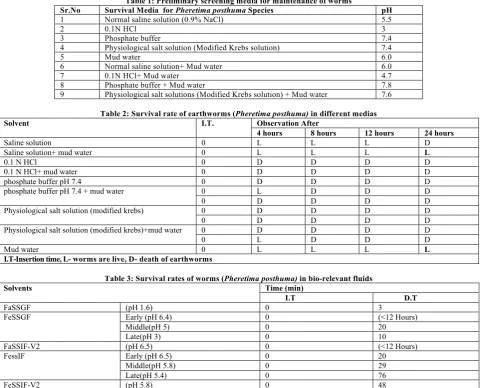
Preliminary Screening of the Appropriate Medium for Maintenance of Worms During the Study Experiments The conventional anthelmintic assay methodology reports the usage of normal saline solution (0.9% NaCl) as maintenance media for the species. But the number of questions arises viz. Whether the media supports the survival of the worms? How long the worms would remain alive during the study period? Can the solvent be the reason for the death of the worms? Etc. As saline solution is not the natural environment for the worms to sustain, so the preliminary screening study was carried out to check the survival rate in various buffer solutions matching the pH conditions of saline solution. The collected worms were divided into groups (2 worms each) and placed in different media to choose the most appropriate for in- vitro maintenance of worms during the study experiments. Nine Medias viz- Normal saline solution (0.9% NaCl), 0.1N HCl, Phosphate buffer, Physiological salt solution (Modified Krebs solution), Mud water, Normal saline solution with Mud water, 0.1N HCl with Mud water, Phosphate buffer with Mud water, Physiological salt solutions (Modified Krebs solution) with Mud water were tested for studying the survival (mortality) rate of worms. Screening medias with pH are mentioned in Table-1. The appearance of the normal alive worms and dead worms is depicted in Figure.1 Survival rate of earthworms (Pheretima posthuma) in different medias are shown in Table-2
Selection of Bio-Relevant Media
The solvents mentioned in the preliminary study match only with the pH conditions of Gastro intestinal tract. In order to simulate the conditions of Gastro intestinal tract, bio-relevant medias simulating gastrointestinal conditions like Fasted state, Fed state were used.15 Various medias used were FaSSGF pH1.6- Fasted-State Simulated Gastric Fluid, FeSSGF Early, Middle, late )- Fed-State Simulated Gatric Fluid, FaSSIF-V2 pH 6.5 Fasted-State Simulated Intestinal Fluid Updated version, FeSSIF- State Simulated Intestinal Fluid, FeSSIF-V2- Fed-State Simulated Intestinal Fluid( updated). Survival rate of
Worms (Pheretima posthuma) in Bio-relevant fluids is depicted in Table 3.
In- Vitro Anthelmintic Assay Using Modifications in Conventional Method
The in- vitro activity of garlic powder on adult earth worms (Pheretima posthuma) was studied in comparison to that of albendazole. Different concentrations of albendazole (20, 40 mg/ml) and garlic powder (10, 20,40,60,80 mg/ml) were prepared in saline solution and tested against Earthworms maintained in the selected medium. Ten milliliters (10 ml) of each concentration of anthelmintic agent was applied to a group of two worms of same length maintained in 10ml of selected medium. All worms were examined for paralysis time and death time. The results are mentioned in Table 4. The decision on dose selected for optimizing the effervescent tablet dosage form was taken on the basis of the results obtained for the anthelmintic assay using modified methodology.
Formulation and Evaluation of Effervescent Tablet
Method adopted for tablet preparation was direct compression method. All ingredients like drug (Garlic Powder) 400 mg (56.65%), cross povidone (4.95%), citric Acid (16.99%), sodium bicarbonate (18.55%), magnesium stearate (1.41%) and talc (1.41%)] were weighed and passed through sieve no. 80 individually and then mixed. This powder mixture was compressed directly using Rimek minipress; model RSB-4, m/s (Karnavathi engineering, Ahmadabad). The prepared tablets were evaluated for various parameters like hardness, friability, weight variation test, effervescent time and disintegration time as per conventional standards applicable for tablet dosage form. The results for optimized batch are mentioned in Table 5.
In- VitroAnthelmintic Assay of Garlic Effervescent Tablet and Albendazole Tablets as Standard
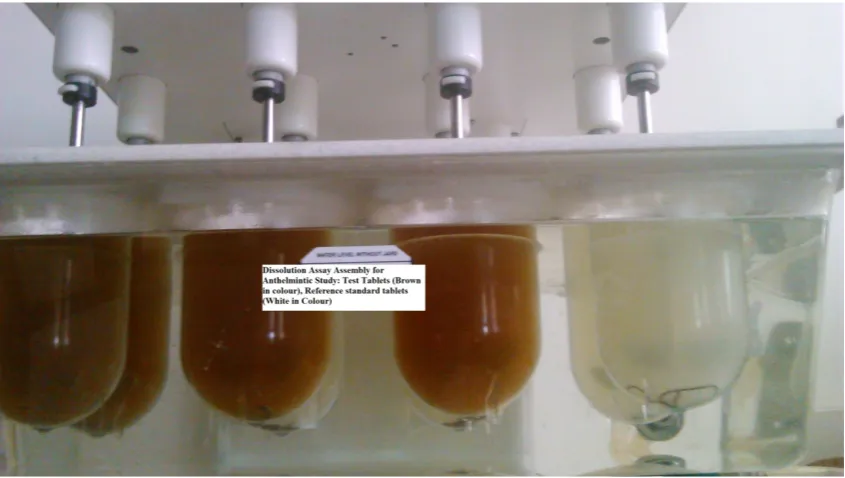
Anthelmintic Assay was performed in simulated intestinal fluid using dissolution paddle apparatus at 25 RPM. Nine hundred milliliters (900ml) of Fasted State Simulated Intestinal Fluid (FaSSIF)15 having pH 6.5 was filled in each jar. Two earth worms were placed in each jar subsequently followed by addition of 2 tablets in each jar and worms were observed for their death time. The death time was concluded when worms did not move on shaking vigorously or dipped in a hot water of 500C. The in- vitro anthelmintic activity of albendazole taken as a standard was done by the same procedure as that of the effervescent tablet, as stated above only with a change in RPM which was set at 50 rpm and worms were observed for the death time. Pictorial representation of dissolution assay assembly for anthelmintic study of tablet under test is shown in Figure 2. The results are mentioned in Table 6.
RESULT AND DISCUSSION
Table 1: Preliminary screening media for maintenance of worms
Sr.No Survival Media for Pheretima posthuma Species pH
1 Normal saline solution (0.9% NaCl) 5.5
2 0.1N HCl 3
3 Phosphate buffer 7.4 4 Physiological salt solution (Modified Krebs solution) 7.4
5 Mud water 6.0
6 Normal saline solution+ Mud water 6.0 7 0.1N HCl+ Mud water 4.7 8 Phosphate buffer + Mud water 7.8 9 Physiological salt solutions (Modified Krebs solution) + Mud water 7.6
Table 2: Survival rate of earthworms (Pheretima posthuma) in different medias
Solvent I.T. Observation After
4 hours 8 hours 12 hours 24 hours
Saline solution 0 L L L D Saline solution+ mud water 0 L L L L
0.1 N HCl 0 D D D D
0.1 N HCl+ mud water 0 D D D D phosphate buffer pH 7.4 0 D D D D phosphate buffer pH 7.4 + mud water 0 L D D D
0 D D D D
Physiological salt solution (modified krebs) 0 D D D D
0 D D D D
Physiological salt solution (modified krebs)+mud water 0 D D D D
0 L D D D
Mud water 0 L L L L
I.T-Insertion time, L- worms are live, D- death of earthworms
Table 3: Survival rates of worms (Pheretima posthuma) in bio-relevant fluids
Solvents Time (min)
I.T D.T
FaSSGF (pH 1.6) 0 3
FeSSGF Early (pH 6.4) 0 (<12 Hours) Middle(pH 5) 0 20
Late(pH 3) 0 10
FaSSIF-V2 (pH 6.5) 0 (<12 Hours) FessIF Early (pH 6.5) 0 20
Middle(pH 5.8) 0 29 Late(pH 5.4) 0 76
FeSSIF-V2 (pH 5.8) 0 48
I.T-Insertion time ,P.T-Paralysis time, D.T-Death time. Note15: FaSSGF pH1.6- Fasted-State Simulate Gastric Fluid, FeSSGF(Early, Middle, late )-
Fed-State Simulated Gatric Fluid, , FaSSIF-V2 pH6.5- Fasted-Fed-State Simulated Intestinal Fluid Updated version, FessIF- Fed-Fed-State Simulated Intestinal Fluid, FeSSIF-V2- Fed-State Simulated Intestinal Fluid ( updated).
Table 4: In- vitro anthelmintic effect of garlic powder and albendazole standard Garlic Powder With additives
Dose mg/ml
Time (min)
MEDIUM
FaSSIF(pH 6.5) FeSSGF (pH 6.4) Saline Solution (pH 5.9)
10
I.T. 0 0 0 0 0 0 P.T. - - - - D.T. - - - -
20
I.T. 0 0 0 0 0 0 P.T. - - - - D.T. - - - -
40 I.T. P.T. 0 - 0 - 0 229 0 - 0 - 0 - D.T. - - - -
60
I.T. 0 0 0 0 0 0 P.T. 58 57 67 62 28 41 D.T. 170 167 182 179 173 178
80
I.T. 0 0 0 0 0 0 P.T. 26 21 21 22 31 34 D.T. 183 181 165 165 101 104
Albendazole standard
20 I.T. 0 0 0 0 0 0 P.T. 93 86 79 86 105 149 D.T. 175 180 119 121 220 205 40 I.T. 0 0 0 0 0 0
P.T. 6 8 11 13 23 21 D.T. 16 15 22 24 26 18
Table 5: Evaluation of effervescent tablet Evaluation Tests
Hardness (Kg/cm2) Weight Variation (mg) Effervescent Time (min.) Disintegration Time (min.) Friability %
4.5 709.9±35.5 07.09 7 0.88
Table-6: In- vitro anthelmintic assay of garlic effervescent tablet and standard albendazole tablet
Garlic Tablet(800 mg)
Observations Time (min.)
For Set I For Set II For Set III
I.T 0 Mean 0 Mean 0 Mean D.T 104 102 122 139 88 89
D.T 100 156 90
Albendazole Standard Tablet (400 mg)
I.T 0 Mean 0 Mean 0 Mean D.T 90
92.5 98 97 100 99
DT 95 96 98
Fig. 1: Appearance of the normal alive worms and dead worms
Fig.3: In vitro Anthelmintic Effect of garlic powder in Bio-relevant Medias and saline solution
From the experimentation carried out under preliminary screening, it was found that worms could survive in saline solution for 12 hours whereas the worms could survive for longer in saline solution plus mud water and pure mud water which are the natural environment for the survival and growth of worms. So it was concluded from the above study that for the anthelmintic study to be carried out and to interpret the proper anthelmintic activity for any drug the study should be carried out in suitable simulated environment which persists in human body where the worms find as a place of parasite. Results mentioned in Table-2.
Selection of Bio-Relevant Media
From these tested medias Saline solution, Fed-State Simulated Gastric Fluid (Fe-SSGF) Early, Fasted-State Simulated Intestinal Fluid Updated version (FaSSIF-V2) were selected as an appropriate medium for maintenance of worms as the worms were found to be alive for about 12 hours. (Table-3)
In- Vitro Anthelmintic Assay Using Modifications in Conventional Method
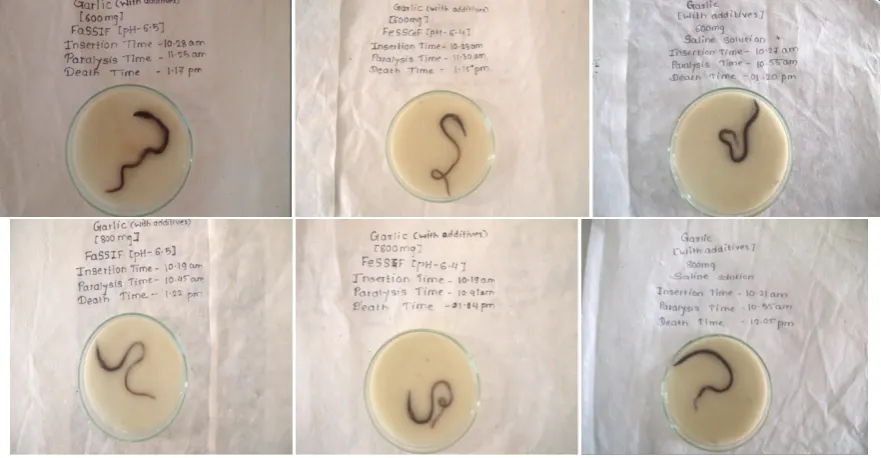
The anthelmintic effect of different concentrations of albendazole against earthworms is shown in Table 4 and Figure-3 The time taken for paralysis of worms was 7± 0.5 minutes. in FaSSIF, 12±0.5 minutes in FeSSGF and 22 ±0.5 minutes in Saline solution, while time taken for death was 16±0.5 minutes in FaSSIF, 23±0.5minutes in FeSSGF and 22±0.5minutes in saline solution at 40mg/ml concentration. On the other hand the lower concentration (20mg/ml) allowed worms to survive for longer (around 2-3 hours). The effective concentration of reference drug albendazole was found out to be 40 mg/ml (400 mg). Garlic powder was prepared with microwave drying technique with inclusion of some additives like corn flour in minor quantity to aid grinding of powder to get uniform particle size for particles. The time taken for paralysis of worms was found to 23.5±0.5 min in FaSSIF, 21.5±0.5minutes in FeSSGF and 32.5±0.5 minutes in Saline solution, while time taken for death was 182±0.5 minutes in FaSSIF, 165±0.5minutes in FeSSGF and 102.5±0.5 minutes in saline solution at 80mg/ml concentration. Changes in body structure of worms after and before death are shown in Figure-2. After death of the worm, fading of body color was observed along with the change in the appearance. In -vitro anthelmintic effect of garlic powder in Bio-relevant medias and saline solution shown in Figure- 3.The results shown in Table-4
Formulation and Evaluation of Effervescent Tablet
As per the anthelmintic concentration obtained for garlic powder which was found to be 80 mg/ml, the expected dose strength of the garlic anthelmintic tablet was 800mg per tablet. For convenience the tablets comprising 400 mg dose strength were designed and optimized. And for studies involving anthelmintic assay for tablet dosage form two tablet dosage form containing 400 mg each of garlic powder were utilized to fulfill the dose of 800 mg dose strength. Post compression evaluation of optimized batch of tablet dosage form depicts the results fitting in the compendial requirements of the dosage form as shown in Table 5
In- Vitro Anthelmintic Assay of Effervescent Tablet and Albendazole Tablets as Standard
As the dose requirements for garlic powder as anthelmintic agent, two tablets were taken for study each containing 400 mg of active drug content fulfilling the requirement of 80 mg/ml concentration. The results obtained are comparable with the albendazole standard used. The results are shown in Table 6. For the albendazole tablets on an average death time reported was 96.16 minutes, whereas for the garlic effervescent tablet dosage form the average death time was 110 minutes, which was found to be equally effective as that of the standard used.
CONCLUSION
The present research work is the successful attempt which came out with the dosage form comparable to marketed formulations. Moreover the most important outcome of the research work was validation and optimization of the conventional assay methodology for the anthelmintic activity.
ACKNOWLEDGEMENT
REFERENCES
1. Helminthiasis,© WHO 2019, Special Programme for Research and Training in Tropical Diseases (TDR) [cited 2019, February 21]. Available from: https://www.who.int/tdr/diseases-topics/helminths/en/. 1. Wang LJ, Cao Y, Shi HN. Helminth infections and intestinal
inflammation. World Journal of Gastroenterology. 2008 September [Cited 2015August 15]; 14(33): 5125-5132 Available from: URL: http://www.wjgnet.com/1007-9327/14/5125.asp
2. Bayan L, Koulivand PH, Gorji A. Garlic: a review of potential therapeutic effects. Avicenna Journal of Phytomedicine. 2014; 4 (1): 1-14. Available From: https://www.ncbi.nlm.nih.gov/pmc/articles/PMC4103721/pd f/ajp-4-001.pdf
3. Amagase H, Petesch BL, Matsuura H, Kasuga S. and Itakura Y. Intake of Garlic and Its Bioactive Components. Journal of Nutrition 2001; 131, 955S-962S.
4. Cortés A, García-FM, Sotillo J, Guillermo EJ, Toledo R, Muñoz-AC. Effects of dietary intake of garlic on intestinal trematodes. Parasitology Research 2017; 116: 2119-2129. 5. Gaafar MR. Efficacy of Allium sativum (garlic) against
experimental cryptosporidiosis. Alexandria Journal of Medicine 2012; 48: 59–66.
6. Deokar G, Pethkar P, Bakshe S, Erande K, Bhambar R. Antimalassezia Activity of Medicated Antidandruff Shampoo Formulated with Microwave Dried Garlic Powder with Improved Allicin Stability. The Natural products Journal 2014; 4:23–32.
7. Yu Li. Characteristics of Microencapsulated Garlic Powder Dried by Microwave-vacuum Combined with Vacuum Drying. 2008; 29(08): 208-213.
8. Ray C. Dry Flowers in the Microwave with Silica Gel - Yahoo Voices. 2006. [Cited 2013, September 14]. Available from: http://voices.yahoo.com/dry-flowers-microwave-silica-gel-56324.html.
9. Spinka J, Stamfer J. Process of producing stable garlic preparation. US Patent 2,618,561; November 18, 1952. 10.Schmidt JC. Drying Flowers in a Microwave. [Cited on 2016,
July 2] From:
http://web.extension.illinois.edu/cook/downloads/9206.pdf. 11.Ilic D, Nikolic V, Stankovic M, Nikolic L, Stanojevic L,
Ranisavljevic IM, et al. Transformation of Synthetic Allicin : The Influence of Ultrasound, Microwaves, Different Solvents and Temperatures, and the Products Isolation. The Scientific World Journal 2012; 7pages.
12.Pusapati MR, Chowdary AY, Krapa H, Nanduri S, Badapati H, Kumar KP, et al. Antimicrobial and Antihelminthic Activities of Various Extracts of Leaves and Stems of
Abutilon indicum (Linn). International Journal of Pharmaceutical and Biological Archives 2013; 4(1): 235-239. 13.Earthworm: Pheretima posthuma. [Cited 2018 December 23] Available from: https://www.iaszoology.com/earthworm/. 14.Jantratid E, and Dressman J. Biorelevant Dissolution Media
Simulating the Proximal Human Gastrointestinal Tract: An Update. Dissolution Technologies 2009; 21–25. Available from:
http://www.dissolutiontech.com/DTresour/200908Articles/D T200908_A03.pdf.
Cite this article as:
Kiran B. Erande and Rajendra Bhambar. Screening of bio-relevant media for in-vitro anthelmintic assay with an objective to check the potentials of garlic formulation for helminth infections. Int. Res. J. Pharm. 2019;10(7):51-56
http://dx.doi.org/10.7897/2230-8407.1007217
Source of support: Nil, Conflict of interest: None Declared