© 2017 IJSRST | Volume 3 | Issue 3 | Print ISSN: 2395-6011 | Online ISSN: 2395-602X Themed Section: Science and Technology
Reverse Calling for Person Safety
Rupesh Sadashiv Ghumare, Mukesh Shivaji Wagh, Rahul Prakash Uphade, Prof. Pushpendu Biswas,
Prof. Bajirao Subhash Shirole
Department of Computer Engineering, Sanghavi College of Engineering, Nashik, India
ABSTRACT
Person Safety is the Important issue in today's world and many android interfaces available in the market targeting this area, but all these Person safety apps acts only when Person in trouble and requires some action like long pressing of power button or click of particular button of device. Parents or relatives who are away from the person who is using safety app and the person in trouble may not get time to press the button on device. relatives are not able to interact with person in existing apps by using available options. To resolve the problem we are introducing new concept of reverse calling where relatives can send command to the device of person in trouble and device can dial the no of relative and also sends the location on relatives device. using this mechanism parents can find the person and judge the situation and also helps to come out of situation.
Keywords: Safety app, Reverse calling, Android interfaces.
I.
INTRODUCTION
Person Safety is the Important issue in today’s world, but all these Person safety apps acts only when Person is in trouble. But Parents or relatives who are away from the person are not able to interact with person in today’s case by using available options. This application is generally meant for the attention of the authorities or public in the emergency response capabilities such as terrorist attacks and the natural disaster by facilitating the communication We will be tracking the location of the person via GPS and storing the details of the current location into a remote server via GPRS consecutively, we will also be tracking the schedule of the person as per the schedule list which is being uploaded by the person and we will be sending SMS to the relatives of the concerned person about the schedule their current location of the concerned person that time. So that they will come to know about the status and if something is wrong, we will be having another set of oppositions to give a call to a police, social workers, volunteer organizations, etc. With their respective along the mobile phones. The difficulties in the existing application are the lack of situational awareness and communication terminology among their respective. Due to this response and recovery is Difficult to the
authorities. In respect of the public safety with the support of the network provider the application runs in the android phones in efficient way to identify and recover the problem by the natural disaster or terrorist attacks etc Furthermore users are likely to operate the mobile devices for the security purpose to intimate the problem detection to their respective in the emergency cases. To develop the application android based mobile application the station and the environment of the surrounding has to been interviewed then the dangerous and the suspicious activates should be notified to the device by the user .if the device detects the problem then only other process creates the attention for reporting to the authority.
Motivation of the Project
1. Person safety apps acts only when Person in trouble and requires some action like long pressing of power button or click of particular button of device.
3. using this mechanism parents can find the person and judge the situation and also helps to come out of situation.
4. Security Purpose.
5. Person Safety is the Important issue in todays world.
The organization of this document is as follows. In Section 2 gives literature survey, Section 3 gives details of system architecture. In Section 4 presents research findings and your analysis of those findings. Section 5 concludes the paper.
II.
LITERATURE SURVEY
The women have to dial a number to call a police or send a Short Messaging Service (SMS) to the particular subscriber code, after they received the service they will get in touch with you later and there is no time to make a call or SMS. There are also so many volunteer organizations all over the world to help them, but they could not able to get those messages. We will be tracking the location of the person via GPS and storing the details of the current location into a remote server via GPRS consecutively, we will also be tracking the schedule of the person as per the schedule list which is being uploaded by the person and we will be sending SMS to the relatives of the concerned person about the schedule their current location of the concerned person that time. So that they will come to know about the status and if something is wrong, we will be having another set of oppositions to give a call to a police, social workers, volunteer organizations, etc. The GPS, elaborated as Global Positioning System, is a satellite based navigation system made up of a network of 24 satellites placed into orbit by the U.S. GPS works in any weather conditions, anywhere in the world, 24 hours a day. There are no subscription fees or setup charges to use GPS . A GPS can help us to determine exactly where we are at any given moment. Not only can a GPS give us the name of the street we might be traveling on, but many GPS systems can also give us the exact latitude and longitude of where you are located. On the other hand, Android mobile platform is becoming more popular to the users for its multi-dimensional purposes. Tracking System via Android Device uses GPS and any mo-bile phones having an Android operating system to track the location of a person whenever necessary. Android is an operating system based on the Linux kernel, and designed primarily for touch screen mobile devices such as smart phones and tablet computers. Initially developed by Android, Inc., which Google backed financially .Android was unveiled in 2007 along with the founding of the Open Handset Alliance: a consortium of hardware, software, and telecommunication companies devoted to advancing open standards for mobile devices. The first publicly available
Smartphone running Android, the HTC Dream, was released on October 22, 2008 The user interface of Android is based on direct manipulation, using touch inputs that loosely correspond to real-world actions, like swiping, tapping, pinching and reverse pinching to manipulate on-screen objects. Internal hardware such as accelerometers, gyroscopes and proximity sensors are used by some applications to respond to additional user actions, for example adjusting the screen from portrait to landscape depending on how the device is oriented. Android allows users to customize their home screens with shortcuts to applications and widgets, which allow users to display live content, such as emails and weather information, directly on the home screen. Applications can further send notifications to the user to inform them of relevant information, such as new emails and text messages. Android is open source and Google releases the source code under the Apache License. This open-source code and per- missive licensing allows the software to be freely modified and distributed by device manufacturers, wireless carriers and enthusiast developers. In practice, Android devices ship with a combination of open source and proprietary software. Android has a large community of developers writing applications ("apps") that extend the functionality of devices, written primarily in the Java programming language. In October 2012, there were approximately 700,000 apps available for Android, and the estimated number of applications downloaded from Google Play, Android's primary app store, was 25 billion. A developer survey conducted in April May 2013 found that Android is the most popular platform for developers, used by 71 percent of the mobile developer population.
III.
SYSTEM ARCHITECTURE
In our System we are introducing new concept of reverse calling where relatives can send command to the device of person in trouble and device can dial the no of relative and also sends the location on relatives device. using this mechanism parents can help the person and
judge the situation and also helps to come out of
Figure 1: System Architecture
A. Modules of Project:
Client and Device registration Module:
Input: User Details eg. Name, email, sim no, tracker no.
Output: All the data will registered to web server and user successful registration message will appear.
Figure 2: Client and Device Registration Model
Location Tracking in Theft Mode Module Input: Trouble Mode Activation
Output: GPS Location Available on Registered Tracker
Biometric Image Capture in Theft Mode Module Input: Theft Mode Activation
Output: Auto Image Capture
Figure 3: Location Tracking
Figure 4: Biometric Image capture in theft mode
module
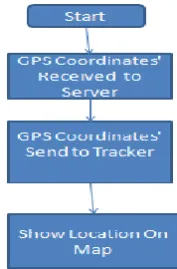
Geographic based tracking system Module:
Input: GPS Co-ordinates From theft Mode Activated Device
Output: Location Tracking Using these coordinates on map
Biometric Content Decryption Module
Input: Encrypted Image From theft Mode Activated Device
Output: Decrypted Image
Figure 6: Biometric Decryptio content module
Design of the system
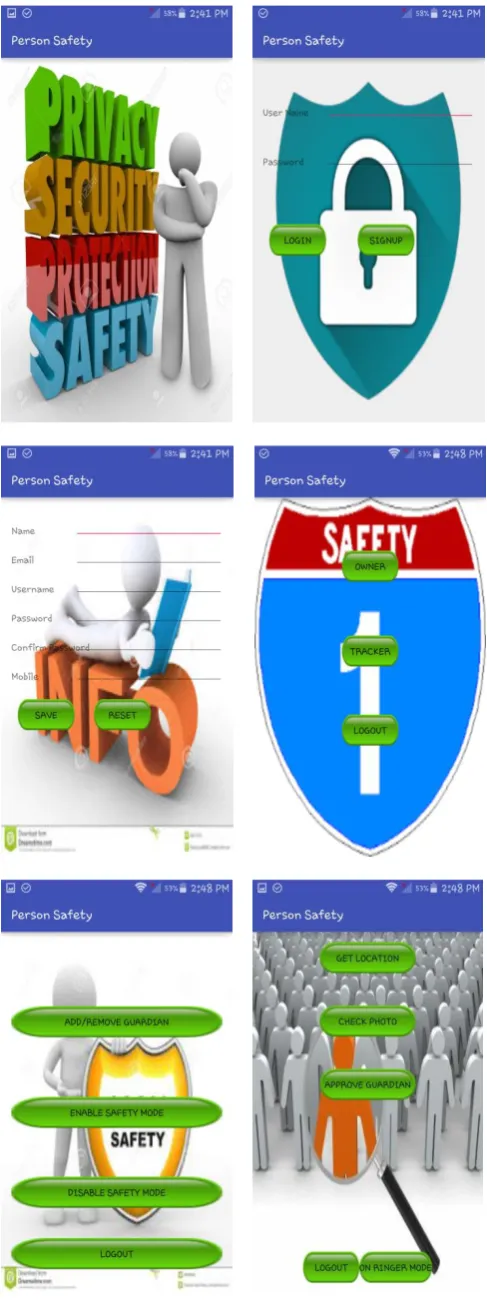
In this application we introduce a new scenario Person safety by developing an application which is able to identify the person in trouble. Suppose that someone has some troublesome situation and his family friends have no idea that the person is in trouble.
Once this application gets installed in your android mobile device, it will store your email id, alternate mobile number, in the phone memory and keep running in the background by using services.
Then it will keep checking for Safety Mode Command, once a Gaurdian send Safety Mode Command, start services.
Now as soon as signal is received, services gets started in the background which will start taking snapshots from front camera if present otherwise from back camera (atleast one camera is necessary) and which are stored in the SD card. Also Service Will Locate GPS Coordinates of the device
Now once these services get finished it will send signal to another service, where a service will send attached snaps and Location to a web Server, an alternate mobile number added as tracker.
IV.
RESULTS
V.
CONCLUSION
Here we our system allows to track a person in trouble without his action, also makes aware of his situation to relatives by reverse calling mechanism. as an effective Android application to prevent such type of the suspicious or natural disaster, by alerting the concern authorities using the android mobile phone which helps to stop such type of illegal activates and to trace the concern.
VI.
REFERENCES
[1]. Michael Burton, Dohn Ferker (2012). Android Application For Dummies. 2nd ed. 111,river street,Hoboker: jhon wiely and sons,inc. p12-90. [2]. Cook book,reipeng liu (2013). Android Application
devlopment kit.Mumbai: packt bimingam. p1-50,p67-90.
[3]. Peter Erickson, Andrew Weinert, and Dr. Paul Breimyer,Matt Samperi, Jason Hu_, Carlos Parra, and Dr. Scarlett Miller. (2013). Designing Public Safety Mobile Applications for Disconnected, Interrupted,and Low Bandwidth Communication Environments.
[4]. Felix, C.; Raglend, I.J., Home automation using GSM, Signal Processing, Communication, Computing and Networking Technologies (IC-SCCN), 2011 International Conference on , vol., no., pp.15,19, 21-22July 2011
[5]. A. Doulamis N. Pelekis and Y. Theodoridis EasyTracker: An Android Application for Capturing Mobility Behavior 2012 16th Panhellenic Conference on Informatics (PCI)/em 2012.
[6]. M. Byrne Evans K. OHara T. Tiropanis and C.Webber Crime applications and social machines: Crowdsourcing sensitive data emSOCIAM: The Theory and Practice of Social Machines/em 2013. [7]. R. K. Sharma, A. Mohammad, H. Kalita and D.