Experience Of Control And Student
Satisfaction With Higher Education Services
Jungki Lee, Korea University at Sejong, South KoreaSekhar Anantharaman, Indiana University of Pennsylvania, USA
ABSTRACT
Although the delivery of satisfactory services is an important strategic goal in many colleges, students are known to face challenges and experience a significant amount of stress during their school life. This study proposes and tests students’ experience of control over their college life as a promising factor that would enhance their satisfaction. The study adopts a structural equation modeling approach which examines the effects caused by cognitive control and behavioral control on students’ experience of overall control over school life, and the effect of control on student satisfaction. Data were collected at a major college in South Korea. Three out of five hypotheses are supported and managerial implications are provided.
Keywords: Experience of Control; Cognitive Control; Behavioral Control; Student Satisfaction
INTRODUCTION
n increasing number of higher education institutions are adopting business perspectives, realizing that they are in a competitive service industry. Students are viewed as customers and their satisfaction becomes a major strategic goal in many higher education institutions. The universities that rated high on student satisfaction are usually considered as delivering a quality education service, making them attractive alternatives and leading to high enrollment rates and low dropout rates. According to Tinto (1994), on the contrary, schools with poor student satisfaction tend to suffer from weak academic performance among students, high dropout rates, and reduced revenue.
There are several challenges that students in higher education have to deal with on a daily basis. These include academic, financial, social and other challenges. Towbes and Cohen (1996) say that many students find college a stressful experience since it forces them to deal with and function in new academic and social settings. Those students that fail to deal with these various stress factors effectively face negative consequences, which include feelings of loneliness, sleeplessness, nervousness, excessive worrying, etc. (Wright, 1967). Under these conditions, a student would find it very difficult to experience satisfaction with his/her academic experience. Clearly, stressors must be effectively dealt with to ensure student success. To this end, Ross et al. (1999) argue in favor of universities designing and implementing stress intervention programs to deal with the stress of college students. Regardless of the importance of the issue, the literature on student satisfaction have paid limited attention to the stress and other negative psychological experiences that are prevalent among college students.
The purpose of this study is to propose and empirically test students’ experience of control as a promising factor that would effectively reduce their stress with school life and enhance their satisfaction with higher education institutions. To be specific, the study proposes a model that incorporates two different routes that students may use to experience control over their school life and also tests the effects of students’ control experiences on their satisfaction with their school. This paper provides literature review dealing with satisfaction and control; a conceptual model, including hypotheses; research methods; findings from a survey; summarized and scrutinized results; and conclusions and implications of the study for higher education institutions.
192 http://www.cluteinstitute.com/ 2013 The Clute Institute LITERATURE REVIEW
Student Satisfaction
The importance of customer satisfaction has been recognized by higher education, just like other business sectors. Since, customer satisfaction is reported to be closely related to the profits and other financial outcomes of service firms (Zeithaml et al., 2006), college administrators have adopted student satisfaction as one of the cornerstones for their competitive strategy. Indeed, no college is free from the necessity of understanding the antecedents, determinants, and consequences of student satisfaction nowadays.
Student satisfaction can be generally defined as a favorable cognitive state resulting from a positive evaluation of a student’s educational experience (Athiyaman, 1997). Satisfaction is perceived when the service delivered matches well with students’ expectations (Szymanski and Henard, 2001). Student satisfaction is not a short-term evaluation but rather an enduring attitude developed through repeated experiences with campus life. As such, it is affected by many factors. Sevier (1996), for example, has argued that college students evaluate their schools in terms of academic, social, physical, and even spiritual experiences. Student satisfaction, then, is a global index, that summarizes one’s general feeling toward one’s educational experiences (Bolton et al., 2000).
A number of factors have been reported as antecedents of student satisfaction. Academic dimensions of a college have been proposed as major factors affecting a student’s satisfaction. These include student-to-faculty ratios, program reputation, quality of teaching, and faculty credentials (Elliott, 2002; Martinez, 2001). Interaction between the student and the school personnel was also noted as an important factor affecting student satisfaction (Browne et al., 1998). Similarly, some have noted the importance of academic advising and career counseling for student satisfaction (Kotler and Fox, 1995). At an individual level, one’s academic performance including grades was found to be highly correlated to one’s satisfaction with the school (Babin and Griffin, 1998). In addition to these academic aspects, the social life of students was also found to be an important factor. Tinto (1994), for example, argued that the social aspect of college life was one of the two most important factors for determining students’ satisfaction with and intention to remain in an academic program. He noted the importance of social integration including the quality of the individual’s relationships with fellow students and with professors. In the same vein, Saenz et al. (1999) have emphasized the importance of regular contact that a student makes with school constituents. One of research streams founded upon service quality perspective has applied either SERVQUAL or SERVPERF perspective to the studies of student satisfaction (Parasuraman et al., 1988; Cronin and Taylor, 1992). Conceptualizing service quality as being composed of five dimensions (namely, tangibles, reliability, responsiveness, assurance, and empathy), studies in this research category have attempted to identify major service quality factors affecting student satisfaction or dissatisfaction (LeBlanc and Nguyen, 1997; Lee and Anantharaman, 2011). A plethora of studies on student satisfaction, while helping us deal with the elusive concept called student satisfaction, have also left a number of questions unanswered.
A direct application of theories developed in commercial sectors to the educational context is problematic. College is considered a stressful experience that forces one to deal with new educational and social environments at start, and to maintain a balance among academic, work, financial burden, and in some cases family-related issues during one’s tenure at school (Towbes and Cohen, 1996). Students, in their interaction with school constituents, tend to enact subordinate roles during such encounters. According to Lee (2010), a number of students in both eastern and western cultures perceive power inferiority to their service providers. This in turn leads to a higher likelihood of them experiencing stress and frustration during their encounters with professors. Considering such a propensity for students to experience negative emotions, there is a surprising paucity in student satisfaction literature dealing with students stress. In this context, Ross et al. (1999) have noted the pervasiveness of students’ stress on campus and called for research in this area. The concept of the experience of control discussed below has a high potential to incorporate that issue.
Experience of Control
superiority, and mastery over an environment (White, 1959). Thus, perceived control can be viewed as one’s belief that one is in charge of a situation. Perceived control has been reported to play a crucial role in determining both negative consequences such as stress, helplessness, meaninglessness, and intention to abuse substances and positive consequences such as self-efficacy, competence, satisfaction, and physical and psychological well-being (Cohen, 1981; Goldstein, 1989; Langer and Saegert, 1977; Mills and Krantz, 1979; Newcomb and Harlow, 1986). Perceived control has been applied to a number of contexts including nursing homes, hospitals, psychotherapy clinics, workplaces, supermarkets, and residence areas (Baum and Valins; Fleming et al., 1987; Tetrick and LaRocco, 1987; Sutton and Kahn, 1986). One of the major themes in literature is that one’s perception of control in an environment reduces one’s stress and perceived risk in it and enhances one’s satisfaction with it.
The concept of perceived control also has been applied to the settings of higher education. Students’ sense of control over their school life was found to be an important factor affecting their satisfaction with undergraduate education (Lee, 2011) and with MBA education (Lee and Anantharaman, 2010). Similarly, Elliott (2002) has noted that students’ desire to feel that they are the center of attention and are important to the university. Mackie’s (2000) qualitative study found that perceived lack of control exerted a significant influence on a student’s intention to withdraw from the program. Thus, it is noted that students’ perception of control and their satisfaction with education has been receiving attention in literature.
What is unclear in literature, though, is the way students perceive control. Studies in psychology diverge into many aspects when it comes to a question dealing with antecedents for one to experience control in an environment. The most fundamental distinction in the literature on control is between actual control, or the objective control conditions present in a given context and the person, and perceived control, or an individual’s beliefs about how much control is available (Skinner, 1996). The difference is similar to whether one can actually exert influence (behavioral control, Averill, 1973) or whether one is able to psychologically incorporate the stressful event into one’s cognitive plan (cognitive control, Averill, 1973). This distinction is important for school administrators who are interested in implementing the program that enhances students’ experience of control, which in turn is likely to affect student satisfaction. Following is a review of each of these controls.
Behavioral Control
The most widely accepted conceptualization of personal control is one’s belief of his/her ability to change the objective nature of an impending event. A group of researchers demonstrated that an individual’s perception of control over a situation is largely affected by his/her belief regarding the ability to modify the objective nature of the situation (Geer et al.; 1970; Kanfer and Seidner, 1973; Litt, 1988; Thompson, 1981). A number of studies have found a positive relationship between the availability of responses one possesses and the ability to respond adaptively to a stressful event. One of the most notable research findings in that aspect was made by Langer and Rodin (1976) who found that one’s ability to exert influence on one’s environment had significant effects on one’s well-being. In their study carried out at nursing homes, residents of the institutions who had behavioral control (i.e.,
opportunities for choices, possibility of influencing nursing home policies, and small decisions to make and small responsibilities to fulfill) reported a higher level of happiness and satisfaction than those that did not have such behavioral control (Langer and Rodin, 1976). Several other studies involving medical settings have confirmed the effects of behavioral control on a person’s well-being (Deci, 1980; Folkman and Moskowitz, 2000; Helgeson, 2003; Schultz and Hanusa, 1979). According to Averill (1973), behavioral control is perceived in two conditions: (1) when one is capable of determining “such things as who administers the stimulus and how/when the stimulus will be encountered” (p. 287) and (2) when one believes that s/he has the right to modify the nature of an aversive event by using her/his behavioral response (e.g., avoidance, escape, attack, and so on). Thus, the theory of behavioral control suggests that perceived risk and stress in an environment can be reduced when one is able to make changes in that environment or when one has behavioral options from which s/he can freely choose.
Cognitive Control
194 http://www.cluteinstitute.com/ 2013 The Clute Institute incorporate the stressful event into one’s cognitive plan. In Langer and Saegart’s study (1977) involving a crowded supermarket, the shopping condition was reported to be more crowded by individuals who did not know about the crowded conditions until they entered the store than those who had been informed about it before. Langer and Saegart (1977, p. 181) explained that “anticipation of crowding does result in behavioral and attitudinal adjustment … [and] information about possible reactions to an environment not only makes a person feel better, but may actually increase the attention available for tasks.” Averill (1973) described such ability to subjectively incorporate an aversive stimulus into one’s cognitive plan as cognitive control. The theory of cognitive control has been elaborated in subsequent studies (Delong, 1970; Seligman and Miller, 1979; Taylor, 1989). Findings of those studies summarize that cognitive control is perceived as a person acquires both the specific information about an imminent event and the consequences of the event for that individual. Thus, a person would perceive less stress in dealing with a potentially stressful event when s/he is provided with sufficient information about the nature of that event in advance.
In summary, a college student may find her/his college life less stressful when s/he maintains a sense of control over her/his school life. Albeit seemingly useful, the concept of control is not a simple concept but a complicated compound of interrelated yet different concepts (Rodin et al., 1980). A juxtaposition of the two theories of behavioral control and cognitive control to the college suggests that a student may experience control (1) when one believes that one can effectively influence school matters relevant to one or (2) when one is fully informed about the nature and consequences of school matters. This study examines both behavioral control and cognitive control as antecedents of college students’ experience of control. In addition, it explores the effects of one’s experience of control on one’s satisfaction with college life.
HYPOTHESES
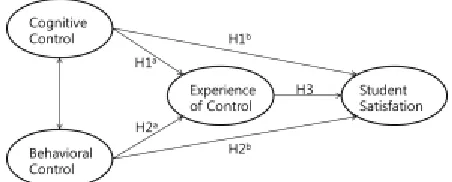
Students getting admitted into a rigorous college program find themselves facing the challenges of academic life at a completely different level from their respective high school experiences. The competition for academic achievement, the need to perform, the enormous volumes of work, and the time constraints of study, work, and family are all the obvious stressors that come to mind when people think of college life (Ross et al., 1999). A significant number of students are found to experience frustration, stress, and dissatisfaction with their colleges (Zajacova et al., 2005). The academic pursuit in a college, indeed, is a potentially stressful event to many people. This study hypothesizes that students who maintain a sense of control in dealing with their colleges will perceive less stress and they evaluate their colleges more favorably than those who lack such a feeling. Specifically, the study investigates whether the experience of control over their school life among college students affects their satisfaction with the school. In addition, this study explores the way control is experienced by examining both behavioral control and cognitive control. The research model is presented in Figure 1.
Figure 1: A Model of the Experience of Control among College Students
H1 a, b: Perception of cognitive control has positive influence on experience of overall controla and satisfaction b with education service among college students.
Second, behavioral control is also likely to affect the student’s experience of control. One’s sense of behavioral control (i.e., one’s ability to make influences on one’s environment) is found to affect one’s experience of control in that environment in studies involving nursing home residents (Rodin and Langer, 1977) and patients (Deci, 1980; Schultz and Hanusa, 1980). In this vein, college students may develop a sense of control when they make decisions and changes on the school matters relevant to them. Besides, behavioral control is also likely to exert a significant influence on students’ satisfaction with their colleges. Students seem to prefer to exert influence on their academic and non-academic aspects of college life. Compared to a program where students feel that they have no choice in their academic life but have to uniformly follow school-required procedures, a program that allows students to make choices with regard to their college life (i.e., behavioral control) is likely to foster a high level of student satisfaction.
H2 a, b: Perception of behavioral control has positive influence on experience of overall controla and satisfaction b with education service among college students.
Finally, those students who experience control over school matters are likely to have a high level of satisfaction with their school. Experience of control refers to a person’s feelings as s/he is interacting with the environment while attempting to produce a desired or prevent an undesired outcome. A student is likely to experience control, then, when s/he feels that s/he is actively interacting with the school environment while getting personally desirable education. As far as the antecedents of the experience are concerned, one’s perception of either cognitive control, or behavioral control, or both may be needed (Skinner, 1996). When a student sees herself/himself as the one making changes happen (i.e., the experience of control), s/he is likely to be motivated to deal with academic and non-academic challenges in a more active manner. Compared to those who do not feel control over their environment, students maintaining a sense of control are likely to experience satisfaction.
H3: Experience of control has positive influence on satisfaction with education service among college students.
METHODS
Data for this study were collected via a self-reported questionnaire administered to 165 students enrolled at a major university in South Korea. The questionnaire was composed of three sections: control measures (cognitive control, behavioral control, and experience of control measures), dependent measures (i.e., service quality and satisfaction), and demographic questions. Likert scales were adopted as a response category for control measures. Cognitive control was measured by using a four-item scale, which includes the students’ understanding, capability of predicting, familiarity with the program, and ability to identify the strengths and weaknesses of the program in which they were enrolled. Behavioral control was incorporated into the questionnaire by using a four-item scale that includes the choice availability in course selection, availability of exercising influence on school policies, and availability of auditing courses before registering. Experience of control was measured by a four-item scale, addressing the belief of one’s capability of getting the best education, capability of gaining the most benefits out of school life, capability of getting the most value from school life, and overall perceived control on school matters. Satisfaction was measured by a three-item scale which used a 7-point scale ranging from 1 (very dissatisfied) to 7 (very satisfied).
196 http://www.cluteinstitute.com/ 2013 The Clute Institute RESULTS
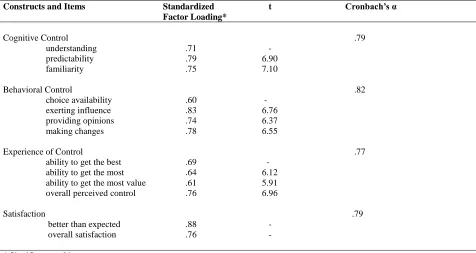
Measurement properties of the scales developed for this study were evaluated using reliability, convergent validity, discriminant validity, and nomological validity. The three scales regarding control had acceptable reliability. The scales of cognitive control, behavioral control, and experience of control had reliability coefficients of .79, .82, and .77, respectively. The scale of satisfaction also had an acceptable level (.79) of reliability. Then, a confirmatory factor analysis using all four scales was carried out. One item dealing with cognitive control and one item measuring satisfaction were removed from further analysis due to either poor factor loading or cross-loading. As shown in Table 1, all remaining items of each construct had significant factor loadings greater than .6, thus providing evidence of significant convergent validity (Anderson and Gerbing, 1988). A summary of construct correlations presented in Table 2 shows that none of the confidence interval around the correlation estimates between the two factors (±2 standard errors) includes 1.0, indicating the discriminant validity of measures (Anderson and Gerbing, 1988). Finally, constructs used in this study were found to behave consistently with pertinent theories in both marketing and psychology, as evidenced by the significant correlations among control constructs. In summary, the measures used in this study were found to have adequate measurement properties for a theory testing.
Table 1: Constructs and Measure Assessment
Constructs and Items Standardized t Cronbach’s α Factor Loading*
Cognitive Control .79
understanding .71 -
predictability .79 6.90
familiarity .75 7.10
Behavioral Control .82
choice availability .60 -
exerting influence .83 6.76
providing opinions .74 6.37
making changes .78 6.55
Experience of Control .77
ability to get the best .69 -
ability to get the most .64 6.12
ability to get the most value .61 5.91
overall perceived control .76 6.96
Satisfaction .79
better than expected .88 -
overall satisfaction .76 -
* Significant at .01
Table 2: Construct Inter-correlations
Construct 1 2 3 4
1. Cognitive Control 1.0
2. Behavioral Control .21* 1.0
3. Experience of Control .40*** .51*** 1.0
4. Satisfaction .15 .50*** .56*** 1.0 * Significant at .1 ** Significant at .05 *** Significant at .01
and 35% variance of students overall satisfaction with their education services. We also compared our hypothesis-testing model with alternative models that contain either more or less paths not shown in Figure 1. These neither significantly increased model fit nor enhanced our understanding of student satisfaction. Thus, the structural equation model in Figure 1 provides stable and parsimonious estimates of the multiple relationships in our data.
Table 3: Standardized Path Coefficients
Path Modeled (Hypothesis) Coefficient Result
Cognitive Control Experience of Control (H1a) .27* Partially Supported Cognitive Control Overall Satisfaction (H1b) .07 Not Supported Behavioral Control Experience of Control (H2a) .61*** Supported Behavioral Control Overall Satisfaction (H2b) .22 Not Supported Experience of Control Overall Satisfaction (H3) .45*** Supported Fit Indexes:
χ2
= 72.88, d.f.=59, p > .10; GFI=.93; CFI=.98; RMSEA=.04 * Significant at .1 *** Significant at .01
Hypothesis 1a, which suggests a positive relationship between cognitive control and experience of control, is partially supported. Albeit statistically significant, it suggests that cognitive control is exerting just a moderate effect on students’ experience of control over their school life. Hypothesis 1b, the posited relationship between
cognitive control to satisfaction among students, was not supported. This finding suggests that students’ capability of understanding and predicting school procedures and details alone do not enhance their satisfaction with their school life. On the other hand, Hypothesis 2a, dealing with the positive relationship between behavioral and experience of control, is supported. The finding suggests the importance of having opportunities to make influences on school matters for students to experience control. The hypothesized relationship between behavioral control and overall satisfaction (H2b), however, is not supported. Thus, behavioral control alone is not good enough for a student to experience satisfaction. The posited relationship between experience of control and overall satisfaction with school life (H3) is supported. The finding indicates a tendency that students prefer to have control over their school life.
CONCLUSIONS
Today’s competitive educational market forces higher education institutions to adopt a customer-oriented strategy that differentiates their offerings from those of their competitors. Most of all, they need to understand their customers’ needs, accommodate their preferences in developing their offerings, and thereby enhancing satisfaction by providing superior educational experiences (Keegan & Davidson, 2004). This study provided empirical findings to incorporate the experience of control as an important antecedent for student satisfaction with higher education institutions. Also, providing a literature review from marketing, psychology, and education, this study demonstrated the importance of experience of control and the way that control is experienced among college students.
Findings in this study offer new insights into the understanding of students’ satisfaction with higher education institutions. First, as proposed in the model, the experience of control exerts a significant influence on students’ satisfaction with their higher education. This finding suggests the importance of providing an educational environment that fosters students to maintain a sense of control over school life for their satisfaction. As per the antecedents of the experience of control, it was moderately affected by cognitive control but strongly by behavioral control. Thus, a student’s sense of control over his/her school life largely hinges upon his/her capability of exerting influence on academic matters relevant to him/her. Colleges should inform their students about choices and options they have and encourage them to use such arrangements. As per cognitive control, knowing what is going on and what will happen to them is found to exert only a moderate influence on one’s experience of control. An interesting finding of this study is that neither cognitive control nor behavioral control alone directly affects student satisfaction. It is the experience of control through which both cognitive control and behavioral control indirectly affect student satisfaction. These findings have many managerial implications.
198 http://www.cluteinstitute.com/ 2013 The Clute Institute sense of control (Skinner, 1996). Such a sense of control was found to be a strong precursor of student satisfaction. Colleges need to provide educational arrangements where students actively engage in decision-making for themselves and for school matters relevant to them. On the contrary, a lack of such arrangement would force students to see themselves as not having many options and being limited by the dictates of school policy. In such an environment, they would not be able to experience control over their school life. Indeed, students prefer to feel as though they are the center of attention and to feel that they are important and have a significant influence on school matters (Elliott, 2002).
Second, colleges should maintain flexibility and diversity in their programs. Because behavioral control is the major factor affecting students’ experience of control, students need to be provided with choices in designing both academic and non-academic pursuits. Colleges, whenever possible, should make an arrangement that accommodates individual preferences and gives students the right to make decisions that are relevant to them. In addition, colleges should inform their students that they are encouraged to provide suggestions for making changes on campus.
In conclusion, this article has attempted to propose and test a factor called the experience of control as an antecedent of student satisfaction. It has also examined the way that control is experienced. Findings of this study are expected to provide a rationale for administrators of higher education institutions to develop a mechanism that fosters the sense of control among the student body. We observe, not infrequently, students under stress, being dissatisfied with their schools, wondering if the college is a right place for them, and leaving campus. The perspective of control, proposed in this study, is a versatile theoretical foundation as it effectively deals with student stress, satisfaction, and dissatisfaction. The experience of control as an important antecedent of student satisfaction, as provided in this study, is expected to complement our understanding in that area. Future research using this study’s perspective is highly expected.
AUTHOR INFORMATION
Dr. Jungki Lee, Professor of Marketing at Korea University at Sejong, holds a Ph.D. in Marketing from the University of Alabama. He has authored a number of articles in refereed journals such as Journal of Retailing,
Service Industries Journal, Journal of Services Marketing, Journal of Contemporary Business Issues, Review of Business Research, and Services Marketing Quarterly,among others. E-mail: [email protected]
Dr. Sekhar Anantharaman is a Professor of Accounting at the Indiana University of Pennsylvania and holds a Ph.D. in Accounting from the University of Central Florida. His teaching interests are in the Financial Accounting area. Dr. Anantharaman has authored and co-authored several research papers that have been published in various refereed journals. E-mail: [email protected] (Corresponding author)
REFERENCES
1. Anderson, J. & Gerbing, D. (1988). Structural equation modeling in practice: a review and recommended two-step approach. Psychological Bulletin, 103, 411-423.
2. Athyiyaman, A. (1997). Linking student satisfaction and service quality perceptions: The case of university education. European Journal of Marketing, 31, 528-540
3. Averill, J. (1973). Personal control over aversive stimuli and its relationship to stress. Psychological Bulletin, 80, 286-303.
4. Babin, B. & Griffin, M. (1998). The nature of satisfaction: An updated examination and analysis. The Journal of Business Research, 41, 127-136.
5. Babin, A. & Valins, S. (1979). Architectural mediation of residential density and control: Crowding and the regulation of social contact. Advances in Experimental Psychology, 12, 131-75.
6. Bolton, R., Kannam, P., & Bramlett, M. (2000). Implications of loyalty program membership and service experiences for customer retention and value. Journal of Academy of Marketing Science, 28, 95-108. 7. Browne, B., Kaldenberg, D., Brown, S. & Brown, D. (1998). Student as customer: Factors affecting
8. Cohen, S. (1981). Aftereffects of stress on human performance and social behavior: A review of research and theory. Psychological Bulletin, 88, 82-108.
9. Cronin, J. & Taylor, S. (1992). Measuring service quality: A reexamination and extension. Journal of Marketing, 56, 55-68.
10. Deci , E. (1980). The Psychology of Self-Determination, Lexington: Lexington Books.
11. Delong, D. (1970). Individual differences in patterns of anxiety arousal, stress-relevant information and recovery from surgery. Unpublished Doctoral Dissertation, University of California, Los Angeles. 12. Elliott, K. (2002). Key determinants of student satisfaction. Journal of College Student Retention, 4,
271-279.
13. Fiske, S. & Taylor, S. (1991), Social Cognition, New York, NY: McGraw-Hill.
14. Fleming, I., Baum, A., & Weiss, L. (1987). Social density and perceived control as mediators of crowding stress in high-density residential neighborhoods. Journal of Personality and Social Psychology, 52, 899-906.
15. Folkman, S. & Moskowitz, J. (2000). The context matters. Personality and Social Psychology Bulletin, 26, 150-151.
16. Geer, J., G. Davison, & R. Gatchel (1970). Reduction of stress in humans through nonverdical perceived control of aversive stimulation. Journal of Personality and Social Psychology, 16, 731-38.
17. Goldstein, D. (1989). Control theory applied to stress management. In W. Hershberger (ed.), Volitional Action: Connation and Control, New York, NY: North-Holland.
18. Hair. J., Black, W., Babin, B., Anderson, R.,&Tatham, R. (2006). Multivariate Data Analysis, Upper Saddle River, NJ: Prentice Hall.
19. Helgeson, V. (2003). Cognitive adaptation, psychological adjustment, and disease progression among angioplasty patients: 4 years later. Health Psychology, 22, 30-38.
20. Kanfer, R. & Seidner, M. (1973). Self-control: factor enhancing tolerance of noxious stimulations. Journal of Personality and Social Psychology, 25, 381-389.
21. Keegan, W.& Davidson, H. (2004). Offensive Marketing: Gaining Competitive Advantage, Amsterdam, Elsevier.7
22. Kotler, P. & Fox, K. (1995). Strategic Marketing for Educational Institutions. Englewood Cliffs, NJ: Prentice Hall.
23. Langer, E. & Rodin, J. (1976). The effects of choice and enhanced personal responsibility for the aged: a field experiment in an institutional setting. Journal of Personality and Social Psychology, 32, 951-955. 24. Langer, E. & Saegert, S. (1977). Crowding and cognitive control. Journal of Personality and Social
Psychology, 35, 175-182.
25. LeBlanc & Nguyen (1997). Searching for excellence in business education: An exploratory of customer impressions of service quality, International Journal of Educational Management, 11, 72-79.
26. Lee, J. (2010). Perceived power imbalance and customer dissatisfaction. Service Industries Journal, 30, 1113-1137.
27. Lee, J. & Anantharaman, S. (2011). Antecedents of satisfaction among MBA students: A cross-cultural study. Review of Business Research, 11, 66-75.
28. Lehtinen, U. & Lehtinen, J. (1982). Service quality: A study of quality dimensions. Unpublished working paper, Helsinki: Service Management Institute, Finland.
29. Litt, M. (1988). Self-efficacy and perceived control: cognitive mediators of pain tolerance. Journal of Personality and Social Psychology, 54, 149-160.
30. Mackie, S. (2001). Jumping the hurdles: Undergraduate student withdrawal. Innovations in Education and Teaching International, 38, 265-276.
31. Martinez, P. (2001). Improving student retention and achievement: What do we know and what do we need to find out? London, UK. Learning and Skills Development Agency.
32. Miller, S. (1979). Controllability and human stress: method, evidence, and theory. Behavioral Research and Therapy, 17, 287-304.
33. Mills, R. & Krantz, D. (1979). Information, choice, and reactions to stress: a field experiment in a blood bank with a laboratory analogue. Journal of Personality and Social Psychology, 37, 608-620.
200 http://www.cluteinstitute.com/ 2013 The Clute Institute 35. Parasuraman, A., Zeithaml, V. & Berry, L. (1988). SERVQUAL: A multiple-item scale for measuring
consumer perceptions of service quality. Journal of Retailing, 64, 12-40.
36. Rodin, J., Rennert, K. & Solomon, S. (1980). Intrinsic motivation for control: Fact or fiction. In Advances in Environmental Psychology: Applications of Personal Control, Baum, A., & Singer, J. Eds. Hillsdale, NJ: Lawrence Erlbaum Associates, Publishers.
37. Ross, S., Niebling, B. & Heckert, T. (1999). Sources of stress among college students. College Student Journal, 33, 312-317.
38. Saenz, T., Marcouldes, G., Junn, E., & Young, R. (1999). The relationship between college experience and academic performance among minority students. International Journal of Educational Management, 13, 199-207.
39. Schultz, R. & Hanusa, B. (1979). Environmental influences on the effectiveness of control and
competence-enhancing interventions. In L. Perlmuter and R. Monty (Eds.) Choice and Perceived Control, Hillsdale, NJ: Lawrence Erlbaum Associates, Publishers.
40. Seligman, M. & Miller, S. (1979). The psychology of power: concluding comments. In L. Perlmuter and R. Monty (Eds.) Choice and Perceived Control, Hillsdale, NJ: Lawrence Erlbaum Associates, Publishers. 41. Sevier, R. (1996). Strategic marketing for educational institutions. Englewood Cliffs, NJ: Prentice Hall. 42. Skinner, E. (1996). A guide to constructs of control. Journal of Personality and Social Psychology, 71,
549-570.
43. Skinner, E., Chapman, M., & Baltes, P. (1988). Control, means-ends, and agency beliefs: a new
conceptualization and its measurement during childhood. Journal of Personality and Social Psychology, 54, 117-133.
44. Sutton, R. & Kahn, R. (1986). Prediction, understanding and control as antidotes to organizational stress. In
Handbook of Organizational Behavior, J. Lorsch ed. Englewood Cliffs, NJ: Prentice Hall.
45. Szymanski, D. & Henard, D. (2001). Customer satisfaction: A meta-analysis of the empirical evidence.
Journal of the Academy of Marketing Science, 25, 4-17.
46. Taylor, S. (1989). Positive illusions: creative self-deception and the healthy mind. New York: Basic Books. 47. Tetrick, L. & LaRocco, J. (1987). Understanding, prediction, and control as moderators of the relationships
between perceived stress, satisfaction, and psychological well-being. Journal of Applied Psychology, 72, 538-543.
48. Thompson, S. (1981). Will it hurt if I can control it: a complex answer to a simple question. Psychological Bulletin, 90, 89-101.
49. Tinto, V. (1994). Leaving College: Rethinking the Causes and Cures of Student Attrition, Chicago, IL: University of Chicago Press.
50. Towbes, L. & Cohen, L. (1996). Chronic stress in the lives of college students: Scale development and prospective prediction of distress. Journal of Youth and Adolescence, 25, 199-217.
51. White, R. (1959). Motivation reconsidered: the concept of competence. Psychological Review, 66, 297-333. 52. Wright, J. (1967). Reported personal stress sources and adjustment of entering freshmen. Journal
Counseling Psychology, 14, 371-373.
53. Zajacova, A., Lynch, S. & Espenshade, T. (2005). Self-efficacy, stress, and academic success in college.
Research in Higher Education, 46, 677-706.