Employee Training, Managerial
Commitment And The Implementation
Of Activity Based Costing; Impact
On Performance Of SMEs
Job Dubihlela, Vaal University of Technology, South Africa Rosebud Rundora, Vaal University of Technology, South AfricaABSTRACT
This article examines the implementation of activity-based costing (ABC) in the SMEs sector in a developing country. The consequences of ABC on the evolution of management accounting and its impact on the accounting processes, particular as it relates to organizational cost performance has been a subject of discourse in the past two decades. This study provides some insight into the conspicuous paradox that in spite of the theoretical benefits of ABC, very few SMEs in South Africa adopt it and that a material number of those that employ ABC do not actually implement it. It is a preliminary study which begins by describing the differences between the traditional and the ABC cost systems; particularly examining the impact of employee training and managerial commitment to ABC implementation. An overview of some literature on ABC and the value of ABC implementation in SMEs sector is provided, reporting some experiences of South African SMEs in implementing ABC. A framework for the implementation of ABC in SMEs and impact on their performance is presented. Using survey data collected from SMEs (n = 149), the results and discussions indicate the prominence of both employee training and managerial commitment as precursors to effective implementation of ABC and that its implementation impacts on SME performance. Implementation of ABC precedes the creation of a costing system that provides management with reliable cost information. The paper concludes by providing, managerial implications, limitations and proposed future research.
Keywords: Training; Managerial Commitment; Activity Based Costing; SMEs; South Africa
INTRODUCTION
ontemporary global competition is leading all forms of businesses towards a renewed commitment to high levels of competitiveness and excellence in their operations. In South Africa, the operating environment for SMEs is constantly changing in the face of a volatile economic environment and a highly demanding cost accounting environment. SMEs find themselves operating within an economic environment characterised by volatility, dynamism and competitive markets that may seriously threaten their survival (O’Regan & Ghobadian, 2002; Hernandez, Dewhurst, Pritchard & Barber, 2004). However, Dansoh (2005) is of the view that SMEs can weather the storm of such volatility and competitive climate by engaging in dynamic processes in all aspects of businesses, including activity-based costing (ABC). Jennings and Disney (2006) posit that stable environments require less planning activity, and that unstable and competitive environments require increased planning capability and comprehensiveness, as well as greater planning flexibility. This is also true with the costing and accounting systems for SMEs.
that impede their development (Abor & Quartey, 2010). For organizations to remain competitive and do proper planning, accurate and up-to-date costing information must be available. The traditional costing methods are no longer relevant in today’s global environment because of their inability to provide accurate cost information. Activity-based costing (ABC) system was developed to deal with the deficiencies of traditional costing systems because of its ability to provide more accurate cost information for firms in today’s global competitive environment. However, many small firms are still using the traditional costing methods that are based on one volume-based cost driver and provide little information about what matters to the customer. Some of the many reasons why firms do not adopt the ABC system is lack of managerial commitment, lack of training facilities, lack of ABC knowledge, resistance to change and the high costs of implementing the ABC system.
Studies have suggested that SMEs can use ABC as a weapon to cushion them from the unstable business environment in order to ensure their survival and growth (McNamara, 1997; Bellamy, 2002; Kraus, Harms & Schwarz, 2006). The need for ABC is even more pronounced in emerging economies like South Africa where the business environment is unstable, business cycles alter and competition is tightening. In this regard, Dansoh (2005) posits that ABC enables SMEs to be forward looking and vigilant to be able to cope with these circumstances. In the light of the above, it is evident that there is a strong argument from the literature that SMEs need to engage in ABC if they are to maintain their position as key economic players. Advocates of ABC by SMEs believe that it cushions SMEs from highly unstable business environments characterised by the heightened pace of technological change, increased government regulations, volatile business cycles, tightening of competition, and inflationary pressures which reduce their capital.
Against this background, it is important to investigate the SMEs’ adoption and implementation of ABC in South Africa, and if they do engage in ABC, the predictive role of employee training and managerial commitment. However, while research on large organisations, ABC has been studied extensively, little attention has been paid to SMEs (O’Regan & Ghobadian, 2002). In fact, there is little evidence of empirical research that has sought to evaluate ABC within the sphere of SMESs (French, 2009), particularly for developing economies such as South Africa. Moreover, despite the extensive recognition of the importance and substantial contributions of SMEs, research on these small enterprises remains scarce (Sum, Jukow & Chen, 2004). Phillips (2000) has advocated for more systematic research aimed at revealing the true nature of SMEs operational and strategic issues such as costing systems. There is no evidence of research conducted in the Gauteng province of South Africa that has evaluated ABC adoption and implementation for SMEs. This study attempts to contribute to the body of knowledge in this field. Therefore its main aim is to establish the predictive role of employee training and managerial commitment on the implementation of ABC by SMEs in South Africa.
The study is valuable to SMEs in that it extends the knowledge of ABC techniques and processes, which can result in enterprise cost saving, growth and competitiveness. The results of this study should assist managers in understanding ABC and how it can assist SMES achieve desired financial positions. In essence, this research, combined with the results of the previous studies, serves as a tool for SMEs to improve the effectiveness of costing systems and their sustainability.
LITERATURE REVIEW
Activity-Based-Costing
ABC is viewed by Kaplan and Cooper (1998) as a system that provides companies with an economic map of their environmental operations by revealing the existed forecasted cost of activities and business processes which in turn leads to knowledge of the cost and profitability of individual products, services, customers and operating units. Furthermore, Garrison, Noreen and Brewer (2008) stated that ABC is used as a supplement to rather than as a replacement for a company’s usual costing system.
Over the past few decades, the paradigm of ABC has assisted many manufacturing and service organisations improve their competitiveness by enabling them to make better decisions based on understanding their cost structure. Innes and Mitchell (1990) posit that ABC provides more accurate product costing and provides a meaningful financial and non-financial measure which are useful for cost management and performance assessment. In addition, this approach provides better profitability measurements and better-informed strategic decisions about pricing, product lines and market segments (Blocher, Stout, Cokins & Chen, 2008). ABC furthermore, does not only allocate overhead costs accurately, but also identifies areas of waste (Gunasekaran & Sarhadi, 1998). According to Berts and Kock (1995), the ABC system gives a more factual basis for decision-making, profitability and long-term strategies to achieve sustainable competitive advantage. According to Gunasekaran (1999), ABC allows management to target cost reduction, manage and control budgets, measure performance and increase efficiency.
Although ABC is of tremendous value to every company that implements it, it has its pitfalls. Firstly, it is costly to implement and to operate, and requires a significant amount of time and monetary investment (Raiborn & Kinney, 2009). Drury (2008) confirmed that the training and software requirements usually prohibit the adoption and implementation of ABC by small organisations. Rasiah (2011, p. 39) states that “the companies that implement it run the risk of spending too much time, effort and even money on gathering and going over the data.” He further reiterated that managers often overlook some activities and costs associated with its implementation. In addition, reports generated by ABC do not necessarily conform to the Generally Accepted Accounting Practice (GAAP).
HYPOTHESES DEVELOPMENT
Drawing from the extent literature on ABC implementation discussed above, a conceptual model is developed as shown in Figure 1. The model consists of four constructs including the predictor variables; employee training and managerial commitment and the moderating variable ‘ABC implementation capacity” as well as the outcome variable cost performance. The model argues that ABC adoption and its implementation by SMEs has positive impact on the performance of SMEs as influenced by employee training and managerial commitment. Detailed explanations of the associations between these constructs are provided in the hypotheses as explained hereunder.
Figure 1: The Conceptual Model
Managerial Commitment
Employee Training
H2 H1
ABC Implementation
Employee Training and ABC Implementation Capacity
Most researchers generally agree that employee training of ABC is critical in the successful implementation of ABC (Barker & Frolick, 2003). According to Nah et al. (2001) employee training enhances skills development through information sharing and knowledge transfer. Furthermore, training helps employees to understand how ABC differs from the traditional costing method and why it is even superior to the traditional method (Sohal & Chung, 1998). According to Gunasekaran and Sarhadi (1998), it is important for the concerned employees of the organization to be well-equipped with knowledge of ABC and the benefits that could be derived from them so that they understand the complexity of the project and its impact on the organization. Training enhances open communication and better cooperation for implementing ABC in a cost effective manner. In addition, training uplifts he employees’ morale and they feel part of the organization.
Nah et al.(2001) asserted that employees should be given adequate training as an incentive to ensure ABC implementation is successful. Their argument was that if adequate training enhances organizational capacity for ABC execution, then training employees increases the likelihood of employee commitment and motivation (Ehlers & Lazenby, 2007). Thus it is proposed that:
H1: Employee training exhibits a positive relationship with SMEs capacity to adopt and implement ABC.
Managerial Commitment and ABC Implementation
According to Gunasekaran and Sarhadi (1998), managerial commitment is key for the adoption and implementation of ABC. Management should commit to change in the cost accounting system. They argued that management should provide proper guidance, motivation and financial and technical support to the employees. If management shows commitment then everyone else will be willing to take part in the implementation of the system. It is crucial for management to have a common goal for the success of ABC adoption and ultimately its implementation. Without management’s commitment, the employees will not be motivated to be part of the process and this will lead to failure. In business, it is generally expected that management should encourage the implementation of ABC by providing support and motivating their employees. Management should know the benefits that may be derived from using ABC so that they are able to set realistic targets. They should also empower the employees with responsibility and authority on the implementation and usage of ABC (Gunasekaran & Sarhadi, 1998). Top management should commit themselves to give support to the employees and to provide the resources and means for ABC implementation.
H2: Managerial commitment exhibits a positive relationship with the implementation capacity of ABC by
SMEs.
ABC Implementation and Business Performance
Several studies have found empirical support for the positive relationship between the implementation of ABC and the business performance of business organisations (Baker, 2003), which is also applicable to South African SMEs. Sanchez and Marin (2005) examined 1351 Spanish SMEs and linked operational dynamics to business performance. The results of a study by Wilson and Eilertsen (2010) show that the line managers and skilled professionals perceived the benefits of ABC implementation during the financial crisis of 2009. The authors further argued that businesses that were dynamic in their operations were more prepared for the economic crisis and were less affected by the crisis than non-regular operations. Another study by Efendioglu and Karabulut (2010) on the impact of ABC on financial performance of companies in Turkey, highlights and reinforces the importance of dynamic systems such as ABC on business performance. These studies suggest that the use of ABC in accounting for decision-making enhances business success. Based on this, it is hypothesized that:
RESEARCH METHODS
This study adopted a quantitative approach to establish the relationship between four key components of employee training, managerial commitment, ABC implementation and the performance of SMEs. The approach, consistent with Johnson and Onweuegbuzie (2004), was deemed appropriate as it enabled the researchers to objectively test and confirm the hypotheses, and to explain the impact of ABC on business performance.
Data Collection
Data were collected from SMEs operating within Emfuleni municipal area of Gauteng, the data were collected by means of structured questionnaires. These were hand delivered to the managers and employees of the selected SMEs operating in the Emfuleni municipal area. Each questionnaire included a copy of the cover letter. The cover letter outlined the purpose of the study, stated the voluntary nature of the survey and assured the respondents of the anonymity of the responses.
Measurement Instrument
A structured questionnaire comprising three research constructs was operationalized on the basis of previous work. This study adapted the measurement constructs from studies by Anderson (2000), with proper modifications made to suit the current research context and purpose. The questionnaire began with the demographic information section which also incorporated the business characteristics such as, number of years in business, number of employees, and the type of industry to which the business belongs. Section A focused on the demographic information, including the company profile. Section B included a scale of items pertaining to employee training. Section C included a scale of items designed to measure the managerial commitment. Section D focused on the measurement of SMEs performance.
Fieldwork
Data were collected from SMEs operating within Emfuleni municipal area of Gauteng, a highly industrialised region of South Africa. The lists of the surveyed SMEs are obtainable from the databases of Gauteng Enterprise Propeller (GEP) and Small Enterprise Development Agency (SEDA) of South Africa. Due to the nature of this research, the targeted research participants were SME owners or officials who occupied senior management positions. Of the total of 300 questionnaires distributed, 149 usable questionnaires were retrieved for the final data analysis, representing a response rate of 49.7%.
DATA ANALYSIS
A quantitative approach was utilized to establish the relationships among the four key constructs of employee training, managerial commitment, ABC implementation and the performance of SMEs. The approach was deemed appropriate as it enables research to objectively test and confirm the hypotheses (Johnson & Onweuegbuzie, 2004); and to explain the impact of ABC implementation on SMEs performance. Descriptive statistics, reliability and validity tests were carried out, followed by structural equation modeling (SEM) and path analysis.
Survey Participants
Table 1: Characteristics of Respondents
Gender of Respondent Freq % Position Held by Respondent Freq %
Male 103 69.1 Chief Executive Officer (CEO) 13 8.7
Female 46 30.9 Senior Manager 39 26.1
Junior Manager 11 7.4
Other 3 2.1
Business Owner 83 55.7
Total 149 100% Total 149 100%
Age of Respondent Freq % Highest Qualification (Respondent) Freq %
16-25 years 13 8.7 Postgraduate Degree 3 2.1
26-35 years 59 39.6 Degree –University/College 21 14.1
36-45 years 37 24.8 Diploma – University/College 29 19.5
46-55 years 31 20.8 Certificate – College 44 29.5
56 years + 9 6.1 Matric - High School 33 22.1
Others –Trade Specific 19 12.7
Total 149 100% Total 149 100%
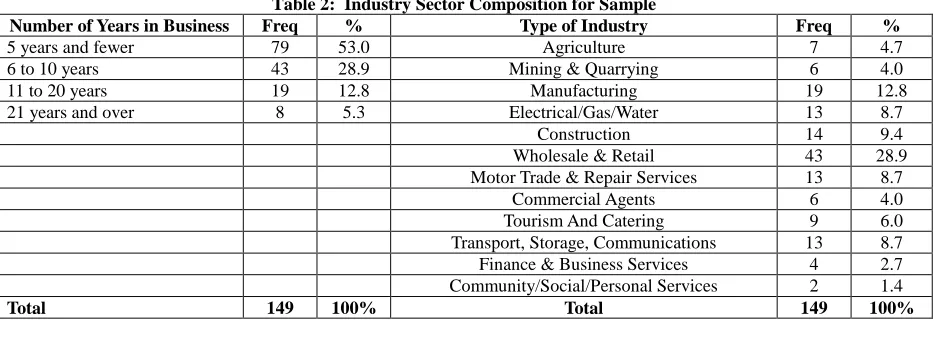
Table 2 presents information on the surveyed SMEs in terms of industry type and period in existence of the SMEs. The frequencies reported in this table show that 53% (n = 79) of the surveyed SMEs had been operating for less than 5 years, with over half of them involved mainly in wholesale and retail (28.9%; n = 43) manufacturing (12.8%; n = 19) and construction (9.4%; n = 14). Although the majority of the respondents were wholesale and retail enterprises, the sample generally contained significant proportions of the different industries represented in South Africa. According to Dubihlela (2013), a large proportion of the SME industries in the Vaal Triangle region are in fact manufacturing, construction, wholesale and retail.
Table 2: Industry Sector Composition for Sample
Number of Years in Business Freq % Type of Industry Freq %
5 years and fewer 79 53.0 Agriculture 7 4.7
6 to 10 years 43 28.9 Mining & Quarrying 6 4.0
11 to 20 years 19 12.8 Manufacturing 19 12.8
21 years and over 8 5.3 Electrical/Gas/Water 13 8.7
Construction 14 9.4
Wholesale & Retail 43 28.9 Motor Trade & Repair Services 13 8.7
Commercial Agents 6 4.0
Tourism And Catering 9 6.0
Transport, Storage, Communications 13 8.7 Finance & Business Services 4 2.7 Community/Social/Personal Services 2 1.4
Total 149 100% Total 149 100%
RELIABILITY AND VALIDITY
The validity of the constructs were established, convergent validity was tested, composite reliability (CR) and average variance extracted (AVE) examined. In addition, all of the coefficient alpha values exceeded the threshold value of 0.7 recommended by Malhotra (2010) and all the factor loadings were significantly above the recommended thresh-hold of 0.5 (Anderson & Gerbing, 1988). Table 3 presents these results confirming the measures of reliability and providing support for an acceptable degree of internal consistency between the corresponding indicators satisfying convergent validity (Bagozzi, Yi & Phillips, 1991).
of approximation (RMSEA = 0.066) measures were considered statistically significant in line with the robust and acceptable model fit of Bentler (1990).
Table 3: Descriptive, Reliability and Validity Statistics Constructs Mean Standard
Deviations
Cronbach’s
Aplha CR AVE
Max. Squared Correlations
Employee Training (EC) 2.929 0.846 0.904 0.92 0.74 0.69
Management Commitment (MC) 2.865 0.891 0.967 0.86 0.73 0.63
ABC Implementation (ABCi) 3.095 0.973 0.916 0.91 0.80 0.73
SME Performance (smeBP) 2.627 0.789 0.869 0.91 0.67 0.64
C.R.: Composite Reliability; AVE: Average Variance Reliability; * Scores: 1 – Strongly Disagree; 3 – Neutral; 5 – Strongly Agree; * significance level: *** p < 0.01; Measurement CFA model fits: Structural Model Fits: χ2/df = 2.139; CFI = 0.926, NFI = 0.901, GFI = 0.856,
RMSEA = 0.066, SRMR = 0.043
To investigate the distinctiveness of constructs, the assessment of discriminant validity was tested by comparing the variance-extracted estimates of the measurements with the squares of the parameter estimate between the measurements. Results show that the variance-extracted estimates of the constructs were greater than the squares of the correlation between two constructs, confirming discriminant validity exists (Fornell & Larcker, 1981). To further ascertain discriminant validity in this study, researchers performed a chi-squire difference in all two-factor CFA tests in line with Anderson and Gerbing (1988). As such, all pairs of the constructs and the two-factor CFA tests results in Table 4, revealed adequate levels of discriminant validity. Overall, the two approaches used to check discriminant validity suggest that discriminant validity exists in all cases.
Table 4: Chi-Squire Differences (Constrained-Unconstrained)-Two-Factor CFA Tests(△Χ2(1))
Research Constructs ETr MC ABCi smeBP
Employee Training (ETr) 1.000
Management Commitment (MC) 51.033 1.000
ABC Implementation (ABCi) 59.987 91.239 1.000
SME Performance (smeBP) 47.354 58.131 54.631 1.000
Note: All figures significant at least at a significance level of 0.01
STRUCTURAL PATH ANALYSIS
The data was subjected to structural equation modelling (SEM) using LISREL 8.8 statistical software program to test for the validity of the proposed model and to test the proposed hypotheses. Reported in Table 5 is the estimated model, illustrating the direction and magnitude of the impact of the standardized path coefficients. Statistical indicators for the overall structural equation model assessment showed acceptable fit of χ2/df = 2.139, CFI = 0.926, NFI = 0.901, GFI = 0.856, RMSEA = 0.066 and SRMR = 0.043. These indexes are deemed satisfactory (Johnson & Onweuegbuzie, 2004), and thereby provide a good basis for testing and confirming the hypothesised relationships. The parameter estimates of the structural model exhibited the direct effects of each dimension on the other. It therefore follows that the significant coefficients at certain levels of alpha thus reveal significant relationships among the latent variables (Mantera & Vaara, 2008). Additionally, the results in Table 5 provide support for the entire proposed three research hypotheses. The path coefficients for H1, H2 and H3 are 0.761, 0.563 and 0.689 respectively; meaning that the hypotheses are all accepted.
DISCUSSION AND CONCLUSIONS
Table 5: Results of the Path Analysis
Hypotheses Path Estimate Result
H1: Employee training (ETr) exhibits a positive relationship with
SMEs capacity to adopt and implement ABC (ABCi). ABCi <-- ETr 0.761*** Accepted H2: Managerial commitment (MC) exhibits a positive relationship with
the implementation capacity of ABC (ABCi).by SMEs. ABCi <-- MC 0.563*** Accepted H3: Implementation of ABC (ABCi).can positively impact on the
business performance of South African SMEs (smeBP). smeBP <-- ABCi 0.689*** Accepted Structural Model Fits: χ2/df = .139; CFI = 0.926, NFI = 0.901, GFI = 0.856, RMSEA = 0.066, SRMR = 0.043; a Significance level p < 0.05; b
Significance level p < 0.01; c Significance level p < 0.001.
Drawing from the findings of this research, both employee training (0.761) and managerial commitment (0.563) to ABC have very strong impacts on its implementation by SMEs. This explains the value of training as supported by Strydon (2011), who states that training is vital for employee performance and work culture. Perhaps since managerial commitment often sets as an example to other employees, it is likely to influence their work ethics and behavior hence the stronger influence of employee training on ABC implementation when compared with managerial commitment. More so, since there exist these noted fairly strong relationships, it might imply that employee training (0.761) and managerial commitment (0.563) could be indirectly influencing SME business performance through ABC implementation (0.689). Perhaps too, path dependencies might explain also, in part, the moderate to strong relationships (Teece, Pisano & Shuen, 1997).
MANAGERIAL IMPLICATIONS
The findings in this study make important academic and practical contributions to the interactive literature on ABC implementation and the practice of SMEs. To commence with, this study is a pioneering research coupling human resources concepts of employee training and managerial commitment with ABC implementation, particularly as it pertains to business performance in South Africa’s SMEs sector; a sector deemed to be the engine of economic growth and the vehicle for employment generation (Dubihlela, 2013). By and large, the current study findings add on supportive empirical evidence to the existing from developed countries literature on ABC that its implementation is positively impacted by employee training and managerial commitment, and that ABC implementation positively influences the cost performance of SMEs.
On the practitioners’ side, prominence of both employee training and managerial commitment as precursors to SME performance is confirmed. Given that high SME performance imply high revenue and profitability, indeed managers in the SMEs that have not adopted ABC yet, can increase their firms’ profitability by effectively implementing ABC. Besides, the fact that both employee training and managerial commitment strongly influence ABC implementation, which eventually has strong impact on SME performance, implies that, managers, accountants or owners of SMEs should make use of all these capabilities since they augment each other in making a successful SME.
The adoption and implementation of ABC might require the SMEs to also adjust their organizational culture and as well as improving employees and management skills in order to achieve high levels efficiency and business performance. For instance, the effective implementation of the ABC processes might require a change in organizational culture and new skills acquisition by both employees and managers of SMEs. Thus, a mismatch between the use of ABC tools by the employees and management may highly likely yield undesirable results. Therefore, it is imperative that the SMEs accordingly adjust for instance, their organizational culture and human capital skills in tandem with the challenges that come with the adoption and implementation of ABC and the management of the ABC processes.
LIMITATIONS AND FUTURE RESEARCH
The data for this study were gathered from the SME owners, managers and accounting staff members. This strategy often has influence on the method bias in the results. Therefore, future survey studies should attempt to incorporate secondary source data in order to provide further insight into the impact of ABC implementation on the performance of SMEs. Also, the current study used a cross-sectional survey data to test the proposed research hypotheses. A richer understanding of the relationships between this study’s research constructs might be expected if longitudinal data is utilized. Moreover, the current study only considered employee training and managerial commitment as the predictor variables, these may not be conclusive, requiring future research to consider investigating other additional possible variables and mediating variables such as work experience, age or gender.
ACKNOWLEDGEMENTS
The researchers would like to acknowledge Professor Roy Dhurup and the anonymous referees of the Journal of Applied Business Research (JABR) for some highly useful comments during this research study and in the revisions of this paper. We are also grateful to Vaal University of Technology for providing funding for this study.
AUTHOR INFORMATION
Job Dubihlela, Ph.D., is currently a Senior Lecturer in the Faculty of Management Sciences at the Vaal University of Technology (VUT), South Africa. He is a seasoned banker turned academic. He completed a PhD at North-West University (NWU), South Africa. He has published various papers in peer-reviewed international and national Journals. His current research interests are financial economics, SMEs finance, growth and development strategies. Job Dubihlela, Faculty of Management Sciences, Vaal University of Technology, Private Bag X021, Vanderbijlpark, 1900, Republic of South Africa. E-mail: [email protected] (Corresponding author)
Rosebud Rundora is currently a lecturer in the Accountancy Department (Faculty of Management Sciences at the Vaal University of Technology. She obtained her BCom degree in Accounting at University of Limpopo (Turf loop Campus). She also obtained B. Tech in Cost and Management Accounting and recently obtained her Master’s degree with distinction from Vaal University of Technology (South Africa). Her master’s degree focused on the application of Activity-based costing within small manufacturing firms in the Southern Gauteng region of South Africa. Rosebud Rundora (corresponding author), Faculty of Management Sciences, Vaal University of Technology, Private Bag X021, Vanderbijlpark, 1900. Republic of South Africa. E-mail: [email protected]
REFERENCES
1. Abor, J., & Quartey, P. (2010). Issues in SME development in Ghana and South Africa. International Research Journal of Finance and Economics, 39, 218-228.
2. Anderson, T. J. (2000). Strategic planning, autonomous actions and corporate performance. Long Range Planning, 33, 184-200.
3. Anderson, J. C., & Gerbing, D. W. (1988). Structural equation modelling in practice: A review and recommended two-step approach. Psychological Bulletin, 103(2), 411-423.
4. Bagozzi, R. P., Yi, Y., & Phillips, L. W. (1991). Assessing construct validity in organizational research. Administrative Science Quarterly, 36(3), 421-458
5. Baker, G. A. (2003). Strategic planning and financial performance in the food processing sector. Review of Agricultural Economics, 25(2), 470-482.
6. Barker, T., & Frolick, M. (2003). Enterprise resource planning implementation failure: A case study. Information Systems Management, 1-7.
7. Bellamy, L. (2002). The strategic planning paradox: Do small firms benefit? ISBA National Small Firms Policy and Research Conference Proceedings: 71-76. Leeds.
8. Bentler, P. M. (1990). Comparative fit indexes in structural models. Psychological Bulletin, (1), 238-246 9. Berts, K., & Kock, S. (1995). Implementation considerations for activity based costing systems in service
10. Blocher, E., Stout, D. E., Cokins, G., & Chen, K. (2008). Cost management: A strategic emphasis. New York: McGraw-Hill.
11. Dansoh, A. (2005). Strategic planning practice of construction firms in Ghana. Construction Management and Economics, 23, 163-168.
12. Drury, C. (2008). Management and cost accounting (7th ed.). London: South-Western Cengage Learning. 13. Dubihlela, J., & Omoruyi. O. (2013). An integration of supply-chain activity imperatives by small and
medium enterprises (SMEs) in South Africa’s Emfuleni municipality. Mediterranean Journal of Social Sciences, 4(6), 385-392
14. Efendioglu, A. M., & Karabulut, A. T. (2010). Impact of strategic planning on financial performance of companies in Turkey. International Journal of Business and Management, 5(4), 3-12.
15. Ehlers, T., & Lazenby, K. (2007). Strategic management: Southern African concepts and cases. Pretoria: Van Schaik Publishers.
16. French, S. (2009). Critiquing the language of strategic management. Journal of Management Development, 28(1), 6-17.
17. Fornell, C., & Larcker, D. (1988). Structural equation models with unobservable variables and measurement error. Journal of Marketing Research,18(1), 39-50.
18. Garrison, R. H., Noreen, E. W., & Brewer, P. C. (2008). Managerial accounting (12th ed.). New York: McGraw-Hill/Irwin.
19. Gunasekaran, A. (1999). A framework for the design and audit of an activity-based costing system. Managerial Auditing Journal,14(3), 118-127.
20. Gunasekaran, A., & Sarhadi, M. (1998). Implementation of activity-based costing in manufacturing. International Journal of Production Economics,56, 231-242.
21. Hernandez, E. J. M., Dewhurst, F. W., Pritchard, M. C., & Barber, K. D. (2004). Modeling the strategy management process: An initial BPM approach. Business Process Management Journal,10(6), 691-711. 22. Innes, J., & Mitchell, F. (1990). Activity-based costing: A review with case studies. London: Chartered
Institute of Management Accountants.
23. Jennings, D., & Disney, J. J. (2006). Designing the strategic planning process: Does psychological type matter? Management Decision,44(5), 598-614.
24. Johnson, R. B., & Onwuegbuzie, A. J. (2004). Mixed methods research: A research paradigm whose time has come. Educational Researcher, 33(7), 14-26.
25. Kaplan, R. S., & Cooper, R. (1998). Cost and Effect: Using integrated cost systems to drive profitability and performance. Boston: Harvard Business School Press.
26. Kraus, S., Harms, R., & Schwarz, E. J. (2006). Strategic planning in smaller enterprises - new empirical findings. Management Research News, 29(6), 334-344.
27. Mantera, S., & Vaara, E. (2008). On the problem of participation in strategy: A critical discursive perspective. Organisational Science, 19(2), 341-358.
28. Mcnamara, C. (2007). Strategic planning in non-profit or for profit organizations. Field guide to non- profit strategic planning facilitation (3rd ed.). Minnesota: Authenticity Consulting, LLC.
29. Nah, F. F.-H., Lau, J. L.-S., & Kuang, J. (2001). Critical factors for successful implementation of enterprise systems. Business Process Management Journal, (7), 285.
30. O’regan, N., & Ghobadian, A. (2004). The importance of capabilities for strategic direction and performance. Management Decision, 42(2), 292-312.
31. Phillips, P. (2000). The strategic planning/finance interface: Does sophistication really matter? Management Decision, 38(8), 541-549.
32. Raiborn, C. A, & Kinney, M. R. (2009). Cost accounting: Foundations and evolutions. Mason: South Western? Cengage Learning.
33. Rasiah, D. (2011). Why activity-based costing is still tagged behind the traditional costing in Malaysia. Journal of Applied Finance and Banking, 1(1), 83-106.
34. Sanchez, A. A., & Marin, G. S. (2005). Strategic orientation, management characteristics and performance: A study of Spanish SMEs. Journal of Small Business Management, 43(3), 287-308.
35. Sohal, A. S., & Chung, W. W. C. (1998). Activity-based costing in manufacturing systems: Two case studies on implementation. Integrated Manufacturing Systems, 9(3), 137-147.
37. Sum, C., Jukow, L., & Chen, S. (2004).Taxonomy of operations strategies of high performing small and medium enterprises in Singapore. International Journal of Operations and Production Management,24(3), 321-345.
38. Teece, D. J., Pisano. G., & Shuen A. (1997). Dynamic capabilities and strategic management. Strategic Management Journal,18(7), 509-535