© 2017 IJSRST | Volume 3 | Issue 8 | Print ISSN: 2395-6011 | Online ISSN: 2395-602X Themed Section: Science and Technology
Using Argumentation Application to Teach States and Change of Matter in
Basic School
Sylvester Donkoh
*1, Bernice Doughan
2*1Tutor, Science Department, Foso College of Education, Assin Foso, Ghana 2Teacher, Fosuansa Catholic Basic School, Breman Fosuansa, Ghana.
ABSTRACT
This research work was aimed at using argumentation to facilitate pupils understanding of the concepts states of matter and change of state of matter. The study was conducted at Assin Andoe D/A „A‟ Basic school. Assin Ando is a town in the Assin South District in the Central Region of Ghana. All the 34 pupils in Andoe D/A „A‟ Basic five were purposively selected to participate in the study. The design for the study was action research since a classroom problem was to be solved. The data collection procedure occurred in three stages; Pre-intervention stage, intervention stage and post-intervention stage. During the intervention stage, the pupils were taught states of matter and change of state of matter using argumentation application. Observation and test were used to collect data. The data collected showed that argumentation application is effective in helping basic school pupils understand states of matter and change of state of matter. The use of argumentation application made pupils active learners and helped the pupils to discard wrong pre-conceptions. Prior to the argumentation application, the pupils held the notion that gases cannot be seen and therefore cannot be characterized by shape and volume, and all solids change from solid to liquid before changing into gas.
Keywords: Argumentation, Argumentation Application, States of Matter, Change of State of Matter, Pre-conception
I.
INTRODUCTION
The definitions of argumentation in science education are varied yet they all have a central theme. van Eemeren and Grootendorst (2004) defined argumentation as the “verbal, social and rational activity aimed at convincing a reasonable critic of the acceptability of a standpoint, by putting forward a constellation of propositions justifying or refuting the proposition expressed in the standpoint” (p.1). The definition proposed by Kuhn and Udell (2003) is similar to that of van Eemeren and Grootendorst (2004). To Kuhn and Udell (2003), argumentation is “the dialogic process in which two or more people engage in a debate of opposite claims” (p.1245). According to Naylor, Keogh and Downing (2007), argumentation is the process in which evaluation and justification claims relating to scientific knowledge occur. Osborne et al. (2004) suggest that argumentation is akin to the process of debating or arguing on an issue. Jiménez-Aleixandre, Agraso and Eirexas (2004) states that argumentation is “the capacity of relating data and evidence to theoretical
claims, the capacity of choosing among several alternatives using reasoned criteria” (p.2). These definitions suggest that argumentation is a social and rational activity in which propositions are verbally defended or rebutted using scientific evidence. The general pattern for conducting argumentation are claim, data, warrant, backing and rebuttal (Clark, Sampson, Weinberger, & Erkens, 2007).
reasoning are at the core of this form of instruction. From a broader perspective, argumentation can be viewed as evidence-based scientific reasoning. More specifically, it can be taken to be a process of reasoning between alternative viewpoints based on data.
In this study, argumentation application was used in helping pupils understand the concepts states of matter and change of state of matter. In the argumentation process, pupils were given the opportunity to defend and discuss a situation with claims and evidences (Anderman & Anderman 2009). During argumentation application, pupils examined the claims of others with their own claims, provided explanation, posed questions and proved their claims as well. This was done to enable pupils to understand concepts, rather than just memorizing facts. The pupils were provided with instructional contexts in which they were to argue between alternative theories, based on data, in order to enhance their argumentation (Acar, 2008). Additionally, small group discussion and writing for thinking were utilized (Günel, Memiş, & Büyükkasap, 2010).
The use of argumentation application in basic schools is rare. The basic school pupils are not very often given opportunities to participate in scientific argumentation because young children are often considered to have a limited process skill, conceptual knowledge and scientific reasoning abilities, necessary for engaging in such scientific practices (Metz 2011). Most previous studies have focused on high school (McNeill & Pimentel 2010; Osborne et al. 2013), and college students (Tsai & Tsai 2014). As a result, little information currently exists on basic school classrooms, even though basic school science practices provide the foundation for developing attitudes, scaffolding readiness capacities and cognitive thinking skills for learning science at higher levels (Jordan & McDaniel 2014). The purpose of this study was to help pupils; understand the concept of state of matter and change of state of matter, develop a skill of relating to scientific issues to real life situations by examining claims available, making their own claims and providing evidence of their claims. It was also to examine the effectiveness of argumentation application in the study of states of matter and change of state of matter. In doing so the following research questions were addressed;
1. How effective is argumentation application to the teaching and learning of change of state of matter? 2. What are pupils‟ pre-conceptions about states of matter and change of state of matter?
II.
METHODS AND MATERIAL
The research design used for the study was action research design. The design was used to improve pupils‟ understanding of states of matter and change of state of matter. The study was conducted at Assin Andoe D/A „A‟ Basic school. Assin Andoe is a town in the Assin South District in the Central Region of Ghana. The population for the study was 34 pupils in Assin Andoe D/A „A‟ Basic school B.S 5 class. All 34 pupils were purposively selected for the study because almost all of them had weak understanding of states of matter and change of state of matter. The sample consisted of 20 males and 14 females.
done as part of the observation constituted the qualitative data.
The information gathered from the pre-intervention stage served as basis for the researchers to employ the argumentation application to help the pupils to understand the concepts states of matter and change of state of matter. In the argumentation application, pupils were put into five groups, each group consisting of six or seven members. Each group was a mixed ability group, thus, both good and weak pupils were mixed up in each group. In the process of argumentation application, all groups were presented with the same questions or statements. Pupils‟ were allowed to communicate in their groups, give their ideas on the possible outcomes of the questions or statements given to them. For example; what will happen when ice is heated? Groups were then given time to discuss and present their ideas to the whole class. An activity on the question or statement was then conducted. The groups were given time to once again discuss the result of the activity conducted and then report to the class for a whole class discussion on whether the groups‟ opinion on the question or statement is acceptable or not,
III.
RESULTS
This section consists of two parts. The first part is the presentation of the pre-intervention test (pre-test) and post-intervention test (post-test) results. The second part is the result from the observation conducted during the argumentation application.
A. The Effectiveness of the Argumentation Application
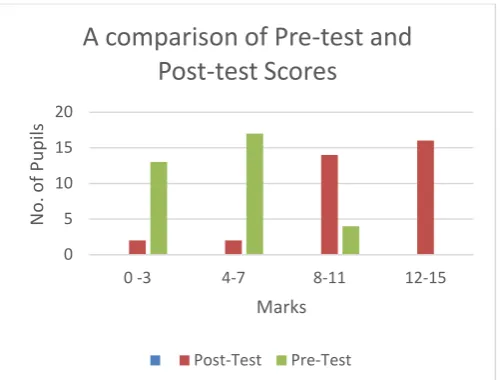
One set of 12 short answer questions was given to the pupils to answer at the pre-intervention stage and post-intervention stage, in order to establish the effectiveness of argumentation application in guiding the pupils to understand states of matter and change of state of matter. The results of the tests have been presented in Figure 1. As shown in Fig. 1, the pre-test results are skewed towards zero. This indicates that prior to the administration of the argumentation application, the pupils‟ understanding of change of state of matter was weak.
Figure 1. Pre-intervention and Post-intervention test scores
Only four pupils scored marks from 8 to 11 while as many as 13 scored less than four. The result for the post-test sharply contrasted the pre-post-test result. In the post-post-test, a total of four pupils scored less than eight and as many as 16 pupils had scores above 11. The results presented in Fig. 1 indicates that after the administration of the argumentation application, the pupils understanding of states of matter and change of state of matter improved.
B. Students’ pre-conceptions on change of state of matter
Pupils characterized solids as anything that is hard and can be held. For example, a pupil said that: A glass of water is solid because it could be held. Pupils could not describe solids in terms of shape and volume. Pupils characterized liquid as anything that cannot be held in the palm though could be touched. Pupils could not describe liquids in terms of shape and volume as well. A pupil said; we can touch water but we cannot hold water in our palms it will pass through our fingers. Pupils gave an example of gas as air but could not consider gases as taking the shape and volume of the container in which they are held. They perceived anything that cannot be seen but felt as gas and hence said gases do not have shape and volume even when held in a container. The challenge the pupils had was classifying matter into the various states using shape and volume.
The Pupils held the view that all solids change to liquids when heated and before solids can change to gas it has to pass through the liquid state. Due to this, they disagreed that sublimation is possible. In support of their argument, the pupils heated camphor and rightly
0 5 10 15 20
0 -3 4-7 8-11 12-15
N
o
. o
f P
u
p
ils
Marks
A comparison of Pre-test and
Post-test Scores
observed that camphor changes from solid to liquid before changing to gas. This pre-conception was altered when the pupils left camphor in the classroom for days at room temperature. The pupils concluded that sublimation of camphor is only possible at room temperature.
IV.
DISCUSSION
Argumentation application is a technique that creates an active classroom (Jiménez-Aleixandre & Erduran, 2008). By applying argumentation in lessons the pupils actively participate in the lesson and the teacher only becomes a guide for the pupils. The teacher guides the pupils to learn what they need to learn as they discuss and argue about a proposition. By becoming active participants of a lesson, the pupils tend to learn better as they replace their wrong pre-conceptions with the right knowledge (Ford, 2012).
This is seen in the result of the pre-test and post-test. It could be seen that in the pre-test the pupils scored low marks, but the data in the post-test portrays a different picture. This is as a result of the argumentation that went on between the pupils themselves and between the teacher and the pupils as the groups made their presentation. In the process, the students were allowed to discuss the issue presented to them, share with the entire class their thought on the issue before the teacher comes in to clear their wrong pre-conceptions. The argumentation application offered the pupils to think about the same concept at two different levels. First, when the question or statement is given, the pupils share their view in their groups and then later the groups share their views to the whole class. In each of these levels, the pupils get the opportunity of comparing their wrong pre-conceptions to pre-conceptions of their peers and then when the activity is conducted they get another opportunity to review their pre-conception and discard wrong pre-conception. This is what accounted for the performance observed in the post-test.
The pupils‟ pre-conceptions about state of matter and change of state matter were quite interesting. To the pupils, solid can be seen, touched and held but the shape of solids cannot be changed, liquid can be seen and touched but cannot be held and gases cannot be seen, touched nor held. The pupils were using the propensity to grasp, touch and see objects only to classify objects
into solid, liquid and gas. This explains why the pupils generally classified a glass of water as solid but said water is liquid. They failed to recognize that in such situation it the liquid being held in a solid container that is been referred to. They were also of the view that since the shape of solids is fixed they cannot be transformed into different shapes. They got this concept from a characteristic of solids which says solids have a fixed shape. Finally, the pupils had the conceptions that all solids pass through the liquid before turning into gas. Because they had seen several instances of solids melting either at room temperature or at elevated temperature, they concluded that all solids behave this way. The pupils‟ pre-conceptions were discarded as the argumentation was applied. Argumentation application, therefore, is an effective way of guiding pupils to discard their wrong pre-conceptions and making pupils become active learners.
V.
CONCLUSION
From the results of the study, argumentation application is effective for helping pupils understand states of matter and change of state of matter. This is because argumentation application gives pupils the opportunity to reason, justify beliefs and draw conclusions and alter their wrong pre-conceptions through thoughtful social dialogue. Argumentation application gives the teacher the opportunity to hear pupils‟ pre-conceptions and design activities to help the pupils discard their wrong pre-conception.
VI.
REFERENCES
[1]. Acar, O. (2008). Development of argumentation and conceptual understanding in a physics by inquiry class. Unpublished doctoral thesis, The Ohio State University, Columbus.
[2]. Berland, L. K., & Reiser, B. J. (2009). Making sense of argumentation and explanation. Science Education,93(1),26–55.
[3]. Clark, D. B., Sampson, V., Weinberger, A.,& Erkens, G. (2007). Analytic Frameworks for Assessing Dialogic Argumentation in Online Learning Environments. Educational Psychology Review, 19(3), 343–374.
1998-2014.International Journal of STEM Education,
2(5), doi:10.1186/s40594-015-0020-1
[5]. Ford, M. J. (2012). A dialogic account of sense-making in scientific argumentation and reasoning.
Cognition and Instruction, 30(3), 207–245. [6]. Gunel, M., Memiş, E. K., & Buyukkasap, E.
(2010). Effects of the science writing heuristic approach on primary school students‟ science achievement and attitude toward science course.
Education and Science, 35(155), 49-62.
[7]. Jiménez-Aleixandre, M. P., Agraso, M. F., & Eirexas, F. (2004, April). Scientific Authority and Empirical data in argument warrants about the Prestige oil spill.Paper presented at the National Association for Research in Science Teaching (NARST) annual meeting, Vancouver, WA. [8]. Jordan, M. E., & McDaniel Jr, R. R. (2014).
Managing uncertainty during collaborative problem solving in elementary school teams: The role of peer influence in robotics engineering activity. Journal of the Learning Sciences, 23(4), 490–536.
[9]. Kuhn, D. (1991). The skills of argument.New York: Cambridge University Press.Mason, L. (1996). An analysis of children‟s construction of new knowledge through their use of reasoning and arguing in classroom discussions.International
Journal of Qualitative Studies in Education, 9(4), 411-433.
[10]. Kuhn, D., & Udell, W.(2003).The Development of Argument Skills. Child Development, 74(5), 1245–1260.
[11]. Manz, E. (2015). Representing student argumentation as functionally emergent from the scientific activity. Review of Educational Research. doi:10.3102/0034654314558490. [12]. Martin, A. M., & Hand, B. (2009).Factors
affecting the implementation of argument in the elementary science classroom: A longitudinal case study. Research in Science Education,39(1), 17– 38.
[13]. McNeill, K. L., & Pimentel, D. S. (2010). Scientific discourse in three urban classrooms: the role of the teacher in engaging high school students in argumentation. Science Education, 94(2), 203–229.
[14]. Naylor, S., Keogh, B, & Downing, B. (2007). Argumentation and Primary Science. Research in Science Education, 37(1), 17-39.
[15]. Osborne, J., Simon, S., Christodoulou, A., Howell-Richardson, C., & Richardson, K. (2013). Learning to argue: a study of four schools and their attempt to develop the use of argumentation as a common instructional practice and its impact on students. Journal of Research in Science Teaching, 50(3), 315–347.
[16]. Tsai, P. S., & Tsai, C. C. (2014). College students‟ skills of online argumentation: the role of scaffolding and their conceptions. The Internet and Higher Education, 21, 1–8.