© 2016 IJSRST | Volume 2 | Issue 6 | Print ISSN: 2395-6011 | Online ISSN: 2395-602X Themed Section: Science and Technology
Bridging the Divide : The Challenges of Sustainable Water
Supply to Peripheral Settlements of Kaduna Metropolis
Damina Bulus Gyuk1, Adegboyega Adesoji Anthony2, Agabi Jechoniah3
1,3
Department of Urban and regional Planning, Waziri Umaru Federal Polytechnic, Birnin Kebbi, Kebbi State, Nigeria
2
Department of Quantity Surveying, Waziri Umaru Federal Polytechnic, Birnin Kebbi, Kebbi State, Nigeria
ABSTRACT
Water problems of urban areas vary greatly with those of peripheral areas. While most cities have provisions for pipe borne water supply, the challenge of the periphery is the lack of provision for supply of pipe borne water. This study provides understanding of potentials and challenges for sustainable water supply in peripheral settlements as basis for intervention. Thirteen settlements were identified cutting across the two local government areas where peripheral growth is dominant: Chikun and Igabi. Data collection and analysis was conducted in 70% of the identified peripheral settlements. A sample size of 0.5% was drawn from 61,182 households constituting 305 questionnaires, from which only 269 were retrieved for analysis. Results reveal poor access to pipe borne water and over dependence on boreholes and dug wells; Valuable time is lost to water fetching. The need for sustainable water supply is established through indication of desire for pipe borne water supply; and willingness to pay for pipe borne water supply. Among the challenges to be surmounted to ensure sustainable water supply are: poor physical conditions of peripheral settlements; poor management of metropolitan growth; and water suppliers’ challenges. It is recommended therefore, that a comprehensive land use plan should be prepared which covers the metropolis and periphery; Legal recognition for the existing peripheral settlements; expansion of the capacity of the water treatment plants; and provision of public boreholes to meet water supply on the interim.
Keywords: Sustainable, Challenge, Water Supply, Peripheral Settlements
I.
INTRODUCTION
Cities worldwide are endowed with basic infrastructure. This advantage creates the pull effect to cities when compared to other forms of human settlements. The pull to cities creates peripheral settlements which look onto the city for supplies. Cities of the developed countries are better serviced with infrastructure compared to cities in developing countries. Such cities are better because of the organized system of infrastructure planning and delivery, which is conceived at the urban level and infrastructure needs are usually properly identified, then Infrastructure Delivery Plans are prepared in conformity to the proposals of the city plan [1].
In developing countries, the number of people living in towns and cities is growing rapidly – both as a result of natural growth and migration. This adds significantly to
the number of people living around the peripheries of cities. In most cases, attention is given to the mother city without much concern to what is happening at the fringe, where new growth points exist. This pattern of growth widen the gap between residents of urban core and periphery- who in most cases lack planning, coordinated growth, and access to a whole range of basic services. [2] Observed that the core –periphery dichotomy has implications being that the availability of infrastructure and services can influence productivity, health, income and employment. [3] Also posits that access to a range of basic infrastructure and services (e.g. water, sanitation, drainages and roads) is also an indicator of community wellbeing.
housing development, urban agriculture, ground rent and payment of development permit charges. As such greater effort is required to ensure that basic needs for human survival are provided to enhance living condition of such areas.
Water demand and supply problems at the city level ([4]; [5]; [6] and [7]) have received greater emphasis in research than those that disaggregate performance at sub city levels. At that scope, details of problems are lost just as for spatial differentiation. The criticism also being that the masking of problems based on aggregation means that solutions are never targeted. This paper fills the gap by exploring the nature of water problems in the peripheral areas of Kaduna and the challenges for improvement. Like most developing countries, the peripheral settlements of Kaduna metropolis have emerged without planning and they lack basic services. Service delivery favours the metropolitan to the neglect of the periphery. As one moves from the centre of the metropolis outwards, there appears to be deprivation in quality of basic services [8].
For the purpose of this study a peripheral settlement is defined as the newly urbanized areas of the city which lie on the fringes. Even though they can be seen as a labour market for both formal and informal economies of the city, they are inadequately integrated into the city and have no prioritized basic services like water. Such areas in addition are characterized by uncertain or illegal land tenure, minimal or no infrastructure, low incomes, and lack of recognition by formal governments.
II.
METHODS AND MATERIAL
The Peripheral Settlements of Kaduna
The peripheral areas of Kaduna are easily identified by the presence of major road arteries. Towards the north along Zaria road development have occurred up to the new trade fair complex and beyond extending to Rigachukun. In the western direction, establishment of Institute of Water Resources, College of Agriculture, Nigeria Defense Academy permanent site and the Airport have opened up the areas along this route for development. Growth has continued in this direction
spreading beyond Mando on the Lagos road [9]. Along the western bypass from Mando, there are developments around Panteka, the National Eye Centre, Rigasa, and Kudenda which serves as industrial layouts. Development in this direction has spread through the road linking NNPC and east-west to Mararaban Rido. Finally, in the south along Abuja express way, unplanned urban development has reached about 6km from the point of express intersection to Gonin Gora [10].
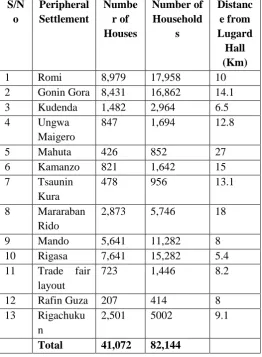
Table 1 : Spatial location of Kaduna Peripheral Settlements
Source: Field Survey, 2012
The peripheral settlements of Kaduna are recently urbanized settlements located at the fringe of the metropolis beyond which there is no continuous development. They are equally identified by the nature of development and physical location in the metropolitan context. No distance yardstick was adopted in defining the peripheral settlements of Kaduna
S/N o
Peripheral Settlement
Numbe r of Houses
Number of Household
s
Distanc e from Lugard
Hall (Km) 1 Romi 8,979 17,958 10 2 Gonin Gora 8,431 16,862 14.1 3 Kudenda 1,482 2,964 6.5 4 Ungwa
Maigero
847 1,694 12.8
5 Mahuta 426 852 27
6 Kamanzo 821 1,642 15 7 Tsaunin
Kura
478 956 13.1
8 Mararaban Rido
2,873 5,746 18
9 Mando 5,641 11,282 8 10 Rigasa 7,641 15,282 5.4 11 Trade fair
layout
723 1,446 8.2
12 Rafin Guza 207 414 8 13 Rigachuku
n
2,501 5002 9.1
metropolis, but just the fact that they are located at the fringe of the metropolis along entry routes as shown in table 1.
2. Methodology
The data used in this paper was collected as part of a research for M.Sc Degree at the Department of Urban and Regional Planning, Ahmadu Bello University Zaria. Field data on household access to water and their demand was collected using systematic random sampling in stratified peripheral settlements of Kaduna metropolis. A total number of 13 settlements were identified and 9 settlements (70%) of which questionnaires were administered. The selected settlements cut across Chikun and Igabi local governments of the metropolis, where peripheral settlements are located. The selection of settlements also reflects the defined stratification of peripheral settlements based on their household sizes (Small, Medium and Large). A total number of 61,182 households exist in these settlements where 0.5% (305) of which make the sample size used for questionnaire administration and only 269 were retrieved for analysis. Analysis was carried out using descriptive statistics where frequency tables, charts and cross tabulation were used to explain the challenges of sustainable piped water supply in these areas. Oral interview was equally conducted with the metropolitan water supply agency called the Kaduna State Water Board (KSWB), commercial and private borehole owners who significantly supply water to households of peripheral settlements.
III. RESULTS AND DISCUSSION
3.1 The Nature of Water Supply Problems in the Peripheral Settlements
Inadequate Supplies
The general situation suggested various levels of difficulties in accessing water across the settlements. Pipe borne water supply is generally low and irregular. Borehole supplies are inadequate as public boreholes across most settlements have failed because they are poorly sunk and maintained. Dug wells and boreholes also dry up in the dry season due to low water table. The
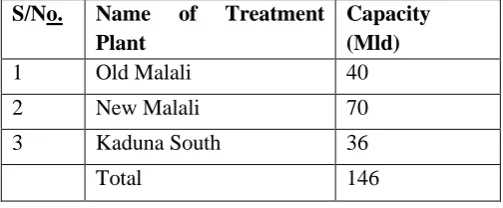
total supplies were determined for pipe borne water where only 5 settlements generally receive supply. The average hourly receipt is 3hours in a day, week or a whole month except in Tsaunin Kura where pipe borne water is supplied for 6hrs/day. The inadequate supplies has link to poor generation by the Kaduna water works. Three water treatment plans exist with a combined capacity of 146million litres, which are to service the population of Kaduna metropolis estimated at 1,361,614people. At a consumption rate of 120 litre/person/day, the water demand of 163,393,680Mld was established to have exceeded supplies by 17,393,680Mld.
Table 2 : Water Treatment Plants in Kaduna Metropolis
S/No. Name of Treatment
Plant
Capacity (Mld)
1 Old Malali 40
2 New Malali 70
3 Kaduna South 36
Total 146
*Mld = Million Litres per Day Source: KSWB, 2012
The daily water demand of peripheral settlements is 58,732,800Mld. The total excess demand for core metropolis and periphery is 76,126,480Mld. Considering the average household size of 8 persons and average water consumption of 260 litres per household leaves an excess water demand of 700 litres using the United Nation (U.N.) per capita per day water demand of 120 litres/person/day.
Table 3: Family Size
Size Frequency Percent
1 – 4 79 29.4
5 – 8 109 40.5
9 – 12 54 20.1
12 and above 27 10.0
Total 269 100.0
It therefore implies that households of peripheral settlements are limited to consuming less water on daily basis than the U.N. minimum consumption rate. This has implication on sanitary conditions and health of residents. Inadequacy in supply is further explained using cross tabulation statistics as shown below. Household size is a determinant of water demand. Knowledge of quantity of water consumed daily by a household reveals shortfall or adequacy of water supply.
Table 4 : Cross tabulation statistics between Family size and Quantity of water used daily
Source: Field Survey 2012
The cross tabulation statistics in this regard showed that while large family size of 12 and above consumes over 400 litres of water daily, low family size of 1- 4 consumes 120 – 200 litres water a day. It therefore implies that large households consumes more water and generate high water demand than small households. The explanation for this being that, individual water needs sums up household water demand. Inadequacy of pipe borne water supply is explained by the short capacity of water treatment plants which currently supplies water to the metropolitan core and the poor budgetary allocation to the KSWB. Supplies from other sources, is threaten in the dry season due to low water table in most peripheral settlements. The general inadequacy in water supply has varying health and socio-economic consequences on residents.
High Expenditure on water
In the absence of pipe borne water, commercial boreholes are the predominant sources of water in peripheral settlements. This has high cost implication on households income where a large chunk is spent on water at about N11,700 per month. This amount is high when compared to the average monthly water bill of N1,370 for households in the metropolitan core. The
study went further to establish the percentage of average monthly income of households spent on water. The highest household income category ranges between N37,000 – N54,000 with 40.9% and the least households whose monthly incomes are less than N18,000 constituting 9.1%. The average household monthly income as shown in table 5 is N54,500, which is considered inadequate to ensure access to basic needs based on inflationary variation of developing countries.
Table 5 : Family Monthly Income
Source: Field Survey, 2012
As established from the analysis, about 21.5% of household monthly income is expended on water. The high expenditure on water is explained by inadequate and unreliable supplies which creates scarcity and subsequently cost of water purchase from vendors.
The next level of analysis attempts to establish the influence of income on quantity of water consumed daily by households as income is a determinant of water demand.
Table 6 : Statistics Between Family Income and Quantity of water used daily
The cross tabulation statistics in this regard showed that the low monthly income families consumes less water than high income families. This implies that families with high incomes have the ability to meet daily water demand than those from the low income group. The high water consumption by high income families reflects the ability to purchase water, sink boreholes or extend pipe borne water supply.
Unreliable supply of water
The problem of water supply in peripheral settlements is characterized by scarcity in the dry season due to high reliance on boreholes and wells in the absence of pipe borne water. Pipe borne water supply is inadequate which leads to rationing of supplies only for the maximum time of 3 hours a day, week or even month. Water supply through boreholes and wells are normally unpredictable as the two sources dry up in dry season due to low water table in the settlements. Supply from unreliable sources has generally led to high expenditure as well as reliance on unsafe and expensive sources. Unreliability of sources of water is further explained using cross tabulation statistics below.
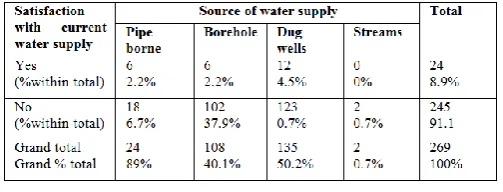
Table 7 : Satisfaction with Current water supply * Source of water supply
Source: Field Survey, 2012
The cross tabulation statistics in this regards reveals that while 37.9% are not satisfied with borehole water supply about 6.7% of households with access to pipe borne water supply are equally not satisfied. The level of dissatisfaction for water supply through Dug wells and stream equals at 0.7% respectively. It is therefore deduced from table 7 that there is general dissatisfaction with the available water supply in the peripheral settlements of Kaduna metropolis. This indicates a huge supply gap that requires immediate intervention.
Inadequate Water Consumption
Water consumption is generally considered inadequate in peripheral settlements. Data on water consumption reveals an individual water consumption of 32.5litres/person/day. This is far below the UN minimum daily requirement of 120 litre/person/day. Inadequate water supply leads to high cost of purchase from vendors, which makes families cut down on water consumption in order to increase savings for other needs. Cutting down water consumption has health implication of reduction in personal hygiene and poor management of sanitary conditions.
Time Wastage in Accessing Water
As established that the average time spent on queue for water fetching is over 30 minutes, indicates that valuable time is wasted that can be committed to other economic activities. Time spent queuing is responsible for dropping out of pupils and women in schools in order to fetch water. Queues are inevitable when scarcity of water and unreliable supply exists. Water scarcity is common in the dry season when water drops too low leading to drying up of wells and boreholes.
3.2 Opportunities Need for Sustainable water supply to peripheral areas
Water is a precious natural resource, vital for life, development and the environment. It can be a matter of life and death, depending on how it occurs and how it is managed. When it is too much or too little, it can bring destruction, misery or death. Approximately 1.1 billion people worldwide lack adequate water provision [11]. Unsafe or inadequate water has been attributed to 80 percent of illnesses and 30 percent of deaths in developing countries. As a result, 2.2 million people die of water-related illnesses each year [11].
be as close as possible to the point of use in order to maximize health benefits of water supply. Poor water supply leads to low sanitary conditions, which in turn causes health risks. [15] Suggested that shortage to water is a factor responsible for common illnesses in children ranging from 0- 5 years of age.
Poor water supply creates economic implication. [16] Asserted that water can be an instrument for poverty alleviation lifting people out of degradation of having to live without access to safe water and sanitation while at the same time bringing prosperity to all. However, when water is inadequate in quality and quantity, it can be a limiting factor in poverty alleviation and economic productivity, food insecurity and constrained economic development. The interdependence between water availability and development is exemplified by the link between water and poverty. Due to poverty, access to adequate water is low in Africa. As a result of inadequate access to water there is a high incidence of communicable diseases that reduce vitality and economic productivity on the continent. Inadequate access to water and sanitation is thus both a cause and a consequence of poverty. Similarly, inadequate water resources can become a constraint to improved agricultural development and food security.
Desire for Pipe Borne Water Supply
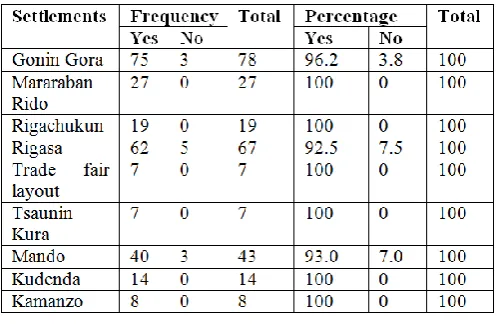
The study went further to explore interest for pipe borne water. Households predominantly have interest in pipe borne water supply as shown in table 8. The high interest is because only Tsaunin Kura that fully receives pipe borne water supply and high water demand, as well as the expensive nature of water purchase from vendors reinforces the hike in demand. Residents equally, have the understanding that payment of monthly water bills is by far cheaper than buying water from vendors.
Dissatisfaction with the current source of water supply further reinforces interest for pipe borne water. The level of dissatisfaction is higher in the dry season where water table drops too low to sustain continuous water supply from wells and some boreholes. Only 4.1% that did not indicated interest for pipe borne water supply can be attributed to borehole ownership.
Table 8 : Indication of interest for pipe borne water supply
Source: Field Survey,2012
The study established that Mararaban Rido, Rigachukun, Trade fair layout, Tsaunin Kura, Kudenda and Kamanzo indicated 100% interest for pipe borne water supply. The least interest is Rigasa, which can be explained by the failure to supply water through the existing network in the settlement.
Willingness to Pay for Pipe Borne Water Supply The indication of willingness to pay for pipe borne water supply suggest good prospect for sustainable water supply.
Table 9 : Willingness to pay for pipe borne water supply
Willing Frequency Percent
Valid Yes 241 89.6
No 18 6.7
I don't know 10 3.7
Total 269 100.0
Source: Field Survey, 2012
3.3 Meeting the Water Needs: Challenges to Sustainable Supplies
Poor Physical Conditions
Land for residential development in peripheral settlements is considered cheaper than in the city core. This is due to poor access to infrastructure and poor conditions of areas in which peripheral settlements are located. These areas are less desirable for formal developments due to their unplanned nature, and difficult site conditions. The attraction to these areas is that land is relatively cheap to purchase and because illegal occupation of such sites is less likely to be challenged. Due to lack of technical know-how, these settlements are mostly developed haphazardly without provision for service right of way. This is true as only two out of the nine peripheral settlements studied are planned. The lack of provision for service right of way has cost implication when new water infrastructures are to be provided. Because compensation for individual properties must be paid in the process of service provisioning.
The scattered nature of peripheral settlements is another environmental challenge. The peripheral settlements are not developed along one direction. The cost of extending water main and distribution pipelines to one direction is less than what is required to several directions. The location of the settlements requires heavy capital investment for installation of distribution network. This is explained by the lack of land use plan and functional Master plan for the metropolis which indicates direction of growth as basis for utility extension.
Although the need for an additional dam is established by the authority and Ministry of Water resources, to be constructed along Mararaban Rido in order to prepare for further city expansion in the southern part of the metropolis. The river source in which water is to be drained into the earth dam when constructed still remains the major challenge.
Poor Management of Metropolitan Growth and Development
Another unique issue is the lack of synergy between authorities concerned with managing city growth and
development. The KASUPDA, Ministry of Lands, Survey and Country Planning, KSWB, Ministry of Works and PHCN do not work together to plan and implement the development of new settlements within the metropolis. This is responsible for the outcomes of this research where Trade fair layout despite its planned status does not receive pipe borne water. While parts of Rigachukun, Mando and Rigasa receives pipe borne water supply.
The entire metropolis at the moment does not have functional strategic Land Use Plan which specifies the extent and types of physical development, that form the basis for water projection and planning. The city does not have a Priority Infrastructure Plan which carries detail utility distribution lines for the entire metropolis, with provisions for future expansion. These two plans are crucial to confirming water service needs to be satisfied and its priorities, identification of key stakeholders and their requirements, determine short, medium and long term strategies (infrastructure investment and non-asset solutions) in relation to major components (sources, trunk mains, treatment plants), to assess the social, environmental and financial implications, and identify future land requirement for various activities.
Water Suppliers Challenges
It was identified during the course of this study that water suppliers in peripheral settlements of Kaduna metropolis are broadly grouped into public sector providers (KSWB, Ministry of Water Resources, Local Government and Ministry of Works), private commercial and non-commercial providers.
KSWB hindering the provision of pipe borne water networks to new areas. The implication is that KSWB prioritize extension of pipe borne water supply to only areas with potentials for cost recovery.
The Ministry of Water Resources and local governments are responsible for boreholes in parts of the metropolis where pipe borne water supply does not exist or regular. Boreholes serve as remedy to critical shortfall in pipe borne water supply. But public boreholes are poorly sunk and maintained in all the peripheral settlements of the metropolis.
Private commercial providers contribute significantly to water supply in peripheral areas with accompanied financial gains. It was gathered through oral interview that commercial borehole owners sell water at N5 per container and make an average of N4,000 ($ 20) daily. This method functions effectively in Rigasa.
IV. CONCLUSION
The research provided useful insight on water supply and demand in peripheral settlements of Kaduna metropolis as basis for identifying opportunities and challenges for sustainable water supply. Sustainable water supply is achievable through capacity increase of the treatment plants and dams, then extension of distribution infrastructure to new areas, without which water supply will still remain a challenge in these areas.
V.
RECOMMENDATIONS
1. The Kaduna state government should expand the capacity of water treatment plants in Kaduna metropolis to cater for both the excess population not served and the population of peripheral areas, in order to ensure pipe borne water supply to peripheral settlements with existing network such as Kudenda and parts of Rigasa and Mando. Since these settlements already have existing network. Provide network to other peripheral settlements without provision. Provide public boreholes to supplement shortfall in pipe borne water supplies and areas without access to piped water. Public boreholes are in high demand at the moment in
Mararaban Rido and Kamanzo because they have the highest percentages of well usage.
2. KSWB should prepare water distribution plans for new areas with adequate cover of developments within the radius of 50km of the metropolis. This can be achieved through good working relationship with the KASUPDA and other relevant agencies. Increased funding should be made to the KSWB in addition to internally generated revenue in order to enable the board undertake water projects in new settlements through the extension of water distribution lines and to ensure there is water supply through the network.
3. Construction of additional earth dam and water treatment plants to provide adequate raw water into treatment facility to enable pipe borne water supply to areas where growth and expansion is focused along Mararaban Rido and Kamanzo.
4. Efficient and effective cost recovery mechanism should be put in place by the KSWB to areas that receives pipe borne water supply and potential areas in order to increase operational revenue of the board. This is because peripheral settlements have the ability and willingness to pay for water supply by the KSWB.
VI. REFERENCES
[1] Abdullahi, M. A. (1990) Water for sustainable Development: Trends and Perspective. A paper delivered at the National Conference on water for sustainable Development.
[2] Devas, N. (1993) 'Evolving Approaches to Urban Management’ in Devas, N. and Rakodi, C (Eds), Managing Fast Growing Cities: New Approaches to Urban Planning and Management in the Developing World, pp 63 – 101, Longman, London.
[3] Mabogunje, A. L. (1993) 'Infrastructure: The Crux of Modern Urban Development’ Urban Edge 1(3) 3. World Bank, Washington DC.
[4] Maiyaki, B.K.J. (2006) Efficiency of public water supply in Kaduna Metropolis. An unpublished M.Sc thesis, Department of Urban and Regional Planning, A.B.U., Zaria.
Department Urban and Regional Planning, A.B.U. Zaria
[6] Osagioduwa, M. (2007) Planning for effective urban water supply in Benin City. Unpublished M.Sc U.R.P. Thesis, Department of Urban and Regional Planning, Ahmadu Bello University Zaria.
[7] Nyam, J. V. (1999) Planning Analysis of Water supply in Kaduna Metropolis. Unpublished M.Sc U.R.P. Thesis, Department of Urban and Regional Planning, Ahmadu Bello University Zaria.
[8] Golam R., Deanna A., and S. I. (2008) City Growth with Urban Sprawl and Problems of Management. 44th ISOCARP Congress
[9] Audu, E. A. (2009): Strategic Planning Proposals for the Development of Peripheral Areas of Kaduna. An unpublished M.Sc thesis, Department of Urban and Regional Planning, A.B.U., Zaria [10] Habila, S. K. (2009) : Characteristics and
problems of Planning Control in the Peri-Urban areas of Kaduna South. An unpublished M.Sc thesis, Department of Urban and Regional Planning, A.B.U., Zaria
[11] W.H.O. and UNICEF (2000) Global Water Supply and Sanitation Assessment. www.unicef.org/wash/files/gafull.pdf
[12] UN Report Africa (2005) The Millennium Development Goals Report. New York.
Downloaded from
unstats.un.org/unsd/mi/pdf/mdg%20book.pdf [13] Batemen, O. M., Smith, S. and Roark, P., (1993)
A Comparism of the Health of Water Supply and Sanitation in Urban and Rural Areas of five African Countries. WASH Field Report No. 398 Water and Sanitation for Health Project, WASH Operations Centre (Arlington, V. A.)
[14] Fadere, S.O. and Olawuni, P.O. (2008) Domestic Water Supply and Health of Household in The Three Residential Densities in Osogbo, Osun State, Nigeria. Ethiopian Journal of Environmental Studies and Management 1(2) 35-43
[15] Osinusi, K. and Oyejide, C. O. (1998) “Morbidity pattern among Nigerian Children from a Poor Urban Community”. African Journal of Medicine and Medical Sciences, 18:43-47