321
Some Applicable Methods Of Approximating Basic
Trigonometric Functions And Their Inverse Value
Manaye Getu Tsige
Abstract: This paper presents some applicable methods of approximating basic trigonometric functions and their inverse value. Methods are the best choice when a need arise to know first few digits after a decimal point and corresponding angle without spending time for immediate purpose. The ways of approximation are helpful for science and engineering field of study; they can be applied to get immediate solutions for practical problems which might be estimating, comparing and judging while operations of numbers. The assumption stated to carry out this work is; There exists certain function which can satisfies the condition defined as; if the sequence of some domain values within a domain of function forms an arithmetic progression, then the sequence of corresponding range values within a range of function will also forms an arithmetic progression. This assumption leads to the assumed generalized approximate equation and finally to the major findings. The major areas of study to carry out this particular work are arithmetic progression, sine function, cosine function and idea related to trigonometric functions such as trigonometric identities, co terminal angles, reference angle and co function definition. The objective is to contribute additional alternative knowledge to the Mathematical science. The findings of this paper are useful to derive general approximation formulae and other related findings that will be presented in the future.
Index Term: sine function, cosine function, co function, trigonometric identities, arithmetic sequence.
————————————————————
1
INTRODUCTION
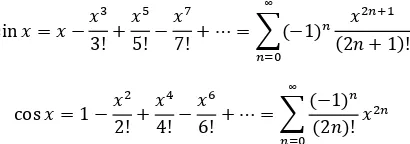
Trigonometric functions arise in geometry but they are also applicable to study sound, the motion of pendulum and many other phenomena involving rotation and oscillation [4]. Different approximation techniques have been used to approximate trigonometric functions since along ago. For instance, evaluating trigonometric functions of common angles and quadrant angles by using the properties of triangle and unit circle respectively [10],[7]. Trigonometric table is often used to approximate value and inverse value of trigonometric functions. Sometimes it is possible to use trigonometric identities, sum of two angle formulae, double angle formulae, half angle formulae, product to sum formulae and sum to product formulae provided that angle is reduced to common angles[10] unless otherwise they have no advantage upon evaluating trigonometric functions. There are equations known as Maclaurin series They are given by [9],[4]
Above equations are also listed in different books [3],[11],[1],[13],[5]. Small angle approximation is given by;
for very small x, [4]. This paper provides the best
alternative methods that should be chose when a need arise to know first few digits after a decimal point and corresponding angle without spending time for immediate purpose.
Methods are helpful for science and engineering field of study; they can be applied to get immediate solutions for practical problems which might be estimating, comparing and judging while operations of numbers. The objective of this paper is to contribute additional alternative knowledge to the Mathematical science. The major areas of study to carry out this particular work are arithmetic progression, sine function, cosine function and idea related to trigonometric functions such as co terminal angles, reference angle and co function definition. Author Hornsby et al., [6] discusses ideas related to trigonometric functions. Co function definition for sine and cosine function is given by
In other word, if then
Authors (Larson and Hosteller [10], Bronshtein, et al., [2], Solomon [12] discuss about arithmetic sequence. If the difference between successive terms of a sequence is constant, then the sequence is an arithmetic progression.
Let is an arithmetic progression, then
If the arithmetic progression has first term and common
difference d, then the nth term of the sequence given by
2
MATERIALS
AND
METHODS
Use the following assumption to arrive at assumed generalized approximate equation and use this equation as starting idea to derive provable methods and finally to other related findings.
Assumption: There exists certain function which can satisfy the condition defined within a certain interval of its domain or throughout its domain. It is defined as; if the sequence of some domain values within a domain of function forms an arithmetic progression, then the sequence of corresponding range values within a range of _____________________
Manaye is currently pursuing masters degree program in Hydraulic Engineering, Arba Minch University, Ethiopia
function will also approximately forms an arithmetic progression.
Let are some values in its domain (D)
are corresponding range values in
its range(R)
If is arithmetic sequence, then
The nth term of the arithmetic sequence given by
If is approximately arithmetic
progression, then
The nth term of the sequence is given by
Assume sine function approximately satisfies above
condition within the given interval
Substitute Eq (2) into (3)
Substitute Eq (1) into (3)
Substitute Eq (4) into (5)
For non-negative increasing terms of an arithmetic progression, the following inequality holds true.
Having this interval in mind, Let and substitute
it into Eq (6)
Let
Assume the value of fall within the interval;
Then, the assumed generalized approximate equation is given by
Use this equation as starting idea to derive provable methods and those methods collectively named as some applicable methods.
2.1 Some applicable methods
Steps to derive provable methods by using assumed generalized approximate equation;
Let
For each value of within the interval , the
following inequality holds true.
Decimal representation of real numbers: Authors
Wrede and Spiegel [14] discuss about decimal
representation of real numbers. In order to equally express real number in terms of decimal number, use a few digits
and dotted line after a decimal point;
Consider decimal representation of real numbers
and introduce variables to represent digits after a decimal point.
Definition: To equally express in terms of decimal number, known digits after a decimal point are denoted by
323 denoted by using dotted line. Having this definition in mind,
consider two digits after a decimal point and let digits and
are known digits after a decimal point, then
approximated by
Substitute Eq (10) into (9)
Correlate Eqs (9), (10) and (11)
Substitute Eq (10) into (8)
Substitute Eq (13) into (12)
If the other unknown digits are taken into account and denoted by dotted line, then the approximate Eq (14) can be written as the Eq (15)
Mind above definition; variables and stand for digits
after a decimal point where as dotted line stands for other unknown digits. There are 51- two digits decimal numbers
within the interval and hence it is now very
easy to verify equation (15) whether it holds true or not for all possible two digits decimal numbers. Use trigonometric table to crosscheck equation (15) for each two digits decimal number.
Let
Consider co function definition [7]
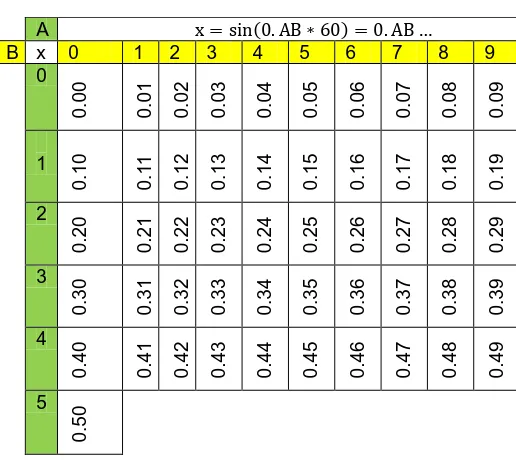
Summarize it by constructing table for all two digits decimal numbers (0. AB)
Table 1. Digits versus corresponding sine value
A
B x 0 1 2 3 4 5 6 7 8 9
0
0.00 0.01 0.02 0.03 0.04 0.05 0.06 0.07 0.08 0.09
1
0.10 0.1
1
0.12 0.13 0.14 0.15 0.16 0.17 0.18 0.19
2
0.20 0.21 0.22 0.23 0.24 0.25 0.26 0.27 0.28 0.29
3
0.30 0.31 0.32 0.33 0.34 0.35 0.36 0.37 0.38 0.39
4
0.40 0.41 0.42 0.43 0.44 0.45 0.46 0.47 0.48 0.49
5
0.50
Table 1 shows Eq (15) holds true for all two digits decimal numbers. Equations (8) and (16) satisfy co function definition.
If the negative and other co terminal angles are taken into account, then the Eq (15) can be modified as the method one and state the equations (8) and (16) as the first
approximation method. The maximum error of
approximation can be calculated by using known digits after decimal point.
2.1.1 Method one
If the stand for digits after a decimal point and the
angle is expressed in degree unit, then the following equations expressed in decimal number hold true.
Where n is integer
The maximum error of approximation is less than 0.009
2.1.2 First approximation method
The maximum error of approximation is less than 0.009 All other methods can be derived in the same way as above methods derived and each method can be verified in the same manner. And therefore, it is unnecessary to repeat
steps hereafter. Take to derive method two and
2.1.3 Method two
If the stand for digits after a decimal point and the
angle is expressed in degree unit, then the following equations expressed in decimal number hold true.
Equations hold true for all 259 three digits decimal numbers
( within the interval; The
maximum error of approximation is less than 0.0009
2.1.4 Second approximation method
The maximum error of approximation is less than 0.0009
Next, take to derive method three and third
approximation method
2.1.5 Method three
If the stand for digits after a decimal point and
the angle is expressed in degree unit, then the following equations expressed in decimal number hold true.
Equations hold true for all 872 four digits decimal numbers
within the interval; The maximum
error of approximation is less than 0.00009
2.1.6 Third approximation method
The maximum error of approximation is less than 0.00009
Next, take to derive method four and fourth
approximation method
2.1.7 Method four
If the stand for digits after a decimal point
and the angle is expressed in degree unit, then the following equations expressed in decimal number hold true.
Equations hold true for all 17453 six digits decimal numbers
within the interval; The
maximum error of approximation is less than 0.0000009
2.1.8 Fourth approximation method
The maximum error of approximation is less than 0.0000009
3
RESULTS
AND
DISCUSSION
The main results of this paper are method one, two, three, four and corresponding approximation methods. They are collectively named as some applicable methods and they are used to compute value and inverse of basic trigonometric functions. For instance, in the case of inverse value computation, method one, two and three can also be written by
Within common interval, the error of approximation gets
smaller and smaller from the first up to the fourth
approximation method. This implies that the assumed generalized approximate equation is very interesting and supposed to be holds true. And therefore, Sine function approximately satisfies above condition within the interval;
provided that the negative angles are taken into
consideration.
3.1 APPLICATIONS
The results of this research work have applications in Engineering, Military institution, Education.
3.1.1 Military institution/Engineering areas
325 simple fraction that it enables to set angle by using a value
of numerator and denominator.
Example 1: Target direction of fire at (near to
but not exactly )
Consider the first approximation method
(it is ok)
Use right angle triangle definition of Trigonometric functions.
Take
Set angle by measuring one unit upward and three units along the direction of fire.
3.1.2 Education
Methods minimize effort while teaching different science.
Example 2: calculate y component of force F= 50 N
Approximate by using the first approximation
method.
4
CONCLUSIONS
In general, the limitation of this paper is maybe approximation becomes possible only within the given interval. It provides foot step to derive general approximation formulae and other related findings that will be presented in the future.
ACKNOWLEDGMENT
Above all I thank God for all things happen. Next I would like to bring heartfelt thanks to Dr. Yewelsow, Dr. Ayele Taye, Dr. Nigatu, Dr. Brook Abate, Mr. Abraham Tulu, Mr. Mohammed Nuri, Mr. Assegid Chernet, Mr. Bishaw Taddele and Applied Mathematics department committee members-2008 from Hawassa University for their big support, comment and encouragement from very beginning. I thank Dr.Berhanu from Addis Ababa University, and Dr. Rogelio B. Paguntalan and Mr. Mitiku kinife from Adama Science and Technology University. I thank all my family especially Getu Tsige and Muluwork Admase. My thank also goes to Haileyesus Kamso, Alemu Amelo, Mimi Bati, Hayso Hassen, Tesfahun Hatya, Getahun Heramo, Mickias Girma, Melaku Teshome, Lisanework Tilahun and Manuhe Mircana.
REFERENCE
[1] Anton, H., Bivens, IRL., and Davis, S., Calculus,
India: Replika Press PVT. LTD, 2005.
[2] Bronshtein, IN., Semendyayew, K.A., Musiol, G.,
and Muehling, H., Hand book of Mathematics, New York: Springer-verlag Berlin Heidlberg. 2007.
[3] Edwards, L.H., Calculus early transcendental
functions, Richard Stratton publishers, 2007.
[4] Ellis, R., and Gulick, D., Calculus with Analytic
Geometry, Orlando, Harcourt Javanovich Inc, 1986.
[5] Fairs, J.D., and Faires, B.T., Calculus of one
variable:, USA, random house publisher, Inc., 1989.
[6] Hornsby, J. , Lial, M.L. and Rockswold, G., Algebra
and Trigonometry, Boston, Pearson education., 2007.
[7] Hornsby, J. and Lial, M.L., College Mathematics
and Trigonometry, New York, Addison Wesley educational publishers Inc., 1999.
[8] Iyengar, N., Baskaran, B., Charyya, L. Engineering
[9] Jeffrey, A., Essentials of Engineering Mathematics: Chagman and Hall, 1992.
[10]Larson, R., and Hosteller, R.P., Algebra and
Trigonometry, Houghton Mifflin Company., 2001
[11]Riley, K.F, Hobsonand, M.P., and Bence, S.J,
Mathematical Methods for Physics and
Engineering: Press syndicate of the University of Combridge., 2005.
[12]Solomon, R.C., (199 Advanced level Mathematics,
London: DP publications LTD. AIdne place., 1992.
[13]Stewart, J., Calculus Concepts and Contexts, USA,
Gary W. Ostedt publisher., 2001.
[14]Wrede, R., and Spiegel, M., Theory and Problems