Kinetic Modeling And Functional Parameters
Evaluation Of Mass Transfer Rate
On Bio Coagulant Interface In Pharmaceutical
Industry Effluent.
*Ugonabo V.I
1, Menkiti, M.C.
2. Osoka, E.C
3, Atuanya, C.U.
4and Onukwuli, O.D
5.
1,2,5
Department of Chemical Engineering, Nnamdi Azikiwe University, Awka, Nigeria.
3
Department of Chemical Engineering, Federal University of Technology, Owerri , Nigeria.
4
Department of Metallurgical And Materials Engineering, Nnamdi Azikiwe University, Awka, Nigeria. *E-mail:[email protected]: Telephone: +23408033481851
Abstract-- The kinetic modeling and functional parameters evaluation of mass transfer rate on bio coagulant interface in pharmaceutical industry effluent has been investigated at room temperature. To remove the mass particles (in form of total dissolved and suspended solids, TDS S ) from the effluent sample. The experiments were carried out using standard Jar test method at varying pH and coagulant doses respectively, while the bio coagulant processing was based on the work reported by [13]. The functional parameters generated indicate the optimum conditions to be 7, 0.6g/l and 40 minutes for pH, dosage and time, respectively. At the optimal pH, TDS S reduced from 1380 to 218.04 mg/l, equivalent to 84.20% removal efficiency at rate constant (k) of 6.332E – 05 l/g.min and corresponding coagulation period (1/2) of 0.38mins. Thus confirming the biocoagulant as effective bioflocculant . In comparative terms, the biocoagulant was found to be more effective for TDS S removal than Alum at the conditions of the experiment.
Index Term-- Bio coagulant, Effluent, Mass transfer, kinetics, Coag- flocculation.
1.0 INT RODUCT ION
Pharmaceutical Industry Effluent (PIE) is a major Waste product from production of pharmaceutical products. It is an objectionable pollutant deleterious to the water networks of the pharmaceutical host communities in Nigeria.
Waste water disposal from pharmaceutical activities and other sources are the major problem being faced by most developing countries like Nigeria because of lack of wherewithal; modern technologies, and to greater extent stringent measures on the part of government.
The most common problem in disposal of wastewaters is their color, and turbidity. Finely dispersed total dissolved and suspended solid particles are responsible for color and turbidity of the wastewaters [12],[25]. Coagulation and flocculation has been found to be effective in the removal of color, turbidity inherent in wastewaters [8],[9],[17],[20][25].
The total dissolved and suspended solid particles inherent in wastewaters generally, carry a negative electrical charge. These particles are surrounded by an electrical dou ble layer as a result of sorption of positively charged ions from the sample medium, which now prevents the rate of approaching each other [23]. Coagulation process is employed by the addition of positively electrical charge coagulant into the waste water rich in dissolved and suspended solid particles, resulting in compression of the double layer and neutralization of electrostatic surface potential of the particles. This phenomenon enables the destabilized particles to stick together when in contact with each order to form microscopic coagulated particles. In the other hand flocculation process is the aggregation of these microscopic coagulated particles to form larger flocs for easy removal from wastewater medium.
Readily, coagulation–flocculation has been accomplished through aluminum and iron salts as synthetic coagulants. Though, they are very effective, but the production of large volume of insoluble sludge and other negative attributes undermines their effectiveness. To avert these inherent problems , focus is hereby given to the study of coag-floculation performance of plant origin, corchorus olitorus seed - biocoagulant. Corchorus olitorus, a herbaceous plant of the family tiliaceae, are edible, non - toxic, biogradable and biocompatible substances with some medicinal values are found in large quantity in western Nigeria. The seed kernels of corchorus olitorus contains reasonable amount of positively charged soluble proteins which bind with negatively charged dissolved and suspended solid particles in wastewater to encourage floc formation [18]. Previous results obtained from coag -flocculation performance in pharmaceutical wastewater using corchorus olitorus seed coagulant was impressive [27].
seed coagulant with aluminum sulphate (Alum) under varying pH of pharmaceutical effluent, dosage, settling time at the same experimental conditions. The result obtained from this work, will determine whether corchorus olitorus seed coagulant can be applied in large scale water treatment technology as a good substitute for aluminum sulphate which has dominated the exercise in the past. Ultimately if found effective and efficient, the post usage handling and health challenges associated with aluminum sulphate coagulant can be ameliorated. Hence determining the rate of adsorption of total dissolved and suspended particles on the coagulant interface.
2.0 THEORET ICAL PRINCIPLES AND MODEL DEVELOPMENT For a uniformly interacting coag-flocculation system where Brownian stiochastic force dominates; the heating/stirring of the system produces temperature gradient which causes migration of the particles driven by thermally excited gradients of surface tension[3],[10],[22].
S = - ST
2.1
Where = - linT r1
S is the surface gradient operator; is the surface tension
and T is the coefficient of interfacial thermal elasticity. The
effect is that particles moving randomly with different velocity can coag-flocculate to form larger flocs.
Assuming monodisperse, perfect elasticity and bi-particle collisions, the general mode for microkinetic coag-flocculation is given as[29],[30].
k-i ∞
=
2.2
i=1 i=1 (k = 1,2,3)
is the rate of change of concentration of particle of size,
K
Where t is time, n1 denotes number of
monoparticles per unit volume;
nk is number of the flocs of K aggregates (k = 2,3,4…..) per
unit volume; a (i,j =- 1,2,3….) is a function of coag
K=1
Also = 4 i,j ( + ) Ei, j
2.4
Similarly, for Brownian transport is given as [30].
( )BR = εp
2.5
Where D(0)i,j is the relative diffusion coefficients for two
flocs of radii Ri and Rj, and aggregation number i and j,
respectively; Ei,j is the collision efficiency[31],[33]; εp = Ei,j
collision efficiency. The aggregation rate of intending potential particles during coag-flocculation can be obtained by the combination of equations 2.2 and 2.5 yields
- = K
2.6
where is the total concentration of constituent particles at time t as expressed in equation 2.3 above
K is the coag-flocculation constant is the order of coag-flocculation process.
Equally, ( )BR = εp
2.7
Where is rate constant of flocculation for rapid flocculation. However, for second order ( ) reaction rate constant ( )
= 8Ro
2.8 Where is particle radius
is diffusion coefficient for intending flocculating particles i and j
= + 2.9
Where is relative particle radius for and Putting = and =
Equation 2.9 transposes to = 2 2.10
From Einstein’s approach to the theory of diffusivity . =
2.11
But for a solid sphere of radius Ro, the stokes equation gives
B = 6 Ro
2.13
where, - is the viscosity of the coag-flocculating fluid. Substituting equation 2.11, 2.13 into 2.8 yields
Kf =
2.14
Combining equations 2.7 to 2.14 gives: K = (acf)BR
2.15
Substituting equations 2.5 and 2.15 into 2.6 yields -
= εp Nt
2.16
For microkinetic aggregation, theoretically equals 2 as given, [18].
From Ficks first law; number of particles entering sphere with radius RP per unit time Jt.
= 4Rp2 D1
2.17
where is flux (number of particles per unit surface and unit time at position Rp) integrating equation 2.16 at initial
conditions = 0, = 2 .
∫ = ∫ 2.18
Thus = 8D1
2.19
Generally, for particle of same size under the influence of Brownian motion. The initial rate of coag -flocculation is
-
= εp
2.20
Substituting equations 2.12, 2.13 and 2.19 into 2.20 yields -
= εp 2.21
Similarly
-
= εp at t > o
Hence, from 2.20 putting, = 2; equation 2.6 transposed to
-
= - K
2.22
Integrating
∫ = - K∫ 2.23
Thus = Kt + 2.24
Plot of vs t gives a slope of K and intercept of On evaluation of equation 2.24, 1/2 (Coagulation period) can
be determined.
=
2.25 1 +
Where =
2.26
Substituting equation 2.26 into 2.25 yields
= 2.27 1 +
As t = equation 2.26 transpose to; =
2.28 Similarly
= 0.5
As 0.5 ; , Hence equation 2.25 becomes
= (0.5 )-1
For a coagulation period, where total number of concentration is halves, solving equation 2.2 results in the general expression for particle of mth order.
(t) = [ ]m-1 [1 + ] m + 1 2.30
Recall; = or (0.5 )-1
For single particle (m = 1)
= 1
2.31 1 + 2
t = 1
2.32 1 + 2
For double particles (m = 2) = [ ]2
1 + 3 2.33
= [ ]2
1 + 3 2.34
For triple particles (m = 3) = [ ]3
1 + 4
2.35
= [ ]3 2.36
1 + 4
Finally, the evaluation of coag-flocculation efficiency or coag-flocculant performance of the process was obtained by applying the relation below.
E i, j (%) = - x 100
2.37
3.0 MAT ERIALS AND MET HODS
3.1 Material sampling, preparation and characterization 3.1.1. Pharmaceutical Industry effluent:
The effluent was taken from pharmaceutical industry located in Anambra State, Nigeria. The effluent was characterized in accordance with standard procedure for examination of water and wastewater analysis[2],[32], and presented in table 1.
3.1.2 Corchorus Olitorus seed sample.
The seed sample was sourced from Dugbe Market, Ibadan, Nigeria and processed to bio-coagulant, based on the work reported by [27]. Subsequently, the sample was characterized on the basis of [1] AOAC standard method and presented in table 2.
3.1.3 Coag-Flocculation Experiments
TABLE I
CHARACTERISTIC OF P HARMACEUTICAL INDUSTRY EFFLUENT SAMP LE BEFORE TREATMENT
Parameter Values
Temperature (oC) 28 Electrical conductivity (µs/cm) 4.9 x 10²
pH 3.87
Phenol (mg/l) Nil
Odor acidic
Total hardness (mg/l) 6,000 Calcium (mg/l) 594 Magnesium (mg/l) 250 Chlorides (mg/l) 100 Dissolved oxygen (mg/l) 20 Biochemical oxygen Demand (mg/l) 50 Turbidity (mg/l) 1256
Iron (mg/l) Nil
Nitrate (mg/l) Nil
Total acidity (mg/l) 250 Total dissolved solids (mg/l) 225 Total suspended solids (mg/l) 57.25 Total viable court (cfu/mil) 9 x 101 Total coliform MPN/ 100ml Nil Total coliform count, cfu/nil 1 x 101 Faecal count MPN/mL Nil Clostridium perfrigens MPN/ml Nil
TABLE II
CHARACTERISTICS OF BIO-CAOGULANT P RECURSOR (CORCHORUS OLITORUS SEED)
Parameter Value
Moisture content % 10
Ash content % 10
Fat content % 8.00
Crude fibre % 20
Crude protein % 29.5
TABLE III
COAG-FLOCCULATION KINETIC PARAMETERS AND LINEAR REGRESSION COEFFICIENT OF COSC AT VARYING DOSAGE AND PH1
Parameters 0.1g/l 0.2g/l 0.3g/l 0.4g/l 0.5g/l 0.6g/l 0.7g/l
2.000 2.000 2.000 2.000 2.000 2.000 2.000
R2 0.655 0.917 0.703 0.924 0.861 0.817 0.859
K(l/g.min) 1.0E-05 7.34E-06 8.837E-06 1.095E-05 2.03E-05 1.150E-05 8.08E-06
Kf(l3/min) 1.5468E-19 1.5468E-19 1.5468E-19 1.5479E-19 1.5479E-19 1.5484E-19 1.5484E-19
(acf)BR(l3/g.min)2.0E-05 1.468E-05 1.7674E-05 2.19E-05 4.06E-05 2.3E-05 1.616E-05
p(g -1) 1.2930E+13 9.4906E+13 1.1426E+14 1.4148E+14 2.6229E+14 1.4854E+14 1.0437E+14
1/2(min) 144.93 197.45 164.00 132.35 71.39 126.02 179.37
(-r) 1.0E-05Nt2 7.34E-06Nt2 8.837E-06Nt2 1.095E-05Nt2 2.03E-05Nt2 1.150E-05Nt2 8.08E-06Nt2
N0(g/l3) 873.0574 853.2423 818.0628 931.5324 105.3060 904.56807 1162.7907
TABLE IV
COAG-FLOCCULATION KINETIC PARAMETERS AND LINEAR REGRESSION COEFFICIENT OF COSC AT VARYING DOSAGE ANDPH3
Parameters 0.1g/l 0.2g/l 0.3g/l 0.4g/l 0.5g/l 0.6g/l 0.7g/l
2.000 2.000 2.000 2.000 2.000 2.000 2.000
R2 0.932 0.722 0.976 0.839 0.847 0.931 0.800
K(l3/g.min) 1.2E-05 7.49E-06 2.145E-05 8.287E-06 9.86E-06 1.030E-05 8.29E-06
Kf(l3/min) 1.5443E-19 1.5443E-19 1.5443E-19 1.5448E-19 1.5448E-19 1.5448E-19 1.5448E-19
(acf)BR(l3/g.min)2.4E-05 1.498E-05 4.29E-05 1.6574E-05 1.972E-05 2.063E-05 1.658E-05
p(g -1) 1.5541E+14 9.7002E+13 2.7780E+14 1.0729E+14 1.2765E+14 1.3335E+14 1.07337E+14
1/2(min) 90.58 145.12 50.67 131.16 110.24 105.53 131.12
(-r) 1.02E-05Nt2 7.49E-06Nt2 2.145-05Nt2 8.287-06Nt2 9.86E-065Nt2 1.030E-05Nt2 8.29E-06Nt2
TABLE V
COAG-FLOCCULATION KINETIC PARAMETERS AND LINEARREGRESSION COEFFICIENT OF COSC AT VARYING DOSAGE AND PH5
Parameters 0.1g/l 0.2g/l 0.3g/l 0.4g/l 0.5g/l 0.6g/l 0.7g/l
2.000 2.000 2.000 2.000 2.000 2.000 2.000
R2 0.851 0.844 0.689 0.919 0.871 0.806 0.850
K(l3/g.min) 6E-06 5.83E-06 7.437E-06 9.751E-06 1.26E-05 9.7E-06 1.4E-05
Kf(l3/min) 1.5750E-19 1.5750E-19 1.5775E-19 1.5775E-19 1.5775E-19 1.5775E-19 1.5801E-19
(acf)BR(l3/g.min)1.2E-05 1.166E-05 1.4874E-05 1.9502E-05 2.52E-05 1.94E-05 2.80E-05
p(g -1) 7.6190E+13 7.4032E+13 1.4288E+13 1.2363E+14 1.25975E+14 1.2298E+14 2.7720E+14
1/2(min) 241.55 248.59 194.87 148.63 115.02 149.41 103.52
(-r) 6E-06Nt2 5.83E-06Nt2 7.437E-06Nt2 9.751E-06Nt2 1.26E-05Nt2 9.7E-06Nt2 1.4E-05Nt2
N0(g/l3) 622.6650 914.9131 955.6575 929.0227 922.5943 1042.9704 1126.1261
TABLE VI
COAG-FLOCCULATION KINETIC PARAMETERS AND LINEARREGRESSION COEFFICIENT OF COSC AT VARYING DOSAGE ANDpH 7
Parameters 0.1g/l 0.2g/l 0.3g/l 0.4g/l 0.5g/l 0.6g/l 0.7g/l
2.000 2.000 2.000 2.000 2.000 2.000 2.000
R2 0.836 0.847 0.762 0.828 0.823 0.860 0.757
K(l3/g.min) 4.0E-05 4.43E-05 5.155E-05 3.305E-05 3.38E-05 6.322E-05 3.39E-05
Kf(l3/min) 1.5417E-19 1.5417E-19 1.5417E-19 1.5417E-19 1.5443E-19 1.5443E-19 1.5443E-19
(acf)BR(l3/g.min)8.0E-05 8.86E-05 5.155E-05 6.61E-05 6.76E-05 1.2644E-04 6.78E-05
p(g -1) 7.1891E+14 5.746E+14 3.343E+14 4.2875E+14 4.3774E+14 8.1875E+14 4.309E+14
1/2(min) 36.23 32.72 28.11 43.85 42.88 22.92 42.75
(-r) 4.0-05Nt2 4.43E-05Nt2 5.155E-05Nt2 3.305E-05Nt2 3.38E-05Nt2 16.322E-05Nt2 3.39E-05Nt2
TABLE VII
COAG-FLOCCULATION KINETIC PARAMETERS AND LINEARREGRESSION COEFFICIENT OF COSC AT VARYING DOSAGE AND PH10
Parameters 0.1g/l 0.2g/l 0.3g/l 0.4g/l 0.5g/l 0.6g/l 0.7g/l
2.000 2.000 2.000 2.000 2.000 2.000 2.000
R2 0.743 0.827 0.848 0.866 0.84 0.922 0.967
K(l3/g.min) 4.4E-05 4.02E-05 5.741E-05 1.822E-05 1.60E-05 1.163E-05 2.90E-05
Kf(l3/min) 1.5622E-19 1.5647E-19 1.5647E-19 1.5647E-19 1.5673E-19 1.5673E-19 1.5673E-19
(acf)BR(l3/g.min) 8.8E-05 8.04E-05 1.1482E-05 3.644E-05 3.2E-05 2.326E-05 5.8E-05
p(g -1) 5.6331E+14 5.1384E+14 7.3381E+13 2.3289E+14 2.0417E+14 1.4841E+14 3.7006E+14
1/2(min) 32.94 36.05 252.44 79.54 90.58 124.62 49.98
(-r) 4.4E-05Nt2 4.02E-05Nt2 85.741E-06Nt2 1.822E-05Nt2 1.60E-05Nt2 1.163E-05Nt2 2.90E-05Nt2
N0(glL3) 280.1905 440.1408 970.6853 931.0987 1018.0189 1399.5801 1310.6160
TABLE VIII
COAG-FLOCCULATION KINETIC PARAMETERS AND LINEARREGRESSION COEFFICIENT OF COC AT VARYING DOSAGE ANDPH13
Parameters 0.1g/l 0.2g/l 0.3g/l 0.4g/l 0.5g/l 0.6g/l 0.7g/l
2.000 2.000 2.000 2.000 2.000 2.000 2.000
R2 0.490 0.324 0.579 0.621 0.626 0.881 0.904
K(l3/g.min) 2.7E-05 1.35E-05 1.050E-05 9089E-06 1.71E-06 4.518E-06 1.10E-06
KR(l3/min) 1.5647E-19 1.5647E-19 1.5647E-19 1.5673E-19 1.5673E-19 1.5673E-19 1.5673E-19
(acf)BR(l3/g.min)5.4E-05 2.7E-05 2.1E-05 1.8178E-05 3.42E-06 9.036E-06 2.20E-06
p(g -1) 3.4511E+14 1.7256E+14 1.3421E+14 1.1598E+14 2.1821E+14 5.7653E+13 1.4037E+13
1/2(min) 40.26 80.52 103.52 119.58 635.65 240.48 988.14
(-r) 2.7E-05Nt2 1.35E-05Nt2 1.050E-06Nt2 9.089E-06Nt2 1.71E-06Nt2 4.518E-06Nt2 1.10E-06Nt2
Fig. 1. Represent ative rate Linear Plot of 1/T DSS Vs T ime for pH=7
Fig. 2. Plot of Efficiency (E%) Vs T ime for pH 1 and varying COSC dosages
Fig. 3. Plot of Efficiency (E%) Vs T ime For pH 3 and varying COSC dosages 0
0.0005 0.001 0.0015 0.002 0.0025 0.003 0.0035 0.004 0.0045 0.005
0 10 20 30 40 50
1
/T
D
SP
(l
/g
)
Time (mins)
0.1g/l
0.2g/l
0.3g/l
0.4g/l
0.5g/l
0.6g/l
0.7g/l
0 10 20 30 40 50 60 70
2 4 6 10 20 30 40
Ef
fi
ci
e
n
cy
(
E%
)
Time (mins)
0.1g/l
0.2g/l
0.3g/l
0.4g/l
0.5g/l
0.6g/l
0.7g/l
0 10 20 30 40 50 60 70 80
2 4 6 10 20 30 40
Ef
fi
ci
e
nc
y
(E
%
)
Time (mins)
0.1g/l
0.2g/l
0.3g/l
0.4g/l
0.5g/l
0.6g/l
Fig. 4. Plot of Efficiency Vs T ime for pH 5 and varying COSC dosages
Fig. 5. Plot of Efficiency (E%) Vs T ime for pH 7 and varying COSC dosages. 0
10 20 30 40 50 60 70
2 4 6 10 20 30 40
Ef
fi
ci
e
nc
y
(E
%
)
Time (mins)
0.1g/l
0.2g/l
0.3g/l
0.4g/l
0.5g/l
0.6g/l
0.7g/l
0 10 20 30 40 50 60 70 80 90
2 4 6 10 20 30 40
0.1g/l
0.2g/l
0.3g/l
0.4g/l
0.5g/l
0.6g/l
0.7g/l
20 30 40 50 60 70 80 90
Ef
fi
ci
e
nc
y
(E
%
)
0.1g/l
0.2g/l
0.3g/l
0.4g/l
0.5g/l
Fig. 7. Plot of Efficiency (E%) Vs T ime for pH 13 and varying COSC dosages
Fig. 8. Plot of Efficiency (E%) Vs Dosage at 40mins
Fig. 9. Plot of Efficiency (E%) Vs pH at 40mins 0
10 20 30 40 50 60 70 80
2 4 6 10 20 30 40
Ef
fi
ci
e
nc
y
(E
%
)
Time (mins)
0.1g/l
0.2g/l
0.3g/l
0.4g/l
0.5g/l
0.6g/l
0.7g/l
0 10 20 30 40 50 60 70 80 90
0.1 0.2 0.3 0.4 0.5 0.6 0.7
Ef
fi
ci
e
nc
y
(E
%
)
Dosage (g/l)
pH=1
pH=3
pH=5
pH=7
pH=10
pH=13
0 10 20 30 40 50 60 70 80 90
1 3 5 7 10 13
Ef
fi
ci
e
nc
y
(E
%
)
pH
0.1g/l
0.2g/l
0.3g/l
0.4g/l
0.5g/l
0.6g/l
Fig. 10. Particle distribution plot as a function of time for minimum half life =0.38mins
Fig. 11. Particle distribution plot as a function of time for maximum half life=16.47mins 0
200 400 600 800 1000 1200 1400 1600 1800
0 10 20 30 40 50
P
ar
ti
cl
e
C
onc
e
nt
ra
ti
on
(g
/l
)
Time (mins)
Singlet
Doublet
Triplet
Sum
0 500 1000 1500 2000 2500
0 10 20 30 40 50
P
ar
ti
cl
e
C
onc
e
nt
ra
ti
on
(g
/l
)
Time (mins)
Singlets
Doublets
Triplets
Sum
20 30 40 50 60 70 80 90
COSC
4.0 RESULT S AND DISCUSSION 4.1 Characterization Results
These are presented in tables 1 and 2. From the results in table 1, the pH value (3.87) obtained indicated that the PIE is acidic which apparently resulted to the acidic odor . This attributes suggest the presence of high level of biological organisms (total viable count, total coliform count etc) . In addition, the relatively high values of turbidity (1256mg/l), biochemical oxygen demand (50mg/l) total dissolved solids (225mg/l) total suspended solids (57.25mg/l), respectively, show that the PIE has high pollution potentials, providing a condition for this study. The relatively high electrical conductivity value (490 µs/cm), indicates that the PIE sample contains charged ions, suggesting that coagulation and flocculation treatment method can be applied to this end. Also, levels of nutrients (Ca, mg) and absence of heavy metal, implies that the PIE can be recycled for agricultural purposes (as a soil conditioner). In table 2, the presence of crude protein extract from COSC, a water-soluble cationic peptide with isoelectric point has been shown to be responsible for the coagulating property inherent in it and other natural coagulants of this type [11]. It can also be deduced from t he characterization results after treatment, though not shown, that the acidic odor of PIE sample drastically reduced after 40mins of treatment. This is indication that COSC, has antimicrobial effect too, in line with previous works [4],[24].
4.2 Coag-flocculation functional parameters.
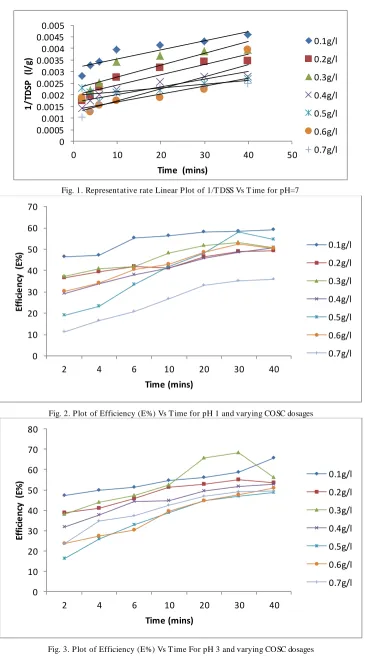
The values of coag-flocculation parameters generated from the representative rate plot of 1/Nt (1/TDSS) vs time for
varying dosages and 40 mins settling time are presented in tables 3 – 8. The squared linear regression coefficient R2 generated from figure 1, was employed to determine the accuracy of fit of experimental results on the generalized model equation 2.24. the values of R2 presented in tables 3 – 8 show that the experimental results obtained at PH 7 (table 6) were adequately described by the linearis ed form of equation 2.22 (with R2 > 75), which was subsequently expressed as equation 2.24 (putting = 2). Hence pH 7 is the optimum, at the condition of this experiment . From the graphical representation of equation 2.24 1/TDSS vs time (figure 1), k is determined from the slope. However, K can also be evaluated from the mathematical relation (K = 0.5 (acf)BR) expressed as equation 2.7 and posted in tables 3 – 8.
Also, tables 3 – 8, show that the maximum and minimum K values are 6.322E-05l/g.min, 1.10 E-06 l/g .min obtained at pH 7 (0.6g/l dose) and pH 13 (0.7 g/l dose) respectively. This is in support of the fact that pH 7 is the optimum at the condition of this experiment. This phenomenon indicates that at high dosage more adsorption sites were made available on the COSC interface for TDSS attachments and subsequently leading to formation of inter particle bridges, hence increasing the chances of COSC to initiate particle sweep, though more effective at lower pH.
The value of 1/2 obtained from equation 2.29 and solved for
0.6g/l dosage (1/2 = 0.38 mins), confirms the authenticity of
the optimal value of K recorded at 0.6g/l dosage. The period of 1/2 = 0.38min can be deduced from tables 3 – 8, as the
lowest, which is an indication of best coag-flocculation performance at the corresponding dosage and pH . Particularly, the results posted in table 6, show that high K corresponds to the, least 1/2 obtained in this experiment, a
phenomenon that amplified a strong relationship among, K, 1/2 and rate of aggregation, which is in line with previous
work[19]. The optimal 1/2 (0.38mins) is relatively
satisfactory, though milliseconds had been reported. Invariably, the optimum k value obtained at 0.6g/l dosage from figure 1, is in agreement with the results presented in table 6. The K, value is a very big determinant on the efficacy of applying coag-flocculation process in water and wastewater purifications.
Observation from equation 2.29, show that 1/2 is a function
of initial TDSS and K. The implication is that the higher the No and K, the lesser the period. This explains the high
purification rate obtained in water and wastewater with high initial TDSS load and high coagulation rate constant.(acf)BR
and Kf were obtained from equations 2.5 and 2.14
respectively. Kf is obtained on substitution of equations
2.11, 2.13 into 2.8.
Moreover, Kf = fn (T, ), and in this experiment there is
negligible change in the values of temperature and viscosity of the effluent medium, consequently resulted to minimal variations of Kf values as presented in tables 3 – 8. In the
vicinity near constant value of Kf, (acf)BR relates to k
proportionally, i.e 2K = (acf)BR expressed as equation 2.15).
Apparently, high (acf)BR result in high kinetic energy to
overcome the electrostatic barrier translating to fast coagulation, generally, obtainable in practical terms in coag -flocculation processes. From theoretical considerations, the following parameters, (acf)BR, 1/2, and kf are understood to
be the prerequisite factors for coagulation efficiency prior to flocculation.
Furthermore, the No determined from the model equation
expressed as equation 2.24 as the exponential value of the intercept obtained from figure 1, though it did n ot follow any observable trend. Finally, the mass transfer rate of TDSS (dNt/dt or(-r) is evaluated from equation 2.22. This
accounts for the mass transfer of TDSS on the bio -coagulant interface in PIE at varying dosages and pH. It is understandable that more TDSS will be removed at the maximum K value and lowest 1/2. Hence, high TDSS
depletion rate is a necessary condition for high K value and low 1/2. In generally, the discrepancies observed in the
results of the kinetic parameters as presented in tab les 3 – 8 may be attributed to the following:-
i. Unattainable assumptions ; that there is perfect homogeneity of PIE particles and COSC throughout dispersion before particle aggregation [19],[26].
ii.The interplay between vander wall’s and hydrodynamic instabilities which is capable of altering theoretical predicted values.
value. On the hand low dosage may result in the provision of insufficient adsorption sites for TDSS attachments. 4.3 Effect of TDSS removal efficiency with settling time.
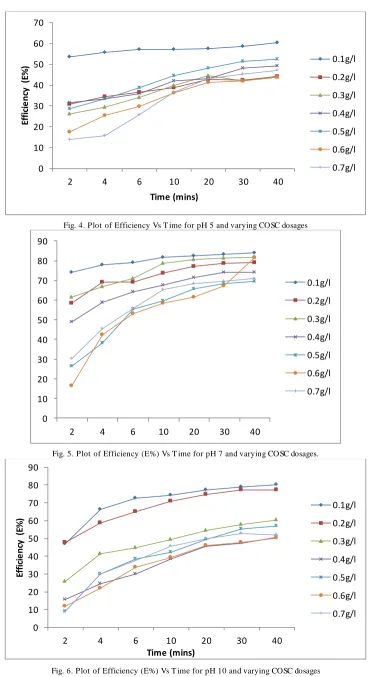
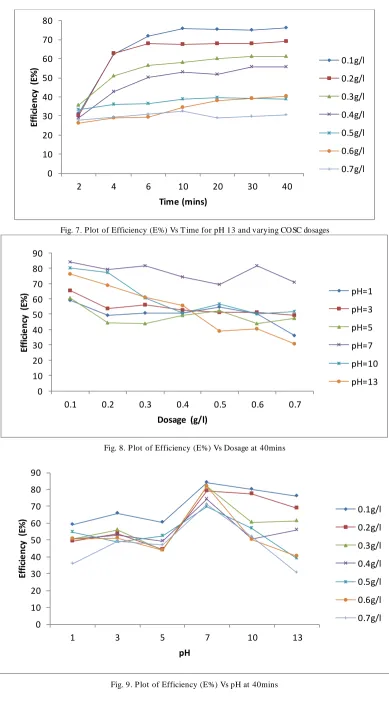
This is a time dependent removal efficiency profile for evaluating the effectiveness of given dos age of COSC at a particular pH and settling time in removing TDSS from PIE. The data obtained from efficiency relation expressed as equation 2.37 are demonstrated in figures 2 – 9 (for 0.1 – 0.7 g/l doses, pH 1, 3, 5, 7, 10, 13 and settling time 2,4,6,10,20,30 and 40). The best performance is achieved at 0.1g/l, at the optimal pH 7 with initial TDSS of 1380 mg/l reduced by 74.20% and 84.20% at the end of 2 and 40mins settling time respectively. The least recorded E% > 69% for all the dosage considered at pH 7, at the end of coag-flocculation period of 40mins. This phenomenon indicate the effectiveness of COSC to remove TDSS (in form of turbidity) from the PIE neutral effluent condition after maximum treatment period. It is also worthy to mention that TDSS removal efficiency results shown in figures 6 and 7 are satisfactory for 0.1g/l COSC dose, pH 10 and 13 respectively at the end of 2 and 40mins coag -flocculation. This establishes the fact that at the condition of the experiment, COSC has also high potency in removing turbidity from alkaline rich PIE medium.
4.4 Effect of TDSS removal efficiency with dosage. This is presented in figure 8. It actually displayed how dosage affected the TDSS removal efficiency from PIE varying pH medium. Thus confirming the observations made from figures 2 – 9. The significant feature of figure 8 show that increase in COSC dosage (0.1 – 0.7 g/l) has negligible effect on the TDSS removal efficiency after 40mins for all the pH studied at the condition of the experiment. The optimum performance is recorded at pH 7 for all dosages after maximum coag-flocculation interval. Also, the level of performance achieved at pH of 10 and 13 are demonstrated. The results obtained indicate that the turbidity removal efficiency values recorded after 40mins, for all the dosages considered are impressive. The best performance recorded at the optimal pH 7, suggest that the effect of pH on TDSS removal efficiency is related to the solubility of COSC in PIE sample, which app arently has high degree of solubility (a measure of high degree of protonation at the neutral region). Also, the satisfactory performance recorded in the alkaline region might be adduced to the greater affinity of cationic ions from the COSC chain to react with hydroxyl ion from sodium hydroxide to form stable hydroxide flocs which can also serve as sorption site for TDSS in PIE. This can subsequently be removed from the system via gravitational principles. However, the performance exhibited by COSC at
the optimal pH 7 for all doses, followed by pH of 10 and 13. In general terms, it can be deduced that high doses of COSC has insignificant affect on TDSS removal efficiency at the condition of the experiment.
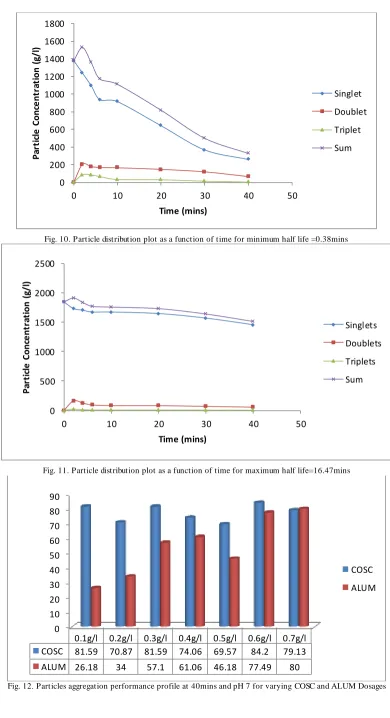
4.6 Time evolution of the cluster size distribution On the substitution of K, values obtained from equation 2.24 into 2.30, the time evolution of particle aggregates (singlets, doublets, triplets for m = 1,2,3, respectively) is predicted. The graphical representation of the results obtained from equation 2.30 in response to period of 1/2 = 0.38mins and
1/2 = 16.47 mins are shown in figures 10 and 11. In figure
10, the sum of particles (singlet, doublets, triplets) reached the peak at 2 mins. The implication is that at 2 mins of coag – flocculation process, there is maximum aggregation of TDSS (made up of various class of particles). This phenomenon could be attributed to the absence of zeta potential between the particles, prevailing in a system where attractive force dominates. However, at 2mins, the primary particles (singlets) and sum of particles are seen to decrees linearly downwards with respect to time. With the absence of zeta potential among the particles (sum of particles and singlets) at 2 mins, the COSC instantly sweeps away the TDSS from the system[18],[21].Though there is little space in between them indicating existence of minimal shear force. On the other hand, the pair of doublets and triplets is seen to aggregate at zero particle concentration at t = 0 (i.e prior to coag-flocculation). However, at 30mins, the triplets tends to infinity at zero particle concentration. This is an evidence of high rate of coag-flocculation demonstrated at low 1/2 of 0.38mins.
Figure 11, depicts a case where the values of the sum of particles and singlets are close such that their variation with time is near same. Also, a similar trend is exhibited by the pair of doublets and triplets. The curves in figure 11, indicate existence of wide space between the pairs of particles, attributable to the wide margin difference in concentration of particles between the pairs of (singlets and sum) and (doublets and triplets). This phenomenon could be linked to the existence of high s hear force causing high resistance to particle collision. It is worthy to mention that this phenomenon applies to pair of the curves in figure 10 but not as pronounced as we have in figure 11.
4.7 Comparative TDSS Removal Efficiency (E%) of COSC and Alum.
all doses, but comparable to that of alum for 0.6 – 0.7g/l doses.
The major advantages of COSC over alum are the production of low volume biodegradable sludge, environmentally friendly, capable of achieving efficient operation over a wide range of dosages, relatively cheap, with simple preparation procedure.
5. CONCLUSION
Within the ambits of this experiment, the generalized model equation 2.24 developed, significantly predicts the coag-flocculation behavior of COSC at the optimal pH. From the results, maximum settling time, high dosage and pH(neutral region) had the most significant effects on the process operation at the conditions of the experiment. The computed experimental results agrees with previous similar works [7],[14],[15][16],[28].
NOM ENCLATURE
K: th order coag-flocculation constant (acf)BR: Collision factor for Brownian Transport
εp: Collision Efficiency
1/2: Coagulation period/half life
Eij: Coag-flocculation Efficiency for i and j particles.
R2: Coefficient of Determination : Coag-flocculation reaction order -r: Coag-flocculation mass transfer rate Biocoagulant: Corchorus Olitorus seed coagulant (COSC) TDSS: Total dissolved and suspended solids. Kf : Rate Constant f or rapid Flocculation
REFERENCES
[1] AOAC, official methods of Analysis . association of official analytical chemist (14th ed.) USA 1993.
[2] AWWA. American water works association, standard methods for the examination of water and waste water effluent, New York, U.S.A., 2005.
[3] Barton, K.D. and Subramanian, R.S. J Colloid interface sci 1989, 133:214,
[4] Broin, M., Santaella, C. Cuine, S., Kokou, K., Pelterier, G, Joet, T . Flocculant activity of a recombinant protein from m oringa Oliefera, seeds. Appl. Micrbiol. Biotechnol, 2002, 60, 114 – 119.
[5] Chatterjee, T., Chatterjee, S., Woo, S,.H. Enhanced coagulation of bentonite particles in water by modified chitosan biopolymer. Chemical Engineering journal, 2008, 148, 414 – 419. [6] Clesceri, L.S., Greenberg, A.E., Eaton, A.O. Standard methods
for the examination of water and waste water. 20th edition. APHA. USA, 1999.
[7] Danov, K.D, Kralchevsky, P.A. and Ivanov, I.B. Dynamic processes in sufracetant stabilized Emulsions. Published as chapter 26 in Encyclopedic Hand book of Emulsion T echnology (J. Sjoblom, Ed.), Marcel Dckker, New York, 2001, 621 – 659. [8] Diterlizzi, S.D. Introduction to coagulation and flocculation of
waste water, environmental system project, 1994, USA. [9] Edzwald, J.K .Coagulation – sedimentation filtration process for
removing organic substances in drinking and waste water. Noyes data corporation, park Bridge, New Jersey, 1987. [10] Feuillebois, F. J. Colloid inferface sci, 1989, 131:267 [11] Gassenschmidt, U., Jany, K.K., T auscher, B., Niebergall, H.
Isolation and characterization of a flocculating protein from moringa oleifera lam. BBA Bio-chemica et Biophysica Acta. 1995, 1243, 477 – 481
[12] Ghebremichael, A.K. Moringa seeds and pumice as alternative natural materials for drinking water treatment T RIT A LWR PHD 1013 KTH land and water Resources Engineering, 2004. [13] Gunaratna, K.R, Garcia, B., Anderson, S. Dalhammar, G. Screening and evaluation of natural coagulants for wat er treatment. Water science and Technology – water supply, 2007, 7 (5/6), 19.
[14] Holthof, H., Egelhaff, S.U, Schurtenberger, P., Sticher, H., Borkovec, M. Coagulation Rate measurement of colloidal particles by simultaneous static and Dynamic light scattering. Langmuir, American Chemical society, 1996, 12, 5541 – 5549. [15] Iyamu, O.K, Eguavoen, O., Osuide, M., Egbon, E.E.,
Ize-Iyamu O.C, Akpoveta, V.O, Ibizubge, O.O. Characterisation and T reatment of sludge from the brewery using chitosan. T he pacific journal of science and technology, 2011, 12 (1), 542 – 547.
[16] Jin, Y. Use of high resolution photographic technique for studying coagulation/flocculation in water treatment. M.SC. T hesis. University of Saskatchewan, Saskatoon, Canada, 2005. [17] Menkiti M.C., Onyechi, C.A. Onukwuli, O.D. Evaluation of perikinetics compliance for the coag-flocculation of brewery effluent by Brachystegia Enrycoma seed Extract. International Journal of Multi disciplinary Sciences and Engineering, 2011, 2 (6), 73 – 80
[18] Menkiti, M.C. and Onukwuli, O.D. Coag-flocculation studies of Moringa Oleifera Coagulant (MOC) in brewery effluent: Nephelometric approach. Journal of American Science, 2010, 6 (12), 788 - 806.
[19] Menkiti, M.C. Aneke, M.C., Onukwuli, O.D. Optimization and kinetics of coag-flocculation of coal effluent by crab extract via response surface methodological analysis. Journal of Nigeria society of chemical Engineers, 2012, 27 (1), 61 – 80 [20] Ugonabo, V.I., Menkiti, M.C., Onukwuli, D.O., Igbokwe, P.K.
Kinetics and functional parameters respo nse of Aluminum Sulphate coagulant to variation in coag-flocculation variables in T urbid pharmaceutical industry effluent. International journal of Engineering and innovative Technology (IJEIT), 2013, 2 (9), 25 – 35.
[21] Menkiti, M.C. and Onukwuli, O.D. single and Multi angle nephelometric approach to the study of coag-flocculation of coal effluent medium using Brachystegia enrycoma coagulant. World journal of Engineering, 2011b, 8 (1), 66 – 76.
[22] Merrtt, R.M and Subramanian, R.S. J. Colloid Interface Sci., 1989, 131:514
[23] Rao, N. Use of plan material as natural coagulants for treatment of waste water. An article describing the coagulation process, plant material as natural coagulant and its use for water treatment; Environment: Waste managements, 2012. [24] Suarez, M., Entenza, J.M, Doerries, C., Meyer, E., Bourquina,
L., Sutherland, J., Marrison, I., Movellon, P., Mermod, N. Expression of a plant -derived peptide Harbouring water-cleaning and antimicrobial activities. Biotechnol Bioeng, 2003, 81 (1) 13 – 20
[25] Ugonabo, V.I, Menkiti, M.C , Onukwuli, O.D. Kinetics and coagulation performance of snail shell bioiness in pharmaceutical effluent. IOSR journal of Engineering (IOSRJEN), 2012, 2(7), 38 – 49.
[26] Ugonabo, V.I, Menkiti, M.C., Atuanya, C.U, Onukwuli, O.D. Comparative studies on coag-flocculation kinetics of pharmaceutical industry effluent by Achatina Maginata shell biomass and Aluminum sulphate. International journal of Engineering & Technology IJET-IJENS,2013,13(02), 134-147. [27] Ugonabo, V.I, Menkiti, M.C., Onukwuli, O.D. Coagulation kinetics and performance evaluation of corchorus olitorus seed in pharmaceutical effluent. International journal of multidisciplinary sciences and Engineering,2012,3(7). [28] Van Zanten, J.H and Elimelech, M. Determination of Rate
constants by multi angle light scattering. Journal of colloid and interface, 1992, 154 (1) 1 – 7.
[29] Von smoluchowski, M. phys. Z 1916, 17:557 [30] Von smoluchowski, M.Z. Phys chem.. 1917, 92:129 [31] Wang, H and Davis, R.H. Journal of colloid interface sci 1993,
159:108.
[32] WST About coagulation and flocculation, information bulleting, USA.