e-ISSN: 2278-7461, p-ISSN: 2319-6491
Volume 8, Issue 1 [January 2019] PP: 76-82
Removal of Reactive Red 120 on Fe-Hydrotalcite: Isotherms
Study
.Vanessa Jurado Dávila
1, Morgana Rosset
2,Oscar W. Perez-Lopez
2, Liliana
Amaral Féris
11
Laboratório de Separação e Operações Unitárias-LASOP
2Laboratory of Catalytic Processes–PROCAT
Department of Chemical Engineering, Federal University of Rio Grande do Sul (UFRGS) Rua Eng. Luiz Englert, s/n. Campus Central, 90040-040 - Porto Alegre - RS –Brazil.
Corresponding Author: Vanessa Jurado Dávila
ABSTRACT
: HDL-MgFe is a Hydrotalcite that represent a compound lamellar double hydroxide. It was prepared through the continuous co-preparation method. The solid was characterized by surface area measurements, X-ray diffraction and temperature-programmed desorption of CO2. The adsorbent was used forthe adsorption of Reactive Red 120 dye, and the factors affecting the adsorption were discussed, including concentration of adsorbent solid and contact time. The adsorption isotherms data were fitted to the Langmuir, Freundlich, Redlich-Peterson, Sips and BET models. The most suitable adsorption conditionswere found at a contact time of 60 min and solidconcentrarion of 2g.L-1. The results for MgFe hydrotalcite showed a high adsorption with percentage about 90% of dye removal. Langmuir and Redlich-Peterson models were the isotherms that best described the removal process.
KEYWORDS: Isotherms adsorption, Reactive Red 120, Fe-Hydrotalcite.
---Date of Submission: 25-04-2019 ---Date of acceptance:05-05-2019 --- ---
I.
INTRODUCTION
Hydrotalcites are lamellar double hydroxides represented by the following general formula: [M2+
1−xM 3+
x(OH)2]x+Am−x/m. nH2O
Where M2+ is a divalent metal cation, M3+ is a trivalent cation, Am- is an intercalated anion with charge m, x is the ratio of divalent and trivalent cations and n is the number of mols of water. These compounds eliminate negatively charged species by surface adsorption and also by anion exchange, because they have a very large surface with spaces between layers(Cavani et al., 1991). Hydrotalcites can present a wide variety of applications depending on their properties (composition, crystallinity, thermal stability and acid-base adjustable properties). Among the mostly applications can be mentioned the use as heterogeneous catalysts, anionic exchangers, in the pharmaceutical industry and as adsorbents of pollutants in effluents(Vaccari, 1998; Xu et al., 2011; Rives et al., 2013; Fan et al., 2014; Zubair et al., 2017; Bharali and Deka, 2017).
Shan et al.,(2015)reported the obtaining of magnesium and aluminum hydrotalcite and its evaluation for the removal of three red dyes by the adsorption method. The results obtained show that the dyes were adsorbed with efficiency by the hydrotalcite and the kinetic models found were of second order and the isotherms corresponded to the Langmuir model.Lazaridis, Karapantsios, and Georgantas.,(2003)studied the removal of a reactive dye, Cibacron Yellow LS-R, from aqueous solutions by adsorption onto hydrotalcite particles and the model that described the process was Langmuir isotherm.Y.-J. Li et al.,(2006)reported the study of the preparation of Mg-Al hydrotalcite and the evaluation of its adsorbent properties for the removal of thiocyanate using the calcined and natural solid and the adsorption isotherms showed correspondencefor the Langmuir.
The studies cited have a common characteristic in the adsorption process, the study of isotherms models.Thisisveryimportantbecausetheexperimentallymeasuredadsorptionisotherms and breakthrough curves are conventionally used to design new ads orption based separation processes. Adsorption is other ms are the out come of static ads orption experiments where the ads or bate and adsorbent are kept in contactfor a long time untilequilibriumisreached(Poursaeidesfahani et al. 2019).
2
NOVA 1000e equipment (Quantachrome Instruments); and temperature-programmed desorption (TPD-CO2) where the profiles were performed in a multipurpose system.
2.2. Adsorption experiments
The adsorption tests were performed in a batch mode using volumes of 100mL at 25 °Cof Reactive Red 120at 30mg.L-1. The equipment used to determine the adsorption parameters (contact time and solid concentration) was the Wagner Agitator model MA160BP from Marconi and the concentration of dye was analyzed in the Thermo Scientific spectrophotometer model Genesis 10S UV-VS at wavelength of 535 nm. All experiments were performed in duplicate. Considering that the prepared adsorbent has alkaline properties, the experiments were carried out at the natural pH of the solution containing the solids, which were approximately 8.
2.3 Adsorption isotherms
For these experiments, 2 g.L-1 of HDL-MgFe was used and the adsorption time was 60 min and natural pH. The experiments were carried out in bench refrigerated incubator Shaker (CIENTEC - model CT-71RN) at temperatures of 25 ºC. The experimental results was adjusted to Langmuir(Langmuir 1918), Freundlich(Rad, Haririan, and Divsar 2015), Sips(Debord et al. 2016), BET (eq. 7) (Pajarre and Koukkari 2018)and Redlich-Paterson models(Wu et al. 2010).
qe = qmKL Ce
1+KLCe (eq. 4) qe = KFCe
1/n (eq.5)
qe = qmaxbCeγ
1+bCeγ (eq. 6) p
v(p0−p)= 1 vmc+
c−1 vmc p p0 (eq.7) qe =
KRCe
1+∝Ceβ (eq. 8)
where qe (mg·g−1) is the equilibrium adsorption amount at equilibrium concentration of Ce (mg·L−1); qm is the maximum capacity of the adsorbent (mg·g−1); v is the total volume of the adsorbed gas, vm the volume of the adsorbed gas in a unimolecular layer covering the surface, p is the pressure, p0 the saturation pressure, c is a constant and KL is the Langmuir adsorption constant (L·mg−1), KF (mg1−n·Ln·g−1) and n are the Freundlich affinity coefficient and linearity, respectively.
III.
RESULTS AND DISCUSSION
3.1 Characterization
Figure 1. X-ray diffractogram of the HDL-MgFe hydrotalcite.
The specific surface for the solid was 118.9 m2.g-1. The HDL-MgFe has a larger surface which is in accordance with the lower crystallinity of HDL-MgFerevealed in XRD profile (Figure1). This fact is important because the rate of adsorption of adsorbent solids depends inversely on particle size and the adsorption properties depend on their shape, internal surface area and pore size distribution.
The total number of basic sites on the surface can be determined by the temperature at which the desorption peak occurs, the value found was 0.23 mmol.gcat-1. As that samples reveal maximum desorption temperatures (Tmax) above 280ºC, which corresponds to medium (240-303°C) and strong (326-396°C) sites (Pavel et al., 2012); and in this case, the maximum of temperature found was 385°C, showing that HDL-MgFe provides strong basic sites, important characteristic for the acid dye removal.
3.2. Effect of solid concentration
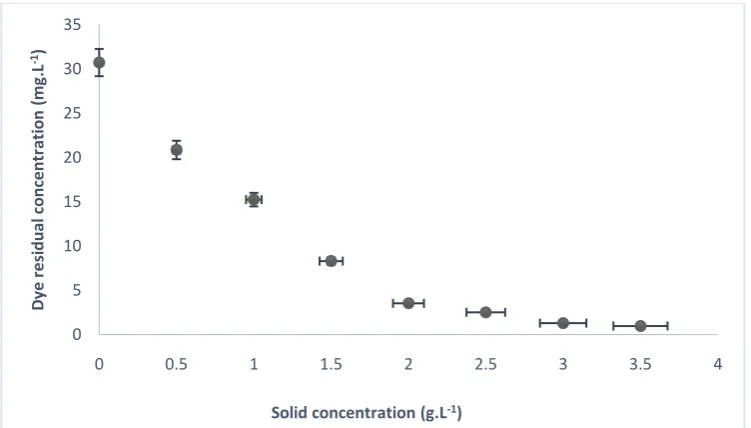
Adsorption experiments of studied the behavior of HDL-MgFe concentration for Reactive Red 120 removal, are show in Figure 2.
Figure 2. Effect of the solid concentration in the removal of Reactive Red120 dye. Conditions: adsorption time 30 min, initial concentration 30 mg.L-1 of the dye, natural pH.
Figure 2 shows that the concentration of the adsorbed dye increases with increasing the adsorbent dosage until arriving to equilibrium, while continuing to increase the solid concentration, after equilibrium, the dye removal is not significative. The results obtained can be explained by evaluation of the behavior of the total adsorption area, where the adsorption in the surface cause an increase in adsorbent concentration and an increase in the number of available and active sites for dye molecules.After of 2 g.L-1of HDL-MgFe, the equilibrium was attained, which indicates thesaturation of the solid surface with the about 90% of the dye removalwhich
0 5 10 15 20 25 30 35
0 0.5 1 1.5 2 2.5 3 3.5 4
D
ye
r
e
si
d
u
al
c
o
n
ce
n
tr
ati
o
n
(
mg
.L
-1)
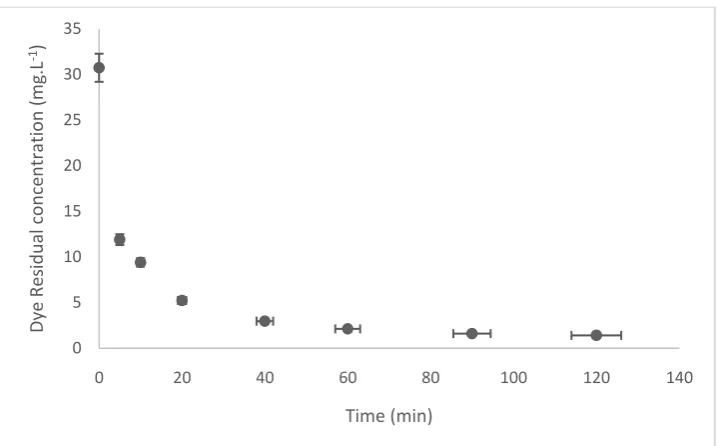
Figure 3. Effect of contact time in the removal of Reactive Red 120 dye. Conditions: solid concentration 2g.L -1
, initial concentration 30 mg.L-1 of the dye, natural pH.
It can be seen in the figure 3 that HDL-MgFe solid present a fast kinetics for the Reactive Red 120 removal which after about 5 min, more than 60% of the dye was removed. This result is important since a rapid removal of pollutant and arrive of equilibrium in a short period of time shows that the adsorbent used was efficient.
Also, it can be seen that kinetics of dye removal was faster up to about 20 min and after a period of 60 minutes the removal occurred slowly and the concentration variation was not relevant over time. Initially all the active sites were free in the solid surface which results in a fast adsorption. When occupied by the sorbate, these free sites decrease, leading to the saturation of the solids. Therefore, it was determined that the best condition for the removal of Reactive Red 120 on HDL-MgFe was in a time of 60 min.
3.4. Adsorption isotherms
Adsorption isotherm is an invaluable curve describing the phenomenon governing the retention of a substance from the aqueous porous media or aquatic environments to a solid-phase(Foo and Hameed 2010).
Therefore, to establish the most appropriate correlation for the equilibrium curves and to estimate the parameters of the isotherms, the Langmuir, Freundlich, Redlich-Peterson, Sips and BET models were adjustedto experimental data. In order to predict whether the adsorption of the Reactive Red120 in aqueous solution was efficient or not, the shape of the isotherm, the statistical parameters and the values of the constants for each non-linearized model were taken into consideration. The experimental values of qe and Ce are initially treated with the linearized equations in order to determine the models parameters and the isotherms are reconstituted using the determined values (Hamdaoui and Naffrechoux 2007).
Figure 4 shows the experimental adsorption isotherms and compared with models of Langmuir, Freundlich, sips, BET and Redlich-Peterson for removal of Reactive Red 120 using HDL-MgFe.
0 5 10 15
0 20 40 60 80 100 120 140
Dy
e
Re
sid
u
al
con
ce
Figure4. Comparison between values predicted by the Langmuir, Freundlich, Sips, BET and Redlich-Paterson models and the experimental data isotherm of Reactive Red 120adsorption in HDL-MgFe. Conditions: Natural
pH, adsorption time 60 min, adsorbent dose 2 g.L-1.
In Table 1 it can be seen that the models that best described the equilibrium data of the Reactive Red 120 with HDL-MgFe were Redlich-Peterson model as it had an R2 value closer to 1 with a value of 0.9943 and exhibited a minor error of 0,108.
Table1. Parameters of the Langmuir, Freundlich, Redlich-Peterson, Sips, BET 1 and BET 2 isotherms for the adsorption of Reactive Red 120 dye in HDL-MgFe.
Freundlich Langmuir Redlich-Peterson
Sips BET 1 BET2
kf 20.025
qmax 82.594
qm 48.872
qm
52.085 9.29E-06
qs 179.820
N 4.484
KL 0.0945
Kr 0.2243
b 940.596
K2 0.0018102
CBET 6.295E-06
N 0.9156
g 10.844
qbet 19682.133
Cs 3.728
R20.9451
R2
0.9822
R2
0.9943
R2 0.1305
R2 0.3815
R2 -2.5833
Error1.043 Error0.339 Error0.108
Error 16.531
Error 11.758
Error 68.124
Figure 4and table 1 show the adsorption isotherm models consideredfor Reactive Red 120 removal onHDL-MgFe and its parameters.
Freundlichisothermis a modelthat can be expressedthe no limit for the ads or ption capacity because adsorption quantity tends to infinity when the solution concentration increases. It can be seen in the table 1 that in this model, the empirical term N obtained was 4,484 and according with Giles, Smith, and Huitson.,(1974), when n>1 the curve qe vs. Ce will present concave shape in relation to the axial plane, therefore the adsorption isotherm is satisfactory. However, considering the R2 (0.9451) and error (1.043), Freundlich was not model that more approximated to experimental data.
The HDL-MgFe solid showed a good behavior of the basic sites indicating a realtion between strength and number of basic sites that involves the dye chemistry and the acid-base properties of the solids. The retention of the dyes by the materials involves several attractive forces, such as ionic interactions, Van de Waals forces, hydrogen bonds and covalent bonds. Depending on the type of the dye, one or more forces act in the adsorption process.
Theresultsofthemodelswerecomparedwiththoseobtainedbyotherauthorsusingthesamedye and differentsorbentsolids.
Srikantan, Suraishkumar, and Srivastava., (2018)studied the influences the ads orption equilibrium of Reactive Red 120 onhairyrootsof H. annuus. The ads orption equilibrium parameters were adjusting to experimental data and the best estimated was for Langmuir is other mw it h them aximumdye ads orption capacity of the roots increasing from0.26 mg g−1 to 1.51 mg g−1.
Jawad et al., (2019)investigated a biofilm ofcross-linkedChitosan- Ethylene GlycolDiglycidyl Ether (Chi-EGDE) as a biosorbent for Reactive Red 120. The adsorption data of dye on the biofilm were in agreement with Langmuir isotherm with a maximum adsorption capacities of 165.3 mg.g-1.
Li et al., (2014)studied Reactive Red 120 removalmodifyingonlysozyme. The ads orption behaviour of lysozyme by the Reactive Red 120 modified magnetic chitos an micro spheres fitted the Langmuir modelwitha maximum adsorption capacities of 116.9 mg.g-1.
Demarchi, Campos, and Rodrigues., (2013) that presents a study of the use of chitosan–iron(III) crosslinked with glutaraldehyde (Ch-Fe) as an adsorbent for the Reactive Red 120 in batch and fixed-bed systems. The maximum adsorption capacity was calculated from the adsorption isotherms, and well fitted by the Langumir–Freudlich isotherm model with the maximum capacity of 433 mg.g-1.
As can be seen in the different studs all models evaluated for the removal of reactive red with different sorbent solids describe a Langmuir equilibrium. The results obtained by the present study with a value of qmax=82.594 mg.g-1 and qm=48.872 mg.g-1 for HDL-MgFe, which is a good value comparing with others adsorbents . The values of qm and qmax obtained in the present work exhibit good results and showing that the basic solids tested in the present study are a good alternative for acid dyes removal as Reactive Red 120.
IV.
CONCLUSIONS
The results of the XRD analysis show that the obtained solid had high crystallinity with hydrotalcite-type structure.The effect of the trivalent ion on the properties of the magnesium-based hydrotalcite was significant, since iron favors the formation of a solid with a good specific area HDL-MgFe of 118.9 m2.g-1. Alkaline characteristics reveal to be more important than the specific surface area of these hydrotalcites for the removal of Reactive Red120 dye.The effect of solid concentration on Reactive Red 120 removalshowed that was reached close to 90% of the dye removal with adsorbent dosage of 2 g.L-1 for HDL-MgFe,and the most suitable condition for the removal of the Reactive Red 120 is given in a time of 60 min.The adsorption isotherms showed that the Langmuir and Redlich-Peterson models described best the equilibrium data of the Reactive Red 120 dye on HDL-MgFe indicate that the processes occurred at homogeneous and specific sites.
REFERENCES
[1]. Bharali, Dipshikha, and Ramesh C Deka. 2017. “Preferential Adsorption of Various Anionic and Cationic Dyes from Aqueous Solution over Ternary CuMgAl Layered Double Hydroxide.” Colloids and Surfaces A: Physicochemical and Engineering Aspects 525: 64–76. https://doi.org/10.1016/j.colsurfa.2017.04.060.
[2]. Cavani, F., F. Trifirò, and A. Vaccari. 1991. “Hydrotalcite-Type Anionic Clays: Preparation, Properties and Applications.” Catalysis Today 11 (2): 173–301.
[3]. Debord, Jean, Michel Harel, Benamar Cheknane, Jean-Claude Bollinger, and Omar Bouras. 2016. A Modified Sips Distribution for Use in Adsorption Isotherms and in Fractal Kinetic Studies. RSC Advances. Vol. 6. https://doi.org/10.1039/C6RA10197F. [4]. Demarchi, Carla Albertina, Mayara Campos, and Clóvis Antonio Rodrigues. 2013. “Adsorption of Textile Dye Reactive Red 120
[5]. Fan, Guoli, Feng Li, David G Evans, and Xue Duan. 2014. “Catalytic Applications of Layered Double Hydroxides: Recent Advances and Perspectives.” Chemical Society Reviews 43 (20): 7040–66.
[6]. Foo, K Y, and B H Hameed. 2010. “Insights into the Modeling of Adsorption Isotherm Systems.” Chemical Engineering Journal 156 (1): 2–10. https://doi.org/https://doi.org/10.1016/j.cej.2009.09.013.
[7]. Giles, Charles H, David Smith, and Alan Huitson. 1974. “A General Treatment and Classification of the Solute Adsorption Isotherm. I. Theoretical.” Journal of Colloid and Interface Science 47 (3): 755–65. https://doi.org/https://doi.org/10.1016/0021-9797(74)90252-5.
[8]. Hamdaoui, Oualid, and Emmanuel Naffrechoux. 2007. “Modeling of Adsorption Isotherms of Phenol and Chlorophenols onto Granular Activated Carbon: Part I. Two-Parameter Models and Equations Allowing Determination of Thermodynamic Parameters.” Journal of Hazardous Materials 147 (1): 381–94. https://doi.org/https://doi.org/10.1016/j.jhazmat.2007.01.021.
[9]. Jawad, Ali H, N F Hanani Mamat, B H Hameed, and Khudzir Ismail. 2019. “Biofilm of Cross-Linked Chitosan-Ethylene Glycol
Diglycidyl Ether for Removal of Reactive Red 120 and Methyl Orange: Adsorption and Mechanism Studies.” Journal of Environmental Chemical Engineering 7 (2): 102965. https://doi.org/https://doi.org/10.1016/j.jece.2019.102965.
[10]. Langmuir, Irving. 1918. “THE ADSORPTION OF GASES ON PLANE SURFACES OF GLASS, MICA AND PLATINUM.”
Journal of the American Chemical Society 40 (9): 1361–1403. https://doi.org/10.1021/ja02242a004.
[11]. Lazaridis, Nikolaos, T D Karapantsios, and D Georgantas. 2003. Kinetic Analysis for the Removal of a Reactive Dye from Aqueous Solution onto Hydrotalcite by Adsorption. Water Research. Vol. 37. https://doi.org/10.1016/S0043-1354(03)00121-0.
[12]. Li, Yu-Jiang, Min Yang, Xiao-Jin Zhang, Tao wu, Nan Cao, Na Wei, Yan-Jun Bi, and Jing Wang. 2006. Adsorption Removal of Thiocyanate from Aqueous Solution by Calcined Hydrotalcite. Journal of Environmental Sciences (China). Vol. 18.
[13]. Li, Zhonghong, Miao Cao, Wengang Zhang, Lizhi Liu, Jianlong Wang, Wupeng Ge, Yahong Yuan, Tianli Yue, Ronghua Li, and
William W Yu. 2014. “Affinity Adsorption of Lysozyme with Reactive Red 120 Modified Magnetic Chitosan Microspheres.” Food Chemistry 145: 749–55. https://doi.org/https://doi.org/10.1016/j.foodchem.2013.08.104.
[14]. López, A, J A Aragón, J G Hernández-Cortez, M L Mosqueira, and R Martínez-Palou. 2019. “Study of Hydrotalcite-Supported
Transition Metals as Catalysts for Crude Glycerol Hydrogenolysis.” Molecular Catalysis 468: 9–18.
https://doi.org/https://doi.org/10.1016/j.mcat.2019.02.008.
[15]. Nguyen, Hong Khanh Dieu, Hung Van Nguyen, and Vu Anh Nguyen. 2018. “Effect of Synthetic Conditions on the Structure of
Mesoporous Mg-Al-Co Hydrotalcite.” Journal of Molecular Structure 1171: 25–32.
https://doi.org/https://doi.org/10.1016/j.molstruc.2018.05.087.
[16]. Pajarre, Risto, and Pertti Koukkari. 2018. “CALPHAD Aqueous Solution Model Based on the BET Approach: General Theory.”
Calphad 63: 1–5. https://doi.org/https://doi.org/10.1016/j.calphad.2018.06.007.
[17]. Perez-Lopez, Oscar W, Andressa Senger, Nilson R Marcilio, and Marla A Lansarin. 2006. “Effect of Composition and Thermal Pretreatment on Properties of Ni – Mg – Al Catalysts for CO 2 Reforming of Methane.” Applied Catalysis A: General 303: 234–44. [18]. Poursaeidesfahani, Ali, Eduardo Andres-Garcia, Martijn de Lange, Ariana Torres-Knoop, Marcello Rigutto, Nitish Nair, Freek Kapteijn, Jorge Gascon, David Dubbeldam, and Thijs J H Vlugt. 2019. “Prediction of Adsorption Isotherms from Breakthrough Curves.” Microporous and Mesoporous Materials 277: 237–44. https://doi.org/https://doi.org/10.1016/j.micromeso.2018.10.037. [19]. Rad, Leila Roshanfekr, Ismaeil Haririan, and Faten Divsar. 2015. “Comparison of Adsorption and Photo-Fenton Processes for
Phenol and Paracetamol Removing from Aqueous Solutions: Single and Binary Systems.” Spectrochimica Acta Part A: Molecular and Biomolecular Spectroscopy 136: 423–28. https://doi.org/https://doi.org/10.1016/j.saa.2014.09.052.
[20]. Rives, Vicente, Margarita Arco, and Cristina Martín. 2013. “Layered Double Hydroxides as Drug Carriers and for Controlled Release of Non-Steroidal Antiin Fl Ammatory Drugs ( NSAIDs ): A Review.” Journal of Controlled Release 169: 28–39.
[21]. Shan, Ran ran, Liang guo Yan, Yan ming Yang, Kun Yang, Shu jun Yu, Hai qin Yu, Bao cun Zhu, and Bin Du. 2015. “Highly
Efficient Removal of Three Red Dyes by Adsorption onto Mg-Al-Layered Double Hydroxide.” Journal of Industrial and Engineering Chemistry 21: 561–68.
[22]. Shekoohi, Khadijeh, Fatemeh Sadat Hosseini, Amir Hossein Haghighi, and Atefe Sahrayian. 2017. “Synthesis of Some Mg/Co-Al Type Nano Hydrotalcites and Characterization.” MethodsX 4: 86–94. https://doi.org/https://doi.org/10.1016/j.mex.2017.01.003. [23]. Srikantan, Chitra, G K Suraishkumar, and Smita Srivastava. 2018. “Effect of Light on the Kinetics and Equilibrium of the Textile
Dye (Reactive Red 120) Adsorption by Helianthus Annuus Hairy Roots.” Bioresource Technology 257: 84–91. https://doi.org/https://doi.org/10.1016/j.biortech.2018.02.075.
[24]. Vaccari, A. 1998. “Preparation and Catalytic Properties of Cationic and Anionic Clays.” Catalysis Today41: 53–71.
[25]. Wu, Feng-Chin, Bing-Lan Liu, Keng-Tung Wu, and Ru-Ling Tseng. 2010. “A New Linear Form Analysis of Redlich–Peterson
Isotherm Equation for the Adsorptions of Dyes.” Chemical Engineering Journal 162 (1): 21–27.
https://doi.org/https://doi.org/10.1016/j.cej.2010.03.006.
[26]. Xu, Zhi Ping, Jia Zhang, Moses O Adebajo, Hong Zhang, and Chunhui Zhou. 2011. “Catalytic Applications of Layered Double Hydroxides and Derivatives.” Applied Clay Science 53: 139–50.
[27]. Yang, Chengxue, Libing Liao, Guocheng Lv, Limei Wu, Lefu Mei, and Zhaohui Li. 2016. “Synthesis and Characterization of Mn
Intercalated Mg-Al Hydrotalcite.” Journal of Colloid and Interface Science 479: 115–20.
https://doi.org/https://doi.org/10.1016/j.jcis.2016.06.057.
[28]. Zubair, Mukarram, Muhammad Daud, Gordon Mckay, Farrukh Shehzad, and Mamdouh A Al-harthi. 2017. “Recent Progress in Layered Double Hydroxides ( LDH ) -Containing Hybrids as Adsorbents for Water Remediation.” Applied Clay Science 143: 279– 92.