Virtual Conversation Entity To Diminish
Depression
1
Uditesh Jha,
2Keyur Khant,
3Milan kotadiya,
4Kirti Gamdha,
5Prof. Zalak Kansagra
1Student, 2Student, 3Student, 4Student, 5Assistant Professor 1Computer Science and Engineering,
1Parul University, Vadodara, India
Abstract: This article is developed to alleviate depression. We provide transparency and privacy between user and chatbot by using the best approach which proves to be more reassuring, empathetic and non-judgmental. This new technology is interactive artificial conversation entity - chatbot. In this article, we are trying to relieve sufferer from depression. It is found that depression is the leading cause of disability globally. Projections indicates that after heart disease, depression is expected to become the second leading cause of disease burden by the year 2020. It will provide psychiatric treatment to users. After understanding the symptoms, causes and treatments of depression, user will be judged and treated according to defined and well- suited treatment. It will be helpful to those having depression, fear of sharing and fear of being judged. Also, it will help at those places where therapists are not easily available and to people who cannot afford therapist. A mobile application will be created for user interface.
IndexTerms - Depression, Chatbot, CBT, AIML, NLP;
I. INTRODUCTION
Depression is a serious medical illness that negatively affects how you feel, the way Depression is a serious medical illness that negatively affects how you feel, the way you think and how you act. It causes feelings of sadness, loss of interest in activity once enjoyed. It can lead to a variety of emotional and physical problems and can decrease a person’s ability to function at work and home. User thus relieve their depression by many ways one of those is by interacting. Chabot’s are getting popular day by day as it is available anytime and anywhere in different domains such as: linguistic research, language education, customer service, website help, and for fun. Something that distinguishes between human and machine is the ability to converse.
Depression is the leading cause of disability globally. Projections indicate that after heart disease, depression is expected to become the second leading cause of disease burden by the year 2020. According to World Health Organization the cost of mental illness to society has doubled in the last 10 years in every region of world. At its most severe, major depression (clinical depression) can be life-threatening because it can make you suicidal or simply give up the will to live. Suicidal behavior is highly prevalent in major depressive disorder (MDD).
So, this research will help user to relieve depression through chatting. It will give intimacy to user as a virtual friend. This chatbot will create natural, personalized and human-like conversations and also proffer emotional support to users using artificial intelligence. As sufferers would not feel free to share due to mistrust on others, thus chatbot would overcome that by its reassuring and empathetic nature. It will encourage users to openly discuss their problems and emotions.
II. THEORY AND MEASURES OF DEPRESSION AND CHATBOT IMPLEMENTATION
This section comprises some of the literatures used for physiological signal measurement techniques developed by various researchers using non-invasive methods with their importance. It also states different chatbot implementation methologies and different ways to extract corpora and how to use them.
A. Understanding Depression:
In mildest form, depression can mean just being in low spirits. It doesn’t stop you leading your normal life but makes everything harder to do and seem less worthwhile. At its most severe, major depression (clinical depression) can be life-threatening, because it can make you feel suicidal or simply give up the will to live.
There are also some specific forms of depression: Seasonal affective disorder (SAD) is a type of depression that’s related to changes in seasons. Seasonal affective disorder begins and ends at about the same times every time. Postnatal depression is a type of depression that many parents experience after having a baby. With self-help strategies and therapy, most women make a full recovery. Bipolar disorder (manic depression): During episodes of depression; deep sadness, hopelessness, loss of energy, lack of interest in activities, periods of too little or too much of sleep and suicidal thoughts are felt.
Causes of depression are life events, loss, anger,
childhood experiences, side effects of medication and physical conditions like conditions affecting the brain and nervous system, hormonal problems, low blood sugar, sleep problems.
Treatments for the depression are break the cycle of negativity, keep active, connect with other people, care for yourself, active monitoring, mindfulness, exercise, cognitive behavior therapy (CBT).
Now what if depression is worse or won't go away? Our general practitioner (GP) may refer us to a mental health professional, such as a psychiatrist, psychologist or mental health nurse, who can review our treatment so far. They may suggest a different medication, or a combination of drugs with other treatments. Following are lists of treatments.
written treatment plan that specifies what your current treatment is and any treatments you would prefer not to have. Crisis resolution services: These are teams of doctors and nurses who provide intensive support, which will enable you to stay at home rather than going into hospital. Hospital admission: If you are severely depressed, you may need to be cared for in hospital as an in-patient. This gives a psychiatrist the opportunity to monitor the effects.
B. Depression, chronic diseases, and decrements in health results from the World Health Surveys:
Depression is one of the biggest public-health problems worldwide. Depression is often comorbid diseases and can worsen their associated health outcomes. Projections indicate that depression is expected to become the second leading cause of disease burden after heart disease, by the year 2020. Depression accounted for 4·4% of total disability adjusted life years (DALYs), rated as the fourth leading cause of disease burden in 2000. The World Health Survey (WHS) by WHO stated that adults aged 18 years and older to obtain data for health, health-related outcomes, and their determinants. Prevalence of depression in respondents based on ICD-10 criteria was estimated.
Observations were available for 245,404 participants from 60 countries in all regions of the world. Overall, 1-year prevalence for ICD-10 depressive episode alone was 3.2%. An average of between 9.3% and 23.0% of participants with one or more chronic physical disease had comorbid depression. Depression produces the greatest decrement in health compared with the chronic diseases like angina, arthritis, asthma, and diabetes.
C. Differential relations of suicidality in depression to brain activation
Suicide is a global leading cause of mortality with an enormous personal and societal impact. Suicidal behavior is highly prevalent in major depressive disorder (MDD). It has been proposed that suicidal behavior encompasses a complex cascade from sensitivity to an environmental trigger, to suicide ideation and then to suicide attempts and suicidal acts.
Task paradigms are as followed.
Faces task: An event-related emotional faces task was conducted to investigate brain activation during emotion processing. During the presentation of angry, fear, happy, neutral, and sad facial expressions participants were instructed to indicate the gender of the actor on the photograph by pressing a button with their index finger. Twenty-four color pictures were presented for each emotional face condition and 80 for the scrambled faces. An arrow was presented with each scrambled face to indicate which button participants should press (left/right). Each face stimulus was shown for 2.5s following by an inter- stimulus interval varying from 0.5 to 1.5s. Each unique person/expression combination was not shown more than four times. Reaction times were recorded.
Tower of London task: A pseudo-randomized, self- paced event-related parametric version of the Tower of London task was employed to examine brain activation during executive planning. A starting configuration and a target configuration were presented, each consisting of three colored beads on three pegs. Participants were instructed to evaluate the minimum number of moves needed to get from the starting to the target configuration (ranging from 1 to 5) by choosing one of two possible answers at the bottom of the screen. During baseline trials, participants were requested to count the number of yellow and blue colored beads. The task was paced by the participant, but duration of each trial was no longer than 60s. Accuracy of responses and Response Time were recorded.
Neural mechanisms of emotion processing might differentiate current suicidal thought from past suicidal behavior.
D. Executive Functions in Students with Depression, Anxiety, and Stress Symptoms:
Many studies suggest that depression is associated with impairment of executive functions and people with depression function more weakly compared to healthy people in executive function tests. Methods applied on this survey are as followed.
Stroop Test: In psychology, the Stroop effect is a demonstration of interference in the reaction time of a task. When the name of a color (e.g., "blue", "green", or "red”) is printed in a color which is not denoted by the name (i.e., the word "red" printed in blue ink instead of red ink), naming the color of the word takes longer and is more prone to errors than when the color of the ink matches the name of the color.
Wisconsin Card Sorting Test (WCST): a computerized version of the Wisconsin test was utilized. This test has 64 different cards, on which there are diagrams of a triangle, star, cross or a circle as well as a number from 1 to 4. Moreover, these cards are colored blue, red, yellow, and green. Hence, the cards have a figure (one of four types), a number (from 1-4), and color (blue, red, yellow, or green). The combination of these gives 64 variations. In other words, every card represents a unique design which is not repeated in any other card. The scores of the test are as follows: 1-number of the correct response, 2- score of perseveration error (this error occurs when the respondent continues sorting based on former principle or a wrong guess, or despite receiving feedback from the assessor trying to avert the incorrect response), and 3- number of clusters, which refers to correct sorting based on three main colors, figure and number ranging from 0 to 3 fluctuating in this regard.
Cognitive Abilities Test: This test was designed by Nejati (2013); this is a questionnaire with 30 items saturated by 7 factors. Each factor has at least 3 options based on the Likert-type scale of 5 multiple-choices ranging from 1 (never) to 5 (always). A total of 448 students were recruited using convenience sampling method. Of study participants, 30 people were depressed, 27 had anxiety, and 15 suffered from stress.
E. Psychological treatments for depression: How do they work:
It is proposed that ‘depression about depression’ arising from a reciprocal relationship between cognitive processing and the depressed state, is frequently an important factor maintaining depression.
The reciprocal relationship between depression and negative cognitive processing may set up a vicious circle which will act to maintain depression.
How is depression about depression to be reduced? In principle, this would be achieved by reducing the aversiveness of the symptoms and effects of depression and increasing their perceived controllability.
F. How do you want your chatbot – An exploratory wizard-of-Oz study with young, urban Indians:
Text messaging chatbots must become human day by day, as its important to understand what users are seeking with a chatbot. Wizard-of-Oz study is an experiment when there is human-computer interaction. So, Wizard-of-Oz study was conducted for few numbers of peoples from the urban areas. The study was made using three different personalities of chatbot, they are:
Maya: Productivity bot with nerd wit. It has facts for backup of any conversation. It is a good conversationalist, who initiates dialogue most times, makes geeky jokes, pays attention to user’s likes and dislikes, but it all need internet for chatting. It results mostly to the related articles for the inferred questions. It also recommends different things.
Ada: Fun and flirtatious bot. It is fun loving, high energy chatty bot which has feature of flirtation while conversing. Many times, it initiates the conversation. I always have opinion on many of the things. It uses emoticons for most of the times while talking.
Evi: Emotional buddy bot. It is low-energy chatbot whose main characteristic is her empathy and reassurance. It allows user to lead the conversation. It tries to be non-judgmental and always prove to be there at all the time.
WoZ study was implemented on 14 different users with this high level chatbots. Different 42 chat sessions were recorded. The way of conversation and other features varied with the personality of chatbots. Results obtained was that overall users liked when chatbot had intelligent of the day, and place where the conversation took place but it also included other topics of interest comebacks with witty and casual conversation. The topic of conversation would depend on the time like movies, TV shows, music, books, travel, fashion, etc. according to users. Results mentioned in the abstract is that users wanted a chatbot like Maya, who could add value to their life while being a friend, by making useful recommendations. But they also wanted preferred traits of Ada and Evi infused into Maya.
G. CSIEC: A computer assisted English learning chatbot based on textual knowledge and reasoning:
To learn English, CSIEC system focuses on building and supplying a virtual chatting partner. Thus, chatbot will create communicative responses according to the user’s input, its inference knowledge, personality knowledge and common-sense knowledge. NLML is used to express all this kind of knowledge. This system has approached naïve approach of logical reasoning using semantic and syntactical analysis of textual knowledge. NLML is Natural Language Markup Language, it is an XML based. NLML is used by English parser to parse the user input text. Parts of speech, entity type, words, chunk tag, grammatical function tag, head word path are different linguistic information and other relations are parsed. NLML parses the NLML obtained from user input or parses the data loaded from database. NLDB will store all the knowledge and other facts. The GTE (Generation of Textual Entailment) will generate the textual entailments. Now, the CR (Communicational Response) mechanism will generate responses by interacting with user. Using the syntactical and semantic analysis. This CSIEC system will be implemented in JDK1.6.0 and MySQL server 5.0 for the database.
This system is also implemented for the education as 60% of the students liked when implemented for the first time. Result obtained was that Human-computer communication is more influenced by ability of natural language understanding and generation.
Contradiction between high response speed, complex, syntactic and semantic analysis should be paid great attention
H. Building chatbot with emotions:
Emotions can be represented using different contents or words while conversing. Chatbot must be built in such a way that generates dialogue not only appropriate at content level but also containing specific emotions. It can be done by comparing emotion tags for generated responses with the expected one and compute the accuracy to measure the performance of emotion level.
Nowadays response generation is based on Sequence- to-Sequence (S2S) model (consists of two RNN called encoder and decoder) using reinforcement learning framework. S2S neural network sometimes ignore the input and produces highly generic responses like “I am not able to understand, please repeat again”.
RNN - Recurrent Neural Network (class of artificial neural network where connections between nodes form a directed graph along a sequence) is used to predict Ekman’s six basic emotions (anger, disgust, fear, happiness, sadness, surprise) with texts.
When users message creates uncertainty for chatbot to process and reply accurately then approaches used for compensation are utterance-utterance collaborative filtering and decision tree for general query. Two different methods used for emotion detection and tagging are text-based classifier and adaptive empirical mode decomposition.
I. Woebot – A example of cognitive behavioral therapist:
Almost half of the people face with symptoms of depression and anxiety in last survey done. Well nowadays many web-based cognitive-behavioral therapy apps have been demonstrated efficacy but they have poor adherence. As conversational agents offer a convenient and engaging way of getting support at any time.
Fully automated conversational agent determines to deliver feasibility, acceptability and preliminary efficacy to the users. As described above, Woebot is an automated conversational agent designed to deliver CBT in format of brief, daily conversation and mood tracking. It is used within a messenger app. Each interaction begins with a general inquiry about context (e.g., “What’s going on in your world right now?”), and mood (e.g., “How are you feeling?”) with responses provided as word or emoji images to represent affect in that moment. The bot’s conversational style was modelled on human clinical decision making and the dynamics of social discourse.
J. Automatic Extraction of Chatbot Training Data from Natural Dialogue Corpora:
Many chatbots or human-computer dialogue systems have been developed in different domains such as: linguistic research, language education, customer service, web site help and for fun. With different functionalities they all need is data to train which overwhelms chatbot ability to converse. Thus, program is developed to machine readable text i.e. corpus (large and structured set of texts) to specific chatbot format in Artificial Intelligence Markup Language. It is then used to retrain the chatbot.
First chatbot ELIZA was surpassed as psychotherapist which merely matched keywords, thus PARRY was introduced. Furthermore Saygin, Cicekli, Akman, MegaHAL, CONVERSE, ELIZABETH, HEXBOT, ALICE and so on worked different corpora where they were trained by extracting data from corpora. Largest amount of training data was obtained from BNC domains (1,153,129 number of training data were extracted automatically from the BNC corpus which is 20 times larger than any existing chatbot), Quran (contains Arabic texts it has 114 sooras as sections grouped into 30 chapters and each sooras consists of more than one verse on basis of which reply was generated) and FAQ websites (chatbot expects user input similar to FAQ questions, and replies with FAQ answers, or with lists of links to possible FAQ answers).
K. Extracting Chabot Knowledge from Online Discussion forum:
Chatbot is a conversational agent that interact with user in certain domain on certain topic. Typical implementation of chatbot knowledge contains set of templates that match user input and generate response. Construction of chatbot knowledge is time consuming and difficult.
Online discussion forum is web community that allows people to discuss common topic and share information in certain domain such as movies, sport etc. people create thread and post replies in online discussion forum, it leads to rich information, and the replies from writer are diverse. If high quality of replies can be mined and used for chatbot knowledge.
For every topic on forum section are created, in this section for every user thread is created. Each pair of <thread-title, reply> are extracted using cascaded framework.
There are three stage to extract knowledge for chatbot
1. Replies logically relevant to thread title are extracted using SVM (support vector machine) classifier. 2. Extracted pairs ranked with SVM based on content qualities.
3. Top N pairs are selected as chatbot knowledge.
A high quality of pair should meet following requirements
Title of thread is popular and meaningful.
The reply provides descriptive and trust worthy content to thread title.
Reply should highly readable, short and in clear structure.
The reply should attractive and can capture user’s interest.
Both thread title and reply should have proper length.
L. A Survey of Design Technique for Conversational Agents:
Chatbot is computer program which tries to generate human like response during conversation. Earlier chatbot uses simple pattern matching and retrieval-based technique. Over time method have evaluated and become generative based form pattern matching.
Classical approach to create and building chatbot typically uses two solutions i.e. AIML: It is XML based markup language for creating conversational flows for chatbot. It is based on pattern matching. It finds pattern and give relevant template as answer and NLP/NLU: It is computational technique for analyzing and representing naturally occurring texts at one or more level of linguistic analysis for the purpose of achieving human like language processing. It consists of two parts NLU (natural language understanding) and NLG (natural language generation).
General structure of chatbot divided into three parts as per standards so that modular development approach can be followed 1. Responder: It act as interface between main method of chatbot and user. It includes functions like data transfer between the user
and classifier, monitoring input and output.
2. Classifier: It is component between responder and graph-master. It includes functionality like normalization and filtering of input, segmentation of user input into logical parts, transfer of normalized sentence to graph- master.
3. Graph master: This component of chatbot is responsible for pattern matching. It is brain of chatbot. It includes functionality like organization of the brain’s contents, keeping the pattern matching algorithm.
Chatbot can be classified into different category based on several criteria
Retrieval-based: It utilize pool of predefine chatbot knowledge and apply some kind of pattern matching and heuristic search to choose proper response for input. It is not capable for handling unfamiliar input and conditions. It uses predefine template so it won’t make any grammatical mistakes.
Generative-based: This model overcome reliance on predefine response by generating new that are built from applying a set of technique. These models are usually based on various machine learning technique. This model translate input into response. It will able to handle unknown pattern or unfamiliar condition that overcome problem of pattern matching. However also make some grammatical mistake.
Long conversation: This are very lengthy conversation. In this type of conversation, a lot of information exchange between user and chatbot in the past which should be kept track on present to derive output. As length of conversation increase it become difficult to automate it.
Short conversation: This are short conversation. It became easy to automate it. In this type of conversation single response is produced to single input.
Open domain: This model is design for general purpose. Domain of conversation may change over time. This model doesn’t design for specific purpose. For ex. Siri, Mitsuku etc.
Close domain: This model is design for specific purpose. Limited specific knowledge is required to generate an appropriate response to input. To train this model domain specific data is required.
M. A Tool of conversation: Chatbot:
Creating pattern matching chatbot is easy as compare to generative based chatbot. During designing chatbot following keep facts into mind and follow steps as below:
Selection of programming language: You can choose any programming language but keep in mind that as per chatbot module are available in that language. For ex. Python, java.
Designing algorithm for response: You can design algorithm based on your requirements. It may use retrieval or generative based approach to give response. In this paper they used simple pattern matching algorithm.
Creating database: This task includes to design database that contain data for training chatbot. Database is basic knowledge of chatbot from it chatbot will retrieve or generate response to user.
N. Using dialogue corpora to train a chatbot:
DDC can be used to improve chatbot knowledge by converting dialogue transcript into AIML format. There are many DDC available like
MICAS corpus (Michigan corpus of academic spoken English): Collection of transcripts of academic speech events.
CIRCLE corpus: Collection of transcripts holding different tutorial such as physics algebra and geometry.
CSPA corpus (Corpus of spoken professional American-English): Transcript conversation of various types occurring between 1994 to 1998.
TRAINS corpus: Corpus of task oriented spoken dialogue.
ICE Singapore (International corpus of English, Singapore English): Corpus of Spoken dialogue recorded through phone. Program can be developed to read dialogue transcripts from the DDC and convert it into AIML format in order to train chatbot. Problems arise when dealing with DDC consists of no standard formats to distinguish between speakers, extra-linguistic annotations used, no standard format in linguistic annotations, long turns and monologues, Irregular turn taking (overlapping), more than one speaker and scanned text-image not converted to text format.
To train chatbot with minimal need to minimal need to post-edit the learnt AIML, dialogue corpuses should have the following characteristics: two speakers, structured format, short obvious turns without overlapping and without any unnecessary notes, expressions or other symbols that are not used when writing a text.
O. Real conversation with artificial intelligence: A comparison between human-human online conversation and human-chatbot conversation:
Communication changes when people communicate with artificial intelligent agent as compared with another human. Human-chatbot communication lacked in vocabulary. MANOVA (Multivariate Analysis of Variants) indicated that people communicated with chatbot for longer duration with shorter message than they did with another human. Linguistic variable analyses is used to measure performance of chatbot using seven dimensions;
Words per message
Words per conversation
Message per conversation
Word uniqueness (type token ratio)
Use of profanity
Shorthand
Emoticons.
According to paper analyses, messages to clever-bot contained (2-13) range of words per Message and to another person was range of (2-25) but people sent more than twice as many messages to chatbot (19-248) than to other people (3-122). In human computer conversation there is more use of profanity as compared to human- human conversation.
P. Implementation of chatbot system using AI and NLP
For using software applications, user interfaces that can be used includes command line, graphical user interface (GUI), menu driven, form-based, natural language, etc. The mainstream user interfaces include GUI and web-based, but occasionally the need for an alternative user interface arises. A chat bot based conversational user interface fits into this space. In this paper author have shown us methodology for building a chat bot for collage information system.
A chat bot is an artificially intelligent creature which can converse with humans. This could be text-based, or a spoken conversation (in case of voice-based queries). Chat bots are basically used for information acquisition. It is a conversational agent which interacts with users in a certain domain or on a particular topic with input in natural language sentences.
While building the chat bot author has created 2 modules. One is for frequently asked question and another is for personalized query related to student like attendance and results. If the user is trying to make a normal conversation with the bot, the input is mapped to an appropriate pattern in Artificial Intelligence Modelling Language (AIML) files. If the response is available, it is sent to the user. Other data provided to the chat bot such as username, gender, etc. are also saved. If the pattern is not available in AIML files, a random response is sent suggesting “Invalid Input”. Upon receiving personal queries like CGPA, attendance, etc., the authenticity of the user is checked through user-id and password. If the user detail is invalid, an appropriate response is sent. If the user authenticates successfully, the input text is processed to extract keywords. Based on the keywords, information required by the user is understood and the information is provided from the database.
It is often impossible to get all the data on a single interface without the complications of going through multiple forms and windows. The college chat bot aims to remove this difficulty by providing a common and user- friendly interface to solve queries of college students and teachers. The purpose of a chat bot system is to simulate a human conversation. Its architecture integrates a language model and computational algorithm to emulate information online communication between a human and a computer using natural language.
Q. Analysis of the chatbot open source languages AIML and chat script: A review:
Human-Computer Interaction that characterizes dialogue between man and computer is gaining momentum in computer interaction techniques. This type of program is called a Chat-bot. This paper presents a survey on the techniques used to design a Chat-bot. The authors discuss similarities and differences in chat-bot implementation techniques and analyze most used open source languages deployed in the designing of chat-bots (AIML and Chat Script).
and knowledge located in AIML files. Reasonable interaction of the users and computers is determined by means of construction of knowledge. AIML has its advantages and disadvantages. Some of the advantages are: Easy to learn and implement, simplicity and user- friendliness of the system of dialogue, the use of XML for the formal, computer readable representation of knowledge.
Chat Script is a scripting language designed to accept user text input and generate a text response. Chat proceeds in volleys, like tennis. The program inputs one or more sentences from the user and outputs one or more sentences back. Chat Script is a system for manipulating natural language, not just for building a chat-bot. Chat Script is not suitable for mobile platform as it requires more memory but Chat Script has more features than Artificial Intelligence markup Language.
In this paper, we gave a technical overview of the two most used open source languages for building a chat-bot. We provided comparisons between those two languages according to the following parameters: Ease of implementation and complexity of language, access to external resources, knowledge acquisition, linking to customized ontologies and possibility to build chat-bot for a mobile application. AIML 2.0 specification fulfils the need for new features but keeps AIML as simple as possible, especially for non-programmers. From the survey, above, it can be said that the technologies for development and implementation of chat-bot are still widespread and no common approach has yet been identified. The use of technology depends on developer decision.
R. Artificial Intelligence Markup Language: A Brief Tutorial:
Many chatbots uses AIML (Artificial Intelligence Markup Language) technique for its development. AIML is XML based markup language. AIML uses pattern recognition to generate output. Since AIML is XML based markup language it is easy to implement and it can be embedded with any programming language. There is high level of reuse, since significant amount of chatbot article is developed under open source license. Therefore, the source code documentation is available for reuse.
The purpose of AIML is to make dialogue modelling easy according to the stimulus response approach. As it is XML markup language it uses tags. Tags are identifiers that are responsible to make code snippets and insert commands in the chatbot. AIML defines data object class called AIML object which is responsible for modelling pattern and conversation. The basic unit of AIML dialogues are called categories. Each category is fundamental unit of knowledge contained in chatbot. AIML also provide features to work with variables, it provides two tag mainly get tag and set tag. Get tag is used to get the value of variable whereas set tag is used to set the value of variable. An AIML command consist of started (<command>) and a closing tag (</command>) and a text (List of Parameters) that contain the commands parameter list.
S. White paper on Natural Language Processing:
We take the ultimate goal of natural language processing (NLP) to be the ability to use natural languages as effectively as humans do. Natural language, whether spoken, written, or typed, is the most natural means of communication between humans, and the mode of expression of choice for most of the documents they produce. As computers play a larger role in the preparation, acquisition, transmission, monitoring, storage, analysis, and transformation of information, endowing them with the ability to understand and generate information expressed in natural languages becomes more and more necessary.
The impact of a breakthrough in computer use of
natural languages will have a profound an effect on society as would breakthroughs in superconductors, inexpensive fusion, or genetic engineering. The impact of NLP by machine will be even greater than the impact of microprocessor technology in the last 20 years. The rationale is simple: natural language is fundamental to almost all business, military, and social activities; therefore, the applicability of NLP is almost limitless.
T. Natural Language Processing:
As chat bots are becoming popular and user communicate with them in natural language the need for understanding natural language arises. Natural Language processing (NLP) is a different set of computerized techniques so the machine can understand human language. The goal of NLP is to accomplish human-like language processing.
NLP approaches fall roughly into three categories: symbolic, statistical and connectionist. Symbolic approaches perform deep analysis of linguistic phenomena and are based on explicit representation of facts about language through well understood knowledge representation schemes. Statistical approaches employ various mathematical techniques and often use large text corpora to develop approximate generalized models of linguistic phenomena based on actual example of this phenomena provided by the text corpora. Similar to statistical approaches, connectionist approaches also develop generalized models from examples of linguistic phenomena. What separates connectionism from other statistical methods is that connectionist models combine statistical learning with various theory of representation thus the connectionist representation allows transformation, inference and manipulation of logic formulae.
III. PROPOSED WORK WITH IMPLEMENTATION
1. Cognitive Behavioural Therapy:
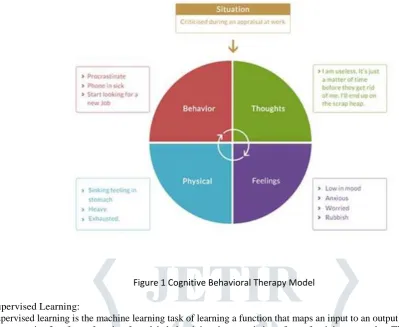
Cognitive Behavioral Therapy (CBT) can be used to treat people with a wide range of mental health problems. CBT is based on the idea that how we think (cognition), how we feel (emotion) and how we act (behavior) all interact together. Specifically, our thoughts determine our feeling and our behavior. Therefore, negative and unrealistic thoughts can cause us distress and result in problems. When a person suffers with psychological distress, the way in which they interpret situations becomes skewed, which in turn has a negative impact on actions they take.
Figure 1 Cognitive Behavioral Therapy Model
2. Supervised Learning:
Supervised learning is the machine learning task of learning a function that maps an input to an output based on example input-output pairs. It refers a function from labeled training data consisting of set of training examples. There are set steps in running any supervised learning, Fair data sampling to get realistic predictive results Data wrangling and cleanup
Data splitting into data sets and test set
Model training using the data set
Model Testing and evaluation using the test set
Deploying your trained model as web services Below Figure 2 shows the proposed chatbot internal architecture.
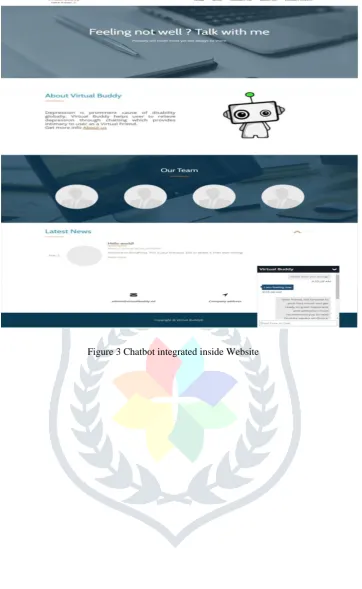
As primary module we have used dialog flow as chatbot backend. The chatbot is further integrated to website. Website allows user to interact with us and with the chatbot both.
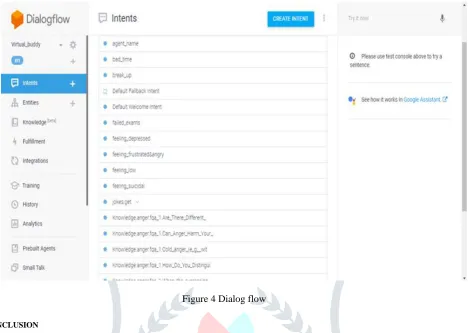
Chatbot intents are manual entered in the dialog flow with using different FAQ’s and by web scraping. These intents are developed in such manner that user gets his/her relevant feedback to their message. These intents work automatically using machine learning by transforming some of user’s message to the fixed intents.
Figure 2 Chatbot Internal Architecture
Here, in Figure 4 back end is done with dialog flow. where in dialog flow, approximately 120 intents have been created. Each intent contains set of different questions and particular response to that questions.
Figure 4 Dialog flow
IV. CONCLUSION
This article is aimed to built more efficient chatbot in specific domain of depression by generating chatbot dialogues with appropriate content and emotions both. User relieve their depression by interacting with the chatbot. As psychiatric therapies are expensive, inconvenient and often hard to approach our proposed work will overcome this. As discussed earlier, we have used (1) Supervised learning to train the chatbot. (2) CBT to relieve depression by improving emotional regulation and development of personal strategies that target solving current problems. We implemented chatbot UI as website. We integrated our chatbot with Facebook messenger.
REFERENCES
[1]Katherine, D., 2001. Understanding Depression. Mind (National Association for Mental Health,
[2] Moussavi, S., Chatterji, S., Verdes, E., Tandon, A., Patel, V. and Ustun, B., 2007. Depression, chronic diseases, and decrements in health: results from the World Health Surveys. The Lancet, 370(9590), pp.851-858
[3] Ai, H., van Tol, M.J., Marsman, J.B.C., Veltman, D.J., Ruhé, H.G., van der Wee, N.J., Opmeer, E.M. and Aleman, A., 2018. Differential relations of suicidality in depression to brain activation during emotional and executive processing. Journal of psychiatric research, 105, pp.78-85
[4] Ajilchi, B. and Nejati, V., 2017. Executive Functions in Students with Depression, Anxiety, and Stress Symptoms. Basic and clinical neuroscience, 8(3), pp. 223-229.
[5] Teasdale, J.D., 1985. Psychological treatments for depression: How do they work. Behaviour Research and Therapy, 23(2), pp.157-165.
[6]Thies, I.M., Menon, N., Magapu, S., Subramony, M. and O’neill, J., 2017, September. How do you want your chatbot? An exploratory Wizard-of-Oz study with young, urban Indians. In IFIP Conference on Human-Computer Interaction. (pp. 441-459). Springer, Cham
[7] Jia, J., 2009. CSIEC: A computer assisted English learning chatbot based on textual knowledge and reasoning. Knowledge-Based Systems, 22(4), pp.249-255
[8] Honghao, W., Yiwei, Z., Junjie, K., 2014. Building chatbot with Emotions. Journal of Stanford University, 23(1). [9] Fitzpatrick, K.K., Darcy, A. and Vierhile, M., 2017. Delivering cognitive behavior therapy to young adults with symptoms of depression and anxiety using a fully automated conversational agent (Woebot): a randomized controlled trial. JMIR mental health, 4(2).
[10] AbuShawar, B. and Atwell, E., Automatic Extraction of Chatbot Training Data from Natural Dialogue Corpora. In RE- WOCHAT: Workshop on Collecting and Generating Resources for Chatbots and Conversational Agents-Development and Evaluation Workshop Programme (May 28 th, 2016) (p. 29).
[11] Huang, J., Zhou, M. and Yang, D., 2007, January. Extracting Chatbot Knowledge from Online Discussion Forums. In IJCAI Vol. 7, pp. 423-428.
[12] Ramesh, K., Ravishankaran, S., Joshi, A. and Chandrasekaran, K., 2017, May. A survey of design techniques for conversational agents. In International Conference on Information, Communication and Computing Technology pp. 336-350. Springer, Singapore.
pp.158-161.
[14] Shawar, B.A. and Atwell, E., 2003. Using dialogue corpora to train a chatbot. In Proceedings of the Corpus Linguistics 2003 conference (pp. 681-690).
[15] Hill, J., Ford, W.R. and Farreras, I.G., 2015. Real conversations with artificial intelligence: A c omparison between human–human online conversations and human–chatbot conversations. Computers in Human Behavior, pp.245-250 [16] Tarun, L., Shreya, B., Shashank, B., Vasundhara, R., Ashish, P., 2018. Implementation of chatbot system using AI and NLP. International Journal of Inovative.Research in Computer Science & Technology.
[17] Arsovski, S., Cheok, A.D., Idris, M. and Raffur, M.R.B.A., ANALYSIS OF THE CHATBOT OPEN SOURCE LANGUAGES AIML AND CHAT SCRIPT: A Review.
[18] Marietto, M.D.G.B., de Aguiar, R.V., Barbosa, G.D.O., Botelho, W.T., Pimentel, E., França, R.D.S. and da Silva, V.L., 2013. Artificial intelligence markup language: a brief tutorial. arXiv preprint arXiv:1307.3091.
[19] Ralph, W., Jaime, C., Barbara, G., Wendy, L., Mitchell, M., Raymond, P., Robert, W., 2010. White paper on Natural Language Processing. Association for Computational Linguistics.