155303-2727-IJCEE-IJENS © June 2015 IJENS
Evaluation of Carnauba Waxes in Warm Mix Asphalt
Technology
Johnny P. M. Feitosa
1, Ana E. V. de Alencar
1, José R. R. de Souza
1, Jorge B. Soares
2, Sandra A. Soares
1, Nágila M. P.
S. Ricardo
11Department of Organic and Inorganic Chemistry, Federal University of Ceará, ZIP-Code: 60455-760, Fortaleza, Ceará, Brazil
2 Department of Transportation Engineering, Federal University of Ceará, ZIP-Code: 60455-760, Fortaleza, Ceará, Brazil
Abstract--Carnauba wax (CW) is a natural product which is being evaluated as a warm mix additive in order to reduce energy consumption and pollution emissions levels. The effect of adding three different types of natural carnauba waxes to asphalt cement 50/70 was investigated with the purpose of evaluating their potential as warm mix additives. Rheological tests were carried out using a rotational viscometer and a dynamic shear rheometer for the neat and the modified asphalt binders. The penetration grade and softening point were also determined. From the results it can be concluded that CW modified binders presented superior rheological and thermal susceptibility properties and have the potential to offer benefits such as energy saving and decrease of pollutant levels.
Index Term-- Asphalt binder, carnauba wax, viscosity, rheology, warm mix.
1. INTRODUCTION
Warm mix asphalt (WMA) is a research topic whose main goal is to reduce energy consumption and asphalt emissions by lowering mixing and compaction temperatures. WMA produces asphalt mixtures at lower temperatures when compared to conventional hot mix asphalt (HMA). HMA has been used as the primary pavement surface course consisting of aggregate and asphalt binder. In order to pump and mix the asphalt binder with aggregates, the asphalt binder must be heated to high temperatures (above 160°C), increasing energy consumption and emission-particulate matter, such as dust, smoke, exhaust vapor, and other gaseous pollutants (Sutton, 2002; Reyes-Ortiz et al. 2012; Paranhos & Petter, 2013).
In order to reduce the emissions, energy requirements and environmental impact, the asphalt industry is constantly trying to reduce the mixing and compaction temperatures of the mixes, without significantly affecting their properties. Mixes containing emulsion as binders usually result in higher air voids and require longer curing times. Foamed binder does not require long curing times, but it has been reported that it only coats well fine aggregates and it is more suitable for recycling applications (Rajagopal, 2004). Another problem with these methods is the extra costs.
Typically, the mixing temperatures of WMA range from 100 to 140°C, therefore much lower when compared to HMA temperatures. WMA has not only the advantage of
lowering mixing and compaction temperatures (lower of energy consumption), but also additional benefits, such as reduced oxidative hardening of the asphalt, hence preventing thermal cracking, reducing of pollutant emissions, among other advantages. Therefore WMA represents an interesting alternative since it is recognized that producing, spreading and maintenance of asphalt mixes is one of the main sources of pollution stemming from industries related to transportation infrastructure (Rubio et al., 2012).
The concept of warm asphalt technology comprises several different approaches. A variety of additives are used in order to reduce mixing temperature. The most widely used additives for this purpose include natural and synthetic waxes– organic additives, also called flow improvers. An example is the commercial Sasobit®, a synthetic wax with longer chain lengths and melting point above 70°C. It is obtained from coal gasification using the Fisher Tropsch synthesis. The long-chains hydrocarbons (40-115 carbon atoms) maintain the wax in solution and reduce binder viscosity, improving its workability during asphalt mixing and compaction. The additive further improves durability and resistance to fuel leaks. Fuels such as kerosene, diesel and gasoline from vehicles damage the asphalt coating, softening the asphalt binder in the surface, then making the aggregates lose their adhesiveness (Cowley & Fisher, 2002; Richter, 2002; Barman
et al., 2011). Besides Sasobit, materials such as Cecabase, Evotherm, Rediset and other waxes have been tested as additives for warm mix asphalt (Banerjee et al., 2012; Polacco
et al., 2012). Some previous studies have evaluated the use of carnauba waxes in asphalt technology (Leite et al., 2010; Feitosa et al., 2012). A patent was published in 2011 by Petrobras applying carnauba wax to modify asphalt binders (Martins et al., 2011).
International Journal of Civil & Environmental Engineering IJCEE-IJENS Vol: 15 No: 03 2 types, and sometimes a fifth type is also mentioned. The main
difference between the different types is based on its purification methodology.
The present study was performed using carnauba wax types 1, 2 and 3 as asphalt binder modifiers in order to reduce viscosity of the binder and to investigate their potential use in WMA. Besides flow properties, the effect of carnauba wax on the rheological properties, softening and penetration point was also investigated.
2. MATERIALS AND METHODS 2.1. Materials
2.1.1. Asphalt Binder
Asphalt binder 50/70 penetration grade was produced and processed by Petrobras/Lubnor in the State of Ceará, Brazil.
2.1.2. Natural Waxes
Natural waxes were obtained from carnauba and they presented a melting point at approximately 83°C. As previously mentioned, three types of carnauba wax were used: type 1 (CW1) – in gold yellow scales, type 2 (CW2) – with yellow color, and type 3 (CW3) – in greenish yellow scales. Those waxes were provided by FONCEPI – Fontenele Ceras do Piauí/Brazil.
2.2. Experimental Procedures
2.2.1. Preparation of modified asphalt binder
Blends were prepared using an IKA RW20 reactor with low shear mixing. The blends were processed for 1 hour at 120 ± 5°C and at 1000 rpm. The concentrations of carnauba wax used for bitumen modification were: (i) CW1 3% w/w; (ii) CW1 5% w/w; (iii) CW2 3% w/w; (iv) CW2 5% w/w; (v) CW3 3% w/w and (vi) CW3 5% w/w. The samples were denoted as LA 3CW1, LA 5CW1, LA 3CW2, LA 5CW2, LA 3CW3 and LA 5CW3, respectively, with the first number indicating the wax content by weight, and the second number indicating the wax type.
2.2.2 Empirical Tests 2.2.2. Penetration
The penetration test for the pure and modified binders was performed in a penetrometer semi-automatic – equipment Solotest, according to ASTM standard D5. Penetration is defined as the depth, in tenths of a millimeter that a 100g standard needle penetrates into a sample after 5 sec at a temperature of 25°C.
2.2.3. Softening Point
The softening point test (ring and ball method) aims to determine the temperature at which a phase change occurs in the asphalt binder. The softening point is the temperature at which the asphalt binder reaches a certain flow condition when heated under certain standard conditions. The test of
pure and modified binders was performed in manual Solotest equipment soft point, according to ASTM D36 (1998). Three measurements were obtained for each sample.
2.2.2.3 Conventional Physical Test
The penetration and softening point results were applied in the Pfeiffer-Van Doormal equation to obtain the Penetration index (PI) (Equation 1). The smaller the PI, the greater is the thermal susceptibility.
PA
PEN
PA
PEN
IP
log
.
50
120
1951
.
20
log
.
500
(1)
2.2.3 Viscosity and flow activation energy (Ef)
The viscosity of the selected asphalt binders was measured using a Brookfield DV-II+ programmable rotational viscometer with a THERMOSEL control system according to ASTM D4402 (2002). The measurements were performed at 120, 135, 150 and 175°C using a spindle SC4-21. To evaluate the shear rate susceptibility of the binders, samples were submitted to shear rates of 20, 30, 40, 50 and 60 rpm. The dependence of viscosity on temperature was used to obtain the flow activation energy (Ef) as indicated below from the Arrhenius equation (2):
A
RT
E
fln
log
(2)Where η is the viscosity of the material, T is the temperature in Kelvin, A is the pre-exponential factor, Ef is the flow activation energy, and R is the universal gas constant (8.314 J.mol-1.K-1). Plotting ln η as a function of 1/T provides the slope values of Ef/R. That parameter has been used to differentiate binders and rank their thermal susceptibility in order to predict the compaction strength of the mixes (Painter & Coleman, 1997).
2.2.4 Mixing and compaction temperatures
Mixing and compaction temperatures (MT and CT, respectively) were determined by two different methods using a Brookfield viscometer. In the first method (Painter & Coleman, 1997), they were determined from viscosity data obtained at temperatures of 120, 135, 150 and 175°C. The compaction of asphalt mixes is performed at a temperature corresponding to a binder viscosity of 0.28 Pa.s ± 0.3, whereas the mixture itself is previously performed at a temperature corresponding to the binder viscosity of 0.17 ± 0.2 Pa.s. The second method consists in analyzing the temperature corresponding to the viscosity of 0.2 Pa.s (line of maximum viscosity of binders in mixing operation) (Bahia et al., 2001). 2.2.5 Rheological characterization
155303-2727-IJCEE-IJENS © June 2015 IJENS
a controlled-stress of 120Pa according to ASTM D 7175 (2005). Measurements were taken within the linear viscoelastic region. The tests were conducted in two different temperature ranges: 10 to 40°C (first stage), and 45 to 90°C (second stage). The samples were prepared in a silicon mold 2mm thick and 8mm diameter for the first stage, and 1mm thick and 25mm diameter for the second stage. The linear viscoelastic parameters obtained were: complex shear modulus (G*) and phase angle (δ). The rheological response in the viscoelastic region was represented by master curves of their viscoelastic functions. The time-temperature superposition principle–TTSP was applied using the Williams-Landel-Ferry (WLF) equation (Pfeiffer & Van Doormaal, 1936; Krishnan & Rajagopal, 2005). The reference temperature was chosen to be 25°C. The temperature sweeps using a DSR were carried out between 40-90°C with an increasing rate of 2 °C/min to an alternating shear stress at a frequency of 1.59 Hz, and measuring the resulting shear strains (AASHTO T315-06).
3. RESULTS AND DISCUSSION 3.1 Conventional Test Result
The results of the conventional test, for pure and modified asphalt binder are shown in Table 1. As expected, the modification causes an increase in asphalt binder consistence: it was observed a decrease in penetration values and an increase in the softening point. The latter is favorable since asphalt binders with higher values may be less susceptible to permanent deformation. All asphalt binders modified with carnauba wax showed increase in the softening point and decrease of penetration with a single exception of the asphalt binder modified with 5% CW3. The asphalt mixtures modified with 5% CW2 and 5% CW3 presented the largest increase in the softening point. However, only the asphalt modified with 5% CW2 showed minor value of penetration. It is possible to observe that an increase of temperature in all modified binders caused a decrease of viscosity when compared to the pure asphalt binder, especially at 120°C, where the viscosity for modified binder is 63% of the value presented by the neat asphalt binder. The penetration index for the all modified asphalt binders indicated that they are all proper for road use.
3.2 Effect of the additives on the viscous properties
Figure 1 shows the dependence of viscosity on shear rates for the neat and the modified asphalt binders. The addition of the waxes to the binder led to a decrease of the viscosity. For the neat and modified binders, a Newtonian behavior was observed for the studied conditions: shear rates (range from 20 to 60s-1) and temperature (120°C). The most pronounced effect was observed for the samples with 5% in weight of carnauba wax type 2, with a 37% of viscosity reduction at 120°C.
The viscosity results for these binders at different temperatures and 20 rpm are shown in Table 1. It was observed that all modified asphalt binders reduced viscosity when compared with the unmodified binder. Those viscosity results indicate that the use of carnauba wax showed to be a “flow improver” additive and its use can improve workability at lower temperatures, reducing energy expenditure. Reducing bitumen viscosity leads to improvement in mix workability which means better working conditions (Rubio et al., 2012).
3.3 Flow activation energy (Ef)
Ef can be used to evaluate thermal susceptibility. Table 2 shows flow activation energy values for modified and unmodified asphalt binders. Those values were calculated using equation 1 and viscosity results in the Arrhenius plot. It was observed a decrease of Ef with CW addition and a decrease with the increase of CW concentration. That effect was observed for all carnauba wax types.
The smaller the value of Ef, the smaller is the binder response to changes in temperature. Ef of the binders can also be related to the energy involved in asphalt binder compaction. In that sense, 5% CW2 presented the best results to reduce costs of energy.
3.4 Mixing and compaction temperatures from viscosity data
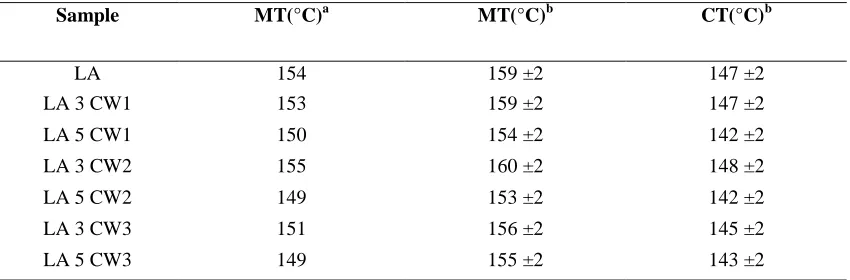
Viscosity reduction of asphalt binder after modification with carnauba wax was observed, with a corresponding reduction in compaction and mixing temperatures. Using Asphalt Institute and CILA method (Oliveira et al., 2009), it was observed that the addition of 5% of CW reduces mixing and compaction temperatures in approximately 5 ±2°C as shown in Table 3. It was also observed that CW1 and CW2, with 3% were less effective in reducing mixing and compaction temperatures when compared to the neat binder in both methods. The results presented confirm what has been established by other researchers (Hanz et al., 2010), i.e., that the conventional viscosity-based methods used to determine mixing and compaction temperatures are not the most appropriate to predict WMA production temperatures in the field.
Tests were also performed for investigating the addition of synthetic wax Sasobit® in asphalt binder and showed the same behavior (Iwański & Mazurek, 2013). So, it is necessary to find a more suitable method for determining compaction and mixing temperatures.
3.5 Rheological properties of binder
International Journal of Civil & Environmental Engineering IJCEE-IJENS Vol: 15 No: 03 4 indicate better deformation resistance. The DSR test results
are shown in Figures 3 and 4.
Figures 2 and 3 show G* and phase angle results as functions of temperature and frequency. The master curves of G* and δ were plotted using 25°C as the reference temperature, for the modified and unmodified binders. The observed results, for all additives, showed an increase for complex modulus value with frequency when compared to the neat asphalt binder.
That effect can be due to several reasons such as melting point range and/or solubility (it is known that at higher temperatures the addition of CW reduces viscosity due to melting temperature). In the other hand, the influence of CW in G*, increasing this parameter at high frequency (low temperature) can contribute to relieve thermal cracking. The most pronounced effects were observed for 5% CW2. Figure 3 shows master curves of δ with frequency for all binders. The CW modified asphalt binders show low values of δ in the range of investigated frequency, improving the elastic properties of the binders. It was observed that for 5% CW3 modified bitumen, it was found lower values of δ when compared with the other waxes and to the unmodified binder, showing an improvement in the elasticity of the asphalt binder. It can be also observed that the effect on rheological parameters was found to depend on the type and amount of additive.
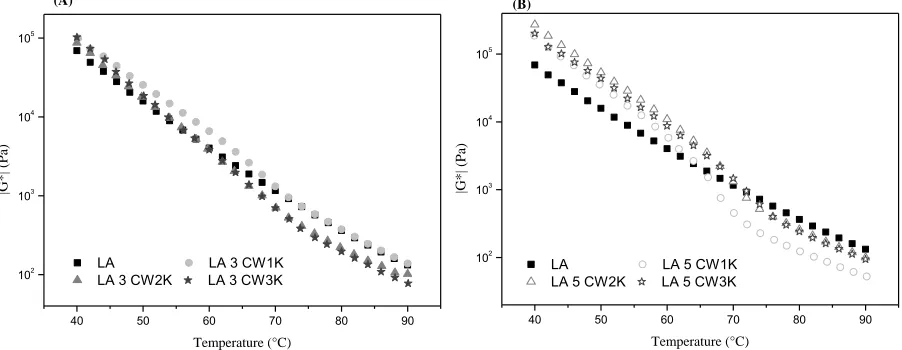
A temperature sweep with the dynamic shear rheometer over the temperature range of 40-90 °C at a frequency of 1.59Hz and with an increase of 2°C was performed for the different modified binders and the unmodified binder. The results are shown in Figure 4.
The addition of carnauba wax, types 1, 2 and 3, promoted an increase in G* when compared with the unmodified binder for temperatures below 70 °C. After that, the opposite occurred. That change of G* is attributed to a phase change of the carnauba wax in the asphalt binder (Iwański & Mazurek, 2013). The increase in G* can improve the binder resistance to permanent deformation for temperatures below 70 °C. The modification of asphalt binder with carnauba wax type 1 with 5% in weight provided the largest change of G* in the studied temperature range. That result can be attributed to a greater presence of aromatic groups in carnauba wax type 1, extracted from the young palm that provides a greater interaction with the asphalt binder. Such interaction decreases with the increase of temperature.
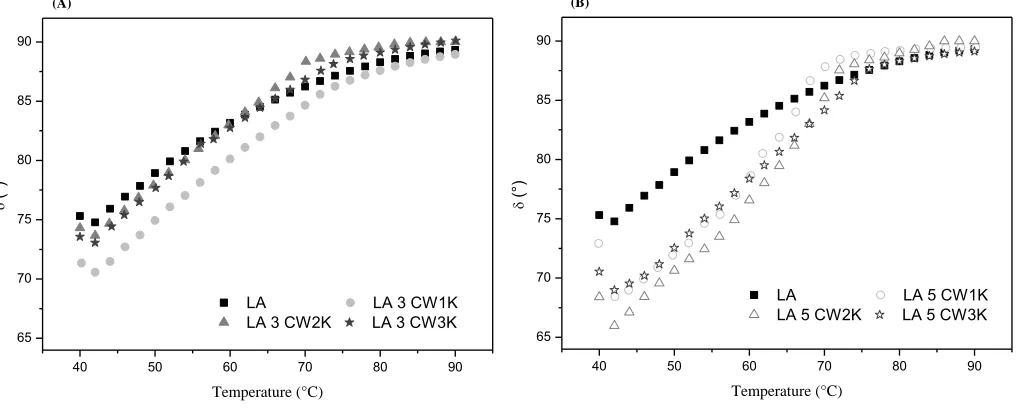
Figure 5 shows the phase angle (δ) plot for modified and unmodified asphalt binders with temperature increase. It is possible to observe that the modification of the asphalt binder with carnauba wax provided a decrease of δ when compared to the unmodified asphalt binder for temperatures below 70 °C.
Lower δ values indicate a more elastic response and a better resistance to permanent deformation. The asphalt binder modified with 5% carnauba wax type 2 provided the lowest δ.
In a similar way as those observed for Sasobit ® by Silva et al. (2010), we can observe that a modification of the bitumen with CW promoted an increase in G* in direct proportion to the amount of CW. But the cross-over of G* for the modified binders occurred at a lower temperature range: between 68 and 73°C. Rubio et al. (2012) emphasize the importance of using WMA technology. Besides mitigating the environment impact because of the lower temperatures in comparison to HMA, the lower bitumen viscosity improves mix workability, and produces fewer emissions, generally creating better working conditions. Besides that, Silva et al. (2010) highlights that the fact that WMAs are produced in lower temperatures can reduce aging of the binder.
Some authors have discussed that the method used in this work for MT and CT determination is not the most appropriate, and recent papers have introduced a lubricity test which could provide a better confirmation for the results observed in the present work (Hanz et al., 2010; Rubio et al., 2012). Anyway, it was observed that the sample LA 5 CW2 produced an interesting reducing effect of 6 and 5°C for MT and CT, respectively.
4. CONCLUSIONS
The results showed that the use of natural wax types 1, 2 and 3 are suitable for use in asphalt binder as a flow improver (low-viscosity modifier). The additives significantly decreased the viscosity of the binder. Reduction of energy consumption and gas emissions are expected, which means energy savings as well as lower emission of pollutant levels. It has been shown also that these natural waxes can also improve thermal susceptibility of the asphalt binder. Master curves of phase angle indicated an increase in the elastic response for 5% CW2 modified binder and an increase in G* when compared to unmodified binder. However, for CW1 and CW3 additives in proportion of 5% promising results were observed, producing a better elastic response and more deformation resistance when compared with the unmodified asphalt binder. It was also possible to observe that rheological parameters, complex modulus and phase angle, did change with temperature ranging below 70°C, probably due to phase changes of the wax. Most of the mixtures produced a reduction on MT and CT values but the sample LA 5 CW2 produced an interesting reducing effect of 6 and 5°C for MT and CT, respectively.
ACKNOWLEDGMENTS
LUBNOR/Petrobras, FONCEPI (Fontenele Ceras do Piauí) for the donation of the samples; CNPq and CAPES for their financial support.
REFERENCES
[1] ASTM D36-95. (1998). Standard test method for softening point of
155303-2727-IJCEE-IJENS © June 2015 IJENS
Standards, Volume V04.04, American Society for Testing and Materials, Philadelphia, PA 19103-1187.
[2] ASTM D4402. (2002). Standard Test Method for Viscosity
Determinations of Unfilled Asphalts Using Brookfield Thermosel Apparatus - American Society for Testing and Materials.
[3] ASTM D7175 (2005). Standard test method for determining the
rheological properties of asphalt binder using a dynamic shear rheometer American Society for Testing and Materials -. American Society for Testing and Materials.
[4] AASHTO T315-06. (2006). Standard Method of Test for
Determining the Rheological Properties of Asphalt Binder Using a Dynamic Shear Rheometer (DSR), American Association of State Highway Transportation Officials.
[5] Bahia, H. U.; H. D., Zeng, M.; Zhai, H.; Khatri, M. A.; Anderson,
R. M. (2001). NCHRP Report 459: Characterization of Modified Asphalt Binders in Superpave Mix Design. Transportation Research Board. Washington D. C.
[6] Banerjee, A.; Andre, F. S.; Prozzi, J. A. (2012). The effect of
long-term aging on the rheology of warm mix asphalt binders. Fuel, v.
97, p. 603-611.
[7] Barman, K.; Asrey, R.; Pal, R. K. (2011). Putrescine and carnauba
wax pretreatments alleviate chilling injury, enhance shelf life and
preserve pomegranate fruit quality during cold storage. Scientia
Horticulturae, v. 130, p. 795-800.
[8] Cowley, L. G.; Fisher, R. G. (2002). Use a bitumen/wax
composition – BP Oil International Limited – International Publication Number (28/02/2002) WO 02/16499 Patent.
[9] Feitosa, J. P. M. A., A. E. V.; Soares, J.B.; Soares, S. de A.;
Ricardo, N. M. P. S. (2012). Evaluation of the addition of carnauba wax in warm mixtures asphalt (WMA). In: 2nd International Symposium on Asphalt Pavements & Environment, Fortaleza, CE.
[10] Gonçalves, F. P.; Martins, M. C.; Junior, G. J. S.; Lourenço, S. A.;
Amorim, L. (2010). Postharvest control of brown rot and Rhizopus
rot in plums and nectarines using carnauba wax. Postharvest
Biology and Technology, v. 58, p. 211-217.
[11] Hanz, A. J.; Faheem, A.; Mahmoud, E.; Bahia, H. U. (2010).
Measuring effects of warm-mix additives: Use of newly developed asphalt binder lubricity test for the dynamic shear rheometer.
Transport Research Record, v. 2180, p. 85–92.
[12] Iwański, M.; Mazurek, G. (2013). Optimization of the Synthetic
Wax Content on Example of Bitumen 35/50. Procedia
Engineering, v. 57, p. 414-423.
[13] Krishnan, J. M.; Rajagopal, K. R. (2005). On the mechanical
behavior of asphalt. Mechanics of Materials, v. 37, p. 1085-1100.
[14] Leite, L. M. A.; Chacur, M.; Nascimento, L. A. H.; Silva Filho, L.
R. (2010). Cera de carnauba como modificador de ligantes asfálticos, In: In: XXII Congresso de Pesquisa e Ensino de Transportes (XXIII ANPET).
[15] Martins, A. T.; Assuncão, D. F.; Leite, L. F. M.; Nascimento, L.
A. H.; Filho L. S.; Cravo, M. C. C. (2011). Composição e processo de preparação de ligante asfáltico por cera e origem natural. Petróleo Brasileiro S.A. PI0901484-5A2.
[16] Oliveira, J. R. M., Ribeiro, R. E. S., Silva, H. M. R. D. (2009).
Utilização de betumes de elevada penetração aditivados em misturas betuminos de desgaste, Proceedings of XV Congresso Ibero-Latinoamericano do Asfalto, Lisboa, Portugal, November, 365-374.
[17] Painter, P. C.; Coleman M. M. (1997). Fundamental of Polymer
Science – An Introductory Test. Technomic Publishing Co. Inc., Lancaster, PA.
[18] Paranhos, R. S.; Petter, C. O. (2013). Multivariate data analysis
applied in Hot-Mix asphalt plants. Resources, Conservation and
Recycling, v. 73, p. 1-10.
[19] Pfeiffer, J. P. H; Van Doormaal, P. M. (1936). The rheological
properties of asphaltic bitumen. Journal of the Institute of
Petroleum Technologists, v. 22, p. 414–440.
[20] Polacco, G.; S. Filippi; M. Paci; F. Giuliani F. Merusi. (2012).
Structural and rheological characterization of wax modified
bitumens. Fuel, v. 95, p. 407-416.
[21] Rajagopal, A. (2004). Comparison and Definition of State DOT’s
practices in selection of Materials for Pavements. Final Report prepared in cooperation of The Ohio Department of Transportation and the Federal Highway Administration.
[22] Reyes-Ortiz, O. E. B.; Alvarez, A. E.; Carvajal-Muñoz, J. S.;
Fuentes, L. G. (2012). Evaluation of Hot Mix Asphalt Mixtures with Replacement of Aggregates by Reclaimed Asphalt Pavement
(RAP) Material. Procedia - Social and Behavioral Sciences, v. 53,
p. 379-388.
[23] Richter, F. (2002). Effect of Waxes on Bitumen Quality. OIL GAS
EUROPEAN MAGAZINE, v. 28, p. 35-38.
[24] Rubio, M. C.; Martínez, G.; Baena, L.; Moreno, F. (2012). Warm
mix asphalt: an overview. Journal of Cleaner Production, v. 24, p.
76-84.
[25] Silva, H. M. R. D.; Oliveira, J. R. M.; Peralta, J.; Zoorob, S. E.
(2010). Optimization of warm mix asphalts using different blends
of binders and synthetic paraffin wax contents. Construction and
Building Materials, v. 24, p. 1621-1631.
[26] Sutton, C. L. (2002). Hot Mix Blue Smoke Emissions. Technical
International Journal of Civil & Environmental Engineering IJCEE-IJENS Vol: 15 No: 03 6
Fig. 1. Viscosity at 120°C versus shear rate of neat binder and modified binder with: (A) carnauba wax 3% and (B) carnauba wax 5%.
Fig. 2. Master curve of Complex Modulus vs reduced frequency of modified and unmodified asphalt binder: (A) carnauba wax 3% and (B) carnauba wax 5% at
temperature (25°C).
(A) (B)
20 30 40 50 60
850 900 950 1000 1050 1100 1150 1200 1250 1300 1350
LA LA 3 CW1K LA 3 CW2K LA 3 CW3K
V
isco
si
ty
(
cPa.s)
Shear rate (s-1)
20 30 40 50 60
850 900 950 1000 1050 1100 1150 1200 1250 1300 1350
LA LA 5 CW1K LA 5 CW2K LA 5 CW3K
V
isco
si
ty
(
cPa.s)
Shear rate (s-1)
(A) (B)
10-7
10-6
10-5
10-4
10-3
10-2
10-1
100
101
102
103
104
100
101
102
103
104
105
106
107
108
109
LA LA 5 CW1K LA 5 CW2K LA 5 CW3K
(Hz)
|G*|
(Pa
155303-2727-IJCEE-IJENS © June 2015 IJENS
Fig. 3. Master curve of phase angle vs reduced frequency of modified and unmodified asphalt binder: (A) carnauba wax 3% and (B) carnauba wax 5% at
temperature (25°C).
Fig. 4. Change of complex modulus with temperature: (A) carnauba wax 3% and (B) carnauba wax 5%.
(A) (B)
10-6
10-5
10-4
10-3
10-2
10-1
100
101
102
103
40 50 60 70 80 90
LA LA 3 CW1K LA 3 CW2K LA 3 CW3K
(Hz)
(°
)
10-6
10-5
10-4
10-3
10-2
10-1
100
101
102
103
40 50 60 70 80 90
LA LA 5 CW1K LA 5 CW2K LA 5 CW3K
(°
)
(Hz)
(A) (B)
40 50 60 70 80 90
102
103
104
105
LA LA 5 CW1K LA 5 CW2K LA 5 CW3K
|G
*
| (
Pa)
Temperature (°C)
40 50 60 70 80 90
102
103
104
105
LA LA 3 CW1K LA 3 CW2K LA 3 CW3K
|G
*
| (
Pa)
International Journal of Civil & Environmental Engineering IJCEE-IJENS Vol: 15 No: 03 8
Fig. 5. Change of phase angle with temperature sweep: (A) carnauba wax 3% and (B) carnauba wax 5%.
Table II
Values of Ef for the neat and modified asphalt binder: LA, LA 3CW1, LA 5CW1, LA 3 CW3 and LA 5 CW3.
Sample Ef (kJ/mol)
LA 70
LA 3CW1 67
LA 5CW1 65
LA 3 CW2 65
LA 5 CW2 60
LA 3 CW3 63
LA 5 CW3 64
Table I
Conventional test results of pure and modified asphalt binder.
Method LA LA 3
CW1
LA 5 CW1
LA 3 CW2
LA 5 CW2
LA 3 CW3
LA 5
CW3 Unity
Soft Point,
ASTM D 36 50 57 55 53 59 57 60 °C
Penetration at
25 °C, ASTM D 5 52 51 36 36 26 60 41 0,1 mm
Penetration Index -1.1 0.47 -0.75 -1.19 -0.59 0.89 0.56 n/a
Viscosity, ASTM D 4402
120°C 1.360 1.256 0.903 1.2 0.865 1.0 0.952 mPa.s
135°C 0.535 0.53 0.401 0.523 0.378 0.435 0.424 mPa.s
150°C 0.258 0.26 0.213 0.265 0.209 0.222 0.213 mPa.s
175°C 0.098 0.1 0.088 0.1 0.087 0.086 0.085 mPa.s
(A) (B)
40 50 60 70 80 90
65 70 75 80 85 90
LA LA 5 CW1K LA 5 CW2K LA 5 CW3K
(°
)
Temperature (°C)
40 50 60 70 80 90
65 70 75 80 85 90
LA LA 3 CW1K LA 3 CW2K LA 3 CW3K
(°
)
155303-2727-IJCEE-IJENS © June 2015 IJENS
Table III
Compaction and mixing temperatures for modified and non-modified asphalt binders.
Sample MT(°C)a MT(°C)b CT(°C)b
LA 154 159 ±2 147 ±2
LA 3 CW1 153 159 ±2 147 ±2
LA 5 CW1 150 154 ±2 142 ±2
LA 3 CW2 155 160 ±2 148 ±2
LA 5 CW2 149 153 ±2 142 ±2
LA 3 CW3 151 156 ±2 145 ±2
LA 5 CW3 149 155 ±2 143 ±2
aMethod referred in Oliveira et al., 2009. b