p
ISSN: 2319-6505
KNOWLEDGE BASED
ENGINEERING SYSTEM (KBES) FOR MECHANIC DESIGN ACTIVITIES
Candia GF
1*., Cruz GMA
2.,
Rodríguez MI
3and Galindo LV
41,2,3,4 Faculty of Engineering, BUAP, State Puebla, México
A R T I C L E I N F O A B S T R A C T
A methodologic change in the instruction of technologies involved in a product development and production is necessary since we are immersed in a knowledge society. Engineering, through the Solid Mechanics and Computational Mechanics topics, has had the duty to improve the products manufacturing processes through knowledge created in industrial design. That is why the actual manufacturing processes have to integrate the Supply Chain and Lean Manufacturing topics with the “CAx” (Computer Aided “x”) activities. Likewise, also they have to protect the intangible assets of an institution as it is the knowledge of CAE. Thus, a Knowledge Based Engineering System (KBES) is introduced which is developed to integrate the MS and MC theories in development, manufacturing and product development activities that are associated to industrial design
practices
.
INTRODUCTION
Actually, in the higher education level the investigation, development, innovation and creativity are imparted as engineering subjects as a technological growth alternative (it is called I+D). Nevertheless, the low productivity of these contents observed in the insufficient Intellectual Property Rights protection at the national level, limits the new product development opportunities in the academic field or business. At the current time of a high technological development, it is foreseen that the main asset of a company will be knowledge. Knowledge is a complex concept that does not only assume theories, methods and rules but also the own mental processes that trigger the creativity. In this project it is assumed that starting creative processes without the development of critical processes limit the technological progress of institutions and nations.
Knowledge Based Engineering (KBE) pursuits the capture, maintenance, reutilization and regeneration of this intellectual capital. It also promotes the best way to incorporate it directly to the productive chain as well as the productive and economic competitiveness improvement. The KBES implementation problem lies in the lack of information about the industrial design topic and the KBES in subjects programs of IES in engineering. To go into the industrial division in a structured way to the benefit of KBES generated knowledge and specially protected by an aware legislation (IMPI) with own technology, it is essential that KE becomes the study subject at IES. That way the entrepreneur business opportunities and SME are expanded and are not conditioned to product commercialization. Above all, when you are talking about macroprojects of the development of a new product or his actualization for his presence in the market.
Through the implementation of KBES it is possible to commercialize the knowledge and keep the competiveness in the small and medium enterprises (SME) that fulfill the complex management processes of international certifications and accreditations like ISO, VDA, etc. Besides, it allows to generate business alternatives through the young entrepreneur initiative at the high specialization consulting firms opening in the product development.
The technological development degree and the Gross Domestic Product increase of a country must begin with its society participation in the development process of its consumption products. The engineering IES egressed must favor the innovation through the adaptation of the foreign technology to the Mexican industrial environment and participating in creativity design processes. That is why linking the MS science, the MC technology and the LM and SCM productive philosophies must be integrated in a concept such as KBES.
The innovation in the development of new products is a knowledge considered as an element capable of the added value contribute to the processes that require a certified intellectual and academic capacity. The high acceptance of a product in the market provokes that the innovation methods become the company added value, which allows its subsistence in the commercial sector. To count on a didactic methodology in the product design process, supported in knowledge, incentives the great associations to trust the new technologic challenges that allow a high diversity in the wealth and services manufacturing. The base knowledge for this methodology to be applied to all the levels and structures of any institution, lies in the MS and MC, and the innovation in the IES egress profile must me focused on the development product.
Available Online at http://journalijcar.org
International Journal
of Current Advanced
Research
International Journal of Current Advanced ResearchVol 5, Issue 6, pp 984-991, June 2016
Article History:
Received 26th March, 2016
Received in revised form 17th April, 2016
Accepted 25th May, 2016
Published online 28th June, 2016
RESEARCH ARTICLE
ISSN: 2319 - 6475
Key words:
KBES, CAD / CAM / CAE, Product Design, Product Development.
985
This project constitutes an approach to one of the recent trends on innovation and design of products: the Knowledge Based Engineering System (KBES), which represent an investigation field capable of the advantage contribution to the manufacturer industry for both the technological added value and its potential to automate repetitive and tedious tasks, also for its capacity to generate methodologies for a better management, division knowledge understanding and retention (Valverde, 2005). Understanding this division knowledge as the product design for its following development, fabrication and production.The intention of this project is to explore, through the study of KBES and its applications, the methodologic alternatives that allow to acquire the knowledge and better CAD/CAM/CAE platforms to apply a KBES to the MS and MC topics focused to the product life cycle at the industrial design phase. As a continuity to the KBES development on industrial design through the MS and MC, the opportunities are analyzed to develop the intellectual property rights and change them into institution assets and, above all, SMEs. Here lies the significance of the inclusion of KBES academic contents to Engineering Degree teaching that implies the industrial design as a egress profile formative axe.
It is considered that from this documental development, it is possible to relate the art state of KBES with the technology involved in the product development. To do that it was indispensable to review the international data base about the KBES theme, identify the KBES methodology as an alternative for product development and identify the challenges, opportunities and strategies that KBES represent actually as a pertinent topic that allows to update the IES engineering study programs.
MATERIALS AND METHODS
The definition of the concepts and its relation to the engineering teaching is involved through the scientific method. At a more ambitious paragraph we attempt to interrelate the concepts involved in the development of new products with the productivity improvement and design efficiency through PLM systems.
Concepts
Information Management (IM) and Knowledge Management (KM)
The information management (Stjepandić, et al, 2015) represent the form through which an organization collects, organices, controls and distributes information, assuring that the information value represents the key to sustain the knowledge creation and its application within the slim organizations. The information and data management are important pillars of knowledge management that allow the individuals to transform information within the business organization to create and share knowledge. Meanwhile the quantitative information usually contains numbers, the qualitative information will be expressed at unmeasurable terms. On both situations we count on data only. For this project it is considered that the MS theory constitutes the quantitative information by organizing exact methods (elastic equation) for problem solution and the MC results are the qualitative information by contributing with results that show a maximum and a minimum, which are evaluated from
criteria (for example, Von Misses). Both types of knowledge are essential in the development of an industrial design KBES.
The organizational knowledge can be located in two different types: the tacit knowledge and the explicit. The tacit knowledge is based on actions (for example, the determination of the static balance), the explicit knowledge is the type of knowledge that can be codified (for example, the determination of the combined efforts effects). The knowledge management (KM) (Stjepandić, et al, 2015) is an integrated form of documental contents and non-documental that mixes the information stored in the company information system and that also contributes for knowledge to be created, shared, learned, perfected and organized on benefit of the organization and its clients.
At most of the cases the KM cycle begins with the knowledge capture, creation or generation phase in order to organize this knowledge (rudiments, laws and MS solution procedures) in a second step. Later, in a third step, this first knowledge experiments with the process of transformation explicit and formal (MS teaching at engineering IES). The forth step cares about the ability to share and distribute the formalized knowledge (with the application of MC through software that use the MEF as a solution algorithm). Some models use a fifth step and a sixth phase that use the ability to reuse knowledge (methodology that allows to offer services to the industry) as it is shown on table 1.
The knowledge managers and employees inadequate abilities can also provoke a KM system failure. Other factors that can lead to the KM system failure are the knowledge loss caused by plant staff desertion or retirement, as well as the lack of responsibility and knowledge property (Stjepandić, et al, 2015).
The importance for knowledge and information to be handled as organizational assets is supported by the idea that IM and KM tools must be organizational strategies, also it is essential that the organizations draw a clear differentiation line between IM and KM when these are used for a new product industrial design. Within slim organizations (understanding slim as every productive system that counts on the minimal elements to be functional), the IM plays a crucial role, and the information needs to be handled in a slim way: without the lack of indispensable information and without spendthrift information (look at figure 3, competence chapter). The KM also needs to be handled under strongly slim principles: avoiding the staff to perform unnecessary knowledge overload and working with the right quantity of transferred knowledge under the concept of “quality then quantity” (Iuga & Kiford Vasile, 2014).
Product
The word “product”, according to RAE dictionary, is explained as a “produced thing”. In more detail, the meaning of “produced” comes from “to produce” which means in an economic sense “to create things or services with economic
Table 1 KM applied cycle
First step Second step Third step Foth step Fifth step
Sixth step
MS laws and rudiments
MC analysis and simulation
Mechanic design
Product development
986
value”, likewise it is relative to fabricate or elaborate useful things. In this project it is denominated “product” to the tangible asset that has been produced by an industrialized process and is susceptible of perfectionism and innovation.Product development
The development of a product is the set of activities that begins with the perception of a market opportunity and ends with the production, sale and product consumption. It is then that the product development process is a sequence of steps or activities that companies use to conceive design and commercialize a product (Ulrich & Eppinger, 2013). The product development cost is approximately proportional to the number of persons that have intervened in a project and the project duration. Besides the expenses for design work (look at table 2), it will always have to make some investment in tooling endowment and necessary equipment for production.
As a result of a KBES development, for industrial design the product has been defined as the “analysis and simulation of skeletal structures” because it is considered an MS and MC final usability. Without leaving aside the proposition where a KBES can be implemented in another group of subjects for product development from another focus, such as automation or the lean manufacturing philosophy implementation.
Factor Design (Dfx) Techniques
The design techniques Dfx have a common feature which is that in most cases these are included within the strategies of recurrent engineering. The adopted term in English for this technique is Dfx, corresponding acronyms to “Design for x” and it responds to a set of approaches that consist on thinking in the product design since one of its factors point of view. X, in this case, is the factor in question. It can be found within these set of design techniques approaches like the following:
DFM: Design for Manufacturing. DFA: Design for Assembly. DFMa: Design for Maintenance. DFRe: Design for Reliability. DFS: Design for Security. DFE: Design for Environment. DFRm: Design for Remanufacturing.
Being that MC is a referent for engineering design problem solution through numeric methods, these require the use of specialized software for its application because of its solution method. Since CAx are the most used tools in industrial design, its integration with Cfx tools is totally correlated to the product development benefit. During the presentation of several product design techniques (Alcaide, Diego, & Artacho, 2006), it has been observed its evaluation and transition from artisan production to massive serial production. The CAx tools advantage lies on the library of CAD/CAM/CAE platform components remanufacturing, which allows that base knowledge at element level (MS) be
integrated at structure level and, through MC theory, analyses its mechanic behavior from the industrial design process.
The common factor between CAx and Cfx techniques is the importance in the management of information generated through computer equipment, which is translated into knowledge and the sequence in the use of knowledge that every stage of the process has to keep (it isn’t possible to be competitive through independent work cells or with lack of sequence). Through CAx and Cfx techniques, the KBES inclusion opportunity is of great potential and it is indispensable in every manufacturing company growth plan that base their product development on the industrial design. After being designed, a product has to be manufactured, which means the conversion of concepts and information into a physical object that requires a great amount of sources and a careful planning. The product manufacturing also has to be designed and it is called the design industrialization (Gómez,
et al, 2013). With the logistic optimization the companies
tend to exclude the geographic boundaries which allows the product deliver in a short time and lower cost in a more efficient manner, as well as the improvement of flow links with commercial partners. KBE is a complete application of artificial intelligence in engineering. Its integration with SCM facilitates the new product development through the approach of material resources to the product manufacturing systematized activities that allow remanufacturing the knowledge of access to raw material and supplies. The idea behind KBE is to store engineering knowledges by appropriate media easy to use and to utilize it whenever it is necessary in a formal process, well documented, repeatable and traceable (Verhagen, et al, 2015).
KBES
Knowledge Based Engineering System (KBES) is a technology that allows the companies to capture and develop explicit knowledge from their engineers, as well as offering the best manufacturing, legislation or costs practices in their career to achieve a better competitivity. Knowledge, in the present time called “knowledge societies”, has become the most important asset of the first level companies since their management and administration are a competiveness detonating for every company at the transformation industry. Thus if it is established a methodology which allows to document the industrial design base knowledge (MS) and also that an initial product be analyzed and simulated (MC).
In a parallel manner to KBES generation, there has been developed the CAD/CAE/CAM computer platforms (also called PLM solutions) that have propitiated a fusion of manufacturing technologies and its knowledge so that the engineer can gather the information at the different product cycle phases (design, analysis, manufacturing, etc.) allowing new products development from the existing and prioritizing the parametric design. Through the CAD/CAM/CAE technologies it is possible to create another product in which it is possible to vary some parameters. In parametric design, with only changing the input dimensions, it is possible to obtain the final product modified or adjusted to other needs, since the whole process is ordered and stored thanks to the KBES organization.
In consequence, the CAD/CAM/CAE models represent an important part of knowledge base of every company focused
Table 2 Product development costs according to Ferré (1990)
PHASE % OF COSTS TO TOTAL
STUDY-DESIGN 10-25
DEVELOPMENT-PRODUCT 15-30
DEVELOPMENT-PROCESS 40-60
BEGINNING-MANUFACTURING 5-15
987
on the new product development that after its generation has to be stores, maintained and protected during a whole product life cycle (Stjepandić, Liese, & Trappe, Intellectual Property Protection, 2015). A new challenge for entrepreneurs, which forces them to center efforts at KBES methodologies.Supply Chain
The Council of Supply Chain Management Professionals (CSCMP) defines supply chain as the stage that covers planning and management of all the activities involved in logistics pursuit, obtaining, transformation and management. It is important to highlight that it also includes coordination and collaboration with the company partners which can be suppliers, intermediaries, third party service and customers. The Supply Chain Management (SCM) is the management strategy of the first level operations for companies that seek to establish and keep a competitive advantage in the actual global market. Developing a KBES in industrial design which supports the product development, originates an anticipated planning about the necessary resources (raw materials and materials) in the manufacturing of goods or services. The analysis and MC simulation results allow to define the quality ranks in raw materials and not depending on an exclusive supplier, as it happens with first prototype manufacturing when it is designed in a trial and error traditional way.
METHODS
The design characteristics of this investigation were determined from the KBES development methodology. It was performed an extraction of the elements considered as important, integrating them into a knowledge wide panorama of the MS solution methods which provides a theoretical cover to diverse engineering problems that find solution through MC (through simulation computer platforms). The KBES methodology implantation is divided in the following actions:
Determine which products or processes are susceptible to automation.
Procurement, storing and maintenance of rules that rule the process to be automated.
Structuring of these rules in an informal model. Generation of a formal model, which can be used as a
bridge between engineer language and the application code.
Programming of computer applications.
The importance of the first tree actions has to be emphasized. Although it isn’t necessary to develop the computer applications. With the first tree points we can capture and organize all the knowledge relative to the process or product concerned (Albarrán Ligero, 2008), which is maximized by using the commercial software dedicated to the use of CAD/CAM/CAE techniques.
It is determined to integrate the 5 points of KBES implantation methodology because the KBE is an abstraction of the highest quantity possible of knowledge, its storing and the way it has to be implemented in the system. The base knowledge is supported by the concept of Cognitive Unity which represents an “agent” or intelligent entity with a determined knowledge through which a designer makes possible to perform certain tasks in a systematized manner.
A cognitive unity allows the capacity of generating three abstraction levels: knowledge level, symbolic level and implementation level, converting the methodologic proposal into an alternative that starts from an idea and it’s specified in a product. Through KBES implementation actions it exists the capacity to construct generic models that can be easily reused in the generation and technological transfer that attend the product development and the industrial design challenges in engineering.
The type of investigation established is documentary, through the access to international data base and repositories that contain the last documented advances of the KBES theme, especially in experience and development of the same.
The reach of KBES implementation in this investigation is: The pertinence of including the KBES topics in the
curriculum of an engineer education.
The participation degree that has KBES actually in the product development through industrial design.
The method is established as scientific beginning from general- theoretical MS information relating its implication in the technology development (MC) for product manufacturing. The techniques to use will be summary and synthesis of documents subjected to analysis and the instruments to use will be correlation tables among lines (alternatives) and columns (characteristics).
RESULTS
To carry the steps 1 and 2 of the selected methodology out and make correlation table, this steps were followed:
Step 1Search of bibliography in free access international data
base of the institutional library electronic resources. Discovery
KBES state of art knowledge for the last 5 years in diverse study areas further than product design.
Step 2KBES topic relation to manufacturing industry
Discovery
The search discoveries are documented registering the bibliographic reference and a quote that sums up the referred publication, identifying the author points of view who are authorities in the topic with its respective data base.
Step 3Support tools relation with engineering thematic areas.
Discovery
The KBES topics are related to manufacturing industry. The impact KBES can have in an engineer education and its participation in the product development.
Step 4Synthesis of the PLM tools (CAD, CAM, CAE)
perspective and the supply chain (SCM) with product development.
Step 5Discuss the discoveries integrated in a diagram.
Step 6Presentation of implementation capacity.
988
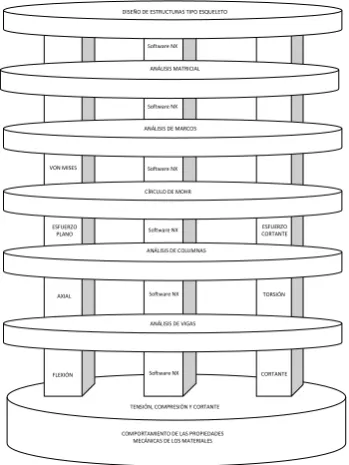
This organization is presented in a schematic mode in figure 2, which indicates the layers of knowledge to be documented and these are described next: Base knowledge. - Are the solid mechanic attributes and its behavior in the presence of frontier conditions (forces and supports) to which materials are exposed when they in basic geometric conditions.
Creative knowledge. - It emerges from the study of Mohr’s circle and Von Mises failure theory that allows to evaluate the failure criteria and the security conditions for structural elements.
Critical knowledge. - It is developed when there is an adequate competence in order to allow the design of skeletal structures with the computing mechanics support, in reduced time in relation to traditional methods without risking the security factor.
Transverse knowledge. – Is the one that allows to integrate solid mechanics and computing mechanics knowledge, this is achieved through NX software authentication which is based on FEM theory.
With this organization is possible to name three base knowledge which are:
Solid mechanics. Computing mechanics.
MEF based software management.
The purpose of dominating these knowledge in a basic level is centered in their aptitude for configuring an education in engineering students as “Analyst of themechanic attributes of metallic materials in solid state”. During the education it must be systematically combined the conscious and unconscious formal apprenticeship processes through a previous knowledge memory. In this education the cognitive learning is used, where the basic principle is a continuation to instructional processes in order to solve structural elements analysis problems which associate knowledge, abilities and skills previously developed in earlier courses.
Occasionally, the student is complemented with improvised laboratory practices and without calibration or equipment certification. This traditional education process limits the computing mechanics in a parallel way and the incorporation of a MEF based software which allows identifying and visualizing the found results in a pragmatic manner and, above all, applying them in favor of industrial design. In this competence unity the main objective seeks the student to understand the solid materials behavior in the presence of real industrial design solicitationsby the analysis of solid material mechanic attributes through the failure criteria evaluated in a MEF based simulation software.
Learning Ambits
Cognitive. - The student must know the solid mechanics theory and its application in the conduct analysis of the solid material attributes when they are submitted to industrial design requirements.
Affective. – The student must have an honesty and trust attitude to guarantee the most trustworthy material behavior evaluation in the presence of industrial design requirements without exposing the physical integrity of final users.
Psycomotor. - The student will know to use and handle measure instruments, technical drawing and calculus. As well as the use of a MEF based simulation software to model 1D, 2D and 3D structural elements.
Key qualities that allow to evaluate the KBES impact degree in the competence unity formation of Solid Mechanics II: knowing, measuring, calculating, analyzing, evaluating and communicating. At the same time the student, through the instructional pursuit that KBES demands, will be in conditions to improve his acing in competences associated to their profession development:
Methodologic Competence
The student will know to follow the KBES methodology for the search of information, based on the scientific method and the evaluation of its property on studying the mechanic attributes behavior of a solid metallic material.
Social Competence
The student will commit with the security evaluation process of industrial designs that guarantee the final users physical integrity of structural industrial designs or consumption products.
Figure 1 Knowledge organization necessary to develop a KBES in skeletal structures industrial design.
CÍRCULO DE MOHR
ANÁLISIS DE COLUMNAS
ANÁLISIS DE VIGAS
COMPORTAMIENTO DE LAS PROPIEDADES MECÁNICAS DE LOS MATERIALES ESFUERZO
PLANO
TORSIÓN ESFUERZO CORTANTE DISEÑO DE ESTRUCTURAS TIPO ESQUELETO
ANÁLISIS DE MARCOS ANÁLISIS MATRICIAL
TENSIÓN, COMPRESIÓN Y CORTANTE
FLEXIÓN CORTANTE
AXIAL VON MISES
Software NX
Software NX
Software NX
Software NX Software NX Software NX
989
Individual competences
The student will be able to generate knowledge, abilities and skills by developing the competence of a work post as “Analyst of themechanic attributes of metallic materials in solid state”, increasing his cognitive level through continuous experience of the performed evaluations to complex industrial designs.
Evidences of Obtained Competence by KBES
Objective Will understand the solid materials behavior in the
presence of industrial design solicitations by means of the mechanic attributes behavior analysis through failure criteria. POST: Analyst of themechanic attributes of metallic materials in solid state.
Characteristics
Analyzes the mechanic attributes behavior in structural elements.
Analyzes stresses through Mohr circle.
Verifies the security factor in function of Von Mises failure theory.
Apprenticeship Product
Validation tables of structural elements results both analytical and simulation by a MEF based software that indicate the results approximation percentage, look at table 3.
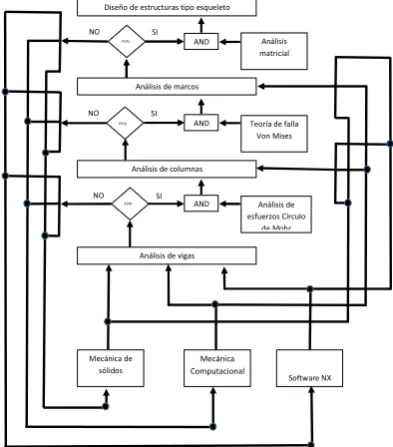
Beginning from the presented argumentation and derived from personal experience in engineering teaching, is possible to show in figure 3 the KBES model in skeletal structures industrial design developed to formalize the teaching of industrial design in engineering with a focus on the product development.
DISCUSSION
If PLM is a business activity orientated to know the company objectives to increase the product incomes under the CAD/CAM/CAE paradigm, the manner in which the company manages its products during their life cycle must be designed and defines proactively aside from being formally documented in the quality handbook. For that, the information domain (IM) and knowledge (KM) are indispensable in the decision taking, justifying the existence of a KBES that performs the transition of industrial design codified knowledge to a knowledge about product development (Stark, Product Lifecyle Management, 2015, pages 16,17). While PLM maintains a leader position in worldwide manufacturing, KBES represent a great area of interesting and opportunity to lead pertinence to curricular contents of plans and study programs of Engineering Degrees, due to PLM is used in a wide rank of industries who develop, produce and provide products. It is applied in discrete manufacturing, process manufacturing distribution and industrial services, although it can be also used in investigations, education and military and governmental organizations (Stark, Product Lifecycle Management, 2015, pages 23, 24).
The educational change that represents being immerse in the knowledge societies, implies dynamic and revolutionary changes without this having to be away from positive and negative experiences in product development, on the contrary these experiences have to be integrated through KM. The change of paradigm to PLM has had important consequences since manufacturing companies who have never been faced to such a radical change (as digital manufacturing) now will have to figure out how to answer to keep an economic competiveness. PLM is a new way to see product world since it offers new opportunities and new methods to organize resources in order to have benefits, principally for administrative areas, information and product application (Stark, Product Lifecycle Management, 2015).
Providing validity to KBES use in the industrial environment from the PLM implementation, allows to question if KBES have a national reach in a country technological development. In the “Classification of countries progress toward a knowledge economy based on machine learning classification techniques” (De la Paz-Marín, Gutiérrez, & Hervás-Martínez, 2015), is emphasized that academics, politicians, advisors and news media have exhibited an increasing interest in knowledge creation as a crucial factor which allows an increase of competitive advantages and, in consequence, of national economies. Being especially crucial in the uncertain environment, changing, ambiguous and complicated which characterizes nations at the present time, and it is why that nations need a knowledge based economy (KE).
The following conditions are examples where knowledge is essential for the actual economic growth of developed countries and developing countries, generating a new commercialization which generates capital flow in favor of SME.
Progress in information and communications technology that consents a cheap access and fast for knowledge and information;
Velocity in continuous increase of scientific and technological advances;
Table 3 Results collection form
DEFLEXIÓN
Type of structural
element
Mathematical solution
1D simulation
2D simulation
3D simulation
Mathematical solution exactness and
1D model
Cantilever 1.9 1.918 1.907 1.913 99.06%
GIRO
Cantilever 0.164 0.164 0.163 0 100.00%
Figure 3 KBES "Software NX" in the teaching of engineering Industrial design
Mecánica de sólidos
Mecánica Computacional
Software NX Análisis de vigas
Análisis de columnas Análisis de marcos Diseño de estructuras tipo esqueleto
AND Análisis matricial
AND Teoría de falla Von Mises
AND Análisis de esfuerzos Círculo
de Mohr
NO SI
NO SI
NO SI
EVAL
EVAL
990
Global competence; and new demands and habits ofcitizens.
In this context, governments must plan investments and develop competitive education systems which allow to train highly skilled workers in highly specialized works such as product design. KBES impact towards society isn’t excluded in first world countries, some developing countries have moved fast to develop a KBE. Likewise have identifies that superior education plays a key role as a part of the innovation triplex model.
The study sustains the perceptions of university leaders and academic personal, determining in particular that teaching and KBES application suggest a more integrated educative system which integrates elementary school, high school and superior education in order to work for an essential common objective: own technology development. With respect to economy and worldwide markets, the specialists (Iuga & Kifor, 2014) comment that this markets are characterized by the focus change of tangible resources towards intangible assets. In the context of a “knowledge economy”, knowledge and information management are key factors since these represent vital strategic resources of an organization. Nevertheless, many organizations struggle with the definition of this two organization areas and, also, delimit among them the correlated acting, because of that is necessary to draw a clear and understandable line of investigation and technologic development among knowledge management concepts and information that should be generated and impulse from IES. Managers must exert themselves to develop and keep an agile organization taking into account that they not only must handle information and knowledge as resources and indispensable assets, but also as separated entities.
The comprehension of these two concepts interaction is decisive for its optimal management (Iuga & Kifor, 2014). Being necessary that this economy concept must be imparted in engineering IES to keep a high competiveness on an international level. In a scientific study presented in Expert Systems with Applications (De la Paz-Marín, Gutiérrez P, & Hervás-Martínez, 2015) there is exposed an analytical focus to classify 54 countries during the years 2007-2009 according to their progress towards a knowledge economy (KBE). It was determined that knowledge economy has become the worldwide main trend in international society speaking of a worldwide level competiveness from XXI century. From analysis of knowledge economy characteristics and the establishment of a proper economical paradigm, it is allowed to accelerate innovation, considered by experts as a priority task for governments. In this context, the main interested need useful tools as KBES which supports the decision making and the accelerated manufacturing processes. Being that constantly changing market demand requires a fast answer that can only be achieved through design efficiency increase, using CAD/CAM/CAE platforms, based on research a KBES technology application in order to improve quality and product design efficiency.
CONCLUSION
It can be concluded that due to robustness and abstraction degree of methodologies that involve knowledge management (called KBE/KBS/KBES), these happen to be unpractical for companies (SME and international) that are just moving into
this type of technology. Especially when they are overwhelmed by certification and accreditation processes; in particular it is evident that significant time and considerable resources are required for its implementation. That is why IES must include in their engineering curriculum degree the product development competence and must add contents about information and knowledge management and KBES operation.
To impact in KBES development in manufacturing industry, the methodology to implement has to be centered in CAD/CAM/CAE tools as a way to integrate information and knowledge; the reason is because actually the accreditations and certifications guide the productive processes to PLM technology in order to generate slim institutions. As long as is sought a higher level and information coverage and knowledge of manufacturing activities and product design within an organization, it is necessary to resort to a higher reach tools as automation and programming languages; this without losing sight of interaction and interoperabilidad with CAD/CAM/CAE systems.
In regard to the planted objectives, these have been covered in a satisfactory way. Since documenting the KBES sate of art in this work and relating it to industrial design has been identified a high contents pertinence in the KBES development and had been proposed in the curricular actualization of the Engineering IES study programs.
Reference
Albarrán Ligero, J. (2008). Fundamentos del KBE (Knowledge Based Engineering). APLICACIÓN AL DISEÑO DE ENGRANAJES DE EJES PARALELOS
CON CATIA v5. Sevilla: Escuela Superior de Ingeniería.
Alcaide, J, Diego, J & Artacho, M. (2006). Diseño de
Producto. Valencia: Alfaomega.
Bano, S & Taylor, J. (2015). Universities and the knowledge-based economy: Perceptions from a developing country.
Higher Education Research and Development, 242-255.
De la Paz-Marín , M, Gutiérrez P, P & Hervás- Martínez, C. (2015). Classification of countries progress toward a knowledge economy based on machine learning classification techniques. Expert Systems With Applications, 562-572.
Ferré, M. R. (1990). El departamento de I+ D; Organización
y Control. Barcelona: MARCOMBO.
Frederick Ross, D. (2015). Distribution Planning and
Control. New York : Springer.
Gómez, A, Mas, F, Menéndez, J & Ríos, J. (2013). Knowledge based Application for Industrialization Design. Procedia Engineering, 318-326.
IMPI. (13 de 05 de 2016). IMPI en cifras 2015. Obtenido de IMPI: http:/ /www. impi. gob. mx/ ICIFRAS/ IMPI_ en_ CIFRAS_ene-mzo_2015.pdf
Iuga, V., & Kifor. (2014). Information and Knowledge Management and their Interrelationship within Lean Organizations. Academiei Fortelor Terestre, 31-38. Saurina, N. (13 de 05| de 2016). Ingenieria Basada en el
Conocimiento. Obtenido de Interempresas.net: http://
991
Stark, J. (2015). Product Lifecycle Management. En J. Stark,Product Lifecycle Management (págs. 23,24). Suiza:
Springer.
Stark, J. (2015). Product Lifecycle Management. Suiza: Springer.
Stark, J. (2015). Product Lifecyle Management. En J. Stark,
Product Lifecyle Management (págs. 16 - 17). Suiza:
Springer.
Stjepandić, J, Liese, H & Trappe, A. (2015). Intellectual Property Protection. En J. Stjepandić, N. Wognum , & W. Verhagen, Concurrent Engineering in the 21st Century
Foundations, Developments and Challenge (págs.
521-551). Zuiza: Springer.
Stjepandić, J, Wognum, N & Verhagen, W. (2015).
Concurrent Engineering in the 21st Century. Germany:
Springer.
Stjepandić, J, Wognum, N & Verhagen, W. (2015).
Concurrent Engineering in the 21st Century.
Foundations, Developments and Challenges. Zuiza:
Springer.
Ulrich, K & Eppinger, S. (2013). Diseño y Desarrollo de
Productos. México: Mc Graw Hill.
UNESCO. (2005). Hacia Las Sociedades del Conocimiento.
Francia: Impreso por Jouve, Mayenne France.
Valverde, A. (13 de 05 de 2016). ¿Ingeniería del conocimiento, reto y salvación para el sector plástico?
Obtenido de Interempresas.net: http:// www. interempresas.net/ Plastico/ Articulos/ Articulo. asp?A = 11872
Verhagen, W, Liese, H & Bermell-Garcia, P. (2015). Knowledge-Based engineering. 125-132.