e-ISSN: 2278-067X, p-ISSN: 2278-800X, www.ijerd.com
Volume 8, Issue 11 (October 2013), PP. 09-16
Citation Analysis of Technology Management Texts in
Selected Databases: A Comparison between 2002-2006
and 2007-2011
Chin-Hsiu Tai
1, Che-Wei Lee
2, Yender Lee
3\1Graduate School of Business and Operations Management, Chang Jung Christian University, No. 396, Sec. 1,
Changrong Rd., Guiren District, Tainan County 711, Taiwan (ROC).
2Institute for International Studies in Education, University of Pittsburgh, 5708 Wesley W. Posvar Hall,
Pittsburgh, PA 15260, USA.
3Graduate School of Business and Operations Management, Chang Jung Christian University, No. 396, Sec. 1,
Changrong Rd., Guiren District, Tainan City 71101, Taiwan (ROC).
Abstract:- In recent years, both academic and commercial sectors have recognized the importance of Technology Management, which has seen significant progress under the efforts of relevant organizations. To obtain quantified data to demonstrate the development of technology management, this study explored the intellectual structure of Technology Management research over the last decade by identifying the most important publications, the most influential scholars, and the correlations among the publications in which these scholars appeared. We employed techniques based on bibliometry and social network analysis to identify the intellectual literary pillars in the field of technology management. Our analysis included 29,572 citations in 1,167 articles published in SCI and SSCI journals between 2002 and 2011. We used our results to map a knowledge network of studies related to Technology Management in order to reveal current trends and provide a valuable resource for researchers seeking to access literature in this area. We hope that the results of our research will enable more scholars of technology management to publish their research in international journals.
Keywords:- citation analysis, co-citation analysis, technology management, intellectual structure, bibliometric techniques, social network analysis
I.
INTRODUCTION
Technology management is a process that involves planning, directing, controlling, coordinating, establishing and implementing technological capacity for the purpose of contributing to organizational strategy and realizing business goals. The increasing popularity of wireless portable devices (laptop computers, PDAs, and wireless telephones), has highlighted the importance of Technology Management in today’s society [1]. According to Sanchez Quiros, Isabel and Garcia-Tenorio Ronda, Jesus, the model used in Canadian Biotechnology companies was investigated to reveal the process of innovation according to the following: (1) identification of the most appropriate competitive strategy; (2) the mediating role of developments in Technology Management; (3) the decisive role of Technology Management in the development of organizational commitment; and, finally, (4) the effect of organizational commitment on organizational results [2]. Gholifar et al. applied structural equation modeling to investigate the factors influencing the psychological empowerment of faculty members regarding access to human resource development in colleges in Iran. Technology Management has been described as a dynamic, distributed system of wireless nodes that move independently from one another.
The objective of this study was to provide researchers in Technology Management a unique map with which to navigate related publications as well as a systematic, objective overview of various themes and concepts that are driving further developments in this area. We also sought to identify the linkage among various publications and confirm their status and position with regard to the development of this field. We employed citation and co-citation analysis, social network analysis, and factor analysis to identify the invisible network of knowledge generation underlying the literature related to Technology Management.
II.
DEFINITION AND CHARACTERISTICS OF TECHNOLOGY MANAGEMENT
A. Definition of Technology Management
Technology management is a recently emerged discipline in the fields of education and research. Although scholars have varying interpretations of what falls under “technology”, technology management can be briefly defined as follows: Technology management integrates knowledge from the fields of technology, engineering and management into the planning, development and operation of technological products in order to achieve organizational objectives. The scope of technology management covers improvement to R&D efficiency, acceleration of product development, technical strategy, industry policy, technology policy, intellectual property rights, technological development and humanistic society.
B. Characteristics of Technology Management
The high-tech industry is continually changing and exhibits such characteristics as short product lifespan, rapid technological development and high operational risk. In response to changing technology and resources, an increasing number of businesses are moving toward strategic alliances in which they hope to utilize their respective advantages for mutual benefit which will strengthen the position of each organization in its own area of specialization.
III.
THE STUDY OF ACADEMIC LITERATURE
Literature reviews are commonly used to study a body of literature; however, this approach tends to be somewhat subjective. Recently, quantifiable techniques have gained popularity, due to the growing availability of online databases. The objectivity of this approach makes these techniques particularly attractive [3].
A number of previous studies have explored the literature of management research using bibliometric techniques. In an examination of the intellectual structure of information systems research, Dillon, Taylor, and van Wingen noted that the discipline has shifted from fragmented adhocracy to a polycentric state, which is particularly appropriate to an applied discipline [4]. Zhao and Wang used co-citation analysis to identify the most influential authors and studies in the field of pervasive and ubiquitous computing [5]. Chen, Zhang, and Li transformed the original paper-reference matrix into a tool for visual analyses in their exploration of new approaches to reveal co-citation relationships [6].
Lin, Kuo, and McLee appear to have conducted the only current study in Technology Management, when they applied factorial analysis techniques to examine the research paradigms of web services [7]. To gain a deeper understanding of the literature gap in this area, we applied citation and co-citation analysis to recent studies in Technology Management, as cited from the Science Citation Index (SCI) and Social Sciences Citation Index (SSCI), covering more than 9,000 journal titles.
IV. METHODOLOGY
This study cited the following data: authors, journal articles, publication outlets, cited references, and publication dates. According to the objectives of this study, we included only those authors who explored the intellectual structure of Technology Management between 2002 and 2011. We selected this time period because studies over the last five years represent the most important research in this field. We employed citation and co-citation analysis as the research methodology. In the first stage, we identified publications related to Technology Management from databases. We then developed techniques to collect and analyze data related to authors, topics, and journals in this field.
Second, we analyzed and systematized the data through screening, ranking, sorting, summing, and sub-totaling. Key nodes in the invisible network of knowledge were identified prior to developing the structure. After several iterations, we produced a map outlining the knowledge distribution process in the field of Technology Management.
V.
RESULTS
A. Citation AnalysisExcel was used to tabulate the source documents and references in order to identify scholars in the field of Technology Management. Our background statistics obtained through citation analysis are as follows. As shown in Table 1, the most commonly cited journals in Technology Management over the last decade are
STRATEGIC MANAGE J MIS QUARTand MANAGE SCI.
We discovered that no journals dedicated to the field of Technology Management ranked higher than No. 14 in the area of “INT J TECHNOL MANAGE”, indicating that most researches in this area still prefer to publish in journals that are not specific to this field of research. This indicates that Technology Management has yet to develop into a fully-fledged field, due to a lack of specific systems for the generation and dissemination knowledge. According to a cluster of titles focusing on information systems, we determined that the general pattern among researchers in Technology Management is to cite journals specific to information systems and computers.
TABLE I:MOST FREQUENTLY CITED JOURNAL:2002-2011
Journals Total Citations
STRATEGIC MANAGE J 307
MIS QUART 264
MANAGE SCI 242
HARVARD BUS REV 179
ORGAN SCI 177
TECHNOVATION 171 ACAD MANAGE REV 162
RES POLICY 157
ACAD MANAGE J 148 JAMA-J AM MED ASSOC 148 ADMIN SCI QUART 135 DIABETES CARE 133
J MARKETING 128
INT J TECHNOL MANAGE 120 NEW ENGL J MED 105 R&D MANAGE 104
COMMUN ACM 102
We then identified the most influential scholars and the most influential documents according to the number of citations found in the selected journal articles. As shown in Table 2, the most commonly cited publications related to Technology Management between 2002 and 2006 were KNOWLEDGE CREATING C, STRATEGIC MANAGE J and ADMIN SCI QUART. As shown in Table 3, between 2007 and 2011, the three most commonly cited publications were KNOWLEDGE CREATING C , J MANAGE, and MIS QUART.
TABLE II:MOST COMMONLY CITED DOCUMENTS:2002-2006
Total Citations Full Citation Index For Document
16 Nonaka I., 1995, KNOWLEDGE CREATING C 9 Teece DJ, 1997, STRATEGIC MANAGE J, V18, P509 8 COHEN WM, 1990, ADMIN SCI QUART, V35, P128 8 Davenport T. H., 1998, WORKING KNOWLEDGE 7 Alavi M, 2001, MIS QUART, V25, P107
7 Grant RM, 1996, STRATEGIC MANAGE J, V17, P109 6 Leonard-Barton D., 1995, WELLSPRINGS KNOWLEDG 6 Norberg A. L., 2005, COMPUTERS COMMERCE S 6 PRAHALAD CK, 1990, HARVARD BUS REV, V68, P79
of Technology Management. Their contributions are the focus of most research in this field and an indication of the historical value as well as popularity of various topics in the field of Technology Management.
TABLE III:MOST COMMONLY CITED DOCUMENTS:2007-2011
Total Citations Full Citation Index For Document
17 Nonaka I., 1995, KNOWLEDGE CREATING C 14 BARNEY J, 1991, J MANAGE, V17, P99 13 Alavi M, 2001, MIS QUART, V25, P107 13 DAVIS FD, 1989, MIS QUART, V13, P319 12 Rogers E.M., 1995, DIFFUSION INNOVATION
10 COHEN WM, 1990, ADMIN SCI QUART, V35, P128
10 FORNELL C, 1981, J MARKETING RES, V18, P39
9 Bharadwaj AS, 2000, MIS QUART, V24, P169
9 EISENHARDT KM, 1989, ACAD MANAGE REV, V14, P532
8 DAVIS FD, 1989, MANAGE SCI, V35, P982
By means of the citation analysis, we do not eliminate the bias against younger scholars who places more emphasis on the quality (as opposed to the quantity) of the documents produced by a given scholar than a ranking of authors based on the frequencies with which a particular author has been cited (as in Table 4 and 5), a paper-based ranking (as in Table 2 and 3). These results further indicate that a high number of citations can influence what is termed field-defining titles, laying the ground work for an understanding of Technology Management as a distinct phenomenon. We compared Table 2 with Table 3 to identify patterns in the first five years with patterns in the second five years. To begin with, the two most influential publications in the last five years indicate that their dominant status for the past five years on Technology Management researches.
TABLE IV:MOST COMMONLY CITED AUTHORS:2002-2006
Author Frequency Author Frequency
RANKY P.G . 26 AMASAKA K. 16 KARWOWSKI W. 20 NOAH L. 16 MACMILLAN K.L. 20 GRANT R.M. 15 Nonaka I. 20 Granstrand O. 13 Teece D.J. 19 Nonaka I. 13
TABLE V:HIGHLY CITED AUTHORS:2007-2011
As show in the table, the total number of citations is gradually increasing, which indicates that Technology Management is increasingly recognized as an academic field and gaining increased recognition in the literature. Few differences were observed between the most influential papers in the first five years and those in the last five years. In fact, four of the top five most cited publications remained the same, despite slight differences in ranking. Of particular note is the fact that the publications of RANKY P.G., KARWOWSKI W., MACMILLAN K.L., Nonaka I., and Teece D.J. are in the top five most cited publications in the first five years as well as the last five years. This result indicates that a small number of influential authors still dominate the field of Technology Management and more theoretical breakthroughs will be required to further develop this area of study.
B. Co-citation Analysis
We further employed bibliometric techniques to perform data mapping in order to reveal the intellectual structure of current research in the field of Technology Management. We counted documents
Author Frequency Author Frequency
selected from paired or co-cited documents in matrix form to capture statistical snapshots at distinct points in time [9].
Co-citation analysis for each of the source documents was tabulated using Excel. This proved difficult because many of the authors had very few co-citations which meant that they were unlikely to have had a significant impact on the development of the field. In addition, their co-citations may also have been too new to have had an impact on the literature. To improve the efficacy of analysis, we required that the authors selected in the final set had at least 30 citations during the first five years and 30 during the last five years. The top scholars were identified according to the total number of citations in the selected journals.
Four factors were extracted from the data in the first five years, the sum of which explained over 74.8%of the variance in the correlation matrix. Table 6 lists the four most important factors along with the authors that had a factor loading of at least 0.5. As is common in this type of analysis, authors with less than a 0.5 loading or with cross-loadings were dropped from the final results [10].
We tentatively assigned names to the factors on the basis of our own interpretation. Our interpretation of the results led us to conclude that research in Technology Management during this period comprised at least three sub-fields: Agency theory, management systems, and biomedical innovation (Fig. 1). Due to their small eigenvalues, we made no attempt to interpret the remaining factors and excluded them from Table 6.
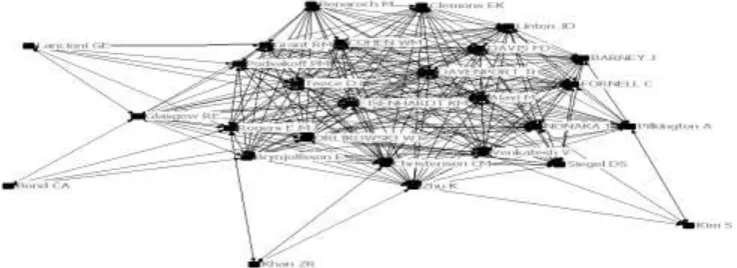
Over the last five years, studies in Technology Management also clustered around various research themes, the sum of which explained over 84.8% of the variance in the correlation matrix. Table 7 lists the four most important factors along with the authors that had a factor loading of at least 0.5. Our interpretation of the results led us to conclude that research in Technology Management during this period comprised at least four sub-fields: dynamically-competitive, field studies , infrastructure, and information technology (Fig. 2).
Table 6 presents the clustering of the most influential authors in Technology Management from 2002 to 2006. The main research focused on Agency theory, two dynamic routing protocols for ad hoc networks Dynamic Source Routing protocol [11], and information technology and much of this research was performed by Das, Perkins, and Royer [12].
Interestingly, the common characteristic of Dynamic Source Routing protocol and information technology is that both initiate routing activities on an on-demand basis. The reactive nature of these protocols demonstrates how these differ from traditional proactive protocols [11]. Studies on information technology and Dynamic Source Routing protocol found a route to the destination using the flooding method, such that the number of rebroadcasts of route request packets is proportional to the number of nodes [13].
Fig.1:key research themes in technology management (2002-2006)
Authors dealing with Multipath routing in the second group are also shown in Table 6. In these studies, multiple paths are established to obtain direct control over each path, thereby increasing reliability, performance, and security.
The authors in the third group dealt with grid location service (GLS) combined with geographic forwarding that allows scaling to a larger number of nodes than possible with previous solutions [14]. Broch et al. provide overviews of these ad hoc routing techniques, along with comparative measurements using 30-50 nodes simulations [15]. GLS can be used as a location service in a routing protocol to considerably improve the scaling properties of mobile networks.
As shown in Table 7, over the second five years, the most influential authors clustered together around On-demand Routing. Toh presented routing protocols for ad hoc networks, mobility, and power conservation, including DSR and Associativity based routing (ABR) that initiate routing activities on an on-demand basis [16]. The authors in the second group dealt with Secure Technology Management. Zhang and Lee claimed that intrusion detection can complement intrusion prevention techniques to improve network security [17]. Zhou identified the absence of a fixed infrastructure as the single most important feature of security services [18]. The authors in the third group dealt with Multipath Routing. Lee and Gerla claimed that Multipath routing can be useful in improving the effective bandwidth of communication pairs, dealing with bursty traffic, responding to congestion, and increasing delivery reliability [19].
TABLE VI:AUTHOR FACTOR LOADINGS:2002-2006
Factor 1 Factor 2
Agency theory 57.30% management systems 11.30% Eisenhardt K.M. 0.983 Alavi M. 0.834 Grant R.M. 0.982 Karwowski W. 0.649 Kogut B. 0.974 Grover V. 0.625 Teece D.J. 0.964 Davenport T.H. 0.558
Porter M.E. 0.963 Factor 3
Cohen W.M. 0.959 biomedical innovation 6.20% Prahalad C.K. 0.956 Noah L. 0.613 Dyer J.H. 0.952 Brown J.S. 0.606 Nonaka I. 0.88
Rogers E.M. 0.878 Granstrand O. 0.867 Hamel G. 0.777 Drejer A. 0.74 Davenport T.H. 0.687 Choi T.Y. 0.655 Grover V. 0.629 Lemley M.A. 0.545
TABLE VII:AUTHOR FACTOR LOADINGS:2007-2011
Factor 1 Factor
2
Factor 4
dynamically-competitive
39.60% field studies 15.40% Technology Management
9.70%
Grant R.M. 0.915 Venkatesh V. 0.866 Bond C.A. 0.699 Cohen W.M. 0.911 Rogers E.M. 0.845 Glasgow R.E. 0.626 Barney J. 0.908 Davis F.D. 0.844 Zhu K. 0.541 Eisenhardt K.M. 0.907 Factor
3
Pilkington A. 0.53
Teece D.J. 0.894 infrastructure 9.90% Lancioni G.E. 0.504 Christensen C.M. 0.894 Kim S. 0.709 Khan Z.R. 0.5 Nonaka I. 0.85 Pilkington A. 0.699 Factor 5
Linton J.D. 0.784 Zhu K. 0.698 Information Technology
6.50%
Siegel D.S. 0.781 Glasgow R.E. 0.562 Benaroch M. 0.839 Davenport T.H. 0.774 Clemons E.K. 0.608
Brynjolfsson E. 0.75 Factor 6
Orlikowski W.J. 0.717 Khan Z.R. 0.622 Podsakoff P.M. 0.654 Lancioni G.E. 0.541 Alavi M. 0.606
Fornell C. 0.54
VI.
CONCLUSION
There has been extensive research in the field of Technology Management over the past decade. This study investigates this research using citation and co-citation data published in SCI and SSCI between 2002 and 2011. This study used factor analysis of co-citation data to create a study map of the intellectual structure of research in Technology Management. Our findings suggest suggests that the contemporary Technology management research in this field is organized along different concentrations of interestscentered around the following topics: dynamically-competitive, field studiesTechnology management, and infrastructure. It appears that Technology Management has created its own literature and gained a reputation as a legitimate academic field. Journals specific to Technology Management, such as STRATEGIC MANAGE J, MIS QUART, and MANAGE SCI, have gained the status required for an independent field of research. Technology Management is still in its infancy and our analysis shows that it has an evolving structure. When we better understand the current paradigms and key research themes in Technology Management, it is believed that publications in this field will gain popularity and prestige. This will increase the available resources and talent with a positive influence on the cross-fertilization of ideas specific to this area of research in turn.
REFERENCES
[1]. J. Broch, D. A. Maltz, D. B. Johnson, Y. C. Hu, and J. Jetcheva, “A performance comparison of multi-hop wireless ad hoc network routing protocols,” Proceedings of the 4th Annual ACM/IEEE International Conference on Mobile Computing and Networking, pp. 85-98, 1998.
[2]. S. R. Das, C. E. Perkins, and E. M. Royer, “Performance comparison of two on-demand routing protocols for ad hoc networks,” Proceedings of INFOCOM 2000 9th Annual Joint Conference of the IEEE Computer and Communications Societies, vol. 1, pp. 3-12, 2000.
[3]. E. Gholifar, S. Y. Hedjazi, S. M. Hoseini, and A. Rezaei, “Human resource development: Faculty members' psychological empowerment in Iran's colleges,” African Journal of Business Management, pp. 12249-12255, 2011.
[4]. S. J. Lee and M. Gerla, “Split multipath routing with maximally disjoint paths in ad hoc networks,” ICC 2002 IEEE International Conference on Communications, vol. 10, pp. 3201-3205, 2002.
[5]. J. Li, J. Jannotti, D. S. J. De Couto, D. R. Karger, and R. Morris, “A scalable location service for geographic ad hoc routing,” Proceedings of the 6th Annual International Conference on Mobile Computing and Networking, pp. 120-130, 2000.
[6]. C. C. Lin, Y. McLee, and J. H. Kuo, “Web services: Themes, concepts and relationships,” International Journal of Machine Learning and Computing, vol. 1, no. 2, pp. 199-204, 2011.
[7]. C. Perkins and E. Royer, “Ad hoc on-demand distance vector routing,” Proceedings of the 2nd IEEE Workshop on Mobile Computing Systems and Applications, pp. 90-100, 1999.
[8]. 8. I. Sanchez Quiros and J.G.T. Ronda, “The relationship among innovation strategy, Technology Management practices and commitment generation in the biotechnology sector,” African Journal of Business Management, pp. 13159-13168, 2011.
[9]. H. G. Small, “Macro-level changes in the structure of co-citation clusters: 1983-1989,” Scientometrics, vol. 26, pp. 5-20, 1993.
[10]. J. H. Song, V. W. S. Wong, and V. C. M. Leung, “Efficient on-demand Routing for mobile ad hoc wireless access networks,” IEEE Journal of Selected areas in Communication, vol. 22, no. 7, pp. 1374-1383, 2004.
[11]. C. K. Toh, “Associativity-based routing for ad hoc mobile networks,” Wireless Personal Communications, vol. 4, no. 2, pp. 103-139, 1997.
[12]. K. A. Walstrom and L. Leonard, “Citation classics from the information systems literature,” Information & Management, vol. 38, pp. 59-72, 2000.
[13]. C. H. Wang, Y. McLee, and J. H. Kuo, “Mapping the intellectual structure of digital divide,” International Journal of Social Science Humanity, vol. 1, no. 1, pp. 49-54, 2011.
[14]. D. H. White and K. W. McCain, “Visualizing a discipline: An author co-citation analysis of information science,” Journal of the American Society for Information Science, vol. 49, pp. 327-355, 1995.
[16]. J. Zang, C. M. Chen, and J. X. Li, “Visualizing the intellectual structure with paper reference matrices,” IEEE Transactions on Visualization and Computer Graphics, vol.15, no. 6, pp. 1153-1160, 2009.
[17]. Y. Zhang and W. Lee, “Intrusion detection in wireless ad hoc networks,” Proceedings of the 6th Annual International Conference of Mobile Computing and Networking, pp. 275-284, 2000.
[18]. R. Y. Zhao and J. Wang, “Visualizing the research on pervasive and ubiquitous computing,” Scientometrics, vol. 86, no. 3, pp. 593-612, 2011.