Page 314 www.ijiras.com | Email: [email protected]
Comparative Study Of The Levels Of Heavy Metals In Fresh And
Used Lubricating Engine Oils Distributed In Nairobi, Kenya
Willy Siele
Msc. Chemistry Postgraduate Student at JKUAT, NAIROBI
George Thuku Thiong’o
Jomo Kenyatta University of Agriculture and Technology, Chemistry Department, NAIROBI
Peter Githira Njuguna
Jomo Kenyatta University of Agriculture and Technology, Chemistry Department, NAIROBI
Anthony Ndegwa Kinyua
Msc. Chemistry Postgraduate Student at JKUAT, NAIROBI
I. INTRODUCTION
Engine lubricating oil is one of the most used product in our everyday life in industries and automobiles and because of its widespread usage it poses a great danger as an environmental pollutant and other associated health hazards or risks such as threat to aquatic life. Since it is a mandatory commodity to use, studies on the levels of hazardous components such as heavy metals that have been identified as the potential environmental pollutants has to be done. It is worth noting that due to growing Kenyan economy, new
industries are coming up, more and more people are acquiring motor vehicles hence the upsurge in the demand of engine oils and consequently, large volumes of lubricating oils are consumed. Statistics has shown that lubricating oil has recorded increased consumption as a proof of the growth of transport vehicles and machinery for use in agriculture and manufacturing industries. Figure 1 shows consumption of total petroleum products in million metric tonnes and in thousand metric tonnes of lubricating oils according to the Petroleum Institute of East Africa (PIEA, 2016).
Abstract: Engine Lubricating oils are essential products and the quality of used lubricating oils is of great importance. It calls for careful examination of the quality of spent engine oils before disposal because they are usually loaded with heavy metals which pose a threat to the environment. The determination of heavy metals in used lubricating engine oil is essential for the assessment of environmental acceptability. The research established a comparison of heavy metals (Pb, Fe, Cu, Cr, Sn, V, Ni and Ag) concentration in fresh engine oils and progressive increase in concentration during its usage in the engine until it was drained. The study revealed the correlation of the heavy metals concentration with the oil brand and type as well as a progressive increase in the concentration of heavy metals over distance travelled. This was achieved by sampling and analysing the samples collected at regular intervals of approximately 2500 km travelled so that a continuous set of data was generated during the study. Vehicles in regular maintenance service from reputed vehicle service companies in Nairobi were considered for the study. The sampling of vehicles used in the study used a quota sampling where all medium and heavy engine vehicles in a particular maintenance service station was given equal chances of selection with restriction on the maximum mileage of 210,000 km. ASTM D6595-16 standard method was employed in which trace quantities of elements dissolved and suspended as fine particles in the lubricant were measured using the rotating disc electrode (RDE) AES and the results compared with the NEMA, EPA and Idaho administrative code maximum allowable limits.
Page 315 www.ijiras.com | Email: [email protected] Noting that these lubricants once used are rarely treated to
remove toxic heavy metals, they eventually find their way into the ecosystem and hence polluting soil, water points and food. More importantly, it poses health risks on the people handling the used oils as the oils are known to be carcinogenic and carries heavy metals which are detrimental to health. Toxicological studies of these heavy metals have established that used lubricating oil is toxic to humans [Tamada et al., 2012]
The removal of Lead and Barium using Kaolinite (Aluminium-silicate) sorbent from the used lubricating oils has been studied [Mathew, 2004] in which an inorganic sorbent to adsorb heavy metals emission from incinerated metal containing waste lubricating oil has been done.
Other related study on distribution of heavy metals and hydrocarbon contents in an alfisol contaminated with waste-lubricating oil ammended with organic wastes has been done [Adesodun and Mbagwu]. The results indicated higher accumulation of Cr and Ni in twelve months, while Pb and Zn diminished with time. The results further showed higher accumulation of Cr followed by Zn, relative to other metals, with oil pollution.
In the article entitled the feasibility studies on sonochemical processes for treating used oil, a chemical-aided ultrasonic irradiation method was used to remove the heavy metals from used oil [Chia, 2008].
Cleaning of heavy metals from spent lubrication oil by adsorption process using acid modified clay [Atsar et al., 2013] proved very effective in the removal of heavy metals from spent lubricating oil. In this study, spent lubrication oil was treated with naturally sourced clay materials modified with three different mineral acids. 1.0 M of nitric, sulphuric and phosphoric acids were used to modify the natural clay. Analysis of the spent lubricating oil showed the presence of Pb, Zn, Fe, Cu, Cr, Mn and Ni. Fe and Zn had the highest concentration of 73.4 mg/L and 24.1 mg/L respectively while Cu had the lowest amount of 0.02 mg/L [Atsar et al., 2013].
It is generally believed that 3,000-mile oil change is suitable and various customers hold on to it only because they are basically ignorant of advances in automotive technology. The majority of OEMs call for oil changes between 7,500 to 10,000 miles which is more than twice the conventional 3,000-mile interval. Oil change intervals using synthetic oil is normally much longer than mineral based engine oils [Edmunds, 2015].
Figure 1: Trends of total petroleum products and lubricant sales in Kenya, PIEA
Levels of contamination in waste oils vary extensively, depending on different types of uses or oil change interval of the virgin lube oil and hence EPA has established a set of used oil specifications to control the potential hazards posed by used oil when burned for energy recovery. Table 2 provides
these allowable parameters for the waste oil to be used as fuel as applied by EPA and Idaho administrative code [EPA, 1993 and Idaho, 2005]
Comparison between heavy metals (Cd, Co, Cr, Cu, Fe, Ni, Pb) concentration in fresh and used lubricating oils using flame atomic absorption spectroscopy have been examined in Yemen [Nozil et al., 2014]. The study established an elevated concentration of heavy metals in all the used lubricating oils. The dry-ashing method adopted depicts the presence of various metals in varying levels in all the investigated metals. Fresh oils from shell reported higher concentrations of the heavy metals, whereas Fuchs oil had the lowest. Using a new filter was found to reduce the Pb concentration even with long mileage.
Investigation to compare the heavy metals content against mileage for two different engines using different lubricating oil brands has been done [Nozil et al., 2014]. Fuchs Titan super GT brand was used on Toyota TownAce engine and Petromin super was used in Suzuki VIP engine. The results demonstrated a consistent increase in heavy metals concentration against the distance travelled. From their results they concluded that heavy metals present in all lubricating oils sample increases with mileage and that copper and iron were below the limits. In a related study the same authors determined the changes in the properties of the lubricating oil with respect to travelled distance. In the study the changes in total base number, kinematic viscosity, flash point, viscosity index, foaming tendency and pour point of two lubricating oil samples were evaluated with respect to mileage in order to assess the deterioration and the optimal oil drain interval. Using the heavy metals content, FTIR spectral analysis and the physicochemical test properties of the oils, the combination of all the results suggested that the oil samples can possibly be used up to 3000 km, however, the flash point and foaming tendencies increases sharply beyond this point.
The trace elements from used lubricating oils usually find their way into water bodies such as rivers, lakes, oceans or seas. Extracts from trend analysis performed over a given period in the Total ANAC database depicts the trends in the accumulation of wear elements over a period of time or distance travelled for various elements in engine oils. There is a general increase in concentration in all the wear elements analysed against distance covered.
Some oil brands exhibit higher value of wear elements in parts per million. This is a fact that has been demonstrated by previous comparative studies of used engine and fresh engine oils based on property analysis. The Pb concentration exhibited higher concentration in Castrol Magnatec oil SAE 5W30 multigrade [Syarifa et al., 2013]. The mild cluster elements category (Sn, Cu and Ag) shows decreasing value of wear compared to its unused oil. The wear elements for both the Perodua Genuine and Castrol Magnatec oils were similar, which consisted of Sn, Cu, Ag, and Pb. The difference on the severity of wear was on Lead observed in both Perodua Genuine and Castrol Magnatec oil in which CM presented higher wear values.
Page 316 www.ijiras.com | Email: [email protected] observed rise in the concentration of the heavy metal
concentration.
Environmental degradation has become a major societal issue due to uncontrolled anthropogenic activity and natural factors. Entry of toxic heavy metals into human system is mainly through contaminated water, food and air. This leads to dangerous health problems. At times expensive modern corrective measures (e.g. refining of used engine oils) are not easy for a third world country like Kenya and hence emphasis has to be on preventing the used engine oils from getting into environment before prior treatment. The major hazardous metals of concern in Kenya in terms of their environmental and health effects are lead, chromium, vanadium and nickel. Human activities and vehicle emissions are the most common airborne routes through which these heavy metals find their way into the environment. Natural processes like leaching from rocks, volcanicity and forest fires can also contribute minerals like arsenic salts of natural origin. Motor vehicle emissions are a major source of airborne contaminants including cadmium, cobalt, nickel, lead, antimony, vanadium, zinc, platinum, palladium and rhodium [Balasubramanian and Wang, 2009]
Hazardous heavy metals are crucial global problem in that they pollute the environment to a great extent. These elements are chemically stable, bio-accumulative and hard to establish their safe limits. The oxidation state for these metals determines toxicity of these elements. Elements like Fe, Zn, Cu, Co, Mn and Ni are essential minerals for human metabolism but may be toxic at higher levels. Others like Hg, Pb, and Cd and As have no beneficial role at all.
Although some heavy metals are essential trace elements, majority can be toxic to all forms of life at higher concentrations due to complex compounds formed in the cells. Biodegradation is not possible in heavy metals once introduced into the environment unlike in the organic waste which can be degraded by microorganisms. They persist indefinitely and cause air, water and soil pollution. Thus, the main strategy of pollution control is to reduce the bioavailability and mobility of metals.
Remediation methods of heavy metal-contaminated environments include physical removal, detoxification, bioleaching, and phytoremediation [Seid et al., 2011]. Microorganisms have evolved several intolerance mechanisms e.g. adsorption, complexation and reduction of metal ions by using them as terminal electron acceptors in anaerobic respiration.
Lead acid battery manufacturing plants are the main source of lead in the environment. Recycling of old batteries also pose a great risk to the environment as it releases lead into the environment in the ionic form Pb2+. Smelting plants of scrap metals in addition introduces As, Ni, Cr and Cd into environment since these metals are used in various metal alloys. Moreover, metals which are electroplated with copper, zinc and silver releases these elements to the environment during smelting operations in the recycling plants of scrap metals [Bahadurshah, 2011].
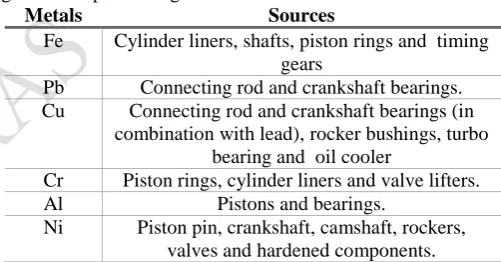
The sources of various heavy metals are also well defined in the oil analysis reports of many oil-testing laboratories. Total ANAC specifically states the sources of each wear
element in the engine lubricating oil as shown in Table 1 [ANAC, 2015].
Management of used oil is primarily done using three methods; refining into base oil for reuse, distillation into marine diesel oil fuel and using it as untreated fuel oil [Boughton, 2004]. The third method is the most undesirable as it pollutes the environment significantly. When utilized as fuel oil, emission of lead and zinc goes up 150 and 5 folds respectively than when refined or distilled. It has been established that Zinc and lead from used oil are the major contributors to the earth surface and toxicity to terrestrial life [Boughton, 2004].
Since it is quite expensive to refine or distil used oil into base oil or marine diesel oil fuel, majority of used oil management methods adopts combustion method as a way of disposing used oil. However, this method is of high concern to environmentalist because of the high concentration of heavy metals it releases into the environment. This study highlighted the heavy metals in used engine oils especially at the time it is drained from the engines.
Before the ban on the use of leaded gasoline fuel, environmental lead pollutant originated mainly from gasoline engine exhaust fumes. Likewise, Zinc in the environment largely emanates from motor oils, tire wear, corrosion of galvanized parts and greases.
Metals Sources
Fe Cylinder liners, shafts, piston rings and timing gears
Pb Connecting rod and crankshaft bearings. Cu Connecting rod and crankshaft bearings (in
combination with lead), rocker bushings, turbo bearing and oil cooler
Cr Piston rings, cylinder liners and valve lifters.
Al Pistons and bearings.
Ni Piston pin, crankshaft, camshaft, rockers, valves and hardened components.
Table 1: Sources of heavy metals in engine parts
Each heavy metal has associated toxicity effects in humans and animals alike. Clinical data detailing the toxicological impact of each of heavy metals found in fresh and used engine oils have been documented. In Kenya, no study has been done to determine at what point and how much heavy metals are introduced into the lubricant from the time the fresh oil is applied into the engine oil sump up to the time it is drained. These heavy metals negatively affect used-oil handlers e.g. vehicle mechanics who are exposed to the oil. Furthermore, lubricants containing heavy metals contaminate soils in places where there is severe spillage such as garages, water bodies when runoff water emanating from such contaminated soils finds its way to rivers, springs and other water points.
Page 317 www.ijiras.com | Email: [email protected] is reached when the oil heavy metal load goes beyond the
allowable limits.
The present study established a point at which the lubricating oil usage becomes heavily loaded with toxic heavy metals for the lubricants widely distributed in Kenya. The oil running hours, engine type and make, determine the kind of toxic heavy metal present in the lubricant since various metal parts have different metal alloys or coating with lead, chromium, nickel, silver and vanadium which wear out during operations and thus release these metals into the lubricant used.
II. MATERIALS AND METHODOLOGY
A. SPECTROCHEMICAL ANALYSIS
The choice of vehicles where the samples were collected from was done carefully with the following criteria strictly considered:
The vehicles were under regular operating schedules.
The vehicles were in regular service and maintenance schedules; this allowed the sampling of all the five intermediate samples until the oil was exhausted and discarded (drained).
The highest total mileage of the vehicles was not greater than 210,000 km to avoid using a vehicle which was too old.
The use of vehicles which met the above criteria justified the assumption that vehicles with longer mileage which do not operate on regular service maintenance have a tendency to produce used engine oils richer in wear metals (heavy metals) than new vehicles with lower mileage.
Fresh oil samples were collected before topping the oil sump of the sampled vehicles whose registration numbers, sump capacity, fuel capacity, make, model and type are known and the initial tachometer reading recorded. The oil analysis results of the fresh oil were used as the point of reference or the benchmark against which intermediate samples were measured. The used oil samples were collected from sampled vehicles every time at approximately 2500 km interval until the oil was drained and a fresh one added. Table 3 shows the details of the vehicles, brand names of the lubricants used and sample identification information.
Two important criteria for achieving representative used oil samples were strictly followed. First, the sample was extracted from a moving volume of lubricant. The samples were only extracted when the lubricant was in circulation and thus a very homogenous and representative sample of the sump volume was collected every time the sample was drawn [Yuegang, 2014].
Secondly, the oil sample was extracted when the machine had been running for several hours before the time of sampling [Bosch, 2014]. About 120 ml of sample sufficient for complete analysis was tapped. The bottles were then sealed to avoid contamination en route to the lab for analysis.
ASTM D6595-16 for determination of wear metals and contaminants in used lubricating oils and used hydraulic fluids by rotating disc electrode atomic emission spectroscopy (RDE-AES) was used. This method provided a quick
indication for abnormal wear and the presence of contamination in new or used engine lubricants. Conostan certified oil analysis standards were used for calibration. The test method detects and quantifies elements resulting from wear and contamination ranging from dissolved materials to particles approximately 10 µm in size and this explains why Spectroil M rotrode atomic emission spectrophotometer was preferred to inductively coupled plasma AES in analysing the samples collected.
B. QUALITY CONTROL
The multi-element certified oil analysis calibration standard solutions (Conostan oil-soluble organometalic complexes) were used. A quality control check sample was analysed after 25 samples during intermittent operation to confirm that the instrument was still within the required ±10 % accuracy guidelines for each element of interest. [ASTM, 2016]
III. RESULTSANDDISCUSSION
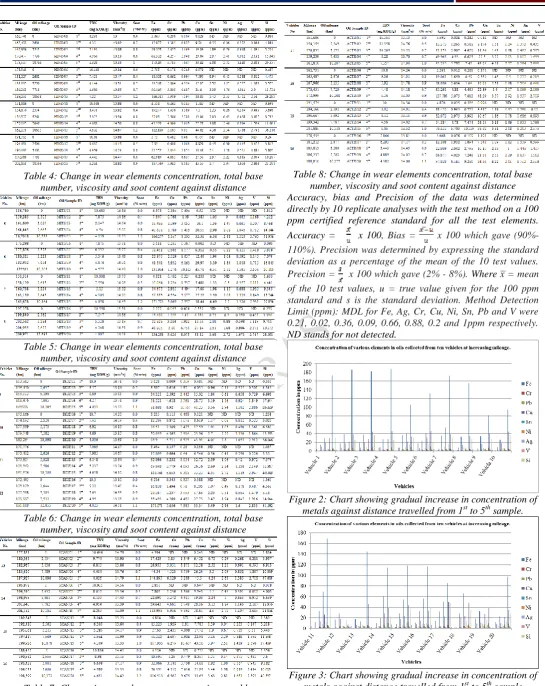
All the wear elements analyzed from 100 samples collected from the 20 vehicles were tabulated in tables 4 to 8. From the data obtained, elements with minute concentrations, moderate concentrations and the most predominant elements in the used oil are clearly illustrated which is in agreement with what previous studies has shown [Syarifa et al., 2013]. In addition, comparison of the concentration of all the heavy metals in fresh oil with the used oil shows a gradual increase in the metals concentrations right from the first sample (fresh oil) all through the three intermediate samples up to the last sample (5th sample) before drainage. This trend was observed in all the twenty vehicles sampled. All the results were plotted in a bar graph (Fig. 2 and 3) so as to give a clear representation of gradual increase in heavy metals from the first to the fifth sample.
Page 318 www.ijiras.com | Email: [email protected] and Idaho administrative code, most of them exceeds the
upper limits.
After examining all the results for the fresh oil before use in all the lubricant brands, it was observed that the concentration of their wear metals were generally lower than the used oils. The data from all the samples indicated that iron was the most prevalent heavy metal in the used oil. This was followed closely with copper, vanadium, chromium, tin, nickel and silver respectively.
From the data, it was also noted that with increasing distance covered there was a consistent increase in silicon concentration and this was evidenced in all samples analysed. This phenomenon is attributed to dust which finds its way through the air filter. The entry of dust containing abrasive dust into an engine accelerates wear and hence the increase in the concentration of the various elements in the intermediate samples.
The three physicochemical parameters (Viscosity, total base number and soot) also displayed expected pattern for engine oils in use as shown in Table 4 to 8. The average viscosity at 100°C for all the lubricants throughout the study period was 13.99 mm2/s which actually fall within the SAE (Society of automotive engineers)limits for 15w40 grade engine lubricating oils. Increasing soot content results in thickening of the lubricant and consequently increasing the viscosity of the oil which consequently increase wear of the engine.
Increased wear of the piston, liners and rings explains the increasing concentration iron, aluminium and chromium. Chromium is a constituent element of metal used in manufacturing piston rings, cylinder liners and valve lifters. On the other hand, iron forms about 96% w/w of the whole engine in most iron based engine blocks and connecting rods - that’s why its concentration is higher compared to the other elements.
Similarly, the simultaneous decrease in Total Base Number and the increasing soot content has a direct relationship with increased wear and hence increased concentrations of the wear elements as tabulated in Table 4 to 8. Low TBN (Total base number) and high soot content compromise the ability of the oil to protect the engine hence accelerates wear and consequently increases the heavy metals concentrations.
It was observed that the iron concentrations from the 2nd to the 5th sample do not conform to the NEMA standards for effluent discharge into the environment which is set at 10 ppm. However, EPA and Idaho administrative code has not set any maximum on iron concentration for used oil.
All the samples collected had less than 10 ppm concentration of chromium and hence complied with EPA standards on this particular heavy metal. However, Idaho administrative code and NEMA sets the maximum limits at 0.33 ppm and 2.00 ppm respectively and based on this all the 5th samples reported values more than 2 ppm and hence they do not conform to these standards.
Since the maximum limit set for Lead according to EPA standards is very high, it is clear from the data that all the used oils are permissible to be used as fuel oil. The highest value reported was 10.757 ppm taken from sample identity ISUZ/05 which used Rubia Tir 7400. On the other hand, both NEMA
and Idaho administrative code limits are stringent on this parameter and thus none of the 5th used oil sample could have been permitted to be discharged into the environment without prior treatment to remove lead. Similarly, copper according to NEMA standards disqualifies all the used engine oils since the 5th sample of all the lubricants had copper concentration greater than 1 ppm. Limited data is available on the toxicological consequences of tin and hence all the three standards did not mention the maximum limits. However, it is reported that over 200 mg/kg daily intake can develop short-term effects in some people [EFSA, 2005].
NEMA sets nickel concentration at 3.00 ppm and apparently none of the used oil samples tested had concentration of nickel above 3 ppm. In fact the highest value reported was 2.996 ppm which was slightly below the set limit. The delisted level for silver concentration is 0.3 ppm according to Idaho administrative code. This value is relatively stringent and thus disqualifies all the twenty samples drawn on the 5th round of sampling. This was also the case with vanadium which as per Idaho standards none of the samples could have pass the compliance limits of 2 ppm.
Concentration of metals in ppm Standards Fe Cr Pb Cu Sn Ni Ag V
NEMA: Standards for
effluent discharge into the environment
(3rd schedule)
10.0 2.0 0.1 1.0 x 0.3 x x
NEMA: Standards for
effluent discharge into
public sewers (5th schedule)
x 2.0 1.0 1.0 x 3.0 x x
Idaho administration
code
x 0.33 0.15 x x x 0.30 2.00
EPA Maximum allowable limits for waste oil
x 10.0 100.0 x x x x x
X stands for no data available.
Table 2: Metal concentration set by NEMA, EPA and Idaho administartive code
Vehicle Make and swept volume. Oil brand Sample identity
HINO RANGER JO7C
6634 cm3
DeoMax HP HINO/05
DX Super HINO/10
Rubia Tir 7400 HINO/15
Rimula R4 X HINO/20
MITSUBISHI FH 6D34-0AT2
5867 cm3
DX Super MITS/05
DeoMax HP MITS/10
Rimula R4 X MITS/15
Rubia Tir 7400 MITS/20
ISUZU FRR6HH1
8226 cm3
Rubia Tir 7400 ISUZ/05
Rimula R4 X ISUZ/10
DeoMax HP ISUZ/15
DX Super ISUZ/20
ACTROS 3340 OM 501 LA
11946 cm3
Rubia Tir 7400 ACTR/05
Rimula R4 X ACTR/10
DX Super ACTR/15
DeoMax HP ACTR/20
Scania P380 DC12-17
11705 cm3
Rubia Tir 7400 SCAN/05
Rimula R4 X SCAN/10
DeoMax HP SCAN/15
DX Super SCAN/20
Page 319 www.ijiras.com | Email: [email protected]
Table 4: Change in wear elements concentration, total base number, viscosity and soot content against distance
Table 5: Change in wear elements concentration, total base number, viscosity and soot content against distance
Table 6: Change in wear elements concentration, total base number, viscosity and soot content against distance
Table 7: Change in wear elements concentration, total base number, viscosity and soot content against distance
Table 8: Change in wear elements concentration, total base number, viscosity and soot content against distance Accuracy, bias and Precision of the data was determined directly by 10 replicate analyses with the test method on a 100 ppm certified reference standard for all the test elements.
Accuracy = x 100, Bias = x 100 which gave
(90%-110%). Precision was determined by expressing the standard deviation as a percentage of the mean of the 10 test values.
Precision = x 100 which gave (2% - 8%). Where = mean
of the 10 test values, u = true value given for the 100 ppm standard and s is the standard deviation. Method Detection Limit (ppm): MDL for Fe, Ag, Cr, Cu, Ni, Sn, Pb and V were 0.21, 0.02, 0.36, 0.09, 0.66, 0.88, 0.2 and 1ppm respectively.
ND stands for not detected.
Figure 2: Chart showing gradual increase in concentration of metals against distance travelled from 1st to 5th sample.
Page 320 www.ijiras.com | Email: [email protected] IV. CONCLUSION
The Kenya gazette supplement No. 68 (Legal notice No. 120) of 2006 gives the standards for effluent discharge into the environment. The 3rd and 5th schedule enumerates both the organic and inorganic compounds of the effluent and the maximum allowable limits for effluent discharge into the environment.
It is evident from the data obtained that most of the heavy metal concentrations exceeds the maximum limits set by NEMA and Idaho administrative code and hence it was concluded that none of the used oil meet the specification of the two standards and consequently declared unfit to be discharged into the environment as ordinary effluent. However, according to EPA all the used oil samples could have been permitted to be used as fuel oil as they meet the standards. All the used oil sampled and tested had one or more of the eight heavy metals concentrations going beyond the set limits as per NEMA and Idaho administrative code rules and standards. This study suggested that any used oil drained beyond this point should be treated by refining into base oil or distilled for use as fuel oil. This conclusion was arrived at after comparing the maximum values stated in table 2 with the final heavy metals results tabulated in table 4 to 8. In addition the study established the relationship between the lubricant running hours or mileage and the progressive accumulation of heavy metals over time. From this relationship wear profile trends was established as shown in Fig. 2 and 3. Based on these results a policy can be formulated which governs the extent of engine oil drain interval. The study concluded that there is a marked difference between fresh oil and used oil in that the later is laden with toxic heavy metals.
ACKNOWLEDGEMENTS
I would like to express sincere gratitude to Prof. George T. Thiongo and Dr. Peter N. Githira for their immense advice and direction in the course of this project. They were the power behind success of the research work as they offered important guidelines and knowledge. Special gratitude also goes to Anthony N. Kinyua who participated in the collection of primary data, analysis and interpretation of data.
REFERENCES
[1] Adesodun, J. K., and Mbagwu J. S .C, (2007). Distribution of Heavy Metals and Hydrocarbon Contents in an Alfisol Contaminated with Waste-lubricating Oil Amended with Organic Wastes, Elsevier Journal. [2] Analysis, Diagnosis and Interpretation Manual, (2015)
Total ANAC Hendleiding
[3] ASTM International, (2016). 100 Barr Harbor Drive, West
Conshohocken, USA. Designation: D6595 − 16, Standard
Test Method for Determination of Wear Metals and Contaminants in Used Lubricating Oils or Used Hydraulic Fluids by Rotating Disc Electrode Atomic Emission Spectrometry.
[4] Atsar, F. S., Kukwa, D. T., Tyohemba, R. L., Ekpo, A. and Wuana, R. A. (2013).Cleaning of heavy metals from Spent Lubrication Oil by adsorption process using acid modified clay, International Journal of Chemical Science and Technology, 3(4): 71-75.
[5] Bahadurshah, Z. M. (2011). Hazardous Metals and Minerals Pollution In India: Sources, Toxicity and Management, Indian National Science Academy, New Delhi India. pp.3.
[6] Balasubramanian, R., and Wang, L. K. Control, (2009).Management and Treatment of Metal Emissions from Motor Vehicles, Heavy Metals in the Environment,
CRC Press, 475–490.
[7] Bosch Rexroth Corporation, (2014). Bosch Rexroth Fluid Sampling Program, GoTo Analysis Kit (GTAK), 1(10):1-4 [8] Boughton, B., (2004). Environmental Assessment of Used
Oil Management Methods. American chemical society, 38(2):354
[9] Chia, Y. Y., (2008).The Feasibility Studies on Sonochemical Processes for Treating Used Oil-Toxin Reduction for Eliminating Recycle Interference, PhD,
University of South California, United States of America. [10] Edmunds, C., (2015) The Right Time to Change Your Oil,
http://www.edmunds.com/car-care/stop-changing-your-oil.html, [accessed on 20.10.15]
[11] European Food Safety Authority, (2005). Opinion of the Scientific Panel on Dietetic Products, Nutrition and Allergies on a request from the Commission related to the Tolerable Upper Intake Level of Tin. The EFSA Journal
254, 1-26
[12] Federal Register (57 FR 41566), (1993). Hazardous waste management system: identification and listing of hazardous waste Recycled oil management standards. US EPA, Final Rules.
[13] Mathew, J. H., (2004). Kaolinite Sorbent for the Removal of Heavy Metals from Incinerated Lubricating Oils, United States Environmental Protection Agency, 27(11): p. 205.
[14] Nozili, S. M., Fathy A. A. and Majed, M. A. (2014). Studying the Changes of Some Heavy Metals Content in Lubricating Oil With their Travelled Distance: Part II Oil Validity. International Journal of Emerging Technology
and Advanced Engineering, 4 (10):304-309.
[15] Petroleum Institute of East Africa, (2016). Quarterly Report, 1st Quarter.
[16] Seid, A.M., Anil K. and Reeta, G. (2011). Biomanagement of Metal-Contaminated Soils.
Environmental Pollution, 20:1-28.
[17] State of Idaho administrative code, (2005). Department of
Environmental Quality. Rules and standards for
hazardous waste.
[18] Syarifa Y. A., Syuzuan, A. R., Nik, A. L., Mohamed, R. A., A. H. and Abdul, H. A. (2013). Comparative study of used and unused engine oil (Perodua Genuine and Castrol Magnatec Oil) based on Property Analysis. Elsevier journal.
Page 321 www.ijiras.com | Email: [email protected]