What’s in a Name? Exploring the Impact of
Naming Assignments
Brittany Landrum, Gilbert Garza
University of DallasPast research has examined how various elements and style of a syllabus influence students’ perceptions of the class. Furthermore, students’ learning and grade orientations have been shown to impact academic performance and effort. We sought to add to this literature by exploring how an assignment’s name might impact estimates of time to be spent on and the importance of the assignment. We also explored the separate interaction effect of the attitudes and behaviors subscales of these orientations on students’ perceptions separately. In total, 159 undergraduate students completed a survey with a written assignment called “Quiz,” “Exam,” or “Journal.” Participants answered questions from the LOGO-II scale, and regarding their anticipated effort, time to be spent on, and the importance of the assignment. We found that the quiz and exam were perceived as more important than the journal even though participants reported spending the least amount of time on the quiz. Significant interactions between name and learning/grade orientation suggest that for students with high motivation to learn (attitudes and behaviors), all assignments are perceived as an opportunity to learn. However, for students focused on grades (grade orientation behaviors), all graded assignments are opportunities for grades and hence equally important. These results support analyzing attitudes and behaviors separately. Results are discussed in light of previous research and directions for future research.
comportements. Ceux-ci font l’objet d’une discussion dans le contexte de la recherche antérieure d’une part, et en fonction de l’orientation de la recherche à l’avenir d’autre part.
Teachers make important decisions about what to name and how to weight the assignments in their courses. But how do the students perceive these assignments and does this shape their invested effort, interest, and even performance? We sought to examine whether the name of an assignments shapes how students perceive them.
We began by searching the relevant literature and found studies providing practical information regarding what to include on a syllabus and how to include it (e.g., Thompson, 2007) as well as literature examining the implications of types of assignments on, for example, students’ creativity (Snyder, 2013) and writing skills (Brand & House, 1987). In addition, Lumpkin, Achen, and Dodd (2015) examined how students perceive various types of assignments; for example, students preferred engaging activities which positively affected their learning. However, to the best of our knowledge no one has examined whether students differ in their perceptions of assignments based on various categories (exam versus quiz).
There is sparse research on students’ perception of various elements of the syllabus. Harrington and Gabert-Quillen (2015) examined students’ perceptions of the syllabus length and use of images reporting more favorable perceptions of medium and long syllabi on both the professor and course but no difference for inclusion of images. Moreover, over 60% of the students preferred a detailed and long syllabus compared to providing a shorter syllabus with the details provided later during the semester. Harnish and Bridges (2011) also assessed students’ perceptions with two versions of a syllabus: friendly and unfriendly tone. Students reported more favorable impressions of the instructor and course in the friendly tone condition. Examining the impact of font choices, Guenther (2012) found that students anticipated higher grades and less difficulty when the syllabus was printed in a clearer font compared to a less clear font. Asking introductory psychology students to rate how much attention they paid to 29 elements of a syllabus, Becker and Calhoon (1999) found that among the items receiving the most attention were due dates of exams/quizzes and assignments followed by reading material, grading, and format of exams/quizzes. The element most relevant to our research question was “kind of assignment (e.g., readings, papers, presentations, projects)” which came in eighth place in order of attention paid. This item also received greater attention from continuing students, non-traditional students, and on the first day of class as compared to first-semester students, traditional students, and at the end of the semester. This literature suggests that small changes to the syllabus can greatly impact students’ perceptions.
Based on this prior literature, we sought to examine whether the name of the assignment (exam, quiz, journal) impacts students’ perception of the importance of the assignment and the anticipated amount of time allotted to complete the assignment. Thus, we hypothesized that:
• H1: The perceived importance of the assignment will differ based on the name with the exam perceived as most important, followed by quiz and lastly by journal.
• H2: The anticipated amount of time spent on the assignment will differ based on the name with students spending more time, wanting more time, and starting earlier on the exam compared to the quiz and the journal.
including motivation. Since we were interested in the students’ perceived understanding of the assignments, we focused on the social-cognitive approach to motivation. In 1981, Eisen proposed that students orient to college in one of two ways: learning orientation (LO) or grade orientation (GO) and thus created the LOGO scale. For students motivated by learning, school is perceived as a chance for further knowledge and attaining personal enrichment. In contrast, those motivated by grades are focused on attaining a good grade which is their reason for attending college. Shortly thereafter, LOGO-II was developed based on two main considerations (Eisen, Pollio, & Milton, 1983). First, the original items only referred to attitudes rather than “criterial behaviors that might also serve to differentiate the LO from the GO student” (p. 4). Second, LO and GO were conceived as two separate constructs; thus it is possible for a student to be high on both LO and GO, and likewise low on both and any combination thereof. Therefore, the new scale contained 32 items creating a total score for LO and GO as well as scores for LO attitudes (LOA), LO behaviors (LOB), GO attitudes (GOA), and GO behaviors (GOB).
LOGO has been examined in relationship to academic performance finding that LO was positively correlated with academic performance (Alexitch, 2002; Eppler, Carsen-Plentl, & Harju, 2000; Paige & Alexitch, 2003) and GO was negatively correlated with academic performance (Alexitch, 2002; Beck, Rorrer-Woody, & Pierce, 1991; Eppler et al., 2000; Paige & Alexitch, 2003). However, Beck et al. (1991) did not find a relationship between LO and academic performance. Moreover, Eppler et al. (2000) examined the notion of LO and GO as separate constructs finding the relationship between GO and academic performance may not be straightforward. Specifically, striking differences were found in GPA between hi LO/hi GO; hi LO/lo GO; lo LO/hi GO; lo LO/lo GO groups (in descending order).
LOGO has also been tied to effort. Specifically, Goodboy and Frisby (2014) found that academic entitlement coupled with GO and lack of self-efficacy predicted students expressing vengeful dissent about the class highlighting how the students’ performance was not tied to their effort. In contrast LO was negatively correlated with external academic locus of control supporting the notion that LOGO are related to students’ perception of effort and whether or not it impacts academic performance. Indeed Dweck’s model of achievement orientation (1986) proposes that students’ thoughts about intelligence (fixed or flexible) impact their goal orientations (performance or learning, respectively), which in turn impacts their academic performance. Testing this model, Eppler et al. (2000) reported that those high in performance orientation had more negative external attributions towards failure compared to those high in LO supporting Dweck’s notion that motivation is tied to whether or not one feels effort makes a difference. Thus those high in LO perceive their failure due to lack of effort—within their control, while those high in GO perceive their failure as lack of ability—outside of their control.
Harris (1987), LOB and LOA (r=.43) as well as GOB and GOA (r=.35) were positively, significantly, but not strongly correlated. Likewise in our study, these correlations were positive and significant but not strong (r=.31 and r=.32 for LO and GO, respectively). Additionally, Richardson, Kring, and Davis (1997) found that scores on LOA, LOB, GOA, and GOB differed based on preferred teaching styles further supporting the notion that attitudes and behaviors are separate. Davis, Noble, Zak, and Dreyer (1994) also found cultural differences between LOA, LOB, GOA, and GOB scores providing further support for the idea of separating attitudes and behaviors. In our study, the inter-item reliability for the combined scales (α=.58 for both LO and GO) were lower than for attitudes and behaviors separately (LOA α=.701, LOB α=.756, GOA α=.663, and GOB α=.740). For these reasons, we chose to analyze attitudes and behaviors separately.
Based on this motivation literature, we anticipated that if the perceptions of exams, quizzes, and journals are different, students with high and low LO and GO across both attitudes and behaviors will perceive the assignments differently. Given that there is sparse literature on separating attitudes and behaviors for the LOGO scale, we proposed a non-directional alternative hypothesis:
• H3: Students who are high and low on LOA, LOB, GOA, and GOB will report different perceived importance of the assignment and anticipated time depending on the name of the assignment.
Methods
Participants
Overall, 159 students participated, with 49 males (30.8%) and 109 females (68.6%) (1 did not report sex). In addition, 34 freshmen (21.4%), 48 sophomores (30.2%), 43 juniors (27%), and 33 seniors (20.8%) participated (1 missing). The average self-reported GPA was 3.4 (SD=.41) with 5 missing or unusable responses. A majority of the participants (61%) reported a humanities major (e.g., philosophy, English, psychology, history, etc.) followed by science (21%; e.g., physics, chemistry, math, etc.), and business (13%). Ten responses were missing or undeclared.
Survey
In order to test our hypotheses, we created a written assignment based on an actual assignment used in one of our developmental psychology classes. The assignment was as follows:
Describe a theme or phenomenon from contemporary adolescent culture that can be illuminated by the themes of Knowles’ structure of ‘fidelity.’ How does this theme or phenomenon represent a crisis of fidelity? What identity issues are outlined by this theme or phenomenon, i.e. how does it illustrate a choice of who one must/must not be? Are there elements of faint-heartedness and/or fanaticism in this phenomenon? Describe fully how faint-heartedness and/or fanaticism are at work in your phenomenon. Does this phenomenon open the door to Knowles’ notion of fidelity? Does it preclude fidelity? Is it a stepping stone on the way to fidelity? Be specific and concrete in your reference to the themes of Knowles and Erikson.
students to write a well thought-out synthetic reflection on the material. In other words, the assignment would take time to complete and presumes having completed previous assignments (i.e., reading). However, the amount of time spent on this assignment could vary and students may or may not be inclined to go back and read the material if they have not already or even re-read the material. Thus, the students’ perception of this assignment may vary depending on what it was called. We created three versions of the survey with the only difference being the name of this assignment: Journal Assignment (Journal), Quiz 1 of 4 (Quiz), and Exam 1 of 4 (Exam). For the last two, we included the phrase “1 of 4” to give the students some sense of how many of these assignments there would be throughout the class so as to not place too much weight on this being the one and only exam, for example.
The rest of the survey was divided into several parts: demographic information, importance of assignment, anticipated time, and the LOGO scale. For demographic information, we asked male or female, student standing (freshman, sophomore, junior, senior, grad student), and to write-in their major and GPA.
To assess the perceived importance of this assignment, we asked how much effort they would put into the assignment as well as how much effort the teacher would put in when giving feedback. These two questions were answered on 5-point step scale from 1=“Very little or no effort” to 5=“A great deal of effort.” We also asked how likely it was that they would “receive feedback from the teacher on this [journal, quiz, or exam]” with 1=“Not very likely” to 5=“Very likely.” We also asked the participants how seriously they thought the teacher would grade this assignment (1=“Not at all seriously” to 5=“Very seriously”). To further assess importance, we also asked how interested they were in this assignment (1=“Not interested” to 4=“Very interested”) and the priority of this assignment (1=“Completely less important than other assignments” to 5=“Much more important than other assignments”). We computed a sum score for these six items ranging from 6 to 29 with higher scores indicating greater importance; it demonstrated good reliability (α=.752).
To assess the students’ anticipated time on this assignment, we asked the following questions as fill-in-the-blank responses: “How long (in days) would you anticipate working on this [journal, quiz, or exam]?”; “How many days in advance of the due date would you like to receive this [journal, quiz, or exam]?”; “If given a week to complete this [journal, quiz, or exam], how many days before the due date would you begin working on it?”
We used the LOGO-II scale (Eisen et al., 1983) with 32 items to assess the participants’ learning and grade orientation. The items are divided into two parts: attitudes and behaviors, with items referring to either LO or GO. Rather than create composite scores for both LO and GO based on the reasons stated above, we separated attitudes and behaviors calculating 4 scales referring to LOA, LOB, GOA, and GOB (see Cronbach’s alpha values above). The attitude items were answered on a 5-point Likert type scale where 1=“Strongly disagree” and 5=“Agree strongly” while the behavior items were answered on a scale from 1=“Never” to 5=“Always.”
Procedure
the appropriate link for the survey using Survey Monkey and the opportunity to win 1 of 3 $25 gift cards awarded randomly. She shared the list of email addresses with us and we randomly divided the list into three groups (journal, quiz, and exam); she used these three lists to send out three respective emails. In total, 1,274 emails were sent with 425, 425, and 424 emails sent for journal, quiz, and exam versions of the survey, respectively. Students were given one week to complete the survey, which was anticipated to take roughly 10 minutes. We received 159 completed surveys (12.5% response rate) with 50 for the journal version, 57 for quiz, and 52 for exam.
Several of the responses to the fill-in-the-blank questions were unusable as the number given did not make sense (e.g., in response to “… given a week to complete … how many days before would you begin working on it” participants would write a number larger than 7) or words were provided (e.g., “a few days”). These responses were coded as missing and thus the number of participants for these analyses varied. To create the LOGO scales, we computed summed composite scales and then converted these into high and low groups based on median splits to use as a between-groups variable in our ANOVA analyses based on previous literature (see for example Eppler et al., 2000).
Results
To see if the perceived importance of the assignment differed, we ran a one-way ANOVA with the name of the assignment as the between-subjects factor. The overall ANOVA was significant, F(2, 156)=3.34, p=.038, η2partial=.041, and Tukey’s post-hoc test showed that the journal (M=18.3) was rated as significantly less important than the exam (M=20.2; p < .05); however the quiz (M=18.7) was not significantly different from either.
To see if anticipated time spent on the assignment differed, we ran 3 one-way ANOVAs with the name of the assignment as the between-subjects factor. First, the anticipated number of hours spent working on this assignment was significantly different, F(2, 141)=7.22, p=.001,
η2partial=.093. Tukey’s post-hoc test showed that the least amount of time would be spent on the
quiz (M=1.69) compared to the exam (M=3.25) and the journal (M=3.62) which did not differ from each other. Next, the number of days students would have liked to receive the assignment before the due date did not significantly differ, F(2, 146)=2.8, p=.065, η2partial=.037. While not significantly different, students reported wanting to receive the journal more days in advance of the due date (M=8.19) compared to the exam (M=6.57) or the quiz (M=6.02). Finally, the number of anticipated days in advance of the assignment due date if given one week to complete did not differ between the groups, F(2, 139)=1.73, p=.18, η2partial=.025. Students reported anticipating starting roughly around the same amount of time prior to the due date on the quiz (M=2.74), exam (M=3.37), and journal (M=3.53).
To assess the impact of LOGO attitudes and behaviors, we assessed whether these orientations and their interaction with the name of the assignment impacted the perceived importance and amount of time spent on the assignments given the significant findings above from the one-way ANOVAs. Using the median splits to dichotomize the LOGO attitudes and behaviors into high and low categories, we ran eight 3(name: exam, quiz, journal) x 2(LOA/LOB/GOA/GOB: high and low) ANOVAs.
and then journal with the high LOA students reporting more importance for all three assignments compared to those low in LOA. For LOB, there was a significant main effect, F(1, 153)=5.3, p=.023, η2partial=.033, and a significant interaction effect, F(2, 153)=6.7, p=.002,
η2partial=.081. As seen in Figure 2, the journal was most important for those high in LOB with
those low in LOB rating this assignment as the least important.
Regarding amount of time spent, there was a main effect for LOA, F(1, 138)=7.4, p=.007,
η2partial=.051 and a significant interaction effect, F(2, 138)=3.7, p=.027, η2partial=.051. As seen
from Figure 3, the least amount of time would be spent on the quiz regardless of LOA, but those Figure 1. Perceived importance ratings for three assignments (quiz, exam, journal) for those high and low on learning orientation attitudes (based on median split).
high in LOA reported spending more time on the journal while those low in LOA would spend roughly the same amount of time on the journal as the other two assignments. There was no main effect or interaction effect for LOB.
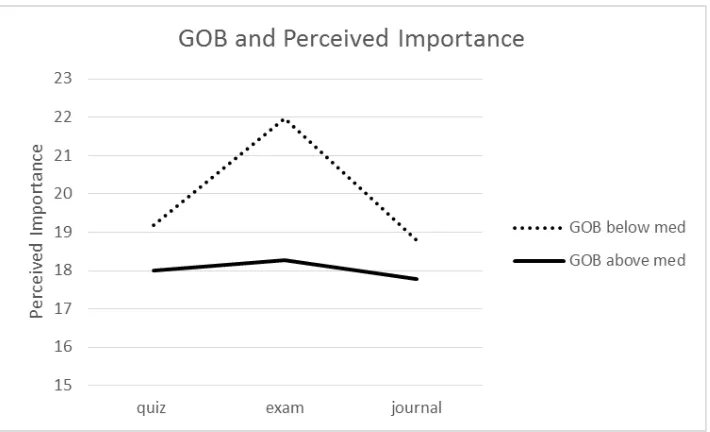
Second, we report the effects for GO on importance followed by time. There was no main effect or interaction effect for GOA on perceived importance. There was a significant main effect for GOB on perceived importance, F(1, 153)=10.1, p=.002, η2partial=.062, but no significant interaction effect. As seen in Figure 4, those high in GOB perceived all three assignments with
Figure 3. Anticipated hours spent on assignment for three assignments (quiz, exam, journal) for those high and low on learning orientation attitudes (based on median split).
similar importance while those low in GOB rated all three assignments as more important than those high in GOB as well as rated the exam as the most important.
Regarding the amount of time spent, there was no main effect or interaction effect for GOA or for GOB.
Discussion
By using the same assignment description, we were able to examine whether students’ perceptions differed solely based on the name of the assignment. Our first hypothesis was partly supported, and results indicate that “exam” was rated as more important than “quiz” and “journal.” Our second hypothesis was also partly supported indicating that students would anticipate spending more time on the exam compared to the quiz or the journal; however this was not the case for wanting more time or starting earlier as anticipated. Becker and Calhoon (1999) found that among the most attended to elements on a syllabus are due dates, format, and type of assignment. Our study adds to this literature showing students also anticipate different time allotment and ascribe different importance to different types of assignments. Our findings indicate that students perceive an exam as both more important and anticipate spending more time completing it than quizzes or journals.
Our third hypothesis was supported with significant main effects and interactions found for LOGO attitudes and behaviors. Those high in LO (both attitudes and behaviors) mostly reported all three assignments as more important than those low in LO with the exam being perceived as the most important by those high and low in LOA. These findings suggest that students who are high in LO perceive all assignments as an opportunity to learn. Strikingly, for LOB a marked distinction emerged for the journal assignment. While those high in LOB attached great importance on the journal, those low in LOB rated it the least important. This suggests that students who engage in LO behaviors perceived the assignment as an opportunity to learn more so than exams and quizzes. This was also reflected in the anticipated amount of time being spent on the journal assignment with those high in LOA allocating more time than those low in LOA. This suggests that students high and low on LO similarly perceive the quizzes and exams, but a sharp contrast emerges for the journal, which was more important and would require more time to complete for those high in LO behaviors and attitudes, respectively. Additionally, these findings highlight how attitudes and behaviors are different and should not be combined in LOGO scales.
Regarding GO, only GOB made a difference in terms of perceived importance. For those high in GOB, all three assignments were seen as roughly equally important. For those low in GOB, all three assignments were rated as more important than their high counterparts, with the exam being the most important. This suggests that for those focused on grades and achieving high marks, all graded assignments are opportunities for grades and hence all equally important. Thus for those with high GO, it seems not to matter what the assignment is called as each assignment is a grade. For those who are not as focused on grades, the name clearly matters with the exam perceived as more important than the others. Perhaps the non-significant findings for GOA suggests that behaviors are not necessarily tied to one’s attitudes, and one could also act at odds with one’s attitudes.
perceived as equally important, and regardless of the name, an assignment is an assignment or rather a grade is a grade. For the other groups, the exam was for the most part perceived as more important than the quiz or journal. The quiz and journal were mostly indistinguishable in terms of perceived importance except for the LO behaviors. The journal was perceived as more important than the exam and quiz by those high in LO behaviors suggesting that this was understood as an opportunity to learn more so than the exam and quiz. For those low in LO behaviors, the journal was the least important, perhaps suggesting that the journal was perceived as a waste of time.
When the second version of the LOGO scale was created, the authors first claimed that LO and GO were separate constructs, and thus a student could be high or low on both LO and GO. While past studies found mixed results regarding the individual impact of LO and GO on academic performance (e.g., Alexitch, 2002; Beck et al., 1991), Eppler et al. (2000) explored how the various combinations of LO and GO showed different relationships to GPA. A second reason behind the creation of the LOGO-II scale was the notion that these orientations entail two components: attitudes and behaviors. Richardson et al. (1997) and Davis et al. (1994) examined LO and GO attitudes and behaviors separately finding differences in preferences of teaching style and cultural differences. Our study indeed supports the notion that attitudes and behaviors affect students’ perceived importance and anticipated time spent on assignments. Future research should examine whether the combination of LO and GO attitudes or LO and GO behaviors could further elucidate associations with academic outcomes.
Limitations and Directions for Future Research
Our results should be considered in view of the limitations of this study. First, our survey was self-report and is subject to social desirability bias. Students could underreport cheating behaviors and overemphasize how bad cheating is, for example. Likewise, students could over-report their desire to learn, particularly given that this was conducted at a small liberal arts college. Second, our sample of students may not be representative of student bodies at other universities and thus these results should be replicated using broader samples. Third, the format of assignment we chose was an essay given that we focused on whether the name made a difference and made the format the same for all three names. However, the format of the assignment (e.g., multiple choice, fill-in-the-blank, etc.) may also have an impact and different formats should be examined in future research.
Given that our study examined perceived importance and anticipated time, future research could examine actual behaviors of the students by giving out an assignment that could be completed within a reasonable time frame (e.g., multiple choice problems) and seeing whether performance and amount of time differ based on various names (e.g., exam, quiz, homework).
References
Alexitch, L. R. (2002). The role of help-seeking attitudes and tendencies in students’ preferences for academic advising. Journal of College Student Development, 43(1), 5-19.
Beck, H. P., Rorrer-Woody, S., & Pierce, L. G. (1991). The relations of learning and grade orientations to academic performance. Teaching of Psychology, 18(1), 35-37. doi:10.1207/s15328023top1801_10 Becker, A. H., & Calhoon, S. K. (1999). What introductory psychology students attend to on a course
syllabus. Teaching of Psychology, 26(1), 6-11. doi:10.1207/s15328023top2601_1
Brand, A. G., & House, G. (1987). Relationships between types of assignments, writer variables, and emotions of college composition students. Alberta Journal of Educational Research, 33(1), 21-32. Davis, S. F., Noble, L. M., Zak, E. N., & Dreyer, K. K. (1994). A comparison of cheating and learning/grade
orientation in American and Australian college students. College Student Journal, 28(3), 353-356. Dweck, C. S. (1986). Motivational processes affecting learning. American Psychologist, 41(10),
1040-1048. doi:10.1037/0003-066X.41.10.1040
Eison, J. A. (1981). A new instrument for assessing students' orientations towards grades and learning. Psychological Reports, 48(3), 919-924. doi:10.2466/pr0.1981.48.3.919
Eison, J. A., Pollio, H. R., & Milton, O. (1983). Manual for use with LOGO-II. Theory and Practice in Teacher Education Publications and Other Works. Retrieved from
http://trace.tennessee.edu/utk_theopubs/2
Eppler, M. A., Carsen-Plentl, C., & Harju, B. L. (2000). Achievement goals, failure attributions, and academic performance in nontraditional and traditional college students. Journal of Social Behavior and Personality, 15, 353-372.
Goodboy, A. K., & Frisby, B. N. (2014). Instructional dissent as an expression of students' academic orientations and beliefs about education. Communication Studies, 65(1), 96-111.
doi:10.1080/10510974.2013.785013
Guenther, R. K. (2012). Does the processing fluency of a syllabus affect the forecasted grade and course difficulty? Psychological Reports, 110(3), 946-954. doi:10.2466/01.11.28.PR0.110.3.946-954 Harnish, R. J., & Bridges, K. (2011). Effect of syllabus tone: Students’ perceptions of instructor and
course. Social Psychology of Education, 14, 319-330. doi:10.1007/s11218-011-9152-4
Harrington, C. M., & Gabert-Quillen, C. A. (2015). Syllabus length and use of images: An empirical investigation of student perceptions. Scholarship of Teaching and Learning in Psychology, 1(3), 235-243. doi:10.1037/stl0000040
Harris, C., & Harris, J. (1987). Learning orientation and academic achievement [On-line serial]. Retrieved from: ERIC.
Lumpkin, A., Achen, R. M., & Dodd, R. K. (2015). Student perceptions of active learning. College Student Journal, 49(1), 121-133.
Marsden, H., Carroll, M., & Neill, J. T. (2005). Who cheats at university? A self-report study of dishonest academic behaviours in a sample of Australian university students. Australian Journal of Psychology, 57(1), 1-10.
Page, S., & Alexitch, L. R. (2003). Learning- and grade-orientation, sex, and prediction of self-reported academic performance. Psychological Reports, 92(1), 320-324. doi:10.2466/PR0.92.1.320-324 Richardson, T. R., Kring, J. P., & Davis, S. F. (1997). Student characteristics and learning or grade
orientation influence preferred teaching style. College Student Journal, 31(3), 347-355.
Snyder, H. T. (2013). Designing creative assignments: Examples of journal assignments and a creative project. In M. Banks Gregerson, H. T. Snyder, & J. C. Kaufman, (Eds.), Teaching creatively and teaching creativity (pp. 163-173). New York: Springer Science + Business Media. doi:10.1007/978-1-4614-5185-3_12
Brittany Landrum is currently an Adjunct Instructor at the University of Dallas. Her scholarly interests include quantitative and qualitative research methodology, mixed methods, teaching methods, and philosophical foundations of research. Please direct all correspondence concerning this article to: Brittany Landrum, PhD, University of Dallas, 1845 E. Northgate Dr, Irving, TX, 75062; [email protected]