FORMULATION AND EVALUATION OF SELF
SYSTEM OF CANDESARTAN CILEXETIL
Shubhangi J. Patil
1., Fahim J. Sayyad
1,3KCT’s Kri
A R T I C L E I N F O
INTRODUCTION
Novel drug delivery system has been introduced to overcome the drawback of fluctuating drug levels associated with conventional dosage forms [1]. Current research is aimed at development of drug delivery system (DDS) with maximum therapeutic benefits.
SMEDDS or Self-Microemulsifying Drug Delivery System is defined as isotropic mixtures of natural or synthetic oils, solid or liquid surfactants or alternatively, one or more hydrophilic solvents and co-solvents/surfactants [4]. Upon mild agitation followed by dilution in aqueous media, such as gastrointestinal (GI) fluids, these systems can form fine oil
emulsions or microemulsions or selfmicroemulsifying drug delivery system (SMEDDS). Fine oil droplets would pass rapidly from the stomach and promote wide distribution of the drug throughout the GI tract, thereby minimizing the irritation frequently encountered during extended contact between bulk drug substances and the gut wall. When compared wit emulsions, which are sensitive and metastable dispersed forms, SMEDDS are physically stable formulations that are easy to manufacture. An additional advantage of SMEDDS over simple oily solutions is that they provide a large interfacial area for partitioning of the drug between oil and water
International Journal of Current Advanced Research
ISSN: O: 2319-6475, ISSN: P: 2319-6505,
Available Online at www.journalijcar.org
Volume 7; Issue 12(A); December 2018
DOI: http://dx.doi.org/10.24327/ijcar.2018
Copyright©2018 Shubhangi J. Patil et al. This is an open access article distributed under the Creative Commons Attribution License, which permits unrestricted use, distribution, and reproduction in any medium, provided the original work is properly cited.
Article History:
Received 13th September, 2018 Received in revised form 11th
October, 2018Accepted 8th November, 2018 Published online 28th December, 2018
Key words:
Self microemulsifying drug delivery system, Candesartan cilexetil, Drug release, Drug content, Stability study, Bioavailability.
*Corresponding author: Shubhangi J. Patil
KCT’s Krishna College of Pharmacy, Karad
FORMULATION AND EVALUATION OF SELF-MICROEMULSIFYING DRUG DELIVERY
SYSTEM OF CANDESARTAN CILEXETIL
Fahim J. Sayyad
2., Shailaja A. Dombe
3and Shubhangi A. Patil
KCT’s Krishna College of Pharmacy, Karad 2Govt.College of Pharmacy, Karad
A B S T R A C T
The aim of our investigation was to formulate a liquid self microemulsifying drug delivery system (SMEDDS) of candesartan cilexetil that could help to improve its solubility, stability, and oral bioavailability. The SMEDDS was prepared by using mixture of drug, oil, surfactant and cosurfactant. The liquid formulation was evaluated for various tests like solubility, Drug-surfactant compatibility, particle size, zeta potential, in vitro dissolution, etc. The optimized formulation S1 showed drug release (99.91%), drug content (97.42%), droplet size (62 nm), Zeta potential (-24.2), PDI (0.228), viscosity (0. 8269 cP) etc. In vitro drug release of the S1 was highly significant 97.96% as compared with marketed preparation (M) 66.73%.
The present investigation shows that SMEDDS of Candesartan cilexetil can be formulated as a unit dosage form. The S1 can be further used for preparation
forms.
Novel drug delivery system has been introduced to overcome the drawback of fluctuating drug levels associated with . Current research is aimed at (DDS) with maximum
Microemulsifying Drug Delivery System is defined as isotropic mixtures of natural or synthetic oils, solid or liquid surfactants or alternatively, one or more hydrophilic Upon mild agitation followed by dilution in aqueous media, such as gastrointestinal (GI) fluids, these systems can form fine oil-in-water (o/w) emulsions or microemulsions or selfmicroemulsifying drug roplets would pass rapidly from the stomach and promote wide distribution of the drug throughout the GI tract, thereby minimizing the irritation frequently encountered during extended contact between bulk drug substances and the gut wall. When compared with emulsions, which are sensitive and metastable dispersed forms, SMEDDS are physically stable formulations that are easy to An additional advantage of SMEDDS over simple oily solutions is that they provide a large interfacial
ning of the drug between oil and water [1, 2].
Apart from solubilisation, the presence of lipid in the formulation helps to improve bioavailability by affecting the drug absorption [1].
Candesartan cilexetil is an esterified prodrug of candesartan, nonpeptide angiotensin II type 1(AT1) receptor antagonist used in the treatment of hypertension. Based on its solubility across physiological relevant pH conditions and absorption characteristic, candesartan cilexetil is classified in the Biopharmaceutical classification system as a class II drug. Low solubility of candesartan cilexetil across the physiological pH range is reported to result in incomplete absorption from the GI tract and hence is reported to have an oral bioavailability of about 15%. Cand
lipophilic compound and has good solubility in tri and diglyceride oils. Thus, a novel oral formulation of candesartan cilexetil can be developed which increases its solubility and enhances permeability across the biological m
overcome its poor bioavailability.
Selection of a suitable self-emulsifying formulation depends upon the assessment of
1. The solubility of the drug in various components, 2. The area of the self-emulsifying region as obtained in
the phase diagram, and
3. The droplet size distribution of the resultant emulsion following self-emulsification
The objective of this study was to develop and characterize liquid SMEDDS of candesa
International Journal of Current Advanced Research
6505, Impact Factor: 6.614
www.journalijcar.org
2018; Page No.16430-16437
//dx.doi.org/10.24327/ijcar.2018.16437.3038
This is an open access article distributed under the Creative Commons Attribution License, which permits unrestricted use, distribution, and reproduction in any medium, provided the original work is properly cited.
MICROEMULSIFYING DRUG DELIVERY
Shubhangi A. Patil
4The aim of our investigation was to formulate a liquid self microemulsifying drug delivery cilexetil that could help to improve its solubility, stability, and oral bioavailability. The SMEDDS was prepared by using mixture of drug, oil, surfactant and cosurfactant. The liquid formulation was evaluated for various tests like ctant compatibility, particle size, zeta potential, in vitro dissolution, etc. The optimized formulation S1 showed drug release (99.91%), drug content (97.42%), 24.2), PDI (0.228), viscosity (0. 8269 cP) etc. In vitro drug release of the S1 was highly significant 97.96% as compared with marketed
The present investigation shows that SMEDDS of Candesartan cilexetil can be formulated as a unit dosage form. The S1 can be further used for preparation of different solid dosage
Apart from solubilisation, the presence of lipid in the formulation helps to improve bioavailability by affecting the
Candesartan cilexetil is an esterified prodrug of candesartan, a nonpeptide angiotensin II type 1(AT1) receptor antagonist used in the treatment of hypertension. Based on its solubility across physiological relevant pH conditions and absorption characteristic, candesartan cilexetil is classified in the al classification system as a class II drug. Low solubility of candesartan cilexetil across the physiological pH range is reported to result in incomplete absorption from the GI tract and hence is reported to have an oral bioavailability of about 15%. Candesartan cilexetil is a highly lipophilic compound and has good solubility in tri and a novel oral formulation of candesartan cilexetil can be developed which increases its solubility and enhances permeability across the biological membrane to overcome its poor bioavailability.
emulsifying formulation depends
The solubility of the drug in various components, emulsifying region as obtained in the phase diagram, and
The droplet size distribution of the resultant emulsion emulsification [6].
The objective of this study was to develop and characterize liquid SMEDDS of candesartan cilexetil for increasing
Reserach Article
International Journal of Current Advanced Research Vol 7, Issue 12(A), pp 16430-16437, December 2018
solubility and permeability across the biological membrane to improve the bioavailability, dosing frequency, in vitro dissolution as well as enhance patient compliance.
MATERIALS AND METHODS
Materials for component selection
Candesartan cilexetil was obtained as a gift sample from Alembic Pharmaceuticals, Gujarat. Oleic acid, Olive oil, Castor oil, Cotton seed oil, Isopropyl myristate, Labrafac PG, Tween 80, Tween 20, Span 80, Span 20, Propylene glycol& Polyethylene Glycol 400 were kindly gifted by Lobachemie, Mumbai. The other chemicals used were of the analytical grades. Double-distilled water was used throughout the study.
Screening of components
The solubility of drug in oils, surfactants and co-surfactants is the most important criterion for the screening of components for SMEDDS. As the aim of this study is to develop an oral formulation, hence, solubility of drug in oils is more important because the ability of SMEDDS to maintain the drug in solubilized form is greatly influenced by the solubility of the drug in oil phase. The solubility of candesartan cilexetil in various oils and distilled water was determined by adding an excess amount of drug in 2mL of selected oils (oleic acid, capryol 90, isopropyl myristate, castor oil, olive oil) and distilled water separately in 5mL capacity stopper vials, and mixed using a vortex mixer. The mixture vials were then kept at 25±1.0 o C in an isothermal shaker for 72 h to reach equilibrium. The equilibrated samples were removed from shaker and centrifuged at 3000 rpm for 15 min. The supernatant was taken and filtered through a 0.45 μm membrane filter. The concentration of candesartan cilexetil was determined in oils and water using UV spectrophotometer at 254 nm. [2]
Drug and surfactant compatibility study
Physical compatibility of the water-insoluble drug with surfactants should be used in surfactant selection procedure. Physical compatibility may include precipitation/ crystallization, phase separation and color change in the drug – surfactant solution during course study. Chemical compatibility is primarily regarded as the chemical stability of the drug in a surfactant solution. A surfactant was considered for further development only if it was physically and chemically compatible with drug[2].
Construction of Pseudoternary phase diagram:
The existence of microemulsions regions were determined by using pseudo-ternary phase diagrams. SMEDDS were diluted under agitation conditions using water titration method: The mixture of oil and surfactant/cosurfactant at certain weight ratios were diluted with water in a dropwise manner. Distilled water was used as an aqueous phase for the construction of phase diagrams. Oil, surfactants and co surfactants were grouped in four different combinations for phase studies. Surfactant and cosurfactant (Smix) in each group were mixed in different weight ratios (1:1, 2:1, 1:2, 2:1, 3:1). These Smix ratios were chosen in increasing concentration of surfactant with respect to cosurfactant and increasing concentration of cosurfactant with respect to surfactant for detailed study of the phase diagrams for formulation of SMEDDS. For each phase diagram, oil and specific Smix ratio was mixed thoroughly in
different weight ratios from 1:1 to 3:1 in different glass vials. Twelve different combinations of oil and Smix were made so that maximum ratios were covered for the study to delineate the boundaries of phases precisely formed in the phase diagrams. Pseudo-ternary phase diagrams were developed using aqueous titration method.The concentration of water at which turbidity-to-transparency and transparency-to-turbidity transitions occurred was derived from the weight measurements. These values were then used to determine the boundaries of the microemulsion domain corresponding to the chosen value of oils, as well as the S/CoS mixing ratio[6]. On the basis of the solubility studies of drug, Oleic acid was selected as the oil phase. The physical state of the SMEDDS was marked on a pseudo-three-component phase diagram aqueous phase,the other representing oil and the third representing mixture of surfactant and cosurfactant at fixed weight ratios (Smix ratio)[1].
Preparation of Liquid Microemulsion:
A series of SMEDDS formulations were prepared using oleic acid as oil, Tween80 as surfactant and Propylene glycol as co-surfactant. Accurately weighed amount of Candesartan Cilexetil was dissolved in oleic acid and then mixture of Smix (2:1) added in a glass vial. The mixture was mixed by gentle stirring by using vortex mixture. The mixture was placed on magnetic stirrer at 50rpm for 15min.The mixture was stored at room temperature until further use. Briefly, for microemulsion Smix ratio(2:1) was selected from pseudo ternary phase diagram. The conditions for preparation of microemulsion were maintained throughout the preparation 50rpm and temp. at 250c the material was mixed slowly for getting well result[3].
Evaluation of Liquid SMEDDS Formulation [1,4,8]:
pH
The pH microemulsion was measured using a systronic digital pH meter at 25 ±1 ºC. The pH meter was calibrated before use and pH value of all formulations were determined in triplicate. The pH of SMEDDS was determined after diluting 1 ml of the formulation with 9 ml of water. The results are given in Table no.2.
Viscosity measurement
The viscosity was determined by using Brookfield Rheometer r/s plus on different rpm and same rpm with different time. Sample was placed on plate and spindle no. C25/2 was adjusted on it and readings were taken with RH-3000 software. The result was shown in table no.2.
Thermodynamic stability
Heating cooling cycle: Six cycles between refrigerator
temperature 4˚C and 45˚C with storage at each temperature of not less than 48h was studied. Those formulations, which were stable at these temperatures, were subjected to centrifugation test.
Table no 1 Liquid batches of Self microemulsifying drug delivery system
Sr.No. Formulation
Code
Candesartan Cilexetil(mg)
Percentage Of Oil (%)
Percentage of Smix(2:1)(%)
1 S1 10 5 95
2 S2 10 7.5 92.5
3 S3 10 10 90
4 S4 10 12.5 87.5
Formulation and Evaluation of Self-Microemulsifying Drug Delivery System of Candesartan Cilexetil
Centrifugation:Passed formulations were centrifuged at 3500
rpm for 30min. Those formulations that did not show any phase separation were taken for the freeze thaw stress test.
Freeze thaw cycle:Three freeze thaw cycles between 4˚C and
+25 ˚C with storage at each temperature for not less than 48hrs was done for the formulations. Those formulations, which passed these thermodynamic stress tests, were further taken for the dispersibility test for assessing the efficiency of self-emulsification. The formulations were observed visually for any phase separation or color change.
Dispersibiity test
The efficiency of self-emulsification of SMEDDS was assessed using a standard USP XXII dissolution apparatus. One ml of each formulation was added to 500 ml of water at 37±0.5 ˚C. A standard stainless steel dissolution paddle rotating at 50 rpm provided gentle agitation. The in-vitroperformance of the formulations was visually assessed using the following grading system:
Table No.2 Grades of Dispersibiity Test
Sr.No. Observations Grades
1 Rapidly forming (within 1 min) microemulsion,
having a clear or bluish appearance.
A
2 Rapidly forming, slightly less clear bluish
emulsion.
B
3 Fine milky emulsion that formed within 2min. C
4 Dull, grayish white emulsion having slightly oily
appearance that is slow to emulsify (longer than 2min).
D
5 Formulation, exhibiting either poor or minimal
emulsification with large oil globules present on the surface.
E
Grade A and B formulation will remain as microemulsion when dispersed in GIT.
% Transmittance Measurement
The percent transmittance of various formulations was measured at 254 nm using UV spectrophotometer keeping water as a blank.
Drug content determination
The drug content of SMEDDS formulation was determined by dissolving 1 ml (equivalent to 10 mg of drug) of the formulation in 50 ml methanol and mixed it well with shaking or inverting in volumetric flask for two to three times. After that 0.1 ml of this solution was diluted with fresh methanol and drug content was determined using UV spectrophotometer at 254nm.
Particle size distribution (PSD) and zeta-potential analysis:
SMEDDS formulation was diluted 100 times with distilled water at 37 ± 0.5˚C. The resultant emulsions were prepared by gentle agitation for 10 min using a magnetic stirrer. PSD and zeta-potential of the final microemulsion were determined using, Malvern zetasizer.
Polydispersibility Index
The procedure is same as in for particle size determination and described in section vii. Polydispersivity which determines size range of particles in the system is measured by No. of particles having size greater than 100nm divided by No. of particles having size less than 100nm.It is expressed in terms of polydispersivity index (PDI).
Cloud Point Determination
Dilute the formulation containing 10mg Candesartan cilexetil with 50ml of distilled water in beaker and placed on water bath with gradually increasing the temperature until the diluted formulation turned to cloudy. It gives the information about the stability of the microemulsion at body temperature.
In-vitroDrug release study
In 0.1 N HCl
Liquid SMEDDS containing 10mg Candesartan cilexetil was filled in hard gelatin capsule shell and placed in 900ml of 0.1N HCl as a dissolution medium. Dissolution study was carried out using USP type II apparatus (paddle) at 50 rpm at 370c. 5ml of aliquot was withdrawn after 5,10,15,20,30,45,60 min. The amount of drug release was determined using UV spectrophotometer at 254nm. All experiments were repeated in triplicate. Same procedure was applied for API.
In pH 6.8 phosphate buffer
Liquid SMEDDS containing 10mg Candesartan cilexetil was filled in hard gelatin capsule shell and placed in 900ml of 0.1N HCl as a dissolution medium. Dissolution study was carried out using USP type II apparatus (paddle) at 50 rpm at 370c. 5ml of aliquot was withdrawn after 5,10,15,20,30,45,60 min. The amount of drug release was determined using UV spectrophotometer at 254nm. All experiments were repeated in triplicate. Same procedure was applied for API.
RESULT & DISCUSSION
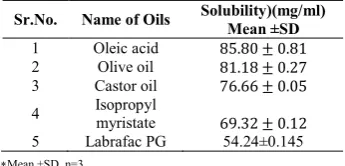
One important consideration when formulating a self-micro emulsifying formulation is avoiding precipitation of the drug on dilution in the gut lumen in vivo. Therefore, the components used in the system should have high solubilization capacity for the drug, ensuring the solubilization of the drug in the resultant dispersion. Results from solubility studies are reported in table 3. The solubility of candesartan cilexetil was found to be highest in Oleic acid (85.80±0.81 mg/ml) as compared to other oils while in water it was 0.09±0.01 mg/ml. This may be attributed to the polarity of the poorly water soluble drugs that favor their solubilization in small/medium molecular volume oils such as medium chain triglyceride or mono or diglyceride. Hence, oleic acid is selected as a oil for preparation of SMEDDS.
Table No 3 Results of Solubility
Sr.No. Name of Oils Solubility)(mg/ml)
Mean ±SD
1 Oleic acid 85.80 ± 0.81
2 Olive oil 81.18 ± 0.27
3 Castor oil 76.66 ± 0.05
4 Isopropyl
myristate 69.32 ± 0.12
5 Labrafac PG 54.24±0.145
Mean ±SD, n=3.
Drug and surfactant compatibility study
International Journal of Current Advanced Research Vol 7, Issue
Construction of pseudo ternary phase diagram
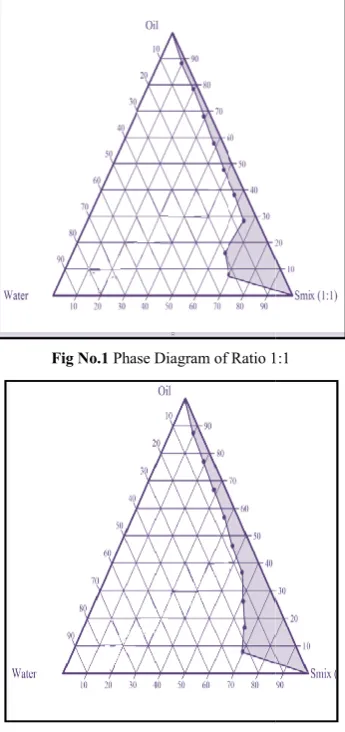
The pseudo ternary phase diagram for SMEDDS was constructed by using water titration method. Based on solubility study, the Oleic acid selected as oil, Tween80 selected as surfactant and Propylene glycol as co
For construction of pseudo ternary phase diagram the surfactant and co-surfactant are mixed in different weight ratios (1:1, 2:1, 3:1). For each phase diagram oleic acid and mixture of tween80 and propylene glycol are mixed thoroughly in different weight ratios from 1:9 to 9:1 (1:9, 2:8, 3:7, 4:6, 5:5, 6:4, 7:3, 8:2, 9:1) in different beakers. Each mixture was titrated with double distilled water and mixed uniformly by magnetic stirrer at room temperature. The mixture was visually examined for transparency. Clear and isotropic mixture indicates the presence of microemulsion region. The phase diagrams are presented below
Fig No.1 Phase Diagram of Ratio 1:1
Fig No 2 Phase Diagram of Ratio 2:1
Table No 4 Drug surfactant compatibility study.
Ratio
(1:1) Precipitation Crystallization separation
Drug+Tween8o √ √
Drug+Tween20 √ √
Drug+Span8o √ √
Drug+Span20 √ √
Drug+Propylene
glycol √ √
Drug+Polyethylene
glycol 400 √ √
√-Passed and ×-Failed
International Journal of Current Advanced Research Vol 7, Issue 12(A), pp 16430-16437
Construction of pseudo ternary phase diagram
The pseudo ternary phase diagram for SMEDDS was constructed by using water titration method. Based on solubility study, the Oleic acid selected as oil, Tween80 selected as surfactant and Propylene glycol as co-surfactant. phase diagram the surfactant are mixed in different weight ratios (1:1, 2:1, 3:1). For each phase diagram oleic acid and mixture of tween80 and propylene glycol are mixed thoroughly in different weight ratios from 1:9 to 9:1 (1:9, 2:8, :7, 4:6, 5:5, 6:4, 7:3, 8:2, 9:1) in different beakers. Each mixture was titrated with double distilled water and mixed uniformly by magnetic stirrer at room temperature. The mixture was visually examined for transparency. Clear and ates the presence of microemulsion region. The phase diagrams are presented below-
f Ratio 1:1
Phase Diagram of Ratio 2:1
Fig No 3 Phase Diagram
Viscosity & pH
The viscosity of microemulsion
standard rheological techniques. All the formulation has viscosity which is highly similar to that of water i.e.1.0. Thus, it shows that SMEDDS forms o/w microemulsion and water remains as external phase. The results of viscosit
shown in Table No. 5.
The excipients used in the formulation decide the pH of the final preparation. The change in the pH may affect the zeta potential of the formulation which in turn can affect the stability of preparation. All the formulations
pH values in the range of 5.1 to 6.0. Thus pH is not affecting stability. Therefore it can be assumed that drug is not diffusing in the external phase and remains in the oil phase. Since, water is the external phase entire system showed pH
Candesartan cilexetil is unstable in alkaline pH. Here the formulations show acidic to neutral pH which is suitable for stability of Candesartan cilexetil.
Thermodynamic stability
SMEDDS are thermodynamically stable systems and are formed at a particular concentration of oil, surfactant and water, with no phase separation, creaming or cracking. It is the thermostability which differentiates nano
from emulsions that have kinetic stability and will eventually phase separate[92].Thus, the selected formulations were subjected to different thermodynam
heating cooling cycle, centrifugation and freeze thaw cycle stress tests. Those formulations, which survived thermodynamic stability tests, were taken for Dispersibility test. The results are as shown in Table No.6.
Table No. 6 Thermodynamic stability test of different formulations
Sr.No. Formulation Code Centrifugation
1 S1 √
2 S2 √
3 S3 √
4 S4 √
5 S5 √
Drug surfactant compatibility study.
Phase separation
Color change
√ √
√ √
√ √
√ √
√ √
√ √
Table No 5 Result of Viscosity & pH
Sr.No. Formulation
Code
1 S1
2 S2
3 S3
4 S4
5 S5
16437, December 2018
Phase Diagram of Ratio 3:1
The viscosity of microemulsion systems can be monitored by standard rheological techniques. All the formulation has viscosity which is highly similar to that of water i.e.1.0. Thus, it shows that SMEDDS forms o/w microemulsion and water remains as external phase. The results of viscosity are as
The excipients used in the formulation decide the pH of the final preparation. The change in the pH may affect the zeta potential of the formulation which in turn can affect the stability of preparation. All the formulations showed similar pH values in the range of 5.1 to 6.0. Thus pH is not affecting stability. Therefore it can be assumed that drug is not diffusing in the external phase and remains in the oil phase. Since, water is the external phase entire system showed pH of water. Candesartan cilexetil is unstable in alkaline pH. Here the formulations show acidic to neutral pH which is suitable for stability of Candesartan cilexetil.
SMEDDS are thermodynamically stable systems and are formed at a particular concentration of oil, surfactant and separation, creaming or cracking. It is the thermostability which differentiates nano-or microemulsion from emulsions that have kinetic stability and will eventually Thus, the selected formulations were subjected to different thermodynamic stability by using heating cooling cycle, centrifugation and freeze thaw cycle stress tests. Those formulations, which survived thermodynamic stability tests, were taken for Dispersibility test. The results are as shown in Table No.6.
Thermodynamic stability test of different formulations
Centrifugation Freeze Thaw Cycle Inference
√ Passed
√ Passed
√ Passed
√ Passed
√ Passed
Result of Viscosity & pH
Formulation
pH Viscosity(cp)
5.53 0.8269
5.42 0.8858
5.89 0.8858
5.21 0.8858
Formulation and Evaluation of Self-Microemulsifying Drug Delivery System of Candesartan Cilexetil
Determination of Cloud Point
The cloud point is the temperature above which an aqueous solution of water soluble surfactant, especially non becomes turbid. Hence the cloud point of formulation is greater than 370C to avoid irreversible phase separation. The following table shows the cloud point of all formulation. The data of cloud point reveals that all formulations are having cloud point greater than 370C. The higher cloud point value is 790C obtained from batch S1 and least value is 61
batch S5.
Determination of Self emulsification Time
The self-emulsification time was measured for all formulations. The following data shows the self emulsification time of all formulations. From the data obtained it is revealed that when the concentration of oil increases then the self emulsification time also increases. If the concentration of Smix increases then the self emulsification time also decreases. The least self-emulsification time is obtained from batchS1 is 32 Sec. and higher self emulsification time obtained from batch S5is 2.04min. The results shown in Table No.8
Dispersibiity Test
From the above data of dispersibility study the formulation S1 belongs into the grade A that emulsified in less than 1min. that is 32 sec. Batch S2 belongs to grade A which also emulsified rapidly. S3 and S4 formulations are emulsified within less than 2min. S5 formulation emulsified within more than 2min.The results are as shown in Table No.9.
Table No.9 Results of Dispersibiity T
Sr.No. Formulation
Code Grades Observation
1 S1 A
Rapidly forming (within 1 min) microemulsion, having a clear or bluish appearance.
2 S2 A Rapidly forming, slightly less clear
bluish emulsion.
3 S3 B Fine milky emulsion that formed
within 2min.
4 S4 B Fine milky emulsion that formed within 2min.
5 S5 D
Dull, grayish white emulsion having slightly oily appearance that is slow to emulsify (longer than 2min).
Table No 7 Result of Cloud Point measurement
Sr.No. Formulation
Code
Cloud
point(0C
1 S1 79
2 S2 75
3 S3 71
4 S4 66
5 S5 61
Table No 8 Result of Self-emulsification Time
Sr.No. Formulation
Code
Self-emulsification time(min.)
1 S1 32
2 S2 43
3 S3 1.12
4 S4 1.45
5 S5 2.04
Microemulsifying Drug Delivery System of Candesartan Cilexetil
cloud point is the temperature above which an aqueous solution of water soluble surfactant, especially non-ionic, Hence the cloud point of formulation is C to avoid irreversible phase separation. The e cloud point of all formulation. The data of cloud point reveals that all formulations are having C. The higher cloud point value is C obtained from batch S1 and least value is 610C is of
emulsification time was measured for all shows the self emulsification time of all formulations. From the data obtained it is revealed that when the concentration of oil increases then the self emulsification time also increases. If the concentration of Smix time also decreases. The emulsification time is obtained from batchS1 is 32 Sec. and higher self emulsification time obtained from batch S5is 2.04min. The results shown in Table No.8
From the above data of dispersibility study the formulation S1 belongs into the grade A that emulsified in less than 1min. that 32 sec. Batch S2 belongs to grade A which also emulsified rapidly. S3 and S4 formulations are emulsified within less than 2min. S5 formulation emulsified within more than 2min.The
Results of Dispersibiity Test
Observation
Rapidly forming (within 1 min) microemulsion, having a clear or bluish appearance.
Rapidly forming, slightly less clear bluish emulsion.
Fine milky emulsion that formed
Fine milky emulsion that formed
Dull, grayish white emulsion having slightly oily appearance that is slow to emulsify (longer than 2min).
Droplet size analysis
Droplet size measurement was performed by using Malvern Metasizer the instrument is based on the principle Dynamic light scattering and Brownion motion of droplets. The results obtained are presented below in Table no.10.
Table No. 10 Results of Droplet Size
Sr.No. Formulation
Code
1 S1
2 S2
3 S3
4 S4
5 S5
Fig No 4 Graphical Droplet size distribution of batch S1
From the above data it is revealed that the smaller droplet size is of Batch S1. It is found to be 62nm and larger droplet size was obtained of batch S5, 682.1 nm. This result revealed that when concentration of oil increase then the droplet size also increases but similarly if we increases concentration of Smix the droplet size decreases.
Zeta potential Measurement
Zeta potential was measured by using zetasizer (Horiba SZ100Z). The zeta potential analysis was performed for all batches. The zeta potential of Batch S1 was found to be which is good. The zeta potential value is negative due to charge on droplets is negative. The zeta potential for various Candesartan cilexetil SMEDDS formulations are as shown in table no.11.
Determination of Polydispersibility Index (P.I.)
Ploydispersibility index was determined by using Nano particle analyzer SZ100Z (HORIBA). Following table shows results of P.I. batches. All formulation batches have P.I. than1. From the above results it is concluded that t
are having uniform size range and having uniform distribution throughout in formulation.
oud Point measurement
Cloud C )
emulsification Time
emulsification time(min.)
Table No 12 Results of Polydispersibility Index
Sr.No. Formulation
Code
1 S1
2 S2
3 S3
4 S4
5 S5
Microemulsifying Drug Delivery System of Candesartan Cilexetil
Droplet size measurement was performed by using Malvern Metasizer the instrument is based on the principle Dynamic light scattering and Brownion motion of droplets. The results obtained are presented below in Table no.10.
Results of Droplet Size
Formulation Droplet Size
(nm) 62
105 189.9 413.7 682.1
Graphical Droplet size distribution of batch S1
From the above data it is revealed that the smaller droplet size is of Batch S1. It is found to be 62nm and larger droplet size was obtained of batch S5, 682.1 nm. This result revealed that when concentration of oil increase then the droplet size also eases but similarly if we increases concentration of Smix
Zeta potential was measured by using zetasizer (Horiba SZ100Z). The zeta potential analysis was performed for all tial of Batch S1 was found to be -24.2, which is good. The zeta potential value is negative due to charge on droplets is negative. The zeta potential for various Candesartan cilexetil SMEDDS formulations are as shown in
dispersibility Index (P.I.)
Ploydispersibility index was determined by using Nano particle analyzer SZ100Z (HORIBA). Following table shows results of P.I. batches. All formulation batches have P.I. less
than1. From the above results it is concluded that the droplets are having uniform size range and having uniform distribution
Results of Polydispersibility Index
Formulation Polydispersibility
Index
International Journal of Current Advanced Research Vol 7, Issue 12(A), pp 16430-16437, December 2018
Determination of % Transmittance
The clarity of Microemulsions &SMEDDSs was checked by transparency, measured in terms of Transmittance (%T). SMEDDS forms o/w microemulsions upon dilution since water is external phase. In case of systems having %T values less than 98% suggest less clarity of microemulsions. This may be due to greater droplet size of the formulation. Due to higher droplet size, oil globules may reduce the transparency of microemulsions and thereby values of % T, so such batches were eliminated from the further study.
Drug content determination
% Drug content of SMEDDS formulations are determined. The data is given in following table. The data revealed that highest drug content is found to be of batch S1 97.42±0.39 because it contain high surfactant concentration which can solubilise 10mg dose of Candesartan cilexetil.
In-vitro Dissolution Study
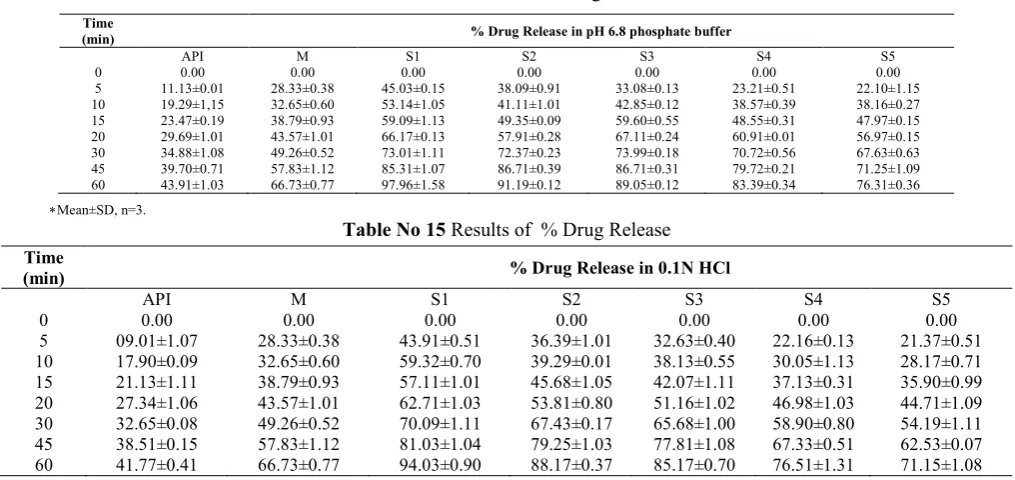
Dissolution study of API and liquid SMEDDS formulation batches S1 to S5 is carried out in different medium such as pH 6.8 phosphate buffer and 0. 1N HCl as per the procedure described in experimental work section.
Dissolution study in pH 6.8 phosphate buffer
When in-vitro dissolution study of pure drug Candesartan cilexetil, marketed preparation (M) of Candesartan cilexetil and liquid SMEDDS formulations were carried out in pH 6.8 phosphate buffer, it was found that the pure drugshows 43.91±1.03 release in 60min, marketed drug shows 66.73±0.77 while prepared liquid batch S1 shows higher release 97.96±1.58 in 60min.Lowest drug release was obtained from batch S5 is76.31±0.36. From the above data it is concluded that the rate of dissolution increases with decrease in droplet size. If droplet size decreases then the relative surface area increases for dissolution.
Dissolution study in 0.1N HCl
When in-vitro dissolution study of pure drug Candesartan cilexetil, marketed preparation of Candesartan cilexetil and liquid SMEDDS formulations were carried out in 0.1N HCl, it was found that the pure drug shows 41.77±0.41 release in 60min, marketed drug (M)shows 66.73±0.77 in 60 min. while prepared liquid batch S1 shows higher release 94.03±0.90in 60min.Lowest drug release was obtained from batch S5 is 71.15±1.08. From the above data it is concluded that the rate of dissolution increases with decrease in droplet size.
From the above data, it is revealed that the drug release of pure drug was increases in pH 6.8 phosphate buffer than in 0.1N HCl. It shows ph dependent release.
Optimization of Liquid SMEDDS formulation Batch
Microemulsions having least globule size are expected to have larger surface area andtherefore, may get absorbed or may transverse rapidly across the gastric mucosa. Moreover, literature citation revealed that SMEDDS which are negatively charged and having zeta potential -30 mV or less exhibits moderate to excellent physical stability. Therefore, both the selection criteria were used as a filter for further studies.
1. Microemulsions having mean droplet size below 100 nm; and
2. Zeta potential at least -5 mV.
3. The other criteria considered for the selection of the optimized formulation are;
Table No 13 % Transmittance of various formulations of SMEDDS (S1 to S5)
Sr.No. Formulation
Code
Appearance after 100 times
dilution
%Transmittance (Mean ±SD)
1 S1 Clear 99.91 ± 0.17
2 S2 Clear 99.41 ± 0.16
3 S3 Clear 98.22 ± 0.15
4 S4 Clear 98.17 ± 0.26
5 S5 Clear 97.11 ± 0.02
Table No.14 % Drug content of various formulations of SMEDDS (S1 to S5)
Sr.No. Formulation
Code
%Drug Content Mean±SD
1 S1 97.42±0.39
2 S2 93.24±0.83
3 S3 91.65±0.09
4 S4 89.56±0.62
5 S5 87.57±0.08
Table No.15 Results of % Drug Release
Time
(min) % Drug Release in pH 6.8 phosphate buffer
API M S1 S2 S3 S4 S5
0 0.00 0.00 0.00 0.00 0.00 0.00 0.00
5 11.13±0.01 28.33±0.38 45.03±0.15 38.09±0.91 33.08±0.13 23.21±0.51 22.10±1.15 10 19.29±1,15 32.65±0.60 53.14±1.05 41.11±1.01 42.85±0.12 38.57±0.39 38.16±0.27 15 23.47±0.19 38.79±0.93 59.09±1.13 49.35±0.09 59.60±0.55 48.55±0.31 47.97±0.15 20 29.69±1.01 43.57±1.01 66.17±0.13 57.91±0.28 67.11±0.24 60.91±0.01 56.97±0.15 30 34.88±1.08 49.26±0.52 73.01±1.11 72.37±0.23 73.99±0.18 70.72±0.56 67.63±0.63 45 39.70±0.71 57.83±1.12 85.31±1.07 86.71±0.39 86.71±0.31 79.72±0.21 71.25±1.09 60 43.91±1.03 66.73±0.77 97.96±1.58 91.19±0.12 89.05±0.12 83.39±0.34 76.31±0.36
Mean±SD, n=3.
Table No 15 Results of % Drug Release
Time
(min) % Drug Release in 0.1N HCl
API M S1 S2 S3 S4 S5
0 0.00 0.00 0.00 0.00 0.00 0.00 0.00
5 09.01±1.07 28.33±0.38 43.91±0.51 36.39±1.01 32.63±0.40 22.16±0.13 21.37±0.51 10 17.90±0.09 32.65±0.60 59.32±0.70 39.29±0.01 38.13±0.55 30.05±1.13 28.17±0.71 15 21.13±1.11 38.79±0.93 57.11±1.01 45.68±1.05 42.07±1.11 37.13±0.31 35.90±0.99 20 27.34±1.06 43.57±1.01 62.71±1.03 53.81±0.80 51.16±1.02 46.98±1.03 44.71±1.09 30 32.65±0.08 49.26±0.52 70.09±1.11 67.43±0.17 65.68±1.00 58.90±0.80 54.19±1.11 45 38.51±0.15 57.83±1.12 81.03±1.04 79.25±1.03 77.81±1.08 67.33±0.51 62.53±0.07 60 41.77±0.41 66.73±0.77 94.03±0.90 88.17±0.37 85.17±0.70 76.51±1.31 71.15±1.08
Formulation and Evaluation of Self-Microemulsifying Drug Delivery System of Candesartan Cilexetil
4. Polydispersity Index 5. % Drug release.
From all formulations of Candesartan cilexetil (S1 to S5), formulation S1 wasselected as final formulation due to lowest globule size (62 nm), higher negative zetapotential (-24.2 mV) and less PDI (0.228) compared to others which indicate thatsystem would remain stable compared to other formulations. The results of % Drug release in pH 6.8 phosphate buffer and 0.1N HCl supported the selection of S1 as the optimized formulation of Candesartan cilexetil SMEDDS. The optimized formulation S1 was further studied for FTIR.
FTIR Spectrum of Liquid SMEDDS (S1):
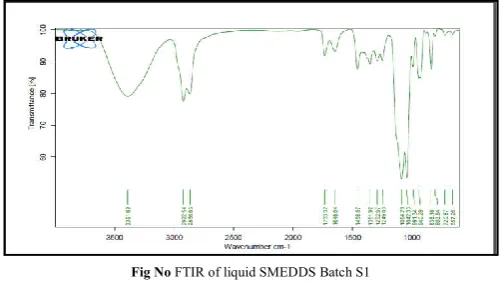
By using FTIR spectrophotometer, IR spectrum of optimized liquid SMEDDS (S1) prepared. Fig. No. shows FTIR of batch S1.Interpretation of IR is shown in table no.
Fig No FTIR of liquid SMEDDS Batch S1
DISCUSSION
The characteristic peaks at 838.18cm-1 (C-H Stretching) alkene, 1038cm-1(C-N Stretching) amines, 2922.54-1 (C-H Stretching) aldehyde, and at 3391cm-1 (N-H stretching) pri. & sec. amines shown in fig.---. It shows all characteristics peak of drug and all excipients hence it reveals that there is no any chemical interaction takes place between drug and excipients.
CONCLUSION
Liquid SMEDDS are prepared using Oleic acid, Tween 80 & Propylene glycol. From the entire study it was found that the drug releases from liquid SMEDDS formulation was found to be significantly higher as compared with that of pure drug. Thus the solubility & dissolution rate of BCS Class-II drug Candesartan cilexetil was enhanced but in-vivo studies are needed to be conducted.
References
1. Kommuru TR, Gurley B, Khan MA, Reddy IK. Self-emulsifying drug delivery systems (SEDDS) of coenzyme Q10: formulation development and bioavailability assessment. Int J Pharm, 2001; 212: pg.233-46.
2. Humberstone AJ, Charman WN. Lipid-based vehicles for the oral delivery of poorly water soluble drugs. Adv Drug Del Rev, 1997; 25: pg.103-28.
3. Pouton CW. Formulation of self-emulsifying drug delivery systems. Adv Drug Del Rev, 1997; 25: pg. 47-58.
4. Gursoy RN, Benita S. Self-emulsifying drug delivery systems (SEDDS) for improved oral delivery of lipophilic drugs. Biomed Pharmacother, 2004; 58: pg. 173-82.
5. Agrawal S. Giri T.P. Tripathi D.K. Review on Novel Therapeutic Strategies for the Enhancement of Solubility for Hydrophobic drugs Through Lipid and Surfactant based Self-Microemulsifying Drug Delivery System American Journal of Drug Discovery and Development 2(4): 143-183, 2012.
6. Murdandea SB, Gumkowskia MJ. Development of a self-emulsifying formulation that reduces the food effect for torcetrapib. Int J of Pharm, 2008; 351: pg. 15-22.
7. Pouton CW. Formulation of poorly water-soluble drugs for oral administration: physicochemical and physiological issues and the lipid formulation classification system. Eur J of Pharm Sci, 2006; 29: pg.278-87.
8. Cuine JF, McEvoy CL, Charman WN, Pouton CW, Edwards GA, Benameur H, Porter CJ. Evaluation of the impact of surfactant digestion on the bioavailability of danazol after oral administration of lipidic selfemulsifying formulations to dogs. J of Pharm Sci, 2008; 97: pg.993-1010.
9. Gershanik T, Benita S. Self-dispersing lipid formulations for improving oral absorption of lipophilic drugs. Eur J of Pharm Sci, 2000; 50: pg.179-188. 10. Pouton CW. Formulation of poorly water-soluble drugs
for oral administration: physicochemical and physiological issues and the lipid formulation classification system. Eur J of Pharm Sci, 2006; 29: pg.278-87.
11. Strickley RG. Solubilizing excipients in oral and injectable formulations. Pharm Res, 2004; 21: pg.201– 230.
12. Tang J. Self-Emulsifying Drug Delivery Systems: strategy for improving oral delivery of poorly soluble drugs. Cur Drug Th, 2007; 2: pg. 85-93.
13. Kawakami K, Yoshikawa T, Moroto Y, Kanakao E, Takahuani K, Nishihara Y, Masuda K. Microemulsion formulation for enhanced absorption of poorly soluble Drugs. I. Prescription design. J of Contr Rel, 2002; 81: pg.75-82.
14. Lawrence MJ, Rees GD. Microemulsion-based media as novel drug delivery system. Adv Drug Deliv Rev, 2000; 45: pg.89-121.
15. Gursoy RN, Benita S. Self-emulsifying drug delivery systems (SEDDS) for improved oral delivery of lipophilic drugs. Biom & Pharma, 2004; 58: pg.173– 182.
16. Anand U. Kyatanwar, et al. Self micro-emulsifying drug delivery system (SMEDDS): Review. J of Phar Res, 2010; 3: pg.75-83.
17. Lopez JC et al. Spontaneous emulsification: mechanisms, physicochemical aspects, modeling and applications. J Disp Sci Techn, 2002; 23: pg.219-268.
Table No IR interpretation of Liquid SMEDDS of Batch S1
Bond Type of
Compound Wave number( cm
-1)
C-H (stretching) Alkene 838.18
C-N( stretching) Amines 1038
C-H(stretching) Aldehyde 2922.54
International Journal of Current Advanced Research Vol 7, Issue 12(A), pp 16430-16437, December 2018
18. Groves MJ, Mustafa RMA. Measurement of the spontaneity of self-emulsifyable oils. J Pharm Pharmacol, 2004; 26: pg.671-688.
19. Constantinides PP. Lipid microemulsions for improving drug dissolution and oral absorption: physical and biopharmaceutical aspects. Pharm Res, 1995; 12: pg. 1561-72.
20. Levy MY, Benita S. Drug release from submicronized o/w emulsion: a new in vitro kinetic evaluation model. Int J of Pharm, 1990; 66: pg. 29-37.
21. Muranishi S. Drug targeting towards the lymphatics. Adv Drug Res, 1991; 21: pg.1-38.
22. Holm R, Porter C, Edwards G, Müllertz K, Charman W. Examination of oral absorption and lymphatic transport of halofantrine in a triple-cannulated canine model after administration in self-microemulsifying drug delivery systems (SMEDDS) containing structured triglycerides. Eur J Pharm Sci ,2003; 20: pg.91-97.
23. Sek L, Porter CJH, Charman WN. Characterisation and quantification of medium chain and long chain triglycerides and their in vitro digestion products, by HPTLC coupled with in situ densitometric analysis. J Pharm Biomed Anal, 2001; 25: pg. 651-661.
24. Khoo SM, Porter CJ, Edwards GA, Charman WN. Intestinal lymphatic transport is the primary route for halofantrine after oral postprandial administration. Pharm Sci ,1999; 1: pg.S-624.
25. Porter CJH, Charman WN. In vitro assessment of oral lipid based formulations. Adv Drug Delivery Rev, 2001; 50: pg.S127-S147.
26. Attama AA, Mpamaugo VE. Pharmacodynamics of piroxicam from self-emulsifying lipospheres formulated with homolipids extracted from Capra hircus. Drug Deliv, 2006; 13: pg.133–137.
27. Jannin V. et al. Approaches for the development of solid and semi-solid lipid-based formulations. Adv Drug Deliv Rev, 2008; 60: pg.734–746.
28. Ito Y. et al. Oral solid Gentamicin preparation using emulsifier and adsorbent. J Control Release ,2005; 105: pg.23–31.
29. Verreck G, Brewster ME. Melt extrusion-based dosage forms: excipients and processing conditions for pharmaceutical formulations. Bull Tech Gattefosse, 2004; 97: pg.85–95.
30. Bo T, Gang C, Jian G, Cai X. Development of solid self-emulsifying drug delivery systems: preparation techniques and dosage forms. Drug Discovery Today, 2008; 13: pg. 606-610.
How to cite this article:
Shubhangi J. Patil et al (2018) 'Formulation and Evaluation of Self-Microemulsifying Drug Delivery System of Candesartan Cilexetil', International Journal of Current Advanced Research, 07(11), pp. 16430-16437.
DOI: http://dx.doi.org/10.24327/ijcar.2018.16437.3038