A Webometric study of selected academic libraries in eastern and
southern Africa using a link analysis approach
Omwoyo Bosire Onyancha
1University of Zulu land, Private Bag X I 00 I Kwadlangezwa, South Africa
b _ onyancha@yahoo
.
eo m
Received: 15th November 2006 Accepted:22nd January 2007
This paper investigates the Web presence and performance of academic libraries drawn from six countries in eastern and southern Africa (i.e. three each from eastern and southern Africa). Using link and content analyses, the study evaluated the libraries' websites in order to: examine the location of the libraries' websites in the university website; measure each library's link performance in terms of web page, directory, domain and site out-links and in-links; examine each library's performance in terms of the provision of essential on line services (e.g. web-catalogues, web forms, web search engines, etc.); map the libraries' inter-linkages with each other; and to find out the most targeted web-sites/pages. Results, discussions and recommendations are provided.
Keywords: Academic libraries, Eastern Africa, Southern Africa, Link analysis, Webometrics
Introduction
Worldwide, library practices are undergoing major revolutionary changes courtesy of the emergence of the Internet. Librarians can now perform several tasks through the Internet. Some of these applications include (a) Electronic Mail
(E-mail), which librarians can use to communicate with colleagues and other clients and participate in discussion groups where they can share experiences and ideas with other librarians and create and monitor discussion groups of interest to their patrons; (b) Telnet, through which librarians can connect to remote computer resources and explore other library catalogues, access database services, and share resources; and (c) File Transfer Protocol (FTP) whiCh librarians can use to obtain software programs, text images and sound files on their and their clients' behalf (McKenna, 1994). Several authors have noted the opportunities that the Internet offers librarians and libraries (Ahmed, 2002; McKenna, 1994): "McKenna
( 1994) outlines several of these opportunities and benefits which libraries and librarians can enjoy_ vy~en connected to the
I _;,_,.,J-. .... ·
Internet thus: leadership opportunities (leadership in the introduction of Internet services to the ~~dustry and community, and user training); cost and time savings; question answering services; international interlibra~ loans; c;J,ocument delivery services; online transactions; provision of government information; and information sharing.
Libraries in Sub-Saharan Africa have embraced the Internet quite recently and as such they are still struggling to measure up to the lnternet-related challenges such as the construction and development of library websites, subscription to online resources (journals, databases, e-books, etc.), implementing their Online Public Access Catalogs (OPAC) -sometimes referred to as Webcatalogs- online communication (with patrons, suppliers, etc.), online library acquisitions, library networking (interlibrary loans), etc. All these services require online connectivity on the part of libraries and thus library websites are increasingly becoming, most importantly, a pre-requisite for libraries to offer and market their services online. Partnerships or consortiums, too, among libraries, and between libraries and other institutions, through the Internet are deemed necessary for effective management of their services. The realization of the lnternet-related benefits and opportunities, therefore, depends not only on a library's connectivity to the Internet but its Web presence, structure and impact. lt thus becomes crucial to audit the libraries' websites periodically with a view to measuring their web presence, structure and impact.
2 Purpose
This study sought to audit and map selected university libraries' websites in order to measure the libraries' web structures, content, and visibility/presence. In view of this, the study's focus areas included the following: the number of web pages, in-links, out-links, location of library links on universities' websites, and the most popular link(s) targeted by these universities. The most popular sites were examined with a view to determining the institutioAs/6rganizations/sites with which these libraries are linked and/or partner.
3 Objectives
The study's objectives include the following:
I.To examine the location of the libraries' websites in the university website.
2.To measure each library's link performance in terms of web page, directory, domain and site out-links and in-links.
3.To examine each library's performance in terms of the provision of essential online services (e.g. webcatalog, web forms, web search engines, etc).
4.To map the libraries' inter-linkages with each other. S.To find out the most targeted web-sites/pages.
4 Literature review
Historically, the Internet and Web are relatively new concepts, but they have elicited a lot of excitement and interest from several scholars as illustrated in the enormous literature that discusses their features, opportunities, challenges and impact, among other issues. Attempts have been made to develop indicators that can be used to measure research and evaluate the performance of individuals, institutions, and countries in the Internet, as a whole and more particularly, on the Web. Virtually all disciplines, including library and information science (LIS), have utilized these lnternet-related studies. Specifically, the Internet's (including Web's) impact on libraries and the usage of the lnternet-related services by libraries have received attention from several researchers based in various countries and from a variety of disciplines, including LIS
Henry ( 1996) provides a description of WebCATS- a directory of online public access catalogs that offers access to OPACs which have Web interfaces. A similar description is offered by Kochtanek, Hein
&
Kassim (200 I) concerning what the authors call 'Projec DL.:. The project was meant to create a site that can assist users to access digital library collections as well as information resources related to the study of digital libraries. McCready's ( 1997) study offers a variety of hints on creating a 'library-related' website. The study focused on the need for a library website, the personnel to develop the website, evaluating its usage, and organizing and structuring it. Westman (200 I), too, provides librarians with resources (i.e. database-backed web pages) that they can use for effective construction of library websites. Falk ( 1999) argues that a library webpage is supposed to serve two purposes, namely provide a means to users to access remotely available information from the library while serving as a patron's guide to the library's collections, and also as a gateway to the resources of the Web. Saeed, Asghar, Anwar&
Ramzan (2000) sought to survey the use of the Internet in university libraries of Pakistan. The authors found that university libraries in Pakistan use the Internet for reference work,classification and cataloguing, document delivery services, and subscription to online journals, etc. On their part, the Arabian Gulf libraries use the Internet to offer such services as web catalogs, web forms, orientation and training and web search engines (Ahmed, 2002). Arte (200 I :93) studied the role of the research library website in the management of the scientific information environment and argues that "each library can develop an individualized change management program that takes into consideration the basic elements of experienced staff, new staff, and creative supervisory practices". Several studies have been carried out in order to introduce main ideas and concepts underlying web services, and resources and opportunities that the Internet offer libraries and librarians (e.g. Cordeiro & de Carvalho, 2002; Hundie, 2003); and library website maintenance (Kennedy, 2004).
There are several indicators or criteria that can be used to evaluate libraries' websites for quality, some of which include design and structure; quality of information; links and navigation; aesthetic impression; miscellaneous; and general assessment (Ciausen, 1999). According to Clausen ( 1999:83), "one of the most serious and widespread objections against information found on the World Wide Web is that the quality in many cases is doubtful". Using the aforementioned criteria for evaluating Danish academic libraries, the author noted that the libraries' websites were above average when compared with other web sites in general. However, they did not measure up to expectations as "virtual expressions of the quality levels of the libraries" (Ciausen 1999:83). On her part, Xue (2004) used user statistics to assess the Government Publications Library at the University of Colorado, Colorado, USA She examined the library website's organization (including access, searchability, and structure) of electronic government information in subject category format and noted, among other issues, that the website attracted a large volume of traffic due to its comprehensive coverage of federal and state government, foreign country and international organizations; detailed classification of subjects; and detailed annotation for each link. She concludes that usage statistics are useful monitoring search engine ranking, improving display, structure and searchability. Pacios (2003) sought to examine management-related documents posted on the Spanish libraries' websites and in view of that the author analyzed the structure and contents of the web pages, among other aspects. Pacios (2003:536) observed that the "information is scanty in many cases- often resulting from a lack of a suitable information policy for determining what is published on the Web - although libraries are beginning to evaluate the quality of their services".
,
•
Director of Mpumalanga's provincial library service estimates, for example, that his rural province needs another 98
public libraries if it is to meet UNESCO guidelines on access(Le Roux
&
Hendrikz 2003).Moreover, the author's research suggests that unavailability is not the only problem. Her survey of Mpaumalanga libraries in 2004 (Hart 2006a; 2006b) shows that township libraries are heavily used by school learners in the afternoons
but adults hardly enter them in their quiet mornings. Le Roux (200 I: 194) attributes the prevailing under-use to perceptions that the library is for an elite middleclass. In his recent conceptual article on the role of public libraries in
good governance (2006), Arko-Cobbah suggeststhat South African public libraries need to change their image if they wish to extend their services to previously excluded group. It seems that research is urgently needed in how South
Africans perceive public libraries.
Witbooi's account of a failed attempt to set up a community/school library in a newly built township in Cape Town gives a rare insight into such perceptions and exemplifies the risk in post 1994 South Africa of too glib assumptions about
what she calls an 'j\frican" library model (2006). Despite months of preparatory work, the library did not open owing to, it seems, inadequate stocks of trust to sustain the community project beyond early enthusiasm. The casestudy serves to illustrate many of the points made in the social capital research literature. Only on reflecting on the lessonsof the project
does Witbooi turn to the concept of social capital in acknowledging that its stocks should have been assessedbefore the project began. The "chicken and egg" question, referred to earlier, is evident in that the failure was due to the low reserves of social capital in the newly established community; yet, one of the aims of the project was to generate a sense
of belonging and community. All in all, the case study offers a tantalising glimpse of how the library might have built social
and human capital.
Witbooi attributes the ultimate failure of the project to its unrealistic reliance on volunteers - no professional staff
being allocated to the library either by the school system or the local government library authority. And there is evidence that the biggest challenge for new vision-building is the inadequate staffing of South African public libraries - in terms of numbers and quality. The author's 2004 study in Mpumalanga(Hart 2005) found that only 30% of staff in charge of public libraries have post school education, usuallya degree or diploma in librar'ianship.Twenty-three of the 57 respondents run
small rural or township one-person libraries. Of the 23, only three have post school education - and five lack school leaving matric. These five were promoted from cleaning posts having being deemed to "know it all" after their years of
working in the library. The study also reveals a trend to ad-hoc secondments from municipality offices. Local authorities, apparently, have little respect for professional library education.
The issue of professional education is not confined to South African public librarianship. In examining the "crisis" of "disorganized and unproductive" rural libraries in the United States, Luchs (200 I: 51) contends that the prevailing low
level of professional education of their staff is their biggest weakness. While acknowledging that the American rural librarians in their studies are dedicated and enthusiastic, both Luchs (200 I) and Vavrek (1997) believe that the diverse information needs of their communities demand professionally qualified staff. Luchs's answer to claims that the
under-educated staff in her study might be perfectly adequate is that they "simply do not know any better" (200 I: 53). Their rural communities, she contends, moreover, may not realise that their library services are inadequate because they have nothing to compare them with. Bundy's warning (2003) that the lack of professional staff in rural Australian libraries hinders leadership and vision is germane to the theme of this article.
Hillenbrand's study of social capital in an Australian public library, which was described in the previous section, demonstrates the importance of ties with other community groups. The author's survey of Mpumalanga libraries
suggests,however, that South African public libraries' ties with other community organisations are rather weak. Figure I summarises responses from the 57 respondents to the question on connections with other organisations in the
community.
The most common category of partnership is business- a closer look at the responses showing that they all refer to
the financial support given to public libraries in Mpumalangaby SAPPI,SASOL and Eskom, three large corporations. In a country with high levels of adult illiteracy, the absence of any mention of connections to adult literacy groups is surprising and throws doubt on any expectation that South African public libraries might be active in literacy education. Support for this doubt is provided by other recent research that finds that only 23% of libraries playa role in adult basic
education (Nassimbeni
&
May 2006: 19). The study reveals, moreover, large variations in thekind
of involvement, withsome of the 23% merely offering a venue for literacy education and others directly involved in the programme. The value of the study is that it provides examples of good practice and insight into the favourable conditions that encourage such community work. Perhaps South African librarians need to heed Stambaugh'ssuggestion that the best way to document
the social role of public libraries is through case study research.
3 Objectives
The study's objectives include the following:
I.To examine the location of the libraries' websites in the university website.
2.To measure each library's link performance in terms of web page, directory, domain and site out-links and in-links.
3.To examine each library's performance in terms of the provision of essential online services (e.g. webcatalog, web forms, web search engines, etc).
4.To map the libraries' inter-linkages with each other.
5.To find out the most targeted web-sites/pages.
4 Literature review
Historically, the Internet and Web are relatively new concepts, but they have elicited a lot of excitement and interest from
several scholars as illustrated in the enormous literature that discusses their features, opportunities, challenges and impact, among other issues.Attempts have been made to develop indicators that can be used to measure research and evaluate the performance of individuals, institutions, and countries in the Internet, as a whole and more particularly, on the Web. Virtually all disciplines, including library and information science (LIS), have utilized these Internet-related
studies. Specifically,the Internet's (including Web's) impact on libraries and the usageof the Internet-related services by libraries have received attention from several researchers based in various countries and from a variety of disciplines, including LIS
Henry (1996) provides a description of WebCATS - a directory of online public accesscatalogs that offers accessto OPACs which have Web interfaces. A similar description is offered by Kochtanek, Hein & Kassim(200 I) concerning what the authors call 'Projec DL:. The project was meant to create a site that can assistusers to accessdigital library collections aswell as information resources related to the study of digital libraries. McCready's (1997) study offers a variety of hints
on creating a 'library-related' website. The study focused on the need for a library website, the personnel to develop the website, evaluating its usage,and organizing and structuring it. Westman (200 I), too, provides librarians with resources (i.e. database-backed web pages)that they can use for effective construction of library websites. Falk (1999) argues that a library webpage is supposed to serve two purposes, namely provide a means to users to access remotely available
information from the library while serving as a patron's guide to the library's collections, and also as a gateway to the
resources of the Web. Saeed, Asghar, Anwar
&
Ramzan (2000) sought to survey the use of the Internet in universitylibraries of Pakistan. The authors found that university libraries in Pakistan use the Internet for reference work, classification and cataloguing, document delivery services, and subscription to online journals, etc. On their part, the Arabian Gulf libraries use the Internet to offer such services asweb catalogs,web forms, orientation and training and web search engines (Ahmed, 2002). Arte (200 I :93) studied the role of the research library website in the management of the
scientific information environment and argues that "each library can develop an individualized change management program that takes into consideration the basic elements of experienced staff, new staff, and creative supervisory practices". Several studies have been carried out in order to introduce main ideasand concepts underlying web services,
and resources and opportunities that the Internet offer libraries and librarians (e.g. Cordeiro & de Carvalho, 2002; Hundie, 2003); and library website maintenance (Kennedy, 2004).
There are several indicators or criteria that can be used to evaluate libraries' websites for quality, some of which include design and structure; quality of information; links and navigation; aesthetic impression; miscellaneous; and general assessment(Clausen, 1999).According to Clausen (1999:83), "one of the most serious and widespread objections against information found on the World Wide Web is that the quality in many cases is doubtful". Using the aforementioned
criteria for evaluating Danish academic libraries, the author noted that the libraries' websites were above average when compared with other web sites in general. However, they did not measure up to expectations as "virtual expressions of the quality levels of the libraries" (Clausen 1999:83). On her part, Xue (2004) used user statistics to assessthe Government Publications Library at the University of Colorado, Colorado, USA. She examined the library website's
organization (including access, searchability, and structure) of electronic government information in subject category format and noted, among other issues, that the website attracted a large volume of traffic due to its comprehensive coverage of federal and state government, foreign country and international organizations; detailed classification of subjects; and detailed annotation for each link. She concludes that usage statistics are useful monitoring search engine
ranking, improving display, structure and searchability. Pacios(2003) sought to examine management-related documents posted on the Spanishlibraries' websites and in view of that the author analyzed the structure and contents of the web pages, among other aspects. Pacios (2003:536) observed that the "information is scanty in many cases- often resulting from a lack of a suitable information policy for determining what is published on the Web - although libraries are beginning to evaluate the quality of their services".
It is notable from this brief review of the literature that little has been achieved in evaluating libraries using link
analysis. Link analysis is a measure of the quality of and relevance of the set of links pointing to a given site
(www.2020visible.com/re-termin0/ogy.html).This
analysis is meant to assist in determining websites that do promote a
given website and how popular one's website is. Link popularity measures how many other sites indexed in the same
search engine have links to one's site by count of links to that particular site. This method has been used to measure the
universities' web impact factors (Thelwall, 2002a); find the most important university web pages (Thelwall, 2003); identify
link relationships between universities (Thelwall, 2002b; 2002c); classify link types in academic environments on the Web
(Bar-lIan, 2005); and to rank universities (InterLab, 2005).
5 Methods and tools
The following procedures were used to identify academic libraries whose websites were the subject of the current study:
I.Selection
of
countries:
At this stage, a total of six countries, out of a total of 18 countries (excluding islands) in eastern
and southern Africa, were purposefully selected for study as follows: Kenya, Tanzania and Uganda (Eastern Africa)
and Botswana, South Africa and Zimbabwe (Southern Africa), i.e. three each from eastern and southern Africa.
2.Selection
of
universities:
universities in each of the six countries were identified using several sources that included:
• Catalogue of world universities
(http://www.webometrics.info/university_by_country_select.asp.htm
)
• Canada's University and College Information Center
(http://www.canadian-universities.net/index.htm/)
• International Network for Higher Education in Africa (2003)
(http://www.bc.edu/bc_org/avp/soe/cihe/inhea/index.htm)
• Study in South Africa
(http://www.studysa.co.za/index.php)
A total of 59 universities which had own websites were identified from among a total of 65 universities in the
six countries.
3.Selection
of
libraries:
It was intended that all academic libraries in the six selected countries be surveyed. As a result,
each of the university's website was browsed for information regarding the library's home page URLaddress. This
address was important because it was the one that was used to measure the libraries' performance on the Web.
Upon browsing the universities' websites for libraries' URL addresses, only 36 libraries were selected for study
based on home page ownership. Excluded from analysis were academic libraries
a) whose
URL home page addresses
were
so long and contained
punctuation
marks, (e.g.
http://
www.unisa.ac.za/Default.asp?Cmd=ViewContent&ContentID=
17)
b) whose home pages were still under construction.
A complete list of the academic libraries in the six countries is provided in Table I. The last column provides notes on the
reasons for exclusion of some of the libraries from the final analysis.
Relevant data were extracted from the Internet between 5th
and 20th
July 2006 by crawling the web using the
SOCSCIBOT computer software (developed by Prof. Mike Thelwall). The extraction of data was conducted only once
for each library in an exercise that was so slow and sometimes took as long as three days (day and night) in the case of
some libraries, especially those that had large websites. Data were analyzed using the SOCSC/BOT toolkit that consists
of matrix and pajek tools in order to:
I.find out the volume of each library's total web pages
2.find out the volume of each library's total out-links
3.measure each library's in-links from and out-links to other libraries in the six countries
4.measure each countries total library web pages and out-links
Table I Countries, universities and libraries selected for study
UNIVERSITY COUNTRY LIBRARY HOME PAGE NOTES
Botswana Collge of Agriculture [BCA] Botswana Under construction
(Excluded)
University of Botswana [BU] Botswana http://www.ub.bw/library/
Africa Nazarene University [ANU] Kenya http://www.anu.ac.ke/library/default.html
The Catholic Univ. of Eastern Africa Kenya http:!/www.cuea.edu/library/lib.htm
[CUEA]
Daystar University [DU] Kenya No library website
(Excluded)
Egerton University [EU] Kenya http://www.egertan.ac.ke/academics/library/index.php
Maseno University [MASENO] Kenya http://www.maseno.ac.ke/library/
Moi University [MU] Kenya http://www.mu.ac.ke/library/index.html Under construction
(Excluded)
University of Eastern Africa, Baraton Kenya http://www.ueab.ac.ke/library/
[UEAB]
University of Nairobi [UONBI] Kenya http://library.uonbi.ac.ke/
United States International University Kenya http://www.usiu.ac.ke/library/index.htm
[USIU]
Jomo Kenyatta Univ. of Agri. & Tech. Kenya No library website
o
KUAT] (Excluded)Kabarak University [KABARK] Kenya http://www.kabarak.ac.ke/library/index.htm
Kenya Methodist University [KEMU] Kenya No library website
(Excluded)
Kiriri Women's Univ of Sci&Tech Kenya Under construction
[KWUST] (Excluded)
Strathmore University Kenya http://www.strathmore.edu/academics/library.html
[STRATHMORE]
Cape Peninsula Univ of Tech [CPUT] South Africa http://www.cput.ac.za/library/
Central Univ of Technology. Free State South Africa http://www.cut.ac.za/web/academics/library/homepage
[CUT]
Durban Institute of Technology [DUT] South Africa http://library.dit.ac.za/index.html
Nelson Mandela Metropolitan Univ South Africa http://www.nmmu.ac.za/default.asp?id=2330&bhcp= I Un-crawlable address
[NMMU] (Excluded)
Rhodes University [RU] South Africa http://www.ru.ac.za/library/
Stellenbosch University [SUN] South Africa http://www.sun.ac.za/library/
Tshwane University of Technology South Africa http://lib.tut.ac.za/
[TUT]
Univ of KwaZulu Natal [UKZN - South Africa http://www.ukzn.ac.za/westvillelibrary/
WEST]
Univ of KwaZulu Natal [UKZN - South Africa http://www.library.und.ac.za
HOWARD] Used www.library.und.ac.za
Univ of KwaZulu Natal [UKZN - Sout~ Africa http://www.library.und.ac.za/med/medical.htm
HOWARD] Used www.library.und.ac.za
Univ of KwaZulu Natal [UKZN - South Africa http://www.library.unp.ac.za/
HOWARD] Used www.library.und.ac.za
University of Cape Town [UCT] South Africa http://www.lib.uct.ac.za
University of Fort Hare [UFH] South Africa http://www.ufh.ac.za/library/index.html
University of Johannesburg [UJ] South Africa http://www.uj.ac.za/1ibrary
University of Limpopo (North) South Africa http://www.unorth.ac.za/Library/index.html
[UNORTH]
University of Pretoria [UP] South Africa http://www.ais.up.ac.za/
University of South Africa [UNISA] South Africa http://www.un;sa.ac.za/ Un-crawlable address
Default.asp?Cmd= ViewContent&ContentlD
=
17 (Excluded)University of the Free State [UOVS] South Africa http://www.uovs.ac.za/faculties/index.php?FCode= 12 Un-crawlable address
(Excluded)
University of the Western Cape South Africa http://www.uwc.ac.za/library/
[UWc]
University of Venda [UNIVEN] South Africa http://www.univen.ac.za/library/library.php
University ofWitvvatersrand [WITS] South Africa http://www.wits.ac.za/library/index.htm
Vaal University of Technology [VUT] South Africa http://www.vut.ac.za/metadot/index.pl?id=2860 Un-c1awlable address
(Excluded)
Walter Sisulu University [WSU] South Africa http://www. wsu. ac.za/library /mai nlibrary.htm
Dar es Salaam Institute of Technology Tanzania University site couldn't be
[DIT] accessed (Excluded)
Dar es Salaam University [UDSM] Tanzania http://www.udsm.ac.tz/library/index.htm
Hubert Kairuki Memorial University Tanzania No library website
[HKMU] (Excluded)
Tanzania No library website
International Med. &Tech Univ [IMTU] (Excluded)
Mount Meru University [MMU] Tanzania No Library website
(Excluded)
Mzumbe University [MZUMBE] Tanzania http://www.mzumbe.ac.tz/libary.htm
Sokoine University of Agriculture Tanzania http://snalwww.suanet.ac.tz/index.html
[SUANET]
Bugema University [BUGEMA] Uganda University site couldn't be
accessed (Excluded)
Central Bugema University [CBU] Uganda No Library website
(Excluded)
Islamic University in Uganda [IUU] Uganda No Library website
(Excluded)
Kampala International University [KIU] Uganda http://www.kiu.ac.ug/ Un-crawlable address
index.php?option =com _cantent&task =blogcategory&id= 79< (Excluded)
emid=56&/ang=en
Makerere University [MAKERERE] Uganda http://www.makerere.ac.ug/mulib/
Mbarara University of Sci.&Tech Uganda http://www.must.ac.ug/ Un-crawlable address
[MBARARA] index.php?option
=
content&task =view&id= 20&/temid=34 (Excluded)Africa University [AFRICAU] Zimbabwe http://www.africau.edu/Library/index.htm
Chinhoyi University [CHINHOVI] Zimbabwe http://www.cut.ac.zw/library/home.html
Midlands State University [MSU] Zimbabwe http://www.msu.ac.zw/libraries/index.php
National University of Sci.&Techn. Zimbabwe http://www.nust.ac.zw//ibrary/index.htm
[NUST]
Solusi University [SOlUSI] Zimbabwe No library website .
(Excluded)
University of Zimbabwe [UZ] Zimbabwe http://www.uz.ac.zw/library/
6 Results
This section presents results and covers the following main areas of study: location of the library(ies) link on university
website(s); essential web-based services offered by each library service; number of pages and out-links; distribution of
library web pages and out-links by country; most commonly targeted web pages and Top Level Domains (TLDs); number
of in- and out-links among the libraries; and the libraries' networks
6.1 Location of library links on the universities' websites
The location of a library link on the university's home page was evaluated so as to assess the ease of accessibility of the
library's website. It was noted that out of the total 36 library websites surveyed, 34 (94.4%) library links were provided
on the respective university home pages. Only two (5.6%) library websites had accessibility through the academic
programs'directory.
6.2 Essential web-based online services
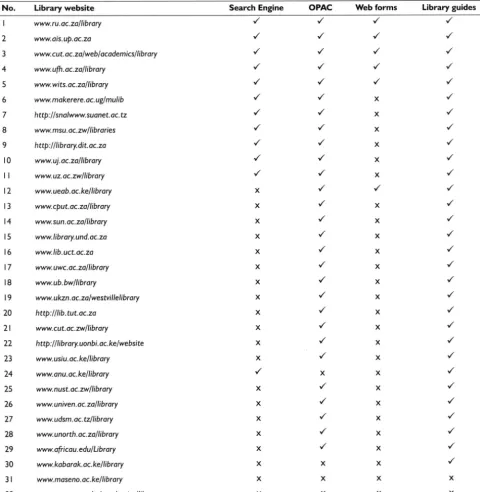
Libraries' websites were compared using four essential services, i.e. the provision of search engines, web-based Online
Public Access Catalogs (OPACs), Web-based forms (e.g: feedback forms, etc) and library guides (including training and
orientation resources) as shown in Table 2. It was observed that 12 (33.3%) libraries provided search engine options on
forms while majority of the libraries (30 or 83.3%) posted special library guides (orientation and training resources) on
their websites.
6.3 Number of pages and out-links
Table 3 provides the rank distribution of the libraries according to the total number of web pages, out-links and out-links
per page. There were a total of 22508 web pages and 275775 out-links, a situation that generated an average of 12.2523
out-links per page. Dividing the total number of pages and out-links by the total number of libraries yielded 625.2 web
pages and 7660.4 out-links per library. On overall, the RU library is ranked number one with 628 pages, 19694 out-links
and 31.3599 out-links per page followed by [all in the order of pages, out-links and out-links per page] CPUT library (335,
9774, 29.1761), SUN library (917, 16784, 18.3032), UKZN - Howard College Campus library (218,9578,43.9358), and
the UCT libraries (16468, 173616, 10.5426). Ranking number one according to the total number of pages was the UCT
library followed by Up, SUN, UFH, and RU libraries in that order while the top ranking libraries in terms of the total
number of out-links were UCT, RU, SUN, UP, and CPUT. The UKZN - HOWARD libraries topped the list of the libraries
with the most out-links per page (Le. 43.9358) followed by RU library (31.3599), CPUT library (29.1761), UKZN
-Westville library (25.8125) and Strathmore library (23.0000), etc.
Table 2 Provision of web-based essential services
No. Library website Search Engine OPAC Web forms Library guides
www.ru.ac.za/library v" v" v" v"
2 www.ais.up.ac.za v" v" v" v"
3 www.cut.ac.za/web/academics/library v" v" v" v"
4 www.ufh.ac.za/library v" v" v" v"
5 www.wits.ac.za/library v" v" v" v"
6 www.makerere.ac.ug/mulib v" v" x v"
7 http://snalwww.suanet.ac.tz v" v" X v"
8 www.msu.ac.zw/libraries v" v" x v"
9 http://library.dit.ac.za v" v" X v"
10 www.uj.ac.za/library v" v" x v"
II www.uz.ac.zw/library v" v" x v"
12 www.ueab.ac.ke/library X v" v" v"
13 www.cput.ac.za/library X v" X v"
14 www.sun.ac.za/library X v" X v"
15 www.library.und.ac.za x v" X v"
16 www.lib.uct.ac.za x v" x v"
17 www.uwc.ac.za/library X v" X v"
18 www.ub.bw/library x v" x v"
19 www.ukzn.ac.za/westvillelibrary x v" x v"
20 http://lib.tut.ac.za X v" X v"
21 www.cut.ac.zw/library X v" x v"
22 http://library.uonbi.ac.ke/website x v" x v"
23 www.usiu.ac.ke/library X v" x v"
24 www.anu.ac.ke/library v" X X v"
25 www.nust.ac.zw/library X v" X v"
26 www.univen.ac.za/library X v" X v"
27 www.udsm.ac.tz/library X v" X v"
28 www.unorth.ac.za/library X v" X v"
29 www.africau.edu/Library X v" X v"
30 www.kabarak.ac.ke/library X X X v"
31 www.maseno.ac.ke/library X X X X
32 www.egerton.ac.ke/academics/library X X X X
33 34 35 www.strathmore.edulacademics www.wsu.ac.za/library www.cuea.edullibrary x
x
x xx
x x xx
xx
x
36 www.mzumbe.ac.tz/libraryKey: ,/ =Service available; x=Service not available
Table 3 Number of pages and out-links
x
Pages
x x
Out-links
x
Out-links per page
Overall rank Site No 2 3 4 5 6 7 8 9 10 II 12 13 14 15 16 17 18 19 20 21 22 23 24 25 26 27 28 29 30 31 32 33 2 3 4 5 6 7 8 9 10 II 12 13 14 15 15 16 17 18 19 20 21 22 23 24 25 26 26 27 28 29 30 31 www.ru.ac.za/library www.cput.ac.za/library www.sun.ac.za/library www.library.und.ac.za www.lib.uct.ac.za www.uwc.ac.za/library www.ufh.ac.za/library www.ais.up.ac.za www.ub.bw/library www.ukzn.ac.za/westvillelibrary www.wits.ac.za/library www.makerere.ac.ug/mulib http://snalwww.suanet.ac.tz http://lib.tut.ac.za www.msu.ac.zw/libraries www.maseno.ac.ke/library www.cut.ac.zw/library
http://library.uonbi .ac. ke/website
www.egerton.ac.ke/academics/library
http://library. d it.ac.za
34 31 www.cuea.edu/library 19 20 32 19 36 0.9500
35 32 www.africau.edu/Library 29 33 4 32 4.0000
36 33 www.mzumbe.ac.tz/library 29 34 35 1.0000
TOTAL 22508 275775 12.2523
Key: r = rank, f= frequency (i.e. number of pages, out-links and out-links per page, respectively)
6.4 Distribution of library web pages and out-links by country
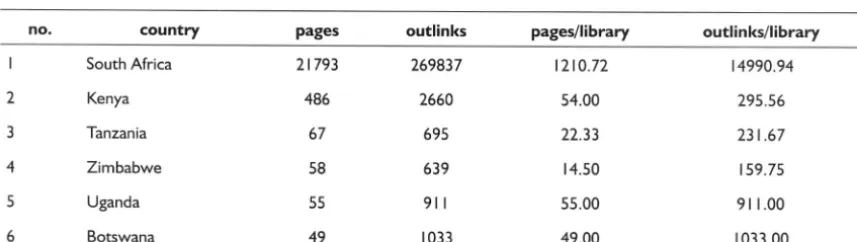
The total number of library web pages and out-links were computed for each country in order to find out the most
productive country. South Africa was the leading with 21793 library web pages followed by Kenya(486), Tanzania(67),
Zimbabwe (58), Uganda(55) and Botswana(49). The number of out-links was highest in South Africa (269837) followed
by Kenya(2660), Botswana (1033), Uganda(911), Tanzania(695) and Zimbabwe (639). When ranked according to the
average number of pages per library, South Africa was the leading with 1210.72 pages per academic library followed by
Uganda (55.00), Kenya (54), Botswana (49), Tanzania(22.33), and Zimbabwe (14.50). The distribution pattern of the
number of out-links per library was as follows: South Africa (14990.94), Botswana (1033.00), Uganda (91 1.00), Kenya
(295.56), Tanzania(231.67), and Zimbabwe (159.75).
Table 4 Distribution of library web pagesand out-links by country
no. country pages outlinks pages/library outlinks/library
South Africa 21793 269837 1210.72 14990.94
2 Kenya 486 2660 54.00 295.56
3 Tanzania 67 695 22.33 231.67
4 Zimbabwe 58 639 14.50 159.75
5 Uganda 55 911 55.00 911.00
6 Botswana 49 1033 49.00 1033.00
6.5 Most commonly targeted web pages and Top Level Domains (TLDs)
Table 5 provides 74 top ranking sites and TLDs that are commonly targeted by the academic libraries in the region. These
include, in descending order, adobe.com/ (104), nlm.nih.gov/ (103), biblioline.nisc.com/ (91), thor.sabinet.co.za/ (83),
sciencedirect.com/ (69), gateway.ovid.com/ (58), serialssolutions.com/ (53) and search.rdsinc.com/ (52). Others are
home.nciferf.gov/ (46), scirus.com/ (44), mg.co.za/ (43), isiknowledge.com/ (38), opencube.com (31), search.epnet.com/
(3 I). Adobe is a company that develops a variety of computer programs such as the Adobe Engagement Platform - built
around Adobe PDF and Flash technology - that greatly enhances how people create, manage, deliver and engage with
information. The National Library of Medicine (NLM) on the other hand, is a medical library based on the campus of the
National Institutes of Health in Bethesda, Maryland. The company collects materials and provides information and
research services in all areas of biomedicine and health care. One of its well known products is the MEDLINE database.
The National Services Corporation (NISC, USA) provides information products that are accessed through BiblioLine, a
Web search service, or on CD-ROM. BiblioLine is a straightforward yet sophisticated approach to online searching via the
internet. SABINET is the short form for South African Bibliographic Network. SABINET facilitates electronic access to
information, largely through the provision of bibliographies while ScienceDirect is a an online database that offers more
than a quarter of the world's scientific, medical and technical information online. Its coverage include over 2,000
peer-reviewed journals; hundreds of book series, handbooks and reference works; and back files.
An examination of the top level domains indicates that the .com or .co TLDs were the most common, recording 59
hits (Le.79.7% ofthe 74 top ranking sites or web pages). In the second position was .edul4 or 5.4%). The .gov, .net and
.org TLDs recorded 3 hits each.
It was observed that there were a variety of sites that are targeted by E&S African academic libraries. When classified
according to the types of services or products these sites provide, the following categories emerged in the top ranking
web sites: news sites (e.g. nytimes.com, daily-mail.co.zm, etc.), search engines (e.g. google.com), electronic databases
(e.g. sabinet.co.za), database publishers (e.g. nlm.nih.gov, sciencedirect.com, etc), computer software companies (e.g.
adobe.com), government sites (e.g. gov.za), and electronic books and general reference resources (e.g.
yourdictionary.com).
Table 5Most commonly targeted web pages and TLDs
No. Rank TLD targeted Hits No. Rank TLD targeted Hits
.adobe.com/ 104 38 19 .observer.co.uk! 24
2 2 .nlm.nih.gov/ 103 39 19 wwwlib.umi.com/dissertations/ 24
3 3 biblioline.nisc.com/ 91 40 20 .1ibrary. uq.ed u.au/trai ning/ 23
4 4 thor.sabinet.co.za/ 83 41 20 .webstat.com 23
5 5 .sciencedirect.com/ 69 42 20 .jutalaw.co.za/ 23
6 6 gateway.ovid.com/ 58 43 20 .update-software.com/ 23
7 7 serialssolutions.com/ 53 44 20 .rekord.co.za/ 23
8 8 search.rdsinc.com/ 52 45 20 .safm.co.za/ 23
9 9 home. ncifcrf.gov/ 46 46 20 .naspers.co.za/ 23
10 10 .scirus.com/ 44 47 21 .nepru.org.na 22
II II .mg.co.za/ 43 48 21 .the-times.co.uk! 22
12 12 isiknowledge.com/ 38 49 21 .arttoday.com/ 22
13 13 .opencube.com 31 50 21 .sky.com/ 22
14 13 search.epnet.com/ 31 51 21 .public.iastate.edu/ 22
15 14 .nytimes.com/ 30 52 21 dictionary. oed. com/ 22
16 15 .zoutnet.co.za/ 28 53 22 .paarlpost.co.za/ 21
17 15 .daily-mail.co.zm/ 28 54 23 .sabcnews.com/ 20
18 15 .zamnet.zm 28 55 23 .gov.za/ 20
19 15 .fingaz.co.zw 28 56 23 .xe.netlucd 20
•
20 16 .memeza.com/zambia/ 27 57 23 .pta-online.co.za/ 2021 16 .witness.co.za/ 27 58 23 .portland.com/ 20
22 16 .headlines.co.za/ 27 59 24 .google.com/ 19
23 16 wagne.net 27 60 25 .swetsnetnavigator. n1/directl 18
24 17 . 123world.com/ 26 61 25 afronet.org.za/monitor.htm 18
25 17 .news24.co.za/ 26 62 25 .Iexis-nexis.com/professional/ 18
26 17 .sowetan.co.za/ 26 63 25 .economist.com.na 18
27 17 .jstor.org/ 26 64 25 .newafrica.com/ 18
28 18 .suntimes.co.za/ 25 65 25 .herald.co.zw/ 18
29 18 .sundaymail.co.zw/ 25 66 25 .nigeriacentral.com/ 18
30 18 .republikein.com.na 25 67 25 .Iibraryspot.com/ 18
31 18 .nyenzLco.tz! 25 68 25 .namibianews.com 18
32 18 galenet.galegroup.com/ 25 69 25 .nyenzLco.tz 18
33 19 library.uncg.edu/ 24 70 25 .yourdictionary.com/ 18
34 19 .nn.independent.co.za/ 24 71 25 .namibian.com.na 18
35 19 .time.com/time/ 24 72 26 wagne.netlmessager 17
36 19 .theexpress.com 24 73 26 .bday.co.za/ 17
37 19 .bbjonline.com/ 24 74 26 .wisc.edu/ltd 17
Table 6In- and out-links among the academic libraries in the six countries
Name Page Directory Domain Site Page Directory Domain Site
inlinks inlinks inlinks inlinks outlinks outlinks outlinks outlinks
Iibrary.und.ac.za 40 8 5 5 0 0 0 0
Iib.uct.ac.za 15 15 6 6 25 25 15 14
.uz.ac.zw/library 10 7 I 0 0 0 0
.sun.ac.za/library 9 8 6 6 13 13 3 3
.wits.ac.za/library 7 6 4 4 2 2 2 2
.uwc.ac.za/library 6 6 3 3 10 10 9 9
.univen.ac.za/library 6 5 5 5 0 0 0 0
ais.up.ac.za 5 4 4 4 6 6 6 6
.ru.ac.za/library 5 5 3 3 19 10 10 10
.cput.ac.za/library 4 4 3 3 0 0 0 0
.wsu.ac.za/library 4 3 3 3 0 0 0 0
.ukzn.ac.za/westvillelibrary 4 3 3 3 34 3 I 1
.uj.ac.za/library 4 3 3 3 0 0 0 0
library.dit.ac.za 3 2 2 2 10 10 10 10
.ufh.ac.za/library 3 3 2 I 1 1 I I
.cut.ac.za/web/academ ics/l ibrary 2 2 2 2 0 0 0 0
.unorth .ac.za/I ibrary 2 2 2 2 0 0 0 0
Iib.tut.ac.za 1 1 0 0 0 0
mzumbe.ac.tz/library I I 0 0 0 0
.makerere.ac.ug/mulib 0 0 0 0 0 0 0 0
.ub.bw/library 0 0 0 0 0 0 0 0
.anu.ac.ke/library 0 0 0 0 0 0 0 0
.cuea.edu/library 0 0 0 0 0 0 0 0
.egerton.ac.ke/academics/library 0 0 0 0 0 0 0 0
.maseno.ac.ke/library 0 0 0 0 0 0 0 0
.ueab.ac.ke/library 0 0 0 0 0 0 0 0
.usiu.ac.ke/library 0 0 0 0 0 0 0 0
library.uonbLac.ke 0 0 0 0 0 0 0 0
.udsm.ac.tz/library 0 0 0 0 0 0 0 0
.africau.edu/library 0 0 0 0 0 0 0 0
.cut.ac.zw/library 0 0 0 0 10 7 I I
.msu.ac.zw/libraries 0 0 0 0 0 0 0 0
.nust.ac.zw/library 0 0 0 0 0 0 0 0
snalwww.suanet.ac. tz 0 0 0 0 1 I
.kabarak.ac. ke/l ibrary 0 0 0 0 0 0 0 0
.strathmore.edu/academics/library.html 0 0 0 0 10 8 I
Total no. of links 150 99 61 60 150 99 61 60
Links per library 4.17 2.75 1.69 1.67 4.17 2.75 1.69 1.67
6.6 Number of in- and out-links among the libraries
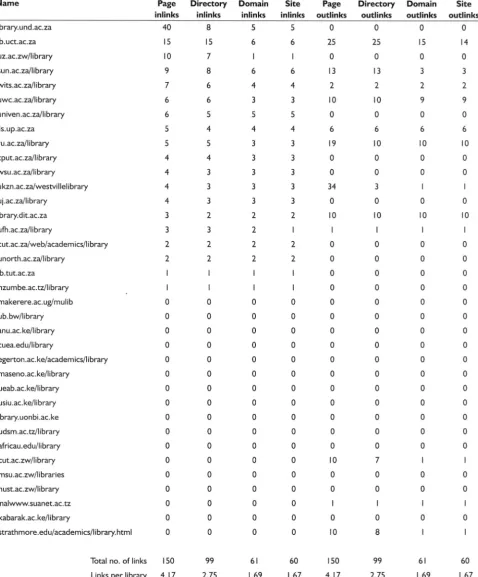
Table 6 ranks the libraries according to the total number of page in-links. The Table provides the total number of in- and
out-links (page, directory, domain, and site) that each universities received from or gave to the other universities,
respectively. For instance, the UKZN [HOWARD] libraries received a total of 40 page links, 8 directory links,S domain
links and 5 site links from the libraries that were surveyed, while it offered no out-links to any of the libraries. The UCT
libraries on the other hand, provided links to other libraries as follows: 25 page and directory links, 15 domain
out-links and 14 site out-out-links. Several university libraries (e.g. MAKERERE, BU, ANU, CUEA, EGERTON, MASENO, UEAB,
USIU, UDSM, AFRICAU, NUST, and KABARAK) did not receive links from nor provide links to any of the other libraries.
Overall, there were a total of 150,99,61, and 60 page, directory, domain and site in-links, respectively. On average, each
university received and produced 4.17, 2.75, 1.69, and 1.67 page, directory"domain and site out-links, respectively, as
illustrated in Table 6. Another notable observation from Table 6 is that most (approximately 50%).libraries did not have
any in-links from and out-links to other libraries under the scope of this study.
A
/.uz.ac,ZW/library
• .cut.ac.zw/library
•
.uc
.wits.ac.za/library
Iib.tut.acza
.unorth .ac.za/library
.univen.ac.za/library
B
•
/ snalwww.suanet.ac.lz
mzumbe.ac.lz
library.und.ac.za
Figure 1 Academic library networks: site in- and out-links
lib.ucte.c.z8/govpuhs
sun,ae lejllbte.'Y/abouVcollections
ulh,o.c,zellibrary/infolit
e.
N oC.l~lbrl>lYfinloln• uwe ac za/11bror:l/eleetronicres
lib.ulh.oc.zo/lrbrary
lib.uetec.ze,lindex,php?html-sun.e.c.zo/librory/o.frlseMces sun.oc.ze/library/eng/S8Mces
i.W>tS."C.'o/libro'Y~,nks/di9Ital_relerenC._lib,or; •
~ / snal\Hw>N.suanetactz rU.ac,za/library,Aheses
mzumbe actz .,CUlOc.ZW/librory
UZ.o.c.zwflibr&y/zulc
~.Ul."c.lW~lbrl>lY \;
/" .wits.ac.za/librory/links
L
.\cut"C.lW~lbrl>lY/resourcss~ .sun"c.l~ibrI>lY/gerickeJlbro'Y
.UZ.cc.zw/libro.ry/obout .UZ.e.c.zw/library/services
• ,uz,oc,rw/library/help ~aJYundoc zo/cgl-bm
•. sun,oc.ze/libre.ry/englfinding/sUbjed-po.gesfl~ -lib,uet.Oc.zoIIow/info
Figure 2 Academic library networks: directory in- and out-links
6.7 Libraries' networks
hbucl.:'le :8,
Uganda's, and Botswana's university libraries are not represented mainly because these libraries do not have any links to
or from any other library investigated.
h rary.und.ac.z
elct db.htm
,,-' ,,; -- •• ,,'_ •• ,'~\:: ukzn ac '.'"~stvillehbro"'llssue about rtm
rJlt 1"Ir.71"1lwP.h/l"lr..l"lriAmic UK.:fl:lj,L:._Stj.;;:l~MI1~llUlo.r1foLlLfJiuLt'U_I/1I II
iprary.dit~c.lelmain.htrt'. , •••..."".11 ,,1 Ij-, ,~ <:>0'\/" ••
,ulh.ac.Zo/library{lndex,htm, '. ~ I.$'rary,.dltac.ze,tl:echmkons html~ I... li stvlllehbrary/per_ejoulOols hIm • ...,... mzumbe ac.tz
uk7n 1"Ir."''lAN~c;;t\lillplihrl'\ryl u~c zeIw/sMfelTr ~~1 htm snol"www suanet ac tz!Unlverslt18shi
e~/other1ib.html?templole"prlnt .cut~C.Zatweb/ocad'~~~~;br~~o~ep~~~~:~~e;~:,~~~~:~/~::,~:.stvlllehbrary/per _contfIll II
lib.uct,aC.Z0t2,004/infQ{lnSti1~tianreV.htm:!S/Otherhb_html "''' •.,, ••••••
_'r ...
e~'.c" •.\....•~~'jI o••_~"""~ukzn ac za!w,eSMltehbrery/per_elechtm. t.OJJJlJ~""If.J • ukzn6c,z~.,~lr:ii'h';;"~i,lt!~'k;n'.~';;;;;;~~ii;libro.'Y/per_usefulhIm
sla ~ngu.ac.zotll~r ftldliu hc/home.htm_'b ,,,,"' I'b I ,ukzn.ec.zo/westvillel,braryjlll_abouthlm ~
~ .n',:;>u,aL;,t.~,1 raryl"ram IralY11m :",ils.oc.ze/librory/links/linkcontent.html
t", ,; 1', lbral~ alSo .I.unorth.e.c.za/hbrary{lndex.html .sun.ac.ze/library/gericke_hbraty/defaulthtml
'.uwc.ac.zotlib. ralYflinks,hlm
0.,... ~".IIUI t7J1lJ"i:1L.lCl,I
'll"1C l:' ., II ry'
univen.eczotllbraJ)fftib index,htm , -"b ". I h html ~" . ~~~~.~, . h~~~:::~j1nl.•iinstltutlon.htm&libida76 .ru.e.C"ZQ{11rary.lllleses rut eses.
Ib.ud.ac.zoI
~ . .w.lts.aC.ZO/hbraryl1inkS/di9ite.l_referenceJibrary/theSeS&diSsert.htm
ItO .' ac.Z )rOIYhtm
.sun,ac.ze/library/afr/abouVcolleetlons/gov oublications.htm
\librory.d'.'~~~:?a.,Cf.~,~I.c;:lL':.,1.:~,~UUV'-UIIC'-UUII~fYUVCIIIlIICllt_~Uu"...o.tlons.html ..•••. . \ ..••• Iib ud.ac za/govpubsj /' hb.ud.ec,zotlewAnfojsldcrtconv.htm
•. sun.eczotlibraJ)f/en~indrnglsubjedJlegesftewflew_reports_south%20african hlml -"b I'd h •. cutaczw"A~lebOut/lriends.hlm ~.uz.eCZWftlbrary/seMces/menu.hlml
.uwc.ac.z~11 raryIn ex.tm I~ ~J' ~
'--I'b•.•. luetaczU{newspBpers..r . htm .eut.aczwftibraJ)f/abouVnews,htm ,uz.ac.zwftibrary/abouVmenu hlml .lNic.ac.zO/llbr aryjeleetronlcres/mternet_resources,htm .uz.e.c.zw/libre.ty/zulr:/ .eut.e.c.zw/library/resources/enq.html
•
.uz.ac..zw/libr!"
.cut.e.c..zw/hbrery/resources/catalo~htmll - .ut.aczw~lorary/l10me.nlml. ' '_ ...• ,cutec.zwflibraN/home.html ,aczwftlbraJ)f/help/menu.hlml .~-~. ; ,.,":',i.IU1o.1ytlfiu.mvululluyraphy.htmlufh.ac zO/Iibraly/infoltl/blbhogrophy.html
Figure 3 Academic libraries' network map: page in- and out-links
South Africa
Tanzania
I
<0
Figure 4 Academic libraries' network map: page in- and out-links
•
Fig 2 is a visual presentation of the interlinkages among the libraries using directory in- and out-links. The nature of the
directory links was identifiable. Some of the linked directories are concerned with library services, information about the library, information literacy, resources, digital reference library sites, electronic resources, library collections, etc.
Finally, the libraries' web pages network reveals several inter-linkages. Fig 3 and 4 provide a map of the web page linkages with and without labels, respectively. Both illustrations demonstrate dense networks that originated largely from
South African academic libraries. There were a total of 8 networks belonging to libraries in South Africa while Tanzania
and Zimbabwe produced one network each.
7 Discussions,
conclusions
and recommendations
Notably, libraries in Eastern and Southern Africa are well aware of the benefits and opportunities of the Internet and the Web. Despite the digital divide and technological barriers in the region, librarians in the two regions have expedited the
construction of library websites. Out of a total 59 universities in the six countries that had their own websites, only 9
(15.3%) did not have library websites. Information available from three university websites indicated that the library
websites were under construction.
It is our conviction that the location of a link to the library's website on the university's website/home page should be
seriously considered when designing the website especially for accessibility purposes. A library whose website is hidden is as good as a library that does not have a website. It was encouraging to note that majority of the libraries' websites had
links from the respective universities' main home pages and that these links were well labeled with the term
'library'.
Toillustrate this more clearly, take for example a library's link that is provided on or under a university's facilities' website.
Library users are left to guesswork when accessing such a library's website. Not only does this situation inconvenience a user, but can lead to non-usability of a library's services, resources and products. It was observed in this study that accessibility of three libraries' websites was a bit problematic. Links to these libraries' websites were provided under the
'academics'
website. One university provided one page of a description of its library services under the directory heading'facilities',
implying that the library is just as any other facility in the university. Some of the 'other' facilities that weredescribed alongside the library were sports and recreational facilities. It is comforting, though, to note that the university does not have a library website and perhaps that is why the university chose to provide information regarding the library
in the way it did. Most probably, when the university library website is constructed, measures will be taken to
appropriately provide links at the right place, preferably on the university's home page.
Concerning the provision of essential web-based services, it was noted that the online public accesscatalogs were the
highly regarded service by the libraries most probably because they are valuable tools in accessing a library's collection. Equally seen as essential library services are the guides (or orientation and training resources). Little regard is placed on search engines. Web forms were the least popular. Whereas OPACs and guides are library-specific (Le. specific to a
library offering them), search engines and web forms are not and perhaps that explains why their provision on the
libraries' websites is not deemed necessary as they can be accessed through other means. For instance, search engines such as Google can be accessed through its google.com website. However, libraries are advised to provide these services on their websites so as to make it easier for their clients to navigate the Internet from their site. Ahmed (2002:266) observes that "library users value the services that they access from their desktops because the services save time".
Concerning the web forms, the author argues that web forms make it easier and convenient for users to communicate to libraries. Communication can be in the form of comments, suggestions, and requests for instruction classes, etc.
The ranking of libraries according to the total number of web pages, out-links and average out-links per page led to the following observations:
• South African university libraries performed better than their counterparts in Botswana, Kenya, Tanzania, Uganda and Zimbabwe
• No university library had a uniform rank throughout the three variables
• Libraries that had branch libraries registered higher number of pages and out-links. For instance, the Howard College Campus library of the University of KwaZulu Natal comprises four libraries, namely, EG Malherbe (Main), Barrie Biermann (Architecture), GMJ Sweeny (Law), and Eleanor Bonnar (Music) while the UCT library consists of the main library and nine branch libraries .
On overall, Rhodes University library was the top ranked followed by Cape Pennisula University library, Stellenbosch University library, KwaZulu Natal (Howard College) libraries, and University of Cape Town libraries. Perhaps librarians from other academic libraries in the region could be advised to learn from the Rhodes University library whose web
performance supersedes others.
Similarly, the distribution of the total number of pages, out-links and average out-links per page showed that South
Africa was the most prolific country followed by Kenya, Uganda, Botswana, Tanzania and Zimbabwe. Whether this
and communication (ICT) policies in the respective countries was not observable from the analyzed data. But recent
developments in the formulation of ICT policies in Kenyaand South Africa could explain the two countries' performance.
There was no information that was readily available regarding the other countries' strategies in the formulation of ICT policies.
The most commonly targeted websites and TLDs include adobe.com, nlm.nih.gov, biblionline.nisc.com,
thor.sabinet.co.za, sciencedirect.com, gateway.ovid.com, serialssolutions.com, search.rdsinc.com, home.ncifcrf.gov,
scirus.com, etc. Among the 74 top ranked websites and TLDs were online newspapers' sites (e.g. nytimes.com - USA,
daily-mail.co.zm - Zambia, sowetan.co.za - South Africa, suntimes.co.za -South Africa, sundaymail.co.zw - Zimbabwe,
etc.), electronic databases and database publishers (e.g. nlm.nih.gov, biblionline.nisc.com, sabinet.co.za,
sciencedirect.com, isiknowledge.com, etc.), and book- and periodical sellers (e.g. serialssolutions.com,
swetsnetnavigator.nl, etc.). This perhaps shows the importance that libraries place on electronically available resources
which may have cut down the costs of subscription. Library resources (e.g. journals, magazines, books, reference
materials, etc) that used to be only in print format are increasingly becoming available electronically thus changing the
libraries' traditional ways of providing such products to their clients. This has called for online subscriptions to journals
and other periodicals that were previously accessed through print subscriptions and perhaps the high ranking of
electronic databases as the most commonly targeted sites and TLDs explains the changesthat libraries are undergoing
and have embraced. Accessing these resources, however, requires some computer softwares that are compatible with
the formats in which they are published and that may explain adobe.com's popularity among libraries. Most full-text
papers are currently published in PDF format.
Figures I, 2, 3, and 4 provide library networks based on site, directory and page in-links and out-links respectively. It
was observed that South African academic libraries do have a well developed network that included all the libraries
surveyed in this study. Only two libraries each from Tanzaniaand Zimbabwe formed networks. Contrary to expectations,
none of the libraries had links with other libraries outside their geographic regions. The few networks that were
generated comprised libraries from the same country. This may imply less collaborative activities between libraries in
different countries, although this observation may not be necessarilytrue since there is "little knowledge about models
and motivations of linking" (Zeinolabedinio, Maktabifard
&
Osareh, 2006). However, it is well acknowledged that SouthAfrican libraries do have an established inter-library cooperation and that may explain the inter-linkages that were witnessed among the libraries in the country.
Some libraries were excluded from the analysison the basisof their website addresseswhich contained punctuation
marks or were too long to be crawled by the personal SOCSCIBOT. Librarians are advised to provide simple and short
website addresses of their libraries. Keeping the website address short and clear is very important, especially for
purposes of accessibility by users. Library users may want to accessthe library's website by use of the library's website
address and if the address is too long and/or contains some characters/symbols, it may become very difficult to memorize
it, thus impeding accessibility.In addition its is recommended that
• Libraries provide spacefor Open Access repositories which may increase in-links
• Libraries develop useful websites that can attract users and ensure that these websites are always functional
• Libraries develop partnerships with others
• Libraries develop in-house ICT policies which can be entrenched in the main library policy(ies)
Finally, it is recommended that librarians become more involved in the construction of their libraries' websites. They
should actively participate in policy formulation as regards legislation of internet-related laws and in the organization of
services and resources on the internet. Libraries need to regularly update their websites to keep up with the current
proliferation of Internet-based resources that are increasingly becoming freely available. For instance, the current
agitation for the availability of journal articles through open accessprovides opportunities for libraries to improve on link
development. Library cooperation (e.g. resource sharing, inter-library loans, etc) needs to be encouraged among
academic libraries in Kenya, Tanzania, Uganda and Tanzania so as to improve their web linkages. Further studies are recommended so as:
I.To cover all academic libraries in Sub-SaharanAfrica
2.To study the coverage of African academic libraries in major search enginesand other online indexing services
3.To use other performance measurements such quality, relevance, etc. in evaluating library websites.
References
Ahmed, S.S. (2002). Managing change to enhance web-based services in the Arabian Gulf libraries.
Online Information Review,
26(4): 265-270
Arte, A (200 I). The management of the scientific information environment: the role of the research library web site.
Online
Information Review, 25(2):88-93
Bar-lIan, J. (2005). What do we know about links and linking? A framework for studying links in academic environments.
Information processing and Management,
41 :973-986Booth, K.&Napier, J. (2003). Linking people and information: web site access to National Library of New Zealand information
and services.
The Electronic Library,
21 (3):227-233Clausen, H. (1999). Evaluation of library web sites: the Danish case.
The Electronic Library,
17(2): 83-87Clyde, L.A (2004). School library web sites: 1996-2002.
The Electronic Library,
22(2): 158-167Cordeiro, M.1.&De Carvalho, J. (2002). Web services: what they are and their importance for libraries.
VINE, 32(4):46-62
Covert, K. (200 I). How the OClC CORC service is helping weave libraries into the Web.
Online Information Review,
25(I):41-46
Falk, H. (1999). Projecting the library onto the web.
The Electronic Library, 17(6):395-399
Falk, H. (2005). State library databases on the Internet.
The Electronic Library, 23(4):492-498
Henry, M. (1996). WebCATS.
Campus-Wide Information Systems,
13(4): 11-13Hildebrand, I. (2002). The South Australian public libraries network web site (iNet): efficiencies through collaboration.
Online
Information Review, 26(6):375-384
Hundie, K. (2003). Library operations and library resources.
The Electronic Library,
21 (6):555-564Interlab. 2005. Webometrics ranking of world universities. [Online]. Available
http://www.webometrics.info/(Accessed
lOth April2006)
Kennedy, P.(2004). Dynamic web pages and the library catalogue.
The Electronic Library, 22(6):480-486
Kochtanek, T.R., Hein, K.K., Kassim, AR.C. (200 I). A digital library resource web site: Project DL.
Online Information Review,
25( I):29-40
McCready, K. (1997). Designing and redesigning: Marquette libraries' web site.
Library Hi Tech,
no. 59-60:83-89McKenna, M. (1994). Libraries and the Internet. [Online]'
www.ericdigests.org
Accessed 27 April 2006Nielsen, H.J. (2005). New media and new roles of Iibrarianship: illustrated by a literary website of Danish libraries.
New Library
World,
I06( 1218/ 1219):510-518Pacios, AR. (2003). Management-related information in Spanish university library web pages.
The Electronic Library,
21 (6):528-537
Saeed, H., Asghar, M., Anwar, M.& Ramzan, M. (2000). Internet use in university libraries of Pakistan.
Online Information Review,
24(2): 154-160
Still, J.M. (200 I). A content analysis of university library web sites in English speaking countries.
Online Information Review,
25(3): 160-164
Thelwall, M. 2002a. A comparison of sources of links for academic web impact factor calculations.
Journal
of
Documentation,
58( I):66-78
Thelwall, M. 2002b. An initial exploration of the link relationship between UK University Web sites.
ASLIB proceedings,
54(2): I 18-126
Thelwall, M. 2002c. Evidence for the existence of geographic trends in university Web site interlinking.
Journal
of
Documentation,
58(5):563-574
Thelwall, M. 2003. Can Google's PageRank be used to find the most important academic web pages?
Journal
of
Documentation,
59(2):205-217
Westman, S. (200 I). Database-backed library web pages.
The Electronic Library,
19(6):424-431Xue, S. (2004). Web usage statistics and web site evaluation: a case study of a government publications library web site.
Online
information Review,
28(3): 180-190Zeinolabedinio, M. H., Maktabifard, L.&Osareh, F. (2006). Collaboration analysis of world national library websites via
webo-metric methods.